
You have completed your modules, watched the tutorials, and taken notes. But when someone asks, "Have you actually worked on a campaign?" you go blank. That is the gap most digital marketing students face. Theory gets you through exams, but projects get you hired.
This guide covers 21 free digital marketing projects for students across SEO, SEM, social media, email marketing, analytics, PPC, and more. Each project comes with a clear overview, key focus areas, tools, and learning outcomes so you can dive in without wasting time figuring out where to start.
Whether you are building a digital marketing portfolio, completing your college assignment, or just looking for hands-on marketing projects to sharpen your skills, this list has something for every level.
What Is Digital Marketing?
Digital marketing is the process of promoting products, services, or brands using the internet and digital platforms. It includes various digital marketing channels like search engines, social media, websites, email, and online advertisements. Businesses use digital marketing to reach more people, attract customers, and grow their sales online.
Why Digital Marketing Projects Matter
Recruiters and clients do not just want certificates. They want proof that you can actually run a campaign, analyze data, and make decisions. Working on digital marketing projects bridges that gap between classroom learning and real-world execution.
Even if you enroll in an online digital marketing course, the practical component of projects is what truly cements your understanding of strategies, tools, and metrics.
Recommended Professional Certificates
AI-Powered Digital Marketing Course
Performance Marketing Bootcamp
SEO Specialist Bootcamp
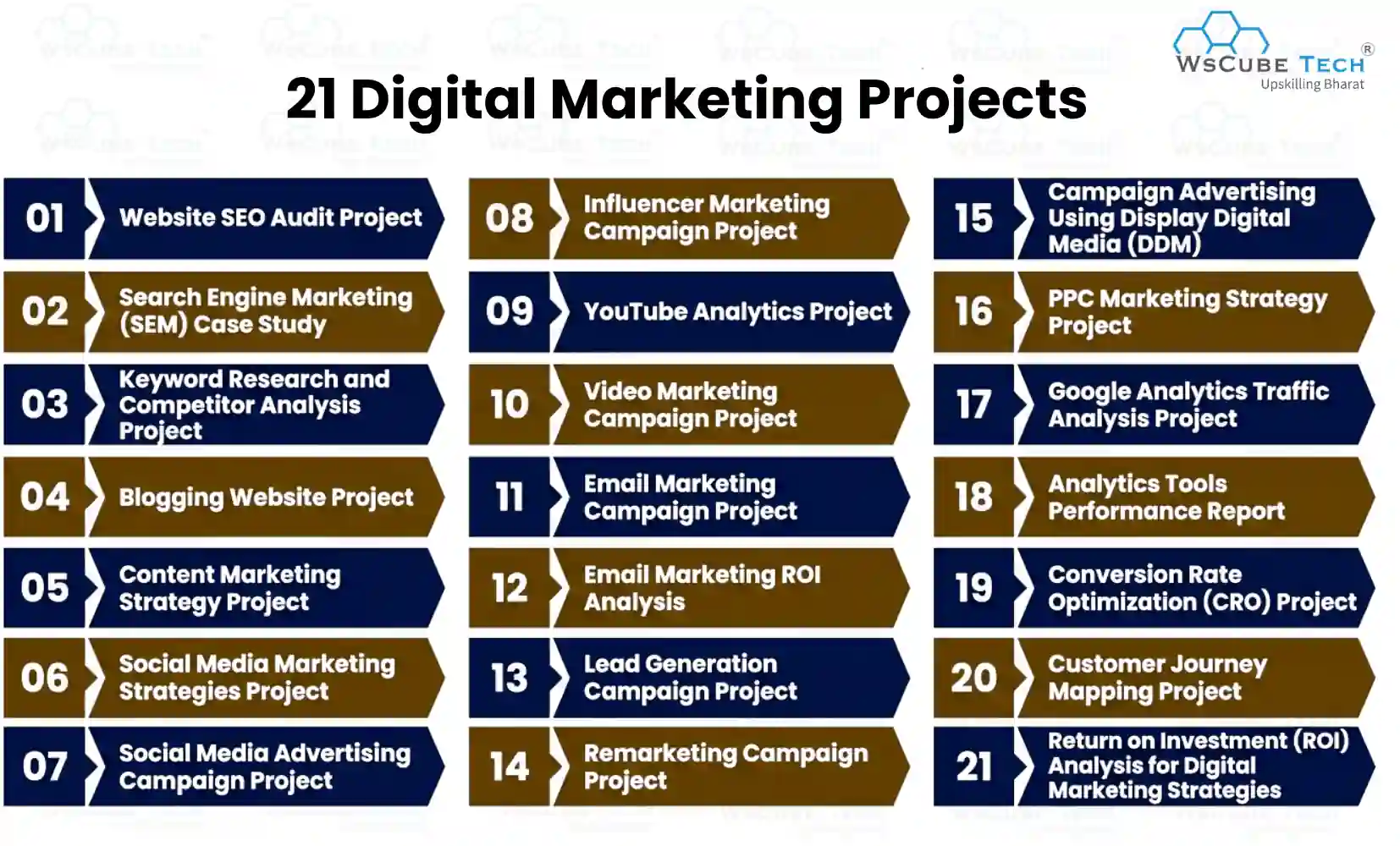
21 Top Digital Marketing Projects
Here are practical digital marketing projects for students & beginners to go from theory to real-world experience.
1. Website SEO Audit Project
In this project, you pick a live website (your own, a local business, or a dummy site) and conduct a full SEO audit. You assess its technical health, on-page elements, and backlink profile to identify what is helping or hurting its search rankings.
Key Focus Areas:
- Site crawl to detect broken links, duplicate content, and indexing errors
- On-page analysis: title tags, meta descriptions, heading structure, keyword placement
- Page speed and Core Web Vitals assessment
- Backlink profile review and toxic link identification
- Competitor benchmark comparison
Tools Required: Screaming Frog, Google Search Console, Ahrefs (free version), SEMrush, PageSpeed Insights
Learning Outcomes: You will learn how to diagnose SEO issues systematically, prioritize fixes by impact, and present actionable recommendations in a structured audit report.
2. Search Engine Marketing (SEM) Case Study
Choose a real or hypothetical brand and build a detailed SEM case study covering both organic and paid search strategies. Document how SEO and PPC work together to drive traffic and conversions.
Key Focus Areas:
- SEO strategy: keyword targeting, content optimization, link-building plan
- PPC strategy: campaign structure, ad copy, bidding model
- Budget allocation between paid and organic channels
- Performance benchmarks and KPIs
- Analysis of what worked and what needs improvement
Tools Required: Google Ads (demo account), Google Search Console, SEMrush, SpyFu, Ubersuggest
Learning Outcomes: You will understand how SEM combines SEO and paid advertising and how to build a case study that demonstrates measurable results for a brand's search presence.
3. Keyword Research and Competitor Analysis Project
This is one of the most fundamental marketing projects for students. You will research high-value keywords for a specific niche, map them to user intent, and analyze what competitors are ranking for to find content gaps and opportunities.
Key Focus Areas:
- Short-tail vs long-tail keyword identification
- Search volume, keyword difficulty, and CPC analysis
- User intent mapping (informational, navigational, transactional)
- Competitor keyword gap analysis
- Building a keyword strategy document
Tools Required: Google Keyword Planner, Ahrefs, SEMrush, Ubersuggest, Moz Keyword Explorer
Learning Outcomes: You will learn how to think strategically about keywords, understand search intent, and produce a keyword map that can drive an entire content or paid campaign strategy.
4. Blogging Website Project
Create and manage a blog on a niche topic of your choice. Publish SEO-optimized content consistently, apply on-page best practices, build internal links, and track organic growth over time.
Key Focus Areas:
- Niche selection and audience definition
- SEO content writing with proper keyword integration
- On-page optimization: headings, meta tags, URL structure, image alt text
- Internal linking structure
- Traffic tracking and performance analysis
Tools Required: WordPress, Yoast SEO, Google Search Console, Google Analytics, Canva (for visuals)
Learning Outcomes: You will gain hands-on experience in content creation, SEO implementation, and audience building, making this one of the most practical digital marketing projects you can show in a portfolio.
5. Content Marketing Strategy Project
Develop a complete content marketing strategy for a brand (real or fictional). This goes beyond writing articles. You will map content to business goals, define audience personas, and create a content calendar.
Key Focus Areas:
- Audience persona development
- Content audit of existing assets (if applicable)
- Content types: blogs, videos, infographics, case studies
- Distribution channels and publishing schedule
- Success metrics: traffic, engagement, lead generation
Tools Required: HubSpot (free CRM), BuzzSumo, Google Trends, Trello or Notion (content calendar), Canva
Learning Outcomes: You will understand how to align content with marketing goals, develop a distribution plan, and measure whether content is actually delivering business results.
6. Social Media Marketing Strategies Project
Select two or three social media platforms and design platform-specific SMM strategies for a brand. Create sample content, define posting frequency, and outline engagement tactics for each channel.
Key Focus Areas:
- Platform selection based on target audience demographics
- Content formats suited to each platform (reels, carousels, threads, etc.)
- Hashtag strategy and optimal posting times
- Community engagement and response strategy
- Cross-platform content repurposing
Tools Required: Meta Business Suite, Buffer or Hootsuite, Canva, Later, Instagram Insights, LinkedIn Analytics
Learning Outcomes: You will learn how social media strategies differ by platform, and how to create content plans that grow followers, boost engagement, and drive traffic.
7. Social Media Advertising Campaign Project
Run or simulate a paid social media advertising campaign on Facebook or Instagram. Set up the campaign structure, define targeting parameters, create ad creatives, and analyze performance data.
Key Focus Areas:
- Campaign objective selection (awareness, traffic, conversions)
- Audience targeting: demographics, interests, custom audiences
- Ad creative design: copy, visuals, CTA
- A/B testing of ad sets and creatives
- Budget management and performance analysis
Tools Required: Meta Ads Manager, Canva, Facebook Pixel (for tracking), AdEspresso (optional)
Learning Outcomes: You will understand how to structure paid social campaigns, test variables, interpret ad metrics, and optimize spend for better results.
8. Influencer Marketing Campaign Project
Plan a complete influencer marketing campaign for a product or service. Identify the right influencers, draft outreach messages, define deliverables, and build a framework to measure campaign success.
Key Focus Areas:
- Influencer identification based on niche, reach, and engagement rate
- Micro vs macro influencer comparison
- Campaign brief creation and collaboration guidelines
- Content approval and publishing workflow
- ROI measurement: reach, clicks, conversions, earned media value
Tools Required: Instagram, YouTube, BuzzSumo, Heepsy or Modash (free trial), Google Sheets (for tracking)
Learning Outcomes: You will learn how to evaluate influencers beyond follower count, plan authentic collaborations, and measure whether influencer spend is generating real business value.
9. YouTube Analytics Project
Analyze the YouTube channel of a brand or creator using YouTube Studio's analytics. Identify trends in viewership, engagement, and audience retention, and recommend content improvements based on the data.
Key Focus Areas:
- Views, watch time, and average view duration analysis
- Audience retention curves and drop-off points
- Traffic source breakdown (search, suggested, external)
- Subscriber growth trends
- Top-performing vs low-performing video comparison
Tools Required: YouTube Studio, TubeBuddy, VidIQ (free version), Google Sheets
Learning Outcomes: You will develop the ability to read video analytics, identify what resonates with audiences, and translate data into content strategy recommendations.
10. Video Marketing Campaign Project
Plan and execute a video marketing campaign for a product or brand. Script the videos, define the distribution strategy, and set up a system to track views, engagement, and conversions.
Key Focus Areas
- Video types: explainer, testimonial, product demo, ad
- Scripting, storyboarding, and production planning
- Platform selection: YouTube, Instagram Reels, LinkedIn
- SEO optimization for video: titles, descriptions, tags
- Performance tracking and iteration
Tools Required: VN or DaVinci Resolve (editing), Canva, YouTube Studio, Meta Ads Manager
Learning Outcomes: You will understand the end-to-end process of creating and distributing video content, and how to measure whether it is actually moving the needle for a brand.
Upcoming Masterclass
Attend our live classes led by experienced and desiccated instructors of Wscube Tech.


11. Email Marketing Campaign Project
Build and execute a full email marketing campaign from scratch. Create a subscriber list, design email sequences, and track open rates, click-through rates, and conversions to measure campaign effectiveness.
Key Focus Areas:
- List building and segmentation strategy
- Email copywriting: subject lines, preview text, body content, CTA
- Automation workflows: welcome series, drip campaigns
- A/B testing of subject lines and send times
- Deliverability and spam avoidance best practices
Tools Required: Mailchimp (free plan), Brevo (formerly Sendinblue), Google Sheets, Canva (for email design)
Learning Outcomes: You will learn how to build and manage an email list, write compelling email copy, set up automation, and analyze campaign data to improve performance over time.
12. Email Marketing ROI Analysis
Take one or more email campaigns (your own or a case study) and perform a detailed ROI analysis. Calculate revenue generated, cost per email, and compare email performance against other digital channels.
Key Focus Areas:
- Calculating email marketing ROI formula: (Revenue - Cost) / Cost x 100
- Cost breakdown: platform fees, content creation, design
- Revenue attribution from email campaigns
- Benchmarking open rates, CTR, and conversions against industry averages
- Recommendations to improve ROI
Tools Required: Mailchimp Analytics, Google Analytics (UTM tracking), Google Sheets
Learning Outcomes: You will understand how to financially justify email marketing investment and compare it against other channels, a skill that is directly useful when presenting to clients or employers.
13. Lead Generation Campaign Project
Design and run a lead generation campaign using a combination of landing pages, lead magnets, paid ads, or organic content. The goal is to capture real or simulated leads and nurture them through the funnel.
Key Focus Areas:
- Lead magnet creation: ebook, checklist, free webinar, discount
- Landing page design and conversion optimization
- Traffic sources: paid ads, SEO, social media, email
- Lead capture forms and CRM integration
- Lead nurturing workflow
Tools Required: HubSpot (free CRM), Mailchimp, Google Ads or Meta Ads (demo), Unbounce or Carrd (landing page)
Learning Outcomes: You will learn how to attract, capture, and nurture leads, one of the most in-demand skills in marketing projects for students pursuing careers in B2B or D2C marketing.
14. Remarketing Campaign Project
Build a remarketing strategy targeting users who have already visited a website or interacted with a brand. Set up custom audiences, design retargeting ads, and track whether the campaign successfully brings users back.
Key Focus Areas:
- Pixel setup and audience segmentation (page visitors, cart abandoners, video viewers)
- Ad creative strategy for warm audiences
- Frequency capping to avoid ad fatigue
- Dynamic remarketing for e-commerce
- Conversion tracking and attribution
Tools Required: Meta Ads Manager, Google Ads (with Remarketing Lists), Google Tag Manager, Google Analytics
Learning Outcomes: You will understand how remarketing works, how to build segmented audiences, and how retargeting campaigns improve overall conversion rates and reduce customer acquisition cost.
15. Campaign Advertising Using Display Digital Media (DDM)
Plan and execute a display advertising campaign using Google Display Network or a similar programmatic platform. Design banner ads, set up targeting, and analyze impressions, clicks, and conversions.
Key Focus Areas:
- Display ad formats: banner, responsive, rich media
- Audience targeting: contextual, behavioral, demographic
- Placement targeting: specific websites and apps
- Creative design and messaging strategy
- Viewability, CTR, and conversion analysis
Tools Required: Google Display Network (via Google Ads), Google Campaign Manager, Canva, Google Analytics
Learning Outcomes: You will gain practical experience in display advertising, understand how to target the right audience across the web, and evaluate campaign effectiveness beyond just clicks.
16. PPC Marketing Strategy Project
Develop a complete Pay-Per-Click strategy for a brand or product. This includes keyword research, campaign structure, ad copywriting, bid strategy, and a plan to optimize based on Quality Score and conversion data.
Key Focus Areas:
- Keyword match types and negative keyword strategy
- Campaign and ad group structure
- Ad copy writing with strong CTAs
- Bidding strategies: manual CPC, target CPA, target ROAS
- Quality Score factors and landing page alignment
Tools Required: Google Ads (demo account), Google Keyword Planner, SEMrush, Unbounce (landing page testing)
Learning Outcomes: You will understand how to structure and manage PPC campaigns efficiently, write ads that get clicks, and use data to continuously improve performance. It is a core skill covered in any performance marketing course.
17. Google Analytics Traffic Analysis Project
Use Google Analytics 4 to analyze the traffic data of a website over a defined time period. Identify top traffic sources, user behavior patterns, high-exit pages, and conversion funnel performance.
Key Focus Areas:
- Session, user, and pageview analysis
- Traffic channel breakdown: organic, direct, referral, paid, social
- User behavior: bounce rate, time on page, pages per session
- Conversion goal setup and tracking
- Audience demographics and device breakdown
Tools Required: Google Analytics 4, Google Search Console, Google Data Studio (Looker Studio)
Learning Outcomes: You will become confident reading GA4 reports, understanding what the numbers actually mean, and presenting insights in a way that informs real marketing decisions.
18. Analytics Tools Performance Report
Compare multiple digital marketing analytics tools and evaluate their effectiveness for different use cases. Prepare a structured performance report that helps a brand understand which tools to invest in.
Key Focus Areas:
- Tool comparison: features, pricing, ease of use, data accuracy
- Use case mapping: SEO tools vs social analytics vs ad platforms
- Data collection and visualization capabilities
- Integration options with other marketing platforms
- Recommendation framework for tool selection
Tools Required: SEMrush, Ahrefs, Moz, SproutSocial, HubSpot, Google Analytics 4, Looker Studio
Learning Outcomes: You will develop a strong understanding of the marketing technology landscape and the ability to recommend the right tools based on a brand's goals and budget.
19. Conversion Rate Optimization (CRO) Project
Analyze a website or landing page and run structured experiments to improve its conversion rate. Use heatmaps, session recordings, and A/B tests to identify friction points and test solutions.
Key Focus Areas:
- Conversion funnel analysis and drop-off identification
- Heatmap and scroll map analysis
- A/B test design: hypothesis, variants, sample size
- UX improvements: form optimization, CTA placement, page speed
- Statistical significance and test result interpretation
Tools Required: Hotjar or Microsoft Clarity (free), Google Optimize or VWO (free trial), Google Analytics 4
Learning Outcomes: You will learn how to systematically increase the percentage of visitors who take a desired action, a high-value skill that directly impacts revenue for any business.
20. Customer Journey Mapping Project
Map the complete customer journey for a brand from initial awareness to post-purchase loyalty. Identify all touchpoints, emotions, and pain points at each stage, and recommend improvements to optimize the experience.
Key Focus Areas:
- Awareness, consideration, decision, and retention stage analysis
- Touchpoint identification: ads, search, social, email, website, support
- Pain point and drop-off analysis at each stage
- Digital channel alignment with journey stages
- Recommendations for experience improvement
Tools Required: Miro or FigJam (free), Google Analytics 4, HubSpot CRM, Notion
Learning Outcomes: You will understand how customers actually interact with a brand across multiple channels and stages, and how to use that insight to design better-targeted campaigns.
21. Return on Investment (ROI) Analysis for Digital Marketing Strategies
Conduct a comparative digital marketing ROI analysis across multiple channels such as SEO, PPC, social media, email, and content marketing. Use real data or published case studies to calculate which channels deliver the best returns for different business types.
Key Focus Areas:
- ROI calculation methodology for each channel
- Cost inputs: ad spend, tool costs, content creation, time
- Revenue attribution: direct and assisted conversions
- Channel comparison: short-term vs long-term ROI
- Budget reallocation recommendations based on findings
Tools Required: Google Analytics 4, Google Ads, Meta Ads Manager, Looker Studio, Excel or Google Sheets
Learning Outcomes: You will develop strong analytical thinking, understand how to justify marketing spend with data, and present ROI findings in a format that speaks to business stakeholders.
Expand Your Marketing Skills
How to Pick the Right Project for You
Not sure where to start? Here is a simple way to choose:
- If you are interested in search and content, start with the SEO Audit, Keyword Research, or Blogging Website project.
- If you want to specialize in paid advertising, go for the SEM Case Study, PPC Strategy, or Social Media Advertising project.
- If data and analytics appeal to you, the Google Analytics project, CRO project, or ROI Analysis are great fits.
- If social and community is your strength, the Social Media Strategies, Influencer Campaign, or YouTube Analytics project will suit you well.
Note: Try to complete at least three to five projects across different areas before you start applying for roles. A well-documented project portfolio is often more impressive than a resume full of certifications.
Explore Our Most Popular Marketing Courses
FAQs about Digital Marketing Projects
Digital marketing projects are hands-on assignments where you apply marketing concepts to real or simulated scenarios, such as running an ad campaign, auditing a website, or analyzing traffic data.
Employers want proof of skills, not just degrees. Projects show you can use tools, manage campaigns, and interpret data, which gives you a strong edge during interviews and internship applications.
An SEO audit or a blogging website project is the best starting point. Both require free tools, have a low barrier to entry, and teach you foundational skills that apply across every other area of digital marketing.
Yes. Most projects in this list use free tools like Google Analytics, Google Search Console, Mailchimp, Meta Ads Manager (demo), Hotjar, and Canva. You do not need to spend money to build a strong portfolio.
Aim for at least three to five projects covering different areas such as SEO, paid advertising, and analytics. A diverse portfolio shows employers you have broad knowledge and can handle multiple types of marketing work.
The most commonly used tools are Google Analytics 4, SEMrush, Ahrefs, Google Ads, Meta Ads Manager, Mailchimp, Canva, and Hootsuite. Most of these offer free plans or demo accounts suitable for student projects.
Record your objective, strategy, tools used, steps taken, results, and key learnings. Include screenshots and data wherever possible. A well-documented project reads like a mini case study and is far more impressive than a simple list of tasks.
Absolutely. MBA students particularly benefit from projects like ROI analysis, customer journey mapping, and SEM case studies, as these involve strategic thinking, data interpretation, and business decision-making alongside execution.
A social media marketing strategy project is one of the easiest to start. You likely already use social platforms daily, which gives you an intuitive understanding of content, engagement, and audience behavior before you even open a tool.
Most projects can be completed in one to two weeks with consistent effort. More complex ones like a CRO project or a full lead generation campaign may take three to four weeks, especially if you are running live tests and collecting real data.

Join Our On-Campus Digital Marketing Program
Explore Our Free Courses






Leave a comment
Your email address will not be published. Required fields are marked *Comments (0)
No comments yet.