
Artificial intelligence is transforming digital marketing faster than ever. From personalized email campaigns and smart ad optimization to AI-powered chatbots, businesses are using AI to save time, improve efficiency, and deliver better customer experiences.
The impact of AI in digital marketing can be seen across almost every marketing channel today. Tasks that once required hours of manual work can now be automated and optimized in real time, helping brands make faster and more informed decisions.
According to Grand View Research, the global AI in marketing market was valued at USD 20.44 billion in 2024 and is expected to reach USD 82.23 billion by 2030. This rapid growth highlights the increasing impact of artificial intelligence in digital marketing and why marketers need to adapt.
Whether you want to grow a business, advance your career, or simply learn digital marketing, understanding AI's role in modern marketing is essential. In this guide, you will discover how AI works, where it is making the biggest difference, and how businesses are using it to achieve better results.
What is AI in Digital Marketing?
AI in digital marketing refers to the use of artificial intelligence technologies, such as machine learning, natural language processing, data analytics, and automation, to plan, execute, and improve marketing activities.
In simple terms, AI helps marketers make smarter decisions by processing huge amounts of data quickly, spotting patterns that humans would miss, and taking actions automatically based on those patterns.
Some of the common AI technologies used in marketing include:
- Machine Learning (ML): Learns from past data to predict future behavior
- Natural Language Processing (NLP): Helps machines understand and produce human language
- Computer Vision: Enables image and video recognition for marketing purposes
- Predictive Analytics: Forecasts customer behavior and campaign outcomes
- Generative AI: Creates content, images, and copy automatically
When these tools are applied to marketing, the result is faster campaigns, smarter targeting, lower costs, and better customer experiences.
How AI is Transforming the Digital Marketing Industry
To understand the ai impact on digital marketing, you have to look at where marketing was before AI became mainstream. Marketers used to rely heavily on guesswork and historical patterns. Targeting an audience meant manually setting demographics.
Creating content meant writing every word from scratch. Measuring results meant exporting spreadsheets and spending hours interpreting data. AI has flipped this process. Today, machines handle repetitive and data-heavy tasks while human marketers focus on strategy, creativity, and relationship building.
According to CoSchedule's AI Marketing Report, 83% of marketers using AI reported increased productivity, and AI saves the average marketer more than 5 hours every week. Those hours add up. More time means more campaigns, more ideas, and more room to grow.
How AI will impact digital marketing in the years ahead comes down to three shifts:
- Marketing is becoming more personal at scale
- Decision-making is becoming more data-driven and less intuitive
- Automation is removing the need for manual effort in repetitive tasks
These shifts are already happening, and they are changing everything about how brands reach and serve their customers. It is also worth noting that this transformation is not limited to large enterprises with massive budgets. Cloud-based AI tools have democratized access to powerful marketing technology.
A solo entrepreneur running an online store and a Fortune 500 brand are now both able to use AI-powered tools for email automation, ad optimization, content creation, and customer insights. That accessibility is one of the most significant aspects of how AI is reshaping the landscape for everyone.
Recommended Professional Certificates
AI-Powered Digital Marketing Course
Performance Marketing Bootcamp
SEO Specialist Bootcamp
Major Impact of AI in Digital Marketing
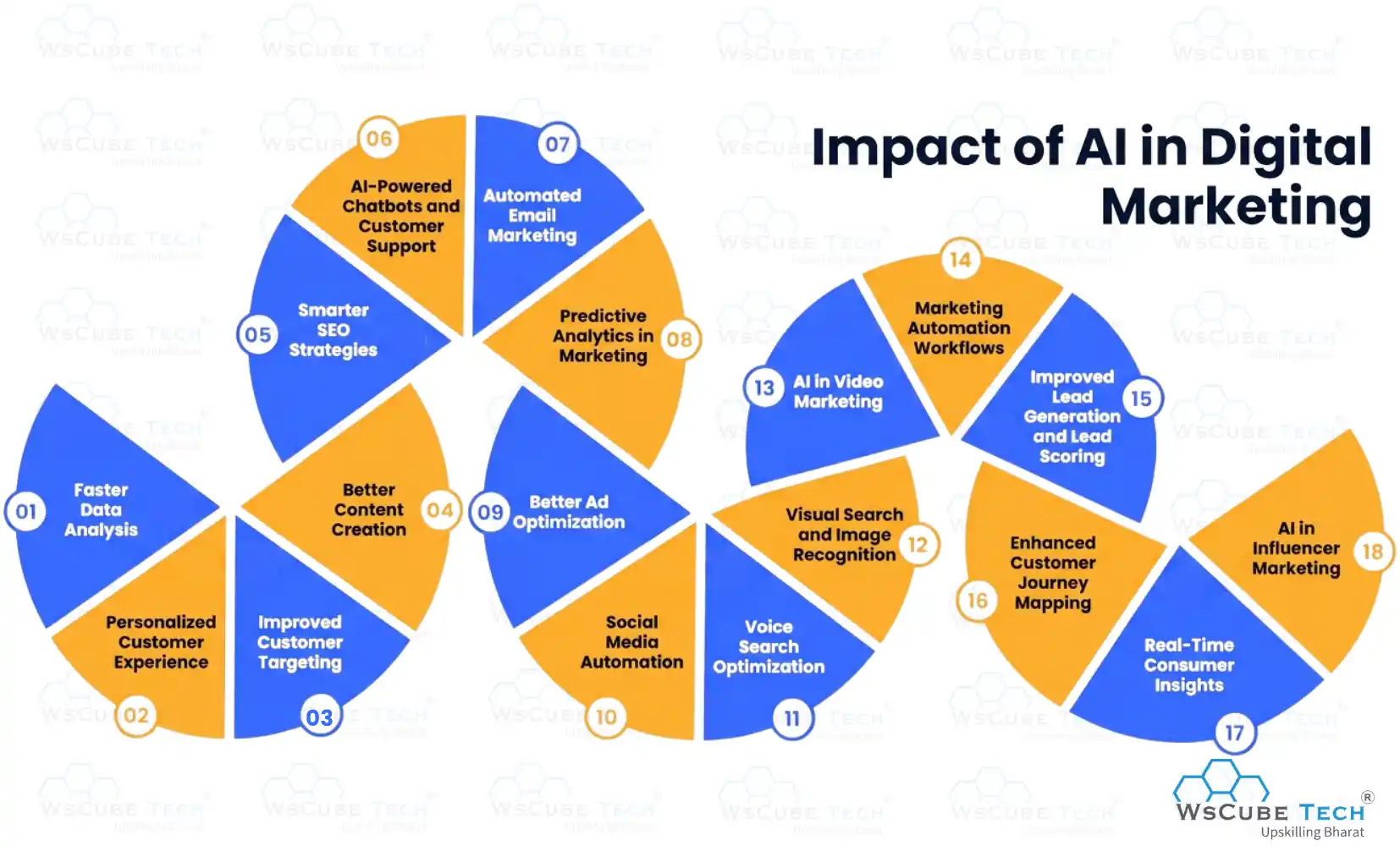
1. Faster Data Analysis
One of the most obvious impacts of AI is how fast it can process data. Human analysts can review hundreds of data points in a day. AI can review millions in seconds.
This matters because modern digital marketing generates an enormous volume of data: website visits, click rates, bounce rates, purchase histories, social media interactions, email open rates, and much more. Without AI, most of this data goes unused because there simply is not enough time to analyze it all.
With AI, marketers can understand what is working and what is not in real time. They can spot trends early, respond to customer behavior faster, and make decisions based on actual data instead of assumptions.
2. Personalized Customer Experience
Personalization is no longer a nice-to-have. Customers expect brands to know who they are and what they want. AI makes that possible at a scale no human team could achieve.
AI analyzes individual customer behavior, including browsing history, purchase patterns, and content preferences, and uses that data to deliver tailored experiences. This could mean personalized product recommendations on an e-commerce site, customized email content, or specific ads shown only to people likely to buy.
The impact of artificial intelligence in digital marketing is most visible here. Brands using AI-driven personalization see higher engagement, better retention, and stronger revenue growth.
A customer who feels like a brand truly understands them is far more likely to remain loyal and recommend it to others. AI is the technology that makes that feeling possible for millions of customers at once, without the brand needing a million-person customer service team.
3. Improved Customer Targeting
Reaching the right person at the right time with the right message is the foundation of good marketing. AI makes this much more precise.
Instead of targeting broad audience segments based on age or location, AI uses behavioral data, purchase intent signals, and real-time activity to identify exactly who is most likely to respond to a particular campaign. This reduces wasted ad spend and improves conversion rates significantly.
Platforms like Google Ads and Meta Ads already use AI-driven targeting tools that automatically find your most valuable potential customers based on your campaign goals.
4. Better Content Creation
AI tools have made content creation faster and more efficient. Tools powered by generative AI can write blog drafts, social media captions, ad copy, product descriptions, and email subject lines in a fraction of the time it would take a human.
This does not mean AI replaces human writers. It means writers can produce more, iterate faster, and spend their energy on the creative and strategic aspects of content rather than starting from zero every time.
According to SEO.com's research, 93% of marketers say AI helps them create content faster. That is a remarkable number and it shows how deeply this technology has been adopted in content workflows.
5. Smarter SEO Strategies
Search engine optimization has always been data-heavy. AI makes it smarter.
AI tools can analyze thousands of keywords, evaluate search intent, study competitor content, find content gaps, and suggest improvements to existing pages. Some tools can even predict which topics are likely to rank well based on current trends.
For anyone looking to grow their organic traffic, AI-powered SEO tools like Semrush, Surfer SEO, and Clearscope have become standard parts of the workflow. Understanding how these tools work is now a key part of any solid digital marketing course.
6. AI-Powered Chatbots and Customer Support
Chatbots have come a long way from the clunky, frustrating bots of the early 2010s. Modern AI chatbots are conversational, intelligent, and genuinely helpful.
They can handle customer inquiries, recommend products, guide users through purchase decisions, process returns, and escalate complex issues to human agents when needed. All of this happens 24 hours a day, 7 days a week, without any downtime.
According to SalesGroup AI, 95% of customer interactions are expected to be AI-powered by 2025. Chatbots reduce the cost of customer service while improving response times, and customers increasingly prefer getting instant answers over waiting for a human agent.
7. Automated Email Marketing
Email marketing remains one of the highest-ROI channels in digital marketing. AI has made it dramatically more effective.
AI can segment email lists based on behavior, send emails at the exact time each subscriber is most likely to open them, test subject lines automatically, personalize email content based on past purchases or browsing, and trigger specific email sequences based on user actions.
The result is email campaigns that feel personal and timely rather than generic and mass-produced. Higher open rates, higher click rates, and higher revenue from email all follow naturally.
8. Predictive Analytics in Marketing
Predictive analytics uses AI to look at historical data and forecast future outcomes. In marketing, this means predicting which leads are most likely to convert, which customers are at risk of churning, what products a person is likely to buy next, and how a campaign is likely to perform before it even launches.
This is a powerful shift. Instead of reacting to what already happened, marketers can take action before problems occur or before opportunities pass. According to Precedence Research, the predictive AI market is growing rapidly and will play a central role in marketing decisions going forward.
9. Better Ad Optimization
Running paid ads without AI is like driving with your eyes half closed. You can do it, but you are missing a lot.
AI-powered ad platforms continuously analyze performance data and make real-time adjustments to bids, audiences, creatives, and placements to maximize results. Google's Performance Max campaigns, Meta's Advantage+ campaigns, and programmatic advertising networks all rely on AI to make thousands of micro-decisions every second that human campaign managers could never replicate.
The impact of AI in digital marketing through ad optimization means lower cost per acquisition, higher return on ad spend, and campaigns that keep improving the longer they run.
Upcoming Masterclass
Attend our live classes led by experienced and desiccated instructors of Wscube Tech.



10. Social Media Automation
Managing multiple social media accounts, staying consistent, responding to comments, and analyzing performance across platforms is a massive amount of work. AI tools like Buffer, Hootsuite, and Sprout Social use AI to schedule posts at optimal times, suggest content based on what performs well, monitor brand mentions, and provide deep analytics.
AI also powers the recommendation algorithms on platforms like Instagram, TikTok, and YouTube, which means understanding AI helps marketers create content that is more likely to be shown to new audiences organically.
11. Voice Search Optimization
Voice search has grown significantly with the rise of smart speakers and voice assistants like Alexa, Siri, and Google Assistant. People ask questions out loud in a conversational way, which is very different from how they type.
AI helps marketers optimize content for voice search by identifying natural language queries, long-tail keywords that match spoken questions, and featured snippet opportunities. As voice search continues to grow, this is becoming an increasingly important part of any SEO and content strategy.
12. Visual Search and Image Recognition
Shoppers no longer have to describe what they are looking for. They can take a photo and search with it. Pinterest Lens, Google Lens, and similar tools use AI-powered image recognition to identify objects and serve relevant results.
For e-commerce brands and retailers, this means optimizing product images with descriptive file names, alt text, and structured data so that AI can understand and surface them in visual search results. The AI impact on digital marketing through visual search is still growing but is already changing how discovery happens online.
13. AI in Video Marketing
Video is the most consumed content format online, and AI is making it easier to produce, optimize, and distribute video at scale.
AI tools can now generate video scripts, create subtitles and translations automatically, identify the best moments in long videos to use as short clips, and personalize video content based on the viewer. Platforms like YouTube use AI to recommend videos, which means understanding what signals the algorithm looks for gives marketers a real advantage.
14. Marketing Automation Workflows
Beyond individual tools, AI enables end-to-end marketing automation workflows. These are sequences of actions that happen automatically based on user behavior, without any manual work from the marketing team.
A visitor downloads a free guide. AI tags them as a lead, adds them to an email sequence, shows them relevant retargeting ads, and scores them based on their engagement. If they reach a certain score, the system automatically alerts a salesperson to follow up. All of that happens without a single human pressing a button.
This level of automation is now accessible to businesses of all sizes through platforms like HubSpot, Marketo, ActiveCampaign, and others.
15. Improved Lead Generation and Lead Scoring
AI has transformed how businesses generate and qualify leads. AI-powered lead scoring models analyze dozens of signals, including website behavior, content engagement, email interaction, company size, job title, and more, to predict which leads are most likely to become customers.
This allows sales teams to focus their energy on the leads most worth pursuing and lets marketing teams refine their campaigns to attract more of the right kind of people. The result is a shorter sales cycle and a higher close rate.
16. Enhanced Customer Journey Mapping
Understanding how customers move from awareness to purchase used to require a lot of guesswork. AI changes that by tracking and analyzing every touchpoint a customer has with a brand across multiple channels and devices.
This gives marketers a complete view of the customer journey and helps them identify where people drop off, what content moves them forward, and where to focus their attention for the biggest impact. Knowing these patterns is one of the key digital marketing benefits of building an AI-driven strategy.
17. Real-Time Consumer Insights
AI can listen to what people are saying about your brand, your competitors, and your industry across social media, review sites, forums, and news outlets, all in real time.
Sentiment analysis tools powered by natural language processing can tell you whether the conversation around your brand is positive, negative, or neutral, and alert you to spikes in mentions so you can respond quickly. This kind of real-time intelligence would take a team of analysts working around the clock to achieve manually.
18. AI in Influencer Marketing
Finding the right influencer for a campaign used to be a time-consuming manual process. AI now makes it much faster and more accurate.
AI tools can analyze an influencer's audience demographics, engagement rates, follower authenticity, content performance, and brand alignment to identify who is genuinely a good fit for a specific campaign. According to Chad Wyatt's AI Marketing Statistics, AI is projected to power 35% of all influencer marketing investments, reflecting how central this technology has become to influencer strategy.
Essential Topics Related to Digital Marketing
Benefits of AI in Digital Marketing
The impact of AI in digital marketing shows up across many dimensions, but here are the key benefits that businesses experience:
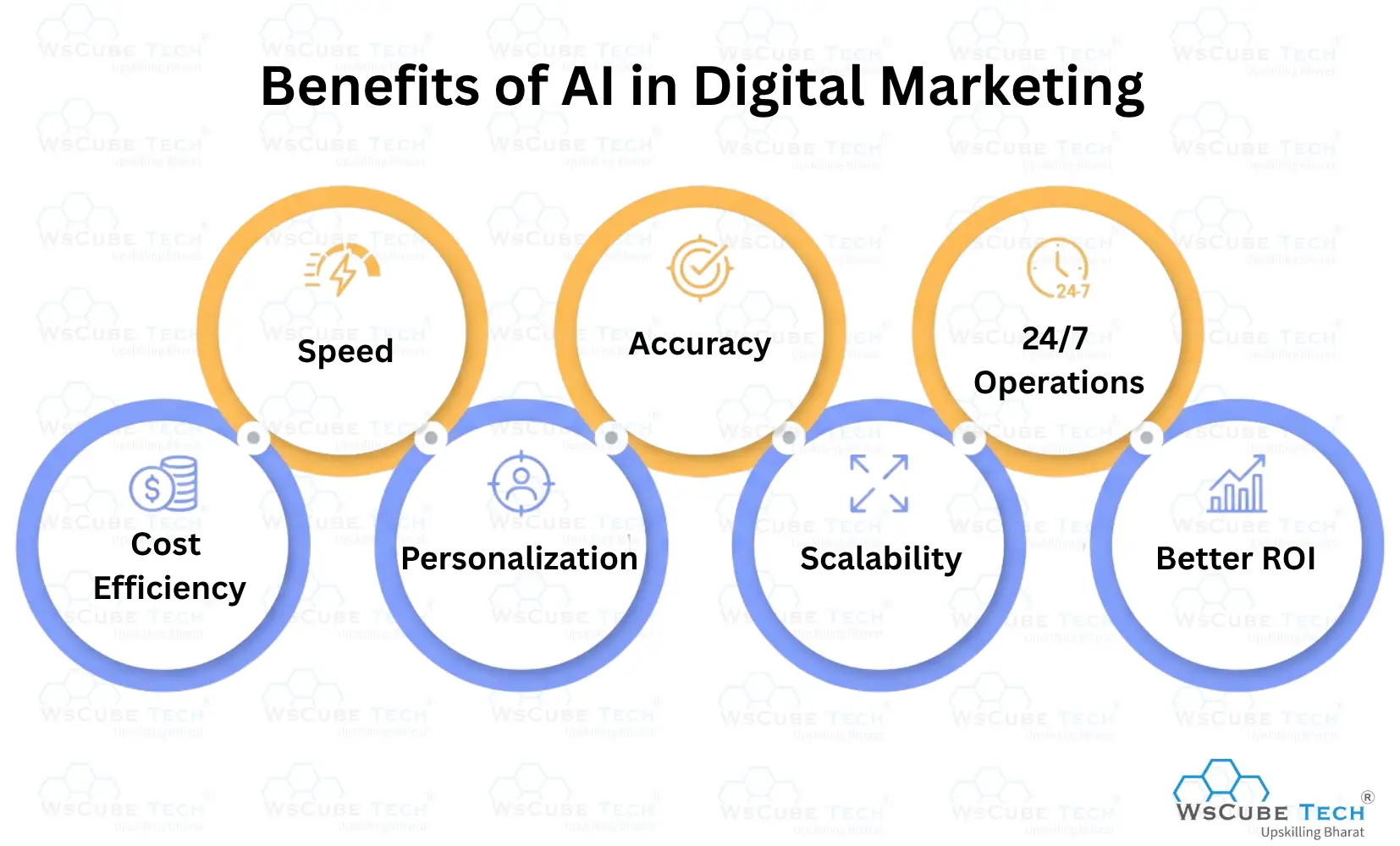
- Cost Efficiency: AI automates tasks that would otherwise require large teams, reducing operational costs without sacrificing output quality. AI-driven ad optimization also means less money wasted on campaigns that do not perform.
- Speed: AI processes data, creates content, and executes campaigns far faster than any human team. This speed means marketers can respond to trends and customer behavior in real time.
- Personalization: AI makes it possible to deliver highly personalized experiences to millions of individual customers simultaneously, something that was simply not achievable before.
- Accuracy: AI reduces human error in data analysis, audience targeting, and reporting. Decisions made on clean, well-analyzed data are simply better decisions.
- Scalability: A small marketing team supported by AI tools can achieve the output of a much larger traditional team. This makes growth much more achievable without proportionally increasing headcount.
- 24/7 Operations: Chatbots, automated email sequences, and AI-powered ad platforms keep working around the clock. Your marketing does not stop when your team logs off.
- Better ROI: All of the above combine to deliver stronger returns on marketing investment. McKinsey's 2025 Global AI Survey found that businesses using generative AI in marketing and sales saw revenue growth of 5% to 10%, with about two-thirds reporting higher revenues in the second half of 2024.
Real Examples of Impact of AI in Digital Marketing
Here are a few real-world examples of how AI is being applied in digital marketing today:
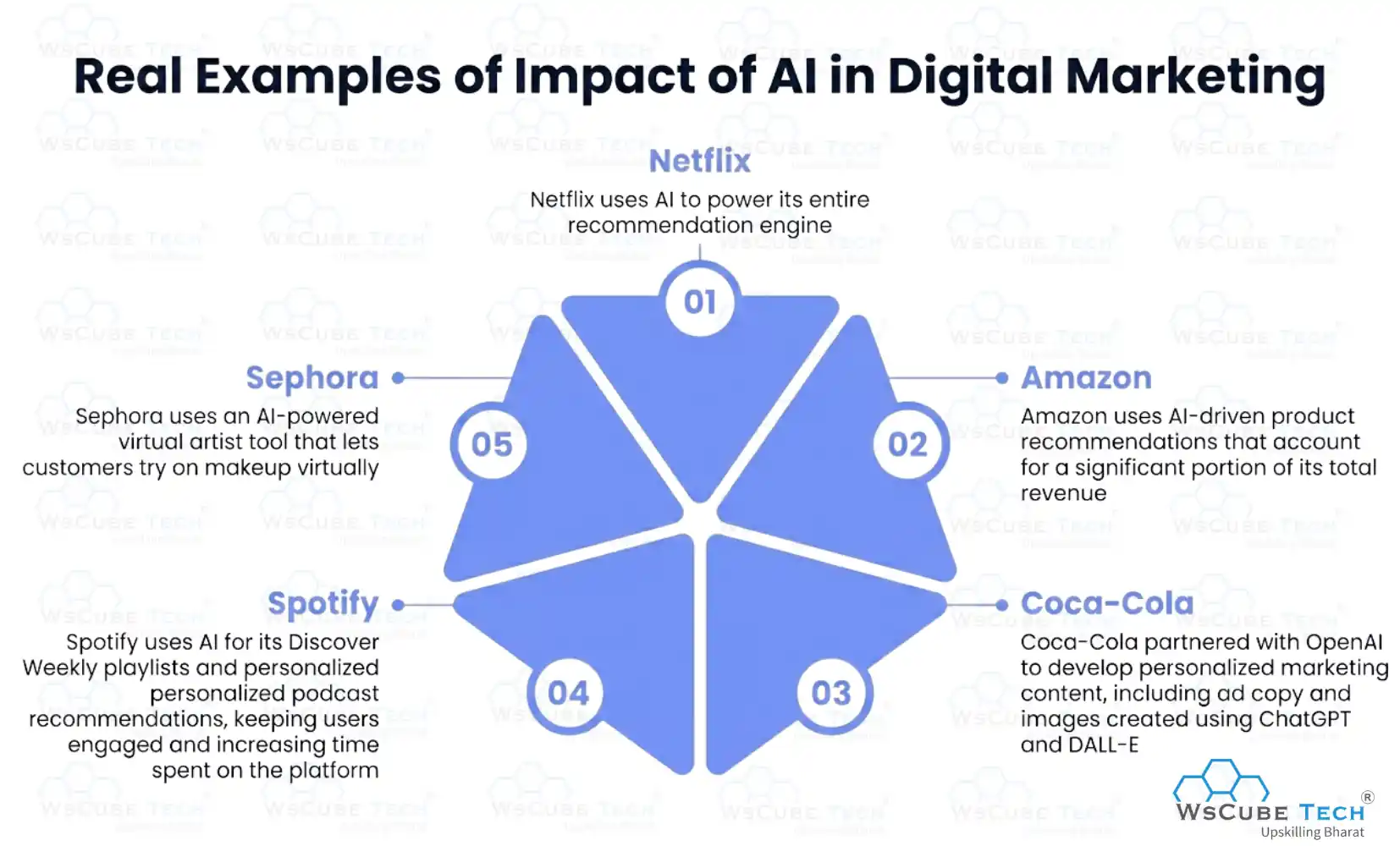
- Netflix uses AI to power its entire recommendation engine. Every time you open Netflix, the thumbnails you see, the order content is displayed, and the recommendations you receive are all determined by AI based on your viewing history and what similar users enjoy.
- Amazon uses AI-driven product recommendations that account for a significant portion of its total revenue. The "customers who bought this also bought" section is pure machine learning in action.
- Coca-Cola partnered with OpenAI to develop personalized marketing content, including ad copy and images created using ChatGPT and DALL-E. This partnership allows Coca-Cola to create highly targeted marketing materials faster than ever before.
- Spotify uses AI for its Discover Weekly playlists and personalized podcast recommendations, keeping users engaged and increasing the time they spend on the platform.
- Sephora uses an AI-powered virtual artist tool that lets customers try on makeup virtually. This enhances the shopping experience and reduces returns significantly.
These are not small experiments. These are AI applications at the core of how some of the world's most successful companies market themselves. The impact of artificial intelligence in digital marketing is already shaping some of the biggest brands on the planet.
Explore Our Most Popular Marketing Courses
AI vs Traditional Digital Marketing
Here is a straightforward comparison of how AI-powered marketing stacks up against traditional digital marketing approaches:
| Factor | Traditional Digital Marketing | AI-Powered Digital Marketing |
| Speed | Campaigns take days or weeks to plan and launch | Campaigns can be planned, built, and launched in hours |
| Cost | Higher operational costs due to manual effort | Lower costs through automation and optimized ad spend |
| Personalization | Broad segments; limited individual personalization | Deep personalization at the individual level |
| Scalability | Scaling requires proportionally more people | AI tools scale without significant added cost |
| Human Touch | High degree of human judgment and creativity | Humans focus on strategy; AI handles execution |
| Error Rate | Higher chance of human error in data and targeting | Significantly reduced errors through automation |
| Decision-Making | Based on past experience and limited data | Based on real-time data and predictive modeling |
The key takeaway is not that one is better than the other in every way. Traditional marketing brings human creativity and judgment that AI cannot fully replicate. AI brings scale, speed, and data processing power that humans cannot match. The best marketing strategies today combine both.
Tips to Use AI Effectively in Digital Marketing
Knowing how AI will impact digital marketing is one thing. Using it well is another. Here are practical tips for making the most of AI in your marketing:
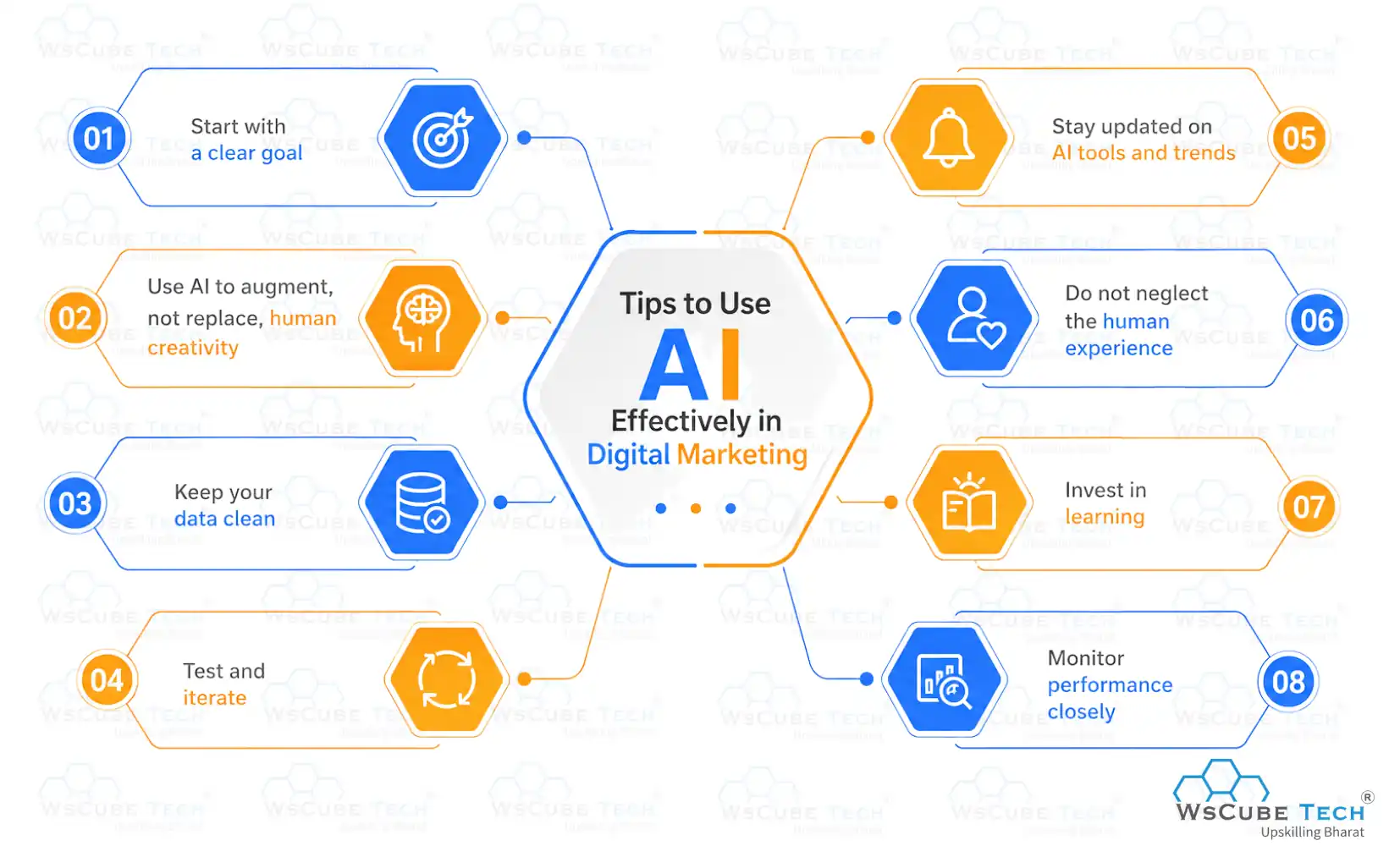
1. Start with a clear goal
AI is a tool, not a strategy. Know what you want to achieve before choosing an AI solution. Are you trying to reduce customer acquisition costs? Improve email open rates? Scale content production? Define the goal first.
2. Use AI to augment, not replace, human creativity
Let AI handle the data analysis, automation, and repetitive tasks. Save your human energy for strategy, storytelling, and creative direction.
3. Keep your data clean
AI is only as good as the data it learns from. Invest in good data collection, organization, and hygiene practices. Garbage in, garbage out.
4. Test and iterate
AI tools give you the ability to test more variables faster than ever. Run A/B tests on subject lines, ad creatives, landing pages, and CTAs constantly. Let the data tell you what works.
5. Stay updated on AI tools and trends
The AI landscape is changing rapidly. Following digital marketing trends regularly will help you stay ahead of what tools are emerging and how to apply them.
6. Do not neglect the human experience
Customers can tell when something feels overly automated. Use AI to personalize and streamline, but make sure your brand voice, values, and human warmth still come through in every interaction.
7. Invest in learning
Understanding AI in marketing is fast becoming a baseline skill. If you are thinking about your career in this field, check the digital marketing course eligibility requirements and consider building this knowledge formally.
8. Monitor performance closely
AI tools can optimize the wrong metric if you are not careful. Make sure your AI campaigns are being measured against the outcomes that actually matter to your business, not just surface-level metrics.
Explore Guides Related to Artificial Intelligence (AI)
| AI Writing Tools | What is ChatGPT |
| Gemini vs.ChatGPT | Perplexity vs.ChatGPT |
| How to Use ChatGPT | How to Make Money With AI |
| ChatGPT Alternatives | Generative AI Roadmap |
Can AI Replace Digital Marketers?
No, not fully. And here is why. This is one of the most common questions people ask when they learn about the impact of AI in digital marketing, and the answer is nuanced. AI can absolutely automate many tasks that digital marketers currently spend time on.
Writing basic content, analyzing data, managing ad bids, scheduling social posts, segmenting email lists: all of these can be handled by AI. In that sense, AI is already replacing certain repetitive functions within marketing. But marketing is fundamentally a human discipline.
It is about understanding people, what motivates them, what they fear, what makes them laugh, what builds trust. Those things require emotional intelligence, cultural awareness, creativity, and intuition. AI does not have those things.
Consider the following areas where humans are still essential:
- Brand Strategy: Deciding what a brand stands for, how it should sound, and what story it should tell requires human insight and judgment.
- Creative Thinking: The best ad campaigns, the most memorable content, and the ideas that cut through the noise come from human creative thinking. AI can assist, but the original spark is still human.
- Ethical Judgment: Knowing what kind of content is appropriate, how to handle a sensitive situation, and when not to send a campaign requires human wisdom.
- Relationship Building: Building genuine trust with an audience, managing influencer relationships, and collaborating with partners are deeply human activities.
- Adapting to the Unexpected: When something changes in the world, a brand needs to respond thoughtfully and sometimes quickly. That kind of judgment is still human territory.
The real picture is this: AI will not replace digital marketers. But digital marketers who know how to use AI will replace those who do not. Understanding what is the impact of AI in digital marketing and building skills around it is what will define who thrives in this industry going forward.
Given the scope of digital marketing in India and globally, the demand for AI-skilled marketers is only going to grow. This is a time to learn and adapt, not a time to worry.
Impact of AI in Digital Marketing: Video Guide
FAQs About Impact of AI in Digital Marketing
AI is transforming digital marketing by making campaigns faster, more personalized, and more data-driven. It automates repetitive tasks, improves customer targeting, enhances content creation, and delivers real-time insights that help marketers make smarter decisions.
The future of digital marketing will be shaped by deeper personalization, predictive decision-making, and increased automation. AI will allow marketers to predict customer needs before they arise, create highly individualized experiences at scale, and run campaigns that continuously optimize themselves.
Key benefits include cost efficiency, faster execution, better personalization, improved accuracy, scalability, 24/7 campaign operation, and higher return on investment from marketing spend.
No. AI is automating specific tasks within marketing, but the strategy, creativity, and emotional intelligence that human marketers bring cannot be replaced by machines. Marketers who learn to use AI effectively will have a major advantage over those who do not.
Examples include Google Ads (AI bidding), Meta Advantage+ (AI ad targeting), HubSpot (AI CRM and automation), Jasper and ChatGPT (AI content creation), Semrush (AI SEO analysis), Salesforce Einstein (AI analytics), and many more.
AI helps with keyword research, content gap analysis, search intent understanding, competitor analysis, and on-page optimization recommendations. Tools like Surfer SEO and Clearscope use AI to help marketers create content that is more likely to rank well in search engines.
Yes. Many AI marketing tools are affordable and accessible to businesses of all sizes. Platforms like Mailchimp, HubSpot, Canva, and ChatGPT offer AI-powered features that small businesses can start using right away without a large budget.
Conclusion
The impact of AI in digital marketing is no longer a future possibility, it is happening right now. From faster data analysis and personalized customer experiences to smarter ad campaigns and AI-powered chatbots, businesses are using AI to improve efficiency and results.
The impact of artificial intelligence in digital marketing can be seen across every stage of the customer journey, helping brands make better decisions, automate repetitive tasks, and deliver more relevant experiences. For marketers, AI is not a replacement for creativity or strategy. Instead, it enhances human skills by making marketing faster, smarter, and more effective.
The professionals and brands that learn to use AI effectively will be best positioned to succeed in the years ahead. As AI continues to evolve, understanding and using these tools is becoming an essential skill for anyone looking to build a successful and future-ready marketing career.
Join Our On-Campus Digital Marketing Program
Explore Our Free Courses




Leave a comment
Your email address will not be published. Required fields are marked *Comments (0)
No comments yet.