If you've ever tried learning digital marketing, you know how confusing it can get. One person says start with SEO, another says focus on social media, and before you know it, you're jumping between videos, blogs, and courses without a clear direction.
That's exactly why this digital marketing roadmap exists.
Instead of overwhelming you with dozens of skills and tools at once, this guide breaks the learning process into simple, practical steps. Whether you're a student, a business owner, someone who wants to become a freelancer, or exploring a marketing career, you'll learn what to focus on first, what can wait, and how everything fits together.
By the end, you'll have a clear path from beginner to advanced digital marketer, without the guesswork.
What is Digital Marketing?
Before diving into this digital marketing roadmap, it's important to understand how the industry is changing.
The meaning of digital marketing is still the same: attract the right audience, build trust, and turn visitors into customers. What has changed is where people search for information. A few years ago, Google was the starting point for almost everything. Today, people are just as likely to ask ChatGPT, browse Instagram, watch YouTube videos, or search on platforms like Perplexity and Gemini.
That's why a successful roadmap for digital marketing in 2026 goes beyond traditional SEO. To stay competitive, you need to understand how search engines, AI platforms, paid advertising, and social media work together.
As you follow this digital marketing learning roadmap, you'll focus on five key areas:
- SEO (Search Engine Optimization): Ranking your website on Google and other search engines.
- AEO (Answer Engine Optimization): Getting your content featured in AI-generated answers.
- GEO (Generative Engine Optimization): Increasing your brand's visibility across AI search platforms.
- SMO (Social Media Optimization): Growing your reach on Instagram, LinkedIn, YouTube, Facebook, and X.
- SEM (Search Engine Marketing): Driving traffic through paid ads on Google, Meta, and LinkedIn.
Think of it this way: SEO helps people find you, AEO and GEO help AI recommend you, SEM helps you reach customers faster through ads, and SMO helps you build an audience that trusts your brand.
Recommended Professional Certificates
AI-Powered Digital Marketing Course
Performance Marketing Bootcamp
SEO Specialist Bootcamp
Digital Marketing Roadmap 2026
From SEO and content marketing to social media, paid ads, and AI tools, this digital marketing full roadmap will help you build a strong foundation and grow from beginner to expert.
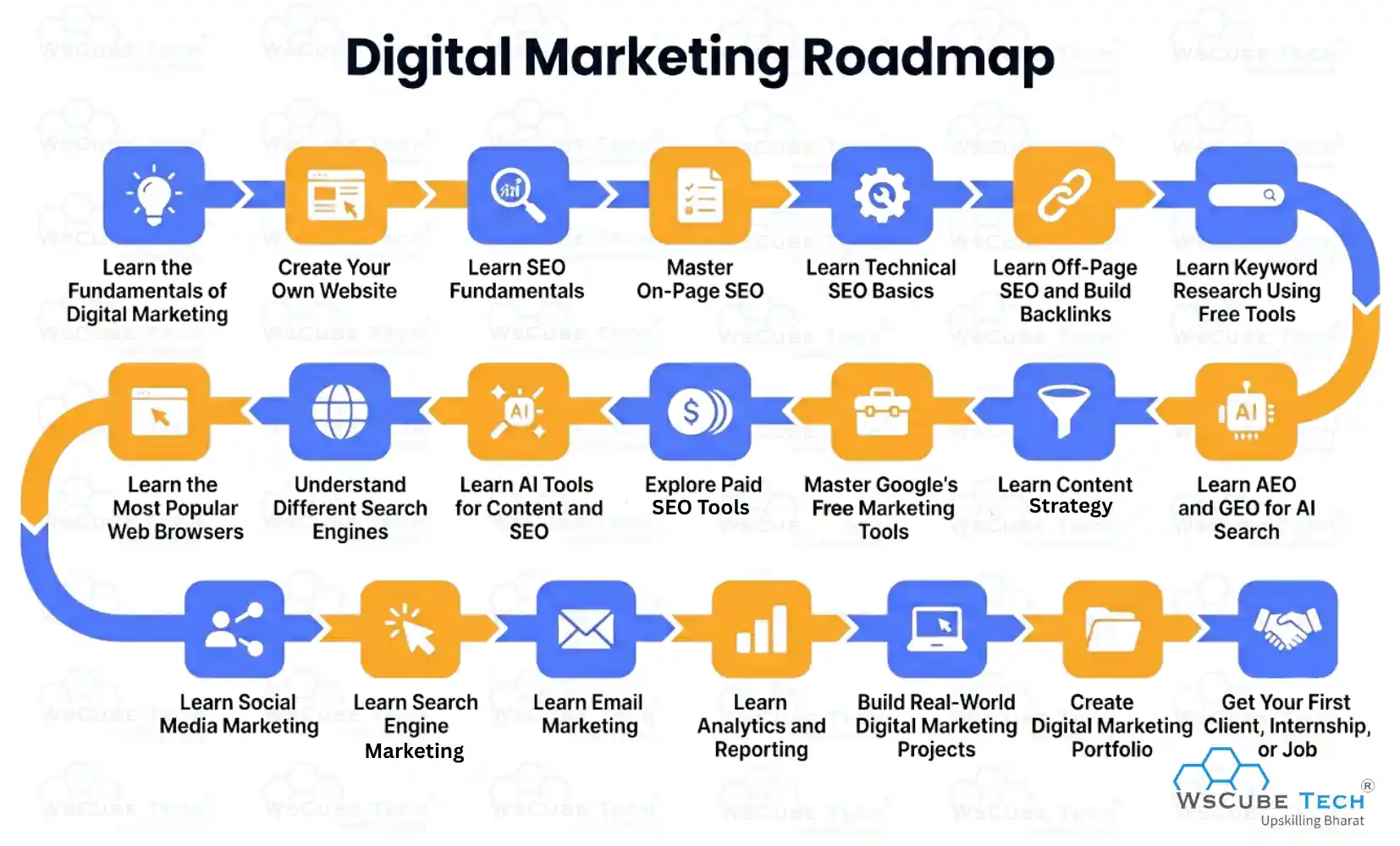
Step 1: Learn the Fundamentals of Digital Marketing
Before diving into SEO, social media, or paid advertising, you need to understand how digital marketing works. Every successful marketer starts by learning the core concepts, including digital marketing channels, customer journeys, content marketing, SEO, analytics, and conversions.
At this stage, focus on understanding how businesses attract visitors, build trust, and turn those visitors into customers. You should also become familiar with important terms like organic traffic, paid traffic, KPIs, and customer acquisition.
Goal: By the end of this step, you should be able to explain the basics of digital marketing and understand how different marketing channels work together to drive business growth.
Step 2: Create Your Own Website
The fastest way to learn digital marketing is by working on a real website. Instead of only watching tutorials, create a simple WordPress blog where you can test everything you learn.
Choose a niche that interests you, buy a domain, install WordPress, and publish a few basic articles. Don't worry about traffic or perfection at this stage. The goal is to create a space where you can practice SEO, content writing, analytics, and website optimization.
As you move through this digital marketing roadmap, your website will become your personal laboratory. Every new skill you learn can be tested and measured on your own project.
Goal: Launch a WordPress website and publish your first 3 to 5 blog posts.
Step 3: Learn SEO Fundamentals
If there's one skill that can accelerate your digital marketing journey, it's SEO. Understanding how search engines work will help you create content that people can actually find.
Start with Google's free SEO Starter Guide and documentation. Since Google controls most of the search market, learning directly from the source helps you understand what search engines expect from websites.
Once you've covered the basics, expand your learning through trusted resources like Search Engine Journal, Ahrefs, Semrush, and Moz. Don't try to learn everything at once. Pick one topic, understand it, and then apply it to your website.
Focus on these three core areas of SEO:
- On-Page SEO – Optimizing content, keywords, titles, and user experience.
- Technical SEO – Improving website speed, structure, indexing, and crawlability.
- Off-Page SEO – Building authority through backlinks, mentions, and brand signals.
Note: Master these fundamentals first, and the rest of SEO becomes much easier to understand.
Step 4: Master On-Page SEO
Once you understand the basics of SEO, start optimizing every blog post you publish. On-page SEO refers to all the elements you can control on a webpage to improve its search visibility.
- Before publishing a post, make sure you:
- Include your target keyword in the title, URL, and first paragraph.
- Use clear H2 and H3 headings to organize your content.
- Write a compelling meta description that encourages clicks.
- Add relevant internal and external links.
- Optimize images with descriptive alt text.
- Use related keywords naturally throughout the content.
- Add an FAQ section when relevant.
- End with a clear call to action.
The first few posts may take time to optimize, but eventually these SEO best practices become second nature. Consistency is what helps content rank over the long term.
Step 5: Learn Technical SEO Basics
Creating great content is important, but it won't rank well if search engines can't properly access and understand your website. That's where technical SEO comes in. It focuses on improving your site's performance, structure, and accessibility so both users and search engines have a better experience.
As part of your digital marketing roadmap, start by learning the core technical SEO concepts and implementing them on your website.
| Technical SEO Area | What to Learn | Why It Matters |
| Google Search Console | Monitor indexing, errors, and search performance | Helps you identify and fix SEO issues |
| XML Sitemap | Submit your website pages to search engines | Makes it easier for search engines to discover content |
| Mobile Optimization | Ensure your site works well on smartphones and tablets | Most searches now happen on mobile devices |
| Site Speed | Improve loading times and Core Web Vitals | Faster websites provide a better user experience |
| HTTPS Security | Install an SSL certificate | Builds trust and protects user data |
| Schema Markup | Add structured data to your pages | Helps search engines better understand your content |
| URL Structure | Use clean, descriptive URLs | Improves usability and crawlability |
| Canonical Tags | Prevent duplicate content issues | Helps search engines identify the preferred page version |
You don't need to master every technical SEO concept immediately. Focus on understanding the basics and gradually optimize your website as you learn.
Goal: Build a website that is crawlable, mobile-friendly, secure, and technically optimized before moving on to advanced SEO techniques.
Upcoming Masterclass
Attend our live classes led by experienced and desiccated instructors of Wscube Tech.





Step 6: Learn Off-Page SEO and Build Backlinks
Creating great content is only half the job. To rank competitively, search engines also need signals that other websites trust your content. This is where off-page SEO comes in.
The most important part of off-page SEO is backlinks (links from other websites pointing to your pages). In general, a few high-quality backlinks from trusted websites are far more valuable than hundreds of low-quality links.
As a beginner, focus on these backlink opportunities:
- Guest posting on relevant blogs
- Business directory listings
- Resource page outreach
- Digital PR and expert quotes
- Podcast interviews
- Brand mention reclamation
- Creating content worth linking to
Along the way, learn how to evaluate websites using metrics such as Domain Authority (DA), Domain Rating (DR), and Page Authority (PA).
Goal: Earn your first 5–10 quality backlinks and understand how off-page SEO helps improve rankings, authority, and organic traffic.
Step 7: Learn Keyword Research Using Free Tools
Keyword research is one of the most important skills in any digital marketing roadmap. It helps you understand what your audience is searching for and creates the foundation for SEO, content marketing, and AEO. Before creating content, learn how to find keywords that have search demand and match user intent.
| Tool | What It Does | Best Use Case |
| Google Keyword Planner | Provides keyword ideas, search volume estimates, and competition data. | Finding primary keywords for blogs and website pages. |
| Google Trends | Shows trending searches and topic popularity over time. | Identifying trending and seasonal topics. |
| Google Search Console | Shows the keywords your website already ranks for. | Finding optimization and content opportunities. |
Goal: Research at least 20 keywords related to your niche and group them into content topics before publishing your next blog posts.
Step 8: Learn AEO and GEO for AI Search
As part of your digital marketing learning roadmap, it's important to understand how search is evolving beyond Google. Today, people search for information on ChatGPT, Gemini, Perplexity, and other AI-powered platforms. That's why understanding AEO (Answer Engine Optimization) and GEO (Generative Engine Optimization) is becoming an essential skill for marketers.
To improve your visibility in AI search, focus on these best practices:
- Write clear answers to common questions.
- Add FAQ sections and schema markup.
- Keep paragraphs short and easy to scan.
- Use descriptive headings and subheadings.
- Mention relevant brands, tools, people, and topics naturally.
- Publish original insights, case studies, and research.
- Build your presence across platforms like YouTube, Reddit, and Quora.
Think of it this way:
- SEO helps your content rank on Google.
- AEO helps your content get cited in AI answers.
- GEO helps your brand stay visible across AI-powered search platforms.
Goal: Create content that ranks in search engines and has a higher chance of being referenced by AI tools.
Step 9: Learn Content Strategy (TOFU, MOFU, BOFU)
Creating content without a strategy is like posting in the dark. A successful content marketing plan targets users at different stages of their buying journey. This is where the TOFU, MOFU, and BOFU framework comes in.
TOFU (Top of Funnel)
This is awareness-stage content designed to attract new visitors and answer basic questions.
Examples:
- What is digital marketing?
- How do search engines work?
- Benefits of content marketing for small businesses
MOFU (Middle of Funnel)
This is consideration-stage content for people who already understand their problem and are looking for solutions.
Examples:
- SEO vs PPC: Which is Better for Your Business?
- Ahrefs vs Semrush Comparison
- How to Create a Content Marketing Strategy
BOFU (Bottom of Funnel)
This is decision-stage content aimed at users who are ready to take action, make a purchase, or contact a business.
Examples:
- Best SEO Agency in Jaipur
- Semrush Pricing and Features Review
- Book a Free Digital Marketing Consultation
For your practice blog, aim for a mix of 60% TOFU, 30% MOFU, and 10% BOFU content. This balance helps you attract new visitors while also generating leads and conversions.
Goal: Create content for all three stages of the funnel instead of focusing only on traffic-generating articles.
Step 10: Master Google's Free Marketing Tools
One of the biggest mistakes beginners make is spending money on expensive SEO and marketing tools too early. The good news is that Google provides several powerful tools for free, and they are more than enough to get started.
Here are the tools every aspiring digital marketer should learn:
- Google Search Console – Monitor keyword rankings, indexing issues, and website performance in search results.
- Google Analytics 4 (GA4) – Understand where your visitors come from and how they interact with your website.
- Google Keyword Planner – Discover keyword ideas and estimate search demand.
- Google Trends – Find trending topics and identify seasonal opportunities.
- Google Business Profile – Improve local visibility on Google Search and Maps.
If you're working with a local business, Google Business Profile deserves special attention. A well-optimized profile can help businesses appear in local search results, collect reviews, showcase products or services, and generate valuable leads from nearby customers.
Goal: Set up and actively use these tools on your website before investing in paid SEO or marketing platforms.
Expert Tip: You should also explore PageSpeed Insights to monitor website performance and Google Tag Manager to manage tracking codes without editing website code.
Explore More Blogs Related to Career Roadmap
Step 11: Explore Paid SEO Tools (When You're Ready)
As you progress through this digital marketing roadmap, you'll eventually reach a stage where free tools are no longer enough. While beginners can learn SEO using Google's free tools, paid platforms provide deeper insights, automation, and competitor data that can help you scale your results.
Some of the most popular SEO tools include:
- Semrush – Great for keyword research, competitor analysis, site audits, and content optimization.
- Ahrefs – Known for its powerful backlink analysis and keyword research capabilities.
- Moz Pro – Useful for tracking Domain Authority (DA), keyword rankings, and link-building opportunities.
If you're looking for more affordable options, consider:
- Ubersuggest – Beginner-friendly keyword research and SEO analysis.
- SE Ranking – A budget-friendly all-in-one SEO platform.
- Serpstat – Useful for keyword research, rank tracking, and competitor analysis.
- Mangools (KWFinder) – Simple and easy-to-use keyword research tool.
- Screaming Frog – Popular for technical SEO audits.
- Seobility – Helpful for website audits and on-page SEO improvements.
Don't feel pressured to buy premium tools immediately. Focus on mastering free tools first. Once you start generating traffic, freelancing, or working on client projects, investing in a paid SEO tool becomes much easier to justify.
Goal: Understand what each SEO tool does and choose one that fits your budget and needs when you're ready to scale.
Step 12: Learn AI Tools for Content and SEO
No digital marketing roadmap is complete without AI. While AI won't replace marketers, it can help you research faster, create content more efficiently, and improve your SEO workflow.
Here are five AI tools worth learning in 2026:
- ChatGPT – Great for brainstorming ideas, creating outlines, content planning, and rewriting drafts.
- Claude – Excellent for long-form content, research, and natural-sounding writing.
- Google Gemini – Useful for research and workflows connected to Google Search, Gmail, and Docs.
- Perplexity – An AI-powered search engine that provides sources and citations for research.
- Surfer SEO – Helps optimize content by comparing it against top-ranking pages and identifying content gaps.
Remember, AI should be used as a research and productivity tool, not as a replacement for original thinking. The best content combines AI assistance with your own expertise, experience, and insights.
Goal: Learn how to use AI tools to improve content creation and SEO without relying on them to do all the work.
Step 13: Understand Different Search Engines
As you follow this digital marketing roadmap, it's important to remember that Google isn't the only search engine people use. Different platforms have different audiences, ranking factors, and opportunities.
Here are the search engines every digital marketer should know:
- Google – The world's largest search engine and the primary focus of SEO.
- Microsoft Bing – Important for B2B audiences and AI-powered search experiences.
- Yahoo – Powered by Bing and still used in certain regions.
- DuckDuckGo – Popular among privacy-conscious users.
- Yandex – Widely used in Russia and nearby markets.
Goal: Understand how different search engines work and where your audience is searching online.
Step 14: Learn the Most Popular Web Browsers
A digital marketer should also understand the browsers people use to access websites. Testing your website across multiple browsers helps ensure a consistent user experience.
Focus on these popular browsers:
- Google Chrome – The most widely used browser with excellent developer tools.
- Mozilla Firefox – Known for privacy features and developer-friendly tools.
- Microsoft Edge – Chromium-based browser with AI-powered features.
- Safari – Essential for testing websites on Apple devices.
- Brave – Privacy-focused browser with built-in ad and tracker blocking.
Before launching a website or campaign, test it on at least Chrome, Firefox, and Safari to identify any display or functionality issues.
Goal: Make sure your website delivers a smooth experience across the browsers your audience uses most.
Step 15: Learn Social Media Marketing (SMO)
A complete digital marketing roadmap isn't limited to search engines. Social media platforms help you build an audience, increase brand awareness, and drive traffic to your website.
Focus on learning how content performs on different platforms and how users engage with brands online.
| Platform | Best For |
| Reels, visual content, brand building | |
| Professional networking and B2B marketing | |
| YouTube | Long-form content and tutorials |
| Communities and local businesses | |
| X (Twitter) | News, trends, and industry discussions |
As a beginner, choose one or two platforms and stay consistent rather than trying to be everywhere.
Goal: Build and grow at least one active social media profile related to your niche.
Explore Our Most Popular Marketing Courses
Step 16: Learn Search Engine Marketing (SEM)
While SEO generates organic traffic, SEM helps you get immediate visibility through paid advertising. Understanding paid ads is an important part of any digital marketing learning roadmap.
Start with:
- Google Ads Search Campaigns
- Google Display Ads
- YouTube Ads
- Meta Ads (Facebook & Instagram)
- LinkedIn Ads
Learn how targeting, bidding, ad copy, and landing pages work together to generate leads and sales.
Goal: Create and launch a small test campaign with a limited budget to understand the fundamentals of paid advertising.
Step 17: Learn Email Marketing
Social media algorithms change. Search rankings fluctuate. Email lists remain one of the few marketing assets you truly own.
Start by learning:
- Email list building
- Lead magnets
- Newsletter creation
- Email automation
- Segmentation
- A/B testing
Popular beginner-friendly tools include Mailchimp, Brevo, and ConvertKit.
Goal: Build your first email list and send a simple newsletter campaign.
Step 18: Learn Analytics and Reporting
Successful marketers don't rely on guesses. They use data to make decisions.
At this stage, learn how to measure:
- Website traffic
- User behavior
- Conversion rates
- Traffic sources
- Campaign performance
- Return on investment (ROI)
The most important tools to learn are Google Analytics 4 and Google Search Console.
Goal: Create a monthly performance report for your website or a practice project and identify opportunities for improvement.
Step 19: Build Real-World Digital Marketing Projects
Knowledge alone won't get you hired. Employers and clients want proof that you can apply your skills.
Work on projects such as:
- Creating a blog and growing traffic
- Running a Google Ads campaign
- Building a content calendar
- Managing a social media account
- Improving a website's SEO
- Creating an email marketing campaign
Document your work and results along the way.
Goal: Complete at least 3–5 practical projects that demonstrate different marketing skills.
Related Reading: Best Digital Marketing Projects (For Students & Beginners)
Step 20: Create a Digital Marketing Portfolio
A portfolio is your evidence that you can do the work.
Include:
- Blog articles you've written
- SEO case studies
- Social media campaigns
- Ad campaign results
- Analytics reports
- Certifications
- Personal projects
Even if you don't have clients yet, showcase your own website and practice projects.
Goal: Build a portfolio website that highlights your best work and achievements.
Step 21: Get Your First Client, Internship, or Job
The final step in this digital marketing roadmap is applying your skills in the real world.
Start by:
- Applying for internships
- Offering services to local businesses
- Freelancing on platforms like Upwork and Fiverr
- Networking on LinkedIn
- Building your personal brand
Your first opportunity doesn't need to be perfect. The goal is to gain experience, collect results, and continue learning.
Goal: Land your first internship, freelance client, or full-time digital marketing role.
Essential Topics Related to Digital Marketing
AI in Digital Marketing: How to Integrate It in Your Roadmap
No roadmap for digital marketing is complete without understanding how AI is transforming the industry. From content creation to data analysis, AI tools can help marketers work faster, make better decisions, and improve overall efficiency. However, AI should be used as a tool to enhance your skills, not replace them.
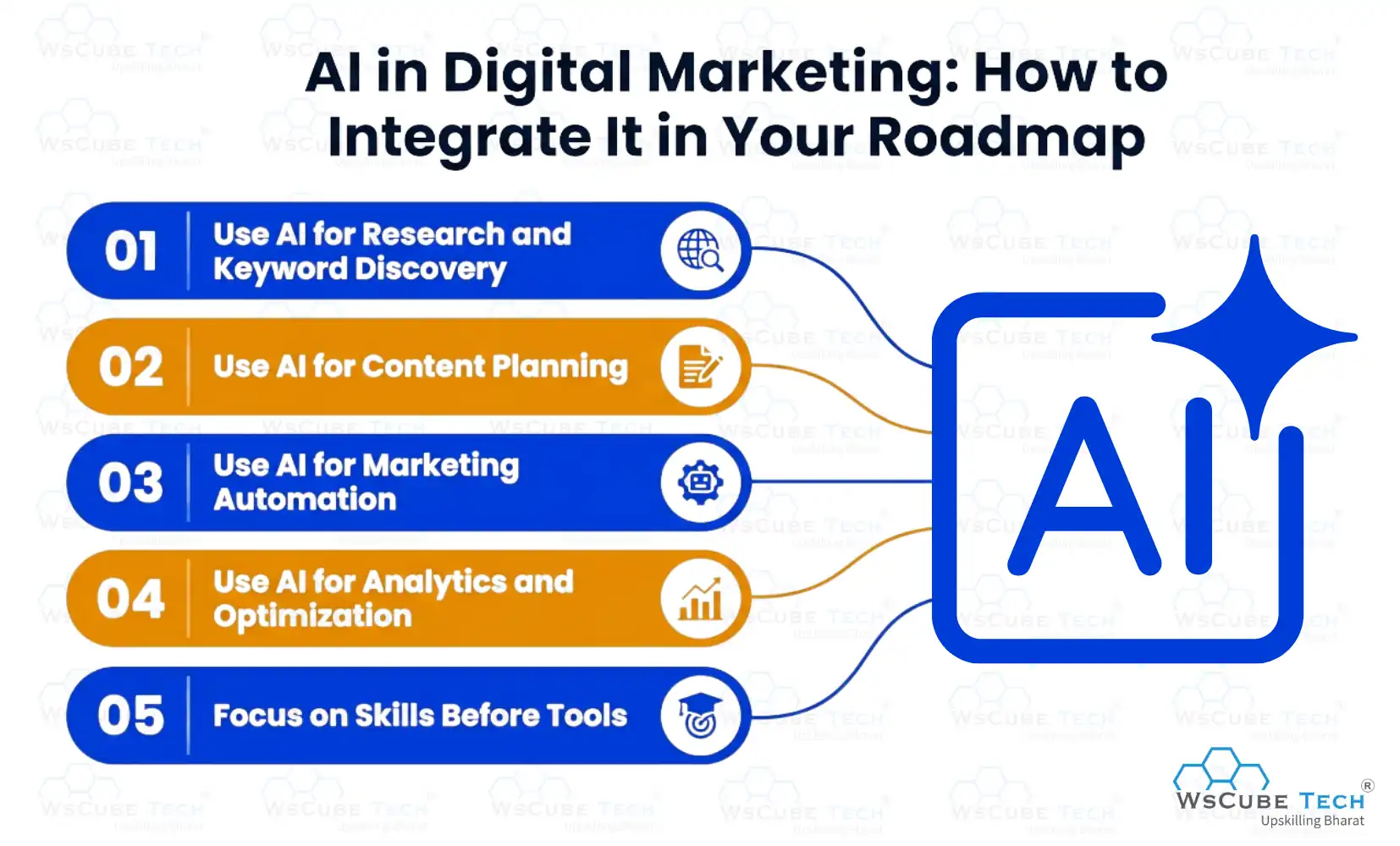
1. Use AI for Research and Keyword Discovery
AI tools can help you identify content opportunities, discover keywords, analyze competitors, and uncover trending topics. This can significantly reduce the time spent on manual research.
2. Use AI for Content Planning
Tools like ChatGPT, Claude, and Gemini can assist with:
- Creating content outlines
- Generating blog topic ideas
- Building content calendars
- Brainstorming marketing campaigns
Always review and refine AI-generated suggestions before publishing.
3. Use AI for Marketing Automation
Once you understand the basics of digital marketing, you can use AI to automate repetitive tasks such as:
- Email marketing workflows
- Customer support chatbots
- Lead nurturing sequences
- Social media scheduling
Automation saves time and allows you to focus on strategy and growth.
4. Use AI for Analytics and Optimization
AI-powered tools can help you:
- Analyze campaign performance
- Identify content gaps
- Predict trends
- Improve conversion rates
Learning how to interpret data is still essential, even when AI provides recommendations.
5. Focus on Skills Before Tools
If you're wondering how to learn digital marketing effectively, start with the fundamentals first. Learn SEO, content marketing, social media marketing, and analytics before relying heavily on AI tools.
The most successful marketers use AI as a productivity assistant while applying their own creativity, experience, and strategic thinking. AI can accelerate your progress, but your knowledge and decision-making skills remain your biggest advantage.
Common Digital Marketing Roadmap Mistakes to Avoid
One of the biggest reasons people fail to learn digital marketing is trying to learn everything at once. A successful digital marketing learning roadmap focuses on building skills step by step rather than jumping between random tutorials and trends.
Some of the most common mistakes beginners make include:
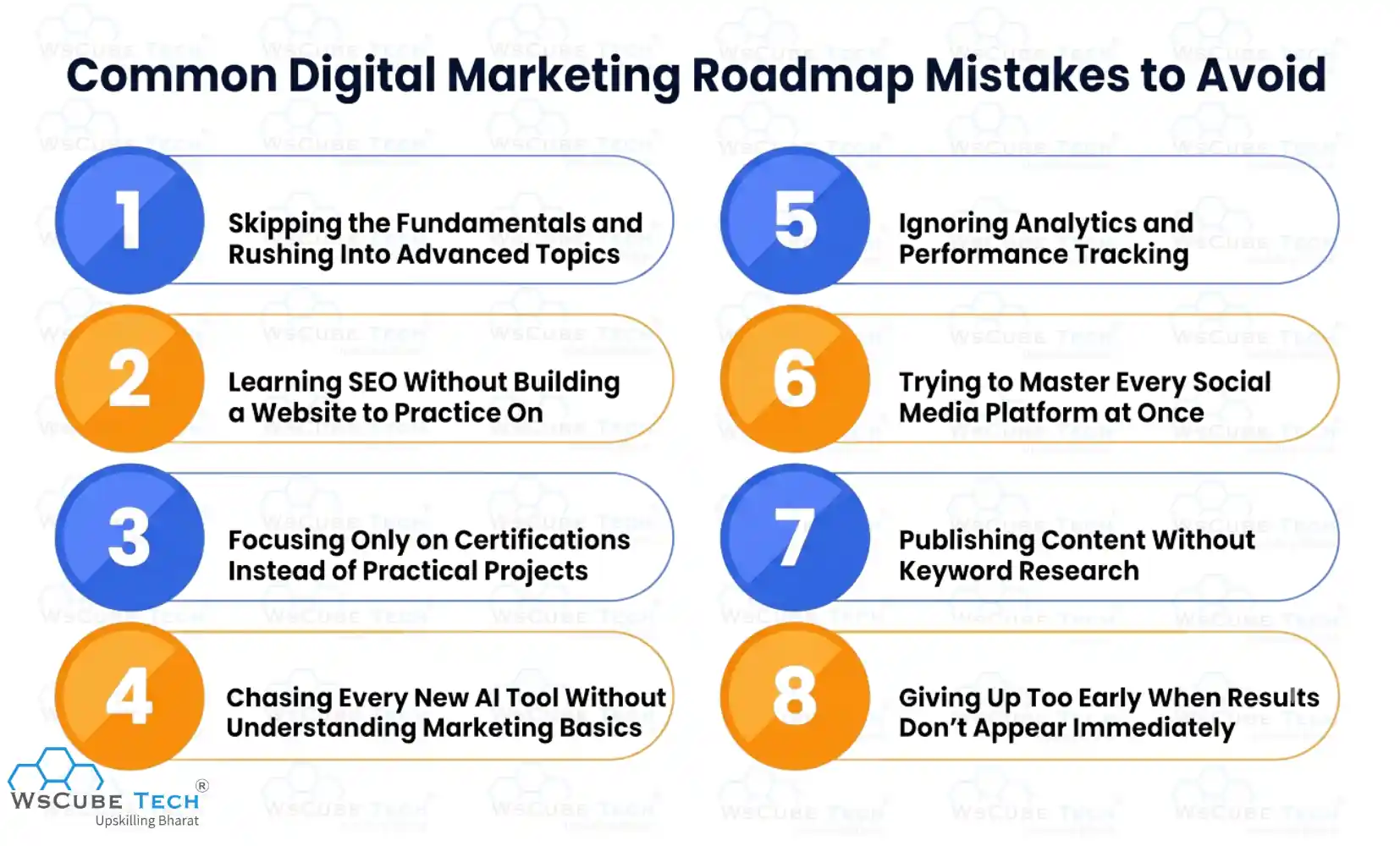
- Skipping the fundamentals and rushing into advanced topics.
- Learning SEO without building a website to practice on.
- Focusing only on certifications instead of practical projects.
- Chasing every new AI tool without understanding marketing basics.
- Ignoring analytics and performance tracking.
- Trying to master every social media platform at once.
- Publishing content without keyword research.
- Giving up too early when results don't appear immediately.
If you're wondering how to learn digital marketing effectively, the answer is consistency. Follow a structured roadmap for digital marketing, apply what you learn on real projects, and focus on building skills over time.
Always Remember: Digital marketing is a long-term skill. The marketers who succeed are usually the ones who keep learning, testing, and improving even when results are slow in the beginning.
Digital Marketing Roadmap 2026: Video Guide
FAQs about Digital Marketing Roadmap
A digital marketing roadmap is a step-by-step plan that helps you learn and implement digital marketing skills in the correct order, from SEO and content marketing to analytics, advertising, and AI-powered marketing.
Most beginners can learn the fundamentals of digital marketing within 3–6 months. However, becoming job-ready typically requires consistent practice and real-world projects over several months.
Start by understanding digital marketing fundamentals, customer journeys, content marketing, and SEO. These skills provide the foundation for everything else in digital marketing.
Yes. Businesses continue to invest heavily in online marketing, creating strong demand for SEO specialists, content marketers, social media managers, paid advertising experts, and marketing analysts.
Absolutely. Many successful digital marketers are self-taught and build their skills through online resources, certifications, practical projects, and hands-on experience.
SEO, content marketing, paid advertising, marketing analytics, and AI-powered marketing skills are among the most in-demand digital marketing specializations today.
The best approach is to follow a digital marketing roadmap for beginners, create your own website, learn SEO, publish content, and apply your knowledge through practical projects.
Google Search Console, Google Analytics 4, Google Keyword Planner, Google Trends, and Google Business Profile are some of the best free tools for beginners.
SEO focuses on ranking in search engines, AEO helps content appear in AI-generated answers, and GEO improves brand visibility across AI-powered search platforms.
No. You can learn digital marketing without AI tools, but platforms like ChatGPT, Gemini, and Claude can help speed up research, content planning, and workflow automation.
Conclusion
The best way to learn digital marketing is to follow a structured roadmap, practice consistently, and apply your skills on real projects. This digital marketing roadmap gives you a clear path from beginner to job-ready marketer without the confusion of jumping between random courses and tutorials.
If you want personalized guidance, practical projects, and one-on-one support, explore our digital marketing mentorship program and accelerate your learning journey.
Join Our On-Campus Digital Marketing Program
Explore Our Free Courses




Leave a comment
Your email address will not be published. Required fields are marked *Comments (0)
No comments yet.