Search has changed rapidly in recent years. Instead of clicking through multiple websites, users now often get direct answers from Google AI Overviews, ChatGPT, and Perplexity. As a result, answer engine optimization has become an essential part of modern digital marketing.
In this guide, you'll learn what it is, why it matters in 2026, and how to optimize your content to appear in AI-powered search results.
What Is Answer Engine Optimization?
Answer engine optimization is the practice of structuring and writing content so that AI-powered platforms, such as ChatGPT, Google AI Overviews, Perplexity, and voice assistants like Alexa and Siri, can easily find it, understand it, and use it as the source of their answers.
If someone asks what is answer engine optimization in one line, here it is: AEO is about making your content easy for machines to read, extract, and quote, not just easy for humans to rank.
This is different from traditional SEO, which mainly focuses on ranking a webpage high on the search results page. AEO focuses on getting your content picked as the actual answer, whether that answer appears as a featured snippet, a voice search response, or a citation inside an AI-generated summary.
So when someone asks what is AEO in digital marketing, the short version is this: it is the set of strategies marketers use to earn visibility inside AI answers instead of just search rankings. As more buyers research products and services through AI tools before they ever visit a website, AEO in digital marketing has become one of the most talked-about skills a content team can build.
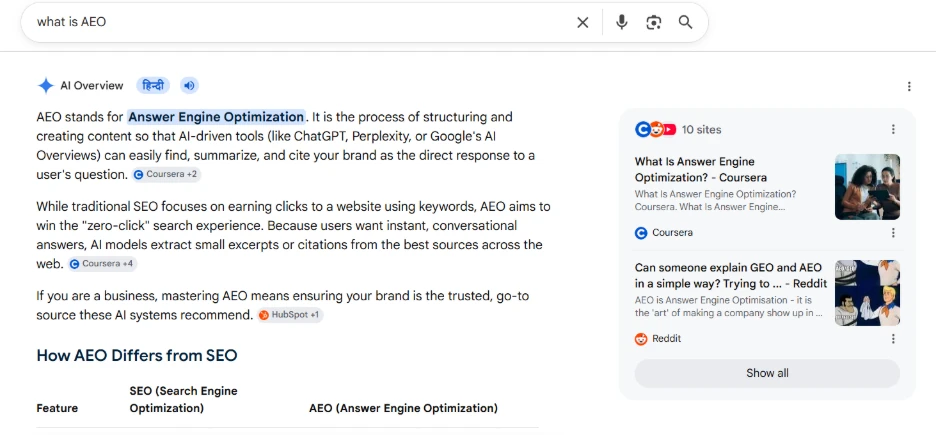
Below is an example of how the websites can appear in AI Answers.
Types of Answer Engines
Not all answer engines work the same way. Knowing the main players helps you optimize content for the platforms your audience actually uses.
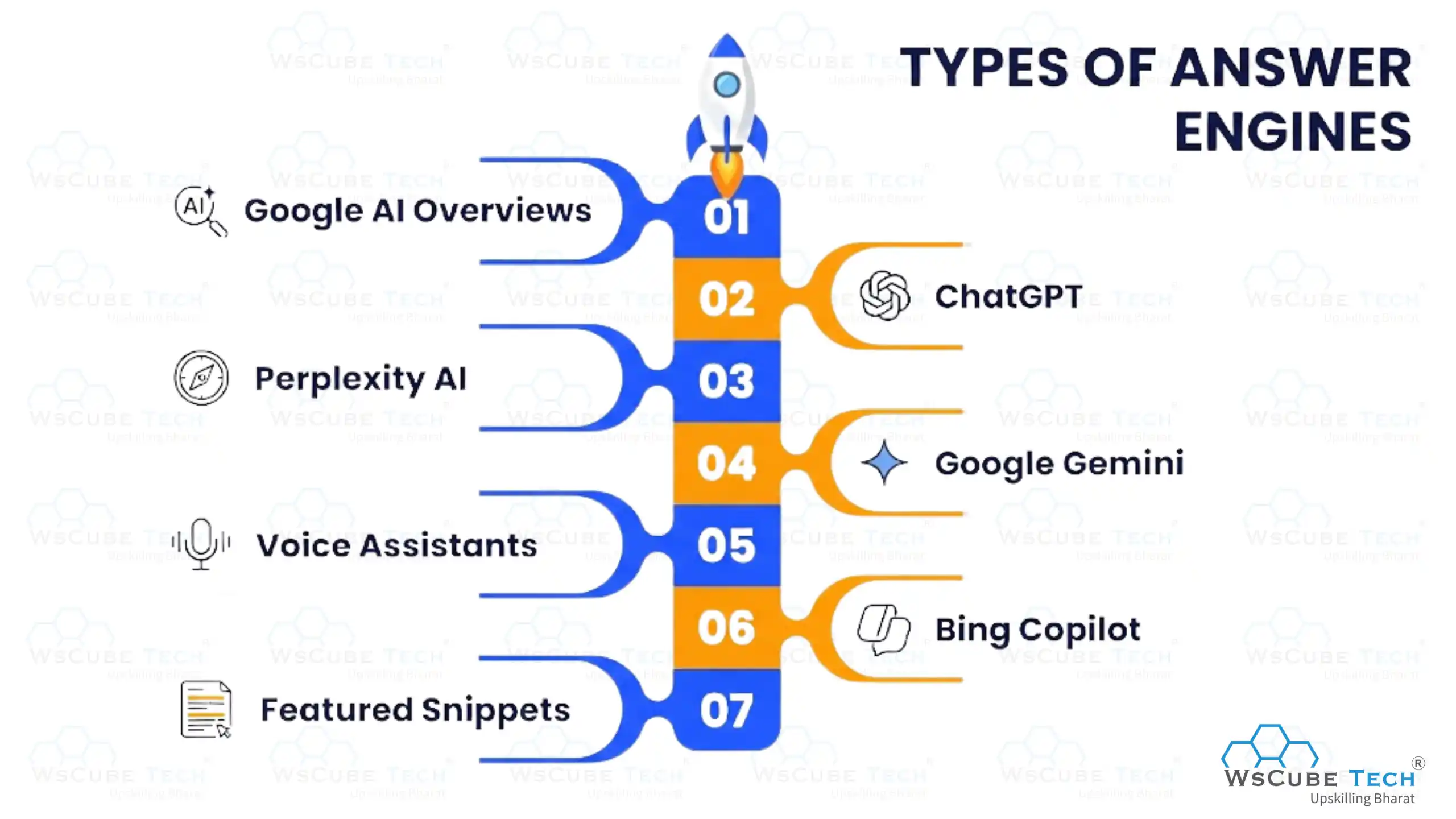
1. Google AI Overviews
Google's AI-generated summary appears above traditional search results and pulls information from multiple top-ranking pages. It answers the query directly, often reducing the need to click through to a website at all.
2. ChatGPT
OpenAI's conversational assistant answers questions using a mix of trained knowledge and, when browsing is enabled, live web results. It rarely shows source links by default, but the pages it references still shape its answers.
3. Perplexity AI
Built specifically as an answer engine, Perplexity searches the web in real time and shows clear source citations alongside every answer. This makes it one of the easier platforms to track for citation performance.
4. Google Gemini
Gemini is Google's AI assistant, integrated across Search, Workspace, and Android devices. It generates conversational answers and can cite sources, making structured, well-sourced content important for visibility here too.
5. Voice Assistants (Alexa, Siri, Google Assistant)
These assistants read out a single spoken answer, usually pulled from a featured snippet or a trusted structured data source. Since there is no screen to scan, being the one clear answer matters even more.
6. Bing Copilot
Microsoft's AI assistant, built into Bing and Edge, blends conversational answers with visible citations. It draws heavily from Bing's search index, so traditional Bing SEO still influences whether your content gets picked up.
7. Featured Snippets (Google Search)
Though not new, featured snippets remain a major answer engine format. Google pulls a short excerpt from a webpage to answer a query directly in the search results, often feeding voice assistants too.
Recommended Professional Certificates
AI-Powered Digital Marketing Course
Performance Marketing Bootcamp
SEO Specialist Bootcamp
Why AEO Matters in 2026
The numbers make it clear why AEO cannot be treated as a side project anymore.
Zero-click search, where a user gets their answer without visiting any website, has become the norm rather than the exception. Multiple industry studies now put the zero-click rate at more than 60% of all Google searches, meaning most searchers never click through to a page at all.
AI Overviews specifically have expanded fast. Google's AI Overviews reportedly reach around 2 billion monthly users across more than 200 countries, and the feature is now appearing on a large and growing share of Google searches.
This growth has a direct cost for websites that are not optimized for answer engines. Pew Research Center analyzed real browsing data from 900 US adults and found that when an AI Overview appears, people click a traditional search result only 8% of the time, compared to 15% of the time when no AI Overview is shown, roughly a 47% relative drop in clicks.
But there is a flip side to this, and it is the real reason AEO matters so much right now. Brands that do get cited inside an AI Overview are not losing out; they are gaining. Data from Seer Interactive shows that being cited inside an AI Overview earns roughly 35% more organic clicks and 91% more paid clicks compared to sitting in the top organic position below the AI answer.
This is one of the clearest benefits of answer engine optimization: it is not about fighting a losing battle against AI search; it is about becoming the source that AI search actually quotes. On top of that, traffic that does arrive from AI citations tends to convert far better than average organic traffic, since the visitor has already seen your content validated as a trustworthy answer before they even click.
How Answer Engines Actually Work
To optimize for something, it helps to understand it. So, let's look at how answer engine optimization works from the machine's side.
Answer engines like ChatGPT, Perplexity, and Google AI Overviews generally follow a similar process:
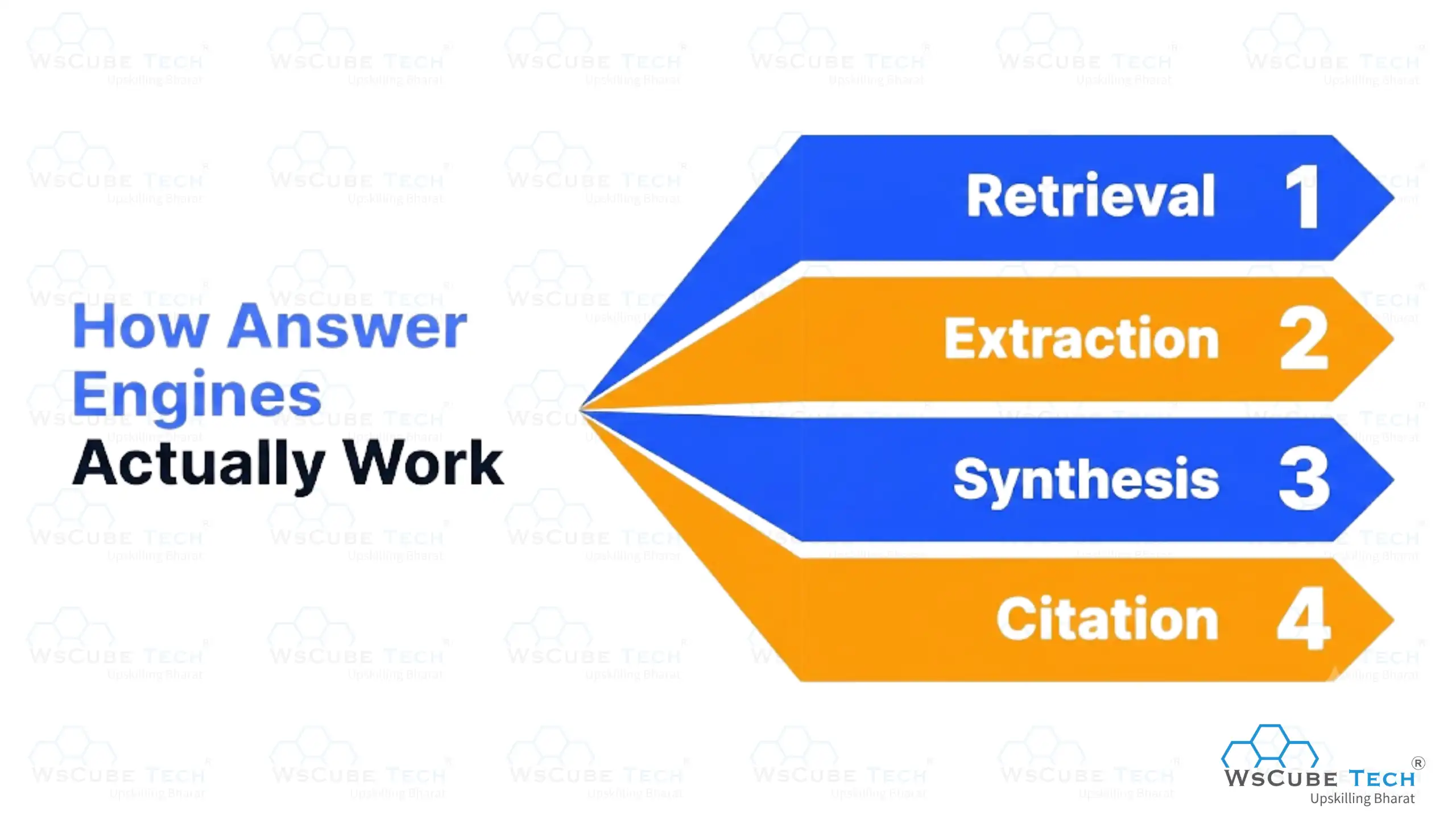
1. Retrieval:
The system searches the web (or an indexed database) for pages relevant to the user's question. Most AI Overviews pull heavily from pages that already rank in the top organic results, since these have already been judged relevant and trustworthy by traditional search algorithms.
2. Extraction:
The system scans the retrieved pages for content that directly answers the question. This is where clear formatting matters. A short, well-structured paragraph that answers a question in the first sentence is far easier to extract than a long, meandering introduction.
3. Synthesis:
The engine blends information from multiple sources into one coherent answer, often citing two or three of the strongest sources rather than just one.
4. Citation:
Some engines, like Perplexity and Google AI Overviews, show the source links. Others, like a plain ChatGPT response, may not always cite a link but are still influenced by which sources were used to generate the answer.
Freshness is a major ranking factor for AI search. According to AirOps' 2026 State of AI Search Report, most AI citations come from pages updated within the past year, with many refreshed in the last six months.
Research from Princeton, Georgia Tech, and IIT Delhi also found that adding clear statistics, expert quotes, and reliable citations can increase AI citation visibility by up to 115%, showing that consistent content updates and quality improvements make a measurable difference.
AEO vs. SEO vs. GEO: A Quick Recap
These three terms get mixed up often, so here is a simple way to tell them apart.
| Feature | SEO (Search Engine Optimization) | AEO (Answer Engine Optimization) | GEO (Generative Engine Optimization) |
| Primary Goal | Rank higher in search engine results | Become the direct answer to user queries | Get cited and referenced by AI-generated responses |
| Focus | Search rankings and organic traffic | Featured snippets, voice search, and AI answers | AI citations, trust signals, and LLM visibility |
| Optimized For | Google, Bing, and other search engines | Google AI Overviews, voice assistants, and answer engines | ChatGPT, Gemini, Perplexity, Claude, and other generative AI tools |
| Content Style | Keyword-optimized, comprehensive content | Clear, concise, question-and-answer format | Authoritative, well-cited, and evidence-backed content |
| Key Ranking Signals | Keywords, backlinks, page speed, technical SEO | Structured content, schema markup, direct answers, E-E-A-T | Statistics, expert quotes, consistent facts, freshness, and brand authority |
| Success Metric | Rankings, impressions, clicks, and organic traffic | Featured snippets, AI answers, and voice search visibility | AI citations, share of voice, and brand mentions in AI responses |
| Best Content Types | Blog posts, landing pages, category pages | FAQs, definitions, comparisons, and how-to guides | Research reports, case studies, original data, expert insights, and authoritative articles |
| Role in Modern Search | Helps pages get discovered | Helps content become the answer | Helps brands become trusted AI sources |
Key Takeaway: SEO helps users find your content, AEO helps answer engines extract your content, and GEO helps generative AI cite and trust your content. Together, they form a complete search visibility strategy for 2026.
SEO (Search Engine Optimization)
It is the original discipline. It focuses on ranking a webpage as high as possible on a traditional search results page, using tools like keyword research, backlinks, page speed, and on-page optimization. Success is measured through rankings, impressions, and clicks.
AEO (Answer Engine Optimization)
Answer Engine Optimization (AEO) focuses on structuring content so it can be selected and presented as a direct answer by search and AI platforms. This includes featured snippets, voice search responses, and concise excerpts used in AI-generated summaries.
The comparison of answer engine optimization vs SEO comes down to this: SEO wants your page to rank; AEO wants your content to be the answer.
GEO (Generative Engine Optimization)
It goes one step further. It focuses specifically on influencing which sources a large language model chooses to cite when it generates a full response, using signals like statistics, expert quotes, consistent facts across the web, and strong domain authority. When people ask about answer engine optimization vs geo, the simplest distinction is that AEO is about being extractable, and GEO is about being chosen and trusted by the AI itself when it writes its final answer.
In practice, these three overlap heavily, and most modern content strategies need all three working together. Traditional SEO still matters because most answer engines pull from the same pool of top-ranking pages. For a deeper side-by-side breakdown, check out our detailed comparison on SEO vs AEO vs GEO.
Upcoming Masterclass
Attend our live classes led by experienced and desiccated instructors of Wscube Tech.



How to Optimize Your Content for Answer Engine
Once you understand how answer engines pick up their sources, the actual writing rules become fairly straightforward. Here are the best practices for answer engine optimization that consistently show up across industry research and case studies.
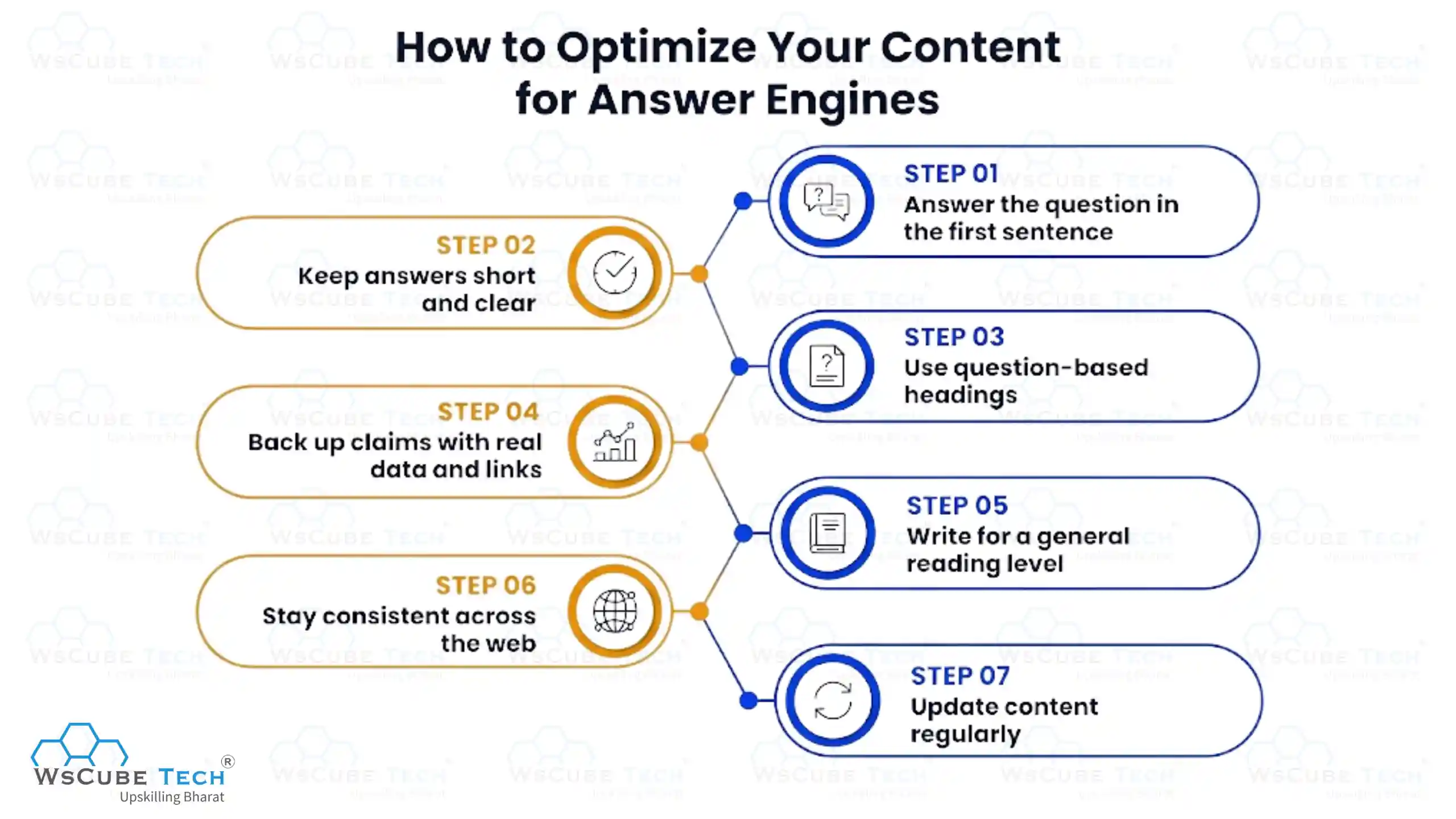
1. Answer the question in the first sentence
Do not bury the answer under three paragraphs of background. If someone asks, "what is answer engine optimization," your first sentence should answer exactly that, in plain language.
2. Keep answers short and clear
A concise 40 to 60 word answer, followed by more detail underneath, is far easier for an AI system to extract than one long, unbroken block of text.
3. Use question-based headings
Structure your content around the actual questions people ask, using natural phrasing rather than robotic keyword strings. This also matches how voice search queries are typically phrased.
4. Back up claims with real data and links
Adding statistics and attributed expert quotes was shown to boost AI citation rates significantly in the Princeton GEO study mentioned earlier. Whenever you state a number, link to where it came from.
5. Write for a general reading level
Long, complex sentences are harder for both readers and machines to parse cleanly. Aim for a level that a ninth grader could follow.
6. Stay consistent across the web
If your business, product, or claim is described differently on different pages, it weakens trust signals. Keep facts, names, and figures consistent across your website, social profiles, and third-party listings.
7. Update content regularly
As shown earlier, freshness strongly influences whether a page gets cited, especially for commercial topics.
These same answer engine optimization tips apply whether you are writing a blog post, a product page, or an FAQ section. The goal is always the same: make the answer impossible to miss.
Schema Markup for AEO
Schema markup is a type of structured code added to your webpage that helps search engines and answer engines understand exactly what your content means, not just what it says. It does not change how your page looks to a human visitor, but it gives machines extra context, which increases the odds of your content being pulled into a rich result, a voice answer, or an AI summary.
How To Schema
How-To schema structures step-by-step content, such as tutorials or guides, into a clear numbered format that machines can read easily. This is especially useful for voice assistants, which often read out instructions one step at a time.
Article Schema
Article schema tells search engines the headline, publish date, author, and main content of a blog post or news piece. This helps establish freshness and authorship, two signals that directly affect how AI systems judge the trustworthiness of a source.
Organization & Author/Person Schema
This schema type provides details about the business or the individual author behind the content, including credentials, job title, and links to verified profiles. Since E-E-A-T plays such a big role in which sources get cited, this schema type strengthens the trust signals that answer engines look for.
Beyond these four, other useful schema types include Product schema for e-commerce pages, Review schema for testimonials and ratings, Breadcrumb schema for site structure, and Local Business schema for location-based queries.
Using the right combination depends on the type of page you are optimizing, but FAQ and Article schema are usually the highest priority for a content-driven website.
Content Types That Perform Best in Answer Engines
Not every kind of content performs equally well in AI search. Some formats naturally match the way answer engines pull and present information.
Definitions
Simple, direct definitions of a term or concept are one of the easiest content types for an AI engine to extract. If your page clearly defines a term in one or two sentences near the top, it becomes an easy candidate for a direct quote.
Comparisons
Content that compares two or more options, such as "X vs Y," performs very well because AI tools are frequently asked comparison-style questions by users trying to make a decision. Structuring these with clear headings or tables makes extraction even easier.
How-To Guides
Step-by-step guides map naturally onto How-To schema and are a favorite format for voice assistants, which read instructions aloud one step at a time. Numbered steps with short, action-based sentences work best.
Decision-Stage FAQs
These are FAQs aimed at people who are close to making a decision, such as "how much does X cost" or "is X worth it." Because these queries carry high commercial intent, being cited here has a strong impact on conversions, not just visibility.
Other formats that tend to perform well include glossary pages, statistics roundups with sourced data, and checklists. All of these share the same trait: they present information in small, self-contained, easily quotable units.
Must-Know Concepts in Digital Marketing
How to Measure AEO Performance
Measuring AEO success looks different from traditional SEO tracking, since the goal is not just rankings and clicks. Here are the metrics worth watching.
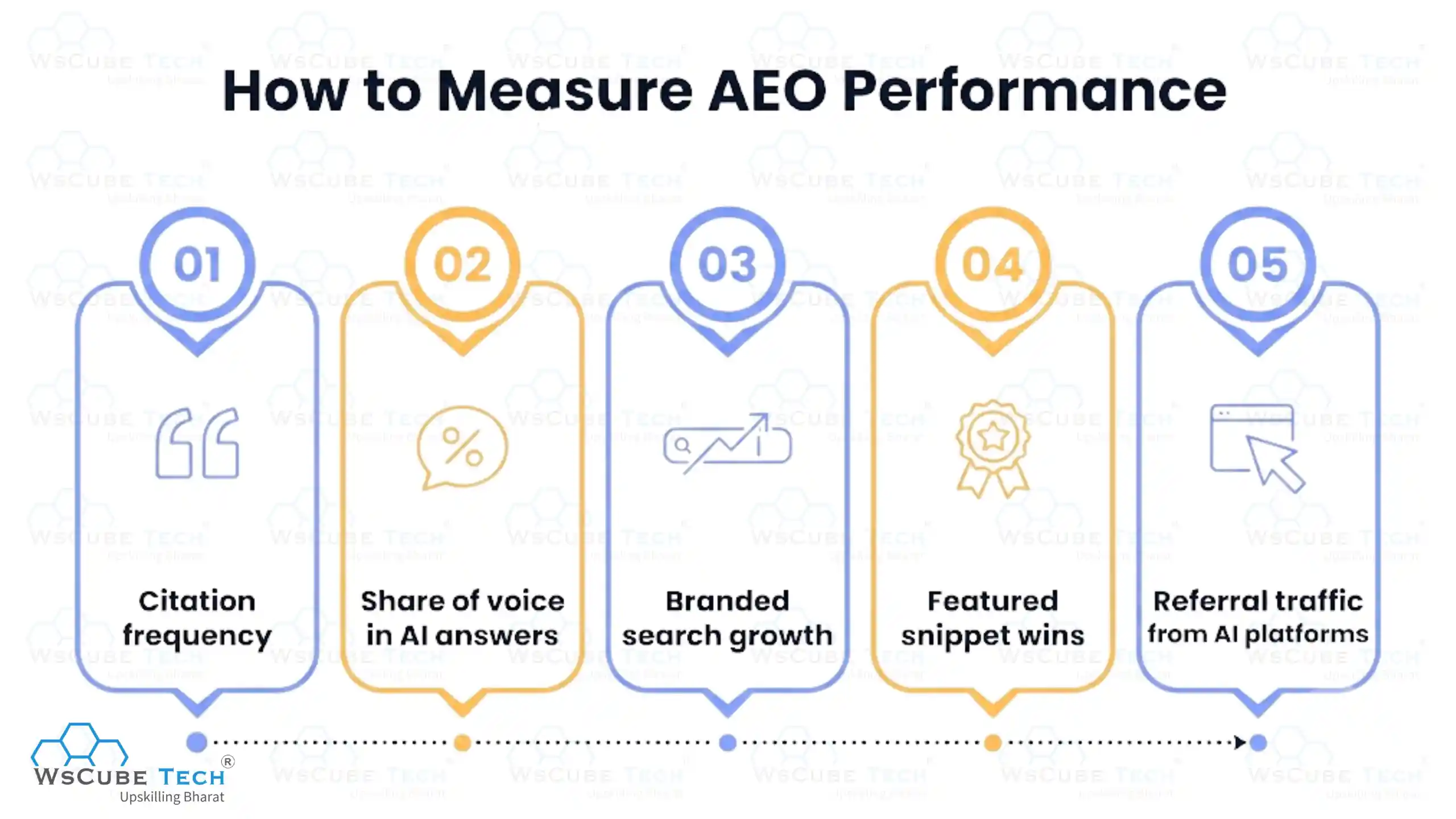
- Citation frequency: Track how often your brand or content is mentioned or linked inside AI-generated answers across tools like ChatGPT, Perplexity, and Google AI Overviews. Several tools now offer this kind of monitoring.
- Share of voice in AI answers: Compare how often you get cited for your target questions versus your competitors, for the same set of queries.
- Branded search growth: When AI tools mention your brand without linking to your site, some users still search your brand name directly afterward. A rise in branded search traffic can be a sign that AEO efforts are working, even if direct clicks stay flat.
- Featured snippet wins: Since featured snippets still feed many voice and AI answers, tracking your snippet count in tools like Ahrefs or Semrush remains relevant.
- Referral traffic from AI platforms: Google Analytics can be set up to track referral traffic coming from chat.openai.com, perplexity.ai, and similar domains, giving a rough sense of how much traffic AI tools are sending your way.
If you are looking for a simple answer engine optimization checklist to track your ongoing efforts, it should include structured content review, schema audit, freshness updates on high-value pages, citation tracking across AI platforms, and a quarterly review of which pages are earning AI visibility versus which ones are being ignored.
Some answer engine optimization statistics worth revisiting when reporting to stakeholders include the 35% organic click lift for cited brands and the 83% freshness correlation mentioned earlier in this guide, both of which help make the business case for continued investment.
Best AEO Tools for Tracking AI Visibility
As AI-powered search continues to grow, tracking your visibility across platforms like ChatGPT, Google AI Overviews, Gemini, and Perplexity has become just as important as monitoring traditional search rankings. While no single tool covers every aspect of Answer Engine Optimization (AEO), combining a few specialized platforms can give you a complete picture.
| Tool | Best For |
| Semrush | Tracks Google AI Overviews, keyword performance, and overall, SEO visibility. |
| Ahrefs | Monitors organic rankings, identifies content opportunities, and supports AI-focused content optimization. |
| Otterly.ai | Tracks brand mentions and citations across ChatGPT, Google AI Overviews, Gemini, and Perplexity. |
| Peec AI | Monitors AI search visibility, brand mentions, competitor performance, and citation trends across multiple AI platforms. |
| SE Ranking | Helps identify which brands and competitors are cited in Google AI Overviews while tracking traditional SEO metrics. |
| BrightEdge | Enterprise platform that combines SEO performance with AI citation and AI Overview tracking. |
| Conductor | Provides AI visibility insights alongside content optimization and search performance analytics. |
| Profound | Enterprise-grade AI search analytics platform for tracking brand visibility across multiple LLMs and answer engines. |
Common AEO Mistakes to Avoid
Even well-intentioned content teams run into the same traps. Here is what to watch for if you want to know how to improve answer engine optimization results over time.
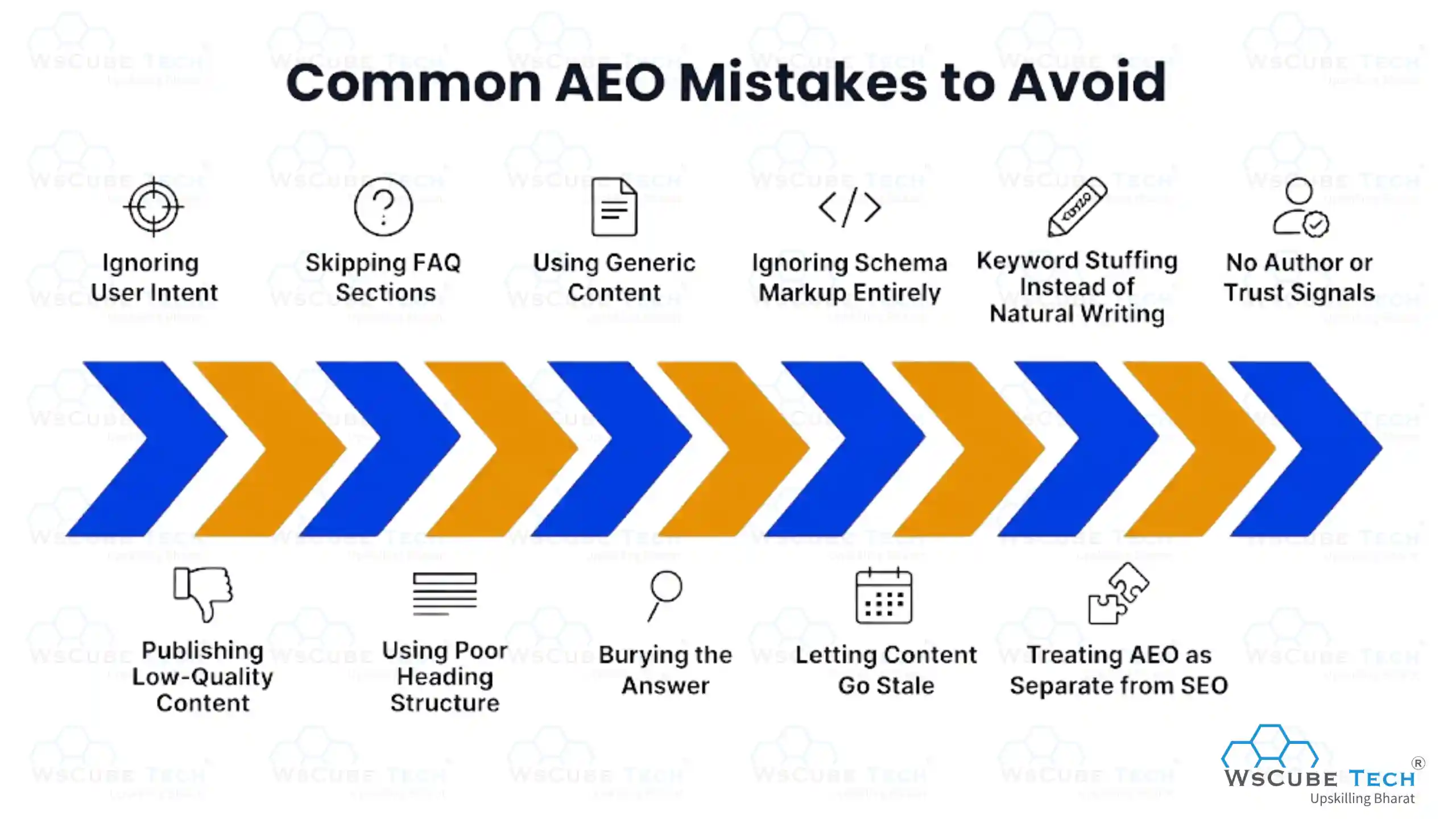
1. Ignoring User Intent
Many websites create content around keywords instead of answering the actual questions users ask. AEO works best when your content provides direct, helpful answers.
2. Publishing Low-Quality Content
Thin, outdated, or AI-generated content without human review is less likely to be trusted by answer engines.
3. Skipping FAQ Sections
Many AI tools look for question-and-answer formats. Not including FAQs means missing opportunities to appear in AI responses.
4. Using Poor Heading Structure
Unclear headings make it harder for AI to understand your content. Use logical H2 and H3 headings with descriptive titles.
5. Using Generic Content
Content that simply repeats information from other websites offers little value. Add unique insights, examples, case studies, or original data.
6. Burying the answer
Long introductions before the actual answer make it harder for AI tools to extract your content cleanly. Lead with the answer, then explain.
7. Ignoring schema markup entirely
Skipping structured data means you are relying purely on writing quality to signal meaning to machines, which is a much weaker approach.
8. Letting content go stale
Publishing once and never revisiting a page is one of the fastest ways to lose AI visibility, given how strongly freshness correlates with citation rates.
9. Keyword stuffing instead of natural writing
Answer engines are built on language models that can detect unnatural, repetitive phrasing easily. Overusing keywords can actually hurt extraction quality.
10. Treating AEO as separate from SEO
Since answer engines pull heavily from pages that already rank well organically, ignoring foundational SEO work while chasing AEO tactics rarely works.
11. No author or trust signals
Skipping author bios, credentials, and source citations weakens E-E-A-T signals, which directly reduces the odds of being selected as a trustworthy source.
Avoiding these mistakes is often more valuable than chasing the newest tactic, since answer engines are ultimately looking for the same thing SEO always rewarded: clear, trustworthy, well-organized content.
Explore Our Most Popular Marketing Courses
How to Implement an AEO Strategy
If you are wondering how to do answer engine optimization in practice, or looking for a clear path on how to implement answer engine optimization across an existing website, here is a simple starting workflow.
- Step 1: Audit your existing content. Identify pages that already rank well or get decent traffic, since these are your best candidates for AEO upgrades.
- Step 2: Restructure key pages around direct answers. Add a short, clear answer near the top of the page for your primary question, followed by supporting detail.
- Step 3: Add relevant schema markup. Start with FAQ and Article schema on your highest-priority pages, then expand from there.
- Step 4: Build out a decision-stage FAQ section. Cover the specific questions your audience asks right before they make a decision.
- Step 5: Refresh high-value content regularly. Set a quarterly review cycle for your most important pages, updating statistics, links, and examples.
- Step 6: Monitor citations and adjust. Track how often you are being cited and by which platforms, then double down on the content formats that are working.
This is also a good place to look at real answer engine optimization examples in your own industry. Search for the exact questions your customers ask inside ChatGPT or Google AI Overviews, and study which competitors are already being cited.
Reverse-engineering their structure, and then improving on it, is often the fastest way to build your own answer engine optimization strategy. If you are looking for a way to explain this shift to a wider team or client, a simple summary works well: SEO gets you found, AEO gets you quoted, and both are needed together in 2026.
Answer Engine Optimization: Video Guide
FAQs about Answer Engine Optimization
No. AEO focuses on structuring content so it can be easily extracted as a direct answer, such as a featured snippet or voice response. GEO focuses specifically on influencing which sources a large language model chooses to cite when generating a full, synthesized answer. They overlap but are not identical.
No. AEO builds on top of SEO rather than replacing it. Most answer engines pull heavily from pages that already rank well in traditional organic search, so strong SEO fundamentals remain the foundation that AEO is built on.
There is no fixed timeline, since it depends on your site's existing authority, how much content needs restructuring, and how often you update it. Many teams start noticing early citation gains within a few months of consistent schema updates and content restructuring, though full results often take longer, similar to traditional SEO timelines.
Not usually. In most cases, the same page can serve both purposes if it is structured correctly, with a clear direct answer near the top, supporting detail below, and proper schema markup. Very few teams need to maintain two completely separate content sets.
FAQ schema and Article schema are generally the highest priority for content-driven websites, since they map closely to how people ask questions in AI tools and how answer engines judge freshness and authorship. How-To schema and Organization/Author schema are also valuable, especially for instructional content and for strengthening trust signals.
Yes. Small businesses can increase visibility by creating clear, trustworthy content with structured data, helping answer engines feature their information alongside larger, established brands.
Question-based guides, FAQs, comparisons, definitions, checklists, and step-by-step tutorials perform well because answer engines can easily extract and present concise information.
Schema markup is not mandatory, but it helps search engines understand your content better, improving the chances of appearing in AI answers, rich results, and voice search.
Review important pages every three to six months. Updating statistics, examples, links, and outdated information improves freshness, increasing the likelihood of AI citations.
Yes. While some searches end without clicks, being cited by answer engines builds trust, increases brand awareness, and attracts highly qualified visitors with stronger intent.

Join Our On-Campus Digital Marketing Program
Explore Our Free Courses






Leave a comment
Your email address will not be published. Required fields are marked *Comments (0)
No comments yet.