
Search is changing faster than ever. Ranking on Google's first page is no longer the only way people discover information. Today, users also rely on AI chatbots like ChatGPT, Google AI Overviews, and voice assistants for instant answers.
This shift has introduced three important approaches: SEO vs AEO vs GEO. While they are closely related, each serves a different purpose in helping your content reach users across traditional search engines, answer engines, and AI-powered platforms.
In this guide, you'll learn how SEO, AEO, and GEO differ, how they work, and how to create a content strategy that keeps your brand visible across every major search experience in 2026.
SEO vs AEO vs GEO? Quick Comparison
Before we go deep into each concept, here is a quick side by side look at what is SEO AEO and GEO in one glance.
| Factor | SEO | AEO | GEO |
| Full form | Search Engine Optimization | Answer Engine Optimization | Generative Engine Optimization |
| Main goal | Rank higher in search results | Get picked as the direct answer | Get cited inside AI generated responses |
| Platforms | Google, Bing, Yahoo | Featured snippets, voice assistants, AI Overviews | ChatGPT, Gemini, Perplexity, Claude and more |
| Success metric | Rankings, organic traffic, clicks | Snippet wins, voice answer share | Citations, brand mentions, AI visibility |
| Content style | Keyword optimized pages | Short, direct answers | Structured, well sourced, question-based content |
This table gives you a short version. Notice how the three disciplines are not competing replacements for each other but layers that build on top of one another.
A page that ranks well through SEO has a better chance of being picked as a featured snippet through AEO, and a website that already has strong topical authority is far more likely to get cited by an AI model through GEO.
Now let us understand each concept from the ground up.
Recommended Professional Certificates
AI-Powered Digital Marketing Course
Performance Marketing Bootcamp
SEO Specialist Bootcamp
What Is SEO (Search Engine Optimization)?
SEO is the process of improving a website's rankings on search engine results pages (SERPs) so it appears higher in search results on platforms like Google when users search for relevant topics. The higher your page ranks, the more people see it, and the more organic traffic your website earns without paying for ads.
SEO has been around since the late 1990s, and it remains the base layer on which AEO and GEO are built. Even in an AI driven search world, most AI tools still rely on the same crawled and indexed web content that SEO helped create in the first place.
How Traditional SEO Works:
Traditional SEO works through a simple cycle. Search engines send out bots called crawlers that scan websites and read their content. This process is called crawling. Once a page is crawled, it gets stored in the search engine's index, which is like a massive digital library. When someone types a search query, the search engine looks through this index and ranks pages based on relevance, quality, and hundreds of other signals.
Google alone considers factors like page speed, mobile friendliness, content quality, backlinks, and user experience before deciding which pages deserve the top spots. This is why SEO is not a one-time task. It requires ongoing work in research, writing, technical fixes, and link building.
Core SEO Pillars:
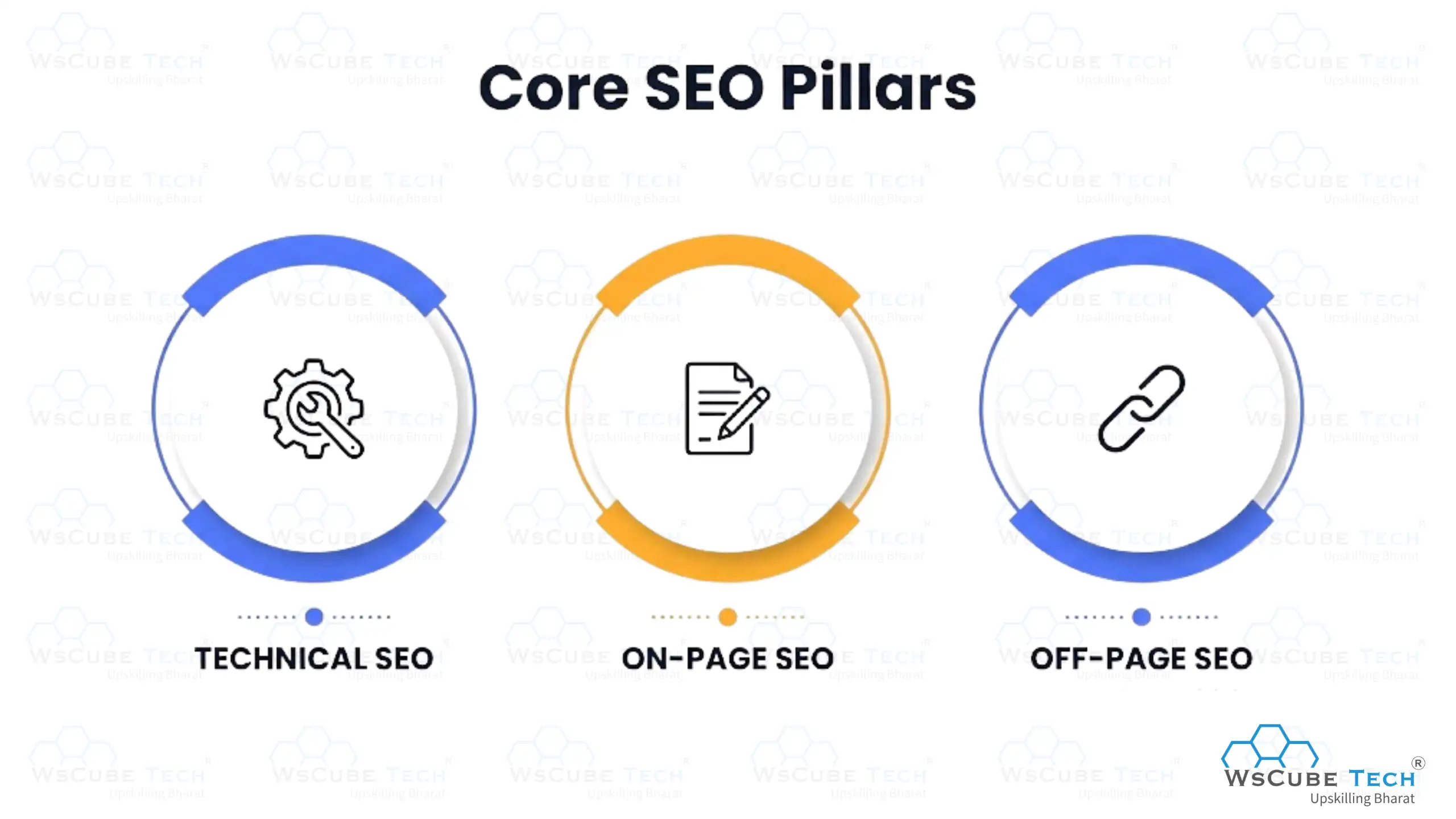
SEO stands on three main pillars. Ignoring any one of them weakens your overall search visibility, no matter how strong the other two are. Think of these pillars as legs of a table. If one leg is short, the whole thing wobbles, regardless of how solid the other legs might be.
1. Technical SEO
This covers the behind the scenes work that helps search engines crawl and understand your website properly. It includes site speed, mobile responsiveness, secure HTTPS connections, clean URL structures, XML sitemaps, and fixing broken links. Without a solid technical foundation, even the best content can struggle to rank. If you want to go deeper into this area, our guide on technical SEO covers it in detail.
2. On-Page SEO
On-page SEO focuses on what happens directly on your web pages. This includes keyword usage in titles and headings, quality content that answers user intent, internal linking, image optimization, and meta descriptions. Good on-page SEO makes it easy for both search engines and human readers to understand what a page is about.
3. Off-Page SEO
Off-page SEO involves actions taken outside your own website to build authority and trust. Backlinks from reputable sites, social media mentions, guest posting, and brand citations all fall under this pillar. Search engines treat these signals as votes of confidence from other parts of the internet.
For example, if several well-known industry websites link to your article, search engines read that as a sign your content is trustworthy and worth ranking higher, similar to how a strong reference from a respected colleague carries more weight than a random recommendation.
Upcoming Masterclass
Attend our live classes led by experienced and desiccated instructors of Wscube Tech.



What Is AEO (Answer Engine Optimization)?
AEO stands for Answer Engine Optimization. It is the practice of structuring content, so it gets picked as the direct, ready to use answer for a user's question. Instead of aiming for a ranking position, AEO aims to become the exact answer that shows up in a featured snippet, a voice search result, or a short AI generated summary.
Think of it this way. SEO gets you on the list of results. AEO gets you the one answer that a search engine reads out loud or displays right at the top, often without the user needing to click anything at all. This matters because a growing share of searches today are questions rather than plain keywords, and search engines increasingly try to resolve those questions right on the results page instead of sending the user somewhere else.
How AEO Differs from Traditional SEO:
While SEO cares about overall page ranking, AEO cares about a single, specific answer to a single, specific question. AEO content is usually shorter, more direct, and written in a question and answer format. It often uses structured data, also known as schema markup, so search engines can easily pull out the exact answer they need.
Another key difference is intent. SEO content can rank for broad or transactional keywords. AEO content works best for clear, factual questions like "what is digital marketing" or "how does SEO work," where a short, accurate answer satisfies the searcher immediately.
Where AEO Shows Up:
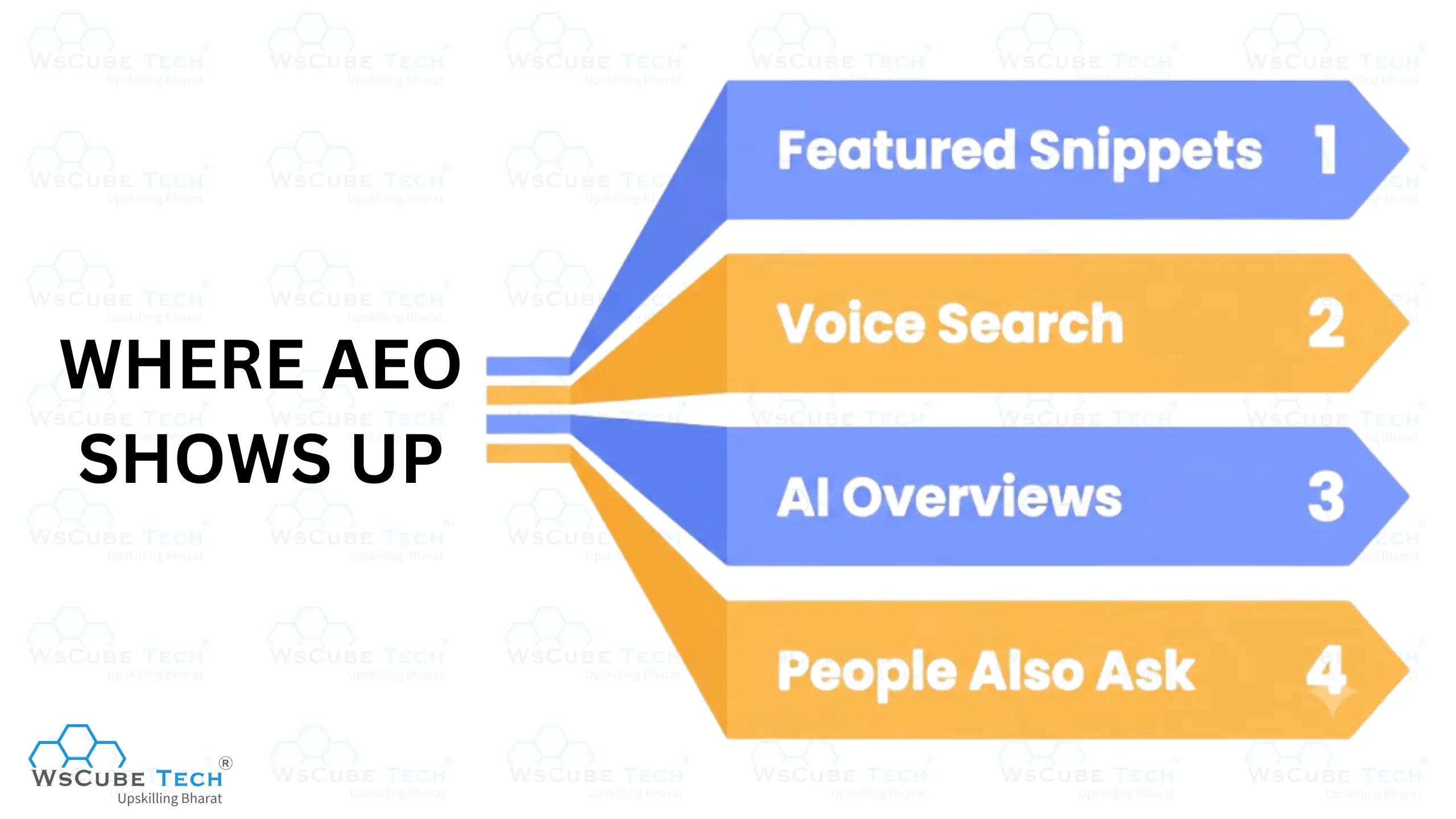
AEO appears across several search surfaces, and its reach keeps growing every year.
1. Featured Snippets
These are the highlighted answer boxes that appear at the very top of Google search results, above even the first organic listing. Winning a featured snippet often means your content gets seen first, even if your page ranks lower on the list.
2. Voice Search
When someone asks a question to Alexa, Siri, or Google Assistant, the device reads out a single answer. That answer is usually pulled from a featured snippet or a well structured piece of content. As voice assistants become more common in homes and cars, optimizing for spoken, conversational queries matters more.
3. AI Overviews
Google's AI Overviews now generate summarized answers directly on the search results page. Recent industry data shows AI Overviews now appear on roughly 48 percent of all Google search queries, a sharp rise from the year before, according to industry tracking data. This means nearly half of all searches now show an AI generated summary before any traditional blue link.
4. People Also Ask (PAA)
The People Also Ask section displays related questions directly in Google search results. When users click a question, Google expands it with a concise answer and reveals more related queries.
Content that uses clear question-and-answer formatting, descriptive headings, and direct explanations has a better chance of appearing here. Optimizing for PAA also helps you target long-tail search queries and improve your overall search visibility.
Must-Know Concepts in Digital Marketing
What Is GEO (Generative Engine Optimization)?
Generative Engine Optimization, or GEO, is the newest of the three disciplines. It focuses on getting your content cited, quoted, or referenced inside answers generated by large language models such as ChatGPT, Gemini, Perplexity, and Claude.
Unlike SEO, which aims for a ranking spot, and AEO, which aims for a single snippet, GEO aims to become a trusted source that an AI model chooses to pull from while writing its response.
GEO has become important quickly because AI chatbots are now a major part of how people search for information. ChatGPT alone had crossed 900 million weekly active users by 2026, according to industry reporting, making it one of the most used platforms in the world for research and everyday questions.
This is not a small niche audience anymore. Millions of people now ask an AI chatbot the same kind of question they once typed into Google, which means brands that are invisible to these systems risk losing an entire generation of potential visibility, even if their traditional search rankings remain strong.
1. How GEO Works with LLMs (ChatGPT, Gemini, Perplexity, AI Overviews):
Large language models like ChatGPT, Gemini, and Perplexity generate answers by combining information from multiple trusted sources instead of simply ranking web pages.
To improve your chances of being cited, create clear, well-structured content that answers questions directly, includes credible sources, uses schema markup, and covers topics comprehensively. Writing in natural, conversational language also makes your content easier for AI systems to understand and reference.
Different AI platforms retrieve information differently, but all tend to favour content that is accurate, authoritative, and easy to extract.
Because of these overlaps, brands cited inside AI Overviews tend to earn noticeably more organic clicks than brands that are left out, according to data from Seer Interactive, which shows citation, not just ranking, is becoming its own measurable advantage.
2. How GEO Differs from AEO:
AEO and GEO can feel similar because both aim to get picked instead of just ranked, but they operate differently. AEO usually targets a single, short, factual answer, often through structured snippets or voice results.
GEO targets a much broader, more conversational response where the AI model may combine information from several sources, summarize it in its own words, and sometimes credit multiple websites at once. Another difference is depth.
AEO content tends to be concise and answer focused. GEO content works better when it is comprehensive, well researched, and treats a topic from multiple angles, because AI models often synthesize longer form and more authoritative content when generating detailed answers.
Other Emerging Terms You Should Know: GSO and AIO
As AI search keeps evolving, new terms keep appearing alongside SEO, AEO, and GEO. Two you should know are GSO and AIO.
What is GSO?
GSO stands for Generative Search Optimization. It is closely related to GEO and is sometimes used interchangeably with it, but GSO specifically focuses on optimizing for AI powered search engines and hybrid search experiences, such as Google's AI Mode, where generative answers appear directly within a search engine rather than a standalone chatbot.
In practice, this means GSO sits at the crossroads of classic SEO ranking factors and GEO style citation worthiness, since Google's AI Mode still uses search infrastructure even while presenting a conversational answer.
What is AIO?
AIO stands for AI Overview Optimization, sometimes also used to mean AI Optimization more broadly. It refers to the specific practice of optimizing content to appear inside Google's AI Overviews, the summarized answer boxes that now show up on a large share of search queries.
AIO is closely tied to AEO but is focused specifically on this one growing search feature. Since AI Overviews pull from top ranking, well structured, and clearly sourced content, strong AIO practice usually means doubling down on clarity, factual accuracy, and concise summaries near the top of your page.
GSO vs AIO
| Factor | GSO | AIO |
| Focus | AI powered and hybrid search engines overall | Google's AI Overviews specifically |
| Scope | Broader, spans multiple AI search platforms | Narrower, tied to one search feature |
| Best used for | Long term AI search strategy | Short term optimization for Google's summary boxes |
Explore Our Most Popular Marketing Courses
SEO vs AEO vs GEO: Key Differences
Now that you understand each term individually, let us compare them directly. This is the part most marketers search for when they type queries like the difference between SEO AEO and GEO or SEO vs GEO vs AEO differences.
1. Goal & Intent
SEO aims to rank a webpage as high as possible for a target keyword, driving clicks and organic traffic over time. AEO aims to become the single best answer to a specific question, often winning the spot without requiring a click at all.
GEO aims to become a trusted, cited source inside a longer, AI generated response, building visibility and authority even when the user never visits your site. In short, SEO chases position, AEO chases the single answer slot, and GEO chases trust and citation inside a much longer, synthesized reply.
2. Ranking Signals Used
SEO relies on signals like backlinks, keyword relevance, page speed, mobile usability, and domain authority. AEO relies heavily on structured data, clear formatting, and content that directly matches a spoken or typed question.
GEO relies on originality, factual accuracy, citation worthy statistics, topical depth, and how easily an AI model can extract and trust your information.
3. How Success Is Measured
SEO success is usually measured through keyword rankings, organic sessions, and click through rates in tools like Google Search Console. AEO success is measured by snippet wins, voice search visibility, and appearances in People Also Ask boxes.
GEO success is measured differently, through brand mentions inside AI responses, citation frequency, and share of voice across platforms like ChatGPT and Perplexity, since traditional analytics tools often cannot track these views directly.
This is one of the biggest adjustments marketing teams are making right now, because a piece of content can be quietly performing very well inside AI conversations while showing flat numbers in a traditional analytics dashboard.
4. Content Format Requirements
SEO content works well as detailed, keyword rich articles, product pages, and landing pages built around search intent. AEO content works best in short paragraphs, bullet points, and direct question and answer formats that are easy to extract.
GEO content performs best when it combines depth with clarity, using clear headings, well cited data, and complete coverage of a topic so an AI model has enough context to summarize it accurately.
5. Best Platforms for Each Strategy
SEO is primarily focused on traditional search engines like Google and Bing, where the objective is to rank web pages for relevant keywords. AEO targets answer-focused platforms such as Google Featured Snippets, People Also Ask, Voice Search, and AI Overviews.
GEO goes a step further by optimizing content for generative AI platforms like ChatGPT, Gemini, Perplexity, Microsoft Copilot, and other AI-powered search experiences that generate conversational responses instead of displaying a list of links.
Read More Digital Marketing Career Related Guides
How to Optimize for SEO, AEO, and GEO Together
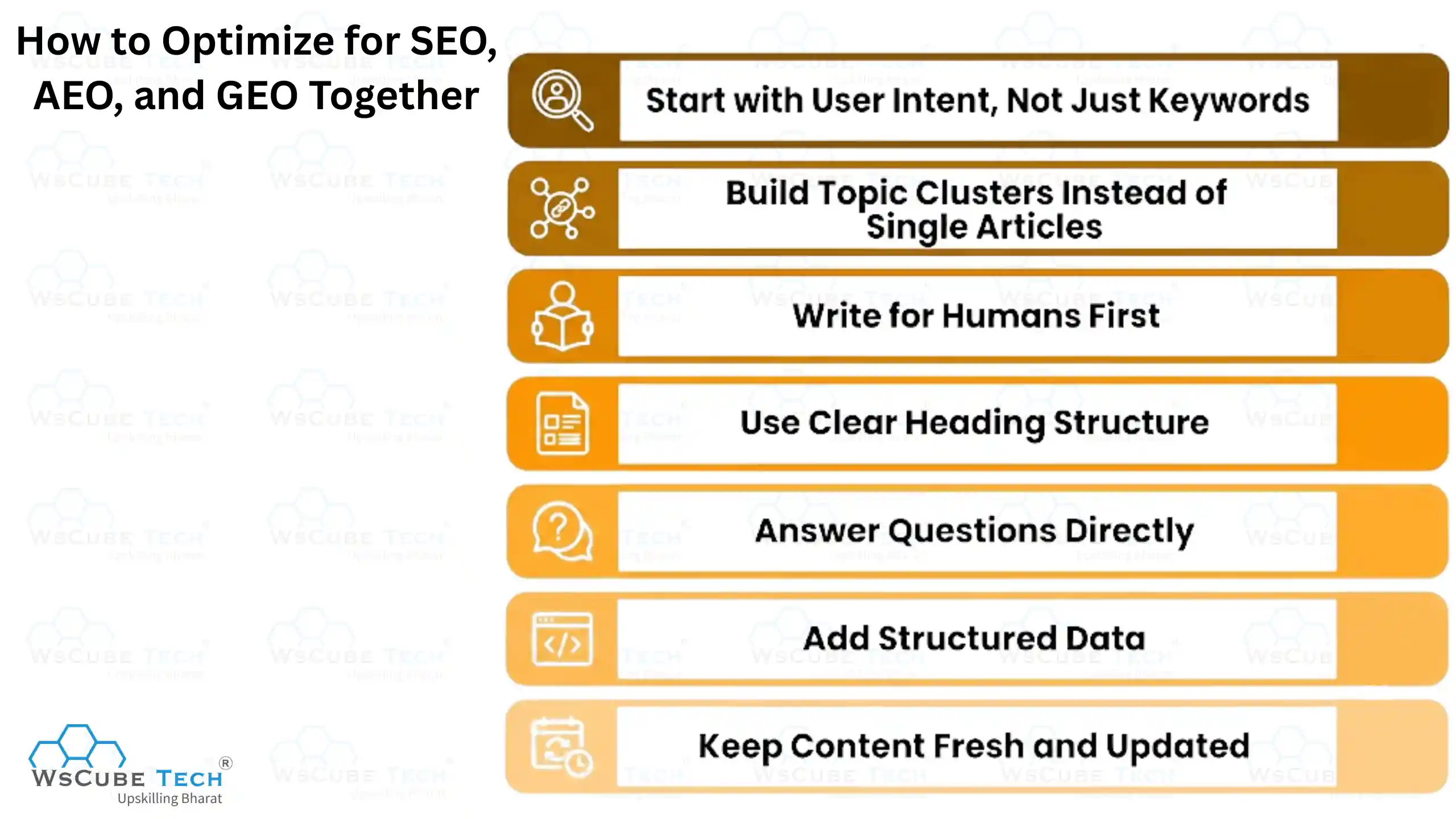
The good news is that you do not need three separate content strategies. Most of the best practices overlap, and a single well-built piece of content can perform across search engines, answer engines, and generative engines at the same time.
1. Start with User Intent, Not Just Keywords
Before writing anything, understand what the reader actually wants to know. Search engines, answer engines, and AI models are all becoming better at understanding intent, not just matching keywords. Content built around solving a real problem naturally performs better everywhere.
2. Build Topic Clusters Instead of Single Articles
Instead of writing one isolated article on a topic, build a group of related articles that link to each other and cover the subject from every angle. This approach signals topical authority to search engines and gives AI models more context to pull accurate, complete answers from your website.
For example, a single article on digital marketing basics becomes far more powerful when it links out to related guides on SEO, content marketing, and social media strategy, since this web of connected content shows both search engines and AI systems that your website has real depth on the subject, not just one surface level page.
3. Write for Humans First
Content stuffed with keywords or written only for algorithms tends to feel robotic and hard to read. Write the way you would explain something to a friend. Simple words, short sentences, and a natural tone perform well with readers and are also easier for AI systems to understand and quote correctly.
4. Use Clear Heading Structure
A logical structure of H1, H2, and H3 headings helps search engines crawl your content properly, helps AI models identify sections quickly, and helps human readers scan the page for what they need. Clear headings are one of the simplest ways to improve visibility across SEO, AEO, and GEO all at once.
5. Answer Questions Directly
Whenever your content addresses a specific question, answer it clearly within the first sentence or two of that section, then expand with more detail afterward. This format increases your chances of winning featured snippets, voice search results, and AI citations, while still giving readers who want more depth the information they need.
This one small habit, leading with the answer instead of building up to it, is often the single biggest change a content team can make to improve visibility across SEO, AEO, and GEO at the same time.
6. Add Structured Data (Schema Markup)
Structured data helps search engines understand your content more accurately. Use relevant schema types such as FAQ, Article, How-to, and Organization to improve your chances of appearing in rich results, featured snippets, and AI-powered search experiences.
7. Keep Content Fresh and Updated
Regularly review and update your articles with the latest facts, trends, examples, and statistics. Fresh content is more likely to maintain strong rankings in search engines and remain relevant for AI-generated answers.

FAQs about SEO, GEO and AEO
No. GEO is not replacing SEO; it is adding a new layer on top of it. AI models still rely on crawled and indexed web content, which means strong SEO foundations remain necessary even as GEO grows in importance.
Not entirely separately. Most SEO best practices, like clear structure, quality content, and credible sourcing, also support AEO and GEO. The main additions are structured data, direct answer formatting, and content built for AI extraction and citation.
Beginners should start with strong SEO fundamentals, since this builds the base for everything else. Once your content ranks and reads well for search engines, layering in AEO and GEO practices becomes much easier.
You can manually test this by asking tools like ChatGPT, Gemini, and Perplexity questions related to your content and checking if your brand or website gets mentioned. Some newer analytics platforms are also starting to track AI citation data directly.
They can reduce clicks for simple factual queries that get fully answered on the results page itself. However, being cited or mentioned in these answers can still build brand awareness and trust, even without a direct click, which is why measuring visibility, not just traffic, matters more now.
Start by making your existing content more citation friendly. Add clear statistics with sources, structure your pages with direct answers near the top, and cover topics comprehensively, so AI models have enough reliable context to quote you accurately.
Yes. Schema markup helps search engines and AI systems understand exactly what a piece of content is about, which makes it easier for them to pull out the right information for featured snippets, voice answers, and AI generated summaries. It will not guarantee a spot on its own, but it removes a lot of the guesswork for the systems trying to read your page.
Yes, and often more easily than in traditional SEO. Because AEO and GEO reward clear, well sourced, and genuinely helpful content rather than only domain authority and backlink volume, a smaller website with accurate, well structured information can still earn snippet wins and AI citations, even while competing against much bigger brands in the traditional rankings.
Conclusion
SEO vs AEO vs GEO is not about choosing one strategy over another. SEO builds the foundation, AEO helps your content appear in direct answers, and GEO improves visibility in AI-powered search experiences.
The best approach is to create clear, well-structured, and genuinely helpful content that performs well across search engines, voice assistants, and AI chatbots. As search continues to evolve, businesses that prioritize quality and user value will remain visible.
Join Our On-Campus Digital Marketing Program
Explore Our Free Courses






Leave a comment
Your email address will not be published. Required fields are marked *Comments (0)
No comments yet.