
Digital marketing is one of the most in-demand skills today, attracting students, job seekers, business owners, and career changers alike. But before starting, most people have the same question: how long does it take to learn digital marketing?
The answer depends on several factors, including your learning pace, the skills you want to master, and how much time you can dedicate to practice. While you can understand the basics in a few weeks, becoming job-ready or reaching a professional level takes consistent learning and hands-on experience.
What is Digital Marketing?
Digital marketing is the process of promoting products, services, or brands through online channels like search engines, social media, websites, email, and paid advertising. If you're wondering how much time does it take to learn digital marketing, understanding its core concepts is the perfect place to start.
Digital Marketing Stats: The numbers say it all. The global digital marketing market was valued at USD 456.7 billion in 2025 and is expected to reach USD 1.20 trillion by 2034, grow at a CAGR of nearly 11%. Businesses everywhere are increasing their digital budgets, and the demand for skilled marketers is rising every single year. In fact, 63% of businesses have already increased their digital marketing spending, and the trend shows no sign of slowing down.
Example: If a clothing store runs Instagram ads, publishes SEO-optimized blog posts, and sends promotional emails to customers, it is using digital marketing to attract and convert potential buyers.
What Does Learning Digital Marketing Involve?
Learning digital marketing is much more than understanding social media or running advertisements. It involves developing a combination of marketing, communication, analytical, and technical skills that help businesses attract, engage, and convert customers online.
A well-rounded digital marketer learns how different online channels work together to achieve business goals. Moreover, to learn overall what’s included in digital marketing, it’s time to check out the digital marketing course syllabus. Here are the key areas you need to understand:

1. Search Engine Optimization (SEO)
SEO focuses on improving a website's visibility in search engine results. You'll learn keyword research, on-page optimization, technical SEO, and link-building strategies to help websites rank higher on Google and attract organic traffic.
2. Content Marketing
Content is the foundation of digital marketing. This includes creating blogs, articles, videos, guides, and other valuable resources that educate, engage, and convert audiences.
3. Social Media Marketing
Social media marketing involves building brand awareness and engaging with audiences across platforms such as Instagram, Facebook, LinkedIn, X, and YouTube. You'll learn content planning, audience engagement, and platform-specific strategies.
4. Paid Advertising (PPC)
Paid advertising helps businesses generate traffic and leads quickly. Learning PPC involves understanding platforms like Google Ads and Meta Ads, audience targeting, campaign creation, budgeting, and performance optimization.
5. Email Marketing
Email remains one of the most effective digital marketing channels. You'll learn how to build subscriber lists, create campaigns, automate emails, and nurture customer relationships.
6. Analytics and Performance Tracking
Digital marketers rely on data to make decisions. Learning tools like Google Analytics and Search Console help you measure traffic, conversions, user behavior, and campaign performance.
7. Marketing Tools and Automation
Modern marketers use various tools for keyword research, content creation, campaign management, reporting, and automation. Understanding these tools can improve efficiency and productivity.
8. Practical Experience
Theory alone is not enough. The most important part of learning digital marketing is applying your knowledge through real projects, personal websites, internships, or freelance work. Practical experience helps turn concepts into skills.
Now, if you are interested in knowing How to become a digital marketer, mastering these core areas and consistently practicing them is the most effective path toward building a successful career in the field.
Recommended Professional Certificates
AI-Powered Digital Marketing Course
Performance Marketing Bootcamp
SEO Specialist Bootcamp
How Long Does It Take to Learn Digital Marketing?
The answer depends on your learning goals. Some people want to understand the basics for personal use, while others aim to build a full-time career in digital marketing. The good news is that with a structured learning approach, most people can become job-ready within 4-5 months.
1. If You Want to Learn the Basics (Timeline: 3-4 Weeks)
If your goal is simply to understand how digital marketing works, you can learn the fundamentals within a few weeks. During this stage, you'll explore topics such as SEO, content marketing, social media, paid advertising, and analytics.
By the end of this period, you'll understand the major digital marketing channels and how businesses use them to attract customers online.
2. If You Want to Become Job-Ready (Timeline: 12 weeks)
A structured 12-weeks digital marketing program is generally enough to make most learners job-ready. During this period, you'll move beyond theory and start working on practical projects, tools, campaigns, and case studies.
You'll typically learn:
- Search Engine Optimization (SEO)
- Content Marketing
- Social Media Marketing
- Google Ads and Meta Ads
- Email Marketing
- Google Analytics
- Marketing Automation
- Portfolio Development
By the end of 5 months, you should be able to confidently manage campaigns, analyze performance, and apply for entry-level digital marketing roles.
3. If You Want to Become a Professional Digital Marketer (Timeline: 15-16 weeks)
Professional-level expertise comes from applying your knowledge to real-world projects. After completing a course, marketers continue improving their skills through internships, jobs, freelance projects, and client work.
At this stage, you'll learn advanced strategies, campaign optimization, audience targeting, conversion rate optimization, and multi-channel marketing.
4. If You Want to Reach Expert Level (Timeline: 18-20 weeks)
Expert marketers develop deep specialization and extensive practical experience. They understand not only marketing channels but also business strategy, consumer behavior, automation, analytics, and emerging technologies.
Expertise is built through years of testing, learning, adapting, and managing successful campaigns across different industries.
| Learning Goal | Estimated Timeline | What You'll Achieve |
| Learn the Basics | 3 to 4 Weeks | Understand core digital marketing concepts and channels |
| Build Foundational Skills | 5-6 weeks | Gain practical exposure to major marketing platforms |
| Become Job-Ready | 12 weeks | Develop hands-on skills, projects, and a professional portfolio |
| Become a Professional Digital Marketer | 15-16 weeks | Manage campaigns independently and drive measurable results |
| Reach Expert Level | 18-20 weeks | Lead strategies, optimize growth, and specialize in advanced areas |
Key Takeaway
For most beginners, a structured 20-week digital marketing course provides enough time to build practical skills and become job-ready. Since there are generally no strict digital marketing course eligibility requirements, learners from different educational and professional backgrounds can start their journey and gradually progress from beginner to professional level.
Why Digital Marketing Learning Timelines Differ for Everyone
Two people can start learning on the same day and end up at very different places 5 months later. Here is why:
1. Time commitment:
Someone studying for four hours a day learns much faster than someone who puts in one hour a week. The total number of hours you invest in matters more than the number of months on the calendar.
2. Prior experience:
If you already understand content writing, basic design, or have run a social media page, you have a head start. Marketers from sales, PR, or journalism backgrounds often pick up concepts faster.
3. Learning method:
A structured course with mentors, assignments, and real projects will always be more effective than random YouTube videos. The quality of your learning source directly affects your speed.
4. Practice vs theory:
Digital marketing is a practical field. Reading about SEO is very different from actually optimizing a website and watching your rankings improve. People who practice alongside learning progress much faster.
5. Consistency:
Showing up every day, even for an hour, beats cramming once a week. Consistent learners build better muscle memory and retain information longer.
Upcoming Masterclass
Attend our live classes led by experienced and desiccated instructors of Wscube Tech.



What Exactly Do You Need to Learn in Digital Marketing?
Before we talk about timelines further, it helps us to know what the full curriculum looks like. Here is a broad overview of the key areas:
- Search Engine Optimization (SEO): Learning how to rank websites on Google through keyword research, on-page optimization, technical SEO, and link building. SEO is a long-game skill. Results take time to show, but the traffic you earn is free and sustainable.
- Content Marketing: Creating blog posts, videos, infographics, and other content that attracts and educates your target audience. Good content builds trust and keeps your audience coming back. The global content marketing industry is expected to reach $107 billion by 2026, which tells you just how important this skill is.
- Social Media Marketing: Managing platforms like Instagram, LinkedIn, Facebook, and YouTube to grow communities and drive engagement. Each platform has its own culture and content format, so learning one well before expanding to others is the smartest approach.
- Pay-Per-Click Advertising (PPC): Running paid campaigns on Google Ads and Meta Ads to get immediate traffic and leads. Unlike SEO, paid ads can deliver results on the same day. However, without the right knowledge, you can burn through your budget quickly.
- Email Marketing: Building email lists and sending automated campaigns that nurture leads and drive conversions. Email is still one of the highest-ROI channels in digital marketing, making it a must-learn skill regardless of your specialization.
- Web Analytics: Using tools like Google Analytics 4 and Google Search Console to measure what is working and what is not. Data is the language of digital marketing. Without analytics knowledge, you are just guessing.
- Conversion Rate Optimization (CRO): Improving landing pages and user experiences to turn more visitors into customers. This skill is about making the most of the traffic you already have by removing friction and building trust at every step.
- Marketing Automation: Using tools to automate repetitive tasks and deliver personalized messages at a scale. As businesses grow, automation becomes essential for consistent communication without increasing headcounts.
- Influencer and Affiliate Marketing: Understanding how to collaborate with content creators and partners to extend your brand's reach to new audiences.
- Personal Branding: Building your own online presence as a marketer makes you more credible and opens doors to better opportunities. Many successful marketers run their own blogs, LinkedIn profiles, or YouTube channels that demonstrate their expertise in action.
How Long Does Each Digital Marketing Skill Take to Learn?
| Skill | Basic Understanding | Hands-On Proficiency | Notes |
| SEO | 2 to 4 weeks | 3 to 4 months | Takes time to see real results |
| Content Marketing | 2 to 3 weeks | 2 to 3 months | Improves continuously with practice |
| Social Media Marketing | 1 to 2 weeks | 1 to 2 months | Platform updates frequently |
| Google Ads / PPC | 2 to 4 weeks | 3 to 4 months | Budget management adds complexity |
| Email Marketing | 1 to 2 weeks | 1 to 2 months | Straightforward to get started |
| Google Analytics 4 | 2 to 3 weeks | 2 to 3 months | Requires consistent data practice |
| Marketing Automation | 3 to 4 weeks | 4 to 5 months | Tool-dependent learning curve |
| CRO | 3 to 4 weeks | 3 to 4 months | Needs real traffic to practice |
Read More Guides on Digital Marketing
A Month-by-Month Digital Marketing Learning Roadmap
If you are wondering how many months it takes to learn digital marketing properly, this six-month digital marketing roadmap gives you a clear path. This schedule assumes two to three hours of learning per day.
Month 1: Learn the Fundamentals
Start with the big picture before diving into individual skills.
What to cover this month:
- What digital marketing is and how each channel fits together
- How the internet and search engines work
- Understanding buyer behavior and the customer journey
- Basic copywriting and communication principles
- Introduction to digital marketing tools like Google Trends, Canva, and keyword planners
By the end of Month 1, you should be able to explain digital marketing concepts clearly and understand how different strategies connect.
Recommended resources: Google Digital Garage (free), HubSpot Academy (free), and YouTube channels dedicated to marketing basics.
Month 2: Learn SEO and Content Marketing
SEO is the backbone of long-term digital marketing success. Month 2 is where things get practical.
What to cover this month:
- Keyword research using free and paid tools
- On-page SEO: title tags, meta descriptions, heading structure, internal linking
- Writing SEO-optimized blog posts and articles
- Understanding backlinks and why they matter
- Content strategy: what to write, for whom, and how often
By the end of Month 2, you should have practiced optimizing at least a few pages or posts and started to see how content ranks.
Goal: Write three to five SEO-focused blog posts and track their performance over time.
Month 3: Social Media Marketing
Social media is where brands connect with their audience in a more human and conversational way.
What to cover this month:
- How algorithms work on Instagram, Facebook, LinkedIn, and YouTube
- Creating content calendars and posting schedules
- Organic growth strategies: reels, carousels, stories, and long-form content
- Community building and engagement tactics
- Social media analytics: reach, engagement, follower growth
By the end of Month 3, you should have managed at least one social media account and run a content experiment to see what performs better.
Goal: Grow a real or practice account using organic methods and document your results.
Month 4: Paid Advertising
Paid advertising is a skill that separates good marketers from great ones. Done right, it can bring immediate and measurable results.
What to cover this month:
- Google Ads: search campaigns, display ads, keyword bidding
- Meta Ads: campaign objectives, audience targeting, ad creatives
- Understanding ad budgets, CPCs, CPMs, and ROAS
- A/B testing ads to improve performance
- Reading ad reports and optimizing based on data
By the end of Month 4, you should have run at least a small paid campaign (even with a minimal budget) and understand how to read the numbers.
Goal: Create and run a Google or Meta Ads campaign, even with INR 500 to 1000 as a test budget.
Month 5: Analytics and Tracking
You cannot improve what you do not measure. Month 5 is all about data.
What to cover this month:
- Setting up and using Google Analytics 4
- Understanding key metrics: sessions, bounce rate, conversions, traffic sources
- Google Search Console for SEO monitoring
- Setting up conversion tracking for ads
- Creating simple dashboards and reports
By the end of Month 5, you should be comfortable reading data and making decisions based on what it tells you.
Goal: Build a simple monthly report for a website or social media account using real data.
Month 6: Real Projects and Portfolio Building
Theory only takes you so far. Month 6 is about building proof of your skills.
What to cover this month:
- Take on freelance projects or help a local business
- Offer to manage social media or run a small ad campaign for free or at low cost
- Document your results with screenshots, before-after comparisons, and reports
- Build a portfolio website or LinkedIn profile that showcases your work
- Prepare for interviews (check common digital marketing interview questions to practice)
By the end of Month 6, you should have two to three real projects you can talk about in interviews. A portfolio with results is far more powerful than a certificate alone.
Explore Our Most Popular Marketing Courses
How Many Hours Per Day Should You Study Digital Marketing?
The total time needed to learn digital marketing is really a function of daily hours multiplied by consistency. Here is a realistic picture of what different time commitments look like.
Learning 1 Hour Per Day
At one hour per day, you can still learn digital marketing, but it will take longer. Expect to cover the basics in about four to 5 months and reach a job-ready level in just a few months. This pace suits working professionals who are slowly transitioning into a new career.
Learning 2 Hours Per Day
Two hours per day is a solid commitment that most people can sustain. You can reach job-ready status in four to five months and professional or high-income skills within a year. This is the recommended pace for students or those with moderate time availability.
Learning 4 Hours Per Day
At four hours per day, you will move significantly faster. Basics in one to two months, job-ready in three to four months, and professional-level in 4-5 months. This is ideal for people who have blocked out dedicated learning time.
Learning Full-Time
If you are learning eight or more hours a day through an intensive bootcamp or full-time self-study, you can become job-ready in as little as three months. However, burning out is a real risk. Build in breaks, real projects, and revision time rather than trying to absorb everything at once.
The Fastest Way to Learn Digital Marketing
If you want to learn as efficiently as possible, here is what works:
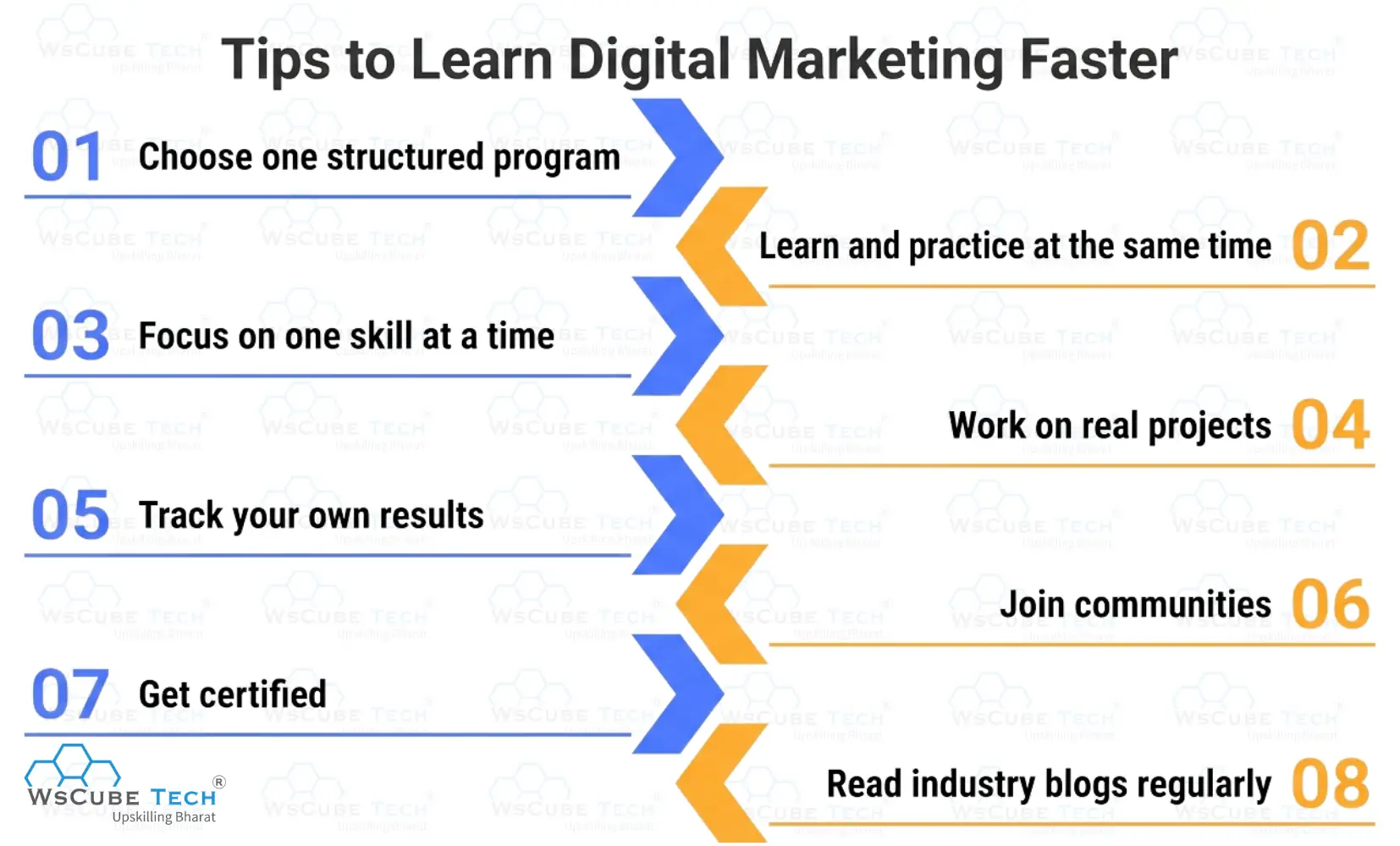
1. Choose one structured program
Jumping between random videos wastes time. Pick a good course, whether free or paid from WsCube Tech, Google Digital garage, and HubSpot academy to follow it from start to finish. A structured path gives you a clear sequence instead of random knowledge gaps.
2. Learn and practice at the same time
Do not wait until you "finish" a course before practicing. Apply what you learn on day one. Start a blog, run a tiny ad, and manage a social account. Real-world applications speed up learning dramatically. If you study SEO for a week and never try to optimize a page, most of what you learned will fade quickly.
3. Focus on one skill at a time
Trying to learn SEO, paid ads, and email marketing simultaneously leads to shallow knowledge everywhere. Go deep into one area, then expand. Think of it like learning to cook. You master one dish before you attempt the entire menu.
4. Work on real projects
Nothing replaces real experience. Offer to help a small business, a friend's startup, or your college's social media page. Real problems force you to think and solve problems in ways courses cannot. Even managing a blog with zero budget teaches you more than watching ten hours of video.
5. Track your own results
Set up a simple spreadsheet to track what you try, what works, and what does not. Marketers who document their experiments learn faster because they build a personal reference bank of what works in the real world.
6. Join communities
Groups on LinkedIn, Reddit (r/digital_marketing), and Slack are filled with working professionals sharing tips, job openings, and feedback. Surrounding yourself with marketers accelerates growth and keeps you updated on what is happening in the industry.
7. Get certified
Certifications from Google, HubSpot, and Meta do not replace skills, but they signal credibility to employers, especially when you are starting out. Google's free certifications are genuinely respected and only take a few days to complete.
8. Read industry blogs regularly
Sites like Search Engine Journal, Neil Patel's blog, Backlinko, and HubSpot's blog publish updates, case studies, and guides that keep you current. Even spending fifteen minutes a day reading industry content builds meaningful knowledge over time.
Expand Your Marketing Skills
When Do You Become Job-Ready in Digital Marketing?
You can consider yourself job-ready when you can:
- Confidently discuss two to three digital marketing skills during interviews.
- Showcase one or two real projects with measurable results.
- You can sse tools like Google Analytics, Google Ads, Meta Ads Manager, or SEMrush independently.
Most learners reach this stage within 18-20 weeks of focused learning and practice. However, employers care more about practical experience and results than the amount of time spent studying.
Being job-ready does not mean knowing everything. For entry-level positions, companies look for candidates who can learn quickly, solve problems, and demonstrate initiative through real-world work. Even a small project, such as growing a social media account or running a basic SEO campaign, can strengthen your profile.
If possible, start applying for internships and junior roles after 15 weeks of learning. The application and interview process itself help you understand industry expectations and identify areas for improvement.
Career Opportunities After Learning Digital Marketing
Once you are ready, the job market is wide open. Digital marketing salary is growing rapidly, and here is what you can realistically expect:
Entry-Level (0 to 2 years' experience):
Roles include Digital Marketing Executive, SEO Executive, Social Media Executive, and Content Writer. Freshers typically earn between INR 2.8 to 4.5 LPA, with some landing INR 5 LPA or higher if they bring a strong portfolio.
Mid-Level (2 to 5 years' experience):
Roles include SEO Specialist, Paid Media Manager, Content Strategist, and Email Marketing Manager. Salaries typically range from INR 6 to 10 LPA.
Senior Level (5 to 10 years' experience):
Roles include Digital Marketing Manager, Growth Manager, and Performance Marketing Lead. Salaries range from INR 12 to 18 LPA.
Leadership Level (10+ years):
Heads of Marketing, Chief Marketing Officers (CMOs), and Digital Strategy Directors can earn INR 20 to 40+ LPA, especially in SaaS, e-commerce, and fintech companies.
The Indian digital advertising market crossed INR 49,000 crore in FY25 and is growing at approximately 20% year on year. This growth means more companies are hiring, and digital marketing professionals who keep their skills updated have excellent long-term prospects.
Recommended Professional Certificates
AI-Powered Digital Marketing Course
Performance Marketing Bootcamp
SEO Specialist Bootcamp
Mistakes That Make Learning Digital Marketing Take Longer
Many people spend twelve to eighteen months and still feel lost. Here is why, and how to avoid it:
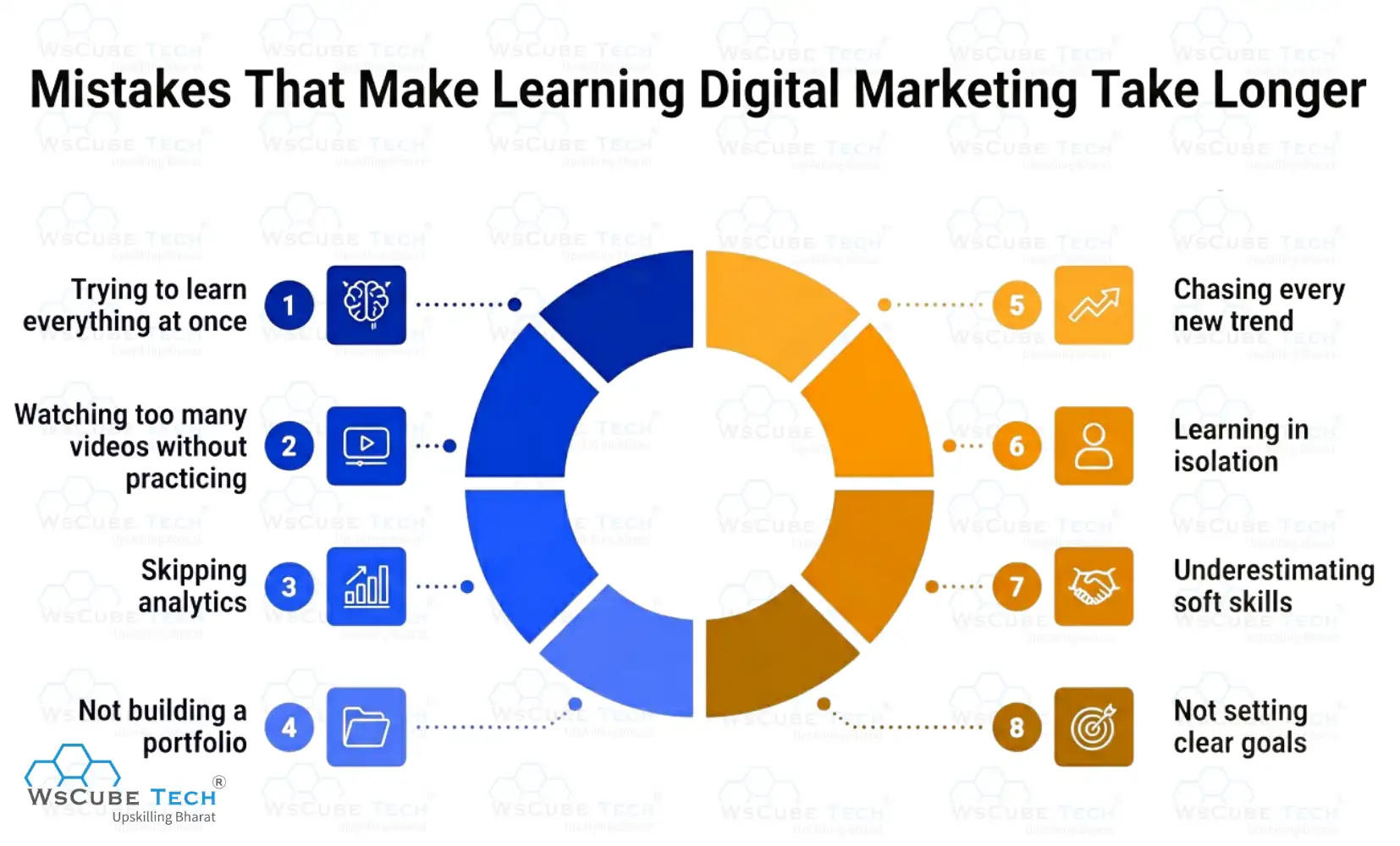
1. Trying to learn everything at once
Digital marketing has many branches. Jumping between SEO, ads, email, and social media without depth in any of them results in slow progress. Focus on one skill before moving to the next. A shallow understanding of ten skills gets you nowhere. A deep understanding of two or three opens real opportunities.
2. Watching too many videos without practicing
Consuming content feels productive, but it is not the same as learning. If you are not applying what you watch within 24 hours, much of it will be forgotten. Practice is not negotiable. Every time you learn something new, challenge yourself to apply for it that same day, even if it is just a small test.
3. Skipping analytics
Many beginners ignore the data side of marketing because it seems complicated. But analytics is what separates marketers who get results from those who just execute tasks. Learn it early. You do not need to be a data scientist. You just need to understand what the numbers are telling you about your audience and campaigns.
4. Not building a portfolio
A certificate without proof of work carries little weight in job interviews. Document your projects, show your process, and share your results. Interviewers want to see that you can deliver outcomes, not just that you attended a course.
5. Chasing every new trend
Digital marketing has new tools and trends that appear every week. Beginners who chase every shiny object end up knowing a little about everything and a lot about nothing. Master the fundamentals first. The principles of good marketing have not changed much. What changes is the platform or tool used to execute them.
6. Learning in isolation
Marketing is about communication and strategy. Learning without feedback from mentors or a community means you make the same mistakes longer. Join groups, get feedback, and share your work.
7. Underestimating soft skills
Great digital marketing is not just about running ads or writing content. It requires clear communication, storytelling, empathy for your audience, and the ability to think strategically. Many learners focus so much on tools that they forget to develop the thinking behind them.
8. Not setting clear goals
Learning digital marketing "in general" is a recipe for a scattered experience. Set specific goals: "I want to become an SEO specialist" or "I want to run profitable Meta Ads." A clear goal shapes your learning path and keeps you from going in circles.
How AI is Changing the Digital Marketing Learning Curve in 2026
Artificial intelligence is reshaping how marketing is done and how it is learned. Here is what every aspiring digital marketer needs to know in 2026:
- AI tools speed up execution. Tools like ChatGPT, Jasper, and Gemini can write content drafts, brainstorm keywords, suggest ad copy, and summarize analytics data in seconds. Marketers who know how to use these tools work dramatically faster.
- AI does not replace strategic thinking. Knowing what to create, who to target, and how to position a brand still requires a human brain. AI is a tool, not a replacement strategy. The marketers who do their best are those who use AI for efficiency and apply their own thinking for direction.
- Prompt engineering is a new skill. Writing effective prompts to get quality output from AI models is becoming a valuable marketing skill. It is worth spending a few hours learning the basics.
- Data analysis is getting easier. AI-powered dashboards and tools like Google Analytics 4's AI-assisted insights make it easier to understand data without deep technical knowledge. However, you still need to understand what the data means.
- The learning curve is shrinking but not disappearing. AI handles more of the repetitive work, which means you can learn and test faster. But the fundamentals of marketing, understanding your audience, crafting messages, and driving conversions still take time to develop properly.
According to a survey, 67% of small business owners already use AI for content marketing and SEO, so knowing how to work alongside these tools is no longer optional.
The benefits of digital marketing as a career are growing precisely because AI is making it more powerful, not less relevant.
Frequently Asked Questions
Yes, absolutely. Digital marketing is one of the few fields where what you can do matters far more than where you studied. Many of the best marketers are self-taught. Free resources from Google, HubSpot, and Meta are genuinely high-quality and cover everything you need to get started.
Digital marketing is not technically difficult, but it does require consistent effort, curiosity, and a willingness to experiment with. The creative and analytical mix can take time to balance, but most people with basic internet literacy can learn it. So, it’s an honest answer to, is digital marketing hard to learn.
No. You do not need to know how to code. A basic understanding of how websites work helps, but you do not need to write HTML or CSS to succeed in most digital marketing roles.
Start with SEO and content marketing. These skills build the foundation for everything else. They teach you how people search and what kind of content attracts attention, which makes every other marketing channel easier to understand.
One month is enough to understand the basics, but not enough to be job-ready or professional. Think of the first month as your orientation phase, where you get comfortable with the landscape.
Google Digital Garage's "Fundamentals of Digital Marketing" is one of the best free certifications available. HubSpot Academy also offers excellent free courses on content marketing, email marketing, and inbound strategy.
Freelancing successfully typically requires three to 5 months of learning plus a small portfolio. Clients hire based on results, so focus on getting one or two small projects done well before pitching your services.
Conclusion
So, how long does it take to learn digital marketing? The answer depends on your goals. Most learners can understand the basics in 1–3 months, become job-ready in 3–5 months, and reach a professional level within 6 months through consistent practice.
The key is not just learning theory but applying your skills through real projects, campaigns, and portfolio building. Whether you choose a structured digital marketing course or a self-paced learning path, consistency and hands-on experience will determine your progress.
Join Our On-Campus Digital Marketing Program
Explore Our Free Courses




Leave a comment
Your email address will not be published. Required fields are marked *Comments (0)
No comments yet.