
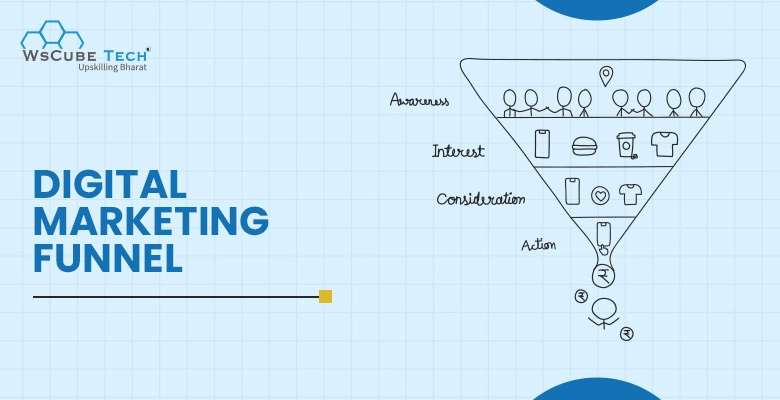
Ever wondered how brands turn complete strangers into loyal customers, all through a screen? The answer lies in the digital marketing funnel, a framework that maps every step a buyer takes, from first hearing about your brand to making a purchase and coming back for more.
Whether you're a business owner trying to boost sales or a marketer looking to sharpen your strategy, understanding this funnel changes how you approach every campaign.
In this blog, we'll break down what a digital marketing funnel is, why it matters, the different types, and exactly how to build one that works.
Want to go deeper? A structured digital marketing course can help you master these strategies from scratch.
What is Funnel in Digital Marketing?
A digital marketing funnel visually represents the journey a customer takes before purchasing a product or service online. It helps businesses understand how potential buyers move from discovering a brand to finally making a purchase.
The funnel applies to digital marketing channels like organic search, social media, email, and paid ads, tracking how a buyer interacts with your brand at every touchpoint.
Stages of the Digital Marketing Funnel
Here are all the 4 stages of digital marketing funnels with a real-life example.
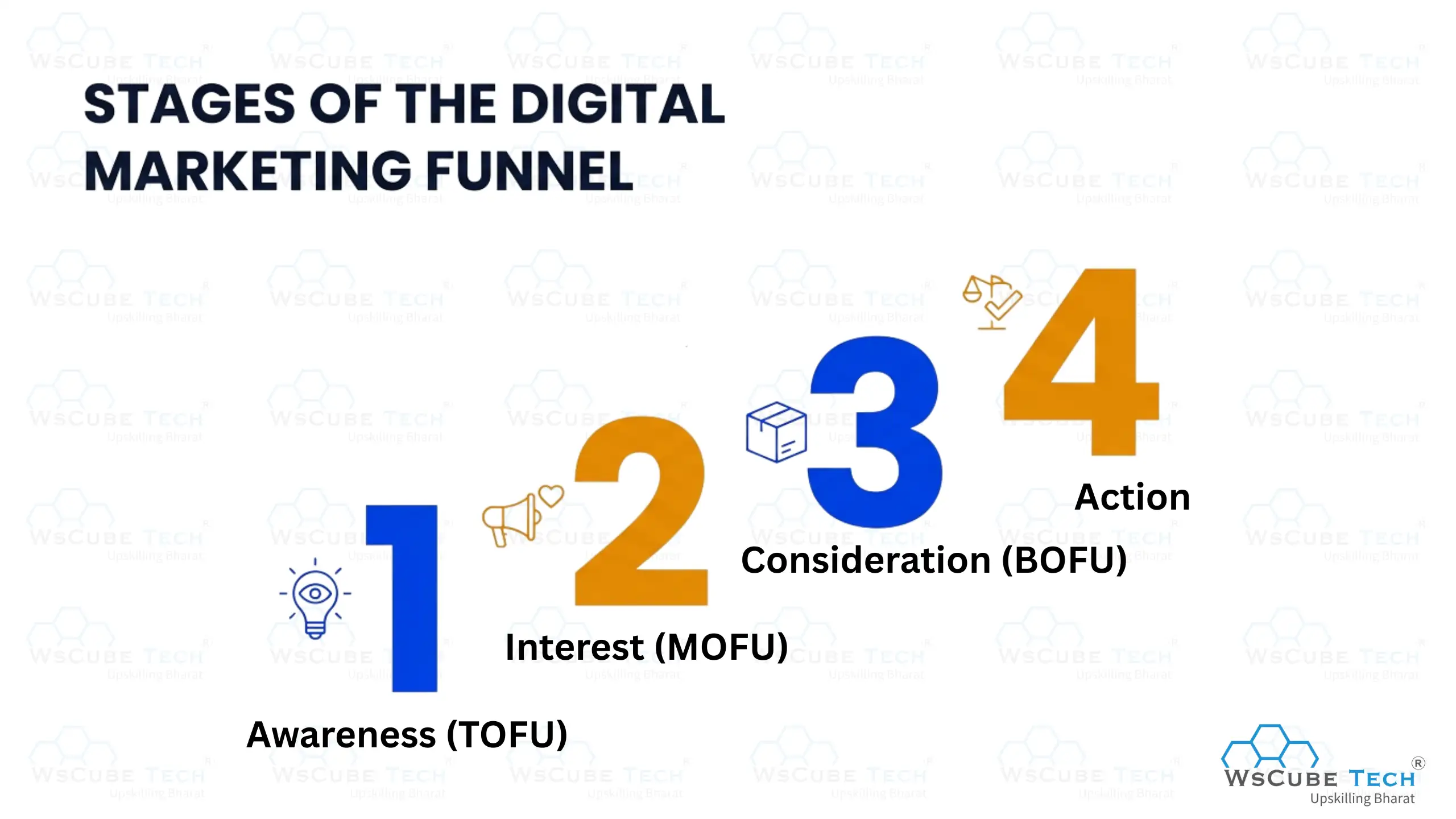
1. Awareness (TOFU)
The buyer discovers your business through organic search, social media, email, or referral links. This is the broadest part of the funnel where first impressions are made.
2. Interest (MOFU)
The buyer starts exploring your brand's offerings through your website content or social media pages, showing early signs of curiosity.
3. Consideration (BOFU)
The buyer goes deeper, watching your YouTube videos, reading customer reviews, and subscribing to your email newsletter to evaluate if you are the right fit.
4. Action
The buyer makes a purchase. But this is not the end. Smart marketers focus on post-sale experiences, through great customer service and consistent brand communication, to turn one-time buyers into loyal, returning customers.
Enroll in an online digital marketing course and get hired by top MNCs.
Real-World Example: Zomato
Zomato is a great example of a brand that runs its digital marketing funnel exceptionally well.
At the top of the funnel (TOFU), Zomato grabs attention through witty social media posts, memes, and push notifications that spark curiosity and keep the brand top of mind, without pushing a sale yet.
At the mid-funnel (MOFU), Zomato engages users through personalized restaurant recommendations, curated food collections, and user reviews inside the app, helping buyers explore options that match their taste and budget.
At the bottom of the funnel (BOFU), Zomato converts with time-limited offers, Zomato Gold membership discounts, and easy one-tap ordering that removes all friction from the purchase decision.
Post-purchase, Zomato keeps users coming back through loyalty rewards, order tracking updates, and re-engagement notifications, closing the loop and building long-term retention.
By understanding your funnel this way, you can guide your audience from just scrolling past to actively choosing your brand, every single time.
Recommended Professional Certificates
AI-Powered Digital Marketing Course
Performance Marketing Bootcamp
SEO Specialist Bootcamp
Types of Funnels in Digital Marketing
Here are the standard types of digital marketing funnel:
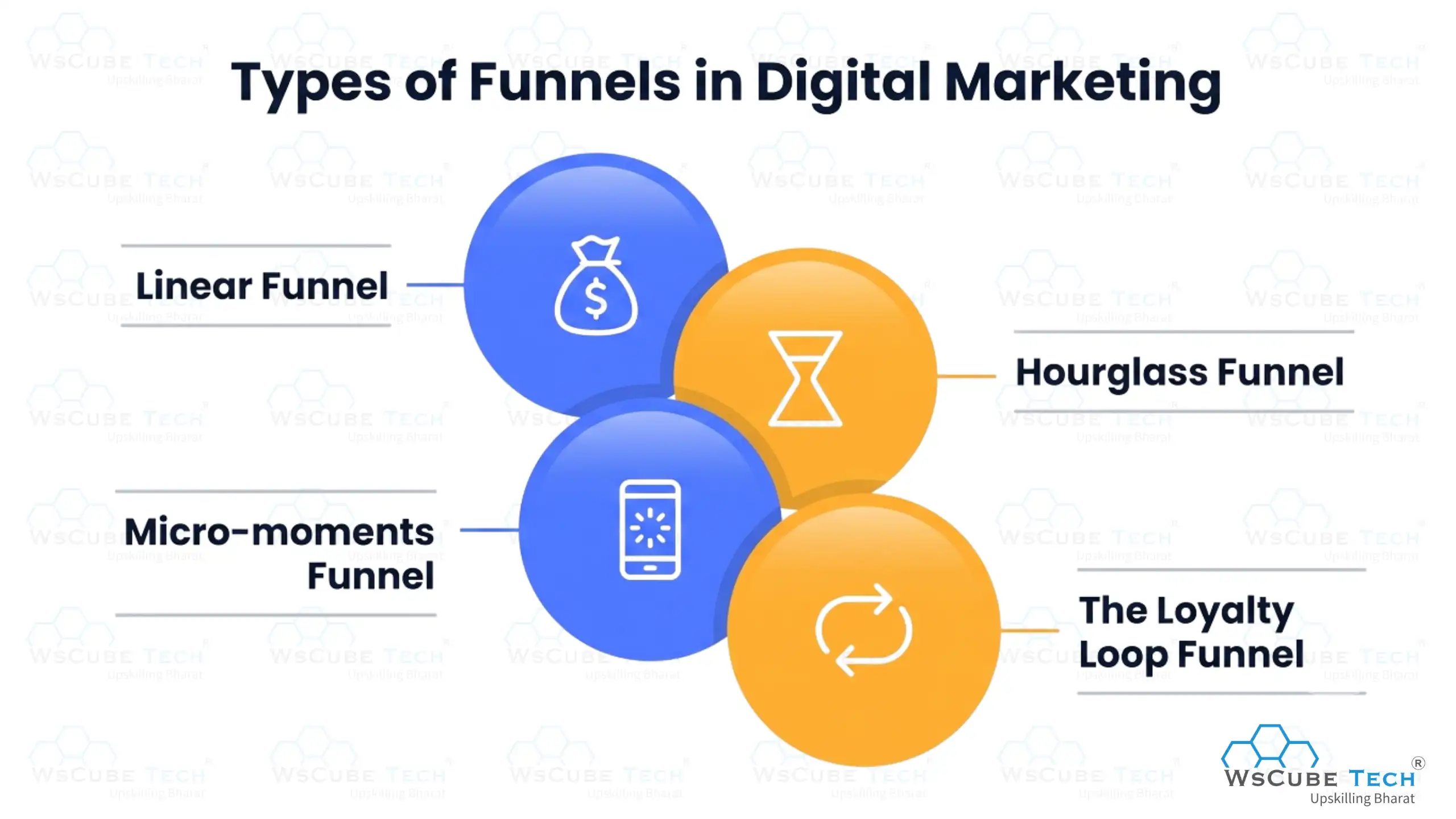
1. Linear Funnel
Linear marketing funnels, strategically designed to conform to the typical top, middle, and bottom funnel path, are like an inverted pyramid. The stages in a linear digital marketing funnel look like:
a) Exposure
In the beginning, introduce your brand to your prospects either by using social media, SEO, or advertising in order to make that vital first impression and draw their attention.
b) Discovery
Later, engage the spectators' curiosity with compelling content demonstrating your brand’s value and advantages.
c) Consideration
Provide clear and persuasive details and comparison highlights about your product/ services. This will make your brand’s name linger in the minds of your potential customers.
d) Conversion
Using call-to-action, you simplify customers' decision-making process and offer them an easy purchasing experience.
e) Customer Relationship
After the conversion, keep the relationship with the customers. Use surveys about their experience or offer personalized deals to keep them engaged.
f) Retention
By encouraging customers to repeat their engagement, you earn their loyalty. Include exclusive content, VIP deals, etc., that keep the customer's interest in your buyer’s retention strategy. It also shows that you care for your customers and their experiences, which all customers love.
2. Hourglass Funnel
Hourglass funnels, with a strong focus on customer engagement, take it a step further. Once the buyer decides to purchase the product, their interaction must expand. This digital marketing process includes adopting the product into their lives, using it consistently, cultivating brand loyalty, and referring it to others. The stages in an hourglass digital marketing funnel look like:
a) Engagement
Try to grab customer’s attention through compelling content, ads, or interactions.
b) Education
Offer valuable information so customers can learn about the solutions to their problems.
c) Research
This is the stage where buyers research your products/services in depth to learn how they can be beneficial.
d) Evaluation
Consumers compare your brand with competitors, trying to find and select the best.
e) Justification
Customers concentrate on advantages and disadvantages at this step and question whether to buy.
f) Purchase
This is the point where the transaction happens, and the buyer officially chooses your product/service, willing to buy.
g) Adoption
Here, the customer acquires your product/service and is about to experience its actual value, an ultimate quality test your brand offers.
h) Retention
If the buyer is satisfied with your product/service, you can have them return and offer them more, which helps build a good relationship.
i) Expansion
Here, you offer your brand’s other products/services to happy customers; they are likely willing to try more, thereby boosting customer loyalty.
j) Advocacy
With loyal customers eager about your brand and willing to suggest it to their family or friends. After this stage, you must focus on not losing these customers.
3. Micro-moments Funnel
This configuration is less of a funnel and more of a series of customer-driven feelings that occur in no set order. These non-linear moments usually break down into:
a) I want to know
This is when a buyer searches for a particular information and wishes to get answers to their queries.
b) I want to do
These are the moments when customers seek a solution for a specific issue.
c) I want to go
Customers here look for a piece of certain information about somewhere they wish to go; it could be a local firm they are interested in.
d) I want to buy
This is where the buyer is interested in purchasing.
4. The Loyalty Loop Funnel
Again, this is less of a funnel-shaped configuration. The customer gets news that a brand is a possible option. The feeling and the trigger incentivize the consumer to decide on the available options and start evaluating them. The consumer focuses on collecting information and comparing the options.
Once the customer has the knowledge and has compared the options to their satisfaction, they buy the product. But here’s where the loop comes in: the consumers’ post-purchase experiences determine whether they will return and purchase more or look for alternatives.
The stages in a loyalty loop digital marketing funnel look like:
a) Consider
Customers' journey begins by considering brands for the products/services they wish to purchase.
b) Evaluate
On finding a couple of brands they are thinking of purchasing from them, they research them or rely on recommendations from family, friends, or reviews.
c) Buy
Once they evaluate the brand, customers will make a purchase decision.
d) Enjoy
If the customer enjoys a positive experience with the brand, they are more likely to experience it again.
e) Advocate
As a result of an enjoyable experience, the buyer is more likely to advocate for the brand to their friends and families, give positive reviews, or even make a repeat purchase.
f) Bond
If all continues to be positive, the customer will likely bond and trust the brand.
Upcoming Masterclass
Attend our live classes led by experienced and desiccated instructors of Wscube Tech.




New vs. Old Digital Marketing Funnel
Let’s see a quick comparison of the new vs. old digital marketing funnel:
| New Funnel in Digital Marketing | Old Funnel in Digital Marketing |
| Concentrates on a non-linear experience | Concentrates on a linear experience |
| Focuses more on consumer behavior at each stage in-depth. | Focuses on overall funnel layers. |
| Thinks about the behaviors driving a user | Thinks about universal user behaviors |
Overall, the new funnel of digital marketing aims more at every user compared to the old one. While moving towards a non-linear journey poses more of a challenge to a business, it lets your firm offer a better experience to your target audience.
Sales Funnel vs. Marketing Funnel
There is a common misconception that the terms marketing funnel and sales funnel are interchangeable or can be combined into a single term: the marketing sales funnel. However, they are two distinct parts of a whole, each with its unique role and purpose.
A firm or an organization's marketing and sales functions have digital marketing objectives, and their respective funnels support those goals. The marketing function creates and manages a brand, generates awareness, and drives sales-qualified leads. In contrast, the sales function aims to boost products/services sold, initially and repeatedly.
Using one to inform another helps teams stay in sync with each other and create an optimal consumer experience. Join the expert-led digital marketing course and skyrocket your career today!
Expand Your Marketing Skills
Why is the digital marketing funnel important?
The digital marketing funnel is advantageous to businesses in the following ways:
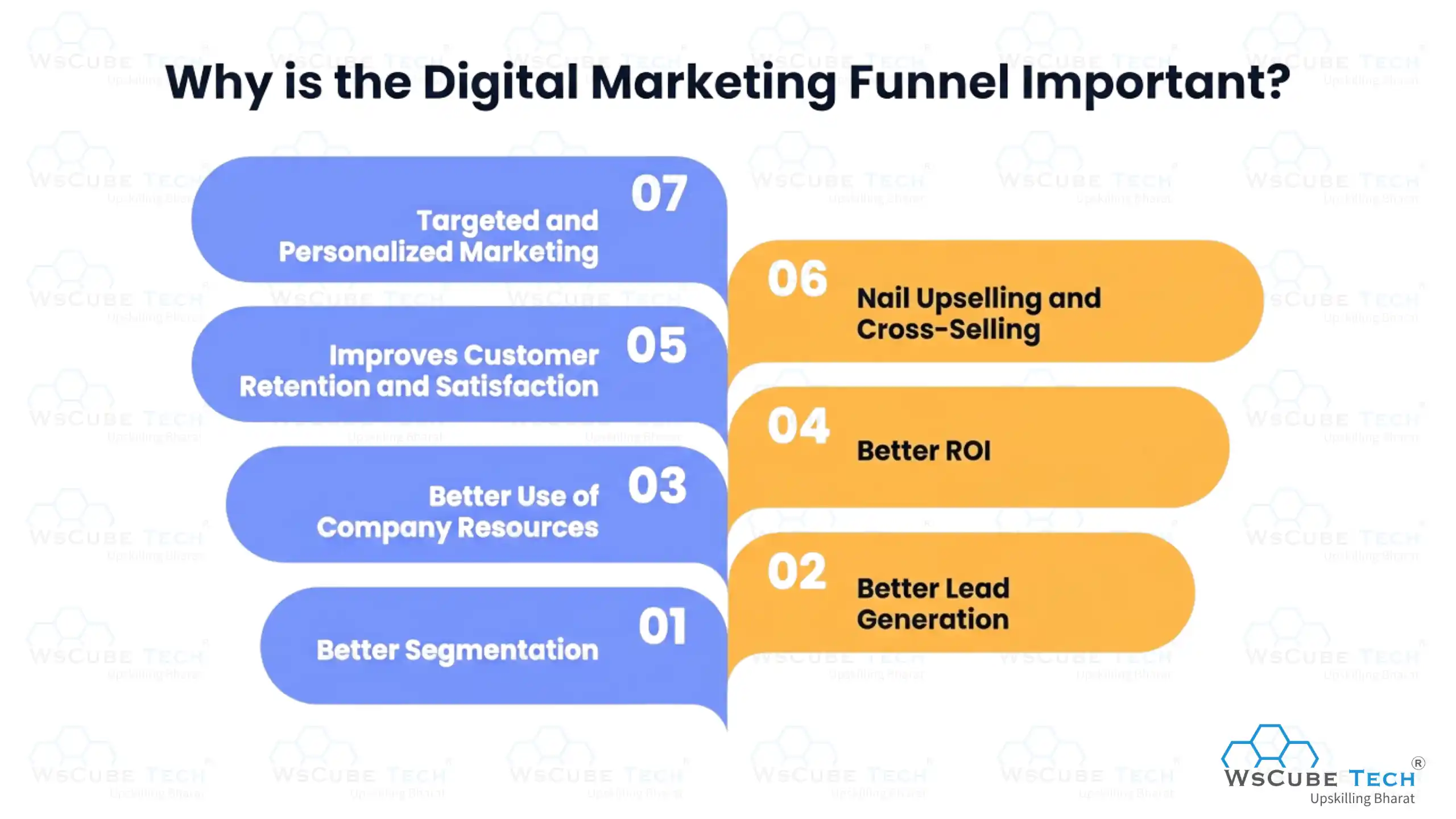
1. Better Segmentation
Funnel in digital marketing leads to better segmentation of your marketing activities that lets you provide appropriate content to your customers at multiple stages of the purchaser’s journey.
2. Better lead Generation
Precise marketing undertaking results in more qualified leads at the funnel's bottom, making conversion much more accessible. A good funnel delivers value, not the hard shell.
3. Better Use of Company Resources
The digital marketing funnel can guide your digital marketing team, enabling them to create accurate content for your buyers and preventing you from wasting valuable time and effort on ineffective marketing efforts.
4. Better ROI
You can allocate resources by concentrating on buyers’ needs at various stages. This reduces marketing spend and improves digital marketing ROI.
5. Improves Customer Retention and Satisfaction
The customer experience doesn’t stop at the purchase. A funnel cultivates long-term consumer relationships by offering valuable content after the sale. Therefore, you earn repeat purchases and build customer loyalty.
6. Nail Upselling and Cross-Selling
Analyze purchaser preferences, past purchases, and engagement patterns. Later, tailor your offers to gain more sales.
7. Targeted and Personalized Marketing
Develop content that resonates with your target group through their journey. Armed with insights, you can modify messages to boost engagement and drive conversions.
How to Create a Digital Marketing Funnel?
Building a digital marketing funnel is not a one-time task. It is an ongoing process that you refine as you learn more about your audience. Here is a step-by-step breakdown to get you started:
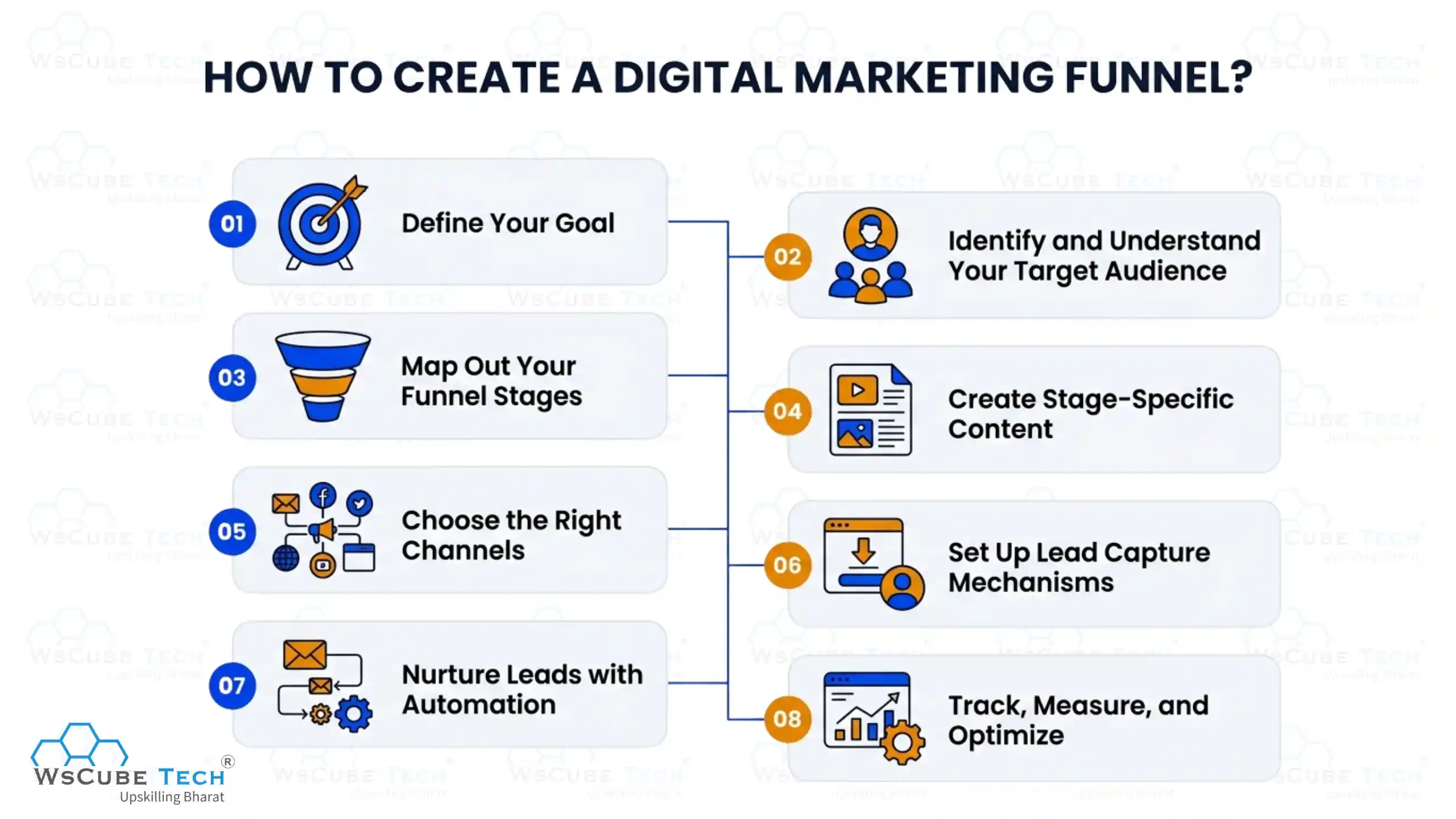
Step 1: Define Your Goal
Before building anything, get clear on what you want to achieve. Are you looking to generate leads, drive product sales, grow your email list, or increase brand awareness? Your goal shapes every decision in the funnel, from the content you create to the channels you use.
Step 2: Identify and Understand Your Target Audience
You cannot build an effective funnel without knowing who you are talking to. Research your audience's demographics, pain points, online behavior, and what motivates them to buy. Build a clear customer persona before moving forward.
Step 3: Map Out Your Funnel Stages
Decide which funnel model fits your business, whether it is a simple TOFU-MOFU-BOFU structure or a more detailed hourglass funnel. Map out what your customer experiences at each stage and what action you want them to take next.
Step 4: Create Stage-Specific Content
Each stage needs a different type of content.
- TOFU: Blog posts, reels, YouTube videos, and social media content to attract attention.
- MOFU: Case studies, email newsletters, webinars, and comparison guides to build trust.
- BOFU: Free trials, demos, discount offers, and testimonials to push the final purchase decision.
Step 5: Choose the Right Channels
Pick the platforms where your audience actually spends time. For B2C, that might be Instagram or YouTube. For B2B, it could be LinkedIn or email marketing. Do not spread yourself thin trying to be everywhere.
Step 6: Set Up Lead Capture Mechanisms
Add landing pages, lead magnets, sign-up forms, or gated content to collect contact information from interested prospects before they drop off.
Step 7: Nurture Leads with Automation
Use email sequences, retargeting ads, and personalized follow-ups to keep prospects engaged and moving through the funnel. Do not let warm leads go cold.
Step 8: Track, Measure, and Optimize
Monitor key metrics at every stage, including traffic, click-through rate, conversion rate, and drop-off points. Use tools like Google Analytics, Mixpanel, or Meta Ads Manager to identify where people are leaving and fix those gaps.
Explore Our Most Popular Marketing Courses
Best Digital Marketing Funnel Strategies
Stepping up your digital marketing game includes more than a single strategy. It's about harnessing a blend of proven methods tailored to your audience’s journey, giving you the power to shape your business's success.
Let’s explore the top digital marketing strategies to shape your digital marketing funnel for optimal conversion and reach.
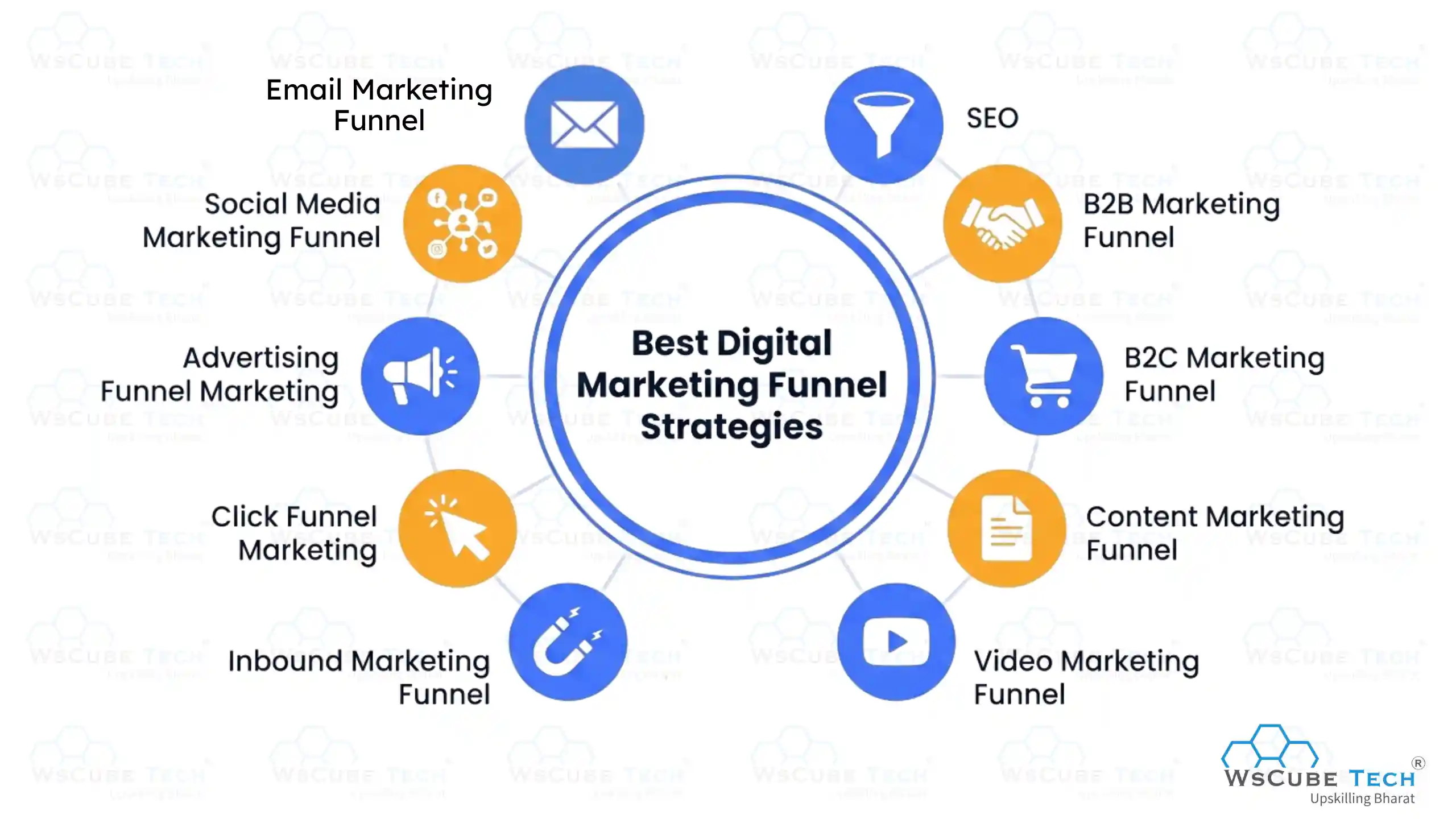
1. SEO
Search engine optimization improves your digital visibility by optimizing your site’s content and design for search engines and users.
2. B2B Marketing Funnel
Aim at long-term relationships and complex decision-making processes common in B2B interactions.
3. B2C Marketing Funnel
Drive individual users by emphasizing convenience, personal benefits, and emotional connections.
4. Content Marketing Funnel
Engage and guide your audience. Provide helpful, valuable, and relevant content at every stage of their purchasing journey.
5. Video Marketing Funnel
Use video content to explain the benefits of your products/services and engage your audience.
6. Email Marketing Funnel
Develop personalized email campaigns to guide your onlookers from awareness to conversion.
7. Inbound Marketing Funnel
Drive clients with valuable content and experiences tailored to them rather than conventional outward promotions.
8. Click Funnel Marketing
Use a series of web pages. Guide visitors to a particular action, like purchasing a product/service.
9. Advertising Funnel Marketing
Deploy targeted advertisements to drive awareness, interest, and conversion.
10. Social Media Marketing Funnel
Leverage social media platforms. Engage your spectators and foster relationships that lead to sales.
Common Mistakes to Avoid in a Digital Marketing Funnel
Even a well-planned funnel can underperform if these common pitfalls are not addressed early on.
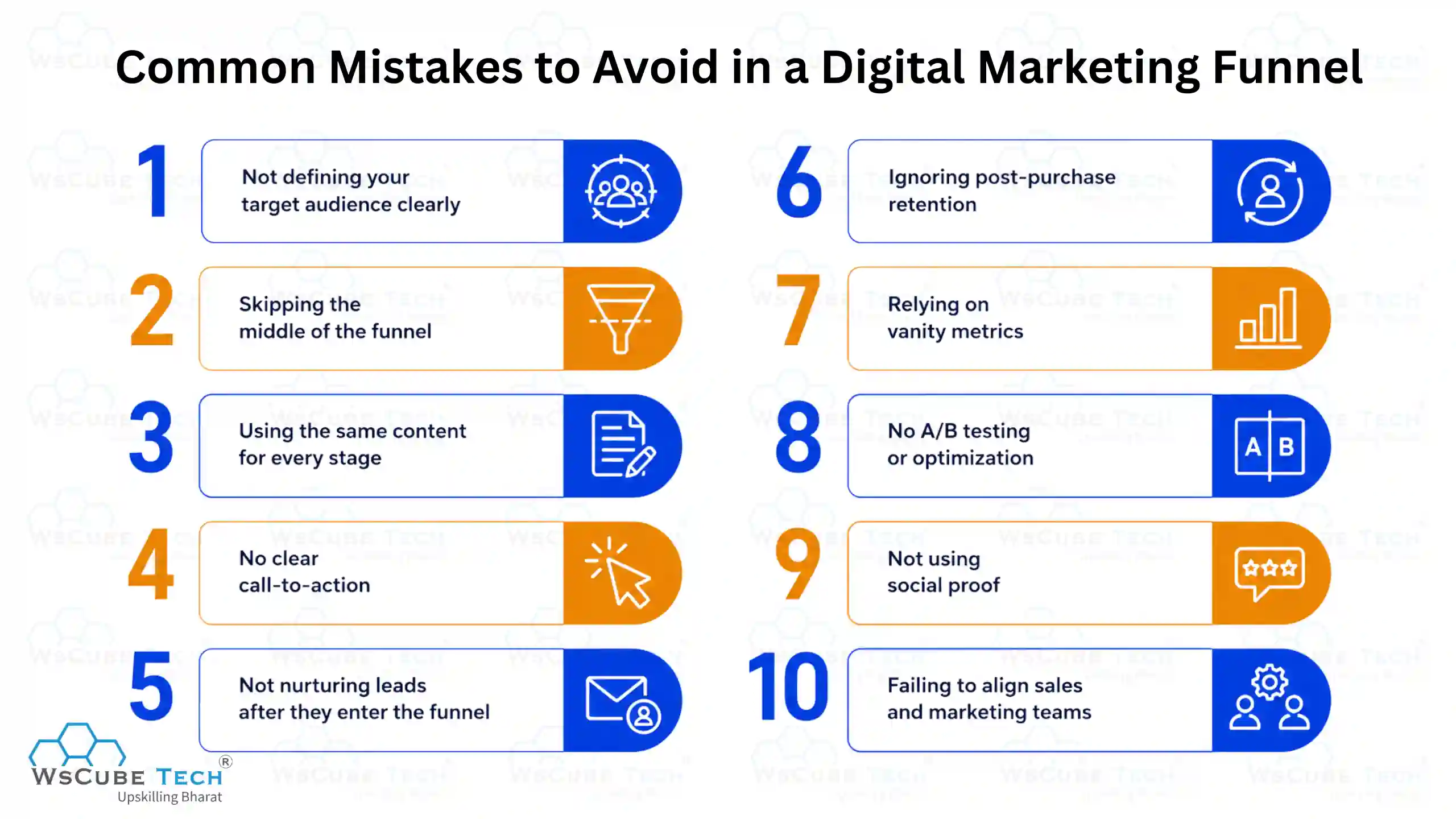
- Not defining your target audience clearly: Trying to market to everyone means you connect with no one. Build a clear buyer persona before setting up any stage of your funnel.
- Skipping the middle of the funnel: Most brands focus only on awareness and conversion, completely ignoring the MOFU stage where trust is built. This is where most leads are lost.
- Using the same content for every stage: A first-time visitor and a ready-to-buy prospect need very different messaging. Generic content at every stage kills conversions.
- No clear call-to-action: Every stage of your funnel must tell the user exactly what to do next. A missing or vague CTA leaves potential buyers confused and disengaged.
- Not nurturing leads after they enter the funnel: Capturing a lead is just the beginning. Failing to follow up with emails, retargeting ads, or personalized content lets warm leads go cold.
- Ignoring post-purchase retention: Most brands stop their funnel at the sale. Not having a retention strategy means you keep spending on acquiring new customers instead of keeping existing ones.
- Relying on vanity metrics: Tracking only page views or impressions without looking at conversion rates or cost per lead gives you a false picture of funnel health.
- No A/B testing or optimization: Running a funnel without testing landing pages, CTAs, or ad creatives means you are leaving conversions on the table.
- Not using social proof: Skipping customer reviews, testimonials, and case studies at the consideration stage reduces trust and slows down purchase decisions.
- Failing to align sales and marketing teams: When marketing generates leads that sales is not prepared to handle, the funnel breaks down. Both teams need to stay in sync on goals and messaging.
Digital Marketing Funnel: Video Guide
FAQs about Digital Marketing Funnel
A digital marketing funnel is a step-by-step framework that maps a customer's journey from first discovering your brand to making a purchase. It typically includes stages like awareness, interest, consideration, and action.
A digital income funnel is an online system designed to generate revenue by guiding potential customers through a series of touchpoints like ads, content, emails, and sales pages, with the goal of converting them into paying customers.
The main stages are Awareness (TOFU), Interest (MOFU), Consideration (BOFU), and Action. Many modern funnels also include retention and advocacy stages after the purchase.
A marketing funnel focuses on attracting and nurturing leads through content and brand awareness. A sales funnel takes over once a lead is qualified and focuses on closing the deal. Both work together for the best results.
It helps businesses deliver the right message at the right stage of the buyer's journey, resulting in better lead quality, higher conversions, reduced marketing spend, and improved customer retention.
TOFU (Top of Funnel) focuses on awareness, MOFU (Middle of Funnel) focuses on engagement and education, and BOFU (Bottom of Funnel) focuses on converting interested prospects into paying customers.
Start by defining your goal and audience, then map out your funnel stages, create content for each stage, choose the right channels, set up lead capture, nurture leads with email automation, and track performance regularly.
Common tools include Google Analytics for tracking, Mailchimp or HubSpot for email automation, Meta Ads Manager for paid traffic, and landing page builders like Unbounce or ClickFunnels for conversions.
A linear funnel follows a fixed, sequential path from awareness to purchase. A non-linear funnel reflects modern buyer behavior, where customers can enter, exit, or jump between stages in any order.
Track metrics like website traffic, click-through rate (CTR), lead conversion rate, cost per lead, and customer retention rate at each stage to identify drop-offs and optimize performance.
Conclusion
A digital marketing funnel visually represents a customer's steps in the journey. The most essential step in the buyer journey is knowing your audience's pain points and figuring out how to help them and communicate their value. Once you know your customers, you can easily create personalized content and advertisement copies to share with them in the best of manners.
Join Our On-Campus Digital Marketing Program
Explore Our Free Courses




Leave a comment
Your email address will not be published. Required fields are marked *Comments (0)
No comments yet.