The average marketer today uses multiple tools for SEO, content creation, analytics, social media, email marketing, and paid advertising. But with hundreds of platforms available, choosing the right tools can quickly become overwhelming.
Whether you're learning digital marketing, improving your SEO strategy, or managing Google Ads campaigns, the right tools can save hours of work and deliver better results. In this guide, we've compiled the best digital marketing tools in 2026, including free and paid options for every stage of your marketing journey.
What are digital marketing tools?
The platforms and software that drive your entire online strategy, from planning and execution to measurement and optimization, are known as digital marketing software or tools. The proper stack not only expedites your work but also changes the way your team engages audiences, makes decisions, and demonstrates business impact.
The majority of digital marketing tools fit into these main categories:
- Social media management: Schedule and share content, engage with your audience, and monitor performance across channels
- AI and automation: Streamline research, content creation, analysis, and optimization processes
- Email marketing: Create targeted campaigns and build relationships with potential customers
- SEO: Improve search visibility and attract organic website traffic
- Analytics: Measure results and understand the impact of marketing efforts on business goals
- Conversion and lead generation: Convert visitors into leads and customers through effective marketing strategies
- Design: Develop engaging visual content that stands out in competitive social feeds
Using the best tools for digital marketing reduces the gap between your current workflow and your goals. The categories below cover every major area of digital marketing, from the channels where your audience spends their time to the infrastructure that keeps your data connected and your team moving fast. If you're new, it helps to understand the fundamentals of SEO before choosing the right tools.
Benefits of Using Digital Marketing Tools
These are the top advantages of using the best tools for digital marketing:
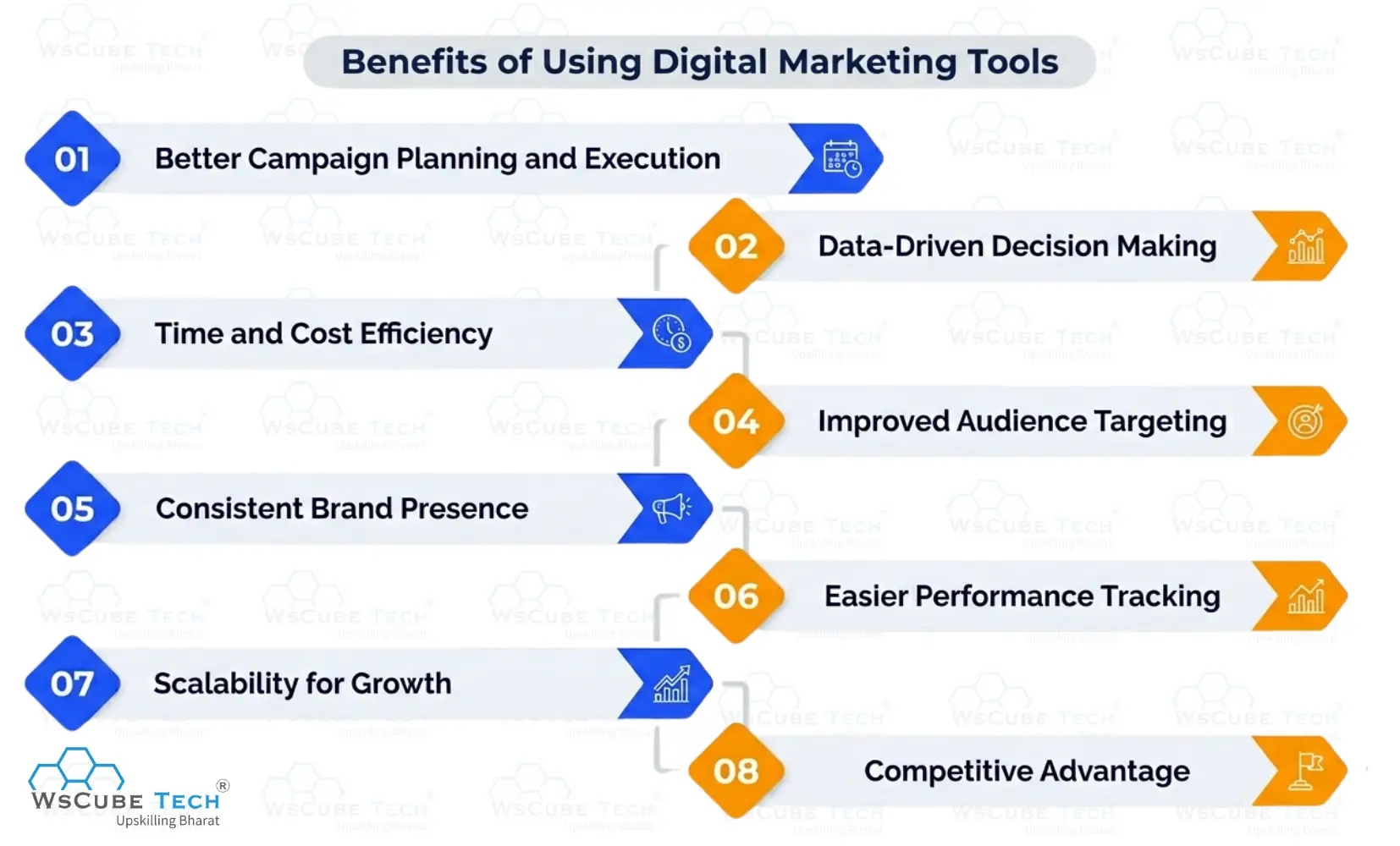
1. Better Campaign Planning and Execution
Digital marketing tools help plan campaigns in advance, organize tasks, and execute them consistently across channels. This reduces guesswork and ensures every campaign follows a clear structure and timeline.
2. Data-Driven Decision Making
With built-in analytics and reports, these tools show what is working and what is not. Marketers can rely on real data instead of assumptions to improve performance and ROI.
3. Time and Cost Efficiency
Automation features like scheduling, bulk actions, and AI assistance reduce manual effort. This saves time, lowers operational costs, and allows teams to focus on strategy and creativity.
4. Improved Audience Targeting
SEO, ads, and CRM tools help segment audiences based on behavior, intent, and demographics. This leads to more relevant messaging and higher engagement across channels.
5. Consistent Brand Presence
Social media and content tools ensure regular posting, brand consistency, and timely engagement. This helps build trust and keeps brands visible where audiences spend time.
6. Easier Performance Tracking
Digital marketing tools track clicks, traffic, leads, conversions, and revenue in one place. This makes it easier to measure success and report results clearly.
7. Scalability for Growth
As businesses grow, these tools scale with them by supporting more campaigns, users, data, and integrations without breaking workflows or efficiency.
8. Competitive Advantage
Advanced tools for SEO, ads, and monitoring help identify trends, competitor strategies, and market gaps early, allowing brands to stay ahead in fast-changing digital spaces.
Best Digital Marketing Tools in 2026: Quick Overview
Here is the complete digital marketing tools list for 2026:
| Digital Marketing Tool | Category | Best For | Pricing | Key Use Case |
| Google Ads | PPC Advertising Tool | Performance marketers | Paid | Search, Display, Shopping, and YouTube ads |
| Meta Ads | Social Media Advertising Tool | D2C & service brands | Paid | Facebook and Instagram advertising |
| Google Search Console | SEO Tool | All websites | Free | Search performance, indexing, Core Web Vitals |
| Ahrefs | SEO Tool | SEO professionals | Paid | Backlink analysis, keyword research, competitor analysis |
| SEMrush | SEO & PPC Tool | Agencies & marketers | Paid | SEO audits, PPC research, competitor insights |
| Ubersuggest | SEO Tool | Beginners & bloggers | Free & Paid | Keyword research and SEO audits |
| PageSpeed Insights | Website Performance Tool | Developers & SEOs | Free | Website speed and Core Web Vitals analysis |
| Buffer | Social Media Marketing Tool | Creators & SMBs | Free & Paid | Social media scheduling and analytics |
| Hootsuite | Social Media Management Tool | Enterprises & agencies | Paid | Scheduling, social listening, analytics |
| Sprout Social | Social Media Management Tool | Large brands | Paid | Engagement, analytics, social listening |
| ChatGPT | AI Marketing Tool | Marketers & writers | Free & Paid | Content creation, ideation, automation |
| Google Gemini | AI Marketing Tool | Google ecosystem users | Free & Paid | Research, image generation, AI assistance |
| Jasper | AI Copywriting Tool | Marketing teams | Paid | Brand-aligned marketing content |
| Notion AI | AI Productivity Tool | Teams & planners | Paid | Content planning and documentation |
| Mailchimp | Email Marketing Tool | Small businesses | Free & Paid | Email campaigns and automation |
| HubSpot | CRM & Email Marketing Tool | Growth-focused teams | Free & Paid | CRM, email marketing, inbound marketing |
| Zoho | CRM Tool | SMBs | Free & Paid | CRM, email marketing, automation |
| Freshsales | Sales CRM Tool | Sales-led businesses | Free & Paid | Lead management and sales automation |
| Google Analytics | Website Analytics Tool | All marketers | Free | Traffic, behavior, and conversion tracking |
| Hotjar | Conversion Rate Optimization Tool | Website owners | Free & Paid | Heatmaps, recordings, user behavior analysis |
| Unbounce | Landing Page Builder | Performance marketers | Paid | High-converting landing pages |
| Typeform | Lead Generation Tool | Marketers & startups | Free & Paid | Interactive forms and surveys |
| Canva | Graphic Design Tool | Non-designers | Free & Paid | Social media and marketing creatives |
| Adobe Photoshop | Graphic Design Tool | Professionals | Paid | Advanced image editing and design |
| Figma | UI/UX Design Tool | Design teams | Free & Paid | UI, UX, and landing page design |
| WordPress | CMS Tool | Bloggers & businesses | Free & Paid | Website and content management |
| Shopify | E-commerce Platform | Online stores | Paid | Online store management and sales |
| Google Workspace | Collaboration Tool | Marketing teams | Paid | Docs, email, file sharing, collaboration |
| Zoom | Communication Tool | Remote teams | Free & Paid | Meetings, webinars, collaboration |
| AiSensy | WhatsApp Marketing Tool | Indian businesses | Paid | WhatsApp automation and campaigns |
| Interakt | WhatsApp Business Tool | E-commerce brands | Paid | Sales and customer support via WhatsApp |
| Wati | WhatsApp Automation Tool | Startups & SMBs | Paid | WhatsApp automation and engagement |
| Chatfuel | Chatbot Marketing Tool | Lead generation | Free & Paid | WhatsApp and Messenger chatbots |
Recommended Professional Certificates
AI-Powered Digital Marketing Course
Performance Marketing Bootcamp
SEO Specialist Bootcamp
Best Digital Marketing Tools for Advertising
Here are all digital marketing tools best for online advertising:
1. Google Ads
Google Ads is the most widely used paid advertising platform for driving targeted traffic through search, display, video, and shopping ads. Additionally, Google Ads controls around 80% of the global pay-per-click (PPC) market. Being one of the most accessible online marketing tools, it allows businesses to reach users actively searching for products or services, making it highly intent-driven. Marketers can bid on keywords, target locations, devices, and audiences, and control budgets with precision.
Understanding Google Ads also helps in remarketing and performance tracking through conversions. When managed properly, it delivers measurable ROI and fast visibility, making it a core tool in performance marketing strategies.
Key Features & Benefits:
- Search, Display, Shopping, and YouTube ads
- Keyword-based and audience-based targeting
- Budget and bid control with real-time optimization
- Conversion tracking and ROI measurement
- Remarketing and audience segmentation
2. Meta Ads
Meta Ads powers advertising across Facebook, Instagram, Messenger, and Audience Network. It is especially effective for brand awareness, lead generation, and eCommerce campaigns due to its advanced audience targeting. Moreover, it reaches more than 3.56 billion people daily across Facebook, Instagram, Messenger, and WhatsApp, giving advertisers access to one of the largest digital audiences in the world.
Having good knowledge of Meta Ads metrics allows marketers to target users based on interests, behavior, demographics, and custom audiences. With visual-first formats like reels, stories, and carousel ads, it works well for engagement-driven campaigns.
Meta Ads are widely used by startups, D2C brands, and service businesses.
Key Features & Benefits:
- Ads across Facebook, Instagram, and Messenger
- Advanced interest and behavior targeting
- Custom and lookalike audiences
- Visual ad formats (reels, stories, carousels)
- Detailed campaign performance insights
Expert Advice: The best digital marketing tools for advertising help marketers reach the right audience, optimize campaigns, and drive measurable business results.
Best Digital Marketing Tools for SEO
SEO tools help improve a website’s visibility on search engines by analyzing keywords, suggesting backlink opportunities, identifying technical issues, and researching competitors. They are essential for driving organic traffic, identifying ranking opportunities, fixing site errors, and tracking search performance over time. These are the top digital marketing tools for SEO, widely used by bloggers, businesses, and agencies focused on long-term traffic growth.
3. Google Search Console
Google Search Console is a free and essential tool from Google that helps website owners, marketers, and SEO professionals understand how their site performs in Google Search. It shows how pages are indexed, which keywords trigger impressions, where clicks come from, and what technical issues affect visibility.
With Search Console, you can monitor indexing status, fix crawl errors, submit sitemaps, and analyze Core Web Vitals. It also helps identify penalties, manual actions, and mobile usability problems. Google handles over 5 trillion searches every year, making Search Console one of the most reliable sources of SEO performance data available.
For anyone serious about organic traffic, Google Search Console acts as the foundation for SEO decision-making and performance monitoring.
Key Features & Benefits:
- Search performance reports for queries, pages, countries, and devices
- Indexing and crawl error monitoring
- Sitemap submission and URL inspection
- Core Web Vitals and page experience insights
- Manual actions and security issue alerts
4. Ahrefs

Ahrefs is one of the most powerful digital marketing tools used for competitor research, backlink analysis, and keyword discovery. It is widely known for its massive backlink database and accurate link metrics.
Ahrefs helps marketers understand why competitors rank, which pages attract links, and where new ranking opportunities exist. It is also one of the best tools for keyword research, helping businesses identify high-value search terms and content opportunities. Beyond backlinks, it offers strong keyword research, content gap analysis, rank tracking, and site audits.
Ahrefs is especially useful for content-driven SEO strategies and link-building campaigns, making it a go-to tool for agencies and advanced SEO professionals.
Key Features & Benefits:
- Industry-leading backlink analysis
- Keyword research with difficulty and traffic estimates
- Competitor and content gap analysis
- Site audit for technical SEO issues
- Rank tracking for keywords across locations
5. SEMrush

Semrush is one of the best paid tools for digital marketing, covering SEO, PPC, content marketing, and competitive research. It helps marketers analyze competitors’ traffic sources, keywords, ads, and content strategies. SEMrush is widely used for keyword research, site audits, backlink analysis, and paid advertising insights.
Its strength lies in combining SEO and paid marketing data in one platform. Businesses use SEMrush to plan content, track rankings, optimize ads, and monitor overall digital visibility across search engines.
Key Features & Benefits:
- Comprehensive keyword research and tracking
- SEO site audits with actionable fixes
- Competitor traffic and keyword analysis
- PPC and Google Ads research tools
- Content optimization and topic research
6. Ubersuggest
Ubersuggest is a beginner-friendly SEO tool designed to make keyword research and basic SEO accessible. It helps users find keyword ideas, search volume, competition level, and content suggestions quickly.
Ubersuggest also provides domain overviews, backlink data, and simple site audits. It is especially popular among bloggers, startups, and small businesses looking for affordable SEO insights without complex dashboards. As one of the best digital marketing tools for beginners, Ubersuggest offers a simple way to learn SEO and improve website visibility.
While not as advanced as enterprise tools, Ubersuggest is practical for learning SEO fundamentals and spotting quick growth opportunities.
Key Features & Benefits:
- Keyword suggestions with SEO difficulty scores
- Domain and competitor overview reports
- Basic backlink analysis
- Content ideas based on top-ranking pages
- Simple site audit for SEO errors
7. PageSpeed Insights
PageSpeed Insights is a free performance optimization tool by Google that analyzes how fast a webpage loads on mobile and desktop devices. It focuses on user experience metrics like loading speed, interactivity, and visual stability.
The tool provides a performance score along with real-world data from Chrome users and lab-based diagnostics. Among the most useful digital marketing tools for website optimization, PageSpeed Insights helps developers and marketers identify speed issues that affect SEO, conversions, and user satisfaction.
It is especially important for improving Core Web Vitals and overall site performance.
Key Features & Benefits:
- Mobile and desktop performance scoring
- Core Web Vitals assessment
- Real-user (field) and lab performance data
- Actionable recommendations to improve speed
- Direct impact on SEO and user experience
WsCube Expert’s Advice: Many marketers invest in advanced SEO tools but use only a fraction of their capabilities. Focus on mastering one tool for keyword research, technical SEO, and performance tracking before expanding your toolkit. Consistent execution delivers better results than having multiple tools.
Upcoming Masterclass
Attend our live classes led by experienced and desiccated instructors of Wscube Tech.



Digital Marketing Tools for Social Media
Social media management tools help schedule posts, manage engagement, analyze performance, and monitor conversations across platforms like Instagram, Facebook, LinkedIn, and X. They save time, ensure posting consistency, and provide insights into what content performs best on each network. These online marketing tools help businesses build brand awareness, strengthen customer relationships, and improve social media performance.
8. Buffer
Buffer is a simple and reliable social media management tool designed to help individuals, small businesses, and teams publish content consistently across multiple platforms. It allows users to schedule posts, manage content ideas, engage with audiences, and track performance from one clean dashboard.
Buffer focuses on ease of use rather than overwhelming users with complex workflows. As one of the best digital marketing tools for social media management, it supports major platforms like Instagram, Facebook, LinkedIn, X, TikTok, and Pinterest, making it ideal for day-to-day social media operations. With transparent pricing and a useful free plan, Buffer is often the first choice for marketers starting with social media management.
Key Features & Benefits:
- Post scheduling with queue and calendar view
- Support for all major social media platforms
- Content creation and idea organization tools
- Unified inbox for comments and replies
- Basic to advanced analytics for post performance
- Beginner-friendly interface with affordable pricing
9. Hootsuite
Hootsuite is a comprehensive social media management platform built for brands, agencies, and large teams that need scale and control. It combines publishing, engagement, analytics, and social listening in one system. As one of the leading online marketing tools for social media management, Hootsuite is especially strong in data-driven marketing, offering detailed reports, competitor benchmarking, and AI-powered insights.
Users can schedule posts in bulk, manage messages from a unified inbox, and track brand mentions and trends across platforms. Due to its advanced features and collaboration tools, Hootsuite is widely used by enterprises managing high-volume social media campaigns.
Key Features & Benefits:
- Multi-platform scheduling and bulk publishing
- AI-powered content and strategy suggestions
- Unified inbox for messages, comments, and mentions
- Advanced social listening and trend tracking
- Custom analytics and performance reports
- Strong team collaboration and approval workflows
10. Sprout Social
Sprout Social is a premium social media management software focused on analytics, customer engagement, and strategic insights. It helps businesses go beyond posting by understanding audience behavior, brand sentiment, and industry trends. As one of the best digital marketing tools for social media analytics, Sprout Social offers a powerful smart inbox, AI-assisted replies, detailed reporting, and social listening capabilities.
It also supports influencer and creator campaign management, making it suitable for brands investing heavily in social media growth. Sprout Social is best suited for medium to large businesses that want deep insights and measurable impact from social media efforts.
Key Features & Benefits:
- Smart inbox for centralized engagement
- AI-assisted replies for faster responses
- Advanced analytics tied to business goals
- Social listening and sentiment analysis
- Influencer and creator campaign management
- Enterprise-grade reporting and collaboration
Latest Digital Marketing tools With AI
The latest digital marketing tools powered by AI help marketers create content, visuals, and presentations faster. They support content writing, ad creation, social media management, and campaign planning while reducing manual effort. Many also support modern SEO strategies such as Answer Engine Optimization (AEO) and Generative Engine Optimization (GEO), helping businesses improve visibility across traditional and AI-powered search experiences.
11. ChatGPT
ChatGPT is an AI-powered assistant that helps marketers generate content, develop campaign ideas, conduct research, and automate repetitive tasks. It can be used to create blog posts, ad copy, email campaigns, social media captions, landing page content, and SEO-focused outlines. According to TechCrunch, ChatGPT has reached 900 million weekly active users
The tool also assists with keyword discovery, content planning, and audience-focused messaging. For marketing teams, ChatGPT improves productivity by accelerating content creation and brainstorming processes. When combined with human expertise and fact-checking, it becomes a valuable tool for content marketing, SEO, AEO, GEO, and social media strategies.
Key Features & Benefits:
- Content creation for blogs, ads, emails, and social media
- Campaign ideation and brainstorming support
- SEO-friendly content planning and outlines
- Content rewriting, summarization, and tone adjustments
- Reduces time spent on repetitive marketing tasks
12. Google Gemini
Google Gemini is Google's advanced AI assistant designed for research, content creation, analysis, and creative tasks. For digital marketers, it combines text generation with visual capabilities, making it useful for producing content, ad creatives, presentations, and marketing assets.
Gemini can generate images, enhance visuals, summarize information, and assist with document creation in Google Workspace. Google reported that Gemini reached over 400 million monthly active users in 2025, highlighting its growing adoption. Features such as Nano Banana support quick idea generation and lightweight AI tasks, making Gemini useful for marketers seeking AI-powered text and visual assistance within Google's ecosystem.
Key Features & Benefits:
- AI-powered research, drafting, and summarization
- Image generation for ads, creatives, and content
- Image enhancement and visual optimization
- Nano Banana for fast AI-assisted tasks
- Integration with Google Docs, Sheets, Slides, and Gmail
- Useful for SEO, content planning, and visual storytelling
13. Jasper

Jasper is an AI content creation platform built for marketing and sales teams that need high-quality content at scale. It specializes in producing brand-consistent copy for blogs, advertisements, emails, landing pages, and product descriptions.
One of Jasper's strengths is its ability to maintain a defined brand voice across multiple campaigns and content formats. It is widely used by agencies and growing businesses that require large volumes of conversion-focused content while maintaining consistency and efficiency.
Key Features & Benefits:
- AI-generated marketing content across channels
- Brand voice and tone customization
- Templates for ads, emails, blogs, and landing pages
- Designed for scalable content production
- Improves consistency across campaigns
14. Notion AI

Notion AI extends the Notion workspace with AI-powered writing, summarization, organization, and planning features. It helps marketing teams create content drafts, document strategies, organize campaigns, and summarize research without leaving their workspace.
The tool is particularly useful for managing content calendars, standard operating procedures (SOPs), project plans, and collaborative marketing initiatives. By bringing planning and content creation into one environment, Notion AI helps teams stay organized and work more efficiently.
Key Features & Benefits:
- AI-assisted writing and content generation
- Automatic summarization of notes and documents
- Campaign planning and documentation support
- Seamless integration within Notion workspaces
- Enhances team collaboration and productivity
Read More Guides Related to Digital Marketing
Digital Marketing Tools for CRM & Email
CRM and Email marketing tools help businesses manage leads, customers, and communication in an organized way. They support email campaigns, automation, lead tracking, customer segmentation, and sales pipelines, making them crucial for nurturing relationships and conversions.
15. Mailchimp

Mailchimp is one of the most popular email marketing tools used by businesses to create, send, and analyze email campaigns. It helps marketers design newsletters, automate follow-ups, and manage subscriber lists without technical complexity.
Mailchimp is widely used for promotional emails, drip campaigns, product updates, and customer retention. Its drag-and-drop editor, audience segmentation, and automation workflows make it suitable for beginners as well as growing businesses. With built-in analytics, Mailchimp allows marketers to track open rates, clicks, and conversions, helping refine email strategies over time.
Key Features & Benefits:
- Drag-and-drop email campaign builder
- Audience segmentation and tagging
- Email automation and drip campaigns
- A/B testing for subject lines and content
- Detailed email performance analytics
- Free plan available for small lists
16. HubSpot

HubSpot offers a powerful combination of CRM, email marketing, automation, and analytics in one platform. Unlike standalone email tools, HubSpot connects every email interaction with contacts, leads, and customers in its CRM.
This allows marketers to personalize communication, track customer journeys, and measure email impact on leads and revenue. HubSpot is widely used for inbound marketing, lead nurturing, and sales alignment. It works especially well for teams that want email marketing tied closely to broader marketing campaigns and business growth goals.
Key Features & Benefits:
- Email marketing integrated with CRM
- Personalized and automated email workflows
- Contact and lead tracking
- Campaign-level performance reporting
- Strong integration with sales and marketing tools
- Free CRM with scalable paid plans
17. Zoho
Zoho provides a complete suite of business and marketing tools, including email marketing, CRM, automation, and analytics. Zoho’s email and CRM tools help businesses manage leads, communicate with customers, and automate follow-ups efficiently.
It is especially popular among small and mid-sized businesses due to its affordability and wide range of integrated apps. Zoho allows marketers to run email campaigns, track customer interactions, and manage sales pipelines from a single ecosystem, making it a strong alternative to higher-priced enterprise platforms.
Key Features & Benefits:
- Integrated email marketing and CRM tools
- Lead management and automation
- Campaign tracking and reporting
- Custom workflows and segmentation
- Cost-effective plans for small businesses
- Seamless integration across Zoho apps
18. Freshsales
Freshsales is a CRM tool designed to help sales and marketing teams manage leads, automate communication, and close deals faster. It focuses on lead scoring, email tracking, and sales automation, making it useful for businesses with active sales pipelines.
Freshsales allows marketers to sync email campaigns with sales activities, track customer interactions, and identify high-intent leads. With AI-based insights and automation, it helps teams prioritize prospects and improve conversion rates through timely and personalized communication.
Key Features & Benefits:
- Email tracking and engagement insights
- Lead scoring and pipeline management
- Sales automation and workflows
- Built-in phone and email tools
- AI-powered insights for lead prioritization
- Suitable for growing sales-focused businesses
Interesting Fact: Email marketing tools automatically remove invalid addresses and handle unsubscribes to protect your sender reputation.
Digital Marketing Tools for Analytics & Conversion Optimization
These digital marketing tools track user behavior, traffic sources, engagement, and conversions. As some of the most valuable online marketing tools for performance measurement, they help marketers understand how users interact with websites and campaigns, identify drop-off points, and optimize pages for better performance and higher conversion rates.
19. Google Analytics

Google Analytics is one of the most widely used digital marketing tools for understanding how users interact with websites and apps. It tracks traffic sources, user behavior, conversions, and engagement metrics.
With GA4, businesses can analyze cross-device journeys and events more accurately. Google Analytics helps identify top-performing pages, traffic channels, and conversion paths, making it essential for data-driven marketing decisions.
Key Features & Benefits:
- Website and app traffic tracking
- User behavior and event-based analytics
- Conversion and funnel analysis
- Traffic source and campaign insights
- Free to use with powerful reporting
20. Hotjar

Hotjar focuses on understanding user behavior through visual insights. Instead of numbers alone, it shows how users actually interact with a website using heatmaps, session recordings, and feedback tools.
Hotjar helps identify friction points, drop-offs, and UX issues that impact conversions. It is especially useful for improving landing pages, forms, and user journeys.
Key Features & Benefits:
- Heatmaps for clicks, scrolls, and movement
- Session recordings to observe real behavior
- On-site surveys and feedback polls
- Funnel and conversion analysis
- UX-focused optimization insights
21. Unbounce
Unbounce is one of the best paid digital marketing tools for marketers running conversion-focused advertising and lead generation campaigns. It allows users to create, test, and optimize landing pages without coding.
Unbounce supports A/B testing, dynamic text replacement, and AI-powered optimization, helping improve conversion rates from ads and email campaigns. It is widely used in performance marketing and lead generation.
Key Features & Benefits:
- Drag-and-drop landing page builder
- A/B testing for conversion optimization
- Dynamic text replacement for ads
- AI-powered optimization tools
- Integrations with ads and CRM platforms
22. Typeform
Typeform is an interactive form and survey tool designed to improve user engagement and response rates. It is commonly used for lead capture, feedback collection, quizzes, and onboarding forms.
Typeform’s conversational design makes forms feel more human, leading to higher completion rates. Marketers often use it alongside landing pages and campaigns to capture high-quality leads.
Key Features & Benefits:
- Interactive and conversational form design
- Lead capture and survey creation
- Conditional logic for personalization
- Integrations with CRM and marketing tools
- High completion and engagement rates
Explore Our Most Popular Marketing Courses
Design & Creative Tools for Digital Marketing
Design tools help create visuals, ads, banners, social media creatives, UI designs, and marketing assets. These tools are essential for branding, content marketing, and ad campaigns, even for users without advanced design skills. They are among the best digital marketing tools for creating professional marketing assets and maintaining brand consistency across channels.
23. Canva

Canva is one of the most widely used design tools in digital marketing, especially for non-designers. It helps marketers create social media creatives, ads, presentations, banners, thumbnails, and marketing visuals quickly using ready-made templates. Canva’s drag-and-drop editor, stock assets, and brand kits make it easy to maintain visual consistency across campaigns.
With AI-powered features like background removal, text generation, and design suggestions, Canva significantly reduces design turnaround time. It is ideal for startups, small businesses, content creators, and marketing teams that need fast, professional-looking designs without complex software.
Key Features & Benefits:
- Thousands of ready-made design templates
- Drag-and-drop editor with no design skills required
- Brand kit for logos, fonts, and colors
- AI-powered design and background removal tools
- Social media, ad, presentation, and print formats
- Free plan with powerful core features
24. Adobe Photoshop
Adobe Photoshop is the industry-standard tool for advanced image editing and graphic design. It is widely used by designers and marketers for photo manipulation, ad creatives, banners, and high-quality visuals. Photoshop offers complete control over images, including retouching, compositing, color correction, and design precision.
For brands that rely heavily on visual storytelling and premium creatives, Photoshop provides unmatched flexibility. Though it has a learning curve, it remains essential for professional-grade design work in digital marketing.
Key Features & Benefits:
- Advanced image editing and retouching
- Layer-based design and composition control
- High-quality output for ads and branding
- Supports complex design workflows
- Industry-standard tool for professionals
25. Figma
Figma is a cloud-based design and collaboration tool widely used for UI, UX, and marketing design workflows. It allows teams to design websites, landing pages, app interfaces, and marketing visuals collaboratively in real time.
Figma is especially valuable for marketing teams working closely with designers and developers. Its component-based system ensures design consistency, while real-time collaboration speeds up approvals and iterations. Figma is ideal for modern, design-driven digital marketing projects.
Key Features & Benefits:
- Real-time design collaboration
- UI and UX design for websites and apps
- Component-based design systems
- Easy sharing and feedback collection
- Works entirely in the browser
Website, CMS & Productivity Tools for Digital Marketing
These digital marketing tools support website creation, content publishing, collaboration, and internal communication. They ensure smooth marketing operations, content management, and team coordination, especially for remote or fast-growing teams.
26. WordPress
WordPress is the most popular content management system in the world, powering a large share of websites, blogs, and marketing pages. It allows marketers to create, manage, and publish content without coding.
With thousands of plugins and themes, WordPress supports SEO, blogging, lead generation, landing pages, and analytics integration. It is highly flexible and scalable, making it suitable for personal blogs, business websites, and large content-driven platforms.
Key Features & Benefits:
- Easy content publishing and management
- SEO-friendly structure with plugin support
- Thousands of themes and plugins
- Suitable for blogs, business sites, and landing pages
- Strong community and long-term scalability
27. Shopify
Shopify is a leading eCommerce platform used to build, manage, and scale online stores. It allows businesses to sell products online without handling technical complexities. Shopify supports product management, payments, shipping, marketing integrations, and analytics in one system.
For digital marketers, Shopify is especially useful for running paid ads, tracking conversions, and optimizing product pages. It is widely used by D2C brands, startups, and growing eCommerce businesses.
Key Features & Benefits:
- Easy-to-set-up online store platform
- Secure payments and checkout system
- Marketing and analytics integrations
- App ecosystem for extended functionality
- Scalable solution for growing eCommerce brands
28. Google Workspace
Google Workspace is a core collaboration and productivity platform used by digital marketing teams to manage communication, content, and workflows efficiently. It includes tools like Gmail, Google Docs, Sheets, Slides, Drive, and Calendar, which help teams collaborate in real time.
Marketers use Google Workspace for content planning, reporting, campaign documentation, presentations, and internal communication. Its cloud-based nature allows teams to work from anywhere without version-control issues.
For agencies and in-house teams, Google Workspace acts as the backbone that keeps marketing operations organized, fast, and transparent.
Key Features & Benefits:
- Real-time collaboration on documents and spreadsheets
- Cloud storage with easy file sharing
- Professional email and calendar management
- Seamless integration with marketing and analytics tools
- Improves team productivity and coordination
29. Zoom

Zoom is a widely used video communication tool that supports meetings, webinars, team discussions, and client calls. In digital marketing, Zoom is commonly used for client presentations, strategy discussions, team meetings, interviews, and training sessions.
It enables remote collaboration with screen sharing, recording, chat, and breakout rooms. Zoom is especially valuable for agencies and distributed teams that rely on clear communication and real-time discussions to manage campaigns and stakeholders effectively.
Key Features & Benefits:
- High-quality video meetings and webinars
- Screen sharing and presentation support
- Meeting recording and transcripts
- Breakout rooms for team collaboration
- Reliable for remote and hybrid teams
WhatsApp Marketing Tools for Digital Marketing
These are the top WhatsApp marketing tools:
30. AiSensy
AiSensy is a WhatsApp marketing and automation platform built specifically for businesses using WhatsApp as a customer communication channel. It helps brands send bulk messages, automate conversations, and manage customer journeys on WhatsApp.
AiSensy is widely used in India for lead nurturing, order updates, support automation, and promotional campaigns. With WhatsApp API integration, it allows businesses to scale personalized messaging while maintaining compliance and automation efficiency.
Key Features & Benefits:
- WhatsApp API-based bulk messaging
- Automated chat flows and broadcasts
- Campaign tracking and analytics
- Lead nurturing and customer support automation
- Popular among Indian businesses and D2C brands
31. Interakt

Interakt is a WhatsApp Business API solution designed to help businesses manage customer conversations, sales, and support through WhatsApp. It integrates WhatsApp messaging with CRM and eCommerce platforms, making it useful for order confirmations, abandoned cart reminders, and customer engagement.
Interakt is commonly used by online stores and service businesses to convert WhatsApp conversations into sales and long-term relationships.
Key Features & Benefits:
- WhatsApp Business API integration
- Automated notifications and reminders
- CRM and eCommerce integrations
- Team inbox for managing conversations
- Useful for sales and customer support workflows
32. Wati

Wati is a WhatsApp automation and customer engagement platform focused on scaling business communication. It allows teams to automate replies, manage customer queries, and run WhatsApp campaigns efficiently.
Wati is widely adopted by startups, service providers, and eCommerce businesses to handle high volumes of WhatsApp interactions. With shared inboxes and automation, it helps teams respond faster and improve customer experience.
Key Features & Benefits:
- Shared WhatsApp team inbox
- Automated replies and workflows
- WhatsApp broadcast campaigns
- Customer tagging and segmentation
- Scales WhatsApp communication efficiently
33. Chatfuel
Chatfuel is a chatbot and automation platform used to build conversational bots for WhatsApp, Facebook Messenger, and websites. It helps digital marketers automate lead generation, FAQs, and customer engagement without coding.
Chatfuel is especially useful for businesses that want 24/7 automated responses and structured conversation flows. By reducing manual workload, it improves response time and user experience across messaging channels.
Key Features & Benefits:
- No-code chatbot builder
- Automation for WhatsApp and Messenger
- Lead capture and qualification flows
- 24/7 customer engagement
- Reduces manual support workload
Recommended Professional Certificates
AI-Powered Digital Marketing Course
Performance Marketing Bootcamp
SEO Specialist Bootcamp
Free Digital Marketing Tools
Below is a clear, practical table of the best free online marketing tools from the tools we covered. These are ideal for beginners, students, freelancers, and early-stage businesses.
| Tool | Category | Free Usage | Best Use Case |
| Google Search Console | SEO | 100% Free | Track search performance, indexing, Core Web Vitals |
| Google Analytics | Analytics | 100% Free | Website traffic, conversions, user behavior |
| PageSpeed Insights | SEO & Performance | 100% Free | Website speed and page experience |
| Canva | Design | Free plan available | Social media creatives and marketing visuals |
| Mailchimp | Email Marketing | Free plan available | Basic email campaigns and newsletters |
| HubSpot | CRM & Email | Free features available | Lead management and basic email marketing |
| ChatGPT | AI & Content | Free tier | Content ideas, drafts, and marketing copy |
| Google Gemini | AI | Free tier | Research, content creation, image generation |
Best Digital Marketing Tools for Small Businesses
These new tools for digital marketing offer the right balance of pricing, ease of use, and scalability, making them ideal for small businesses.
| Tool | Category | Why It’s Best for Small Businesses |
| Zoho | CRM & Email | Affordable all-in-one CRM and marketing tools |
| Buffer | Social Media | Simple scheduling with low learning curve |
| Ubersuggest | SEO | Budget-friendly SEO insights for beginners |
| Canva | Design | Fast design without hiring designers |
| Google Ads | Paid Ads | High-intent traffic with controlled budgets |
| WordPress | Website | Flexible, SEO-friendly website management |
| AiSensy | WhatsApp Marketing | WhatsApp automation for Indian businesses |
Best Digital Marketing Tools by Use Case
Choosing from dozens of digital marketing tools can be overwhelming. To make your decision easier, we've categorized the best tools by use case so you can quickly find the right option for SEO, content marketing, analytics, advertising, design, and customer engagement.
| Goal | Recommended Tool |
| SEO | Ahrefs, Semrush |
| Keyword Research | Ahrefs, Semrush |
| Website Analytics | Google Analytics |
| Social Media | Buffer |
| Email Marketing | Mailchimp |
| CRM | HubSpot |
| AI Content Creation | ChatGPT |
| AI Research | Gemini |
| Landing Pages | Unbounce |
| Design | Canva |
| WhatsApp Marketing | AiSensy |
How to Choose the Right Digital Marketing Tools?
With hundreds of digital marketing tools available, choosing the right ones can feel overwhelming. The best approach is to focus on your goals, budget, team size, and existing workflow rather than selecting tools based solely on popularity.
Here are a few factors to consider:
1. Define Your Marketing Goals
Start by identifying what you want to achieve. For example, SEO tools help improve search visibility, social media tools support audience engagement, and analytics tools measure campaign performance.
2. Consider Ease of Use
Choose tools that match your team's skill level. A user-friendly platform can reduce the learning curve and improve productivity.
3. Check Integration Capabilities
Look for tools that integrate with your CRM, analytics platforms, email marketing software, and other systems to streamline workflows and centralize data.
4. Evaluate Features and Scalability
Select tools that meet your current needs while providing room to grow as your business and marketing efforts expand.
5. Compare Pricing and ROI
Free tools can be a great starting point, but premium solutions often offer advanced features and automation. Compare costs against the value and results the tool can deliver.
6. Read Reviews and Test Before You Commit
Take advantage of free trials and demos to evaluate usability, support, and performance before making a long-term investment.
Interesting Fact: The right internet marketing tools should help you save time, improve efficiency, and generate better results across your marketing campaigns.
FAQs about Digital Marketing Tools
Digital marketing tools are software applications that help businesses plan, execute, automate, and measure online marketing activities. These tools support SEO, social media marketing, email marketing, paid advertising, analytics, content creation, and customer relationship management.
Some of the best digital marketing tools are Google Search Console, Ahrefs, SEMrush, Google Analytics, HubSpot, Mailchimp, Canva, Buffer, ChatGPT, and Google Ads.
Yes, these tools often provide advanced features such as competitor analysis, automation, detailed reporting, AI capabilities, and CRM integrations. Businesses typically use paid tools for digital marketing for scaled campaigns and improved efficiency.
Beginners can start with free and easy-to-use tools such as Google Search Console, Google Analytics, Canva, Mailchimp, ChatGPT, and Buffer.
When evaluating online marketing tools, consider ease of use, pricing, scalability, integrations, reporting capabilities, customer support, and automation features. The best tool should align with your marketing objectives and support long-term business growth.
Most digital marketers use multiple tools rather than relying on a single platform. A typical marketing stack may include SEO software, analytics tools, email marketing platforms, CRM systems, social media tools, and AI content solutions.
When selecting digital marketing software, consider your goals, budget, team size, integration requirements, reporting needs, and growth plans. The best solution should align with your marketing strategy and support future scalability.
Small businesses often benefit from affordable internet marketing tools such as Ubersuggest, Canva, Buffer, Zoho, Mailchimp, Google Analytics, Google Search Console, and WordPress.
Some of the latest digital marketing tools powered by AI include ChatGPT, Google Gemini, Jasper, Notion AI, and AI-powered automation platforms. These tools help marketers create content, perform research, automate repetitive tasks, and improve campaign efficiency.
Digital marketing tools range from completely free to ₹1.7 lakh+ per month, depending on your needs. For small businesses, costs typically average ₹4,000 to ₹17,000 per month, while mid-sized and large companies may spend ₹68,000 to ₹1.7 lakh+ per month on marketing tools and software.
Join Our On-Campus Digital Marketing Program
Explore Our Free Courses





Leave a comment
Your email address will not be published. Required fields are marked *Comments (0)
No comments yet.