
Many businesses have an online presence, but not all have a clear digital marketing strategy. Posting on social media, running ads, or maintaining a website without a plan often leads to wasted time and budget. A well-defined strategy helps you identify the right audience, focus on the most effective channels, and align every marketing effort with your business goals.
With the global digital advertising and marketing industry expected to reach $786.2 billion by 2026, businesses that follow a structured approach are better positioned to grow and stay competitive. In this guide, you will learn how to build a successful strategy, avoid common mistakes, and measure the results that truly matter.
What Is a Digital Marketing Strategy?
A digital marketing strategy is a documented plan that defines how your business will use digital channels to reach its target audience, communicate its value, and achieve specific business goals. It is the foundation of all your online marketing. It answers the most important questions before you spend a single rupee or dollar on marketing:
- Who are you trying to reach?
- What do you want them to do?
- Which channels will you use to reach them?
- What content will you create?
- How much will you invest?
- How will you know if it is working?
Think of it like a blueprint before building a house. You would not start laying bricks without a plan. Similarly, you should not start running campaigns, creating content, or buying ads without a clear digital marketing strategy in place.
It is also worth noting what a strategy is not. It is not a single campaign. It is not a posting schedule. It is not just an ad budget. Those are tactics. A strategy is the bigger picture that holds all those tactics together and ensures they serve a common purpose.
To understand which tactics fit your strategy, it helps to first learn about the types of digital marketing available, so you can make informed choices about what belongs in your plan and what does not.
Digital Marketing Strategy vs Digital Marketing Plan
These two terms often get used interchangeably, but they mean different things. Knowing the difference helps you think about your marketing more clearly.
| Feature | Digital Marketing Strategy | Digital Marketing Plan |
| Definition | The overall vision and direction for your marketing | The specific actions and steps to carry out that vision |
| Focus | The "why" and "what" | The "how" and "when" |
| Timeframe | Long-term (6 months to 1 year or more) | Short-term (weeks to a few months) |
| Content | Goals, audience, channels, positioning | Campaigns, timelines, task assignments, budgets |
| Flexibility | Stays consistent across campaigns | Changes as campaigns evolve |
| Scope | High level and directional | Detailed and tactical |
| Who creates it | Business owners or marketing leaders | Marketing managers and execution teams |
| Example | "We will build brand awareness through SEO and content" | "We will publish 3 blogs per week targeting these 10 keywords" |
In simple terms: your digital marketing strategy sets the destination, and your digital marketing plan maps the route. Both are necessary, but the strategy always comes first.
Why Is a Digital Marketing Strategy Important?
Here is a number that should surprise you. According to AgencyHandy, 42% of businesses do digital marketing without any formal strategy. Nearly half of all companies are making decisions on the fly, wasting resources and missing opportunities.
Here is why a clear digital marketing strategy matters so much:
- It aligns your team around shared goals: When everyone knows the direction, there is no confusion about priorities or what to work on next.
- It helps you spend smarter: A strategy tells you where to focus your budget for the best possible return instead of spreading money thin across everything.
- It builds a consistent brand presence: When your messaging and tone are consistent across channels, your audience recognizes and trusts your brand faster.
- It makes measuring results meaningful: Without a strategy, data is just numbers. With one, you know exactly what to track and what the numbers mean for your business.
- It improves ROI: According to Webandcrafts, businesses that use structured, data-driven approaches report an average ROI of 240%, with the top performers reaching up to 390%.
- It helps you compete more effectively: Your competitors are investing in digital marketing. A strategy helps you understand where they are strong, where there are gaps, and how you can stand out.
- It connects all your marketing efforts: SEO, content, paid ads, social media, and email all perform better when they are part of a unified plan rather than isolated activities.
- It keeps you agile: When things change, and in digital marketing they always do, a clear strategy helps you adapt quickly without losing sight of your goals.
Understanding the benefits of digital marketing is one thing. But those benefits only become real, measurable outcomes when you have a strategy that activates them deliberately.
Recommended Professional Certificates
AI-Powered Digital Marketing Course
Performance Marketing Bootcamp
SEO Specialist Bootcamp
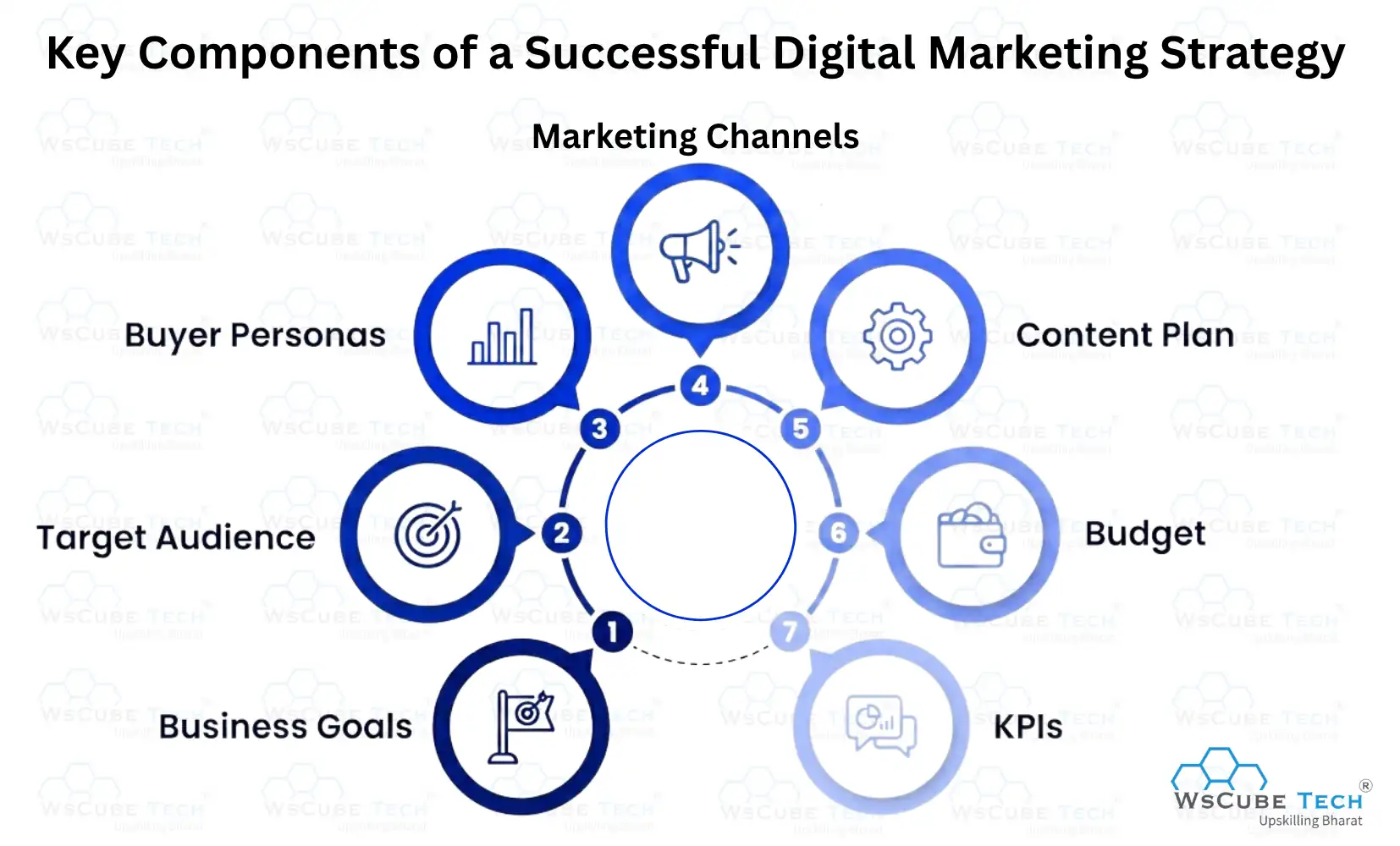
Key Components of a Successful Digital Marketing Strategy
Before you build your digital marketing strategy, you need to understand what goes into it. These are the core building blocks that every effective strategy is made of.
1. Business Goals
Everything starts here. Your digital marketing strategy objectives should be directly tied to what your business is trying to achieve overall. Are you trying to grow revenue? Expand into a new market? Increase customer retention? Build brand awareness?
Setting clear, measurable goals keeps your strategy focused. A goal like "increase qualified leads by 35% in six months" is actionable. A goal like "get more customers" is not.
Your goals also determine which channels and tactics make the most sense. A business focused on immediate sales will take a different approach than one trying to build long-term brand authority.
2. Target Audience
You need to know exactly who you are marketing to. Your target audience is the group of people most likely to benefit from your product or service and most likely to buy from you.
Defining your audience means going beyond age and location. You need to understand their problems, their motivations, where they go for information, what content they enjoy, and what makes them hesitate before buying.
The more specific you are about your audience, the more relevant and effective your entire strategy becomes.
3. Buyer Personas
A buyer persona is a detailed profile of your ideal customer. It is built from real data and research and gives you a human face to create content and campaigns for.
A well-developed persona includes demographic details, job role or lifestyle, daily challenges, goals, preferred content formats, and questions they ask at each stage of the buying process.
Most businesses should have between two and four buyer personas. These profiles guide every decision in your strategy, from what to write about to how to write it, and from which ads to run to what headlines will resonate.
4. Marketing Channels
Not every platform is right for every business, and trying to be everywhere at once is one of the fastest ways to burn out your team and your budget.
Your strategy should identify the specific digital channels that match your audience's behavior and your business goals. These might include Google Search, Instagram, LinkedIn, YouTube, email, or others depending on who you are trying to reach.
Choosing the right channels is one of the most critical digital marketing strategy components. Two to four well-executed channels will always outperform ten poorly managed ones.
5. Content Plan
Content is how you communicate your value to your audience. Your content plan outlines what you will create, in what format, how often, and with what goal.
It should cover blog posts, videos, social media content, email newsletters, case studies, and any other formats relevant to your audience. The plan should be consistent in tone and quality, rooted in your audience's questions, and aligned with your SEO goals.
A content plan also keeps your team organized and prevents the "what should we post today?" scramble that so many businesses fall into.
6. Budget
Your marketing budget determines what is possible and what trade-offs you need to make. It covers ad spend, content creation, tools and platforms, team costs, and any outside help like freelancers or agencies.
A clear budget prevents overspending in one area while neglecting another. It also forces you to prioritize. If you have a limited budget, organic strategies like SEO and content marketing will likely take center stage. With a larger budget, paid advertising can accelerate your results significantly.
7. KPIs
KPIs are the specific metrics that tell you whether your strategy is working. They are the scoreboard for your marketing efforts.
Common KPIs include website traffic, conversion rate, cost per lead, return on ad spend, email open rate, social media engagement, and keyword rankings. The KPIs you choose should connect directly to your goals.
Without KPIs, you are guessing. With them, you have a clear picture of what is working, what is not, and where to focus your energy next.
How to Create a Digital Marketing Strategy (Step-by-Step)
Now that you understand the components, here is a clear, practical process for how to make digital marketing strategy that actually works.
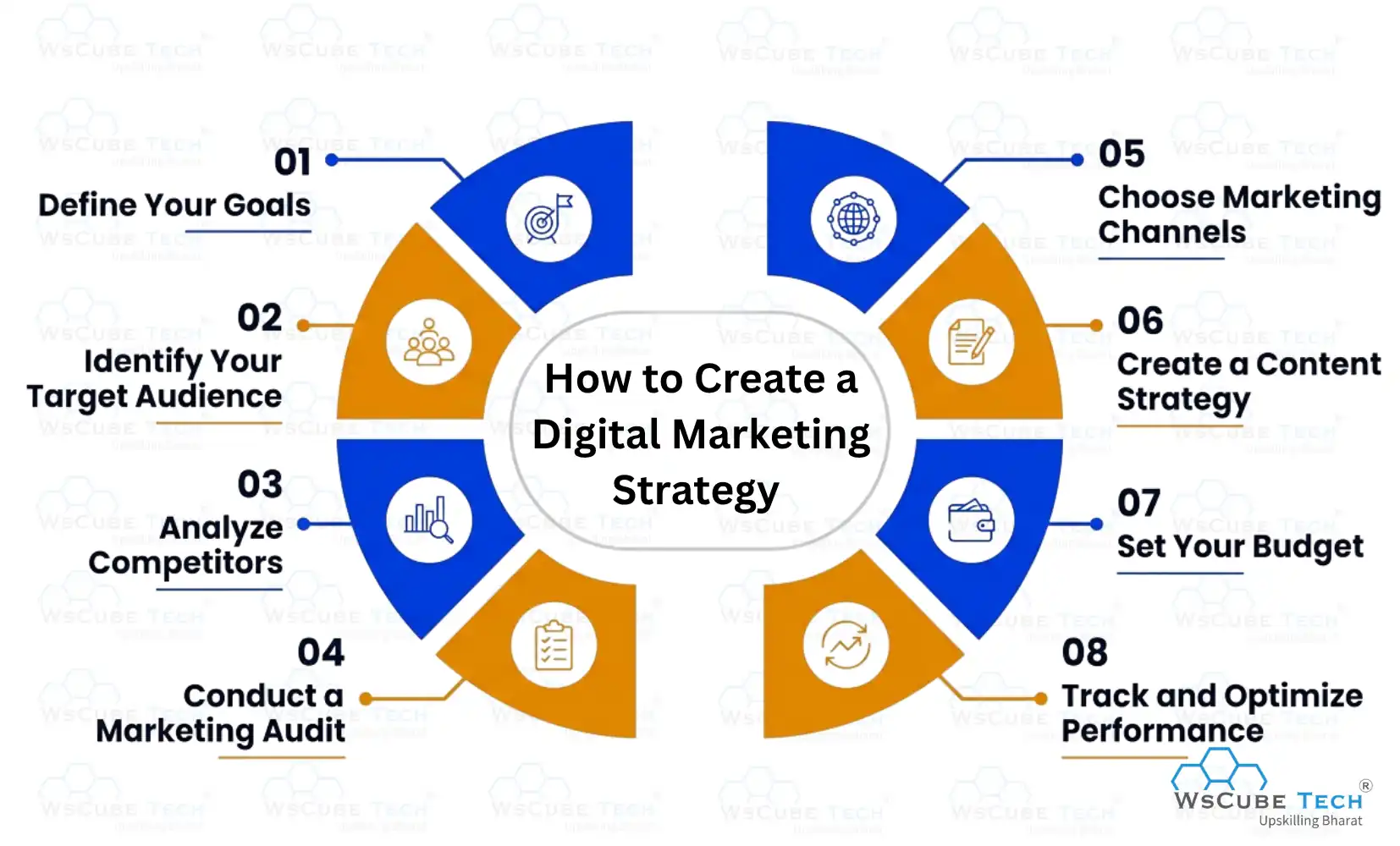
Step 1: Define Your Goals
Start by writing down what you want to achieve and be specific. Use the SMART framework: Specific, Measurable, Achievable, Relevant, and Time-bound.
Good examples of strategic goals:
- Grow organic website traffic by 40% over the next six months
- Generate 300 qualified leads per month through content and SEO
- Increase email subscriber count from 8,000 to 15,000 by year end
- Reduce customer acquisition cost by 20% within the next quarter
Your goals shape everything that follows in your strategy. Weak goals produce weak results. Take the time to make them meaningful.
Step 2: Identify Your Target Audience
Research your current customers, your website visitors, and your social media followers. Look for patterns in who they are, what they care about, and how they behave online.
Use tools like Google Analytics, Meta Audience Insights, customer surveys, and interviews to build a clear picture of your audience. The goal is to understand them so well that your content and campaigns feel like they were made specifically for them, because they were.
Step 3: Analyze Competitors
Your competitors can teach you a lot. Look at what is working for them, what they are missing, and where you can genuinely do better.
Review their websites, blogs, social media activities, keyword rankings, and ad campaigns. Tools like SEMrush and Ahrefs make this research faster and more thorough.
Competitor analysis helps you find gaps in the market, avoid strategies that are already saturated, and identify areas where your business can own a unique position.
Step 4: Conduct a Marketing Audit
If your business has been doing any digital marketing already, do not start from scratch without reviewing what you have. A marketing audit looks at everything you have done so far, your website, your social profiles, past campaigns, your content library, and your email list.
The audit tells you what is already working and worth building on, what needs improvement, and what should be cut entirely. It prevents you from reinventing wheels and helps you allocate resources more efficiently.
Step 5: Choose Marketing Channels
Based on your audience's research, competitor analysis, and goals, select the channels that make the most sense for your strategy. Do not try to cover every platform. Pick the ones where your audience is most active and where your content has the best chance of making an impact.
This is a central part of digital marketing strategy and planning. The wrong channel choices waste time and budget. The right ones accelerate everything.
For example, a professional services firm will likely see more traction on LinkedIn and through SEO than on other platforms. A consumer product targeting Gen Z might find the opposite to true.
Step 6: Create a Content Strategy
Plan what content you will create, in which formats, on which channels, and how often. This should be based on your audience's questions and pain points, your SEO keyword research, and the buying journey of your customers.
Create a content calendar that maps out the next 30, 60, or 90 days of content. Assign owners, set deadlines, and define what success looks like for each piece.
Quality matters more than volume. One well-researched, genuinely helpful blog post will outperform ten rushed, shallow ones.
Step 7: Set Your Budget
Allocate your marketing budget across your chosen channels and activities. Be specific about where money will go, how much is reserved for testing new ideas, and what the expected return looks like for each area.
Review your budget monthly. Digital marketing gives you detailed data on what each channel is producing, so use that information to shift spend toward what is generating the best results and away from what is not.
Step 8: Track and Optimize Performance
Once your strategy is live, measurement becomes your most important job. Track your KPIs consistently. Look for trends over time rather than reacting to every spike or dip.
Use what you learn to run tests, improve underperforming areas, and double down on what is working. The best digital marketing strategies are not static documents. They evolve continuously based on real data.
The right digital marketing tools make it significantly easier to track performance, automate reporting, and spot opportunities that might otherwise go unnoticed.
Upcoming Masterclass
Attend our live classes led by experienced and desiccated instructors of Wscube Tech.


7 Most Effective Digital Marketing Strategies in 2026
Knowing the strategy framework is one thing. Knowing which specific digital marketing strategies are delivering results right now is another. Here are the seven that are making the biggest impact in 2026.
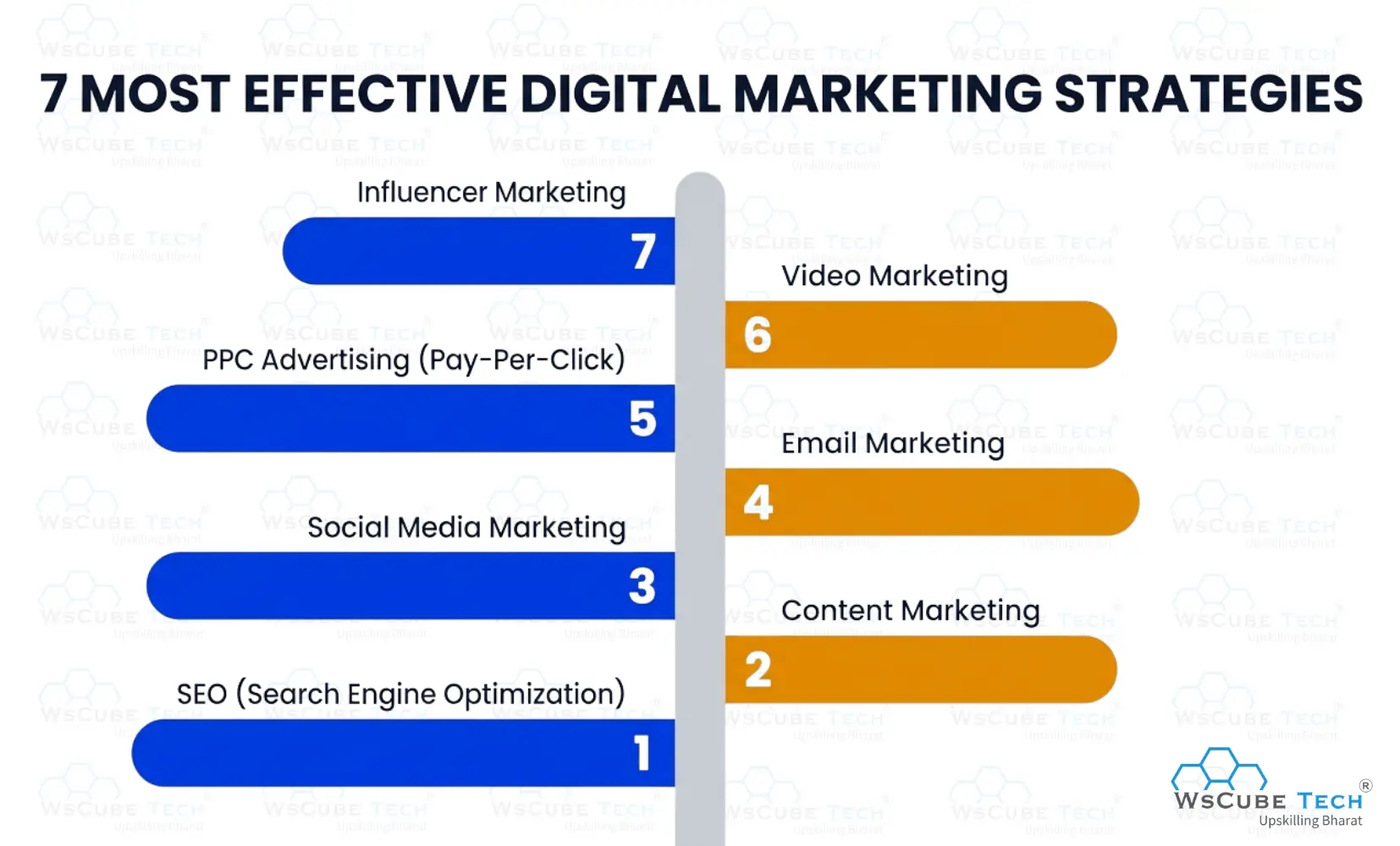
1. SEO (Search Engine Optimization)
SEO is the practice of optimizing your website and content to rank higher in search engine results. It remains one of the most valuable and cost-effective digital marketing strategies available.
According to Incremys, 93% of all online traffic comes from search engines. If people cannot find your business through search, you are invisible to the majority of your potential customers.
A strong SEO strategy in 2026 includes keyword research, on-page optimization, technical SEO, high-quality link building, and content that genuinely answers what people are searching for. With AI-driven search results becoming more common, content that is clear, accurate, and helpful matters more than ever.
SEO takes time, but the results compound. Unlike paid advertising, organic rankings continue to bring traffic long after the initial work is done.
2. Content Marketing
Content marketing is the strategy of creating and sharing valuable content that attracts, educates, and converts your target audience. It powers almost every other digital marketing channel.
The global content marketing industry is expected to reach $107 billion by 2026, and 72% of marketers report that their content strategy has directly increased engagement and website traffic.
Effective content comes in many forms: blog posts, how-to guides, video tutorials, case studies, infographics, podcasts, and email newsletters. The format matters less than the quality. Content that solves real problems for your audience builds trust, drives search traffic, and creates loyal customers over time.
Keeping up with the latest digital marketing trends helps you adapt your content strategy as audience behavior and platform preferences evolve throughout the year.
3. Social Media Marketing
Social media is where conversations happen; communities form, and brands either connect with their audience or disappear into the noise.
Platforms like Instagram, LinkedIn, Facebook, YouTube, and X each serve different purposes and attract different audiences. An effective social media strategy identifies which platforms your audience actually uses, then creates content tailored to each one.
In 2026, short-form video, interactive content, and authentic storytelling continue to dominate social media. Brands that show their human side and engage genuinely with their followers grow faster than those that treat social media as a broadcast channel.
Consistency is the single most important factor in social media success. Posting regularly, engaging with comments, and showing up for your audience builds the kind of presence that translates into trust and sales over time.
4. Email Marketing
Email marketing remains one of the highest-returning channels in digital marketing. It gives you a direct line of communication with people who have already expressed interest in your brand.
A strong email strategy goes beyond sending monthly newsletters. It includes personalized welcome sequences for new subscribers, nurture campaigns that guide leads through the buying process, re-engagement campaigns for inactive subscribers, and promotional emails tied to specific offers.
According to Webandcrafts, companies with strong omnichannel strategies that include email achieve an 89% customer retention rate, compared to just 33% for those with weaker channel alignment. That gap represents a significant competitive advantage.
Personalization is key. The more relevant your emails feel to each individual subscriber, the better your open rates, click-through rates, and conversions will be.
5. PPC Advertising (Pay-Per-Click)
PPC advertising lets you place your business in front of people who are actively searching for what you offer or who match a detailed audience profile you define. Google Ads and Meta Ads are the two dominant platforms.
According to SEO.com, 80% of companies use Google Ads for PPC, and 84% of brands report positive results from their paid advertising campaigns. PPC works best when you have a clear, compelling offer, a well-defined audience, and a landing page built to convert.
The biggest advantage of PPC is speed. While SEO takes months, a well-structured paid campaign can generate traffic and leads within days. The trade-off is that results stop when you stop spending, which is why combining PPC with organic strategies like SEO gives you the best of both worlds.
6. Video Marketing
Video has become a non-negotiable part of any strong digital marketing strategy. According to DemandSage, over 91% of businesses are using video in their marketing campaigns in 2026, and digital video ad spend is expected to reach $72.4 billion this year.
Video works across every stage of the marketing funnel. Short-form videos on Instagram Reels build awareness and reach new audiences. Tutorial and explainer videos on YouTube educate and build trust. Testimonial videos and case study videos help convert hesitant buyers.
You do not need a studio or a big budget to get started. Authentic, helpful videos shot on a smartphone often outperform expensive productions because they feel more genuine.
Using the right AI tools for digital marketing can help you script, produce, caption, and repurpose video content far more efficiently than doing it all manually.
7. Influencer Marketing
Influencer marketing has matured into a serious, measurable channel. Brands have moved away from chasing celebrity endorsements and are instead partnering with micro-influencers and nano-influencers who have smaller but highly engaged audiences in specific niches.
The reason this works is simple: people trust recommendations from creators they follow more than they trust advertisements. Influencer partnerships drive product discovery, build credibility, and generate authentic social proof in a way that traditional advertising cannot replicate.
The key to good digital marketing strategy execution with influencers is choosing partners whose audience genuinely overlaps with your ideal customer, setting clear expectations, and tracking results carefully.
Digital Marketing Strategy Examples
Understanding the concept of a digital marketing strategy is easier when you can see what it looks like in practice. Here are three clear examples across different types of businesses.
Example 1: A Local Education Institute
A coaching center in a mid-sized city wants to increase enrollment in its digital marketing course. Its digital marketing strategy focuses on local SEO to rank for searches like "digital marketing course in [city name]," a YouTube channel with free tips to build trust, and a Facebook and Instagram ad campaign targeting students and working professionals aged 18 to 35. Email is used to follow up with people who fill out inquiry forms. KPIs include course inquiries, ad cost per lead, YouTube subscribers, and enrollment conversions.
Example 2: A B2B SaaS Company
A software company selling HR tools to mid-sized businesses builds its strategy around long-form blog content targeting HR-related keywords, LinkedIn thought leadership from company executives, and Google Search ads targeting high-intent searches like "HR management software for small teams." Demo bookings, cost per acquisition, and monthly recurring revenue are the primary KPIs.
Example 3: An E-Commerce Fashion Brand
A clothing brand targeting young women builds its digital marketing strategy around Instagram content, micro-influencer partnerships, Google Shopping ads, and a strong email marketing funnel for repeat purchases. It tracks return on ad spend, customer lifetime value, and repeat purchase rate as its main success metrics.
These are three different businesses with three very different strategies, but the structure is the same across all of them: clear goals, defined audience, chosen channels, content plan, budget, and measurable KPIs. That is the digital marketing strategy framework at work.
Expand Your Marketing Skills
Common Digital Marketing Strategy Mistakes to Avoid
Even businesses with good intentions make strategic mistakes that cost them time, money, and growth. Here are the most common ones and how to avoid them.
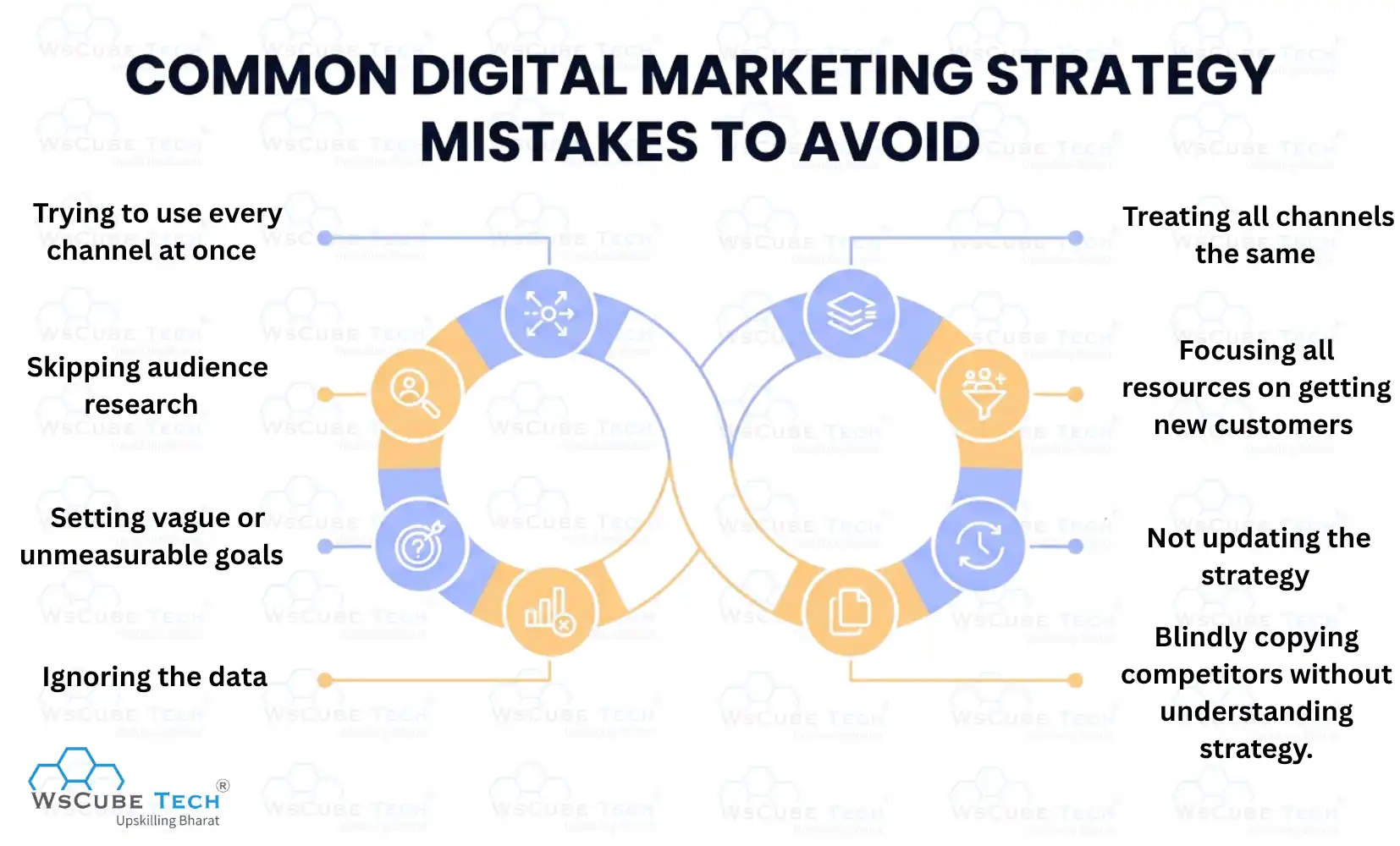
1. Trying to use every channel at once
This is one of the most frequent mistakes. When you spread your effort across too many platforms, you do a poor job on all of them. Choose two to four channels and do them well.
2. Skipping audience research
Building a strategy without deeply understanding your audience is like building a product no one asked for. Always start with research. Talk to your customers. Study your data. Build real personas.
3. Setting vague or unmeasurable goals
"Grow our online presence" is not a strategic goal. It gives your team no direction and no way to measure success. Be specific about what you want to achieve and when.
4. Ignoring the data
Your analytics tools are generating insights every single day. Ignoring them means you keep running the same campaigns even when they are not working. Set a regular habit of reviewing your numbers.
5. Treating all channels the same
What works on LinkedIn does not work on Instagram. What resonates with a B2B audience will fall flat with a consumer audience. Tailor your content and tone to each platform and each audience segment.
6. Focusing all resources on getting new customers
Acquisition is important, but retention is often more profitable. Existing customers cost less to sell to and tend to spend more over time. Make sure your strategy includes efforts to keep the customers you already have.
7. Not updating the strategy
A digital marketing strategy written at the start of the year should not look exactly the same at the end of it. Markets shift. Platforms change. Audience behavior evolves. Review and update your strategy at least every quarter.
8. Copying competitors without understanding why they do what they do
It is fine to learn from what competitors are doing but copying them blindly without understanding their audience or goals rarely works. Build your strategy around your own customers and your own goals.
How to Measure the Success of Your Strategy?
Building a strategy is only useful if you can tell whether it is working. Here are nine ways to measure the performance of your digital marketing strategy effectively.
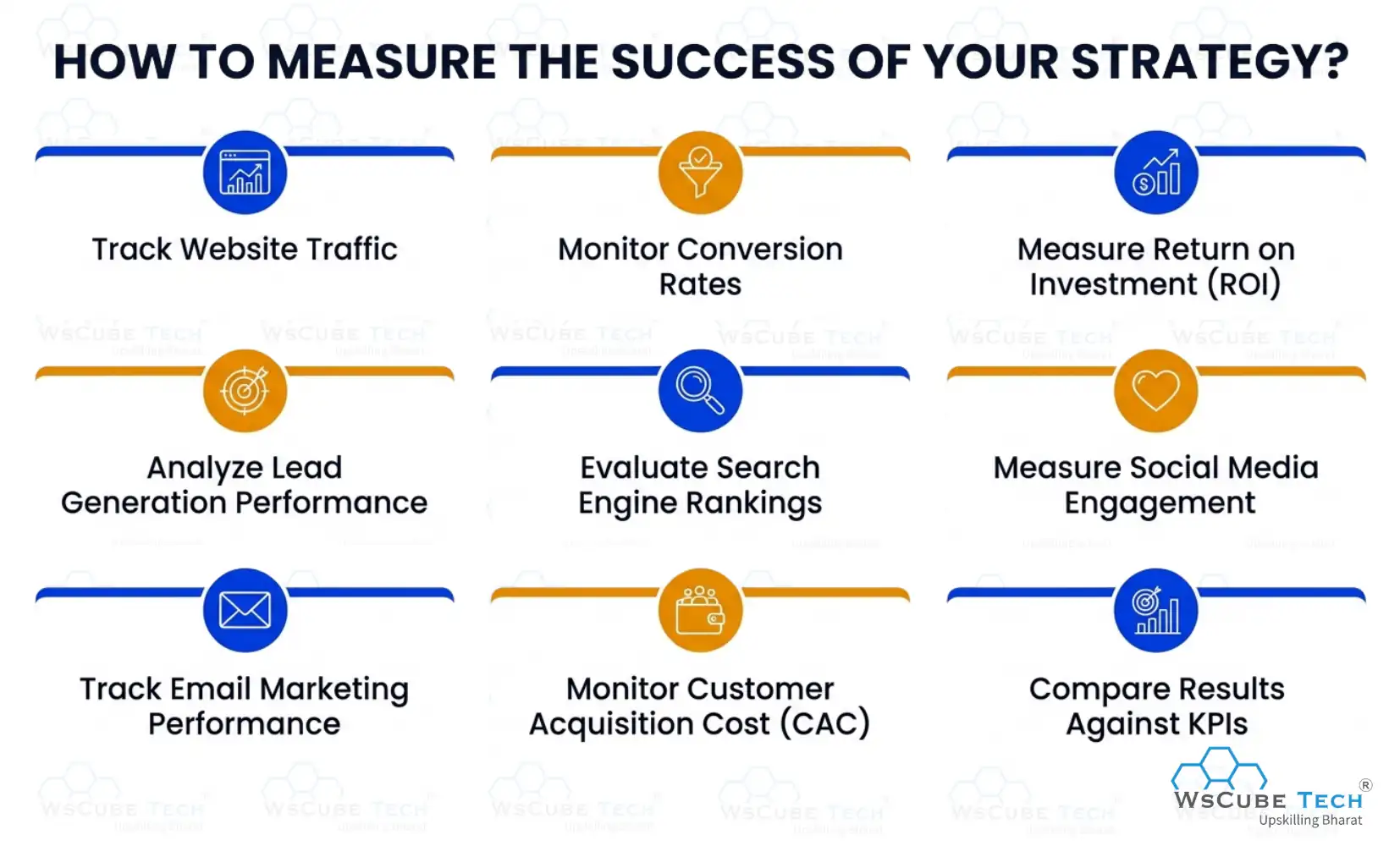
1. Track Website Traffic
Monitor the total number of visitors to your website, where they are coming from, and which pages they spend the most time on. Growing organic traffic over time is one of the clearest indicators that your SEO and content efforts are gaining traction.
2. Monitor Conversion Rates
Traffic alone is not enough. Track what percentage of your visitors are completing a meaningful action: filling out a form, making a purchase, signing up for a newsletter, or booking a demo. Improving your conversion rate means you get more results from the same amount of traffic.
3. Measure Return on Investment (ROI)
Calculate how much revenue your marketing is generating compared to what you are spending on it. A positive and growing ROI means your strategy is working. If ROI is negative or flat, it is time to reassess where the money is going.
4. Analyze Lead Generation Performance
If generating leads is one of your goals, track not just how many leads you are getting but where they are coming from and how many convert into paying customers. Lead quality matters as much as lead volume.
5. Evaluate Search Engine Rankings
Track where your website ranks for the keywords you are targeting. Improving rankings over time confirms that your SEO efforts are moving in the right direction. Tools like Google Search Console, SEMrush, and Ahrefs make this easy to monitor.
6. Measure Social Media Engagement
Go beyond follower counts. Track likes, comments, shares, saves, link clicks, and story interactions. High engagement means your content is connecting with your audience. Low engagement is a signal to test different content types, topics, or posting times.
7. Track Email Marketing Performance
Review your email open rates, click-through rates, and unsubscribe rates regularly. These metrics tell you how relevant and valuable your subscribers find your emails. Falling open rates often mean your subject lines need work. High unsubscribe rates suggest your content or frequency needs adjustment.
8. Monitor Customer Acquisition Cost (CAC)
CAC is the average amount you spend to acquire one new customer. Tracking it over time tells you whether your marketing is becoming more or less efficient. A falling CAC with stable or growing revenue is a sign of a strong strategy.
9. Compare Results Against KPIs
At the end of each reporting period, compare your actual results against the KPIs you set at the start of your strategy. This comparison tells you exactly where you succeeded, where you fell short, and what to prioritize in the next period.
Staying on top of the latest digital marketing tips and tricks can help you continually sharpen how you measure and improve performance across all your marketing channels.
Explore Our Most Popular Marketing Courses
Tips for Creating an Effective Digital Marketing Strategy
Here are practical, experience-backed tips to help you build a best digital marketing strategy for your business:
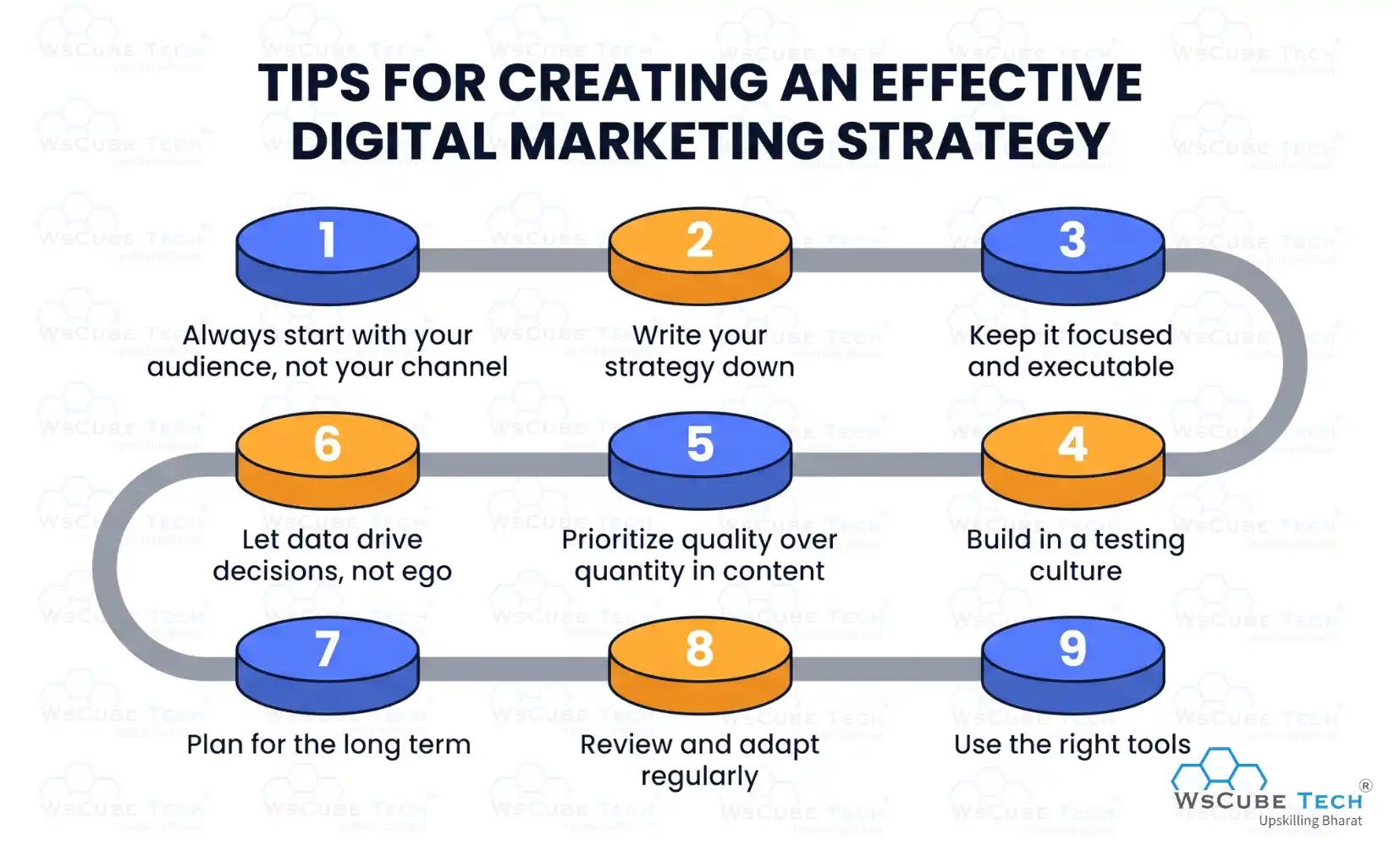
1. Always start with your audience, not your channel
Many businesses pick up platforms first and then figure out what to say. Reverse that process. Know your audience deeply first, and the right channels will become obvious.
2. Write your strategy down
A strategy that exists only in someone's head is not a strategy. Documenting it creates clarity, keeps your team aligned, and gives you a reference point for future decisions.
3. Keep it focused and executable
The best digital marketing strategy is one your team can actually implement consistently. A complex strategy with 12 channels and 40 tactics will collapse under its own weight. Simplicity and consistency beat complexity every time.
4. Build in a testing culture
Digital marketing gives you the ability to test ideas quickly and cheaply. Create a habit of running small experiments, measuring results, and scaling what works. Every test teaches you something useful.
5. Prioritize quality over quantity in content
One well-researched, genuinely helpful piece of content will drive more long-term value than ten shallow posts. Invest the time to create content that truly serves your audience.
6. Let data drive decisions, not ego
It is easy to fall in love with a campaign or a channel because you worked hard on it. But if the data says it is not performing, listen to the data. Shift resources to what is actually working.
7. Plan for the long term
Channels like SEO and content marketing take six to twelve months to show meaningful results. Businesses that give up after a few weeks never see the compounding benefits that come with sustained effort. Commit to your strategy and give it time to work.
8. Review and adapt regularly
Set a monthly or quarterly review cadence to assess your results, identify what has changed in your market, and update your strategy accordingly. Staying current with the latest digital marketing trends is a big part of this.
9. Use the right tools
You cannot manage a modern digital marketing strategy manually. Invest in the right tools for analytics, content management, email automation, and social scheduling to keep your operation efficient and scalable.
If you are serious about developing the skills to build and execute a professional-grade digital marketing strategy, enrolling in a structured digital marketing course is one of the most effective steps you can take.

FAQs About Digital Marketing Strategy
A digital marketing strategy is a plan that outlines how your business will use online channels to reach your target audience, communicate your value, and achieve your goals. It covers which channels to use, what content to create, how much to spend, and how to measure success.
A strategy is the big-picture direction: your goals, your audience, and your overall approach. A plan is the specific, step-by-step roadmap for carrying out that strategy. The strategy comes first. The plan follows.
The core digital marketing strategy components are: business goals, target audience, buyer personas, marketing channels, content plan, budget, and KPIs. Each one plays a specific role, and leaving any of them out weakens the whole strategy.
It depends on your channels. Paid advertising can produce results within days. SEO and content marketing typically take three to six months to show meaningful traction. A balanced strategy usually combines both to get short-term wins while building long-term growth.
For most small businesses, a combination of local SEO, content marketing, and email marketing offers the best return given limited budgets and resources. These are channels that build compounding value over time without requiring massive ad spend.
The key digital marketing strategy steps are: define your goals, identify your target audience, analyze competitors, audit your existing marketing, choose your channels, create a content strategy, set your budget, and then continuously track and optimize performance.
A digital marketing strategy framework is a structured model for planning, executing, and measuring your marketing. Common frameworks include the RACE model (Reach, Act, Convert, Engage), the SOSTAC model (Situation, Objectives, Strategy, Tactics, Actions, Control), and the PESO model (Paid, Earned, Shared, Owned media). These frameworks give your strategy a consistent, repeatable structure.
A clear example of a digital marketing strategy would be a fitness brand that defines its goal as growing online sales by 30% in six months, identifies its audience as women aged 25 to 40 interested in home workouts, and chooses Instagram, YouTube, and email as its main channels. It creates a content calendar around fitness tips and product tutorials, allocates budget across organic content and Meta ads, and tracks conversion rate, revenue per email, and return on ad spend as KPIs.
Start with your goals and your audience. If your audience is actively searching for your product or service, SEO and PPC are strong channels. If your product benefits from demonstrations, the video works well. If you are in a relationship-driven industry, email and content marketing may be your best bet. Base your decisions on research, not assumptions.
Most strategies fail because they lack specific goals, skip proper audience research, or are never actually executed consistently. Many businesses also fail because they do not track results or adapt based on data. A strategy without measurement is just a wish list.
Conclusion
A strong digital marketing strategy is not just for large companies; it is essential for businesses of all sizes. The most successful brands in 2026 are those that use clear digital marketing strategies, understand their audience, create valuable content, and make data-driven decisions.
Remember, strategy comes before tactics. Set clear goals, choose the right channels, track performance, and continuously improve based on results. Your strategy does not have to be perfect from the start. What matters is taking action, learning from the data, and refining your approach over time. Start today, stay consistent, and build a foundation for long-term online growth.
Join Our On-Campus Digital Marketing Program
Explore Our Free Courses






Leave a comment
Your email address will not be published. Required fields are marked *Comments (0)
No comments yet.