

Imagine creating a marketing campaign that looks perfect but fails to attract the right audience. In many cases, the problem isn't the product or the message; it's not understanding the right customer. This is where buyer personas make all the difference.
Buyer personas are research-backed profiles that help you understand your ideal customers, their needs, challenges, and buying behavior. In this guide, you'll learn what they are, why they matter, how to create them step by step, along with real examples, best practices, and common mistakes to avoid.
What is Buyer Persona?
So, what does buyer persona means in simple terms? A buyer persona is a semi fictional representation of your ideal customer, built using real data, market research, and educated assumptions about their demographics, behavior patterns, goals, and challenges.
A buyer persona is semi-fictional, meaning it isn't one real person, but a profile created from the shared traits of many real customers. Instead of targeting a broad audience like "young job seekers," you create a specific persona, such as "Aman, a 23-year-old graduate looking for a high-paying, practical skill." This helps you create more personalized and effective marketing messages.
A buyer/customer persona typically includes information such as:
- Age, gender, location, and education
- Job title, income range, and career stage
- Goals and motivations
- Pain points and challenges
- Preferred communication channels
- Buying behavior and decision making process
So, what is buyer persona in marketing? It is the foundation that every marketing decision should be built on. Without it, marketing becomes a guessing game. With it, marketing becomes a conversation with a specific person who has specific needs.
A buyer persona goes beyond basic demographics by including customer goals, challenges, motivations, and buying behavior. Unlike an ideal customer profile (ICP), which defines the right company to target, a persona focuses on the individual decision-makers, helping teams create more relevant and effective marketing.
What are the Benefits of Buyer/Customer Personas?
Building a persona takes time and effort, so it is fair to ask whether it is worth it. The data says yes, clearly. According to a HubSpot study, companies that exceed their revenue and lead generation goals are far more likely to have documented buyer personas compared to companies that fall short of their targets.
This is not a coincidence. When you know exactly who you are targeting, you stop wasting budget on people who were never going to convert. Here are the main benefits of using customer personas in your marketing strategy:
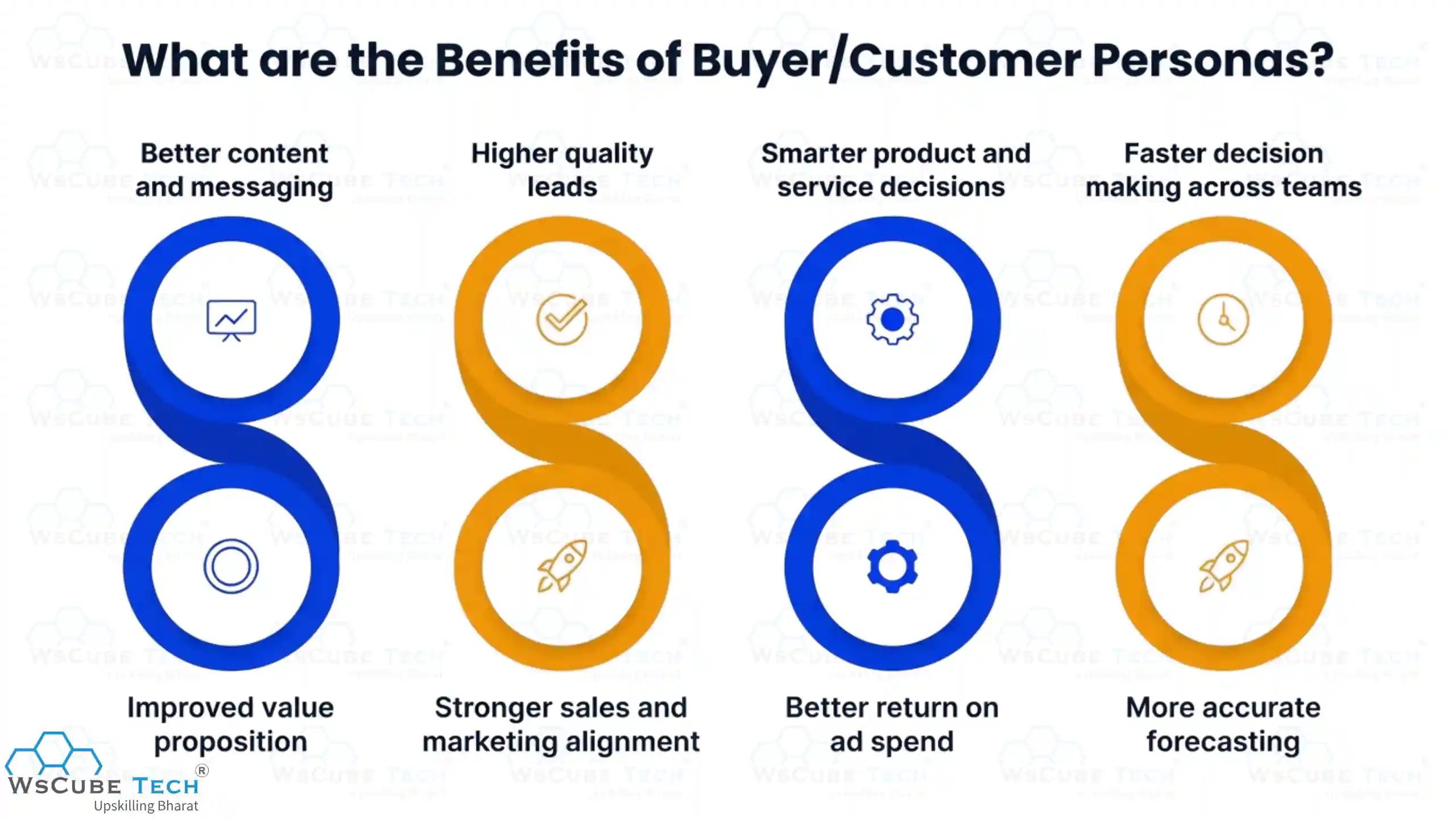
1. Better content and messaging
When you know your persona's pain points, you can write blog posts, social media captions, and ad copy that speaks directly to their problems. Generic content gets ignored. Specific content gets read.
2. Improved value proposition
Research from Delve AI shows that a large majority of companies using personas reported an improved value proposition, because they finally understood what their customers actually cared about.
3. Higher quality leads
When your ads and landing pages are built around a clear persona, you naturally attract people who match that profile, which means fewer wasted clicks and more qualified leads.
4. Stronger sales and marketing alignment
Sales teams often complain that marketing sends them unqualified leads. Personas give both teams a shared understanding of who the ideal customer is, which reduces this friction.
5. Smarter product and service decisions
When you understand your persona's goals and frustrations, you can shape your courses, products, or services to solve their actual problems instead of guessing what they might want.
6. Better return on ad spend
Personalized and targeted campaigns consistently outperform broad, generic ones. HubSpot research cited by Protocol 80 found that personalized emails can drive significantly higher click through rates and revenue compared to generic, one size fits all messages.
7. Faster decision making across teams
When a new campaign idea comes up, teams often spend hours debating who the audience should be and what tone to use. A documented persona removes this guesswork, since everyone can simply refer back to the agreed profile instead of starting the conversation from scratch every time.
8. More accurate forecasting
When you understand a persona's typical buying cycle, objections, and triggers, you can predict with more confidence how a campaign targeting that persona is likely to perform, which makes budget planning far less of a gamble.
These benefits compound over time. A business that consistently builds and refines its personas tends to see steady improvement across every metric, from click through rates to customer retention, simply because every decision becomes more informed.
Recommended Professional Certificates
AI-Powered Digital Marketing Course
Performance Marketing Bootcamp
SEO Specialist Bootcamp
Why are Buyer Personas Important?
It is one thing to know the benefits, but it helps to understand the deeper reason why customer persona is important for any business that wants to grow sustainably. Marketing without a persona is like writing a letter without knowing who will read it.
You might write something well crafted, but if it does not match the reader's interests, language, or concerns, it gets ignored. Buyer personas solve this problem by giving you a clear, specific reader to write for. There are a few core reasons personas matter so much:
- They reduce guesswork: Instead of assuming what your audience wants, you base decisions on actual research and patterns.
- They make personalization possible: Modern customers expect brands to understand them. A report referenced by Delve AI found that a large share of consumers expects personalized engagement based on their past interactions, and a similar share said they feel frustrated when content is not personalized.
- They guide budget allocation: When you know which segment of your audience brings the most value, you can direct your ad spend and content efforts toward that segment instead of spreading resources too thin.
- They keep teams aligned: Marketing, sales, product, and customer support all work better when everyone is picturing the same type of customer.
- They protect you from chasing the wrong customers: A negative persona, which represents the type of customer you do not want, helps you avoid wasting time and resources on leads that rarely convert or that create more support burden than they are worth.
A well-defined buyer persona helps businesses understand their audience, create relevant messaging, and build stronger customer relationships. By addressing real customer needs instead of using generic marketing, brands can stand out in competitive markets and connect with the right audience more effectively.
Types of Buyer Personas
Not every business needs just one persona, and not every persona looks the same. Understanding the different types of buyer persona helps you build a more complete picture of your audience.
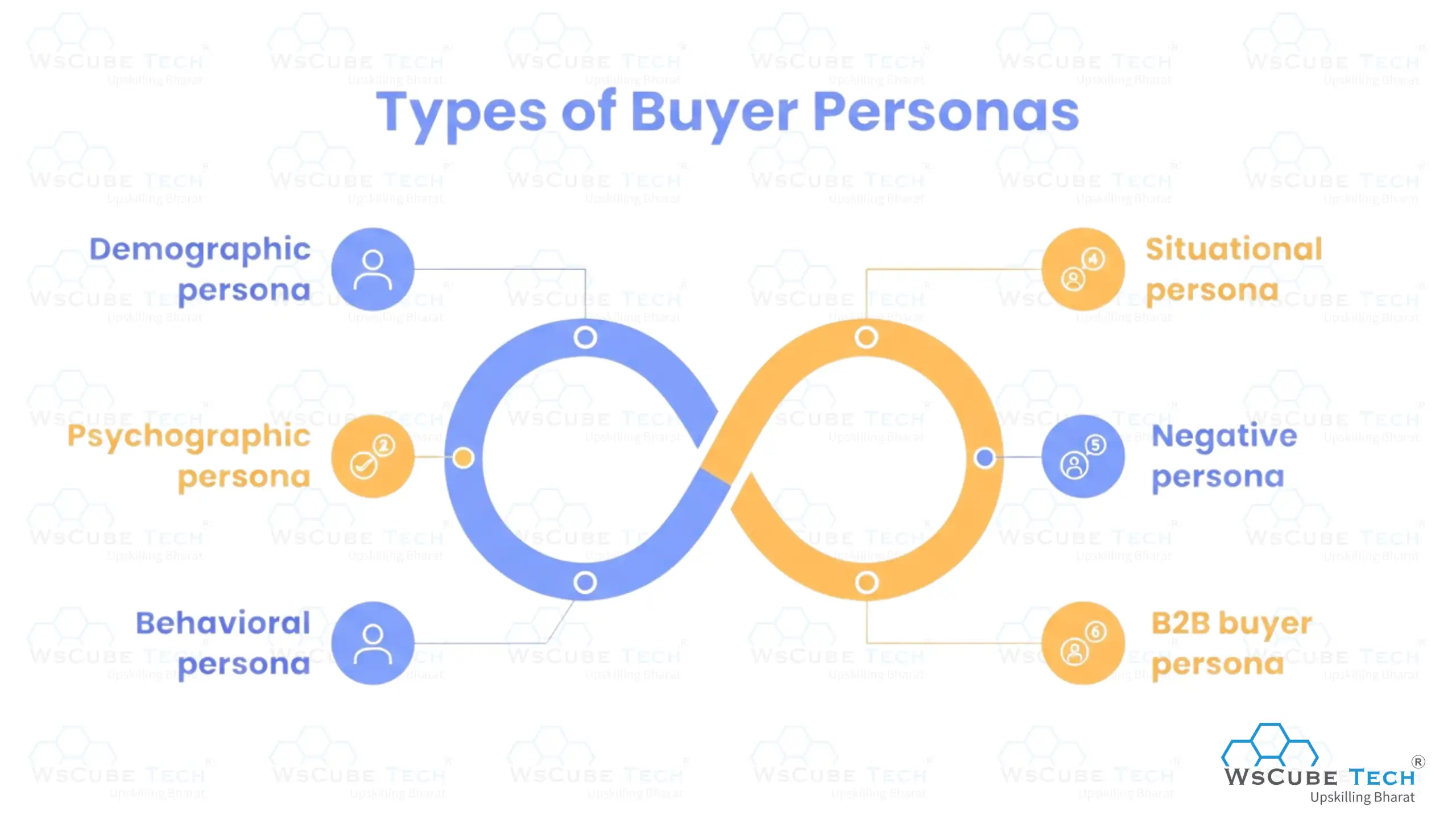
1. Demographic persona
This is the most basic type, built around age, gender, income, education, location, and family status. It answers the question of who your customer is on paper.
2. Psychographic persona
This type goes deeper into values, interests, lifestyle, and attitudes. It explains why a customer behaves the way they do, not just what they look like in a form.
3. Behavioral persona
This persona is built around how people interact with your brand, such as their browsing habits, purchase frequency, preferred channels, and content consumption patterns.
4. Situational persona
This persona considers the specific situation or stage a customer is in, such as a student about to graduate, a professional looking for a career switch, or a business owner trying to scale digital presence.
5. Negative persona
A negative persona represents the type of person who is unlikely to convert, churns quickly, or drains your support resources. Knowing who not to target is just as valuable as knowing who to target, because it saves ad spend and content effort.
6. B2B buyer persona
For companies selling to other businesses, a single decision maker rarely exists. Research from Forrester found that the average B2B purchase decision involves over a dozen stakeholders, and most of these decisions cross multiple departments.
This means B2B companies often need multiple personas representing different roles in the buying committee, such as the end user, the budget approver, and the technical evaluator.
Most businesses should start with one or two buyer personas focused on their most valuable customers. Combining demographics, motivations, and buying behavior creates more accurate personas that help deliver relevant marketing and better business results.
What Should Be Included in a Buyer Persona?
A persona is only useful if it contains the right information. A vague persona with just an age range and a job title will not help you write better content. Here is what a complete persona should include.
- Basic demographics: Name (you can give them a fictional name to make them memorable), age range, gender, location, education level, and income range.
- Professional background: Job title, industry, years of experience, and company size if relevant. This matters even for individual customers, since career stage often shapes buying decisions.
- Goals and motivations: What is this person trying to achieve? Are they trying to get a promotion, switch careers, grow a business, or simply learn a new skill to feel secure about their future?
- Pain points and challenges: What is stopping them from reaching their goals right now? This could be a lack of skills, lack of time, lack of money, or simply not knowing where to start.
- Buying behavior: How does this persona research and decide on a purchase? Do they read reviews, ask friends, compare prices, or trust recommendations from influencers?
- Preferred channels: Where does this persona spend time online? Instagram, YouTube, LinkedIn, Google search, or WhatsApp groups? Knowing this helps you choose where to invest your marketing budget.
- Objections and hesitations: What might stop them from buying even if they are interested? Common objections include price, lack of trust, fear of wasting time, or confusion about whether the product fits their needs.
- A real quote: Many marketers add a short, realistic quote that captures how this persona thinks, such as "I want a course that actually gets me a job, not just a certificate." This makes the persona feel human and easier to write for.
A strong buyer persona goes beyond describing a customer—it helps predict their needs and decisions. Start with the best data you have, even if some details are assumptions, and refine the persona over time using customer feedback, surveys, and campaign insights.
Upcoming Masterclass
Attend our live classes led by experienced and desiccated instructors of Wscube Tech.




How to Create a Buyer Persona?
If you are wondering how to create buyer persona from scratch, the process is more structured than most people expect. Here is a step-by-step approach you can follow.
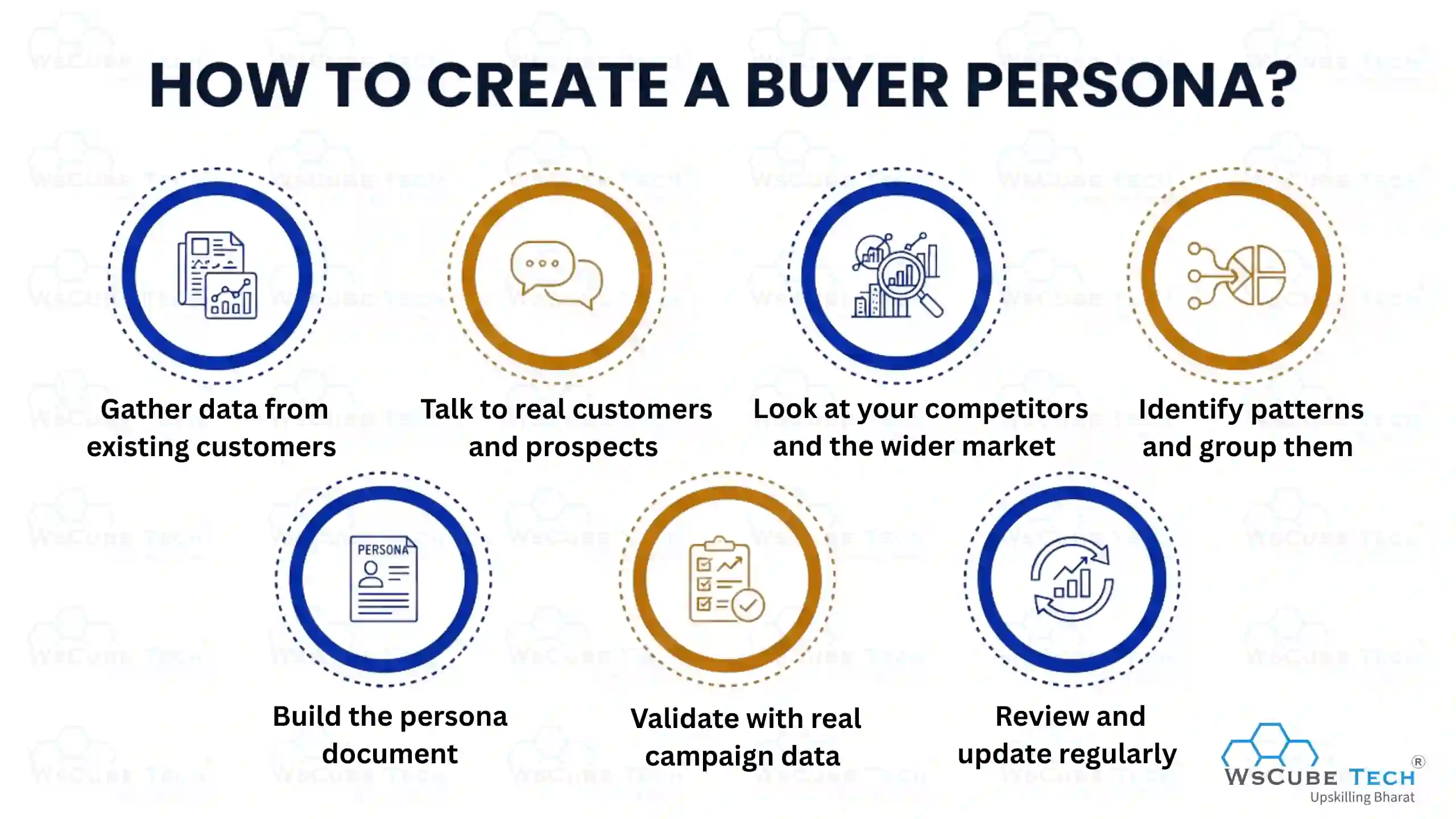
Step 1: Gather data from existing customers
Start with the people who already know your brand. Look at your CRM, sales records, website analytics, and customer support tickets. Identify patterns such as common job titles, common reasons people buy, and common questions they ask before purchasing.
Pay close attention to your highest value customers, the ones who stay longest and spend the most, since their traits often point to the segment worth targeting more aggressively. It also helps to look beyond your paying customers.
Website analytics can reveal which blog posts get the most traffic, which pages people bounce from quickly, and which search terms bring visitors to your site in the first place. These small signals often hint at problems your audience is searching to solve, even before they ever talk to your sales team.
Step 2: Talk to real customers and prospects
Data alone will not tell you why someone buys. Interviews will. Speak with a mix of recent customers, long term customers, and people who almost bought but did not. According to research highlighted in the B2B buyer persona playbook, interviewing lost prospects often reveals more honest insights than talking only to happy customers, since they are more willing to share what almost stopped them.
Step 3: Look at your competitors and the wider market
Study who your competitors are targeting and how they position themselves. This helps you spot gaps in the market that your persona might care about but that nobody is addressing yet.
Step 4: Identify patterns and group them
Once you have enough data, you will start noticing repeated patterns, such as a large group of people in a similar age range with a similar career problem. Group these patterns into two or three core segments rather than trying to capture every possible variation.
Step 5: Build the persona document
Turn each segment into a detailed persona using the elements mentioned earlier, including demographics, goals, pain points, buying behavior, and a memorable name. Keep the document visual and easy to scan, since your team will need to reference it often.
Step 6: Validate with real campaign data
Once your persona guides a campaign, measure the results. If engagement and conversions improve, your persona is accurate. If not, revisit your research and adjust.
You do not need expensive software to do any of this. A simple Google Form can collect survey responses, a basic spreadsheet can track patterns across interviews, and free templates from platforms like HubSpot can help you organize the final document into something visual and shareable. The quality of your research matters far more than the tools you use to organize it.
Step 7: Review and update regularly
Markets shift, platforms change, and customer expectations evolve. A persona built two years ago may no longer reflect reality. Most experienced marketers recommend reviewing personas every six to twelve months, or sooner if you notice a major shift in your industry.
This process applies whether you are building a buyer persona in digital marketing agency, an ecommerce store, or a B2B software company. The core steps stay the same, only the data sources and depth of research change.
Must-Know Concepts in Digital Marketing
Buyer Persona Example:
Understanding the concept of a buyer persona becomes much easier when you look at a real example. Below are two sample buyer personas—one for a B2C audience and another for a B2B audience.
Example 1: Buyer Persona for a Digital Marketing Training Institute (B2C)
| Attribute | Details |
| Persona Name | Career Switch Aman |
| Age | 24 years |
| Location | Tier-2 city in India |
| Education | B.Com Graduate |
| Current Job | Working in an entry-level office job with limited career growth |
| Goal | Wants to build a successful career in digital marketing because of the growing demand and better salary opportunities. However, he has no prior technical knowledge. |
| Pain Points | Confused about choosing the right course, worried about spending money on a program that doesn't lead to a job, and lacks confidence in his English communication skills. |
| Buying Behavior | Watches YouTube reviews, compares different institutes, asks for recommendations in Telegram and WhatsApp groups, and carefully checks Google reviews and placement records before enrolling. |
| Preferred Channels | YouTube, Instagram Reels, and Google Search |
| Main Objections | Thinks the course fee is expensive compared to his current salary and worries whether he can balance learning with his full-time job. |
| Typical Quote | "I don't just want a certificate—I want practical skills that can help me get a good job." |
This persona represents thousands of young professionals who are looking for a career change but need trust, guidance, and proof before making a decision.
Example 2: Buyer Persona for Corporate Training (B2B)
| Attribute | Details |
| Persona Name | Scaling Startup Sana |
| Age | 31 years |
| Job Title | Marketing Manager at a growing eCommerce startup |
| Goal | Wants to train her existing marketing team instead of relying on external agencies, helping the company save money and gain more control over marketing activities. |
| Pain Points | Finds it difficult to hire skilled digital marketers, has a limited training budget, and needs employees who can handle both strategy and execution. |
| Buying Behavior | Compares different corporate training providers, studies course curriculum, practical projects, trainer experience, and client testimonials before making a decision. |
| Preferred Channels | LinkedIn and Google Search |
| Main Objections | Wants clear proof that the training will improve employee performance and deliver measurable business results. |
| Typical Quote | "I need a training partner that focuses on real business outcomes, not just classroom theory." |
What Can You Learn from These Examples?
Although both personas are interested in digital marketing training, their needs are completely different.
- Career Switch Aman is an individual learner who wants to improve his career prospects and secure a better job.
- Scaling Startup Sana is a business decision-maker looking for a reliable training partner to upskill her team.
This is why businesses should avoid creating just one generic buyer persona. Different customer groups have different goals, challenges, buying habits, and decision-making processes. Creating separate buyer personas helps you deliver the right message to the right audience, resulting in better engagement, stronger trust, and higher conversions.
Best Practices for Creating Buyer Personas
Once you understand the basics, a few best practices can help you build personas that actually drive results instead of becoming forgotten documents.
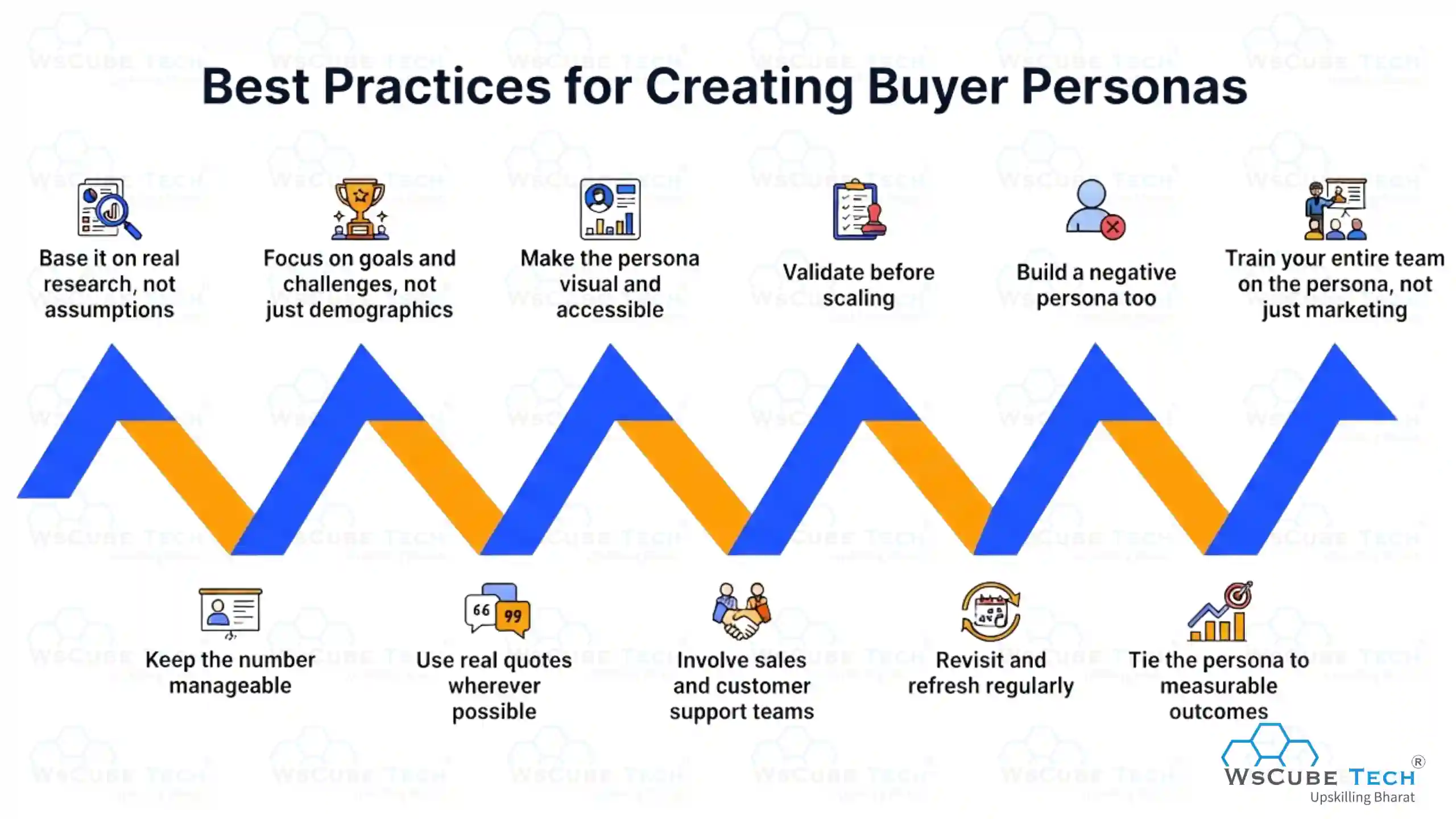
1. Base it on real research, not assumptions
It is tempting to imagine what your ideal customer looks like, but personas built purely on guesswork often miss the real motivations and objections that drive buying decisions.
2. Keep the number manageable
Most businesses only need one to three primary personas to start. Building too many personas creates confusion and makes it hard for your team to keep messaging consistent.
3. Focus on goals and challenges, not just demographics
Knowing someone's age and location is useful, but knowing what keeps them up at night is what actually shapes good marketing copy.
4. Use real quotes wherever possible
Pulling actual phrases from customer interviews or reviews makes your persona feel authentic and gives your copywriters real language to work with.
5. Make the persona visual and accessible
A persona buried in a long document nobody reads is useless. Create a one page summary with a photo, name, and key details that your whole team can quickly reference.
6. Involve sales and customer support teams
These teams talk to customers every day and often have insights that marketing data alone cannot show.
7. Validate before scaling
Test your persona assumptions on a small campaign before rolling them out across your entire marketing strategy.
8. Revisit and refresh regularly
Customer behavior shifts with new trends, platforms, and economic conditions, so treat your persona as a living document rather than a one time project.
9. Build a negative persona too
Knowing who is unlikely to convert helps you avoid wasting ad spend on the wrong audience.
10. Tie the persona to measurable outcomes
A persona is most useful when it is connected to specific metrics, such as conversion rate on a landing page or engagement rate on a particular type of content. This turns the persona from a creative reference into a tool you can actually test and improve over time.
11. Train your entire team on the persona, not just marketing
Customer support agents, sales representatives, and even product teams benefit from understanding who the persona is, since it shapes how they communicate and what features or services they prioritize.
When these practices are followed consistently, a buyer persona stops being a one time document and becomes an ongoing part of how your business thinks about its customers.
Explore Our Most Popular Marketing Courses
Common Buyer Persona Mistakes & How to Avoid Them
Even experienced marketers fall into a few common traps when building personas. Here are the most frequent mistakes and how to avoid them.
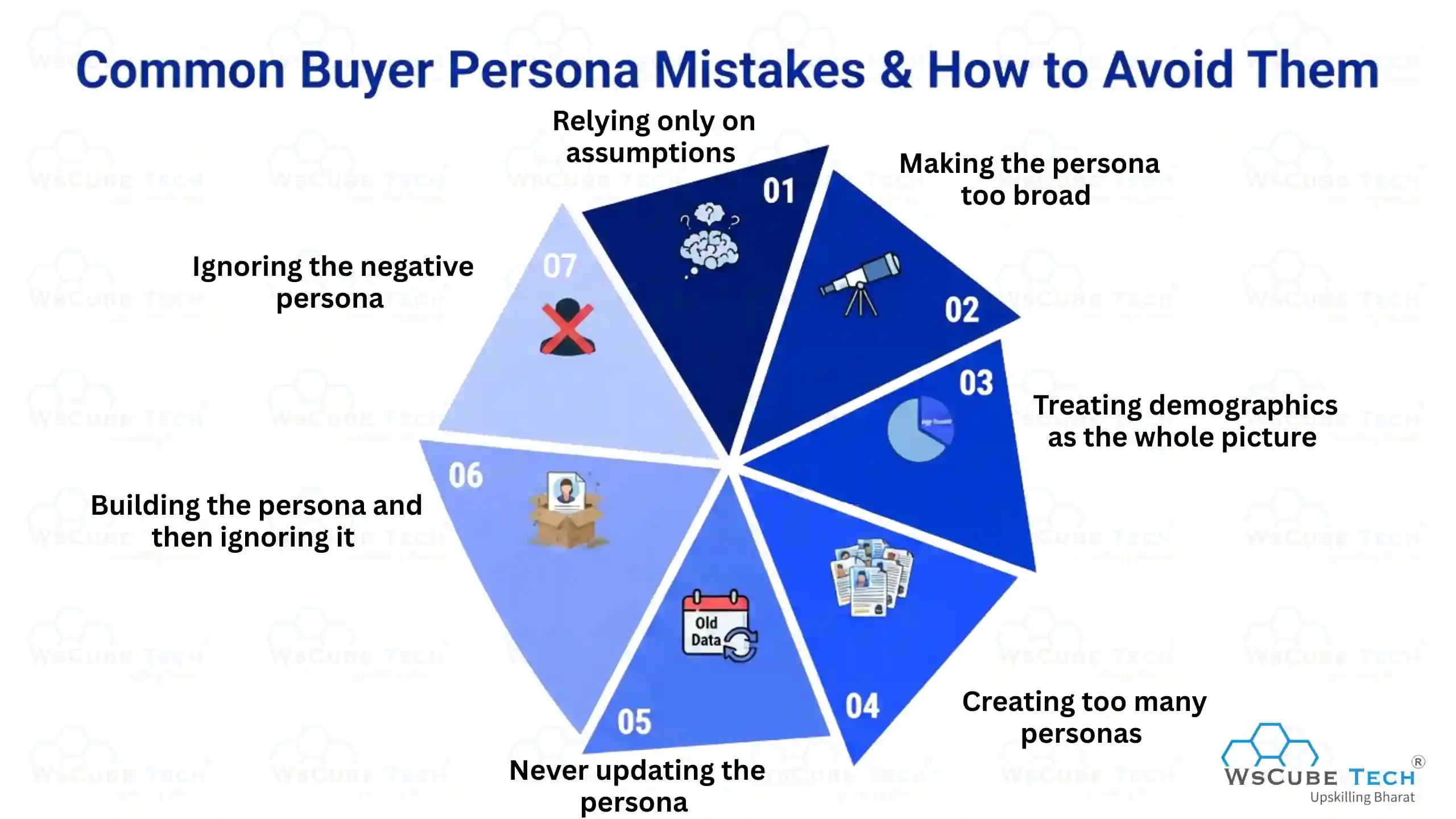
Mistake 1: Relying only on assumptions
Many teams write a persona based on what they imagine their ideal customer looks like, without talking to a single real customer. This often leads to a persona that sounds nice on paper but does not reflect actual buying behavior.
How to avoid it: Always base your persona on interviews, surveys, and real customer data, even if it is a small sample to start with.
Mistake 2: Making the persona too broad
A persona like "young professionals interested in marketing" is too vague to be useful. It does not tell you what content to create or what objections to address.
How to avoid it: Narrow your persona down to specific goals, pain points, and a clear buying trigger.
Mistake 3: Treating demographics as the whole picture
Age and income alone do not explain why someone buys. Two people with the exact same demographics can have completely different motivations.
How to avoid it: Spend more time on psychographics, goals, and pain points than on basic demographic data.
Mistake 4: Creating too many personas
Trying to capture every possible customer type leads to a confusing mix of personas that nobody on your team can remember or use effectively.
How to avoid it: Start with your highest value segment and only add new personas when data clearly shows a distinct buying pattern.
Mistake 5: Never updating the persona
A persona built years ago, before major shifts in your industry or platform behavior, can quietly mislead your entire marketing strategy.
How to avoid it: Set a recurring review schedule, ideally every six to twelve months, to check if your persona still matches reality.
Mistake 6: Building the persona and then ignoring it
Many businesses invest time in research and design a beautiful persona document, only for it to sit unused while the actual content and campaigns continue exactly as before.
How to avoid it: Share the persona across every team, refer to it during content planning meetings, and use it as a checklist before launching any campaign.
Mistake 7: Ignoring the negative persona
Without knowing who not to target, businesses often keep spending on audiences who were never going to convert.
How to avoid it: Document the traits of customers who churn quickly or rarely convert, and exclude similar profiles from your targeting.

FAQs Related to Buyer Persona
A buyer persona is a detailed, semi fictional profile of your ideal customer, built using real research, that helps you understand their goals, challenges, and buying behavior.
These terms are often used interchangeably. Both describe a research based profile of your target audience, though some marketers use customer persona to refer specifically to existing customers and buyer persona to describe the wider target audience, including prospects.
Most businesses should start with one to three primary personas based on their highest value customer segments, and only expand when there is clear evidence of a distinct buying pattern.
Buyer personas are mainly used to guide content creation, ad targeting, product development, sales conversations, and overall messaging, ensuring every part of the customer journey speaks directly to the right audience.
Yes. Even small businesses with limited budgets benefit greatly from personas, since they help avoid wasted ad spend and ensure marketing efforts are focused on the audience most likely to convert.
Most marketers recommend reviewing and updating personas every six to twelve months, or sooner if there is a major shift in your industry, platform algorithms, or customer behavior.
You can build personas using simple tools like Google Forms for surveys, CRM software for existing customer data, and using free templates, alongside direct customer interviews.
No. A target audience is a broad group, such as "women aged 25 to 35," while a buyer persona is a detailed, humanized profile within that audience, complete with a name, goals, and specific pain points.
Conclusion
A well-researched buyer persona helps businesses create relevant content, attract qualified leads, and improve marketing results. Start by understanding your most valuable customers through real research, then refine your persona over time as you gather more insights and customer feedback.
Join Our On-Campus Digital Marketing Program
Explore Our Free Courses






Leave a comment
Your email address will not be published. Required fields are marked *Comments (0)
No comments yet.