
When you are just starting out, terms like SEO, PPC, funnels, and retargeting can feel overwhelming, like everyone else already knows something you don't. But here's the thing: every successful marketer started exactly where you are right now.
Digital marketing is not reserved for tech experts or big-budget brands. It is a skill anyone can learn, grow in, and genuinely enjoy. You just need the right digital marketing mentorship to get going in the right direction.
This guide covers 19 practical digital marketing tips for beginners from content and SEO to AI tools and influencer marketing. It is everything you need to build a strong foundation in 2026.
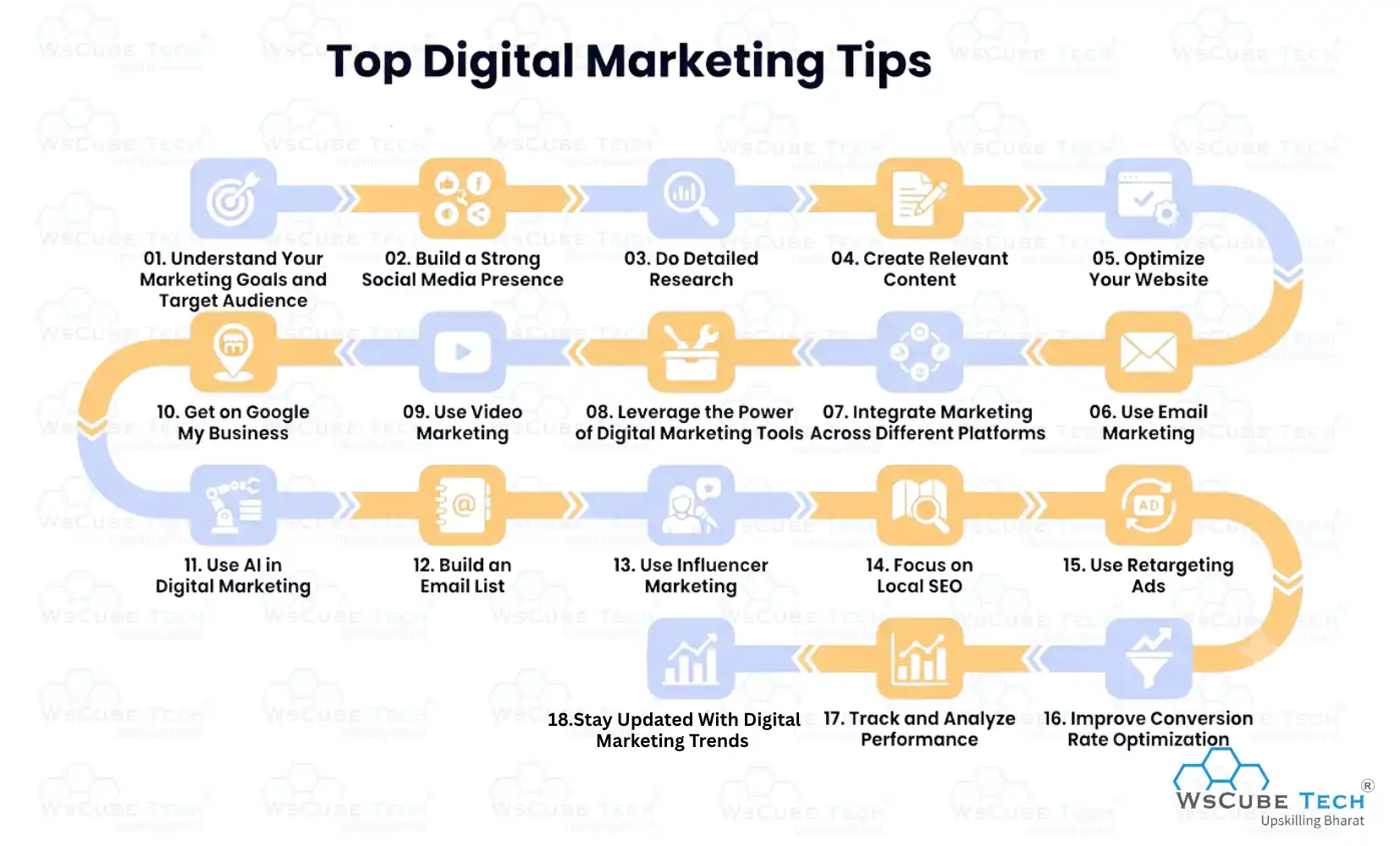
List of Digital Marketing Tips for Beginners
- Understand Your Marketing Goals and Target Audience
- Build a Strong Social Media Presence
- Do Detailed Research
- Create Relevant Content
- Optimize Your Website
- Use Email Marketing
- Integrate Marketing Across Different Platforms
- Leverage the Power of Digital Marketing Tools
- Use Video Marketing
- Get on Google My Business
- Use AI in Digital Marketing
- Build an Email List
- Use Influencer Marketing
- Focus on Local SEO
- Use Retargeting Ads
- Improve Conversion Rate Optimization
- Track and Analyze Performance
- Stay Updated with Digital Marketing Trends
Recommended Professional Certificates
AI-Powered Digital Marketing Course
Performance Marketing Bootcamp
SEO Specialist Bootcamp
Top Digital Marketing Tips 2026
Let’s go through the top tips for digital marketing for beginners:
1. Understand Your Marketing Goals and Target Audience
Before you start working on a project and develop a digital marketing strategy, here's one of the most useful digital marketing tips. Take a moment to consider a few key aspects.
- What are your marketing goals?
- What are you trying to achieve with your marketing efforts?
- Who is your target audience?
- What are their taste, interests, preferences, and desires?
Answer these questions and then tailor your campaigns accordingly. Focus on a specific section of the audience rather than trying to reach everyone. You can define customers based on gender, age, location, income, etc.
For example, if you are promoting Bridal wear, target brides-to-be through your marketing campaigns. You can use different tools to understand your customers. Also, detailed market research will take you a long way. You can use collected data to get familiar with the buyer persona and their buying journeys. This will enable you to offer them a seamless experience.
Knowing your ideal buyers and having their clear picture helps you enhance your marketing efforts and drive better results. You can create strategies that resonate with them. Also, you can offer them the right product at the right time and at the right place.
2. Build a Strong Social Media Presence
We need not mention that most of your prospective customers spend a large part of their day scrolling their social media accounts, be it Instagram, Twitter, or Facebook. They use these networks to connect with friends, find the latest trends, discover brands, and even buy products. If you are not including social media in your digital marketing strategy, you are missing out on an excellent opportunity.
So, social media is certainly an essential online marketing tip to connect with the audience and interact with them. There are ample social media channels, and each has its pros and cons. Analyze their strengths and weaknesses to choose the one that suits your brand and marketing goals. For B2B businesses, LinkedIn is a great option, but for B2C, Instagram and Facebook are reliable platforms.
Social media channels are also used to promote blogs and services. Many advertisers trust these platforms to build brand loyalty and long-term relationships with consumers. Moreover, it is an affordable marketing method that connects you with global users.
Marketers who are not tech-savvy can also use social media for promotions, but they must possess social media marketing skills and knowledge.
Here are a few things to consider for social media marketing:
- Find the right platform and communities to connect with the target audience.
- Monitor the trends and content that your users engage the most with.
- Post regularly to educate, inform, and entertain your audience.
- Make sure your content aligns with their taste and interests.
- Reply to comments and feedback on social media platforms.
- Post high-quality images and videos.
If you are a beginner or a business person, you can go for an live online social media marketing course.
3. Do Detailed Research
As we talk about digital marketing tips for beginners, how can we forget research? Once you define your goals and audience, it's important to do meticulous research. You must have a fair understanding of the market trends, demands, consumer demands, top marketing strategies, target keywords, and other aspects.
You can use SEO tools to find relevant keywords that potential consumers are looking for on Google. Moreover, you must know what social media networks they use and what type of content they consume. The more you know the industry and market, the better. It will come in handy while developing different strategies and running campaigns.
Your research is not restricted to your business but must include analyzing competitors and their strategies. This will help you understand what's working for the target buyers and what's not.
4. Create Relevant Content
In the digital landscape, content is the king. It engages the audience, answers their doubts, interacts with them, and boosts website rankings. So, it's important that you post compelling and relevant content regularly on social media, websites, and other platforms.
According to data published by HubSpot, marketers must publish content at least once a week for higher ROI, which can drop if published less frequently.
Compose content that can draw people to websites and make them click on the CTA button. It should provide value to the audience and influence their buying decisions. The content should be a balance of entertainment and information. It can be in the form of infographics, blogs, videos, or images.
The following are a few other factors to keep in mind while creating content:
- Customize content for each digital channel.
- Content should be informative, interesting, and creative.
- Use visual elements to get more shares, likes, and comments.
- Apart from promoting your brand, use content to speak to the audience and meet their needs.
- Content should be original and align with the brand’s message.
- Focus on user-generated content.
- Be consistent so shoppers can identify with your brand.
- Be regular with posting.
5. Optimize Your Website
Another important internet marketing tip for beginners to follow is optimizing websites. A business website is like its first impression. It's a gateway to revenue and a key factor in customer's buying decisions. So, it must be powerful, responsive, and optimized to drive more conversions.
The layout of a website should not be cluttered but organized, clear, and appealing. Also, a website should be customer-centric, which means it must be easy to navigate and browse quickly. There should be a clear call-to-action, and the page must load within seconds. In addition, the checkout process must be hassle-free.
As customers mostly use smartphones to check websites, your website must be compatible with all operating systems, screen sizes, and devices. This will boost conversion rates and sales. Moreover, use website speed optimization tools for best practices.
Moreover, optimize the website in such a way that it can collect customer data efficiently, including their browsing history, preferences, buying patterns, click pathways, etc. Analyze this data and use it to discover opportunities to segment visitors and target consumers.
Lastly, your website content must include relevant keywords so search engines can find it and display it on top of search engine result pages whenever users look for related phrases or queries. It is a crucial part of your website's SEO. You can learn this skill by joining the live online SEO course.
6. Use Email Marketing
Email marketing has been around for years and is considered a crucial part of any digital marketing strategy, so no marketer can ignore it. Email is a proven way to stay connected with the target audience, engage them, and build strong relationships. Moreover, it is a cost-effective solution to promote your products and services, sales, blogs, and news. If done efficiently, it can lead to higher ROI.
You can use several software and tools to build email templates, create email lists, track open rates and clicks, and automate the process. Also, using an option to add banners, forms, and pop-ups on websites to collect email addresses can accelerate your business growth and expand your customer base. There is no denying that email is a great communication channel to convey brand messages timely and effectively.
There are numerous reasons why email marketing is among easy digital marketing tips, and we have listed a few of them for you:
- Quick to set up and easy to manage
- Budget-friendly and high-volume strategy
- Businesses can reach a wider and global audience in no time
- Complete control over content
- A faster way to tell potential customers about deals, offers, discounts, and events
- Digital marketers with no technical background can do it themselves
We can conclude that email is one of the most powerful ways to reach customers and get their attention. So, if you want faster results, include email marketing now in your digital marketing campaign. You can learn it practically with a free email marketing course.
Upcoming Masterclass
Attend our live classes led by experienced and desiccated instructors of Wscube Tech.



7. Integrate Marketing Across Different Platforms
This is one of the most important tips that every digital marketing beginner should remember. It’s vital to integrate branding, messaging, and marketing campaigns across multiple platforms simultaneously. Yes, managing different channels and campaigns running on each can be strenuous.
However, it’s something you must do to attain your marketing goals and business success. As you integrate digital marketing across different channels, here are some points to remember:
- Create a content calendar, modify it according to requirements, and share it with the team.
- Create short-term and long-term goals.
- Develop effective digital marketing strategies that map to your goals.
- Be consistent with branding in terms of style, theme, font, etc.
- Use a CRM platform to track customer details and understand their behavior.
- Run A/B tests and focus on conversion metrics.
8. Leverage the Power of Digital Marketing Tools
With advancements and evolution in digital marketing, an array of tools were introduced to make marketing tactics more data-driven, powerful, and flexible. Continuing our digital marketing tips, next is using digital marketing tools. These tools not only aid businesses and marketers while executing digital marketing campaigns but also enhance customer experience and their journey.
From social media and CRM to content and SEO, there are many excellent tools to back your marketing strategies. Some tools are free, while most offer monthly or annual subscriptions.
You can zero in on the best tool or combine two or more tools based on your budget and goals. For a restricted budget, you can opt for free tools initially and then move on to the paid ones. Although many features will be locked in a free subscription, you can get the job done.
The right mix comprises SEO tools, social media management tools, email marketing tools, content creation tools, analytics tools, and more. They will save you time, effort, and resources while improving results. Go for an online digital marketing course led by experts to learn the top strategies and execute them.
9. Use Video Marketing
Videos are known for grabbing the attention of viewers at once. It is a growing medium for connecting with potential customers. The number of viewers who watch videos online has doubled since 2018, and over 87% of marketers have agreed that video marketing generates higher ROI. With the rising popularity of YouTube, Instagram Reels, and other social media platforms, videos now play a critical role in promoting products, services, and brands.
Hence, most businesses share videos and visual elements on their websites, social media pages, and blogs to engage users.
There can be different types of videos depending on the channel, goal, and brand. You can go for a short video like Reels on Instagram, how-to videos, unboxing videos, or entertaining videos. You can even share demos on your site and social media page to inform customers about products and boost sales. There are live feeds, too, where an expert answers questions asked by users.
The ultimate goal is to capture customers’ attention and keep them hooked. As the viewership increases, the popularity of your brand will also surge, boosting online brand visibility and awareness.
10. Get on Google My Business
Last but not least. Ending our list of top digital marketing tips with one of the most crucial steps - creating a Google My Business account. This free platform allows businesses to create a listing on Google so they can reach the target audience. It is ideal for local businesses that target nearby customers and have brick-and-mortar stores.
Claim your business listing and mention all the correct details. You can update information about your business, including images, contact details, videos, website URL, business hours, address, etc.
It is also a type of SEO strategy that will boost your search engine rankings. Moreover, customers can easily find your business, rate your products or services, and share reviews. Once you are listed, you’ll get regular data reports so you can see the number of page views, review notifications, and more.
11. Use AI in Digital Marketing
Artificial intelligence is no longer a futuristic concept. It is actively reshaping how marketers plan, execute, and optimize campaigns. For beginners looking for practical digital marketing tips, understanding how to use AI tools is now a must-have skill.
AI helps marketers automate repetitive tasks, personalize customer experiences at scale, and make smarter data-driven decisions. Whether it's AI-powered chatbots for customer support, predictive analytics for campaign targeting, or AI writing tools for content creation, the applications are vast and growing every day.
Here are a few ways you can start using AI in your digital marketing efforts:
- Use AI writing assistants like ChatGPT or Jasper to draft content, social media posts, and email copies faster.
- Leverage AI-powered SEO tools to find keyword opportunities and optimize content.
- Implement chatbots on your website to handle customer queries 24/7 without human intervention.
- Use AI analytics platforms to predict customer behavior and improve ad targeting.
- Automate A/B testing with AI tools to find winning creatives and messaging without manual effort.
- Use AI-based tools to personalize email campaigns based on user behavior and preferences.
12. Build an Email List
While using email marketing is important, building a quality email list is the foundation that makes it work. It is one of the most valuable assets a digital marketer can own. Unlike social media followers, your email list belongs to you, no algorithm can limit your reach to your own subscribers.
As a part of your broader internet marketing tips strategy, focus on growing your email list organically from day one. A well-maintained list of engaged subscribers will always outperform a large but cold or uninterested list.
Here are some effective ways to build your email list:
- Add opt-in forms, pop-ups, and banners to your website and landing pages.
- Offer a lead magnet such as a free eBook, checklist, or mini-course in exchange for an email address.
- Run social media campaigns that direct users to a signup page.
- Use exit-intent pop-ups to capture visitors before they leave your site.
- Promote exclusive deals, discounts, or early access offers to encourage signups.
- Embed subscription CTAs within your blog content.
Always focus on quality over quantity. An email list of genuinely interested subscribers is far more valuable than thousands of unengaged contacts. Also, make sure to comply with email regulations like GDPR and CAN-SPAM to maintain trust and avoid penalties.
Expand Your Marketing Skills
13. Use Influencer Marketing
Influencer marketing has grown into one of the most powerful digital marketing strategies in recent years. For beginners, it is an effective way to build brand awareness quickly by collaborating with individuals who already have a loyal and engaged audience.
Influencers can range from mega celebrities with millions of followers to micro-influencers with a few thousand highly engaged ones. In fact, among the most practical marketing tips for beginners, partnering with micro-influencers is often more cost-effective and delivers better engagement rates than working with large-scale celebrities.
Here is how you can get started with influencer marketing:
- Identify influencers whose audience matches your target customers.
- Check their engagement rate, not just their follower count, before partnering.
- Start with micro-influencers (10K–100K followers) if you have a limited budget.
- Collaborate on authentic content such as product reviews, unboxings, tutorials, or giveaways.
- Use platforms like Instagram, YouTube, and TikTok for influencer partnerships, depending on your niche.
- Track campaign performance using unique discount codes, affiliate links, or UTM parameters.
Expert Tip: Always choose influencers who genuinely align with your brand values. Audiences are smart, forced or inauthentic promotions are easy to spot and can harm your brand's credibility.
14. Focus on Local SEO
If you are running a local business or targeting customers in a specific geographic area, local SEO is one of the most essential digital marketing tips you should act on immediately. It helps your business appear in local search results when nearby users search for products or services you offer.
For example, when someone searches for "best bakery near me" or "digital marketing agency in Mumbai," local SEO determines which businesses show up first. Ranking high in these searches can drive significant foot traffic and online inquiries.
Here is how you can strengthen your local SEO:
- Create and optimize your Google My Business profile with accurate and up-to-date information.
- Include location-specific keywords in your website content, meta titles, and descriptions.
- Encourage happy customers to leave positive reviews on Google and other platforms.
- Ensure your business Name, Address, and Phone number (NAP) are consistent across all online directories.
- List your business on local directories and citation sites such as Justdial, Sulekha, or Yelp.
- Create locally relevant content, such as blog posts about community events or local industry trends.
15. Use Retargeting Ads
Not every visitor who lands on your website will make a purchase right away. In fact, studies suggest that over 95% of first-time visitors leave without converting. This is where retargeting ads come in and they are among the smartest online marketing tips for recovering potential lost customers.
Retargeting works by placing a small piece of code (called a pixel) on your website that tracks visitors. Once they leave without converting, you can show them targeted ads across other websites, apps, or social media platforms to bring them back.
Here is how to use retargeting ads effectively:
- Set up the Facebook Pixel or Google Ads remarketing tag on your website to start tracking visitors.
- Segment your retargeting audience based on the pages they visited or actions they took, such as adding a product to the cart but not purchasing.
- Show personalized ads that reflect what the user was browsing to make the ad more relevant.
- Use time-sensitive offers, such as limited-time discounts, to create urgency and encourage conversions.
- Exclude existing customers from certain campaigns to avoid showing them ads for products they have already purchased.
- Monitor your frequency settings so your ads do not become annoying by showing too often.
16. Improve Conversion Rate Optimization
Driving traffic to your website is only half the battle. Converting that traffic into leads or customers is where the real results lie. Conversion Rate Optimization (CRO) is the process of improving your website and marketing assets to increase the percentage of visitors who take a desired action.
As part of your core digital marketing advice, CRO should be a continuous practice, not a one-time fix. Even small improvements in conversion rates can lead to significantly higher revenue without increasing your marketing budget.
Here are some effective CRO strategies for beginners:
- Write clear, compelling, and action-oriented CTA (Call-to-Action) buttons that guide users to the next step.
- Simplify your forms, ask only for information that is absolutely necessary.
- Improve page load speed, as slow pages increase bounce rates and lower conversions.
- Use trust signals such as customer reviews, testimonials, certifications, and secure payment badges.
- Run A/B tests on landing pages, headlines, images, and CTAs to find what works best.
- Ensure your website design is clean, mobile-friendly, and easy to navigate.
- Remove unnecessary distractions from product or landing pages that could pull users away from converting.
17. Track and Analyze Performance
One of the most overlooked yet critical digital marketing tips for beginners is consistently tracking and analyzing your marketing performance. Without data, you are essentially working blindly, you won't know what is working, what is wasting your budget, and where to improve.
Every campaign you run, every piece of content you publish, and every ad you launch should be measured against clear KPIs (Key Performance Indicators). This is what separates strategic marketers from those who simply guess.
Here is how to build a strong habit of tracking and analysis:
- Set up Google Analytics on your website to monitor traffic, user behavior, bounce rates, and conversions.
- Use platform-native insights tools such as Facebook Insights, Instagram Analytics, and Google Search Console.
- Define clear KPIs for each campaign before launching, such as CTR, CPC, conversion rate, or email open rates.
- Review your performance reports on a weekly or monthly basis and look for patterns and opportunities.
- Track your ROI for every marketing channel to understand which ones deliver the best results.
- Use UTM parameters to track the source of traffic and measure campaign effectiveness accurately.
Explore Our Most Popular Marketing Courses
18. Stay Updated With Digital Marketing Trends
Digital marketing is one of the fastest-evolving fields in the world. Strategies and tools that worked two years ago may no longer deliver the same results today. As part of your ongoing digital marketing advice, staying updated with the latest trends is not optional but it is essential for long-term success.
New platforms emerge, search engine algorithms change, consumer behaviors shift, and new technologies like AI and AR continue to reshape the marketing landscape. As a beginner, developing a habit of continuous learning early in your career will give you a significant edge over the competition.
Here are some practical ways to stay current with digital marketing trends:
- Follow reputable industry blogs and publications such as HubSpot, Neil Patel, Moz, Search Engine Journal, and Social Media Examiner.
- Subscribe to newsletters that deliver the latest digital marketing news directly to your inbox.
- Join online communities, LinkedIn groups, and forums where marketers discuss trends and share insights.
- Attend webinars, virtual conferences, and local marketing events to network and learn from industry experts.
- Follow thought leaders and influencers in the digital marketing space on LinkedIn, Twitter, and YouTube.
- Enroll in updated online digital marketing courses to keep your skills fresh and relevant.
- Experiment with new tools and platforms early, being an early adopter can give you a competitive advantage.
Expert Advice: The best marketers are lifelong learners. Dedicate even 20–30 minutes a day to reading, watching, or listening to marketing content, and over time, this habit will compound into deep industry expertise.

FAQs about Digital Marketing Tips
Digital marketing is the promotion of products and brands through online channels like SEO, social media, and email. It is the most cost-effective way for beginners to reach a large audience and grow a business online.
The best digital marketing tip for beginners is to define your target audience and goals before picking any strategy. Without clarity on who you are targeting, no tool or tactic will deliver consistent results.
As an online marketing tip, start with SEO and content marketing since they build long-term organic traffic for free. Once comfortable, expand to social media, email marketing, and paid ads gradually.
SEO takes 3 to 6 months while paid ads and email marketing deliver faster results. Consistency and regular performance tracking are key to improving outcomes over time.
No, beginners can start digital marketing for free using tools like Google Analytics, Google My Business, and social media platforms. Paid strategies can be added gradually as your budget grows.
Essential digital marketing skills for beginners include SEO, content creation, social media marketing, and email marketing. Advanced skills like paid ads, analytics, and AI tools can be added as you grow.
Track metrics like website traffic, conversion rate, CTR, and ROI using tools like Google Analytics. Regular performance reviews help you refine your internet marketing strategy and improve results.
Yes, most digital marketing tools like Canva, Mailchimp, and WordPress are beginner-friendly and require zero coding. Anyone can follow basic digital marketing advice and start executing campaigns from day one.
Content drives SEO, engages social media audiences, and builds brand trust, making it the backbone of any digital marketing strategy for beginners. Focus on creating consistent, valuable, and audience-relevant content regularly.
Follow blogs like HubSpot, Neil Patel, and Moz and join marketing communities on LinkedIn. Spending just 20 to 30 minutes daily on industry content keeps your digital marketing knowledge fresh and competitive.
Wrapping Up
With this, we conclude our digital marketing tips and advice for beginners. We hope they help you at the beginning of your career and make it seamless for you. As you start your digital marketing profession, you need to know that this industry has no one-size-fits-all situation. What works today might be useless tomorrow. So, you need to keep growing and experimenting while implementing marketing strategies.
With more experience and knowledge, you will gradually achieve better results. Take chances, and don't be afraid of making mistakes because that's the only way to learn and become better at your job. All the Best.
Join Our On-Campus Digital Marketing Program
Explore Our Free Courses




Leave a comment
Your email address will not be published. Required fields are marked *Comments (0)
No comments yet.