
Every successful marketing campaign starts with understanding where your business stands. A SWOT analysis for digital marketing helps you identify your strengths, weaknesses, opportunities, and threats before investing in SEO, social media, paid ads, or content marketing.
In this guide, you'll learn what SWOT analysis is, why it matters, how it compares with other strategic planning frameworks, and how to conduct one step by step using a practical example.
With businesses competing across multiple digital channels, a clear strategy is more important than ever. A SWOT analysis helps you focus on what works, address gaps, reduce risks, and make smarter marketing decisions that support long-term growth.
What is a SWOT Analysis?
A SWOT analysis is a planning tool used to evaluate four key areas of a business or campaign: Strengths, Weaknesses, Opportunities, and Threats. The first two, strengths and weaknesses, look inward at your own business. The last two, opportunities and threats, look outward at the market and competition around you.
So, what is SWOT in digital marketing, in simple terms? It is a structured way to step back from daily tasks like posting content or running ads, and instead ask bigger strategic questions about your digital presence as a whole. Instead of guessing what to do next, you base your decisions on a clear, honest assessment of your current position.
This framework works well because it is simple enough for beginners to use, yet detailed enough to guide decisions for experienced marketing teams. Whether you run a small local business or manage a large brand, the same four questions apply.

SWOT Analysis Template
Download Here!SWOT Analysis vs PESTLE vs SOAR: What's the Difference?
Marketers often confuse SWOT with other planning frameworks like PESTLE and SOAR. While they share some similarities, each one serves a different purpose.
| Feature | SWOT Analysis | PESTLE Analysis | SOAR Analysis |
| Purpose | Evaluates internal strengths and weaknesses alongside external opportunities and threats | Identifies external macro-environmental factors affecting a business | Focuses on strengths, opportunities, aspirations, and desired results |
| Focus | Internal and external business analysis | External environment only | Positive future-oriented strategic planning |
| Best For | Business planning, competitive analysis, decision-making | Market research, risk assessment, long-term planning | Organizational growth, innovation, and goal setting |
| Key Components | Strengths, Weaknesses, Opportunities, Threats | Political, Economic, Social, Technological, Legal, Environmental | Strengths, Opportunities, Aspirations, Results |
| Approach | Balanced (positive and negative factors) | Analytical and research-driven | Strength-based and collaborative |
| When to Use | Launching a product, entering a new market, improving business strategy | Understanding external market conditions before making strategic decisions | Building a growth strategy, improving team engagement, or driving innovation |
| Main Advantage | Provides a complete picture of internal and external factors | Helps identify external risks and opportunities early | Encourages a positive, action-oriented mindset |
| Limitation | Can become subjective if not backed by data | Doesn't assess internal capabilities | May overlook weaknesses and potential threats |
The key difference is scope. SWOT looks at both your business and the market around it in one framework, making it a well-rounded starting point. PESTLE zooms out further and focuses only on external, big-picture factors like government policy or economic shifts that could affect your industry. SOAR skips weaknesses and threats entirely, focusing instead on where you want to go rather than where you currently stand.
Many marketing teams use SWOT first to understand their current reality, then bring in PESTLE if they need a deeper look at external market forces, or SOAR when they are ready to shift into goal setting and growth planning. None of these frameworks replace the others. They simply answer different questions at different stages of planning.
Recommended Professional Certificates
AI-Powered Digital Marketing Course
Performance Marketing Bootcamp
SEO Specialist Bootcamp
What are the Elements in a SWOT Analysis?
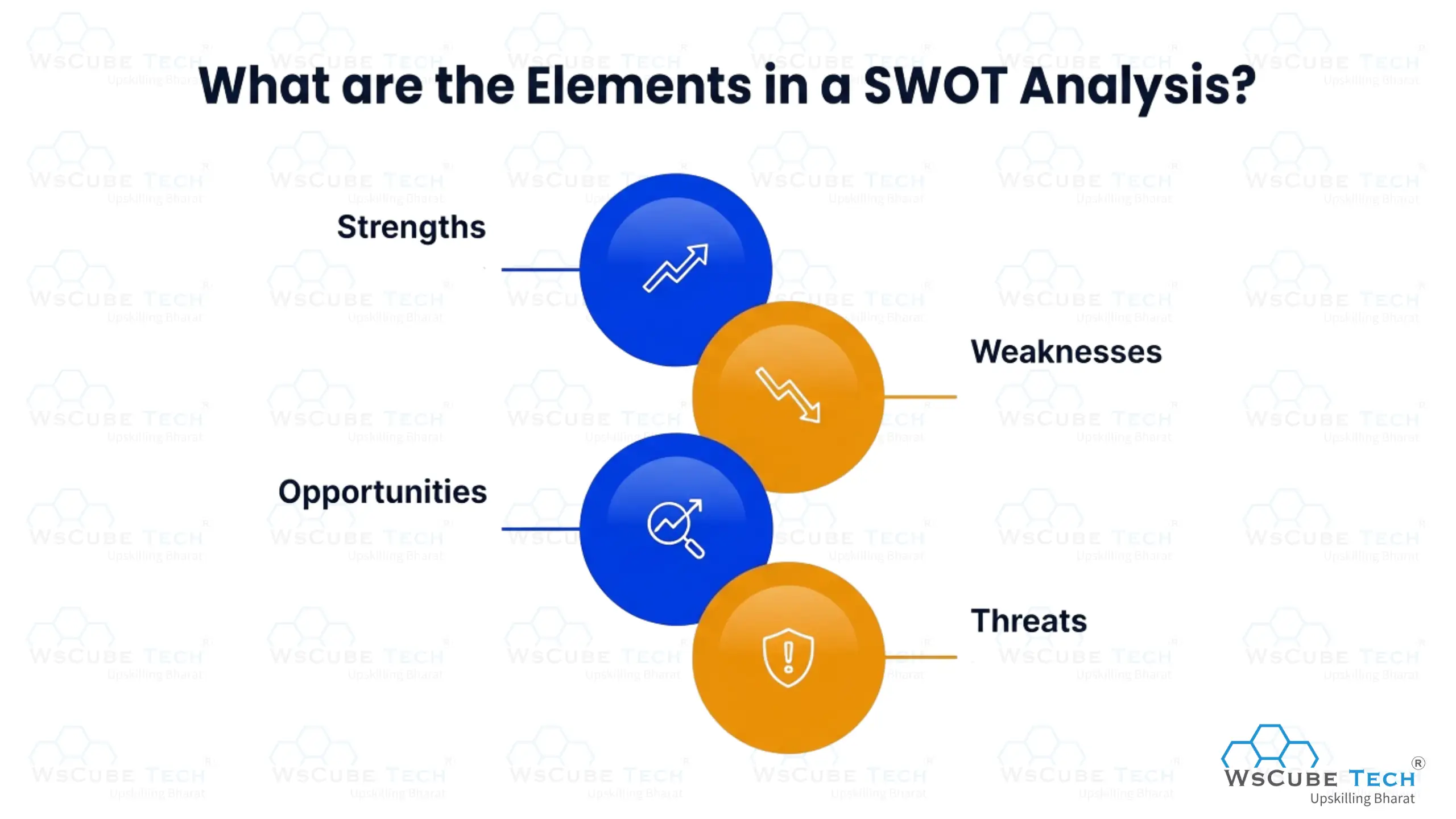
A SWOT analysis is built around four factors, split evenly between internal and external elements.
1. Strengths
Strengths are the internal advantages your business already has. In a digital marketing context, this could include a strong social media following, a website that ranks well for important keywords, high-quality content, a loyal email subscriber list, or a recognizable brand name. These are the assets you can lean on when building your digital marketing strategy.
2. Weaknesses
Weaknesses are internal gaps or limitations that hold your marketing back. This might be a slow-loading website, inconsistent posting schedules, a small marketing budget, weak SEO rankings, or a lack of skilled team members. Identifying weaknesses honestly, without downplaying them, is what makes this step of the analysis genuinely useful.
3. Opportunities
Opportunities are external factors you could take advantage of to grow. This includes emerging platforms your competitors have not fully explored yet, new keyword trends, changes in customer behavior, seasonal demand, or partnerships that could expand your reach. Understanding shifts in your target audience often reveals opportunities that are easy to miss otherwise.
4. Threats
Threats are external risks that could hurt your marketing performance. Common threats include new competitors entering the market, rising ad costs, algorithm changes on platforms like Google or Instagram, or economic conditions that reduce customer spending. Recognizing threats early gives you time to plan around them instead of reacting after damage is already done.
Upcoming Masterclass
Attend our live classes led by experienced and desiccated instructors of Wscube Tech.



Why Should You Perform a SWOT Analysis?
Some marketers skip this step because it feels like extra planning before the "real work" begins. In reality, a SWOT analysis often saves far more time than it takes, since it prevents wasted effort on the wrong priorities.
1. Better Decision-Making
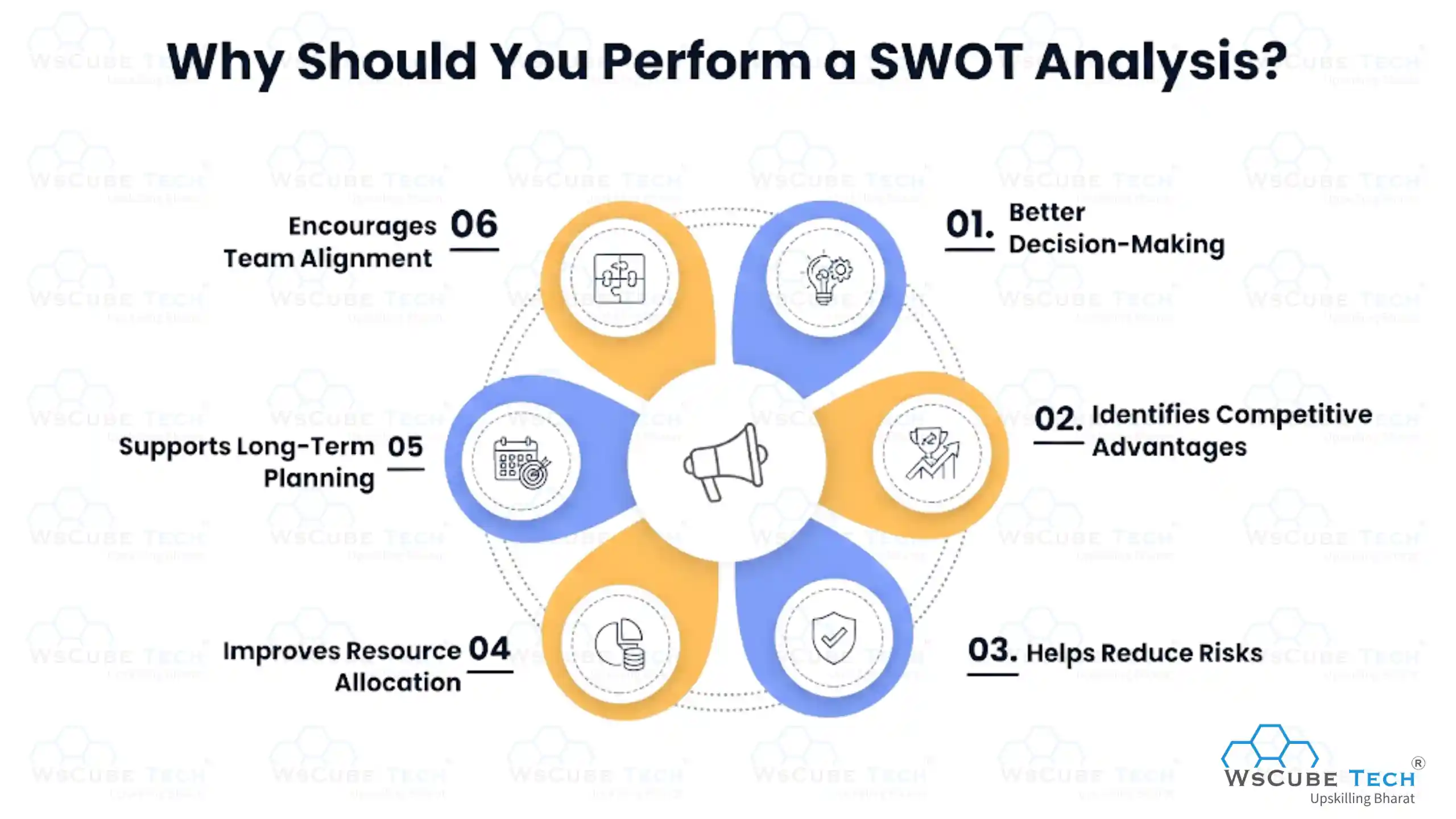
When you clearly see your strengths, weaknesses, opportunities, and threats laid out together, decisions become easier to make. Instead of choosing a marketing tactic because it worked for someone else, you choose it because it fits your specific situation. This structured view reduces guesswork and helps teams agree on priorities faster.
2. Identifies Competitive Advantages
A SWOT analysis often reveals strengths you were not fully using. Maybe your customer service response time is faster than competitors, or your content has a more relatable tone. Once these advantages are clearly identified, you can highlight them more intentionally across your website, social media, and ad campaigns.
3. Helps Reduce Risks
By spotting threats early, whether it's a competitor's aggressive pricing or a shift in how your buyer persona searches for products, you get the chance to adjust your approach before those risks turn into real losses. This kind of early warning system is one of the most practical benefits of doing this analysis regularly.
4. Improves Resource Allocation
Every business has limited time, budget, and team capacity. A SWOT analysis helps you direct these resources toward the areas that matter most, rather than spreading effort thin across too many channels. It becomes much easier to decide where to invest more and where to pull back.
5. Supports Long-Term Planning
Beyond immediate campaigns, a SWOT analysis gives you a clearer picture of where your business stands in the broader market. This makes it easier to set realistic long-term goals and track whether your marketing efforts are actually moving you closer to them over time.
6. Encourages Team Alignment
When a marketing team completes a SWOT analysis together, it creates a shared understanding of the business. Everyone, from content writers to paid ads specialists, works from the same picture of what is going well and what needs attention, which reduces confusion and miscommunication down the line.
How to Conduct a SWOT Analysis
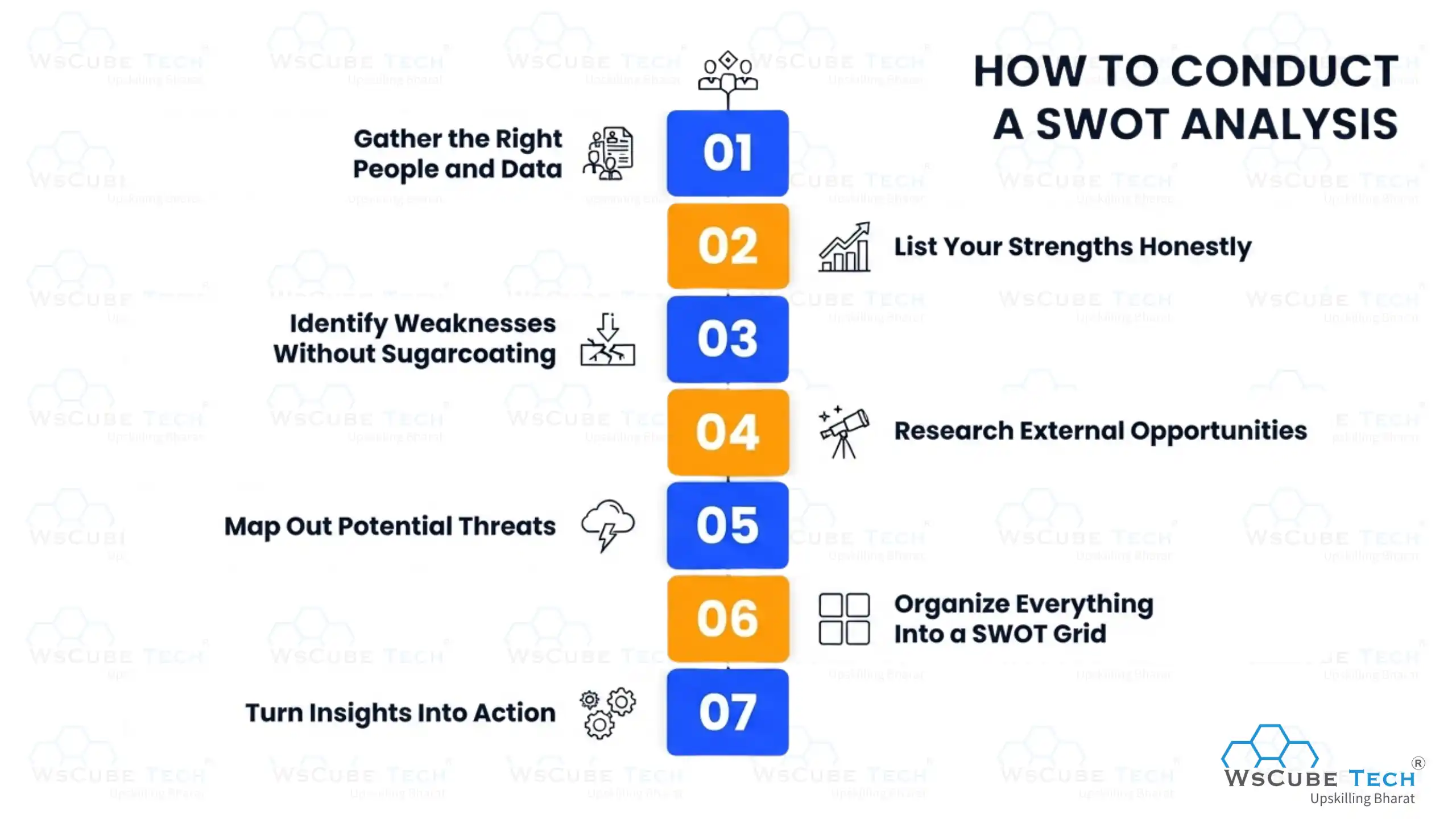
Conducting a swot analysis in digital marketing does not require complicated tools or software. It requires honesty, structure, and a bit of research. Here is a practical step-by-step process.
Step 1: Gather the Right People and Data
Before you start listing points, pull together relevant data such as website analytics, social media performance, ad campaign results, and customer feedback. If possible, involve people from different parts of your team, since a content writer and a paid ads manager often notice different strengths and weaknesses.
Step 2: List Your Strengths Honestly
Ask what your business does better than others. Look at your best-performing content, your highest-converting channels, and any positive customer feedback you consistently receive. Be specific rather than vague. Instead of writing "good content," write "blog posts that consistently rank in the top five results for target keywords."
Step 3: Identify Weaknesses Without Sugarcoating
This step requires the most honesty. Look at underperforming campaigns, high bounce rates, low email open rates, or channels where competitors are clearly ahead of you. Avoid the temptation to soften weaknesses just to make the analysis feel more comfortable, since accuracy here is what makes the rest of your strategy effective.
Step 4: Research External Opportunities
Study market trends, competitor activity, and shifts in customer behavior. Look at keyword research tools to spot rising search terms, check what content formats are gaining traction on social platforms, and consider whether your digital marketing funnel has any gaps competitors are not yet filling either.
Step 5: Map Out Potential Threats
Consider what could disrupt your current marketing performance. This includes algorithm updates, new competitors, rising advertising costs, or broader economic shifts that might affect customer spending in your industry. It also helps to review whether your business is too dependent on a single channel, since losing that one channel could become a serious threat on its own.
Step 6: Organize Everything Into a SWOT Grid
Once you have your points listed, organize them into a simple two-by-two grid, with strengths and weaknesses on top and opportunities and threats below. This visual format makes it easier to see connections, such as how a specific strength could help you capture a particular opportunity.
Step 7: Turn Insights Into Action
A SWOT analysis is only useful if it leads to action. For each point, ask what you should do about it. Should you double down on a strength, fix a weakness, chase an opportunity, or build a plan to defend against a threat? Turning each insight into a specific next step is what separates a useful SWOT analysis from a list that gets filed away and forgotten.
Must-Know Concepts in Digital Marketing
Common Mistakes to Avoid When Doing a SWOT Analysis
Even with a simple framework like this, a few common mistakes can reduce how useful your analysis turns out to be.
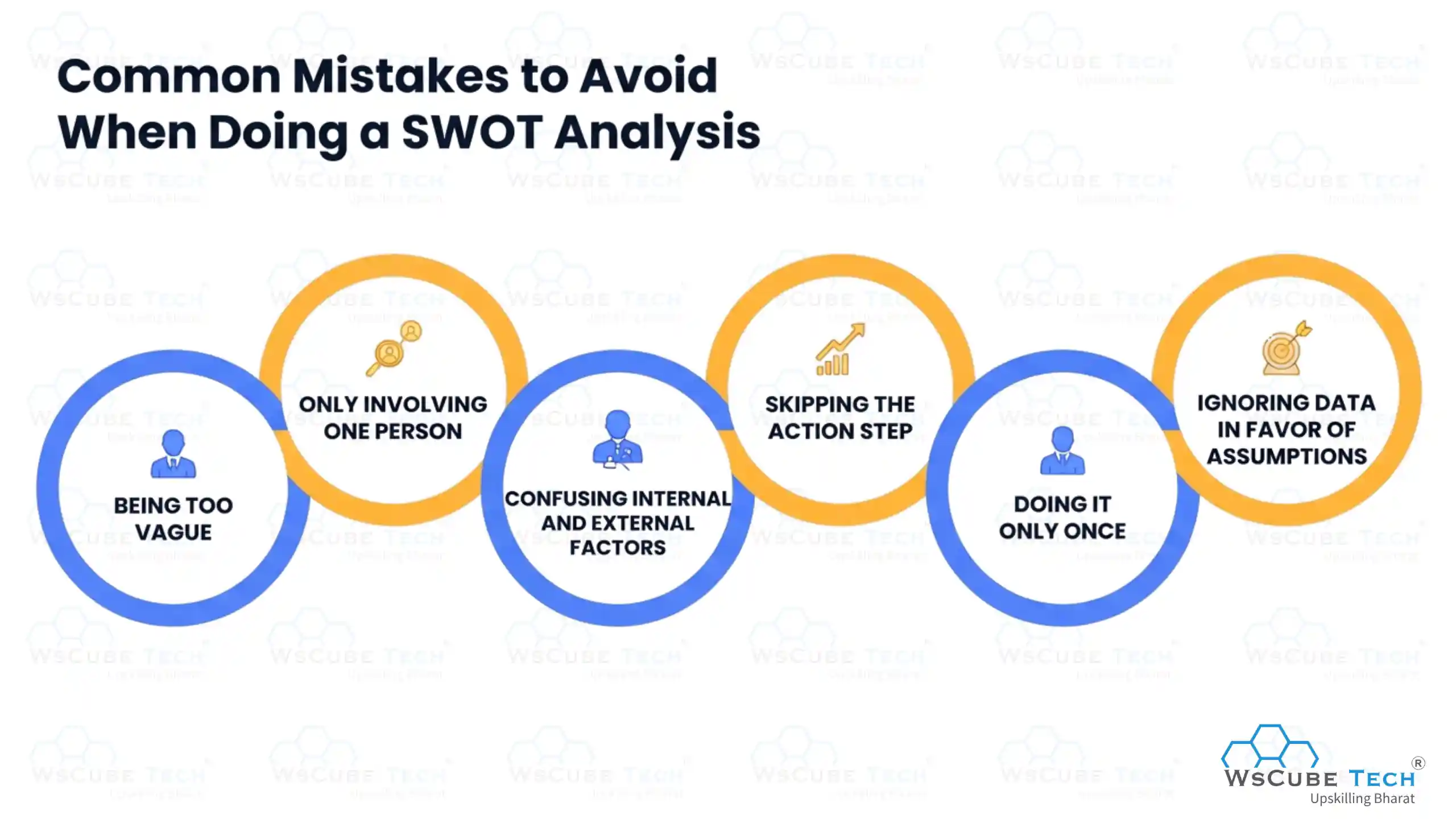
1. Being too vague
Writing broad statements like "we have good content" or "our competitors are strong" does not give you anything actionable to work with. Always aim for specific, measurable points wherever possible.
2. Only involving one person
A SWOT analysis done by a single team member often misses blind spots. Different roles within a marketing team notice different strengths and weaknesses, so involving multiple perspectives leads to a more complete picture.
3. Confusing internal and external factors
Strengths and weaknesses should always be about your own business, while opportunities and threats should focus on the external market. Mixing these up, such as listing "rising ad costs" as a weakness instead of a threat, weakens the clarity of the entire analysis.
4. Skipping the action step
As mentioned earlier, listing points without deciding what to do next makes the entire exercise far less valuable. Every SWOT analysis should end with a short list of next steps tied to your findings.
5. Doing it only once
Markets change, algorithms update, and competitors shift their strategies. A SWOT analysis done once a year, or even once every quarter, keeps your strategy aligned with the current reality rather than one that is months out of date.
6. Ignoring data in favor of assumptions
It can be tempting to rely on gut feelings about what is working and what is not. Backing up your points with actual analytics, campaign data, and customer feedback makes the analysis far more reliable.
SWOT Analysis Example
To see how this works in practice, imagine a mid-sized online fashion brand conducting a SWOT analysis for its digital marketing efforts.
- Strengths: A loyal Instagram following of 150,000 engaged users, strong product photography, and a website that already ranks on the first page for several branded search terms.
- Weaknesses: Low email marketing engagement, with open rates well below industry averages, and a blog section that has not been updated in over a year, leading to a steady drop in organic traffic.
- Opportunities: Growing interest in short-form video content on platforms like Instagram Reels, along with an untapped audience segment of younger shoppers who are increasingly discovering fashion brands through influencer collaborations rather than traditional ads.
- Threats: A new competitor entering the market with significantly lower prices, combined with rising costs for paid social ads that are shrinking overall campaign returns.
Based on this analysis, the brand could decide to invest more heavily in short-form video content to capture the growing interest identified as an opportunity, while also revamping its email marketing strategy to fix a clear weakness.
At the same time, it might diversify its ad spend away from an increasingly expensive platform to reduce dependence on a single channel that has become a threat to profitability.
This example shows how a simple four-part analysis can lead directly to a focused, practical action plan rather than staying as an abstract exercise.
Explore Our Most Popular Marketing Courses
FAQs About SWOT Analysis in Digital Marketing
It is used to evaluate a business's internal strengths and weaknesses alongside external market opportunities and threats, helping marketers make informed decisions about where to focus their strategy and budget.
A SWOT analysis helps businesses understand their strengths, weaknesses, opportunities, and threats. This allows marketers to create smarter campaigns, improve decision-making, reduce risks, and achieve better digital marketing results.
The four elements of SWOT analysis are Strengths, Weaknesses, Opportunities, and Threats. Together, they help businesses evaluate internal capabilities and external market conditions to build effective marketing strategies.
Yes, a SWOT analysis can improve marketing performance by identifying growth opportunities, addressing weaknesses, reducing potential risks, and helping businesses allocate resources more effectively for stronger campaign results.
SWOT analysis is valuable for startups, small businesses, enterprises, and marketing agencies. Any business planning a new campaign, product launch, or growth strategy can benefit from this strategic planning framework.
Most marketing teams benefit from reviewing their SWOT analysis at least once every quarter, since market conditions, platform algorithms, and competitor strategies can shift fairly quickly.
No, SWOT analysis works well for businesses of any size. In fact, small businesses often benefit even more, since limited resources make it especially important to focus effort on the right priorities.
SWOT looks at both internal business factors and external market factors together, while PESTLE focuses only on broader external elements like political, economic, and technological trends affecting an entire industry.
Yes, many marketers apply SWOT analysis not just to an entire business, but to individual campaigns, product launches, or new marketing channels before committing budget and resources to them.
The findings should be turned into a clear action plan, with specific steps for leveraging strengths, addressing weaknesses, pursuing opportunities, and preparing for potential threats.

Conclusion
A swot analysis for digital marketing is one of the simplest yet most effective tools available for building a smarter, more focused strategy. It forces you to look honestly at where your business stands, both internally and in the wider market, before committing time and budget to any new campaign.
A SWOT analysis helps you build a stronger digital marketing strategy by leveraging strengths, improving weaknesses, identifying opportunities, and preparing for potential threats. Regularly reviewing your analysis leads to better decisions and measurable growth.
Whether you're a solo marketer or part of a larger team, taking time to conduct a SWOT analysis can improve your planning and campaign performance. Update it regularly to stay aligned with changing business goals and market trends.
Join Our On-Campus Digital Marketing Program
Explore Our Free Courses






Leave a comment
Your email address will not be published. Required fields are marked *Comments (0)
No comments yet.