

You are running ads, publishing content, investing in SEO, and executing a 360° digital marketing strategy, but do you actually know what is working? Without tracking the right digital marketing KPIs, even the most well-planned campaigns run blind.
Digital marketing key performance indicators are the measurable values that tell you whether your performance marketing efforts are generating real results or just activity. From conversions and revenue to engagement and reach, KPIs give every metric a purpose.
In this guide, we break down the most important KPIs in digital marketing across every major channel, so you can stop guessing and start making decisions backed by data.
What Are KPIs in Digital Marketing?
Digital marketing KPIs are quantifiable metrics used to measure the performance of marketing campaigns. They work as a baseline to gauge different aspects of marketing activities and assess how efficiently a company achieves its goals.
These KPIs can be digital or non-digital. They are generally represented in numbers and refer to any aspect of business, such as productivity, financial structure, consumer behavior, employee performance, or sales.
Using KPIs, marketers can design improved future strategies. Hence, finding the right KPIs to measure marketing performance from the beginning is essential. They must prioritize the most effective areas and indicators while tracking metrics. Although learning about all the KPIs can be challenging, our best online digital marketing course will help you understand the primary metrics required to track the performance of marketing campaigns.
Why Track Digital Marketing KPIs?
Using KPIs for digital marketing enables us to:
- Optimize our marketing budget and direct spending toward marketing channels that generate maximum ROI.
- Find the marketing efforts and tactics that meet expectations
- Identify weak or underperforming campaigns and make necessary improvements
- Get data-driven insights to make informed decisions.
Why Are KPIs Important in Digital Marketing?
Digital marketing key performance indicators are more than just numbers on a dashboard. They act as a direct link between your marketing activities and your broader business goals, helping teams stay focused on what actually drives growth.
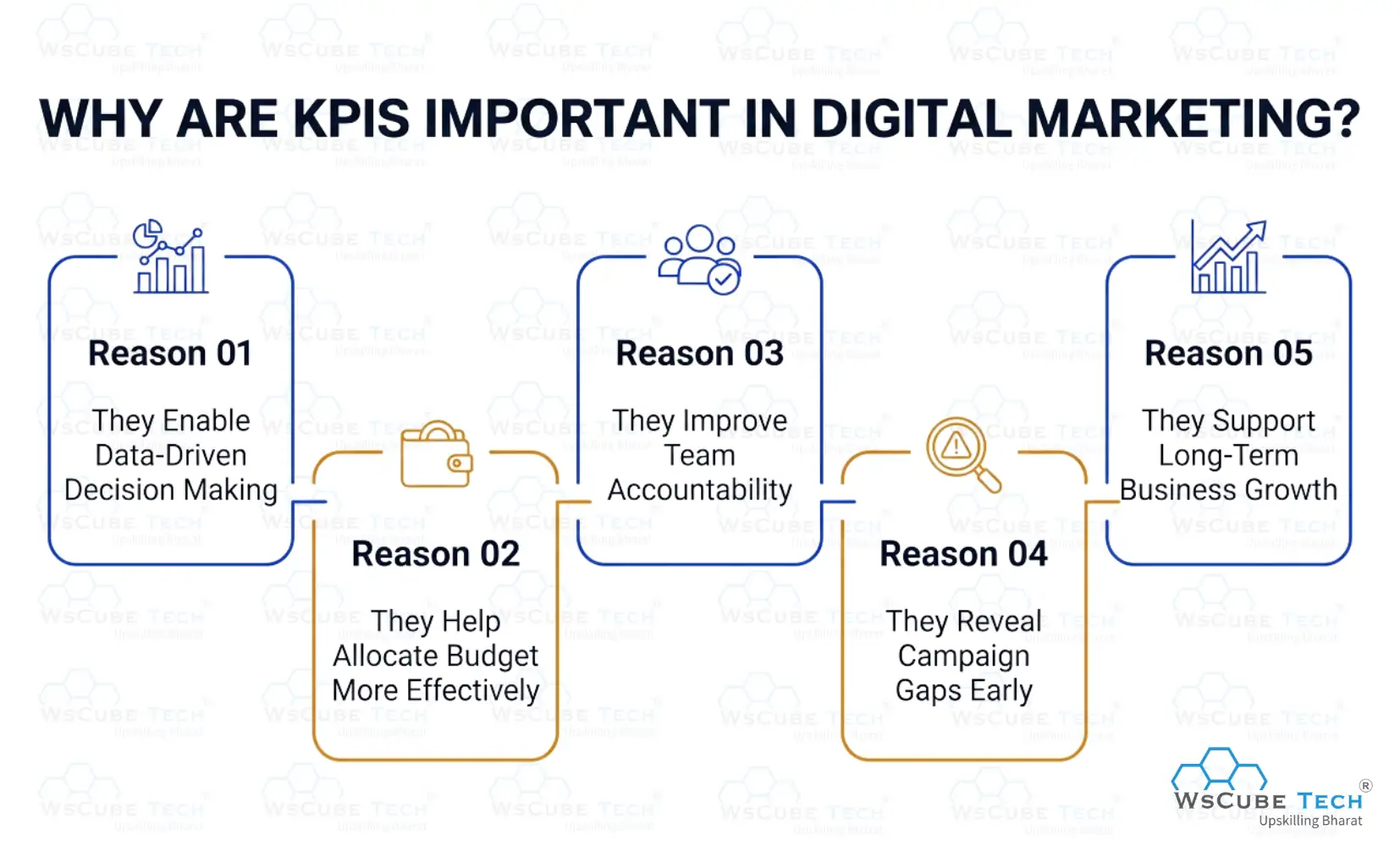
1. They Enable Data-Driven Decision Making
KPIs in digital marketing replace guesswork with evidence. When you track the right metrics consistently, every strategy shift or budget decision is backed by real performance data rather than assumptions.
2. They Help Allocate Budget More Effectively
Without clear digital marketing KPIs, marketing budgets often get spread thin across channels with no way to measure which ones are working. Tracking KPIs helps teams redirect spend toward higher-performing channels and cut waste from underperforming ones.
3. They Improve Team Accountability
When every team member knows which KPIs they are responsible for, it creates clear ownership. Whether it is an SEO specialist tracking keyword rankings or a paid ads manager monitoring ROAS, KPIs give each role a measurable target to work toward.
4. They Reveal Campaign Gaps Early
Monitoring digital marketing KPIs on a regular basis helps marketers catch performance drops before they become costly. For example, a sudden dip in email open rates can signal a subject line issue or list fatigue, allowing teams to respond quickly.
5. They Support Long-Term Business Growth
Beyond short-term campaign wins, tracking KPIs for digital marketing consistently helps businesses identify patterns, refine strategies over time, and build a more scalable marketing operation.
Recommended Professional Certificates
AI-Powered Digital Marketing Course
Performance Marketing Bootcamp
SEO Specialist Bootcamp
Difference Between KPIs and Metrics
Many marketers use the terms KPIs and metrics interchangeably, but they are not the same thing. Understanding the distinction is essential before diving into any digital marketing KPI framework.
A metric is any quantifiable data point you can track, such as page views, impressions, or session duration. A KPI is a specific metric that has been chosen because it directly reflects progress toward a defined business goal. In simple terms, all KPIs are metrics, but not all metrics are KPIs.
| Basis | KPIs | Metrics |
| Definition | Strategic measurements tied to specific business goals | Broader data points that track operational activity |
| Purpose | Indicate whether you are succeeding or failing toward a goal | Provide context and supporting data |
| Examples | Conversion rate, ROI, Customer Lifetime Value | Page views, impressions, session duration |
| Decision Impact | Directly inform strategic decisions | May or may not influence strategy |
| Focus | Narrow, goal-aligned | Wide, general |
| Frequency of Review | Weekly, monthly, or quarterly | Can be tracked in real time or daily |
For example, if your goal is to grow revenue through email marketing, your KPI might be the conversion rate from email clicks. Metrics like open rate and click-through rate provide supporting context, but the KPI is the number that tells you if the strategy is working.
Choosing the right digital marketing KPIs means starting with your business objective and working backward to identify which specific metrics reflect real progress.
How to Set SMART KPI Goals
Setting KPIs without a structured framework often leads to vague targets that are hard to act on. The SMART method ensures every KPI for digital marketing is clear, achievable, and tied to a real outcome.
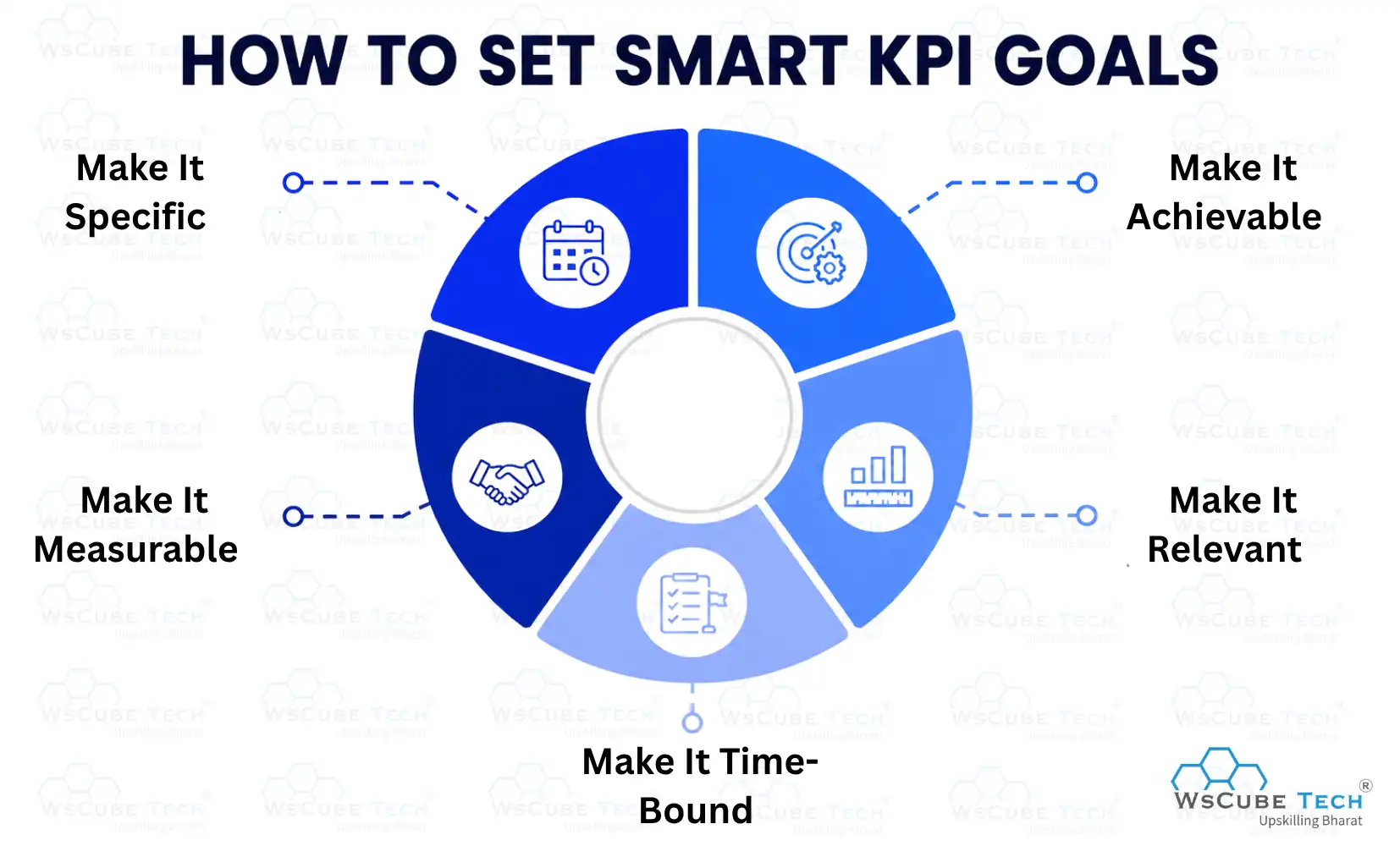
Step 1: Make It Specific
Define exactly what you want to measure and why. Avoid broad statements like "improve SEO." Instead, go with something like "increase organic traffic to the blog by 20% in Q3." A specific KPI removes ambiguity and gives your team a clear direction.
Step 2: Make It Measurable
Every digital marketing KPI must be trackable with a clear number or percentage. If you cannot measure it, you cannot manage it. Tools like Google Analytics, HubSpot, or SEMrush should be able to pull the exact data point you are targeting.
Step 3: Make It Achievable
Your KPI targets should be ambitious but realistic. Use historical data and industry benchmarks to set a baseline. A target that is too aggressive can demotivate teams, while one that is too easy adds no value.
Step 4: Make It Relevant
Each KPI should connect directly to a broader business goal. If your company is focused on increasing sales this quarter, your key performance indicators in digital marketing should reflect metrics that contribute to conversions and revenue, not just traffic or likes.
Step 5: Make It Time-Bound
Set a clear deadline for every KPI. A review cadence of 30, 60, or 90 days works well for most digital marketing KPIs. Time-bound goals create urgency and make it easier to evaluate whether a strategy is working or needs adjustment.
Upcoming Masterclass
Attend our live classes led by experienced and desiccated instructors of Wscube Tech.


Top Digital Marketing Key Performance Indicators to Track
KPIs in digital marketing can vary based on marketing channel or method. Here are the most important KPIs to track and measure:
- Marketing KPIs
- Search Engine Optimization KPIs
- Social Media KPIs
- Email Marketing KPIs
- Paid Marketing KPIs
1. Marketing KPIs

A) Conversion Rate
Conversion rate is the percentage of users that have taken the desired action, such as submitting a form, buying a product, signing up for the newsletter, or installing an app, after interacting with the content or ads.
The desired action can be any step you want your target users to take. Conversion rate is a crucial KPI for businesses to understand how much traffic turns into leads and how many leads turn into buyers, which will increase revenue. By tracking conversion rates, marketers can assess which CTAs, messages, or page designs are most effective and drive better results.
The formula to calculate the conversion rate is:

B) Return on Investment
Return on investment (ROI) is the queen of digital marketing KPIs. It calculates the amount of money a marketing campaign generates against the money invested. ROI is the performance metric marketers use to analyze the efficiency of the money invested in a specific marketing strategy.
We can calculate ROI for almost every process, which must be above 100%. A positive ROI shows that the marketing campaign has performed well, contributing to the bottom line. It’s essential to set a benchmark for each case while calculating ROI.
Below, we have shared the formula to calculate ROI for a marketing campaign:

C) Cost Per Lead
Cost per lead (CPL) is a metric that indicates the amount paid to earn each lead from a marketing campaign. It helps businesses understand how much money they have spent on marketing to get new leads.
We can track CPL across various campaigns and channels. CPL allows us to determine which activities generate more leads at the lowest cost. Hence, we can assess if the amount invested in a campaign is worth the leads generated from it. We can evaluate the resources and time spent on a strategy within a specific period.
We can calculate CPL by using the following formula:

D) Customer Lifetime Value
Customer Lifetime Value (CLV) is among the important digital marketing metrics to find the total revenue a business can possibly earn from a customer throughout their engagement and relationship. CLV can either be historical, which means total profit from the purchases a buyer has made, or predictive, which signifies the expected revenue from a customer.
This KPI helps marketers and businesses guide their marketing efforts in the right direction and make informed decisions regarding customer retention, acquisition, and loyalty programs. This will allow them to nurture and establish long-term customer relationships, leading to sustainable business growth.
CLV must be higher than the amount spent on marketing and sales to acquire one customer. This is a great method for brand owners and marketers to better understand the business.
You can calculate CLV by using the following formula:

2. Search Engine Optimization KPIs

A) Keyword Rankings
Keyword ranking tells you where your website or page stands in search engine results. SEO KPIs help you track your website’s position for a specific keyword.
Your website ranking may change over time, and you can track this shift to find what works and what doesn’t. You can get more organic traffic and leads with improved search engine rankings.
One page can rank for multiple keywords, and the top five search results get the most clicks by users. Hence, make sure to regularly track your keyword rankings and improve your SEO efforts to drive higher traffic.
B) Domain Authority
Moz gets all the credit for introducing domain authority, one of the most important digital marketing KPIs that measures the overall authority and trustworthiness search engines attribute to a website.
It shows if search engines find your content useful and valuable. Page authority is also the same, but it is measured on a page-by-page basis. A higher domain authority score means better search engine rankings.
C) Website Traffic
Website search traffic means the total number of visitors arriving on your site through unpaid search results. The traffic on your website shows its relevance and visibility in SERPs.
Search traffic is among the top KPIs for digital marketing that includes several metrics, such as organic traffic, total visits, page views per session, unique visitors, traffic source, site visitors, top web pages, and more KPIs associated with the traffic your website gets from search engines.
D) Backlinks
Quality backlinks are endorsement of a website. Hence, they are considered a vital search engine ranking factor, especially the ones websites get from high authority and reputable websites. That is why marketers invest a lot of time and energy in building optimized and relevant backlinks.
Using this KPI, you can track the number of websites linked to yours and assess how these links influence your website traffic and rankings in SERPs.
When you build quality and relevant links from top websites, Google treats your website as more authoritative and credible, which translates into higher rankings and more organic traffic.
3. Social Media KPIs

A) Average Engagement Rate
The average engagement rate (AER) refers to the percentage of people who liked, shared, or commented on your social media posts compared to the number of followers. It also includes saved content. You can find out the average engagement rate by dividing the total number of engagements received by the total number of posts within a specific period. Divide the answer by total followers and multiply it by 100.
Here is the formula to calculate AER:

B) Number of Followers
Follower count signifies the total number of users following your social media page or profile on different platforms. It is a social proof used to gauge the popularity of your brand and helps you know the number of people who can potentially see your posts and content.
Big brands regularly create innovative and unique content for their social media profiles to engage users and increase followers. However, a larger follower count doesn’t ensure that every follower sees your posts.
C) Likes, Shares, and Comments
Likes, shares, and comments are like the lifeline of social media sites and posts. Hence, it is a crucial part of every digital marketing KPIs list.
If social media is one of the key marketing channels for your brand, you need to post engaging content and get more exposure on various platforms.
4. Email Marketing KPIs

A) Open Rate
The open rate shows the percentage of recipients on your email list who open your emails compared to the number of emails sent. This is an excellent KPI to assess the effectiveness of your email campaigns and evaluate their engagement and relevancy.
Monitor open rates regularly to see how different subject lines perform and influence people. For example, you may notice that shorter or quirkier subject lines are more compelling than others.
If you witness the open rate going down, revamp your email marketing campaign and craft more attractive subject lines. Subject lines that resonate with the audience will lead to higher open rates. Try adding different subject lines for various sections of the audience to increase open rates.
B) Subscribers
Subscribers are the total number of users who have opted to receive your emails. You can use reliable email marketing tools to track the number of subscribers.
It is a crucial KPI as it indicates the size of the audience your brand can reach through your emails. With time and through effective email marketing campaigns, you can nurture subscribers, build a loyal connection, and convert them into leads. There are several ways to increase subscribers, such as offering discounts, sharing valuable information, and updating about the latest products.
Once users subscribe to your newsletter, consistently provide useful information to keep them engaged with your brand; otherwise, they can unsubscribe.
Unsubscribe is also one of the digital marketing KPIs examples used to track the number of people who have unsubscribed to your newsletter.
C) Sign-up Rate
The sign-up rate is the percentage of people who visit your website and sign up for your email list. It can be for white papers, newsletters, case studies, blogs, etc.
D) Click-through Rate
The click-through rate (CTR) is the ratio of the total number of people who click on a link in your email to the number of email recipients who have opened the email. It is one of the key digital marketing KPIs, showing how many users engage with your emails and are interested in learning more about your brand, product, or offerings.
When you include a page or product link in your email, you can easily track the number of people who click on it.
Always set CTR expectations according to industry standards. For example, the average CTR in the e-commerce industry is 2.01%. So, if a company in this industry achieves a CTR above this, it is likely to perform well.
One proven way to increase CTR is to write engaging and informative email content. Be accurate, get to the point fast, convey your message directly, and add strong visuals. Your tone must align with the brand voice and be consistent.
5. Paid Marketing KPIs

A) Cost Per Acquisition
Cost per acquisition (CPA) is the total marketing spend to acquire a buyer on a specific marketing channel. It includes all the costs incurred to convert a user into a paying customer, including software, tools, salaries, and other resources and overhead.
The aim of calculating CPA is to know if ads are making profits or not. A profitable ad will have lower CPS than the customer lifetime value. On the other hand, a growing CPS means your paid ads are not effective enough.
A few useful ways to lower CPA are by optimizing conversion rates through improved landing page designs and content, creating more targeted ads, and adding attractive visuals. Also, track CPA for each channel individually for deeper insights, as you might find that social media ad campaigns are much cheaper than Google Ads or vice-versa. This will help you allocate your PPC budget wisely.
Here is the formula to calculate CPA for a given period for a specific ad campaign.

B) Return on Ad Spend
Return on ad spend is the revenue earned from a paid ad compared to the amount spent across multiple channels over a period. It is a critical digital marketing metric to measure the performance of an ad and get a clearer picture of how well your allocated budget translates into revenue.
Return on ad spend shows the revenue a business has earned for every penny it spent on paid ads. Marketers use it for every digital marketing paid ad campaign and find the most result-driven campaigns.
Calculating return on ad spend is quite simple. You simply have to divide the revenue generated from the ad by the total money spent.

C) Cost Per Click
Cost per click (CPC) is another digital marketing KPI that shows the total amount paid for every click on your ad. It measures the profitability and cost-effectiveness of your online paid advertising campaigns.
The formula to calculate CPC is:

Explore More on Digital Marketing
Digital Marketing KPI Examples
To make digital marketing key performance indicators more practical, here are real-world examples of how businesses use them across different scenarios:
- An e-commerce brand tracks conversion rate across product pages to identify which ones drive the most purchases and which need redesign.
- A SaaS company monitors Cost Per Lead from Google Ads versus LinkedIn Ads each month to determine where to shift budget for maximum efficiency.
- A content marketing team tracks organic keyword rankings weekly to measure SEO progress and adjust their content calendar based on gaps and opportunities.
- A retail brand running seasonal campaigns monitors Return on Ad Spend in real time to pause underperforming creatives and double down on high-performing ones.
- An email marketing team tracks both open rate and click-through rate to evaluate whether subject lines are attracting attention and whether the email body is compelling enough to drive action.
- A B2B company uses Customer Lifetime Value alongside Customer Acquisition Cost to ensure their paid acquisition strategy remains profitable over the long term.
These digital marketing KPI examples illustrate that the best-performing teams do not track everything. They identify the two or three metrics most aligned with their current goal and focus on moving those numbers consistently.
Common KPI Tracking Mistakes to Avoid
Even experienced marketers fall into habits that make KPI tracking less effective. Here are the most common mistakes to watch out for:
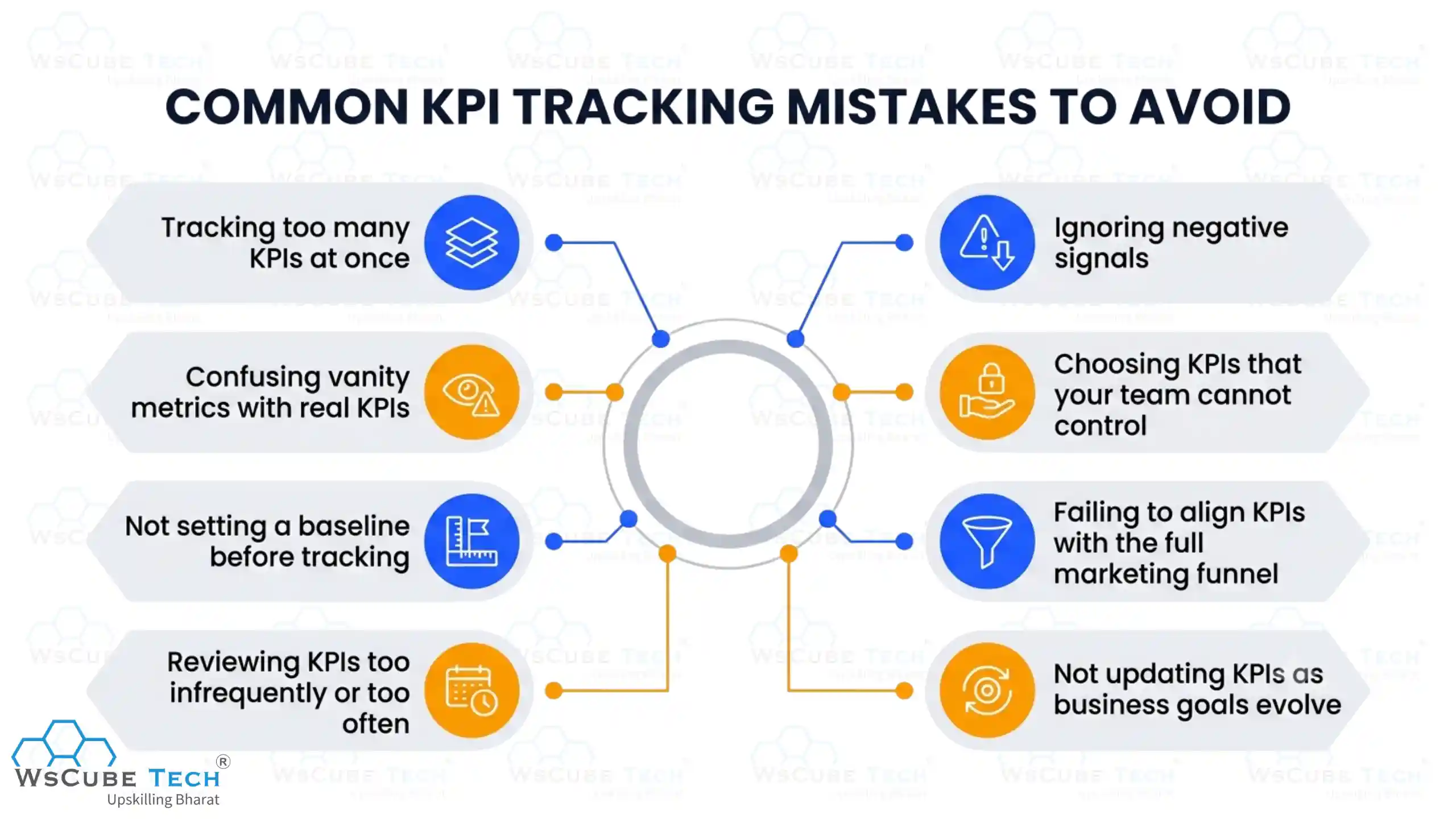
- Tracking too many KPIs at once. Having 20 metrics on a dashboard creates noise, not clarity. Focus on five to seven KPIs that directly connect to your current business goals.
- Confusing vanity metrics with real KPIs. Raw follower counts, page views, or ad impressions look good in reports but rarely indicate actual business progress. Prioritize metrics tied to conversions and revenue.
- Not setting a baseline before tracking. Without a starting point, you have no way to measure whether performance has improved or declined. Always establish a benchmark before a campaign launches.
- Reviewing KPIs too infrequently or too often. Daily tracking works for fast-moving paid campaigns. Monthly or quarterly reviews are better suited for SEO or brand-awareness KPIs. Misaligned review cycles lead to poor decisions.
- Ignoring negative signals. Many teams focus only on metrics that are trending positively. Keeping an eye on rising churn, falling open rates, or increasing CPA is equally important and often more actionable.
- Choosing KPIs that your team cannot control. If a metric is driven entirely by external factors outside your marketing team's influence, it should not be a KPI. Accountability requires a direct link between team actions and KPI outcomes.
- Failing to align KPIs with the full marketing funnel. Using only bottom-funnel KPIs like CPA while ignoring top-funnel metrics like reach and brand awareness gives an incomplete picture of campaign health.
- Not updating KPIs as business goals evolve. A KPI that was relevant six months ago may no longer reflect your current priorities. Review and refresh your KPI framework every quarter.
Explore Our Most Popular Marketing Courses
Digital Marketing KPIs: Video Guide
FAQs about Digital Marketing KPIs
A KPI in digital marketing is a quantifiable metric used to measure whether your marketing campaigns are achieving specific business goals. It stands for Key Performance Indicator and helps marketers track progress across marketing channels.
The most important digital marketing KPIs include Conversion Rate, ROI, Cost Per Lead (CPL), Customer Lifetime Value (CLV), CTR, Cost Per Acquisition (CPA), and ROAS. The right ones depend on your current business goals and marketing channel.
Fast-moving metrics like paid ad performance and conversion rates should be reviewed daily or weekly. SEO and brand-awareness KPIs are better suited to monthly or quarterly reviews. Most experts recommend a 30/60/90-day cadence for strategic KPI assessments.
A metric is any data point you can measure, such as page views or impressions. A KPI is a specific metric chosen because it directly tracks progress toward a defined business goal. All KPIs are metrics, but not all metrics qualify as KPIs.
Most marketing experts recommend tracking five to seven KPIs at a time. Tracking too many metrics dilutes focus and makes it harder to identify what is actually driving or hurting performance.
A good conversion rate varies by industry. On average, across industries, a conversion rate between 2% and 5% is considered solid for most digital campaigns. E-commerce sites often see rates between 1% and 3%, while B2B lead generation pages can see higher rates with well-targeted traffic.
Use the SMART framework. Make your KPI Specific, Measurable, Achievable, Relevant, and Time-bound. Start by reviewing historical data and industry benchmarks, then set a realistic improvement target with a clear deadline.
ROAS stands for Return on Ad Spend. It tells you how much revenue you earn for every rupee or dollar spent on paid advertising. It is one of the most critical digital marketing KPIs for paid campaigns because it directly measures ad profitability and helps guide budget allocation.
Yes. Even with limited budgets, tracking a small set of KPIs such as cost per lead, conversion rate, and website traffic helps small businesses identify which efforts are generating results and where they should focus their spending for better returns.
Commonly used tools include Google Analytics for website and traffic KPIs, Google Search Console for SEO KPIs, Meta Ads Manager and Google Ads for paid marketing KPIs, Mailchimp or HubSpot for email marketing KPIs, and Hootsuite or Sprout Social for social media KPIs.

Conclusion
Tracking the right digital marketing KPIs is what separates campaigns that scale from ones that stall. From conversion rate and ROI to keyword rankings and email CTR, each KPI gives you a specific lens into how well your strategy is working. The key is not to track everything but to track what matters most to your goals right now.
If you want to build a strong foundation in measuring and optimizing campaigns, enrolling in an online digital marketing course is a great way to get structured, practical knowledge. Start with the core digital marketing key performance indicators covered in this guide, stay consistent with your tracking, and let data guide every decision you make.
Join Our On-Campus Digital Marketing Program
Explore Our Free Courses






Leave a comment
Your email address will not be published. Required fields are marked *Comments (0)
No comments yet.