
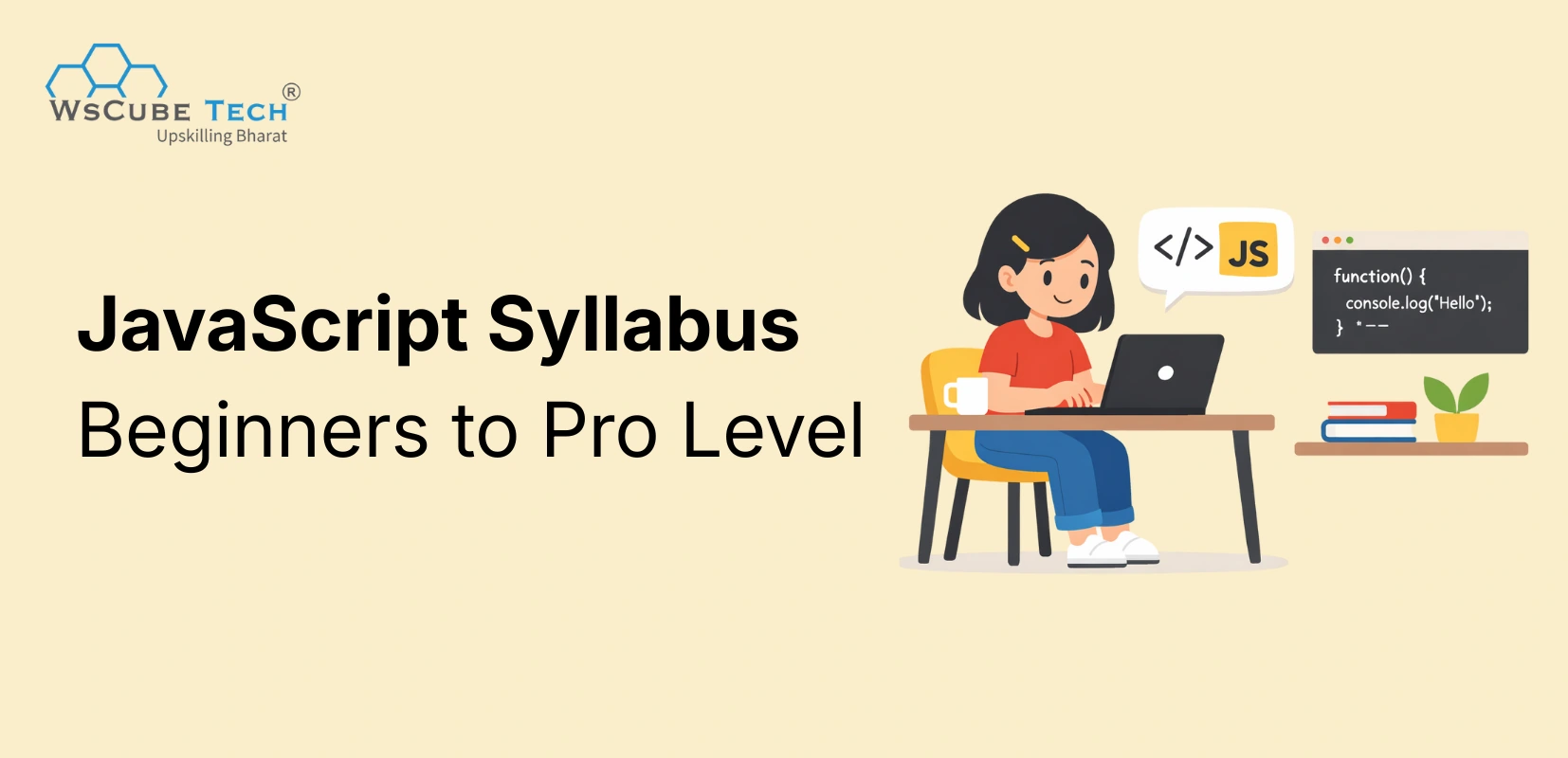
JavaScript is a versatile and widely used programming language known for making websites interactive and dynamic. It is popular among both beginners and professional developers for creating a wide range of applications, from simple web scripts to complex web applications. Its flexibility and ease of use make it an excellent choice for anyone starting a journey in web development.
This JavaScript syllabus blog is designed to guide learners step by step, starting with basic concepts and progressing to advanced topics. It builds a strong foundation while also developing the practical skills needed for real-world web development projects.
Also Read: Web Design vs Web Development: Key Differences & Comparison
What is JavaScript?
JavaScript is a high-level and versatile programming language created by Brendan Eich in 1995. It is designed to make web pages interactive and dynamic, using a simple syntax that allows developers to add behavior, animations, and real-time updates to websites. JavaScript runs directly inside web browsers, making it one of the most important languages for modern web development. Its flexibility enables developers to build both small interactive features and large-scale applications.
Because it is flexible and works across different platforms, JavaScript has become one of the most commonly used programming languages. It is used in many areas, including:
- Web Development: Building interactive elements, dynamic content, and responsive features that improve user experience on websites and web applications.
- Frontend Development: Creating modern and responsive user interfaces using libraries and frameworks like React.
- Backend Development: Developing server-side applications and APIs using environments such as Node.js.
- Mobile App Development: Building cross-platform mobile applications with tools like React Native.
- Game Development: Designing browser-based games and interactive entertainment experiences.
- Software Development: Creating desktop applications and tools using JavaScript-based technologies.
JavaScript Code Example
console.log("Welcome to JavaScript!");Why Learn JavaScript?
JavaScript is important for building interactive websites and modern applications, offering strong career opportunities, cross-platform development abilities, and a powerful ecosystem that supports beginners and professionals alike.
- Easy to Start: JavaScript has simple syntax and runs directly in browsers, allowing beginners to start coding quickly without complex setup, while gradually learning core programming concepts and problem-solving skills.
- Web Development Foundation: JavaScript is a core technology of the web, enabling developers to create dynamic content, interactive interfaces, and responsive features that improve user experience across modern websites and applications.
- Career Opportunities: JavaScript skills are in strong demand across industries, opening roles in frontend, backend, and full-stack development, giving learners versatile career paths in today’s growing technology-driven job market.
- Versatility Across Platforms: JavaScript is not limited to browsers; it is also used for server-side programming, mobile applications, desktop software, and even games, making it a truly flexible and multi-purpose language.
- Rich Ecosystem: JavaScript has a large community and extensive libraries, frameworks, and tools that speed up development, simplify complex tasks, and provide continuous learning resources and real-world project support.
Learning JavaScript helps you build practical skills, create real-world applications, and prepare for a wide range of modern technology careers. If you want to become a developer, join our online full-stack development course to learn front-end and back-end skills with real projects.
Recommended Professional Certificates
Full Stack Development Course with AI Engineering
WordPress Bootcamp
JavaScript Syllabus (Curriculum)
Below is the JavaScript syllabus, organized from beginner to advanced levels, to help you learn step by step with a clear structure, strong fundamentals, and a smooth, easy-to-follow learning path.
1. JavaScript Introduction
2. JavaScript Fundamentals
- JavaScript Variables and Constants
- JavaScript Data Types
- JavaScript Number
- JavaScript Strings
- JavaScript Booleans
- JavaScript Symbol
- JavaScript Comments
- "use strict" in JavaScript
- JavaScript Type Conversion
- JavaScript Scope
3. JavaScript Operators
- JavaScript Operators
- JavaScript Arithmetic Operators
- JavaScript Assignment Operators
- JavaScript Comparison and Logical Operators
- JavaScript Spread Operator
4. JavaScript Control Flow
- JavaScript if...else Statement
- JavaScript Ternary Operator
- JavaScript Switch Case Statement
- JavaScript Loops
- JavaScript while and do...while Loop
- JavaScript Break Statement
- JavaScript Continue Statement
5. JavaScript Functions
- JavaScript Functions
- JavaScript Function Expression
- JavaScript Anonymous Functions
- JavaScript Arrow Function
- JavaScript Recursion
- JavaScript Callback Function
- JavaScript Hoisting
- JavaScript Closure
6. JavaScript Arrays & Collections
7. JavaScript Objects
8. Object-Oriented Programming (OOP) in JavaScript
- Object-Oriented Programming (OOP) in JavaScript
- JavaScript Classes
- JavaScript Inheritance
- JavaScript Prototype
9. JavaScript DOM & Events
10. JavaScript Asynchronous Programming
11. JavaScript Error Handling
12. Advanced JavaScript Concepts
- JavaScript this Keyword
- JSON in JavaScript
- Modules in JavaScript
- Generators in JavaScript
- Regular Expressions in JavaScript
- Date and Time in JavaScript
- JavaScript Math Object
After completing the JS syllabus, you will understand core concepts, build interactive websites, solve programming problems, and use modern features confidently, preparing you for real-world development and exciting career opportunities in web and software development.
Upcoming Masterclass
Attend our live classes led by experienced and desiccated instructors of Wscube Tech.



Who Should Learn JavaScript?
JavaScript is suitable for anyone interested in building interactive websites, dynamic applications, and modern digital solutions. It suits beginners, students, professionals, and creators who want strong programming and web development skills.
- Students and Beginners: JavaScript is beginner-friendly, helping learners understand programming logic, problem-solving, and web development basics while building interactive projects that strengthen coding confidence and practical development experience.
- Aspiring Web Developers: JavaScript is essential for frontend and backend development, enabling developers to create dynamic websites, responsive interfaces, and full-stack applications that power modern digital platforms and services.
- Working Professionals: Professionals from non-technical or technical backgrounds can learn JavaScript to automate tasks, build tools, and expand career opportunities in growing technology-driven industries and digital roles.
- Career Changers: Individuals moving into the technology field can learn JavaScript as a strong starting point, gaining practical programming skills that open pathways into web development, software roles, and other in-demand tech careers.
- Tech Enthusiasts and Creators: Anyone interested in building apps, games, or digital tools can use JavaScript to turn ideas into functional products while improving logical thinking and problem-solving skills.
Learning JavaScript opens doors to innovation, career growth, and the ability to build real-world digital solutions.
JavaScript Interview Questions
Regular practice is essential for mastering JavaScript. Solving JavaScript interview questions helps you test your understanding, improve problem-solving skills, and prepare effectively for job interviews. You can also explore more JavaScript interview questions and answers to enhance your knowledge and build confidence.
Also Read: Java vs JavaScript: Key Differences & Comparison Explained
JavaScript Projects
JavaScript projects help you turn your programming knowledge into practical experience by building real applications and solving meaningful problems. Working on projects improves your coding skills, deepens your understanding of core concepts, and builds confidence in creating interactive and dynamic applications.
By applying the concepts covered in the JavaScript curriculum, you gain hands-on experience with logic building, user interaction, and application structure. This practical approach helps you confidently develop complete, functional, and well-structured software solutions.
Explore More on Syllabus Blogs
| C++ Syllabus | SQL Syllabus |
| C Language Syllabus | Python Syllabus |
| DSA Syllabus | Java Syllabus |
| HTML Syllabus | CSS Syllabus |
| MERN Stack Course Syllabus | DBMS Syllabus |
Learn JavaScript from Scratch with WsCube Tech
You can explore the JavaScript tutorial by WsCube Tech, specially designed for beginners who want to start from zero and gradually grow into confident JavaScript developers. The tutorial explains concepts in simple terms, making programming easier to understand.
This tutorial follows a clear, step-by-step learning path with practical examples and hands-on exercises. You don’t just read theory, you actively write programs and apply what you learn. You can also use an online JavaScript compiler to write, run, and test your code instantly, which makes learning more interactive and engaging.
Along with learning, you can test your knowledge with JavaScript quizzes to check your understanding and strengthen your concepts. This step-by-step approach takes you from foundational knowledge to advanced skills, preparing you to confidently build modern websites, applications, and interactive software.
Also Read: Coding vs. Programming: What’s the Difference?
FAQs About JavaScript Syllabus
JavaScript is a programming language that helps you create interactive websites and dynamic applications. When you learn JavaScript, you gain the ability to control webpage behavior, build engaging user experiences, and develop skills that are highly useful in modern technology careers.
A JavaScript syllabus usually starts with basics like variables, data types, and operators. As you progress, you learn functions, objects, DOM manipulation, and asynchronous features, helping you build interactive web applications and understand how modern websites actually work.
You can benefit from a JavaScript curriculum whether you are a student, beginner, working professional, or career changer. It helps you build programming logic, improve problem-solving skills, and prepare for opportunities in web development and software-related roles.
The time depends on your learning speed and practice routine. If you study consistently a few hours daily, you can complete the basic JavaScript course syllabus in two to three months, then continue improving through projects and advanced concepts.
No, you do not need prior programming experience. You can start learning JavaScript from the basics. Its readable syntax and browser-based practice environment make it easier for you to understand concepts, experiment with code, and gradually build confidence.
Yes, JavaScript projects are very important because they help you apply what you learn. When you build projects, you improve your coding skills, understand real application flow, and gain practical experience that strengthens your overall programming confidence.
JavaScript is important because it allows you to make websites interactive and responsive. You can update content without reloading pages, handle user actions, and create modern web experiences that feel smooth, dynamic, and engaging for users.
When you learn JavaScript, you can explore careers like frontend developer, backend developer, full-stack developer, or web application developer. Your skills can also support roles in software development, technical support, and other technology-focused job positions.
You can practice JavaScript using an online JavaScript editor by WsCube Tech that allows you to write, run, and test code directly in your browser. This makes learning simple, fast, and convenient without requiring any software installation.
After finishing the syllabus of JavaScript, you should start building larger projects, exploring frameworks, and practice coding regularly. This helps you strengthen your skills, better understand advanced concepts, and prepare for professional development opportunities.

Conclusion
Learning JavaScript is a valuable step toward building strong programming and web development skills. Its simple syntax and powerful capabilities allow you to create interactive websites, dynamic applications, and modern digital solutions. By following a structured syllabus, you gradually develop a solid understanding of core concepts and practical coding techniques.
With consistent practice and hands-on projects, you can turn your knowledge into real skills. JavaScript opens pathways to careers in web development, application development, and software creation. Staying curious and building regularly will help you grow into a confident and capable developer.
Free Courses for You




Leave a comment
Your email address will not be published. Required fields are marked *Comments (0)
No comments yet.