Web development involves far more than writing code. Developers rely on web development frameworks to speed up the process, avoid repetitive work, and follow proven coding practices. These frameworks provide ready-made structures, tools, and libraries that make development faster, more organized, and easier to maintain over time.
Frameworks generally fall into two categories: front-end and back-end. Depending on your project's needs, you might use one for building interactive interfaces and another for handling databases, servers, and application logic.
In this blog, we'll break down some of the most popular web development frameworks, their key benefits, and how to pick the right one for your project. And if you're looking to build these skills from the ground up, our online full stack development course can help you get started the right way.
What is a Development Framework?
A framework is a collection of programming tools. It's an essential guide for building well-structured, reliable systems and software. Web development frameworks help build web applications, including web resources, web services, and web APIs.
A web framework provides, through a library, access to ready-made components, snippets of code, or templates. This convenience is a relief and aids in web development.
Types of Web Development Framework
Web app frameworks are generally divided into front-end (client-side) and back-end (server-side) frameworks. A few frameworks, called full-stack frameworks, allow development on both ends. Understanding the difference between frontend and backend frameworks is the first step toward selecting the right tech stack for your website.
Also Read: Front-end vs Back-end Development: Explained for Beginners
1. Front-end Frameworks (Client side)
A client-side framework deals with user interfaces. The web application's front-end is what you see and interact with. A website’s user experience is significant to any business. Although complex functions and operations may occur in the background, what end-users experience and see must be seamless. To do this, front-end frameworks facilitate the development of interactive, user-centric websites.
2. Back-end Frameworks (Server side)
Frameworks for back-end web development are libraries of modules and tools that aid developers in creating website structures. The back-end consists of the server, the database, and the code interacting with them. A server-side framework ensures the smooth functioning of the website in the background. They simplify daily web development tasks such as database interaction, URL routing, user authentication, enhanced security, push notifications, etc.
Recommended Professional Certificates
Full Stack Development Course with AI Engineering
WordPress Bootcamp
Web Development Frameworks for Front-end Development
Front-end frameworks are the most innovative and pioneering web design and development aspects. These frameworks for web applications direct the user experience, aesthetics, and visual appeal of web applications. They enhance the look and feel of websites and mobile apps and increase traffic. To become a pro in front-end development, read our blog on Front End Developer Skills: 14 Essential Skills to Learn to improve your skills in this field.
Let’s take a look at a few of them.
1. React
Developed by Facebook, React is a well-known JavaScript library. It is used to build complex and interactive user interfaces using reusable components. React web dev framework makes it easier to update and render certain parts on a web page without affecting the rest of the page, offering a fast and smooth user experience. Learn ReactJS through our online ReactJS course and climb the ladder of success!
What are the Benefits of React?
- Allows the breaking down of complex UI into smaller components and starts developing the same.
- The presence of many handy tools allows developers to inspect and debug the DOM quickly when using Chrome extensions.
- Virtual DOM aids React know when to re-render and ignore certain pieces of the DOM. This increases the page’s performance.
- Including HTML in your JavaScript helps developers write code quickly.
2. Angular
One of the most popular and well-known frameworks, Angular.js, comes from the digital giant of the day, Google. It is an open-source JavaScript framework that can help you make single web-page applications using an MVC (Model-Controller-View) architectural pattern. It's not a full-stack framework, but you can consider it a front-end framework, which is great for handling your Web Pages. If you plan headless commerce development, you must have Angular.js in your toolkit for great results.
What are the Benefits of Angular?
- Well-detailed documentation that is kept updated on time by Google.
- Provides faster loading time.
- Allows dependency injection to execute multiple functions at a time.
- Allows numerous third-party integrations that improve the overall functionality of websites.
3. Vue JS
A lightweight and flexible JavaScript framework, Vue.js is used to build end-user interfaces and single-page applications. Learning and integrating this programming web framework into a project is relatively simple, allowing developers to easily create engaging and responsive UI components. Its incremental adaptability enables developers to use it in part or as the key framework for a project. This flexibility of Vue.js enables teams to easily integrate it with ongoing projects or opt for it as the primary choice for new applications based on their needs.
What are the Benefits of Vue JS?
- Simple and easy to grasp.
- Effortlessly handle 2-way data binding, thus making the code reactive.
- Offers comprehensive documentation, making it easier to learn.
- With a reduced jQuery library, the compressed Vue.js weighs around 29KB.
4. Ember.js
Ember is an open-source JS-based framework. It provides comprehensive application flow and data management solutions. Ember offers two-way data binding and is also a component-based framework. Due to its rigid structure, it has a steep learning curve. However, it is a flawless and fast development framework, and tech giants like Apple and LinkedIn use it for their development.
What are the Benefits of Ember.js?
- Easy-to-learn and easy-to-use APIs.
- Offer a full front-end stack, i.e., router, services, and asset pipeline.
- Offers high performance.
- Has an active and massive community that provides developers with resources and support.
5. Asp.net Core
Probably the most popular framework for web apps built by Microsoft, Asp.net has gained the respect of developers worldwide. Established in 2002, It is especially popular because it can create rich and dynamic websites, web pages, and even web portals. Many companies worldwide prefer Asp.net and deem it the best technology in website development.
What are the Benefits of Asp.net Core?
- Integrates seamlessly with web dev technologies like HTML, CSS, and JavaScript. This makes it more accessible for developers to build modern web applications.
- Its modular architecture lets developers include only the components required for their applications, reducing the overall size and memory footprint.
- Contains built-in security features, such as authorization and authentication. It supports various encryption technologies, making it suitable for developing secure, enterprise-level applications.
6. jQuery
A JavaScript library, jQuery simplifies HTML DOM tree traversal and manipulation besides event handling, CSS animation, and Ajax. jQuery is a free, open-source software that uses the permissive MIT License. Its syntax makes navigating a document, selecting DOM elements, handling events, creating animations, and building Ajax applications easier. This web dev framework enables developers to create plugins on top of the JavaScript library. The core features here, including DOM element selections, traversal, and manipulation, further enabled by the selector engine Sizzle, have created a unique programming style combining algorithms and DOM data structures.
What are the Benefits of jQuery?
- Simple syntax and various built-in methods make it simple for developers to add dynamic behavior to pages.
- The library’s API is intuitive and straightforward. This makes it easier for developers to get started and make progress quickly.
- Has multiple plugins and extensions that add functionality to web applications.
Upcoming Masterclass
Attend our live classes led by experienced and desiccated instructors of Wscube Tech.



Web Development Frameworks for Back-end Development
Web development without backend frameworks isn't possible. For developers, finding the best web application development framework is essential for scalability and optimal performance. Choosing a backend framework for your web development project ensures the highest performance, the fastest development, and the greatest flexibility.
Let’s take a look at a few of them.
1. Node.js
Node.js is decidedly the best for building a lightweight yet highly efficient website. How well it works with real-time applications with massive data on distributed devices is uncanny. Node.js is more than a mere framework. It can ensure scalability and fast network applications as they can deal with multiple applications simultaneously without compromising performance. Uplift your career with the NodeJS course, an immersive learning and improve your skills!
What are the Benefits of Node.js?
- Due to its event-driven architecture, Node.js excels at handling many concurrent connections, making it suitable for building scalable web applications.
- With the rise of JavaScript frameworks like Angular or React, Node.js enables developers to use JavaScript for front-end and back-end development, creating a unified development experience.
- Well-suited to build real-time applications that needs constant two-way communication between client and server, such as chat applications or collaborative editing tools.
- JavaScript’s familiarity with and availability of pre-built packages speeds up development than traditional server-side languages.
2. Express.js
Built on the Node.js platform, Express.js is a fast and minimalist web framework to create server-side applications. It offers tools for creating web applications and APIs and handling HTTP requests, making it more accessible to develop web apps in JavaScript across client and server sides. The vital features and benefits of Express.js include its routing capabilities, lightweight design, support for .middleware, and straightforward management of HTTP requests and responses.
What are the Benefits of Express.js?
- If developers are comfortable with Node.js for the back end, they will become more comfortable with Express.js's improved and advanced process.
- Allows to define the routes of a preexisting app using URL and HTTP.
- Static files and resources are accessible to serve.
- An advanced feature is creating a REST API server.
- When employed with Node.js, both frameworks can support numerous concurrent actions.
- Helps connect with MongoDB, Redis, and MySQL.
- Effortlessly customize and configure the framework as per user needs.
- With an open-sourced community, the code is constantly reviewed and improved. You will get help from other community users whenever you are stuck.
3. Django
Django is a widely used high-level web framework developed in Python that helps developers build powerful web applications. Django includes an Object-Relational Mapping (ORM) system that simplifies interacting with databases and creating database schemas. Enhance your skills with our free Django course with expert-led sessions.
What are the Benefits of Django?
- Offers the best documentation since its inception, improving drastically with current tech innovation. It is also available in many languages.
- Django offers high security by default, closing loopholes left open in the past for the back-end developer to complete.
- Building a fully functional website requires no prior experience in the back end. It simultaneously runs different files without developing separate server files for database design.
- Gives flexibility through pluggable apps, through which third-party applications are quickly plugged.
- Django controls the website through URLs instead of IP addresses on the server. This makes it simple for SEO executives to connect the site to the server while avoiding the need for the web developer to translate the URL into any numeric code.
4. Ruby on Rails
The Ruby on Rails framework focuses on building web applications more efficiently. This website framework provides the components while you focus on what matters—your application’s code. It is a popular back-end framework even if it is not a widely used programming language since it supports developers with ease, automated testing, and libraries during the programming process.
What are the Benefits of Ruby on Rails?
- Designed to allow for the rapid development of web applications.
- Provides tools and abstractions that make it easier for developers to quickly develop and test applications, reducing the time and effort required to create a functional application.
- Promotes convention over configuration, meaning that it follows established conventions and best practices that make it easier for web developers to create applications without configuring every aspect of the application from scratch.
- Offers a rich ecosystem of plugins and gems used to add extra functionality to web applications.
- Highly scalable, making it a good choice for web applications that handle massive amounts of traffic and data.
5. Laravel

A free and open-source web framework for PHP made by Taylor Otwell. Laravel helps developers build websites by providing helpful tools and features. Based on the MVC (Model-View-Controller) Architecture, it organizes the code neatly and makes it easier to perform common operations in web development.
What are the Benefits of Laravel?
- It offers an easy-to-use command-line interface for performing everyday tasks, such as generating code and running database migrations.
- Offers a templating engine called Blade that makes creating and managing templates for your application easy. The blade is designed to be simple and intuitive, making it a good choice for developers new to templating engines.
- Includes an Object-Relational Mapping (ORM) tool called Eloquent, making it easy to interact with databases and perform database operations.
- Provides a simple and flexible routing system. This makes it easy to define the URLs for your application.
6. Flask

Flask is a WSGI framework running the web server rather than a user’s browser. Several modern applications run on the Flask; the reason behind this is that it allows them to create customized projects that run at a smooth pace. It offers assistance for the feature-adding extensions that might make them appear like they were built directly into Flask.
What are the Benefits of Flask?
- Designed to be simple and easy to use, with a minimalist approach to web development.
- A lightweight framework with a small codebase and minimal dependencies. This makes it fast and efficient and allows it to run on various hardware platforms and configurations.
- Highly flexible, allowing developers to build web applications that meet their needs and requirements
Integrates well with other technologies, such as databases, caching systems, and web development tools. Hence, building complex web applications that require integration with other technologies is easy.
Read More Web Development Related Guides
Difference Between Frontend and Backend Frameworks
Here are some points that explain the key differences between the two:
| Front-end Framework | Back-end Framework |
| Focus on a web application's client-side components, user interface, and user experience. | Focus on web application's sever-side components, handling requests, managing databases, and processing data. |
| Use multiple programming languages, such as HTML, CSS, and JavaScript. | Use multiple programming languages, such as Ruby, Python, and Java. |
| Offer pre-written tools and libraries for building interactive and responsive user interfaces, such as buttons, forms, and data visualization components. | Provide pre-written tools and libraries for building scalable and secure server-side applications, such as routing, authentication, and database integration. |
| Handle tasks such as data binding, state management, and routing within the user's browser. | Handle tasks such as authentication, database interaction, and security within the server. |
| Examples: React, AngularJS, and Vue.js. | Examples: Ruby on Rails, Django, and Express. |
Benefits of Using Web Development Framework
Using a web development framework improves both the speed and quality of your work by giving you a tested foundation instead of building from scratch. Here are the key benefits:
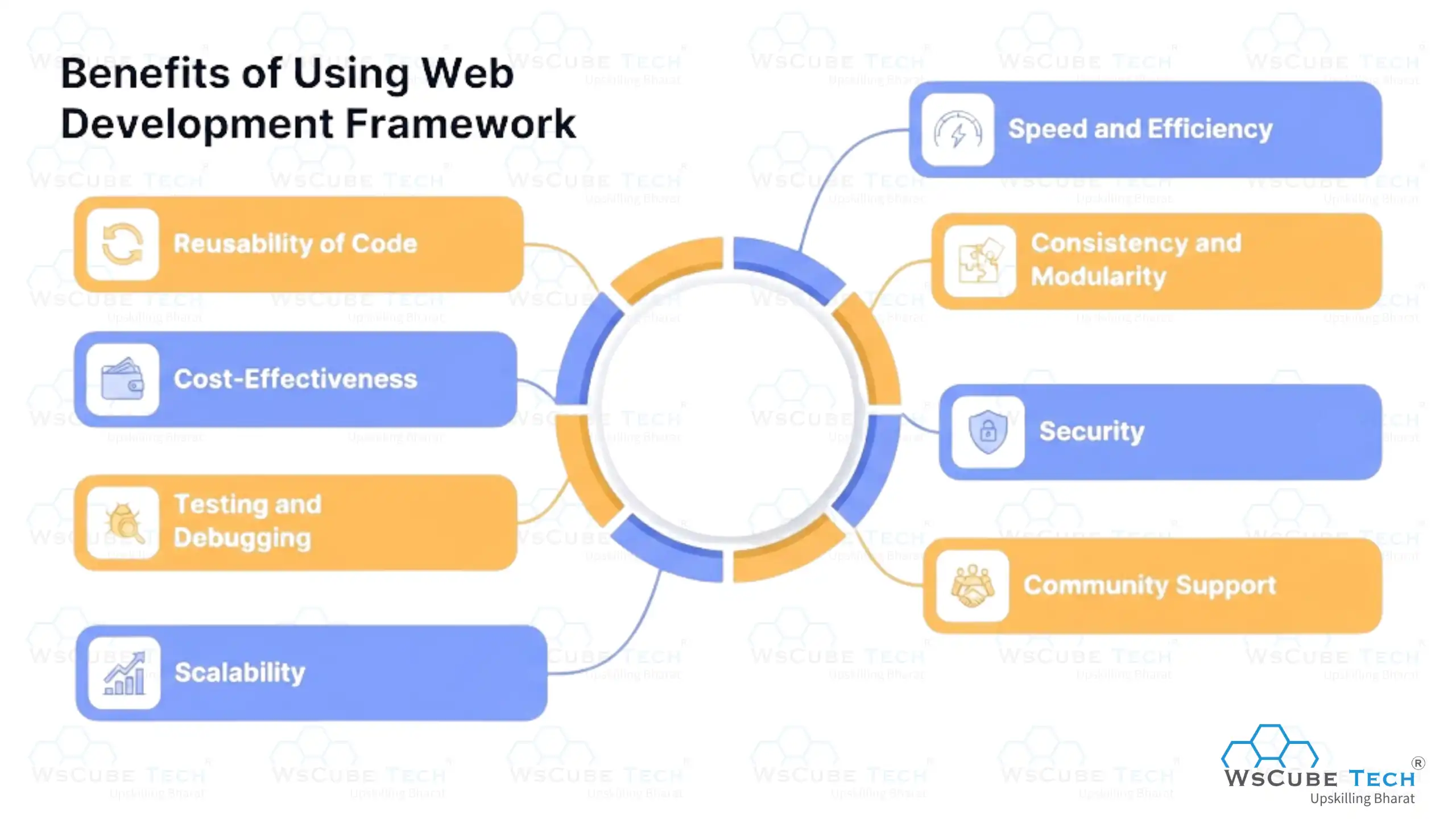
- Speed and Efficiency: Ready-made components and libraries mean less code and faster delivery. Repetitive tasks like routing and database connections are already handled, freeing you to focus on the product.
- Consistency and Modularity: Frameworks enforce a standard structure across the project, keeping the codebase organized and easier to maintain and scale over time.
- Security: Most frameworks ship with built-in protection against common threats like SQL injection, XSS, and CSRF, reducing vulnerabilities without manual effort.
- Community Support: Popular frameworks have large, active communities offering documentation, plugins, and quick help, which shortens the learning curve.
- Scalability: Frameworks are built to grow with your application, handling higher traffic and complexity without a complete rebuild.
- Testing and Debugging: Built-in tools and integrations make it easier to catch errors early, run automated tests, and maintain reliable performance.
- Cost-Effectiveness: Reduced development time and open-source tools lower the overall cost of building and maintaining a web application.
- Reusability of Code: The modular nature of frameworks lets developers reuse code across a project or multiple projects, avoiding duplication.
Overall, the latest web development frameworks can remarkably improve the development process and quality of the finished product, making them a valuable tool for any web development project.
Explore Our Web Development Related Courses
Things to Consider Before Selecting a Web Development Framework
There are many factors to consider when choosing the best framework for web app development, including whether it provides the necessary functionality, contains well-documented code, or has an active community.
However, there are more specific needs that are often overlooked while deciding on the top framework for web development, including:
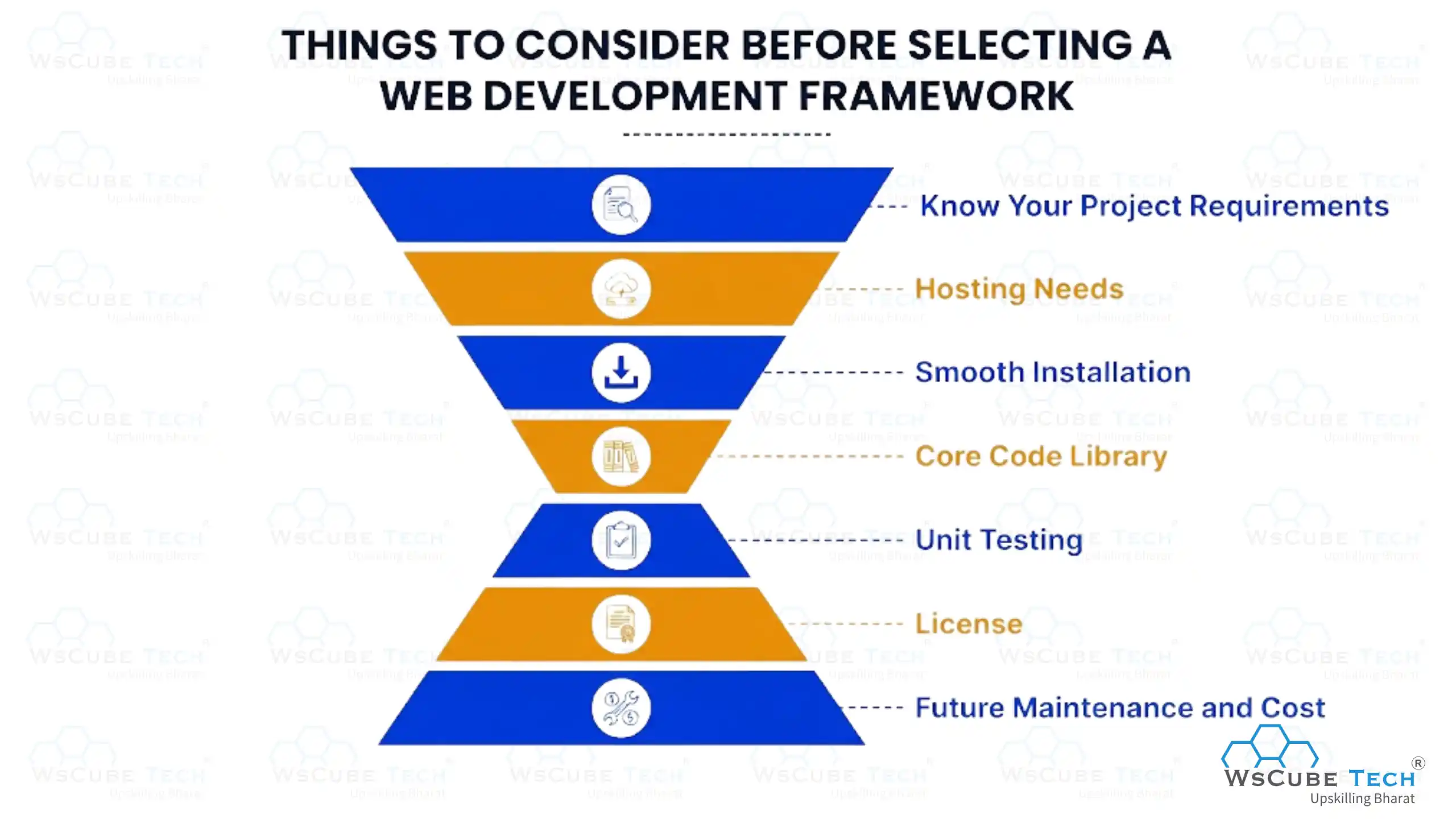
1. Know Your Project Requirements
While exploring a suitable web framework, first analyze your projects’ requirements, such as if you need a simple or complex app or site. In this regard, clarify technical constraints, functionalities required in the project, scalability, and languages to avoid.
2. Hosting Needs
Does the framework need a dedicated host for the application, or does it work in shared hosting situations? Some frameworks, especially Ruby on Rails and Django, require more non-standard, non-shared setups.
3. Smooth Installation
Given that the prime benefit of using a framework is to make things more accessible, the last thing you want is a complicated installation, which can add to deployment time. Some frameworks only require minor configuration adjustments, while others require many more steps—so developers beware!
4. Core Code Library
As mentioned above, if the primary choice for using a framework is to assist in development, then that framework’s core library must include the needed features. Plus, there should be the option to customize those characteristics or swap out parts for others from another library to have the type of granular control needed.
5. Unit Testing
As the base of any testing set-up, unit testing is performed frequently during development and maintenance to ensure performance. Look for frameworks with core tests and/or allow custom unit tests to be written.
6. License
While most web dev frameworks offer licenses without restriction, some may not support commercial application development. Ensure that this due diligence extends to any plugins, libraries, or extensions used in the application.
7. Future Maintenance and Cost
Verify that the framework will offer long-term maintenance and technical upgrades over the years. Also, confirm if it’s an open-source web framework, has a subscription fee, or additional charges for premium features.
FAQs on Web Development Framework
A framework is a pre-built set of tools, libraries, and best practices that helps developers build websites and applications faster. It saves you from writing repetitive code from scratch for every project.
A library is a tool you call when needed, while a framework controls the overall structure and calls your code. In short, you use a library, but a framework dictates how your application is built.
There's no single "best" framework — it depends on your project. React and Next.js lead for frontend, while Django, Laravel, and Node.js remain top picks for backend development.
Vue.js and Django are considered the easiest to pick up due to their simple syntax and clear documentation. They're a great starting point if you're new to web development.
Frontend frameworks handle what users see and interact with, like buttons and layouts. Backend frameworks manage servers, databases, and the logic running behind the scenes.
React is technically a JavaScript library, not a full framework. However, due to its ecosystem and component-based structure, most developers treat it like a frontend framework.
A full-stack framework lets you build both the frontend and backend of an application using a single technology. Examples include Ruby on Rails, Django, and Laravel.
Frameworks aren't mandatory, but they save significant time, reduce errors, and follow tested coding practices. For anything beyond a basic static page, using one is highly recommended.
Django and Node.js are popular for large-scale apps due to their scalability and strong community support. Spring Boot is also widely used for enterprise-level Java applications.
Base your choice on project size, required scalability, team expertise, and long-term maintenance needs. Also check the framework's documentation quality and community support before committing.
It depends on your website's complexity and goals — React or Vue.js works well for interactive frontends, while Django or Laravel suits content-heavy, database-driven sites. For small business websites, WordPress with lightweight frameworks is often enough.
Conclusion
Listed above are the 12 best web development frameworks to help you build a stunning online presence for your business so you can choose the one most suitable for your application. Using these popular web development frameworks to develop sites can significantly speed up your development process.
Pick a framework and start with it. It will give you a better picture of how to approach things, and you will find multiple similarities between frameworks. To continue to grow, giant companies always migrate and adopt the latest technologies; therefore, their evolution never halts.
Explore Our Free Tech Tutorials
| Python Tutorial | Java Tutorial | JavaScript Tutorial |
| C Tutorial | C++ Tutorial | HTML Tutorial |
| CSS Tutorial | SQL Tutorial | DSA Tutorial |
Practice Coding With Our Free Compilers
| Online Python Compiler | Online HTML Compiler | Online C Compiler |
| Online C++ Compiler | Online JS Compiler | Online Java Compiler |
Join Our On-Campus Full Stack Related Courses
Free Courses for You





Leave a comment
Your email address will not be published. Required fields are marked *Comments (0)
No comments yet.