
Because of the similarity in their names, many people wonder what sets these two languages apart. If you have ever asked yourself the same question, this guide breaks down the difference between Java and JavaScript in a clear and simple way.
Java and JavaScript are two of the most widely used programming languages in software and web development. Despite the shared word "Java," they are built, executed, and applied very differently. Their only real connection is the name, and understanding this early helps avoid confusion.
In this article, we will cover how each language works, their key uses, benefits, and limitations, followed by a factor by factor comparison and a quick tabular summary. By the end, you will know which language fits your goals best.
What is Java?
Java is a class-based, object-oriented programming language that is designed to run on a virtual machine. Java was developed by Sun Microsystems in the 1990s and is now owned by Oracle. More than 3 billion devices run on Java programming language today!
Java is known for its WORA (Write Once, Run Anywhere) capabilities. This signifies that Java code can run on any platform, as long as the platform has Java virtual machine, also known as JVM, installed on it. JVM ensures that Java supports the feature of Write Once, Run Anywhere to support cross-platform adaptability.
This capability of Java makes it a popular choice for building large-scale enterprise applications, including web and mobile applications. If you are preparing for a job interview in this field, then going through the top Java 8 interview questions and answers is crucial.
Main Uses and Applications of Java
Some of the most common uses and applications of Java include:
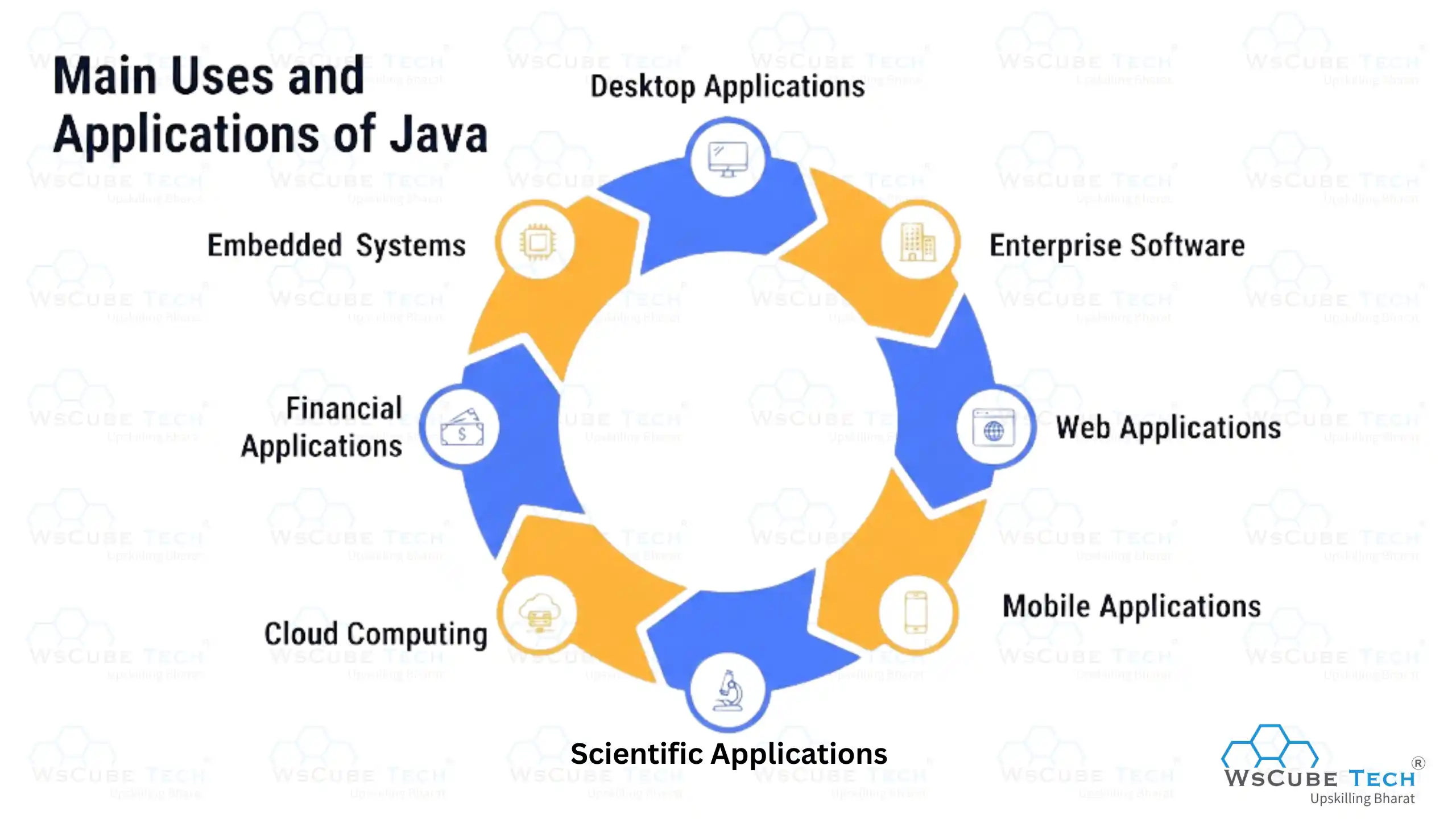
1. Desktop Applications
Java can be used to develop desktop applications, such as media players, image editors, and games.
2. Enterprise Software
Java is widely used for developing enterprise-level applications, such as customer relationship management (CRM) tools, inventory management systems, and human resources management systems.
3. Web Applications
Java can be used to develop server-side components for web applications, such as e-commerce websites, social media platforms, and content management systems.
4. Mobile Applications
Java is the primary programming language used to develop Android mobile apps, making it one of the most popular languages for android mobile app development.
5. Scientific Applications
Java can be used to develop scientific applications, such as weather forecasting systems, simulations, and data analysis tools.
6. Cloud Computing
Java is widely used for cloud computing, as it is well-suited to building large-scale, distributed systems that can handle large amounts of data and processing.
7. Financial Applications
Java is used to develop financial applications, such as stock trading systems, banking systems, and insurance systems.
8. Embedded Systems
Java can be used to develop embedded systems, such as smart home devices, medical equipment, and industrial control systems.
These are just a few examples of the many uses and applications of Java. The versatility and power of Java make it a popular choice for a wide range of projects and industries, from small-scale desktop applications to large-scale enterprise systems.
Top Benefits of Java Programming Language
It is important to know why we should use Java. Let’s discuss some of Java’s features and advantages:
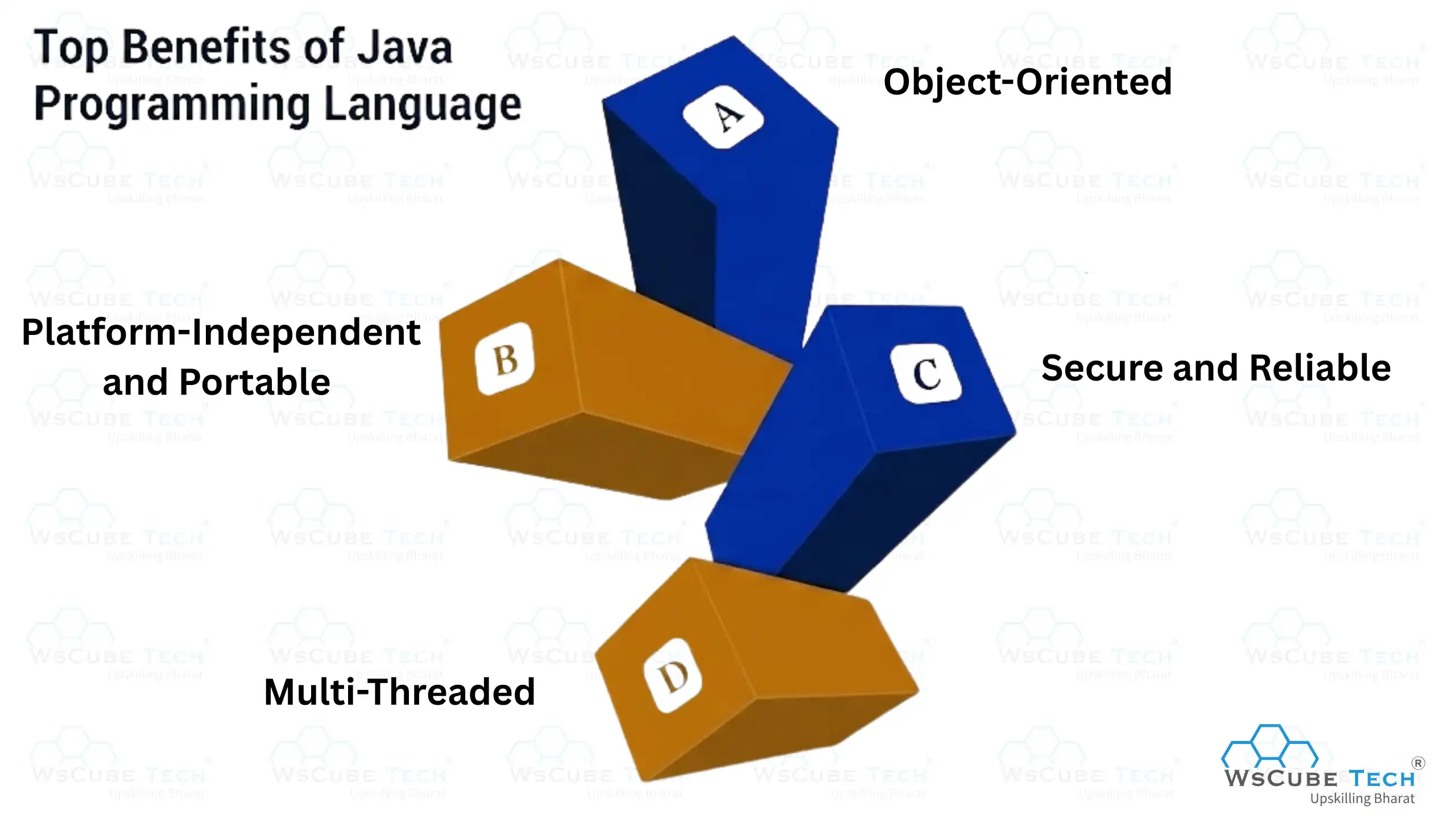
1. Object-Oriented
The Java programming language encompasses all the features of object-oriented programing, such as Abstraction, Encapsulation, Inheritance, etc. All these OOPs concepts grant several benefits to the Java programming language, including enhanced security, the prevention of data redundancy, simplified problem-solving, etc.
2. Platform-Independent and Portable
This is the most valuable feature of Java Programming Language. Java is built in such a way that it can run on any platform, machine, or operating system. As long as the platform has JVM (Java Virtual Machine) installed on it, Java code is good to run. This allows Java to build cross-platform applications that need to run on different platforms or applications.
3. Secure and Reliable
Java has a built-in security manager that acts as a guard which restricts access to system resources based on the permissions assigned to an application. This is how Java prevents malicious code from external systems.
4. Multi-Threaded
Java supports multi-threading, which enables multiple threads to execute concurrently within a single process. It is suited for applications that want to run multiple tasks at the same time.
Disadvantages of Java (Limitations)
Every coin has two sides, and so does Java. We looked at the positive aspect of the language, and now let’s dive into the negative aspect of it as well.
1. Performance
Java gives slow performance due to the additional tasks of compilation and interpretation. Since Java consumes high memory, it puts a heavy load on the CPU and slows down the performance and efficiency of the language.
2. Memory Management
The auto garbage collector automatically collects unused and unnecessary objects. It puts a heavy load on the processor and increases the time to complete a task.
3. Backup
Backup is another significant drawback of Java programming language. Java can collect and store data but does not have a strong facility to back up the data.
Read the top Java Interview Questions and Answers to have a better idea of this programming language and become able to crack your job interview.
Recommended Professional Certificates
Full Stack Development Course with AI Engineering
WordPress Bootcamp
What is JavaScript?
JavaScript is a high-level programming language that is primarily used for creating dynamic, interactive pages and web-based applications. It was developed by Brendan Eich in the mid-1990s while working at Netscape Communications Corporation.
JavaScript, along with HTML and CSS, forms the trio of fundamental technologies crucial for web development. JavaScript is a scripting language that runs on the client side (i.e. in your user’s web browser) and is also used to add interactivity and dynamic behaviour to web pages. It can also be used to develop server-side applications using technologies such as Node.js.
The language has evolved over the years and is now widely supported by all modern web browsers, making it a popular choice for web developers.
If you want to build your career with JS, then going for a MERN Stack Course online will prove to be fruitful.
Top Features and Benefits of JavaScript
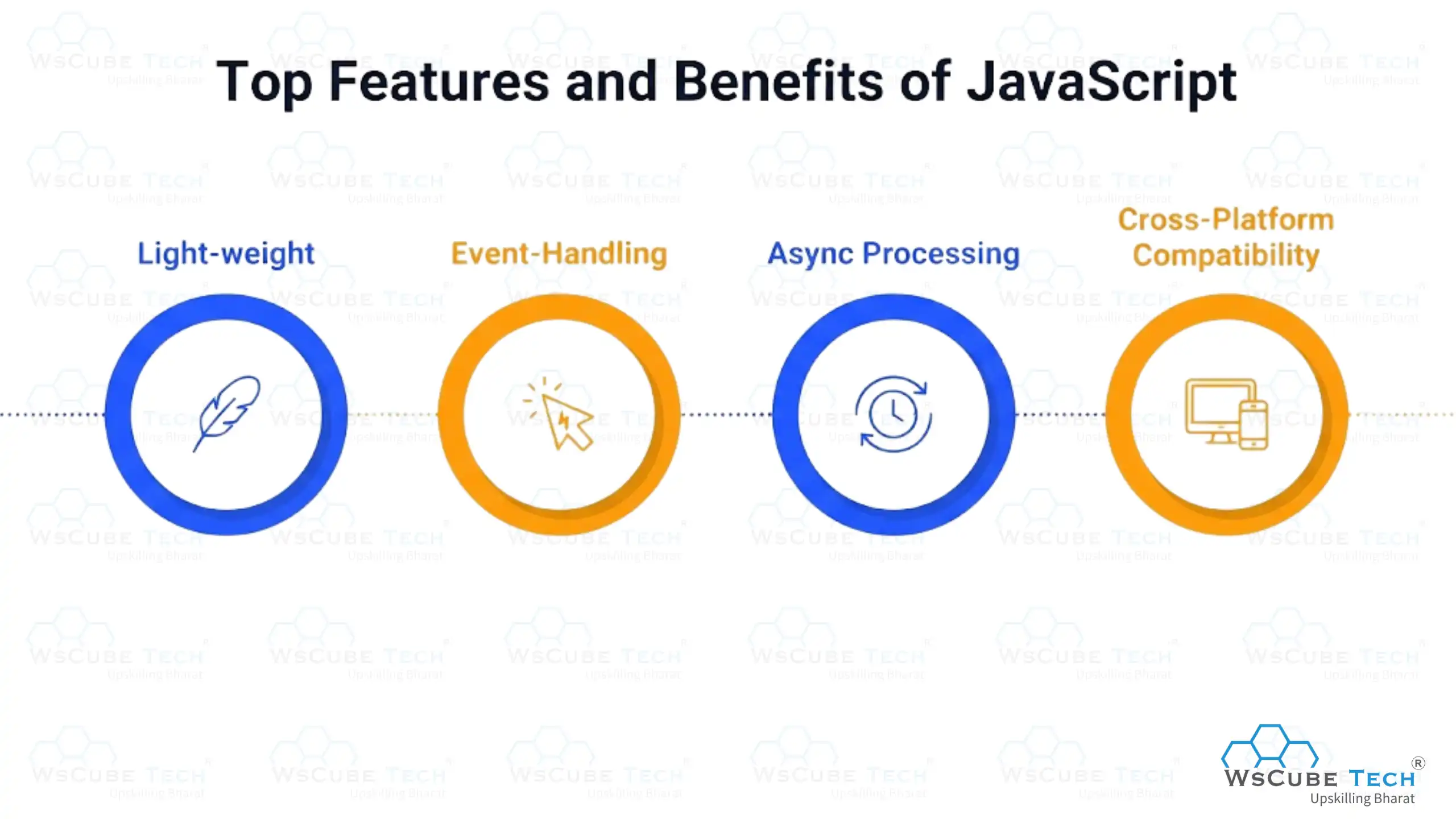
1. Light-weight
JavaScript is a lightweight scripting language. It indicates that JavaScript has minimalistic features and characteristics. It is also easy to implement
2. Event-Handling
An event is basically an action or an occurrence in a system. For example, a user clicks on a button, and the system tells the user to respond to the button click event. Here clicking of a button is an event that would further need an action to be performed.
In event-driven programming, the program waits for events to occur and then executes code in response to events.
Event-driven programming is a key feature of the JavaScript language. By handling events and responding to them, JavaScript enables a user-friendly experience that can dynamically update and respond to user actions.
3. Async Processing
When a program can continue to execute other tasks while waiting for the completion of one or more long-running tasks.
This kind of processing allows for more efficient use of system resources and results in faster and more responsive programs. Asynchronous processing is widely used in JavaScript.
4. Cross-Platform Compatibility
Just like Java, JavaScript can be run on various platforms, including web browsers, servers, and stand-alone applications. This feature makes it a versatile language for web development.
Disadvantages of JavaScript (Limitations)
Let’s head to the disadvantages of JavaScript to understand the scope of the language better.
1. Time-consumption
JavaScript has varied complex functionalities, and it can take up a lot of time to convert these functions into machine-readable code. This in turn reduces the website speed and also serves a bad user experience.
2. Front-end Security
JavaScript is a client-scripting language, the code runs on the browser. It makes source code more visible and also harpers code security.
Upcoming Masterclass
Attend our live classes led by experienced and desiccated instructors of Wscube Tech.



What is the Difference Between Java and JavaScript?
Now that we have evaluated both languages, their features, advantages and disadvantages, it’s time to see what is the difference between Java and JavaScript. These are two different programming languages with distinct features and use-case scenarios.
Below are some key differences between the two based on different factors:
1. Syntax
Java:
Java uses a syntax that is familiar to C/C++. The data types in Java need a declaration.
JavaScript:
The syntax of JavaScript programming language is similar to scripting languages such as Perl or Python. The data types in JavaScript need no declaration.
2. Compilation and Interpretation
Java:
Java is both compiled and interpreted. A compiled language is a type of programming in which the source code is compiled into a machine code, which can be executed directly by the computer’s hardware.
The compilation is more efficient in comparison to the interpretation.
JavaScript:
JavaScript is an interpreted language and is interpreted only on web browsers directly.
An interpreted language is a type of programming language in which source code is not compiled into machine code, but is instead executed directly by an interpreter. The interpreter reads the source code and executes the instructions as they are written, line by line.
3. Language Type
Java:
Java is a class-based object-oriented programming language. It is a stand-alone language.
JavaScript:
It is a prototype-based scripting language. JavaScript is not stand-alone, it has to be incorporated into the HTML program for operation.
4. Concurrency
Concurrency is the phenomenon of handling multiple different instructions that are running at the same time.
Java:
Java ensures concurrency by using multi-threading which makes the program faster and more efficient.
JavaScript:
JavaScript does not support the concept of multiple events taking place at the same time.
5. Source Code Visibility
Java:
Java programming language has hidden source code. The source code is in the form of byte code that cannot be read by any third parties.
JavaScript:
It runs the code on a browser, which is a plain text visible to everybody.
6. Requirements
Java:
To run a Java program, the developer needs to have an entire Java Development Kit (JDK).
JavaScript:
JavaScript only requires a text editor to write the code.
7. Security
Java:
Java programming language has been designed in such a way that its primary motive is to make source code as secure as possible. It provides robust features to support that.
JavaScript:
In order to ensure tight security in JavaScript, developers need to explicitly add functions. JavaScript’s code is essentially not secured as it is visible to the user in plain text format.
8. File Extension
Java:
Java supports “.java” file extension.
JavaScript:
JavaScript supports “.js” file extension.
9. Companies using Java and JavaScript
Java:
Netflix, Airbnb, Google, etc.
JavaScript:
Paypal, Uber, Microsoft, etc.
10. Suitability
Java:
Java can be used for several types of applications, such as Mobile applications, Big Data technologies, IoT applications, Cloud-based applications, etc.
JavaScript:
JavaScript is used primarily for front-end development. It can be used for building web and server applications, game development, mobile application development, etc.
Java vs JavaScript: Which is Better?
It's not really about Java vs JavaScript being "better" or "worse." Despite the similar names, they are built for completely different purposes. Java is a statically typed language made for large, secure backend and enterprise systems, while JavaScript is the flexible language that powers interactivity across the web. The right choice depends on your requirements, along with your own skills and preferences.
If you are just starting out, you can kickstart your career with a full stack web development course that comes with a certificate and placement support.
Read More Web Development Related Guides
Java vs JavaScript: Core Structural Differences
This direct comparison highlights how their underlying technical mechanics differ:
| Feature | Java | JavaScript |
| Type System | Statically typed (types checked at compile time) | Dynamically typed (types checked at runtime) |
| Execution | Compiled to bytecode, runs on the JVM | Interpreted or JIT-compiled by browsers/Node.js |
| Concurrency | Native multi-threading | Single-threaded event loop architecture |
| Primary Domain | Backend, Android, Big Data, Banking | Web Browsers, Full-stack Web, Mobile hybrid |
| Syntax Style | Verbose and strict class-based OOP | Flexible, prototype-based OOP / Functional |
When Java is Better
- Enterprise Applications: Java's strict type checking makes it highly predictable, robust, and the default choice for secure industries like banking.
- Native Android Development: It remains a primary foundation for creating native Android mobile applications.
- Big Data and Streaming: Frameworks like Apache Kafka, Hadoop, and Flink heavily rely on the Java Virtual Machine (JVM) ecosystem.
- Maintainability at Scale: Catching type errors during compilation makes massive codebases much easier to maintain over time.
When JavaScript is Better
- Web UI Interactivity: JavaScript is the only language natively supported by web browsers to manipulate the DOM and build dynamic interfaces.
- Full-Stack Flexibility: Using tools like Node.js, developers can write both frontend and backend systems in a single language.
- Prototyping and Speed: Its relaxed syntax allows startups to build, test, and ship minimal viable products (MVPs) much faster than Java.
- Ecosystem Diversity: It boasts a massive collection of UI libraries and frameworks like React, Angular, and Vue.js.
Suggested Reading: Top 10 Front-End Languages (List for Beginners)
Java vs JavaScript: Which is Easier to Learn?
The ease of learning Java and JavaScript depends on the individual and varies according to their exposure to programming languages.
For people with prior experience in Object-Oriented Programming, it is relatively easier for them to learn Java due to the syntax and structure. On the other hand, JavaScript offers more flexibility when it comes to syntax. People who are familiar with HTML and CSS will find it easier to learn JavaScript.
Regardless of your current knowledge and skills, you can go for an online web development course or MERN Stack Developer Course in India to build your career in these fields.
Java vs JavaScript: Salary in India
The salary for Java and JavaScript developers in India can vary greatly depending on several factors, such as location, experience, and the size and type of the company.
In 2026, JavaScript developers tend to earn higher salaries than Java developers. The scenario was different a few years ago, where Java Developers used to earn more.
According to Ambitionbox, the average salary for a Java developer in India is around INR 6.2 LPA to INR 6.8 LPA, while the average salary for a JavaScript developer is around INR 6.9 LPA to 7.6 LPA.
JavaScript is a highly versatile language that is used in a wide range of applications, from web development to mobile app development to server-side programming. As a result, JavaScript developers have more job opportunities and a wider range of salaries.
It is worth noting that the salary for a Java or JavaScript developer will also depend on a variety of factors, including their experience, location, and the type of company they work for.
It's important to keep in mind that salary is just one factor to consider when choosing a career in programming. Other factors, such as job satisfaction, growth potential, and job security, are also important to consider.
Suggested Reading: Full Stack Developer Salary in India: Monthly & Annual
JavaScript vs Java: Comparison with All Differences
Yes, here's a comparison table showing the differences between Java and JavaScript:
| Feature | Java | JavaScript |
| Type of Language | Object-Oriented | Object-Based |
| Typing | Static | Dynamic |
| Execution | Compiled | Interpreted |
| Object Creation | Classes | Objects |
| Syntax | C-style syntax | C-style syntax with some differences |
| Inheritance | Class-based | Prototype-based |
| Error Handling | Try-Catch blocks | Try-Catch blocks |
| Execution Environment | Standalone, Web, Mobile | Web |
| Usage | Standalone applications, server-side web development, Android mobile app development | Web development, browser scripting, server-side development with Node.js |
Explore Our Web Development Related Courses
FAQs about Difference Between JavaScript and Java
No. Despite the shared name, they are completely separate languages with different syntax, purposes, and runtime environments. The name similarity came from a 1990s marketing decision, not any technical link.
Yes. Many websites use Java on the back end and JavaScript on the front end. The two often work side by side in full-stack applications, but they run independently.
Most beginners find JavaScript easier because of its flexible syntax and quick results in the browser. Java has stricter rules, which makes it harder to start but easier to catch errors early.
If your goal is web development, start with JavaScript. If you want to build Android apps or large enterprise systems, Java is the better first choice.
No. JavaScript was not built from Java and is not a version of it. It only borrowed the name for marketing, while its actual design is closer to scripting languages like Python or Perl.
Both are in strong demand. JavaScript leads in web and full-stack roles, while Java dominates in enterprise, backend, and Android development.
Generally yes for heavy computation, since Java is compiled and runs on the JVM. JavaScript is interpreted and lighter, which suits interactive web tasks better.
Yes. With Node.js, JavaScript runs on the server side and can power full backend applications, APIs, and databases, not just browser scripts.
Both use a C-style syntax, so they look similar at a glance. However, Java requires strict type declarations, while JavaScript allows variables without defined types.
JavaScript is the core language of web development and is essential for interactive front-end pages. Java is used mainly for backend logic in larger web systems.

Conclusion
This article aimed to give you a clear perspective on both languages. When it comes to Java vs JavaScript, no single language is superior to the other. Each has its own demand, purpose, and use case in today's marketplace.
Java powers large-scale, enterprise, and Android applications, while JavaScript remains the backbone of interactive web experiences. The right choice depends on the kind of project you want to build and the career path you wish to follow. Many developers even learn both, since the two complement each other well.
Explore Our Free Tech Tutorials
| Python Tutorial | Java Tutorial | JavaScript Tutorial |
| C Tutorial | C++ Tutorial | HTML Tutorial |
| CSS Tutorial | SQL Tutorial | DSA Tutorial |
Practice Coding With Our Free Compilers
| Online Python Compiler | Online HTML Compiler | Online C Compiler |
| Online C++ Compiler | Online JS Compiler | Online Java Compiler |
Join Our On-Campus Full Stack Related Courses
Free Courses for You




Leave a comment
Your email address will not be published. Required fields are marked *Comments (0)
No comments yet.