
Modern marketing expert Philip Kotler once said, “The best advertising is done by satisfied customers.” While that remains true, the way customers engage with brands has evolved significantly. Today, consumers discover, research, and interact with businesses through multiple ways, including social media management, search engines, emails, websites, and offline advertisements.
As customer journeys become more complex, brands can no longer rely on isolated marketing efforts. They need a unified approach that delivers consistent messaging and experiences at every touchpoint. This is where 360 degree marketing comes in. By integrating various online and offline channels into a cohesive strategy, businesses can build stronger customer relationships and drive better results.
In this comprehensive guide, we'll explore what 360 degree marketing is, how it works, its benefits, examples, and best practices for building successful 360 campaigns.
What is 360 Degree Marketing?
360 degree marketing is an integrated marketing approach that promotes a brand across multiple online and offline channels using a consistent message. The goal is to create a seamless customer experience and maximize brand visibility at every touchpoint, helping businesses reach and engage their target audience more effectively.
Marketers often struggle to craft a strategy that targets and reaches the maximum number of potential buyers. Despite using multiple online channels, several data-driven tactics, and unique ideas, conveying the brand message effectively is challenging.
Fortunately, 360 degree marketing offers a solution by connecting various advertising platforms and communication channels into a unified strategy. It helps brands build a strong presence by delivering the same message consistently across different customer touchpoints.
This approach combines multiple marketing concepts, including branding, digital marketing, social media marketing, content marketing, and traditional advertising, to create a cohesive customer journey. As a result, customers can easily recognize, understand, and connect with the brand.
To know more about 360 marketing and its fundamentals, sign up for the best online digital marketing course by WsCube Tech that offers live and interactive classes led by industry leaders.
Expert Tip: Don't treat every marketing channel separately. The most successful brands maintain a consistent message across all customer touchpoints.
How Does a 360 Marketing Campaign Work?
A 360 marketing campaign works by delivering a consistent brand message across multiple channels while guiding customers through every stage of their buying journey.
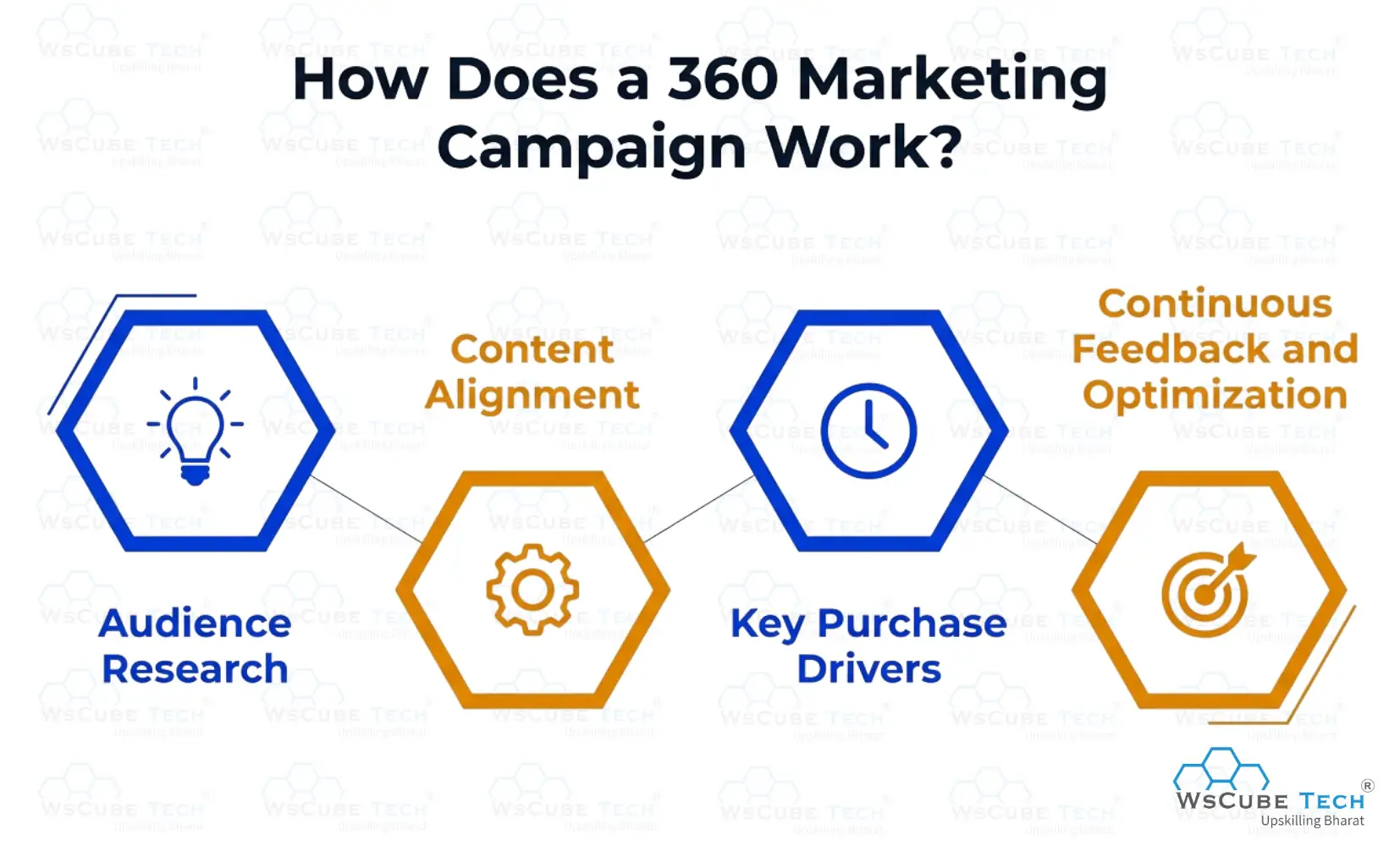
1. Audience Research
Every successful 360 degree marketing strategy begins with understanding the target audience. Businesses need to identify where customers spend their time, how they interact with brands, and what influences their purchasing decisions.
2. Content Alignment
A 360 marketing campaign delivers the right message at every stage of the buyer's journey. Whether customers are discovering a brand, comparing solutions, or ready to make a purchase, content should align with their specific needs and intent.
3. Key Purchase Drivers
Consumers often rely on specific factors before making a buying decision. These may include discounts, customer reviews, brand credibility, social proof, or limited time offers. Identifying these drivers helps marketers create more persuasive campaigns.
4. Continuous Feedback and Optimization
An effective 360 degree digital marketing approach relies on ongoing analysis and improvement. By collecting customer feedback, monitoring analytics, and evaluating campaign performance, businesses can identify opportunities to refine their messaging and improve results.
Recommended Professional Certificates
AI-Powered Digital Marketing Course
Performance Marketing Bootcamp
SEO Specialist Bootcamp
Benefits of 360 Degree Marketing
A well-planned 360 marketing campaign helps businesses create a consistent brand experience across multiple channels while maximizing customer reach and engagement. Here are the key benefits:
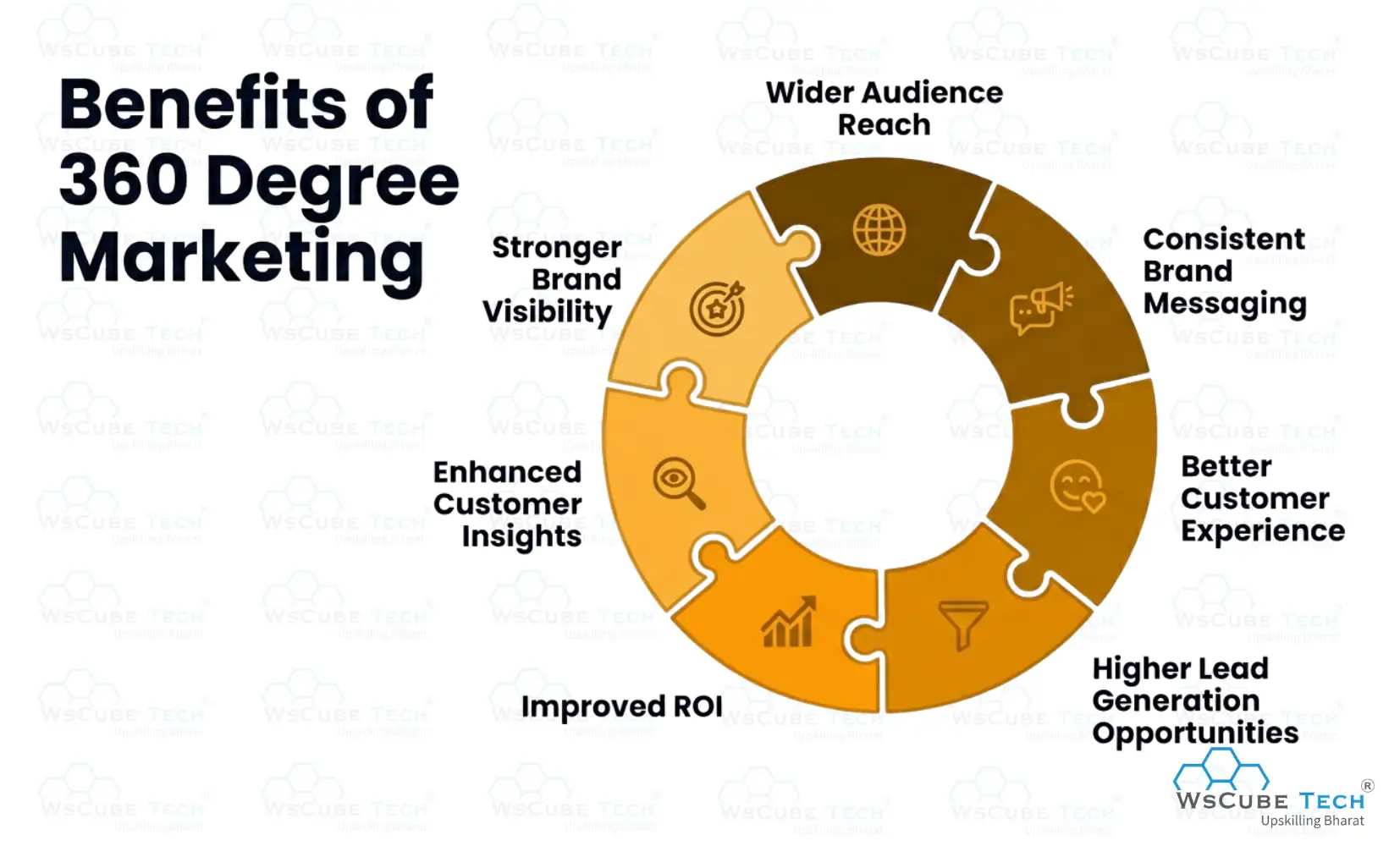
- Wider Audience Reach: Connect with potential customers across multiple online and offline channels.
- Consistent Brand Messaging: Deliver a unified message that strengthens brand recognition and trust.
- Better Customer Experience: Provide seamless interactions throughout the customer journey.
- Higher Lead Generation Opportunities: Reach prospects at different touchpoints and stages of the buying process.
- Improved ROI: Optimize marketing efforts by integrating channels and reducing communication gaps.
- Enhanced Customer Insights: Track customer behavior across platforms to make data-driven decisions.
- Stronger Brand Visibility: Increase exposure through a combination of digital and traditional marketing channels.
One of the biggest advantages of 360 degree marketing is its ability to engage customers wherever they are. For example, a consumer may see a Zomato advertisement on a billboard, later come across it on Instagram, and then watch a related TV commercial. These repeated interactions help improve brand recall and influence purchasing decisions.
Always Remember: More channels don't always mean better results. Focus on the platforms where your target audience is most active.
What Does a 360 Marketing Campaign Contain?
A successful 360 marketing campaign combines multiple online and offline channels to deliver a consistent brand message across every customer touchpoint. Key components include:
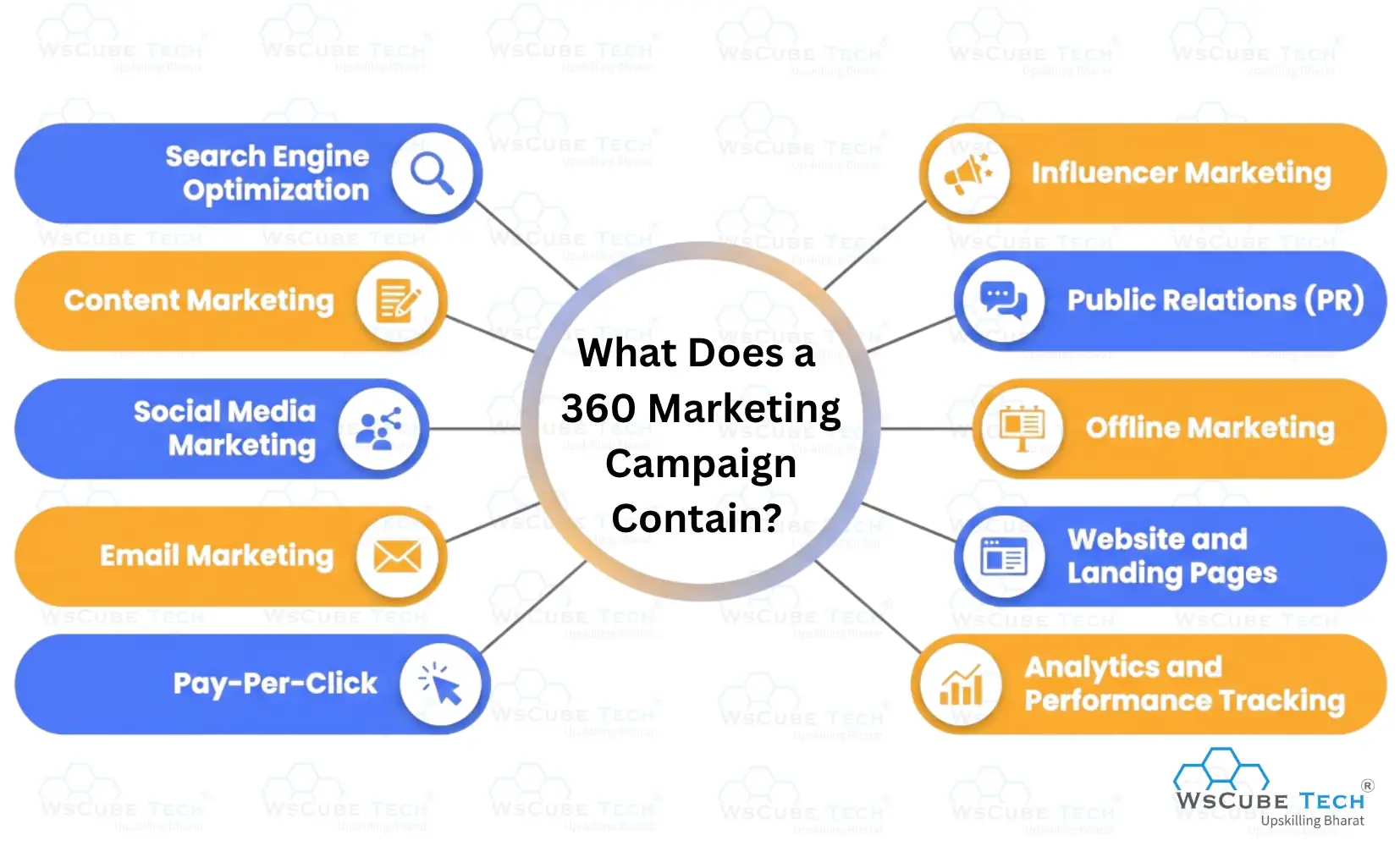
- Search Engine Optimization (SEO) – Improves organic visibility on search engines.
- Content Marketing – Uses blogs, videos, guides, and other content to attract and educate audiences.
- Social Media Marketing – Engages customers through platforms like Facebook, Instagram, LinkedIn, and X.
- Email Marketing – Nurtures leads and maintains customer relationships through personalized communication.
- Pay-Per-Click (PPC) Advertising – Drives targeted traffic through paid search and display ads.
- Influencer Marketing – Leverages industry experts and creators to increase brand reach.
- Public Relations (PR) – Builds brand reputation through media coverage and publicity.
- Offline Marketing – Includes TV, radio, print ads, billboards, events, and direct mail.
- Website and Landing Pages – Serve as central destinations for conversions and customer interactions.
- Analytics and Performance Tracking – Measures campaign effectiveness and helps optimize results.
The goal of 360 degree marketing is to integrate these channels into a unified strategy, ensuring customers receive a seamless and consistent brand experience wherever they interact with your business.
How to Build an Effective 360 Degree Marketing Campaign?
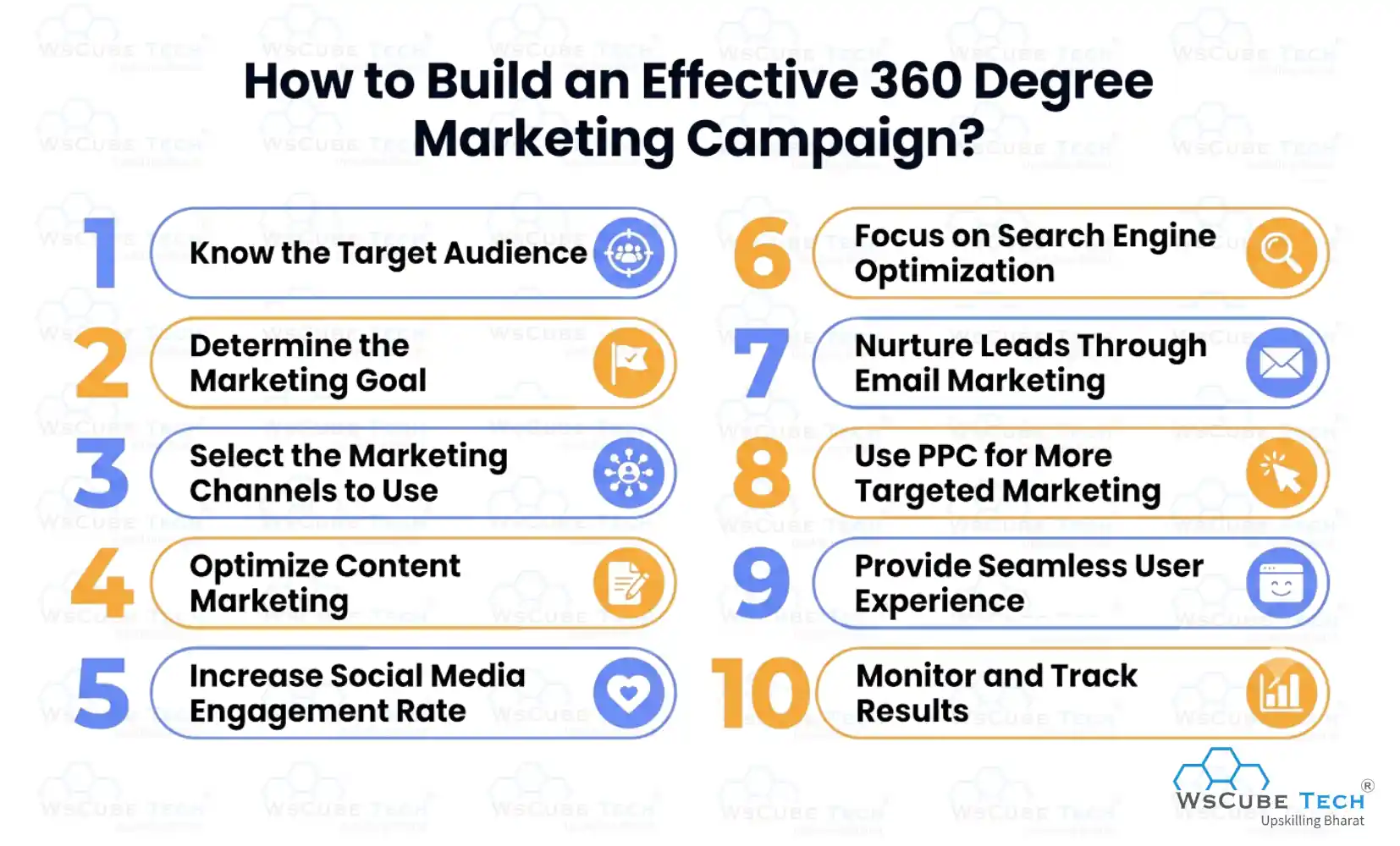
Now that you are familiar with 360 digital marketing meaning, let’s take a look at the key steps to build an effective 360 marketing strategy:
- Know the Target Audience
- Determine the Marketing Goal
- Select the Marketing Channels to Use
- Optimize Content Marketing
- Increase Social Media Engagement Rate
- Focus on Search Engine Optimization
- Nurture Leads Through Email Marketing
- Use PPC for More Targeted Marketing
- Provide Seamless User Experience
- Monitor and Track Results
WsCube Expert Advice: Regularly review campaign data and customer feedback to identify gaps and continuously improve performance.
1. Know the Target Audience
The first step in developing a 360 degree digital marketing campaign is knowing your target audience. Before you have a plan, it’s essential that you learn about your potential clients, including who they are, what they prefer, where they are, etc.
This will help you focus on a specific section of users and decide on the right platform where you will find them. Invest enough time in researching your customers, the best place to reach them, and how to convey your message to them.
You can use different social media platforms and digital marketing tools to gather data and get insights into their preferences. Find common points between buyer personas by exploring their interests, demographics, and more. You can also gather data from polls, surveys, studies, and questionnaires.
2. Determine the Marketing Goal
Now that you know who to target and offer your products or services, it’s time to set your goals for executing the 360 digital marketing campaign. This is the stage where you find the purpose of your marketing strategy. It can boost organic traffic, improve search engine rankings, build brand awareness, engage the audience, launch a new product, or increase revenue.
Your goal will help you select the right marketing channel, tools, tactics, and other factors. Based on your objectives, you can determine the budget, timeline, and resources.
Your goals should be achievable, measurable, and clear so you can build your marketing plan around them and track its performance with the expected results.
3. Select the Marketing Channels to Use
The next step to creating a 360 degree marketing plan is to find the right marketing channels to reach the target audience and establish a brand.
When it comes to online marketing channels, there are ample options available, including social media, email, blogs, websites, mobile apps, search engines, and whatnot. You don’t have to use all of them, so zero in on the ones that align with your goals and potential customers. Select digital channels that help you mark your presence in the digital world.
As you advertise your brand, product, or service on these channels, make sure that you offer a consistent brand message across all platforms. This will guide users effectively through the sales funnel and provide a unified experience.
4. Optimize Content Marketing
Content is the king. It is a crucial tool to engage the audience, interact with them, and convey brand messages. Hence, content marketing is integral to any 360 degree digital marketing campaign.
Brainstorm unique ideas to create high-quality, SEO-friendly, and relevant content that can work wonders for your brand. Craft different types of personalized content to connect better with readers and provide value. Ensure that your content answers the audience’s queries and resolves their doubts while offering useful information. It should also educate and entertain them.
From blogs and infographics to video tutorials and how-to guides, your content marketing must cover everything to engage users. It’s important to include a variety because you never know what your audience needs and responds best.
Use a storytelling approach to make content more compelling and encourage readers to take some sort of action. When you convey information in the form of a story, it influences readers more and connects them to the brand at an emotional level.
Your content must be optimized according to search engine algorithms, so users can find it easily and rely on it to seek solutions.
5. Increase Social Media Engagement Rate
Billions of social media users today spend hours on these channels connecting with like-minded people, discovering new brands, and expanding their networks. So, you can’t ignore social media while developing a 360 marketing plan. It is the best way to reach a wider audience, engage with users, foster a community, and improve brand visibility.
As you incorporate social media into your marketing campaign, you must understand that no two platforms are alike. Twitter has its own set of audiences that enjoy posting their opinions on it, while Instagram is an ideal channel for a different section of users.
So, figure out what works best for your brand and where you can find your potential customers. Based on the research and data collected in previous steps, select the best platform to post content and engage the audience.
You can use different social media tools to schedule and post content at times when your target users are most active on the selected platforms. You can also collaborate with famous people and celebrities for influencer marketing, amplifying your brand reach and credibility.
To achieve higher engagement, add visual elements such as images, videos, and infographics. Follow the latest trends and use them to your advantage.
Upcoming Masterclass
Attend our live classes led by experienced and desiccated instructors of Wscube Tech.



6. Focus on Search Engine Optimization
According to research, around 68% of online experiences start with organic search. Hence, it’s important to include SEO in digital marketing strategy. SEO is the heart of any online marketing campaign, as it enhances brand visibility on search engines, optimizes web pages for better user engagement, and drives traffic to the website.
Anyone who is wondering what a 360 degree marketing campaign is must understand the importance of SEO to tailor their marketing tactics and redirect their efforts in the right direction.
Find relevant keywords, include them in your content, and optimize the pages to boost their search engine rankings for those keywords. This will make it easier for users to find your brand and seek solutions to their queries.
Also, if you have a brick-and-mortar store, you must work on local SEO to build brand awareness among native customers and driving traffic to your physical store.
7. Nurture Leads Through Email Marketing
Create a list of buyers and subscribers to make the most of email marketing. It is one of the most result-driven marketing methods businesses rely on to nurture leads, build trust, and establish a connection with them.
Personalize your email messages based on user preferences and behavior patterns. This will help you connect and engage with them. Also, personalized messages and subject lines compel users to open emails and go through them once.
We understand that personalizing bulk messages is challenging. Therefore, use an email marketing automation tool or software to send timely and targeted messages. This will speed up the process, freeing up time and resources that you can invest in other areas.
We also recommend conducting A/B testing to find out what’s working for your business and what isn’t, be it the subject line, CTA, or email copy.
8. Use PPC for More Targeted Marketing
You must invest in pay-per-click advertising for a more targeted marketing approach that puts your brand directly in front of users. This paid marketing technique requires you to pay a certain amount for every click on your ad. You can place your ads on social media, websites, e-commerce platforms, and other portals.
PPC is known for generating faster results, but it demands a huge budget. So, mostly bigger brands and companies use PPC. Brands must use paid ads as a key component of 360 marketing, but they can’t rely completely on it for results.
Businesses use PPC to increase brand awareness and drive sales. Paid ads on social media are best for gaining traction. As you place ads across different channels, make sure that the link you provide takes users to the right page where they can take the desired action.
9. Provide Seamless User Experience
Your web pages, landing pages, and websites must have responsive designs to offer a seamless and valuable user experience. Text, images, videos, and other elements must adjust accordingly to different screen sizes and devices.
Users must easily navigate the website and find products or information they seek without hassle. So, optimize user interfaces, as it leads to higher conversions.
10. Monitor and Track Results
End your 360 degree marketing plan by tracking and measuring results. You must keep a close eye on the progress, monitor the results, and take corrective measures for improvements.
You can regularly check different KPIs and metrics using various tools and software. This will let you know if you are moving in the right direction and allow you to make the necessary adjustments to get back on track.
Also, evaluate data for deeper insights and find out if your research regarding the target audience was on point or not. Keep your marketing strategy flexible so you can tweak it whenever required to meet the audience’s demands and the latest trends.
Expand Your Marketing Skills
Measuring and Optimizing Your 360 Campaign
For a 360 marketing campaign to deliver consistent results, it's essential to measure performance across all channels and continuously optimize your strategy.
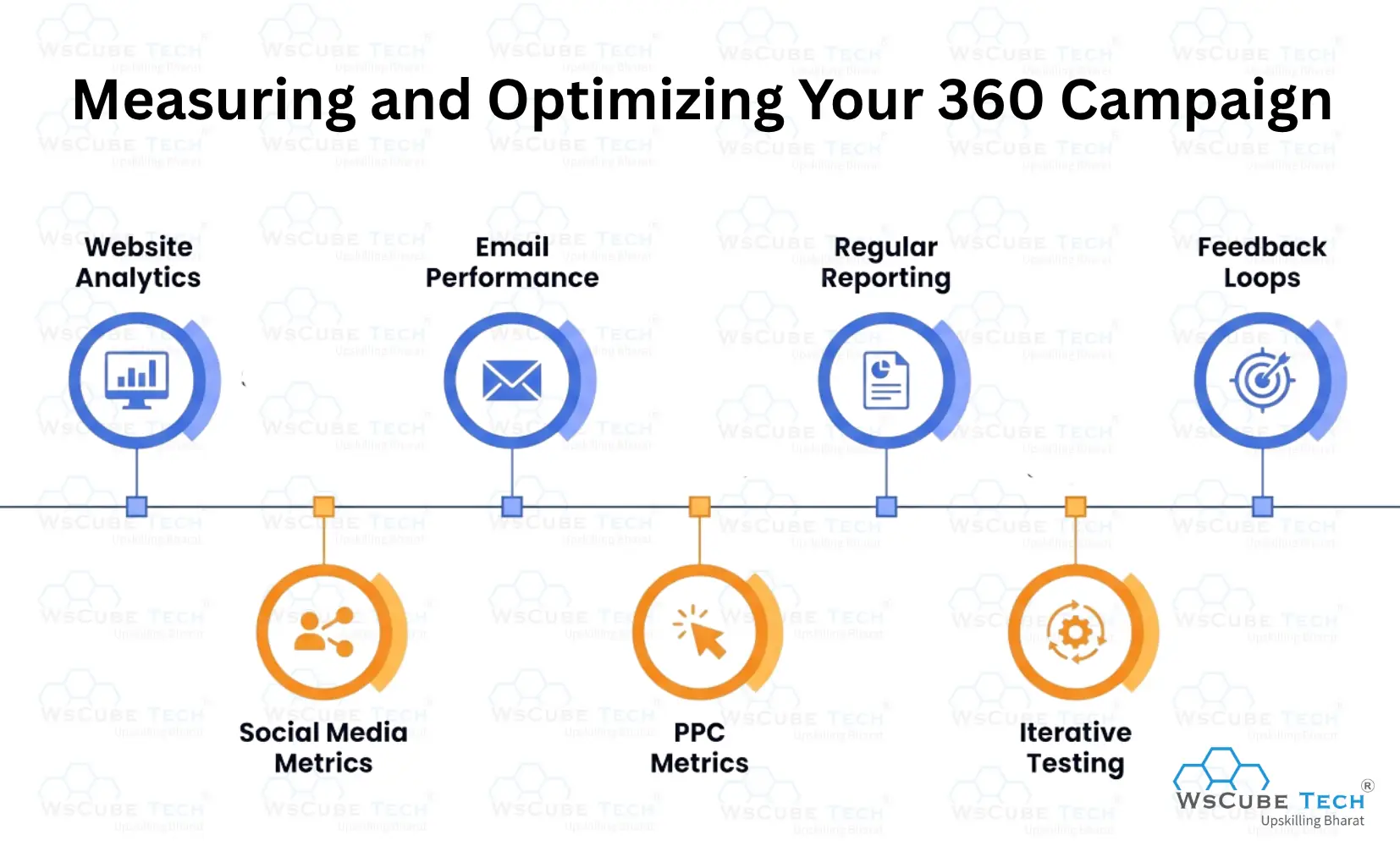
- Website Analytics: Monitor traffic sources, user behavior, bounce rates, and conversion metrics to evaluate the effectiveness of your 360 degree marketing efforts.
- Social Media Metrics: Track engagement rates, shares, comments, and audience growth to understand how your content is performing.
- Email Performance: Analyze open rates, click-through rates, and conversions to measure the impact of email campaigns.
- PPC Metrics: Review cost per click (CPC), click-through rates (CTR), and conversion rates to optimize paid advertising performance.
To improve campaign results over time, consider these optimization practices:
- Regular Reporting: Use tools like Google Analytics and social media insights to track performance and identify trends.
- Iterative Testing: Conduct A/B testing on headlines, CTAs, landing pages, and content formats to improve outcomes.
- Feedback Loops: Gather customer feedback and performance data to refine messaging and strengthen your 360 degree digital marketing strategy.
Future Trends in 360 Degree Digital Marketing
The future of 360 degree digital marketing is being shaped by emerging technologies, changing consumer expectations, and the growing need for personalized experiences. Here are the key trends businesses should watch:
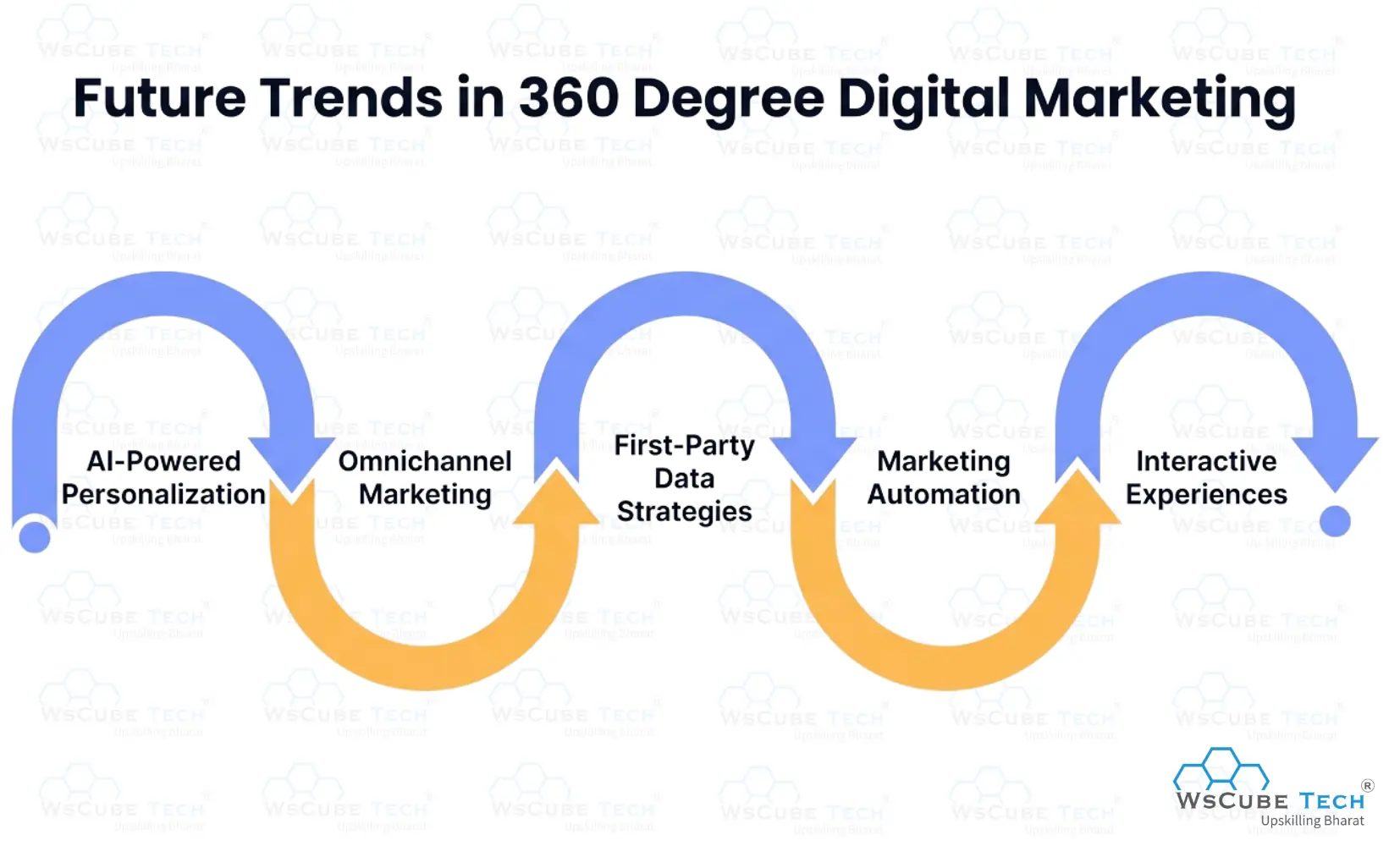
- AI-Powered Personalization: AI will help brands deliver tailored content and offers based on customer behavior.
- Omnichannel Marketing: Businesses will focus on providing a seamless experience across online and offline channels.
- First-Party Data Strategies: Marketers will rely more on customer-owned data to improve targeting and comply with privacy regulations.
- Marketing Automation: Automation tools will streamline campaign management and enhance customer engagement.
- Interactive Experiences: AR, VR, live shopping, and interactive content will play a bigger role in engaging audiences.
Explore Our Most Popular Marketing Courses
FAQs about 360 Marketing Campaign
A 360 campaign is an integrated marketing strategy that delivers a consistent brand message across multiple online and offline channels to create a seamless customer experience.
360 degree marketing is a holistic approach that uses multiple marketing channels and touchpoints to engage customers throughout their buying journey.
Digital marketing focuses on online channels, while 360 marketing combines both digital and traditional marketing channels under a unified strategy.
It helps businesses maintain consistent messaging, improve customer experiences, increase brand visibility, and maximize marketing effectiveness.
Common channels include SEO, social media, email marketing, PPC, content marketing, PR, events, television, radio, and print advertising.
Popular examples include campaigns by Coca-Cola, Nike, Apple, and Zomato that use multiple channels to deliver a unified brand message.
Start by understanding your audience, defining goals, creating consistent messaging, selecting channels, and continuously measuring performance.
Yes. Small businesses can use affordable digital channels and local marketing efforts to build an effective 360 marketing strategy.
Performance is measured using website traffic, conversions, engagement rates, lead generation, customer acquisition, and ROI metrics.
The primary goal is to create a consistent brand experience across all customer touchpoints and improve engagement, conversions, and brand loyalty.

Conclusion
The best way to drive a 360 degree marketing strategy is by researching the target audience. This helps you reach all aspects of a customer’s life and take the right steps toward success. You can develop a comprehensive marketing campaign to efficiently combine all marketing channels and tactics to take your business to new heights.
Also, customers can access necessary information about your brand, which builds a strong image for your business and pays off in the long run. This holistic approach is a proven way to mark your presence at every touchpoint where potential consumers can enter the sales funnel. You can create long-term and meaningful relationships with them, drive engagement, and establish a brand that stands out.
If reading and following so many steps seem overwhelming, then join our digital marketing course to hone your skills and gain practical experience under the guidance of experienced mentors.
Join Our On-Campus Digital Marketing Program
Explore Our Free Courses




Leave a comment
Your email address will not be published. Required fields are marked *Comments (0)
No comments yet.