
Programming plays an important role in today’s digital world, as it helps build the software and applications we use every day. From mobile apps and websites to operating systems and smart devices, programming languages make it possible for developers to communicate with computers and create useful solutions for real-world problems. As technology continues to grow rapidly across industries, understanding how different programming approaches work has become essential for students, developers, and anyone interested in the tech field.
With the wide range of programming and coding available today, each language is designed to serve specific tasks and development needs.
In this guide, we will explore the types of programming languages to help you understand their purpose, usage, and how they support different areas of software development.
What is Programming Language?
A programming language is a system of symbols, words, and rules used to create instructions for a computer. These instructions tell the computer what actions to perform, how to process information, and how to produce the desired output.
Developers use programming languages to build applications, websites, software tools, and operating systems. Each language has its own syntax and structure, making it suitable for specific tasks. By using a programming language, you can turn ideas and logic into working computer programs.
Features of Programming Languages
Now, let us look at the features of programming languages:
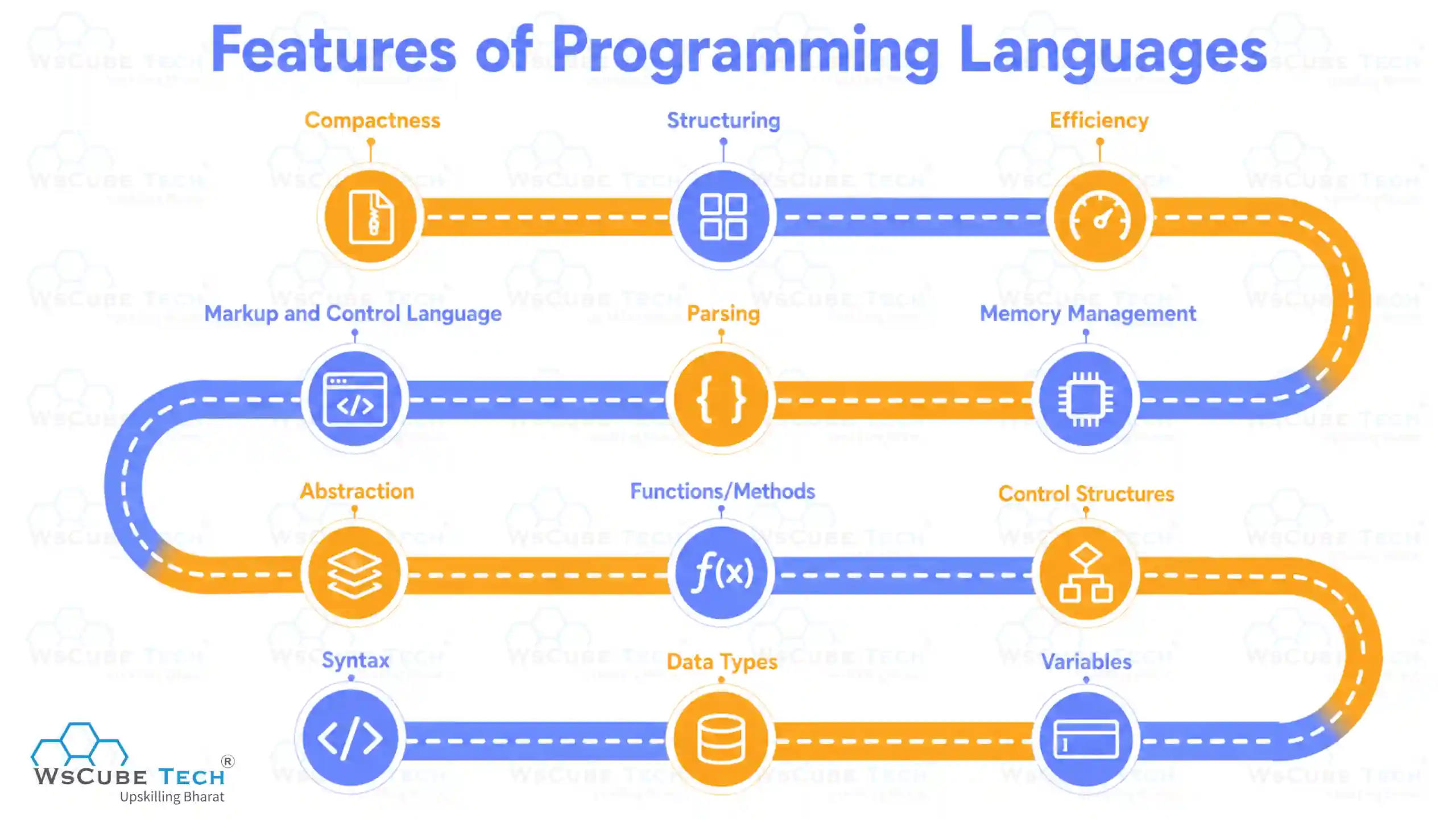
- Syntax: The specific rules and structure that programming languages use to write code properly.
- Data Types: The type of values stored in a program, such as strings, integers, etc.
- Variables: Named memory locations used to store values.
- Control Structures: Statements like loops and conditions that control the flow of a program.
- Functions/Methods: Blocks of code are called from other parts of a program to perform specific tasks.
- Abstraction: The ability to hide complex details and provide a simple interface to users.
- Memory Management: Allocating and deallocating memory for data structures and variables.
- Parsing: The process of analyzing code to understand its structure and meaning.
- Markup and Control Language: The ability to add comments and other annotations to code to make it more readable and maintainable.
- Efficiency: Programming languages can be translated and executed efficiently to avoid excessive use of memory and time.
- Structuring: Allows developers to write code based on structured programming concepts to reduce errors.
- Compactness: A language with this characteristic expresses operations concisely without writing too many details.
Types of Programming Languages
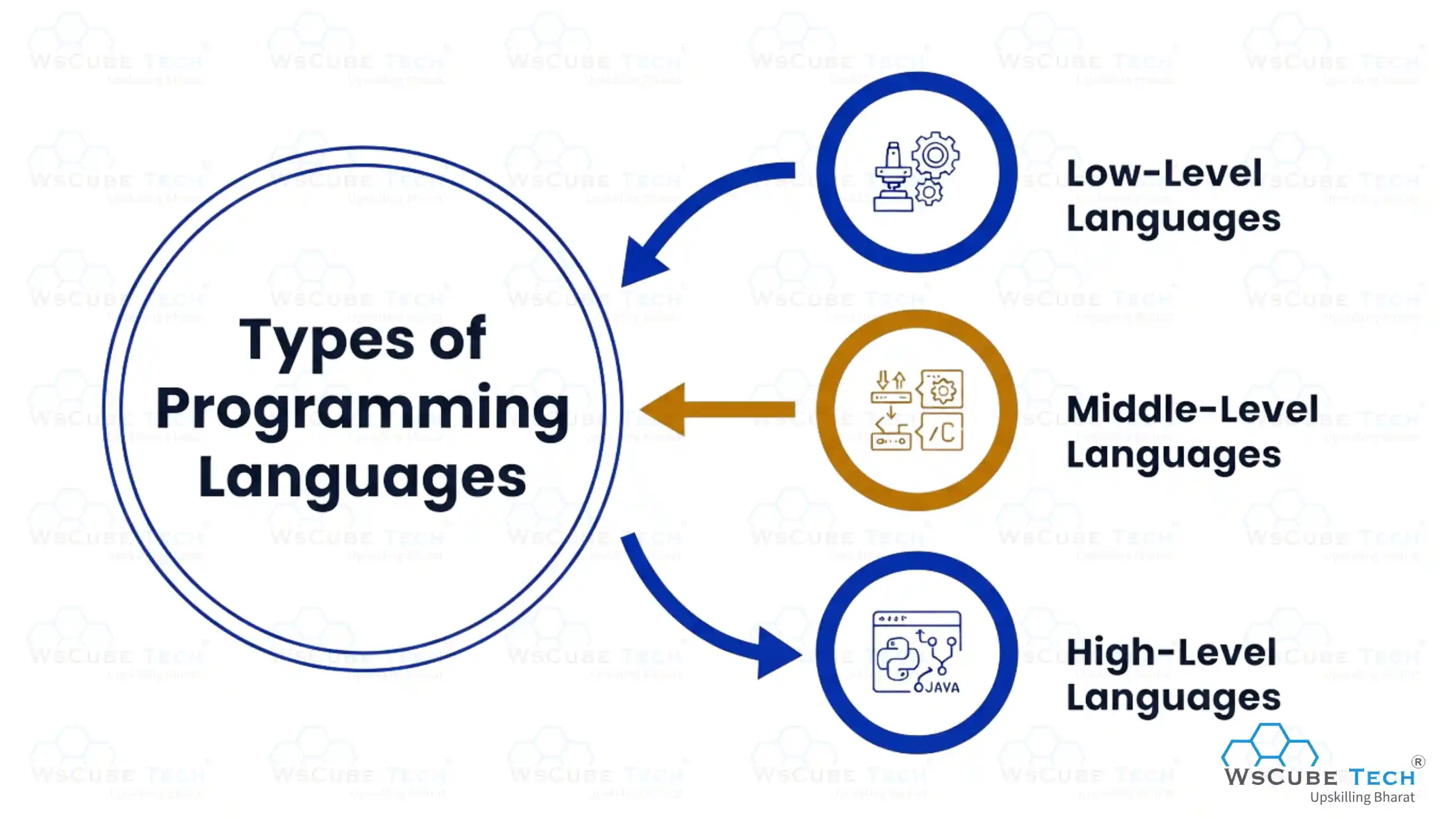
Various types of programming languages are used for different purposes and functions. There are many ways to classify programming languages. Let us start with the 3 types of programming languages commonly used:
1. Low-Level Languages
Low-level programming languages provide very little abstraction between the language and the processor’s instructions. In other words, these languages closely resemble machine code and are considered "close to hardware." One major advantage is that processors can run low-level programs directly without requiring an interpreter or compiler. This is why programs written in low-level programming languages run very fast.
Advantages of Low-Level Programming Languages:
- High Efficiency: Programs written in low-level languages execute faster and utilize memory more efficiently, resulting in improved overall system performance.
- Direct Hardware Interaction: Programmers can control hardware components, registers, and memory directly, which provides greater control over program behavior.
- Small Code Size: Requires less memory, making it suitable for environments with limited storage.
Examples of Low-Level Programming Languages:
- Machine Language
- Assembly Language
2. Middle-Level Languages
As the name suggests, middle-level languages (MLL) are positioned between low-level and high-level programming languages. These languages act as a bridge between hardware and software by supporting both low-level system programming and high-level application development. Due to this combined functionality, middle-level languages are often referred to as intermediate-level programming languages.
Advantages of Middle-Level Programming Languages:
- Sufficient Abstraction: Middle-level languages provide more abstraction than low-level languages, making code easier to understand and write.
- Improved Portability: Programs written in middle-level languages are more portable compared to low-level languages, although some platform-specific changes may be required.
- Better Productivity: These languages are more user-friendly, which helps developers work more efficiently.
- Versatility: Middle-level languages can be used for both system-level and application-level programming tasks.
Examples of Middle-Level Programming Languages:
3. High-Level Languages
High-level programming languages provide the greatest level of abstraction between machine code and the language itself, making them appear closer to human languages than machine languages. For computers to understand and execute the commands, compilers are used to convert high-level language (HLL) code into machine-readable instructions. The primary benefit of high-level programming languages is that they are simple to learn, write, and maintain.
Advantages of High-Level Programming Languages:
- Ease of Learning and Use: High-level languages often feature English-like syntax, making them easier for beginners to learn and use.
- Enhanced Productivity: Programming in high-level languages is faster and more efficient than in low-level or middle-level languages.
- Extra Portability: Programs written in high-level languages are often portable across different platforms with little or no modification.
- Quick Development: High-level languages often include features like dynamic typing, automatic memory management (garbage collection), and built-in libraries to support faster development.
- No Complex Operations: High-level languages avoid complex tasks such as manual memory management and hardware-specific operations, allowing developers to focus on solving problems at a higher level.
Examples of High-Level Programming Languages:
- Python
- Java
- C#
- JavaScript
WsCube Tip: Don’t wait to become perfect before starting coding, because real learning begins when you make mistakes and try solving them consistently.
Recommended Professional Certificates
AI-Powered Digital Marketing Course
Performance Marketing Bootcamp
SEO Specialist Bootcamp
Other Common Programming Language Types
Apart from low-level, middle-level, and high-level languages, there are other common programming language types based on their functionality and usage in software development. Below are some of the commonly used types of coding languages:
1. Procedural Languages
Procedural programming languages follow a step-by-step approach for writing and executing commands. A sequence of instructions is referred to as a procedure, and these languages are also known as procedural-oriented programming (POP) languages. One of the main advantages of POP languages is their simplicity and ease of use.
Examples: Java, Pascal, BASIC
2. Functional Programming Languages
Functional programming languages are based on mathematical functions. In these languages, programs are written using expressions and functions to perform computations. These languages can be further divided into pure functional and impure functional languages.
Examples: Scala, Haskell, F#, Lisp, Erlang
3. Object-Oriented Programming Languages
Object-oriented programming languages treat a program as a collection of objects. In these languages, programs consist of objects that contain both data and methods to perform specific tasks.
Examples: Python, Ruby, C++, Java, C#, Swift, Kotlin, Objective-C
4. Scripting Languages
Scripting languages are designed to write instructions that are interpreted at runtime, which means they do not need to be compiled before execution. These languages are often used to automate tasks, create web applications, or manage system operations. Their simplicity and flexibility make them ideal for rapid development and quick testing.
Examples: Python, Perl, PHP, Bash, JavaScript, PowerShell
5. Logic Programming Languages
Logic programming languages allow you to write programs using logical statements and relationships rather than step-by-step instructions. These languages focus on rules, facts, and queries, letting the computer infer solutions automatically. They are especially useful in areas that require knowledge representation, reasoning, and problem-solving.
Examples: Prolog, Alma-0, Absys, Mercury
Upcoming Masterclass
Attend our live classes led by experienced and desiccated instructors of Wscube Tech.

6. Front-End Languages
Front-end programming languages are used to develop the user interface of websites and applications. They help create elements that users interact with, such as images, text, buttons, and layouts in a web browser. These languages ensure that websites are interactive, responsive, and visually appealing across different devices.
Examples: CSS, JavaScript, HTML, React, TypeScript, Angular
7. Back-End Languages
Back-end programming languages are used for server-side development of websites, applications, and software systems. They handle data processing, database interactions, and server requests that generate the output displayed on the front end. Having backend developer skills helps you run apps smoothly, securely, and efficiently on the server side.
Examples: PHP, Python, JavaScript (Node.js), Java
8. Compiled Languages
Compiled languages use a compiler to convert programming code into machine language before execution by the processor. The entire program is translated into machine code before it runs, which helps improve performance and execution speed. These languages are commonly used for system software and application development where high performance is required.
Examples: C, C++, Rust.
9. Interpreted Languages
Interpreted languages do not require compilation before execution. Instead, the code is executed directly by an interpreter at runtime, making it suitable for quick testing and development.
Examples: Python, JavaScript, PHP, Ruby, Perl
10. Languages by Generation
Programming languages can also be classified based on their generation level:
| Generation | Description | Examples |
| First Generation (1GL) | Machine-level programming languages; lowest code level, closest to hardware | Machine Language |
| Second Generation (2GL) | Assembly languages; slightly more readable than machine code | Assembly Language |
| Third Generation (3GL) | Machine-independent, programmer-friendly languages; used for general-purpose programming | C, C++, Java, Python, PHP, Perl, C#, BASIC, Pascal, Fortran, ALGOL, COBOL |
| Fourth Generation (4GL) | Languages specialized for specific domains or tasks; often database- or report-oriented | SQL, PL/SQL, Unix Shell, ABAP, Oracle Reports, R |
| Fifth Generation (5GL) | Based on problem-solving using constraints instead of step-by-step algorithms | Prolog, OPS5, Mercury |
| Sixth Generation (6GL) | Low-code or visual development languages designed for easy human use | Webflow, Pega, Bubble |
Read More Web Development Related Guides
Popular Programming Languages and Their Types
Here’s a quick rundown of the 10 best programming languages and the types of programming in computers they belong to:
1. Python

High-level, interpreted or compiled, imperative, object-oriented, back-end programming language, 3GL.
2. Java
High-level, compiled, imperative, object-oriented, back-end programming language, 3GL.
3. JavaScript
High-level, interpreted, imperative, object-oriented, front-end and back-end programming language, 3GL.
4. C++
Mid-level, compiled, imperative, object-oriented, system and back-end programming language, 3GL.
5. C#
High-level, compiled, imperative, object-oriented, back-end programming language, 3GL.
6. SQL
High-level, compiled and interpreted, declarative, domain-specific programming language, 4GL.
7. Go

High-level, compiled, procedural and concurrent, back-end programming language, 3GL.
8. Ruby
High-level, interpreted, imperative, object-oriented, back-end programming language, 3GL.
9. Perl

High-level, interpreted, imperative, object-oriented, back-end programming language, 3GL.
10. PHP
High-level, interpreted, imperative, object-oriented, back-end programming language, 3GL.
WsCube Tip: Learn from your coding mistakes because every error helps you understand concepts better and improves your practical implementation skills.
Tips for Choosing the Right Types of Programming Language
Choosing the right programming language is essential to match your project goals, career path, and learning style. Making the right choice helps in faster development, better performance, and efficient problem-solving. Below are some important points to guide your decision:
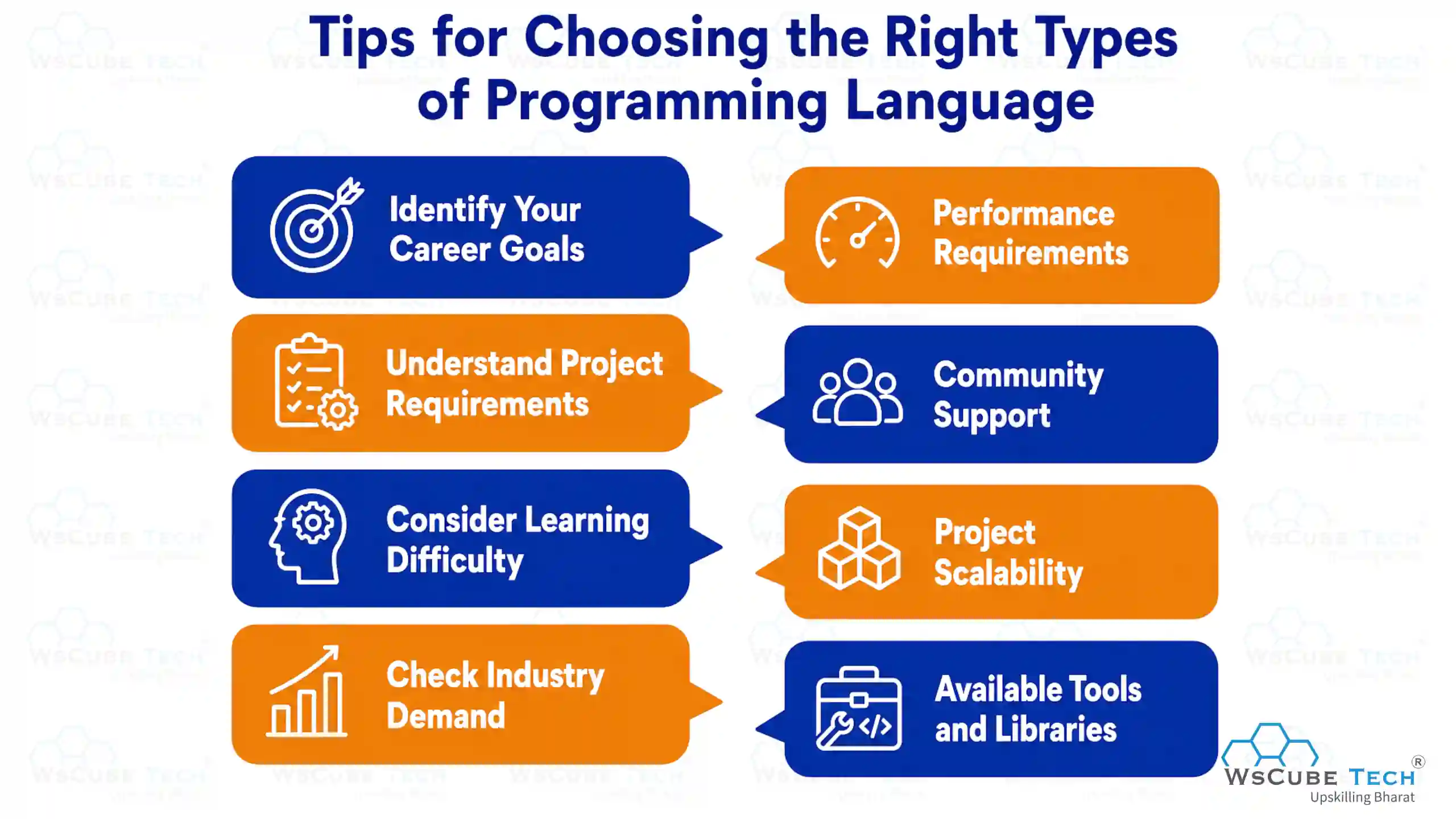
- Identify Your Career Goals: Choose a programming language based on your future career plans such as web development, app development, data science, or software engineering to ensure your learning path matches industry requirements and job opportunities.
- Understand Project Requirements: Always select a programming language that suits your project type, whether it involves website creation, system programming, database management, or automation tasks, as different languages are designed for specific purposes.
- Consider Learning Difficulty: Beginners should choose programming languages with simple syntax and strong community support to understand concepts more easily, avoiding unnecessary complexity during the initial learning phase.
- Check Industry Demand: Research the current market demand for programming languages to choose one that offers better career opportunities, higher salary potential, and long-term growth in the technology industry.
- Performance Requirements: For tasks that require speed, memory management, and high efficiency, choose compiled or mid-level programming languages such as C, C++, or Rust to ensure optimal system performance.
- Community Support: Programming languages with active communities offer helpful libraries, frameworks, and forums that make problem-solving easier and help developers stay updated with the latest trends.
- Project Scalability: Consider programming languages that can handle large-scale applications if you plan to expand, update, or maintain your software in the future without performance or compatibility issues.
- Available Tools and Libraries: Choose a language that offers robust development tools, frameworks, and libraries to speed up coding, reduce development time, and improve overall productivity during software development.
Selecting the right programming language carefully ensures smoother development, better efficiency, and long-term benefits, making it the best choice for your projects and career growth in the IT industry.
If you want to learn these skills in a structured way, you can join the WsCube Tech Full Stack Web Development course, where you can learn programming, web technologies, and real-world project development from industry experts.
Explore Our Web Development Related Courses
FAQs About Programming Languages Types
The main types of programming languages include low-level, middle-level, and high-level languages. Each type serves a different purpose. You can choose a language based on your needs, such as system programming, application development, or web development tasks.
High-level languages are easier for you to read, write, and maintain because they are closer to human language. Low-level languages are closer to hardware, giving you better control and performance but requiring more technical knowledge to understand and use effectively.
For beginners, high-level programming languages are the best choice because they have simple and easy-to-understand syntax. They help you learn programming concepts without worrying about hardware-level details or complex memory management.
Today, popular programming languages like Python, JavaScript, and Java are widely used across industries. You can use these languages for web development, software applications, automation, and data-related tasks based on your career goals.
For front-end development, you can use languages like HTML, CSS, and JavaScript. For back-end development, you can use languages such as Python, Java, and PHP to manage server-side operations and database interactions.
Yes, you can use certain programming languages like JavaScript for both front-end and back-end development. With tools like Node.js, you can build complete applications using the same language for client-side and server-side tasks.
Compiled languages convert your entire code into machine language before execution, while interpreted languages execute code line by line at runtime. You can choose between them based on your need for performance or flexibility during development.
Dynamic programming languages allow you to define variables without specifying data types, making coding flexible. Static languages require you to declare data types beforehand, helping you catch errors early and improve program stability.
For mobile app development, you can use languages like Java, Kotlin, and Swift. These languages help you create efficient applications for Android and iOS platforms with better performance and user experience.
You do not need to learn many programming languages at the beginning. You can start with one language and gradually learn others based on your career goals and project requirements in software or web development.
The time required depends on your learning speed and practice. You can learn the basics of a programming language within a few weeks, but becoming proficient may take several months of consistent practice.
A programming paradigm is a style of writing code, such as procedural or object-oriented programming. Understanding paradigms helps you choose the right approach for solving problems efficiently during software development.
Low-level programming languages are usually faster because they interact directly with hardware. You can use them when performance and speed are important, especially in system-level programming tasks.
The different types of computer programming languages include procedural, object-oriented, scripting, functional, and logic languages. You can select a type depending on your project requirements and development environment.

Conclusion
Understanding the different types of programming languages helps you choose the right option based on your learning needs, project goals, and career plans. Each language type, such as low-level, mid-level, and high-level, serves a specific purpose in software development and system programming.
Selecting a suitable programming language allows you to learn concepts more effectively and build applications with better performance. Making the right choice supports long-term growth, improves problem-solving skills, and helps you succeed in the evolving technology industry.
Explore Our Free Tech Tutorials
| Python Tutorial | Java Tutorial | JavaScript Tutorial |
| C Tutorial | C++ Tutorial | HTML Tutorial |
| CSS Tutorial | SQL Tutorial | DSA Tutorial |
Practice Coding With Our Free Compilers
| Online Python Compiler | Online HTML Compiler | Online C Compiler |
| Online C++ Compiler | Online JS Compiler | Online Java Compiler |
Join Our On-Campus Full Stack Related Courses
Free Courses for You






Leave a comment
Your email address will not be published. Required fields are marked *Comments (0)
No comments yet.