
Ever wondered how hackers break into systems—and how you can learn it legally? You watch videos, read stories, and feel excited to try it yourself, but when you actually start, everything seems confusing and overwhelming.
The biggest problem is confusion. With so many courses, tools, and tutorials available, it becomes hard to choose the right path or understand what to learn first.
Because of this, many learners waste time, feel overwhelmed, and lose motivation. Some even give up early, missing out on valuable skills and career opportunities.
In this blog, you’ll learn how to learn ethical hacking step by step, along with essential skills, tools, and common mistakes to avoid.
If you want to learn in a structured way, you can join our best ethical hacking course.
What is Ethical Hacking?
Ethical hacking is the process of legally testing computer systems, networks, and applications to identify security weaknesses before malicious hackers can exploit them. Ethical hackers, also known as white-hat hackers, use the same techniques as attackers but with proper permission to improve security and protect sensitive data. It helps organizations detect risks, fix vulnerabilities, and prevent cyber attacks. Below are the key aspects of ethical hacking:
- Authorized Access: Ethical hackers always work with proper permission before testing any system.
- Vulnerability Assessment: Identifying and analyzing security weaknesses in systems and networks.
- Penetration Testing: Simulating real-world attacks to evaluate system security.
- Security Improvement: Providing solutions to fix vulnerabilities and strengthen protection.
- Legal & Ethical Practice: Following all laws, rules, and ethical guidelines during testing.
- Use of Tools & Techniques: Using tools like vulnerability scanners, packet sniffers, and penetration testing frameworks to identify and assess risks.
Why Learn Ethical Hacking in 2026?
Learning ethical hacking in 2026 is a smart choice due to rising cyber threats, high demand for skilled professionals, and strong career growth opportunities. Below are the key reasons:
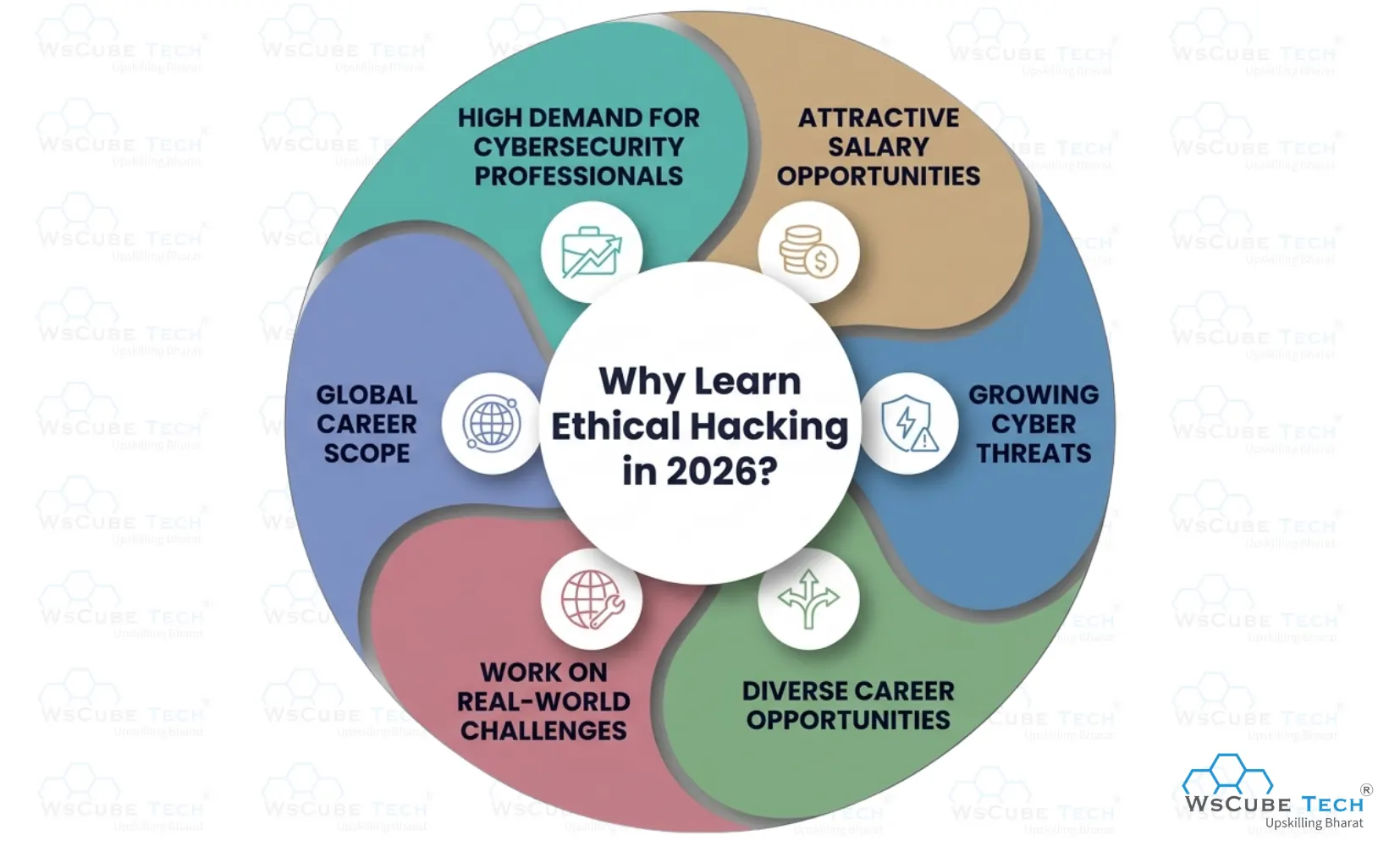
- High Demand for Cybersecurity Professionals: Organizations worldwide are facing increasing cyber attacks, creating a strong demand for ethical hackers who can protect systems, secure sensitive data, and prevent security breaches effectively.
- Attractive Salary Opportunities: Ethical hacking offers competitive salaries due to the specialized skills required. Skilled professionals are highly valued, and companies are willing to pay well to ensure strong cybersecurity protection.
- Growing Cyber Threats: As technology advances, cyber threats are becoming more sophisticated and frequent. Ethical hackers play a crucial role in identifying vulnerabilities, preventing attacks, and protecting systems from data breaches, ransomware, and financial losses.
- Diverse Career Opportunities: Ethical hacking opens doors to multiple roles, including penetration tester, security analyst, bug bounty hunter, and cybersecurity consultant, offering flexibility and long-term career growth.
- Work on Real-World Challenges: Ethical hackers tackle real security issues by testing systems, discovering vulnerabilities, and strengthening defenses, making the work hands-on, practical, and continuously evolving with new technologies and threats.
- Global Career Scope: Cybersecurity is a global field, allowing ethical hackers to work with international companies, remote jobs, and freelance opportunities across different industries and countries.
Recommended Professional Certificates
Ethical Hacking Bootcamp
Penetration Testing Bootcamp
How to Learn Ethical Hacking? Step-by-Step
Learning ethical hacking step by step helps beginners build strong fundamentals, gain practical skills, and progress confidently from basic concepts to advanced security techniques. Below are the steps:
- Step 1: Learn Basic Computer Fundamentals
- Step 2: Understand Networking Concepts
- Step 3: Get Familiar with Operating Systems (Linux & Windows)
- Step 4: Learn Basic Programming Skills
- Step 5: Understand Cybersecurity Fundamentals
- Step 6: Learn Networking and Web Security
- Step 7: Practice Ethical Hacking Tools
- Step 8: Perform Hands-on Practice and Labs
- Step 9: Learn Penetration Testing Techniques
- Step 10: Build Projects and Gain Experience
- Step 11: Join Communities and Stay Updated
- Step 12: Earn Certifications and Build a Career
Now, let’s break down each step in detail so you can learn ethical hacking step by step, with clarity and confidence.
Step 1: Learn Basic Computer Fundamentals
Before starting ethical hacking, you need a strong understanding of basic computer concepts. This includes knowing how a computer works, understanding hardware and software, managing files and folders, and using the command line. You should also be comfortable with basic operations like installing programs, troubleshooting simple issues, and navigating different system settings.
These fundamentals help you understand how systems behave, which is important when identifying vulnerabilities. When you know how a system normally works, it becomes easier to spot unusual activities or weaknesses. Building this foundation will make all the advanced ethical hacking topics much easier to learn and apply.
Step 2: Understand Networking Concepts
Understanding networking concepts is essential for ethical hacking, as it helps you learn how systems communicate, transfer data, and where potential security vulnerabilities can be identified and tested.
- IP Address & MAC Address: Learn how devices are uniquely identified on a network and how communication happens between systems using logical and physical addressing.
- DNS (Domain Name System): Understand how domain names are converted into IP addresses to access websites over the internet.
- HTTP/HTTPS Protocols: Learn how web data is transmitted and secured between browsers and servers.
- Ports & Protocols: Study common ports and communication protocols, how they enable data exchange, and how misconfigurations can expose security risks.
- Network Types (LAN, WAN): Understand different network types and how devices are connected and communicate within local and wide-area environments.
Building strong networking knowledge will make it easier to understand cyberattacks and protect systems effectively as you move forward in ethical hacking.
Step 3: Get Familiar with Operating Systems (Linux & Windows)
Understanding operating systems is important in ethical hacking, as it helps you learn how systems function, manage resources, and handle security, making it easier to identify vulnerabilities and test systems effectively.
- Linux Basics: Learn essential Linux commands, file management, permissions, and terminal usage, as Linux is widely used in ethical hacking tools and environments.
- Windows Fundamentals: Understand Windows system structure, settings, user management, and basic security features used in most organizations.
- File Systems & Permissions: Learn how files are stored, accessed, and secured in both Linux and Windows systems.
- Command Line Interface (CLI): Practice using the terminal and command prompt to perform tasks efficiently and manage system operations.
- System Processes & Services: Understand how background processes and services operate and how to analyze them for vulnerabilities.
Gaining hands-on experience with both Linux and Windows will help you work confidently with different systems and perform ethical hacking tasks more effectively.
Step 4: Learn Basic Programming Skills
Learning basic programming skills is essential in ethical hacking because it helps you understand how applications and scripts work. You should start with beginner-friendly languages like Python, JavaScript, or C, and focus on core concepts such as variables, loops, conditions, functions, and basic data structures like arrays, lists, and stacks.
Programming also helps you write clean and correct code, analyze logic, and understand how applications handle data. This makes it easier to identify vulnerabilities, automate tasks, and create testing scripts. With strong programming fundamentals, you can better understand attacks and build secure systems effectively.
Step 5: Understand Cybersecurity Fundamentals
Understanding cybersecurity fundamentals is essential for ethical hacking, as it helps you learn how systems are protected, how attacks happen, and how security measures are applied to prevent threats and vulnerabilities.
- CIA Triad (Confidentiality, Integrity, Availability): Learn the core principles of cybersecurity that ensure data is secure, accurate, and accessible only to authorized users.
- Types of Cyber Attacks: Understand common attacks like phishing, malware, ransomware, and DDoS to know how systems are targeted and exploited, and learn basic prevention techniques to reduce security risks.
- Authentication & Authorization: Learn how users are securely verified and granted access to systems and resources.
- Encryption & Hashing: Understand how data is protected using encryption techniques and how hashing is used for secure storage of passwords.
- Firewalls & Security Controls: Learn how firewalls and other security tools protect systems from unauthorized access and threats.
Building strong cybersecurity fundamentals will help you understand how to defend systems effectively and apply ethical hacking techniques more accurately.
Step 6: Learn Networking and Web Security
Learning networking and web security is essential for ethical hacking, as it helps you understand how websites and network systems are attacked and how to effectively identify and fix common security vulnerabilities.
- Web Application Basics: Understand how websites work, including client-server architecture, requests, responses, and how data flows between users and servers.
- Common Web Vulnerabilities: Learn about SQL Injection, XSS, CSRF, and other common security flaws found in web applications.
- Network Security Concepts: Study how networks are protected using firewalls, IDS/IPS, and secure configurations to prevent unauthorized access.
- HTTPS & SSL/TLS: Understand how data is encrypted during transmission to keep sensitive information safe from interception.
- Session Management & Cookies: Learn how user sessions work, how cookies store data, and how these can be targeted if not properly secured.
Mastering networking and web security will help you identify real-world vulnerabilities and protect systems more effectively as you advance in ethical hacking.
Upcoming Masterclass
Attend our live classes led by experienced and desiccated instructors of Wscube Tech.




Step 7: Practice Ethical Hacking Tools
Practicing ethical hacking tools is essential to gain real-world, hands-on experience and understand how security testing actually works. You should start with widely used tools like Nmap, Wireshark, Metasploit, and Burp Suite to learn scanning, traffic analysis, vulnerability detection, and exploitation basics in a safe environment.
Using these tools regularly helps you identify weaknesses, analyze network behavior, and simulate real attack scenarios. It also improves your practical skills, problem-solving ability, and confidence, preparing you to perform ethical hacking tasks effectively in real-world situations.
Step 8: Perform Hands-on Practice and Labs
Performing hands-on practice and labs is essential in ethical hacking, as it helps you apply your knowledge in real-world scenarios and understand how attacks and defenses actually work.
- Practice Platforms: Use platforms such as TryHackMe, Hack The Box, and PortSwigger Labs to gain real-world hacking experience in a safe environment.
- Virtual Labs Setup: Create your own lab using virtual machines to practice attacks and defenses without affecting real systems.
- Capture The Flag (CTF): Participate in CTF challenges to improve problem-solving and practical hacking skills.
- Real-World Scenarios: Work on simulated environments that replicate real systems to better understand vulnerabilities and attack methods.
- Regular Practice: Consistency is key; practice daily to build confidence and improve your skills over time.
Hands-on practice helps you move from theory to real skills, making you more confident and capable in ethical hacking.
Step 9: Learn Penetration Testing Techniques
Learning penetration testing techniques is essential in ethical hacking, as it helps you understand how real attacks are performed and how to identify and fix security vulnerabilities effectively.
- Reconnaissance (Information Gathering): Learn how to collect detailed information about targets using techniques like footprinting, OSINT, and basic scanning methods.
- Scanning & Enumeration: Identify open ports, services, and system details to find possible entry points.
- Exploitation Techniques: Understand how vulnerabilities are safely used to gain access to systems in a controlled and legal environment.
- Post-Exploitation: Learn how to analyze accessed systems, check the level of access gained, and understand the overall impact of vulnerabilities.
- Reporting & Documentation: Learn how to document findings clearly, explain risks, and provide proper solutions to fix security issues.
Mastering penetration testing techniques helps you perform real-world security testing, think like an attacker, and improve system protection more effectively
Step 10: Build Projects and Gain Experience
Building projects is essential in ethical hacking because it helps you apply your knowledge in practical situations and understand how security concepts work in real-world environments. You can create projects like setting up a secure network, testing a web application, or building your own virtual lab to practice different attack and defense techniques.
Gaining experience through projects improves your problem-solving skills and builds confidence over time. It also helps you create a strong portfolio to showcase your abilities to employers or clients, making you better prepared for real-world cybersecurity roles.
Step 11: Join Communities and Stay Updated
Joining cybersecurity communities is important in ethical hacking because it helps you stay connected with experts, learn from others, and keep up with the latest trends and threats in the field. Being part of a community allows you to share knowledge, ask questions, and gain insights from real-world experiences.
Staying up to date is equally important, as cybersecurity is constantly evolving. Following blogs, forums, and security news helps you learn about new vulnerabilities, tools, and techniques. This continuous learning approach keeps your skills relevant and helps you grow as an ethical hacker.
Step 12: Earn Certifications and Build a Career
Earning certifications is important in ethical hacking because it validates your skills and proves your knowledge. Certifications like CEH, CompTIA Security+, and others help you gain credibility and improve your chances of getting opportunities in cybersecurity.
Building a career in ethical hacking requires continuous learning, practical experience, and strong problem-solving skills. You can start with entry-level roles like security analyst or junior penetration tester and gradually move to advanced roles with experience and expertise.
If you’re interested in structured learning, WsCube Tech offers the best online ethical hacking course that helps you learn step by step, making it easier to build skills and start your cybersecurity career with confidence.
Read More Blog Guides
| Is Ethical Hacking Hard to Learn | How long to be an Ethical Hacker |
| Is Ethical Hacking a Good Career | Ethical Hacking Course Syllabus |
| Ethical Hacking Course Fee & Duration | Ethical Hacking Course Eligibility |
Skills Required to Learn Ethical Hacking
Learning ethical hacking requires a mix of technical knowledge and non-technical abilities to understand systems, identify vulnerabilities, and apply security techniques effectively in real-world scenarios. Below are the skills required:
Technical Skills
- Networking Knowledge: Understanding how networks operate, including IP addressing, protocols, ports, and data flow, helps you analyze communication and identify potential entry points for security testing.
- Operating System Skills: Being comfortable with Linux and Windows systems, including file management, permissions, and command-line usage, is essential for performing security tasks and analyzing system behavior effectively.
- Programming Skills: Knowledge of languages like Python, JavaScript, or C helps you understand application logic, analyze code, and write scripts for automation and vulnerability testing.
- Cybersecurity Fundamentals: Understanding concepts like encryption, authentication, firewalls, and common attack types helps you identify threats and apply proper security measures to protect systems.
- Knowledge of Security Tools: Familiarity with tools like Nmap, Wireshark, and Burp Suite helps you perform scanning, analysis, and testing tasks to identify vulnerabilities in systems and applications.
- Web Security Knowledge: Understanding how web applications work and learning common vulnerabilities like SQL injection and XSS helps you test and secure websites effectively.
Soft Skills (Non-Technical Skills)
- Problem-Solving Ability: Strong problem-solving skills help you analyze complex situations, identify root causes of security issues, and find effective solutions during testing and vulnerability assessment tasks.
- Analytical Thinking: The ability to think logically and analyze patterns helps in understanding system behavior, detecting anomalies, and making better decisions while performing ethical hacking activities.
- Attention to Detail: Even small mistakes or hidden vulnerabilities can lead to major security risks, so careful observation and detailed analysis are essential for accurate results.
- Communication Skills: The ability to clearly explain security issues, risks, and solutions to non-technical people is important when working with teams, clients, or organizations.
- Curiosity and Learning Mindset: A strong desire to learn and explore new technologies helps you stay up to date with evolving threats, tools, and techniques in the cybersecurity field.
Join Our Cybersecurity Related Courses
Common Mistakes to Avoid When Learning Ethical Hacking
Learning ethical hacking can be challenging, and avoiding common mistakes helps you learn faster, stay focused, and build strong practical skills. Below are the common mistakes:
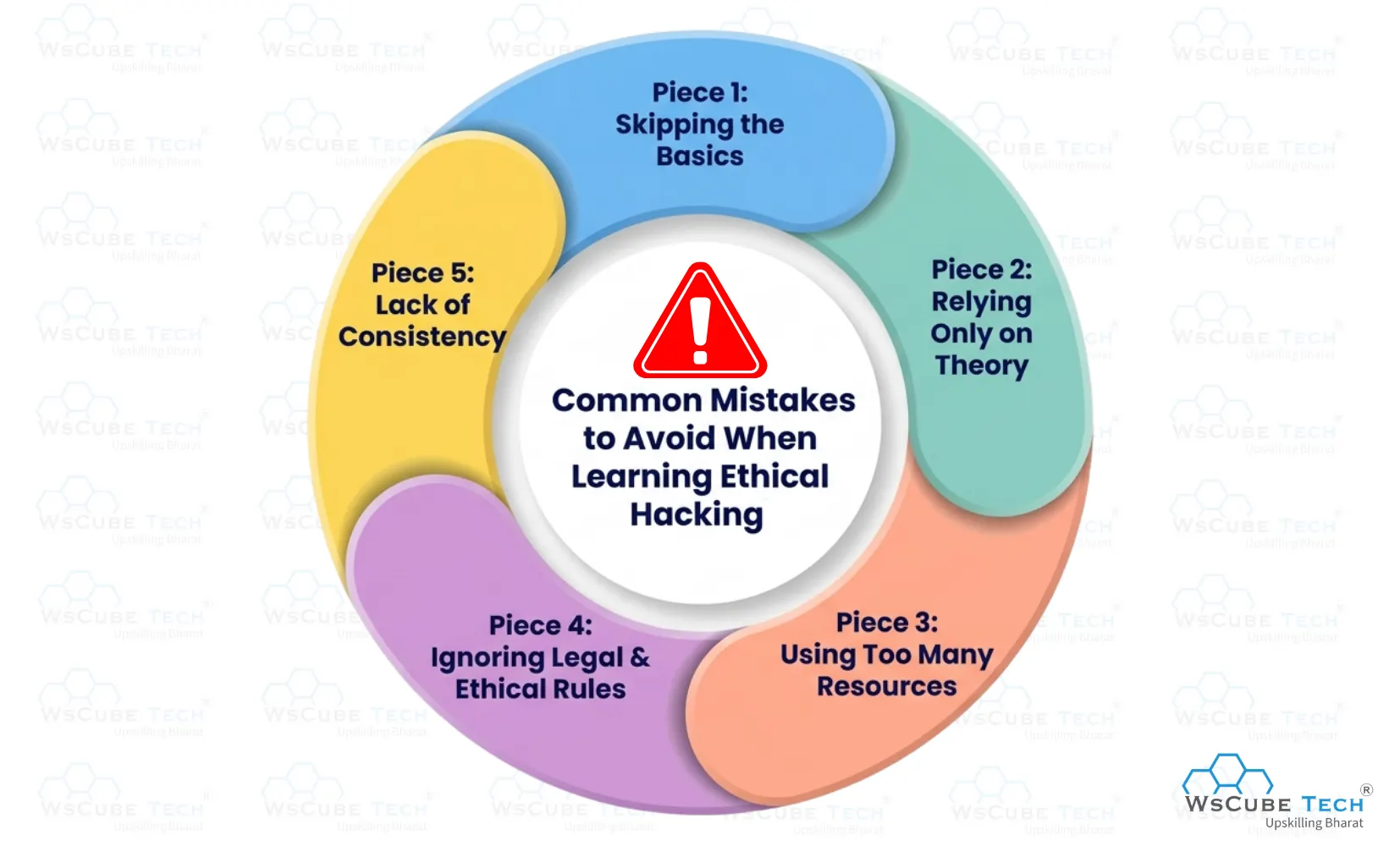
1. Skipping the Basics
Many beginners jump directly into advanced tools without understanding fundamentals like networking, operating systems, and cybersecurity basics. This creates confusion later. Building a strong foundation first makes it easier to understand complex concepts and apply ethical hacking techniques effectively in real-world scenarios.
2. Relying Only on Theory
Focusing only on reading or watching tutorials without practicing is a major mistake. Ethical hacking is a practical skill that requires hands-on experience. Without applying concepts in labs or real environments, it becomes difficult to understand how attacks and defenses actually work.
3. Using Too Many Resources
Trying to learn from multiple courses, videos, and blogs at the same time often leads to confusion and lack of direction. It’s better to follow one structured path or course, complete it properly, and then explore additional resources for deeper understanding.
4. Ignoring Legal and Ethical Rules
Practicing hacking without permission or in unauthorized environments can lead to serious legal issues. Always use legal platforms, labs, or your own systems for practice to ensure you are learning safely and responsibly as an ethical hacker.
5. Lack of Consistency
Learning ethical hacking requires regular practice and continuous effort. Studying randomly or taking long breaks slows down progress and reduces retention. Consistency helps you build skills gradually and stay updated with new tools, techniques, and cybersecurity trends.
If you want to learn step by step, you can explore the Ethical Hacking Course Syllabus to understand what topics to cover and how to start your learning journey effectively.
FAQs About Learning Ethical Hacking
Ethical hacking is not too hard if you start with basics like networking and operating systems. With consistent practice, patience, and the right learning path, beginners can understand concepts and gradually build strong skills.
The time depends on your dedication and learning pace. On average, beginners can understand basics in 3–6 months, while mastering ethical hacking with practical experience may take one to two years.
Programming is not mandatory at the beginning, but basic knowledge helps a lot. Learning languages like Python or JavaScript makes it easier to understand vulnerabilities, automate tasks, and perform advanced security testing.
Python is considered the best for beginners due to its simplicity and wide use in automation and security tools. Other useful languages include JavaScript, C, and Bash for deeper understanding.
Yes, you can learn ethical hacking without a technical background by starting with basic concepts step by step. With consistent effort, practice, and the right resources, beginners can gradually build strong skills.
Basic skills include understanding networking, operating systems, and cybersecurity fundamentals. You should also have problem-solving ability, curiosity, and willingness to learn continuously to grow in ethical hacking effectively.
Yes, ethical hacking is a great career in 2026 due to increasing cyber threats and high demand for cybersecurity professionals. It offers good salaries, job security, and opportunities across various industries worldwide.
Yes, you can start learning ethical hacking online for free using tutorials, blogs, and practice platforms. However, structured courses can provide better guidance, clarity, and faster learning compared to scattered resources.
Popular beginner certifications include CEH, CompTIA Security+, and eJPT. These certifications help validate your knowledge, improve credibility, and increase your chances of getting entry-level jobs in cybersecurity.
Ethical hackers use tools like network scanners, vulnerability scanners, password testing tools, and web security tools. These tools help identify weaknesses, test systems, and improve overall security in a controlled environment.
Yes, ethical hacking is legal when done with proper permission and in authorized environments. Practicing without consent on real systems is illegal, so always use legal labs, platforms, or your own systems.
You can practice safely by using legal platforms like TryHackMe, Hack The Box, or virtual labs. Always avoid testing on real systems without permission to ensure ethical and responsible learning.
Ethical hacking is a broad concept of identifying vulnerabilities, while penetration testing is a specific method where professionals simulate attacks to test system security in a controlled and authorized manner.
Yes, after learning ethical hacking and gaining practical experience, you can apply for roles like security analyst or penetration tester. Certifications and projects further increase your chances of getting hired.
Conclusion
Ethical hacking is a valuable skill that helps you protect systems, understand cyber threats, and build a strong career in cybersecurity. By learning step by step and focusing on practical skills, anyone can start their journey confidently.
With the right guidance, consistent practice, and continuous learning, you can develop real-world skills and grow in this field. Ethical hacking not only offers career opportunities but also helps you stay ahead in the digital world.
Free Courses For You




Leave a comment
Your email address will not be published. Required fields are marked *Comments (0)
No comments yet.