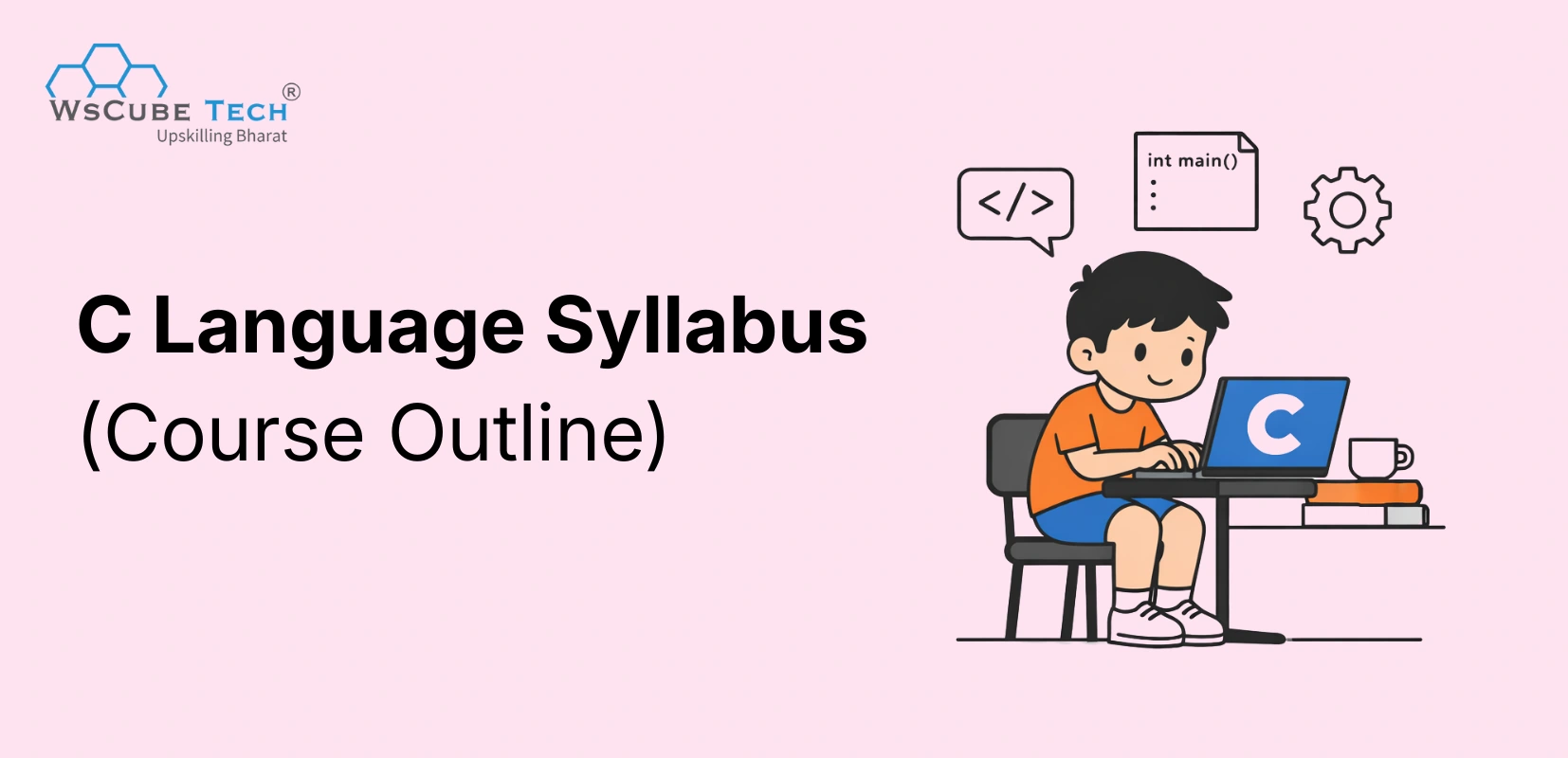
C is a powerful and foundational programming language known for its speed, efficiency, and direct control over system resources and computer hardware. It is commonly used by both beginners and experienced developers to create programs ranging from simple console applications to complex system software. Its structured approach and strong performance make it an excellent choice for anyone starting a programming journey.
This complete C language syllabus is designed to guide learners step by step, starting with basic concepts and gradually progressing to advanced topics. It builds a strong programming foundation while also introducing practical skills required for real-world software development.
What is C Language?
C is a general-purpose programming language created by Dennis Ritchie in 1972 at Bell Labs. It is known for high performance, efficient execution, and close interaction with system memory and hardware. C follows a structured programming style that helps you write clear, organized, and maintainable code while building a strong understanding of how programs work internally.
It is used to build operating systems, embedded software, and device drivers. Many modern languages are influenced by C, making it a strong foundation for learning programming and software development today.
C Code Example
#include <stdio.h>

int main() {
    printf("Hello, World!");
    return 0;
}
Why Learn C?
C builds strong programming fundamentals, improves problem-solving skills, and helps you understand how software interacts with hardware, making it a valuable language for core technology careers.
- Strong Programming Foundation: Learning C strengthens your understanding of core programming concepts like variables, loops, functions, and memory usage, which makes it easier to learn other programming languages later.
- Better Understanding of Computer Systems: C allows you to work closely with memory and system resources, helping you understand how programs interact with hardware, operating systems, and low-level processes inside a computer.
- High Performance and Efficiency: Programs written in C execute quickly and make efficient use of system resources, making the language suitable for applications that require speed and stability, such as operating systems, embedded systems, and real-time software where reliable performance is essential.
- Wide Use in Core Technologies: C is used to develop operating systems, compilers, device drivers, and embedded software, giving you opportunities to work in important technical fields that require strong programming skills.
Learning C not only builds confidence in coding but also creates a strong base for advanced programming, system development, and many future technology career paths.
Recommended Professional Certificates
Full Stack Development Mentorship Program
WordPress Bootcamp
C Syllabus (Curriculum)
Below is the C programming language syllabus, organized from beginner to advanced levels, to help learners progress step by step with a clear structure and a smooth learning path.
1. Introduction to C
2. Fundamentals of C
- Basics of C Language
- First Program in C
- Structure of C Program
- Comments in C Programming
- Tokens in C Language
- Keywords in C Language
3. Data Types and Variables
- C Data Type
- C Variables
- C Constants
- C Scope and Lifetime of Variables
- C Type Conversion
- C Type Casting
- C Global Variables
- C Literals
- C Escape Sequence
- C Bool
4. Operators in C
- C Operators
- C Arithmetic Operators
- C Relational Operators
- C Logical Operators
- C Bitwise Operators
- C Assignment Operators
- C Unary Operators
- C Increment and Decrement Operators
- C Ternary Operator
- C Operator Precedence and Associativity
5. Input and Output Functions
- C Input & Output
- C printf() in
- C scanf()
- C getchar()
- C putchar() Function
- C gets() Function
- C puts() Function
- C Formatted Input/Output
- C Format Specifiers
6. Control Flow in C
- C Control Statements
- C If Statement
- C If-else Statement
- C Nested if-else Statement
- C Switch Statement
- C Loops
- C For Loop
- C While Loop
- C Do-While Loop
- C Break Statement
- C Continue Statement
- C goto Statement
- C Nested Loops
7. Functions in C
- C Functions
- C User-defined Function
- C Language Function Declaration and Definition
- C Function Prototype
- C Function Callback
- C Nested Function
- C Recursion
- C Storage Classes
8. Arrays and Strings in C
- C Arrays
- C One-Dimensional Array
- C Two-Dimensional Arrays
- C Multidimensional Arrays
- C Length (Size) of Array
- C Pass Array to Function
- C String Functions
- C Strings
- C Array of Strings
9. Pointers in C
- C Pointers
- C Pointer Arithmetic
- C Passing Pointer to Function
- C Function Pointers
- Difference Between Pointer and Array in C
- C Null Pointer
- C Dangling Pointer
- C Dereference Pointer
- C Dynamic Memory Allocation
10. Structures and Unions in C
- C Structures
- C Structure Pointer
- C Nested Structure
- C Self-Referential Structures
- C Bit Fields
- C Array of Structures
- C Unions
- Structure vs Union in C
11. File Handling in C
12. Preprocessors and Macros
13. Advanced Topics in C
14. Standard Library Functions
15. Additional Topics
After completing the full syllabus of C programming language, you will understand core and advanced concepts, system-level programming, and standard libraries. This knowledge enables you to build efficient applications and create a strong base for learning higher-level languages and real-world software development.
Upcoming Masterclass
Attend our live classes led by experienced and desiccated instructors of Wscube Tech.




Who Should Learn C?
Anyone who wants to understand how software works internally, build strong programming logic, and learn system-level concepts can benefit from learning C, as it develops deep technical knowledge and solid problem-solving skills.
- Students and Beginners: C is a great starting point for students because it builds strong programming basics, improves logical thinking, and helps learners clearly understand how programs run inside a computer system.
- Aspiring System Programmers: Learners who want to work on operating systems, compilers, or low-level software will benefit from C, as it provides direct control over memory and system resources.
- Embedded Systems Developers: C is commonly used for programming microcontrollers and embedded devices because it delivers efficient performance and direct hardware control. It is essential for learners who want to build firmware, IoT devices, and reliable hardware-based applications used in real-world technology systems.
- Computer Science Learners: Students studying computer science can use C to understand data structures, algorithms, and memory management in depth, which strengthens their overall programming and technical foundation.
Learning C opens the door to deeper technical knowledge and prepares you for advanced programming, system development, and many specialized technology career paths.
C Programming Interview Questions
Regular practice is essential for mastering C programming. Practicing C interview questions and answers helps you improve your understanding, improve problem-solving skills, and prepare effectively for technical job interviews. You can also explore more C interview questions to deepen your knowledge and build confidence in core programming concepts and system-level topics.
More Web Development Blog Topics to Read
Learn C Programming from Scratch with WsCube Tech
You can explore the C programming tutorial by WsCube Tech, specially designed for beginners who want to start from zero and gradually grow into confident C programmers. The course explains concepts in simple language, making it easier for you to understand programming clearly and build strong fundamentals.
This tutorial follows a structured, step-by-step learning path with practical examples and hands-on exercises. Instead of only reading theory, you write real C programs and apply what you learn. You can also use an online C compiler to write, run, and test your code instantly, making learning more interactive and effective.
Along with learning, you can test your understanding through a C Quiz Test to strengthen your concepts and track your progress. This structured approach helps you move from basics to advanced topics while preparing for real-world software development.
FAQs About C Syllabus
C is a powerful programming language that helps you understand core programming concepts, system-level operations, and memory management. Learning C builds a strong foundation and prepares you for developing efficient, high-performance applications and reliable system software.
A C syllabus covers topics from basic to advanced, including syntax, data types, operators, control statements, functions, arrays, pointers, structures, file handling, and memory management, helping you build a strong foundation and progress step by step.
You can benefit from C whether you are a student, beginner, or professional. It is a great choice if you want to understand system-level programming, develop efficient applications, or build a strong base for learning other programming languages.
The time depends on your pace and practice. If you practice regularly, you can cover the basic topics within a few months and gradually move to advanced topics and project-based learning with confidence.
No, you don’t need prior experience. The C syllabus is designed for beginners, so you can start from the basics and gradually understand programming concepts, logic building, and problem-solving skills through consistent practice.
C is important for core technology fields because it gives you direct control over memory and system resources. When you learn C, you understand how operating systems, embedded devices, and low-level software work, which builds strong technical knowledge and problem-solving skills.
By learning C, you gain strong programming fundamentals and system-level understanding. This opens opportunities in software development, embedded systems, game development, and other technology fields that require efficient and reliable programming skills.
C is used to build operating systems, embedded applications, compilers, and performance-critical software. Learning C allows you to create real-world applications and understand how software interacts directly with computer hardware.
Yes, you should. Working on C projects reinforces concepts, improves problem-solving, and helps you apply what you learn to real scenarios. It also builds confidence in programming and prepares you for professional development tasks.
You can use our C online compiler or install a C IDE on your computer. These tools let you write, run, and test programs instantly, helping you practice efficiently while following the C programming syllabus.

Conclusion
Learning C gives you a strong understanding of how programming works at a deeper level. It helps you build clear logic, write efficient code, and understand how software interacts with system memory and hardware. These skills make it easier for you to learn other programming languages and advanced technical concepts in the future.
By following a structured syllabus and practicing regularly, you gain confidence in solving problems and building real programs. C not only strengthens your programming foundation but also prepares you for careers in system programming, embedded development, and other important technology fields.
Start Learning With Our Free Tutorials



Leave a comment
Your email address will not be published. Required fields are marked *Comments (0)
No comments yet.