Imagine building a complete website on your own, from the login page users see the database quietly storing their information. That is exactly what a MERN Stack developer does every day.
The problem is that most beginners get stuck deciding what to learn first. MongoDB, Express, React, and Node.js each look important, and without a clear order, months go by with tutorials watched but nothing actually built.
This guide fixes that. It breaks down how to become a MERN Stack developer into a practical roadmap covering the skills you need, the order to learn them in, the projects worth building, and the career paths waiting at the end. If you prefer structured guidance with mentor support, a MERN Stack Development Course can help you move faster with less guesswork.
What is MERN Stack?
MERN Stack is a popular full-stack development approach that uses four technologies to build modern web applications. It allows developers to use JavaScript for both frontend and backend, making development simple and efficient.
MERN stands for MongoDB, Express, React, and Node.js. These technologies work together to create fast, scalable, and dynamic applications. MongoDB handles data storage, Express and Node.js manage the server, and React builds the user interface, helping developers easily create complete web solutions.
Why Choose MERN Stack in 2026?
The MERN Stack remains one of the best choices for developers in 2026 due to its flexibility, high demand, and strong ecosystem. Below are the key reasons to choose the MERN Stack:
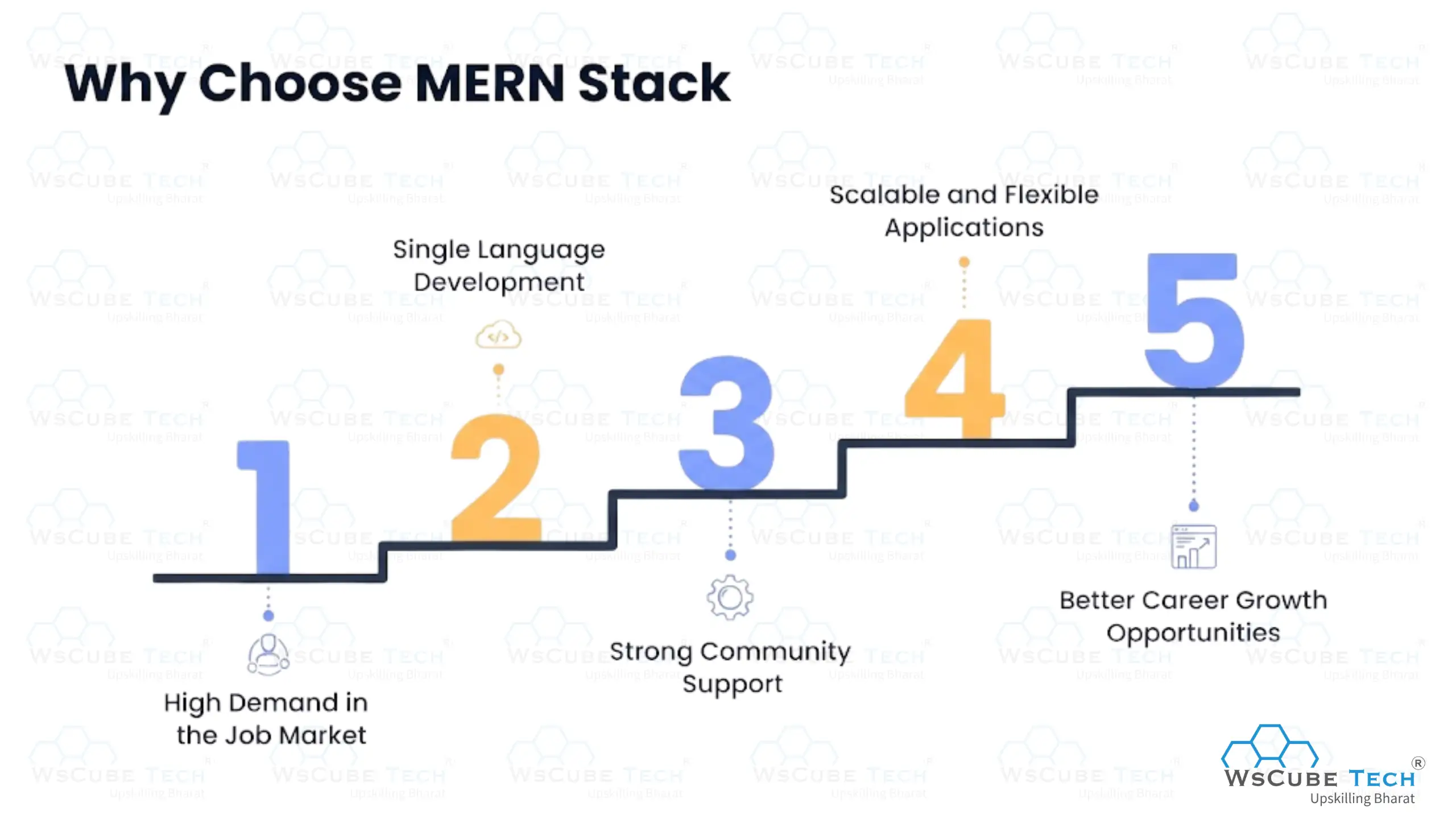
1. High Demand in the Job Market
MERN Stack developers are in high demand as companies prefer full-stack developers who can handle both frontend and backend development. Startups and tech companies look for developers who can build complete applications, making MERN skills valuable for better job opportunities and career growth.
2. Single Language Development
One of the biggest advantages of MERN Stack is that it uses JavaScript for both frontend and backend. This makes learning easier and faster for beginners, while also improving productivity by reducing the need to switch between different languages.
3. Strong Community Support
MERN Stack technologies have a large and active community. Developers can easily find tutorials, documentation, and solutions to problems online. This support helps beginners learn quickly and solve issues without getting stuck, making the learning journey smoother and more efficient.
4. Scalable and Flexible Applications
MERN Stack allows developers to build scalable and flexible web applications. It is suitable for both small projects and large-scale applications. With tools like MongoDB and Node.js, developers can handle growing data and traffic efficiently without affecting performance.
5. Better Career Growth Opportunities
Learning MERN Stack opens doors to multiple career roles such as frontend developer, backend developer, and full-stack developer. It provides strong practical skills that are useful in real-world projects, helping developers grow faster and build a successful career in web development.
Also Read: MERN Stack Course Syllabus (Updated Curriculum)
MERN Stack Components
Below are the main components discussed in detail:
1. MongoDB
MongoDB is a NoSQL database used to store application data in a flexible, JSON-like format. It allows developers to handle large amounts of data easily and scale applications when needed. Its document-based structure works smoothly with JavaScript, making data handling faster and more efficient.
2. Express.js
Express.js is a lightweight backend framework used with Node.js to build web applications and APIs. It simplifies server-side development by handling routing, requests, and middleware. Developers use Express to create secure and structured backend systems, making it easier to manage application logic and connect with databases.
3. React.js
React.js is a popular frontend library used to build interactive and user-friendly interfaces. It allows developers to create reusable components, making development faster and more organized. With its fast rendering and efficient updates, React helps improve user experience and performance in modern web applications.
4. Node.js
Node.js is a runtime environment that allows JavaScript to run on the server side. It is used to build fast and scalable backend services. With its non blocking architecture, Node.js can handle multiple requests efficiently, making it ideal for real-time applications and high-performance web development.
Recommended Professional Certificates
Full Stack Development Course with AI Engineering
WordPress Bootcamp
Skills Required to Become a MERN Stack Developer
To become a MERN Stack developer, you need strong technical knowledge and practical skills to build complete web applications. Below are the essential technical skills required:
- HTML and CSS: HTML structures web pages and CSS styles them for better appearance. Together, they help you create layouts, design responsive interfaces, and improve the overall user experience across different devices.
- JavaScript: JS is the core language of the MERN Stack, used in both frontend and backend. It helps build interactive features, handle application logic, and connect different parts of an application.
- React.js: React.js is used to build dynamic and interactive user interfaces. It allows developers to create reusable components, manage application state, and improve performance with efficient rendering techniques.
- Node.js: Node.js is a runtime environment that allows JavaScript to run on servers. It is used to build fast, scalable backend systems and handle multiple user requests efficiently.
- Express.js: Simplifies backend development by managing routes, handling requests, and building secure APIs for smooth frontend and backend communication.
- MongoDB: A NoSQL database for storing application data in a flexible format. It supports scalability and works well with JavaScript-based applications in the MERN Stack.
- Version Control: Git and GitHub are used for version control and code management. They help track changes, collaborate with other developers, and efficiently maintain project history.
- REST APIs: Allow communication between frontend and backend systems. They help send and receive data, making it possible to connect user interfaces with server-side functionality.
- Basic Data Structures and Algorithms: DSA knowledge improves problem-solving skills and coding efficiency. It helps developers write optimized code, handle complex logic, and perform better in technical interviews.
Suggested Reading: MERN Stack Developer Salary in India
How to Become a MERN Stack Developer? (Step-by-Step)
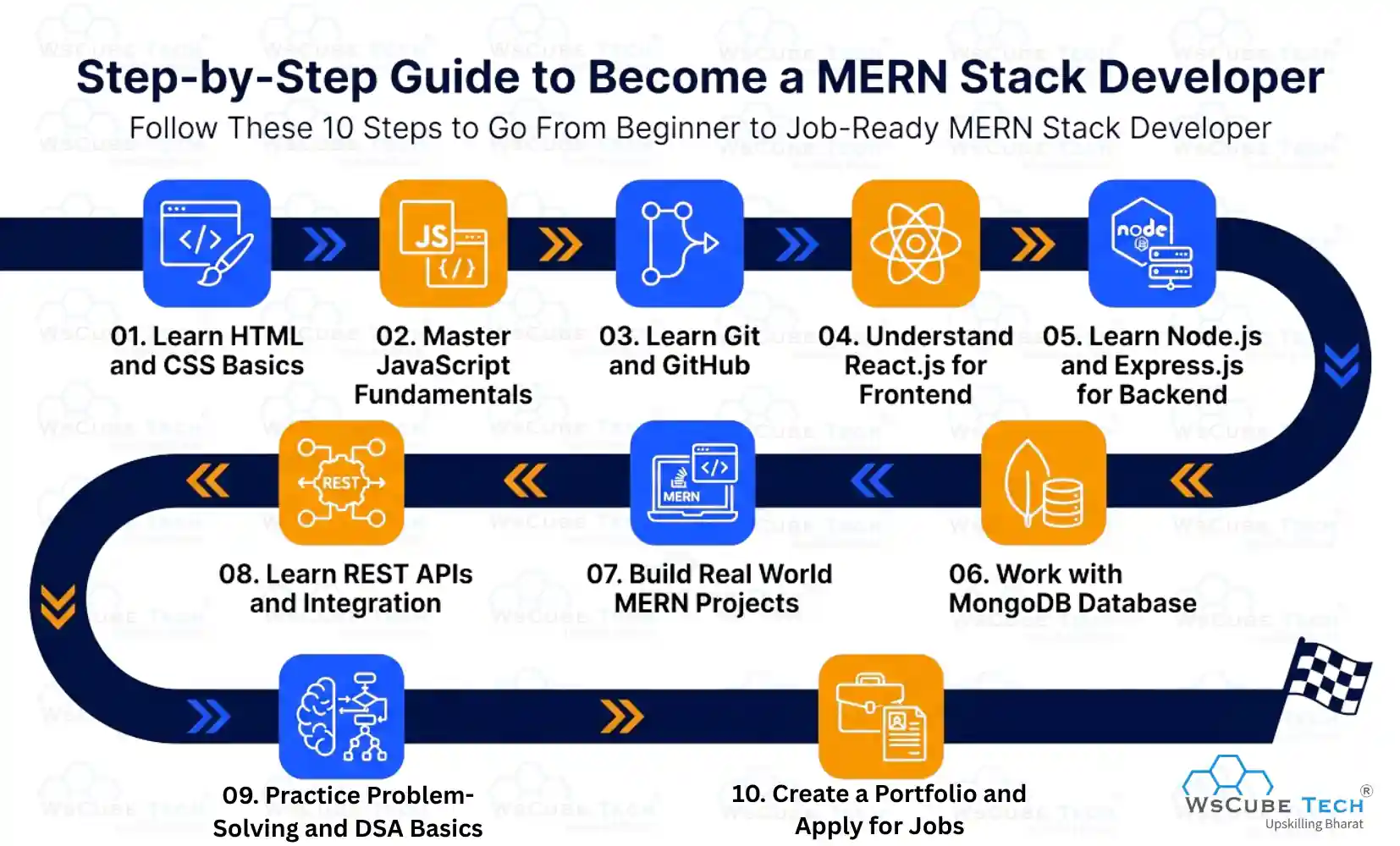
Here is the MERN Stack developer roadmap that you can follow step by step to build strong skills and become job-ready:
- Step 1: Learn HTML and CSS basics
- Step 2: Master JavaScript fundamentals
- Step 3: Learn Git and GitHub
- Step 4: Understand React.js for frontend
- Step 5: Learn Node.js and Express.js for backend
- Step 6: Work with MongoDB database
- Step 7: Build real world MERN projects
- Step 8: Learn REST APIs and integration
- Step 9: Practice problem-solving and DSA basics
- Step 10: Create a portfolio and apply for jobs
Below, we will explore each step in detail to help you follow a clear and structured learning path.
Step 1: Learn HTML and CSS basics
Learning HTML and CSS is the first step to becoming a MERN Stack developer, as it helps you understand how web pages are structured and styled from scratch. Here are the key concepts you should focus on:
- HTML (HyperText Markup Language): Learn to structure web pages using elements like headings, paragraphs, links, images, and forms to create a clear and organized layout.
- CSS (Cascading Style Sheets): Learn how to style web pages using colors, fonts, spacing, layouts, and simple animations to make your website visually appealing and easy to use.
- Responsive Design: Understand how to make websites adapt to different screen sizes using media queries and flexible layouts for mobile, tablet, and desktop users.
- Flexbox and Grid: Learn modern layout techniques like Flexbox and Grid to design clean, flexible, and well-structured web page layouts efficiently.
- Basic Projects: Practice by building simple projects like landing pages, portfolios, or forms to strengthen your understanding and gain practical experience.
Building a strong foundation in HTML and CSS will make it easier to move toward JavaScript and advanced frontend technologies.
Step 2: Master JavaScript Fundamentals
JavaScript is the core of the MERN Stack, so mastering its fundamentals is essential to building interactive and dynamic web applications. Here are the key concepts you should focus on:
- Basic Concepts: Learn variables, data types, operators, and control structures like if-else and loops to understand how JavaScript works.
- Functions and Scope: Understand functions, parameters, return values, and scope to write reusable and organized code.
- DOM Manipulation: Learn how to interact with web pages by selecting elements, updating content, and handling events like clicks and inputs.
- ES6 Features: Explore modern features like arrow functions, destructuring, spread operator, and modules to write cleaner and efficient code.
- Asynchronous JavaScript: Learn promises, async await, and callbacks to handle API calls and asynchronous operations effectively.
- Practice Projects: Build small projects such as a to-do list, a calculator, or form validation to strengthen your understanding.
Mastering JavaScript fundamentals will make it easier to learn React, Node.js, and other advanced concepts in the MERN Stack.
Step 3: Learn Git and GitHub
Git and GitHub are essential tools for version control and collaboration. They help you manage code, track changes, and work efficiently on projects. Below are the key concepts you should focus on:
- Git Basics: Learn commands like init, add, commit, status, and log to track and manage your code changes locally.
- Repositories: Understand how to create and manage local and remote repositories to store and organize your projects.
- Branching and Merging: Learn to create branches, work on features, and merge them without affecting the main project code.
- GitHub Usage: Learn to push code, create repositories, and share your projects online for collaboration and visibility.
- Collaboration Workflow: Understand pull requests, code reviews, and issue tracking to work effectively in team environments.
- Project Management: Use GitHub to maintain project history, track progress, and showcase your work to recruiters.
Learning Git and GitHub will help you manage projects professionally and collaborate with other developers easily.
Step 4: Understand React.js for frontend
React.js is used to build modern and interactive user interfaces. It helps you create fast and dynamic web applications using reusable components. Here are the key concepts you should learn:
- Components: Learn how to create reusable components to organize your code and build scalable user interfaces efficiently.
- JSX: Understand JSX syntax to write HTML like code inside JavaScript for building UI elements.
- Props and State: Learn how to pass data using props and manage dynamic data using state in your applications.
- Event Handling: Handle user interactions like clicks, inputs, and form submissions to make applications interactive.
- Hooks: Learn the basics of hooks like useState and useEffect to manage state and side effects in functional components.
- Routing: Understand how to use React Router to navigate between different pages in a single-page application.
- Projects Practice: Build small projects, like to-do apps or dashboards, to strengthen your understanding.
Learning React.js will help you build powerful frontend applications and improve user experience in your MERN Stack projects.
Step 5: Learn Node.js and Express.js for Backend
Node.js and Express.js help you build the backend of web applications, handle server logic, and manage data communication between frontend and database. The following are the main areas to learn:
- Node.js Basics: Learn how to run JavaScript on the server, handle modules, and work with file systems and basic server setup.
- Express.js Framework: Understand routing, middleware, and how to build simple and structured backend applications using Express.
- API Development: Learn to create REST APIs to handle requests and responses between frontend and backend.
- Middleware Usage: Understand how middleware works for authentication, logging, and request handling in applications.
- Error Handling: Learn to manage errors properly to make your application stable and reliable.
- Backend Projects: Build simple projects like APIs or basic servers to practice backend development.
Mastering Node.js and Express.js will help you build strong backend systems and connect your application with databases like MongoDB.
Upcoming Masterclass
Attend our live classes led by experienced and desiccated instructors of Wscube Tech.


Step 6: Work with MongoDB Database
MongoDB is used to store and manage application data. It helps you handle data efficiently and connect your backend with a database. Here are the key concepts you should learn:
- Database Basics: Learn how databases work, including collections, documents, and how data is stored in MongoDB.
- CRUD Operations: Understand how to create, read, update, and delete data using MongoDB queries.
- Mongoose: Learn to use Mongoose for schema creation, data validation, and easier interaction with MongoDB in Node.js applications.
- Data Modeling: Understand how to design schemas and organize data for better performance and scalability.
- Connecting with Backend: Learn how to connect MongoDB with Node.js and Express.js to store and retrieve application data.
- Practice Projects: Build small applications like user authentication systems or simple databases to gain hands-on experience.
Learning MongoDB will help you manage data effectively and build complete backend systems for your MERN Stack applications.
Step 7: Build Real World MERN Projects
Building real world MERN projects is one of the most important steps in your learning journey. It helps you apply your knowledge of frontend, backend, and database concepts in practical scenarios. By working on projects, you understand how different technologies connect and gain confidence in developing complete web applications.
You can also explore 20+ MERN Stack Project Ideas (With Source Code) to find useful ideas and practice projects. Working on multiple projects will strengthen your skills, improve your problem-solving ability, and help you create a strong portfolio for job opportunities.
Step 8: Learn REST APIs and Integration
REST APIs help your frontend and backend communicate by sending and receiving data. Learning APIs is essential for building complete and functional web applications. Here are the key concepts you should learn:
- API Basics: Understand what APIs are, how they work, and how clients and servers communicate using HTTP methods like GET, POST, PUT, and DELETE.
- API Creation: Learn to build REST APIs using Node.js and Express.js to handle requests and send proper responses.
- API Integration: Understand how to connect frontend with backend APIs using tools like fetch and axios to display and send data.
- JSON Data Handling: Learn how to work with JSON format for sending and receiving structured data between systems.
- Authentication: Explore basic authentication methods like tokens and JWT to secure your APIs.
- Testing APIs: Use tools like Postman to test API endpoints and ensure they are working correctly.
Learning REST APIs and how to integrate them will help you connect all parts of your MERN application and build complete, data-driven web applications.
Step 9: Practice Problem Solving and DSA Basics
Practicing problem-solving and learning basic Data Structures and Algorithms helps you improve your logic and coding skills. It helps you think efficiently, write optimized code, and solve real problems in web development and interviews.
You can also explore a DSA tutorial to strengthen your understanding of important concepts like arrays, strings, and recursion. Regular practice will boost your confidence, improve coding speed, and prepare you for technical interviews.
Step 10: Create a Portfolio and Apply for Jobs
Creating a strong portfolio is important to showcase your skills and projects. It helps recruiters understand your practical knowledge and the type of applications you can build using the MERN Stack.
Add your best projects, explain features, and include links to GitHub repositories. Once your portfolio is ready, start applying for internships and developer roles. Consistent applications and practice will increase your chances of getting hired.
Web Development Career Guides
| How to Become a Web Developer? | What does a Web Developer do? |
| How to Become Frontend Developer? | How to Learn Web Development? |
| Backend Developer Roadmap | How to Become Full Stack Developer? |
Careers After Becoming a MERN Stack Developer
After becoming a MERN Stack developer, you can explore multiple career opportunities in web development across startups, companies, and freelance platforms.
| Job Role | Description | Salary Range (India) |
| Frontend Developer | Focuses on building user interfaces using React, HTML, CSS, and JavaScript to create responsive and interactive web applications. | ₹6 LPA – ₹7 LPA |
| Backend Developer | Works on server-side logic using Node.js and Express, handling databases, APIs, and application performance efficiently. | ₹11 LPA – ₹12 LPA |
| Full Stack Developer | Handles both frontend and backend development, building complete web applications using MERN Stack technologies. | ₹9 LPA – ₹11 LPA |
| MERN Stack Developer | Specializes in MongoDB, Express, React, and Node.js to develop full-stack applications with efficient data handling. | ₹4 LPA – ₹5 LPA |
| Web Developer | Builds and maintains websites, focusing on design, functionality, and performance using various web technologies. | ₹4 LPA – ₹5 LPA |
| Software Developer | Develops software applications using programming skills, working on both web and system-level projects. | ₹9 LPA – ₹11 LPA |
| Freelance Developer | Works independently on projects, building web applications for clients and delivering customized solutions. | ₹5 LPA – ₹15+ LPA |
Explore Our Web Development Related Courses
FAQs About Becoming a MERN Stack Developer
A MERN Stack developer builds full-stack web applications using MongoDB, Express.js, React.js, and Node.js. They handle both frontend and backend development to create complete and interactive applications.
Start by learning HTML, CSS, and JavaScript fundamentals. Then learn React, Node.js, Express.js, and MongoDB, build projects, practice coding regularly, and create a strong portfolio for job opportunities.
The learning time depends on your consistency and practice. Beginners can usually learn MERN Stack in six to twelve months by studying regularly and building practical projects consistently.
You need skills like HTML, CSS, JavaScript, React.js, Node.js, Express.js, MongoDB, REST APIs, Git, problem solving, and basic Data Structures and Algorithms for MERN Stack development.
Yes, MERN Stack is beginner friendly because it uses JavaScript for both frontend and backend development. This makes learning simpler and helps beginners understand full stack development more easily.
No, a degree is not mandatory for becoming a MERN Stack developer. Strong skills, practical projects, and a good portfolio are often more important than formal educational qualifications.
You can become a MERN Stack developer without experience by learning core concepts, building projects, contributing to open source, and creating a portfolio to showcase your practical skills.
JavaScript is the main programming language used in the MERN Stack. It is used for frontend development with React and backend development with Node.js and Express.js.
Beginners can build projects like to do apps, authentication systems, blog websites, chat applications, and portfolio websites to improve their MERN Stack development and practical coding skills.
Yes, MERN Stack development remains a strong career choice in 2026 because companies continue hiring full stack developers to build modern, scalable, and interactive web applications efficiently.
The salary of a MERN Stack developer in India depends on skills and experience. Freshers usually earn between ₹3 LPA and ₹6 LPA, while experienced developers earn significantly more.
Yes, you can learn MERN Stack from home using online tutorials, courses, documentation, and practice projects. Consistent learning and hands on practice are important for improving your skills.
MERN Stack is a part of full stack development that specifically uses JavaScript technologies. It is a great choice for developers who want to specialize in JavaScript based applications.
You can learn MERN Stack using online courses, YouTube tutorials, official documentation, coding platforms, and project based learning resources that provide practical experience and hands on development practice.
After 12th, start with HTML, CSS, and JavaScript, then move to React, Node.js, Express.js, and MongoDB. A degree is optional, so focus on building projects and a portfolio alongside your studies.
Both use MongoDB, Express.js, and Node.js. The only difference is the frontend, where MERN uses React and MEAN uses Angular. MERN is usually easier for beginners because React has a simpler learning curve.
AI tools speed up coding but cannot handle architecture, debugging, and product decisions on their own. Developers who use these tools well while understanding fundamentals continue to stay in demand.
Yes, both appear frequently in current job listings. Learn TypeScript for safer and cleaner code, and Next.js for server side rendering and SEO, once you are comfortable with core React.
Basic DSA is enough for most web development work, but product companies test it in interviews. Learn arrays, strings, objects, recursion, and time complexity alongside your project building.
Yes, many developers switch from non IT fields successfully. Since MERN uses only JavaScript, consistent practice, structured learning, and completed projects matter more than a technical degree.
Three to four focused hours daily is enough for most learners to become job ready in six to eight months. Consistency matters far more than long and irregular study sessions.
Yes, MERN skills suit freelance work like business websites, dashboards, and custom web apps. Build three to four strong portfolio projects before approaching clients on freelance platforms.
Certifications add credibility, but recruiters usually prioritise working projects and GitHub activity. A portfolio with deployed applications carries more weight than any certificate alone.

Conclusion
Every step in this roadmap builds on the one before it, from HTML and CSS to React, Node.js, Express.js, and MongoDB. Work through them in order and you will have the MERN Stack developer skills required to build and ship a full application entirely on your own.
The real difference between learners who succeed and those who struggle comes down to what they build. Focus on creating real projects, keep improving your portfolio, and apply what you learn consistently. This hands-on approach will help you understand how the entire MERN stack works together in real-world scenarios.
Explore Our Free Tech Tutorials
| Python Tutorial | Java Tutorial | JavaScript Tutorial |
| C Tutorial | C++ Tutorial | HTML Tutorial |
| CSS Tutorial | SQL Tutorial | DSA Tutorial |
Practice Coding With Our Free Compilers
| Online Python Compiler | Online HTML Compiler | Online C Compiler |
| Online C++ Compiler | Online JS Compiler | Online Java Compiler |
Join Our On-Campus Full Stack Related Courses
Free Courses for You


Leave a comment
Your email address will not be published. Required fields are marked *Comments (0)
No comments yet.