Every website, web application, and online service you use is built by web developers. Web development is one of the most exciting and in-demand technical skills today, and its scope keeps growing rapidly as more businesses and brands move their operations online.
For anyone who enjoys building things and solving real problems, it offers strong pay, flexible work options, and a secure long-term career. No wonder web development is such a popular choice for students, career switchers, and tech enthusiasts alike.
The best part is that you do not need a fancy degree or years of formal training to get started. This complete guide walks you through how to become a web developer from scratch, covering the key skills, tools, specializations, and simple steps you can follow to launch your career.
Who is a Web Developer?
Web developers are professionals who design, build, maintain, and optimize websites and web applications that users access over the internet. They write code to create appealing, functional, and feature-rich sites, and can work on the front end, the back end, or both to build dynamic web applications.
Well-versed in different programming languages, they draw on software development, computer programming, and graphic design to deliver projects on time and within budget. They are the backbone of any online business, making sure visitors get the best possible experience. Their exact roles and responsibilities vary depending on the company, position, and team size.
Recommended Professional Certificates
Full Stack Development Course with AI Engineering
WordPress Bootcamp
What Does a Web Developer Do?
Web developers create and maintain websites and web applications, writing code that shapes both the appearance and the functionality for a seamless user experience. Almost every social media platform, e-commerce store, streaming service, and online application you use is built by a team of web developers.
Here is what their work typically involves:
- Building and designing websites and web applications using tools and programming languages such as PHP, HTML, CSS, Python, JavaScript, and more.
- Collaborating with designers, product managers, testers, and stakeholders to meet the client's goals.
- Turning designs into a fully functional product, while designers focus on the look and feel.
- Handling ongoing maintenance and updates and fixing bugs that affect features or performance.
- Improving speed, security, and scalability to keep the application running smoothly.
Types of Web Developers
Before you get familiar with how to be a website developer, take a look at the different types of developers. Broadly, there are three primary types based on their area of expertise and specialization.
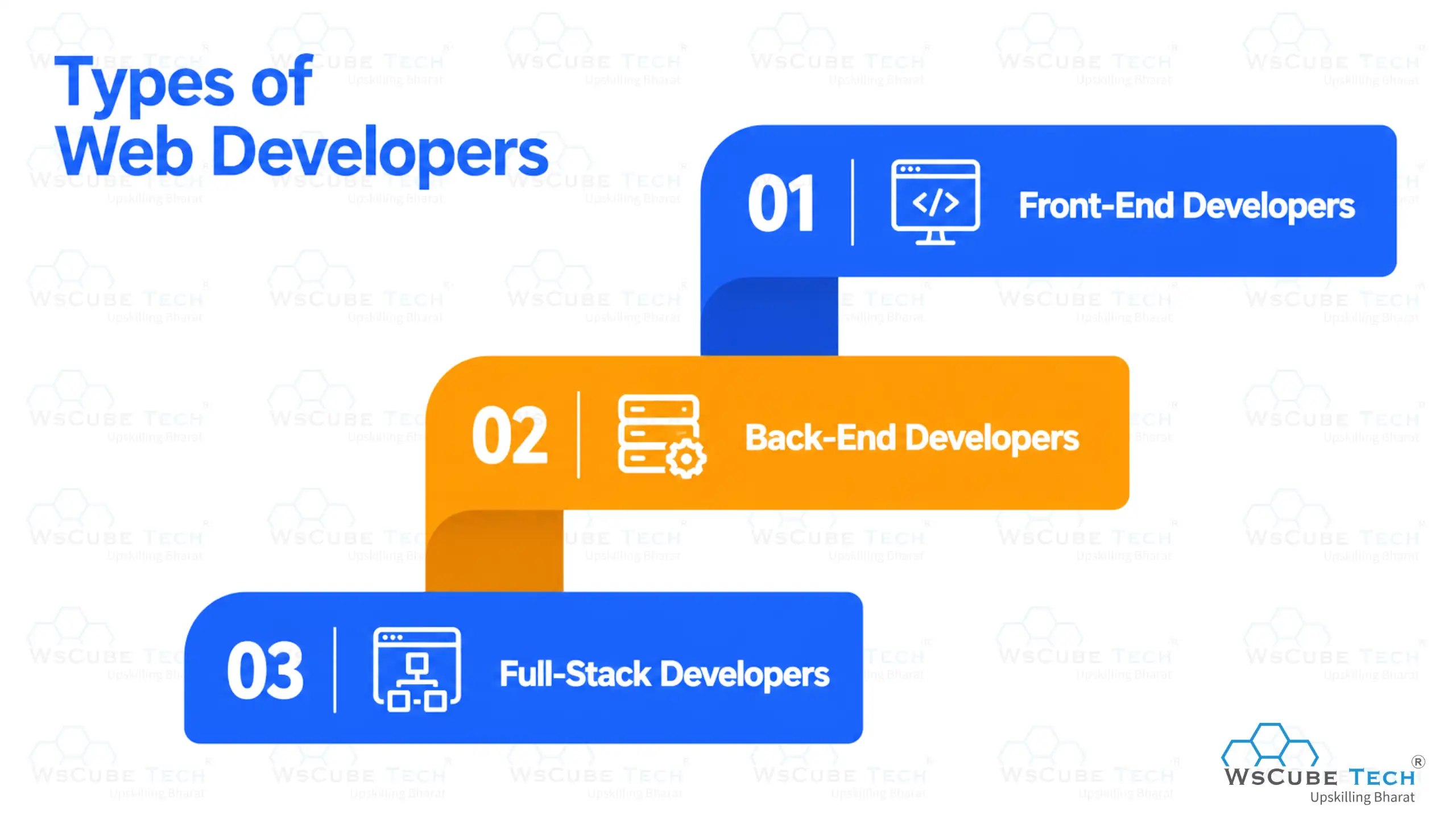
1. Front-End Developers
Front-end developers work on the visual part of a website, the part users can view and interact with, such as colors, images, theme, fonts, and layout. They use three core languages, HTML, CSS, and JavaScript, to design web pages and make sure a site looks good and responds smoothly across all devices.
2. Back-End Developers
Back-end developers build the structure behind a website, handling everything users cannot see. Their work covers database storage, security, integrations, server management, and program logic, using server-side languages such as Java, PHP, Python, SQL, and React.
3. Full-Stack Developers
Full-stack developers handle both front-end and back-end work, building a complete website from its look and design to its core functionality. With experience, they gain command over the full range of tools and technologies needed to build an entire site.
Upcoming Masterclass
Attend our live classes led by experienced and desiccated instructors of Wscube Tech.



How to Become a Web Developer? Step-by-step
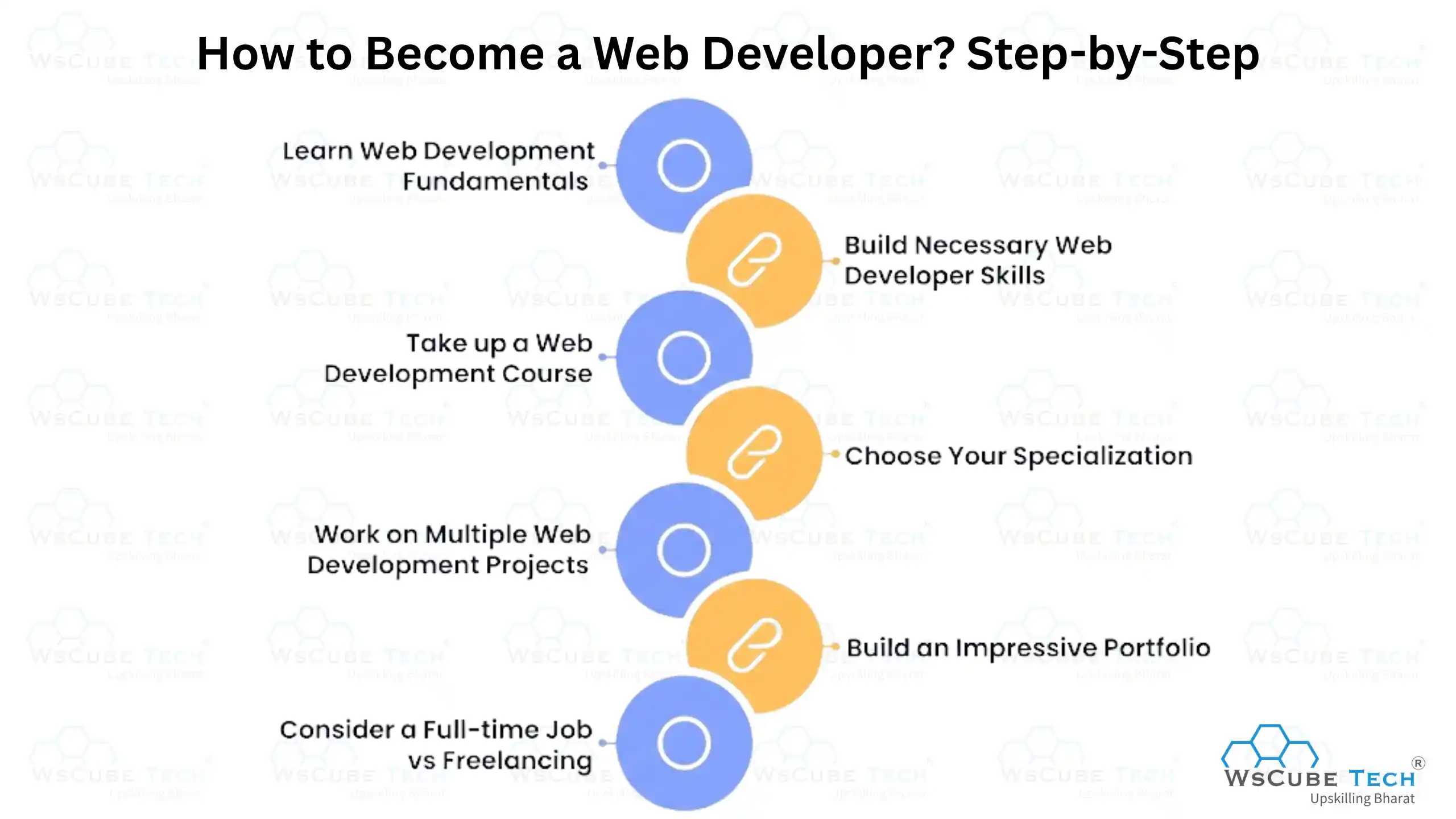
To become a web developer in India, you need both theoretical and practical knowledge. Even if you don’t have formal education, a trusted web development course will add credibility to your job profile. Make sure you have an in-depth understanding of coding and programming and possess key soft skills. The following steps will help you understand the web developer roadmap:
- Learn Web Development Fundamentals
- Build Necessary Web Developer Skills
- Take up a Web Development Course
- Choose Your Specialization
- Work on Multiple Web Development Projects
- Build an Impressive Portfolio
- Consider a Full-time Job vs Freelancing
Step 1: Learn Web Development Fundamentals
Every experienced web developer was once a novice, and it was through consistent practice and learning that they became leaders in the field. Web development is a demanding sector, and every aspirant needs to start by learning the basics. Get a thorough and fair knowledge of all the fundamentals of web development. CSS and HTML are the key programming languages that are considered the backbone of web development. Master these two first to develop core skills and then move on to the other advanced web development tools.
Here are the key fundamentals to focus on:
- Visual designing: fonts, images, and themes that give a website its look and feel.
- Version control: managing changes in the source code to avoid starting from scratch.
- Technical SEO: optimizing websites for top search engine ranking.
- Accessibility: making websites accessible to a wider audience.
- Core languages: gradually gain insights into PHP, SQL, MySQL, and JavaScript that are important to add and manage media applications.
Step 2: Build Necessary Web Developer Skills
The next step in the guide to how to become a web coder is building essential practical skills. Every recruiter and employer expects you to possess a certain set of skills that demonstrate your prowess as a web developer.
Yes, the job description and required skills may vary depending on the company and project, but the basic criteria will be the same. So, here are a few skills that you need to work on to build a strong foundation as a developer.
1. Technical skills
- Programming/Coding: Acquire knowledge of common programming languages, such as PHP, HTML, CSS, and JavaScript, for front-end development and learn PHP, Python, React, Ruby, and NodeJS for back-end development.
- Technical SEO: There are several website design factors that work together to boost a site’s search engine ranking. Gather knowledge of SEO and search engine algorithms to become a well-versed developer.
- Visual Design: Get familiar with the basic design principles, such as how to choose fonts, use white space, and add images to enhance user engagement.
- Responsive Design: Websites that you develop must be compatible and responsive based on different devices and screen sizes. Images, text, and videos must load within seconds, irrespective of the device.
- Version Control: Version control allows you to track and monitor changes to the source code without requiring you to start from scratch every time you run code or face an issue.
2. Workplace Skills
- Communication: Work on your communication skills as you will collaborate and engage with designers, testers, and stakeholders to complete a project successfully.
- Detail-oriented: Focus on every detail and aspect of programming, as even a small change can make a big difference to a website.
- Problem-solving: Another stage in the web development roadmap for beginners is learning problem-solving skills. Whenever you run into a problem or face an issue, you should maintain your calm and come up with the appropriate solution to solve it methodically.
- Customer Service: Web developers should have a customer-centric approach to deliver what clients expect and meet their requirements efficiently.
- Organization: Make sure to track project tasks, deadlines, budgets, and workflow to effectively complete your project.
Step 3: Take up a Web Development Course
The most common question that pops into the mind of any aspiring web developer is how to learn website development. If you are wondering the same, the good news is you don’t necessarily need formal training or a degree.
You can build key skills by joining a comprehensive full-stack web development course where industry leaders and experts will train you through live projects and interactive classes. We would recommend trying free online courses first to explore the field and basic concepts. It will help you know if web development is something you’ll enjoy or not. Take up lessons in HTML, CSS, and JavaScript.
Once you build an interest, opt for a reliable paid course and learn different programming languages. Evaluate if you enjoy writing code or creating user interfaces. Based on your preference, you can select your area of expertise and work on honing your skills accordingly.
Web Development Career Guides
| How to Become MERN Developer? | What does a Web Developer do? |
| How to Become Frontend Developer? | How to Learn Web Development? |
| Backend Developer Roadmap | How to Become Full Stack Developer? |
Step 4: Choose Your Specialization
Web development specialization means deciding if you want to be a front-end developer, back-end developer, or full-stack developer.
- Front-end Developer- You will mainly work on the client-side aspects, which means the side of a website that users see or interact with. This includes designing layouts, themes, fonts, and more.
- Back-end Developer- If you are passionate about coding and want to manage databases, then you can specialize in back-end development. You will handle all the behind-the-scene actions, ensuring the website runs and functions smoothly.
- Full-stack Developer- Full-stack developers can manage entire web development projects independently as they work on front-end and back-end aspects of websites.
Step 5: Work on Web Development Projects
A project can be anything that interests you. It doesn’t have to be something massive or related to real life. You can start with a small project, like a single-page website or web game. If your web development course already involves multiple real-life assignments, it’s great. However, we would suggest you try projects outside your curriculum to learn better.
With a grasp of HTML, CSS, and JavaCSript, start building websites on your own, as it will help you gain hands-on experience using technical skills. These projects are your chance to dive deeper into interesting and complicated topics so that you have a clear understanding and practical exposure. Moreover, projects will showcase your skills and talent to recruiters.
If you are interested in databases, take up a project that involves storing and manipulating data. If developing websites fascinates you, then design websites to show off your proficiency in front-end technologies and frameworks.
And if coding is your true calling, then design an exceptional back-end to ensure that a website and its features work seamlessly. The more you use your skills, the better you will become.
Step 6: Build an Impressive Portfolio
Now that you have worked on numerous projects and have gained firsthand experience, it’s time to build a portfolio to demonstrate your talent and skills. This is a crucial step in any web development roadmap 2026. Your portfolio must highlight your strengths and capabilities for employers. It must show your range of skills and attract the attention of recruiters.
Make sure that your portfolio clearly conveys that you have a well-rounded understanding of front-end, back-end, and full-stack web development and it aligns with the job description you are applying for.
Remember that your portfolio is not restricted to the final product you have built but must explain how you achieved the final result by describing the process of each project. Mention why you wanted to build a specific project, what motivated you, how you executed your plan, the issues you faced, the solutions you implemented, and more.
Step 7: Consider a Full-time Job vs Freelancing
Being a certified web developer doesn’t mean you need to accept a full-time position in a company and work in a team. You can even start as a freelancer and be your own boss.
This is an opportunity to interact with clients directly, build your technical and soft skills, and create a huge network. Many aspirants prefer this step up as compared to a typical 9-5 job as it not only allows work flexibility but is also a lucrative option.
On the other hand, a full-time job guarantees regular work and salary. Plus, you get to learn design and testing skills from your fellow co-workers. So, consider the pros and cons of a job and freelancing and make a decision that intrigues you.
Explore Our Web Development Related Courses
FAQs About Becoming a Web Developer
Start by learning the fundamentals like HTML, CSS, and JavaScript, then build core skills, take a structured course, and choose a specialization. After that, work on real projects, build a portfolio, and apply for jobs or freelance work.
With consistent effort, most beginners become job-ready in about six to twelve months. The exact time depends on your learning pace, the hours you put in daily, and whether you follow a structured course or self-study.
Yes, a formal degree is not mandatory. Many successful developers are self-taught or learn through a trusted web development course, and employers care more about your skills, projects, and portfolio than your qualifications.
Start with HTML and CSS, since they form the backbone of every website. Once you are comfortable, move on to JavaScript to add interactivity, and then explore back-end languages based on your chosen path.
No, web development relies more on logic and problem-solving than on advanced maths. Basic arithmetic is enough for most front-end and back-end tasks, so weak maths skills should not hold you back.
Yes, self-learning is possible with free tutorials and practice. However, a structured course speeds up the process, keeps your learning organized, and adds credibility to your profile through certification.
You need technical skills like coding, responsive design, version control, and basic SEO, along with soft skills such as communication, problem-solving, and attention to detail to work well within a team.
Pick front-end if you enjoy design and visuals, back-end if you prefer logic and databases, and full-stack if you want to handle both. Beginners often start with front-end before expanding their skills.
A portfolio is very important, as it proves your skills through real projects. Recruiters use it to judge your abilities, so include your best work along with the process and problems you solved.
A full-time job offers a steady income and mentorship, which is ideal for beginners. Freelancing gives flexibility and direct client experience, so choose based on your goals and comfort with uncertainty.
Conclusion
Web development is a rewarding and future-proof career, and this guide has walked you through the complete roadmap, from learning the fundamentals and building core skills to choosing a specialization, working on projects, and creating a strong portfolio. If you follow these steps to become a web developer with consistency, you can go from a complete beginner to job-ready in just a few months.
The best way to speed up this journey is to learn in a structured environment. Enrolling in a reliable full stack web development course will help you build the right skills, work on real projects, and add credibility to your profile. With genuine passion, steady effort, and a willingness to keep learning, web development can offer you a secure and satisfying career path.
Explore Our Free Tech Tutorials
| Python Tutorial | Java Tutorial | JavaScript Tutorial |
| C Tutorial | C++ Tutorial | HTML Tutorial |
| CSS Tutorial | SQL Tutorial | DSA Tutorial |
Practice Coding With Our Free Compilers
| Online Python Compiler | Online HTML Compiler | Online C Compiler |
| Online C++ Compiler | Online JS Compiler | Online Java Compiler |
Join Our On-Campus Full Stack Related Courses
Free Courses for You

Leave a comment
Your email address will not be published. Required fields are marked *Comments (0)
No comments yet.