
The job market is changing faster than ever. New technologies, artificial intelligence, automation, and digital transformation are reshaping the way companies hire and the skills they look for in employees.
Because of this, many students and professionals are asking the same question: What are the most demanding skills in the future? More importantly, which skills should you start learning today to stay relevant and build a successful career in the coming years?
The reality is that having a degree alone is no longer enough. Employers are increasingly looking for people who can solve problems, adapt to change, and work with modern technologies. Those who continuously learn new skills will have a significant advantage in the job market.
The good news is that there has never been a better time to learn. Whether you're a student, a working professional, or someone planning a career change, developing the right skills can open the door to better job opportunities, higher salaries, and long-term career growth.
In this guide, you'll discover the 10 most demanding skills in future job markets, why they matter, and how they can help you stay ahead in 2026 and beyond.
What Are In-Demand Skills in 2026? (Simple Definition)
In-demand skills in 2026 are abilities that employers actively seek because they align with the needs of a fast-changing, technology-driven job market. These skills help individuals stay relevant, competitive, and employable across industries.
In 2026, the job market is driven by AI, automation, remote work, and digital transformation. Companies value skills like AI literacy, data analysis, digital marketing, communication, and problem-solving. Professionals who keep upgrading their skills and adapting to new technologies are more likely to succeed, making these the most demanding skills in the future, aligned with innovation and growth.
To stay relevant in the evolving 2026 job market, upskilling is essential—and it can be done through multiple practical ways:
- Education – This involves structured learning from institutes or platforms like WsCube Tech. It builds a strong theoretical foundation and helps you understand core concepts in depth.
- Training – Unlike education, training is more skill-focused and hands-on. It helps you apply what you’ve learned through practical exercises, live projects, or guided sessions.
- Experience – This is where real growth happens. By working on real-world tasks, internships, or freelance projects, you combine both knowledge and skills to solve actual problems.
In today’s fast-changing landscape, combining these three methods ensures you’re not just learning—but becoming job-ready with the demanding skills in the future.
Why High-Demand Skills in 2026 Matter More Than Degrees
In 2026, employers value real-world ability over degrees—many freelancers, creators, and self-taught professionals secure high-paying roles by showcasing high demand skills through portfolios, proving that practical expertise, adaptability, and results matter more than traditional qualifications in today’s fast-changing, skill-driven job market.
India Skill Gap Report: Key Stats You Need to Know
India’s skill gap highlights a growing mismatch between education and industry needs. Reports show rising employability but limited job readiness, making demanding skills in future essential.
| Area | Where It Is Lacking | Where It Is Strong / Opportunity | Key Insight |
| Employability | ~44% workforce not job-ready | ~56% employable candidates | Improvement is happening, but the gap is still large |
| Technical Skills | Low readiness in AI, ML, and Cybersecurity | Growing demand in IT & SaaS roles | Huge opportunity for tech upskilling |
| Practical Exposure | Limited real-world experience | Increase in internships & live projects | Hands-on learning is the key to the gap |
| Skill vs Degree Focus | Over-dependence on degrees | Shift toward skill-based hiring | Industry prefers skills over marks |
| Mid-Level Talent | 38% shortage in experienced roles | Freshers entering the workforce rapidly | The experience gap is a critical issue |
| Female Workforce | Lower participation (~41%) | Gradual rise in employability | Untapped talent pool |
| Digital Skills | Weak in rural & non-tech sectors | Rapid digital adoption in cities | Urban-rural divide exists |
| Soft Skills | Communication & problem-solving gaps | High demand across industries | Often ignored but crucial |
| Industry-Academia Gap | Outdated curriculum | Growing industry collaborations | Education needs modernization |
| Training Investment | Lack of individual upskilling | 60–70% companies are investing in training | Companies filling the gap |
| Emerging Tech Readiness | Only ~40–45% ready | High demand in AI, data, and cloud | Biggest future opportunity |
| Workforce Quality | 85% in low-skill roles | Rise of digital economy jobs | Reskilling is essential |
Key Takeaway: India is rapidly moving towards a skill-based economy, but a major gap still exists between education and industry needs. Upskilling in digital and technical domains is now critical for career growth.
10 Most Demanding Skills 2026 & Future
The job market in 2026 and beyond will demand professionals who can adapt to new technologies and changing work environments. Learning in-demand skills can help you secure better career opportunities and stay future-ready.
- Generative AI & Prompt Engineering
- Data Analytics & Business Intelligence
- AI & Machine Learning
- Cybersecurity & Ethical Hacking
- Cloud Computing & DevOps
- Full Stack Web Development
- Digital Marketing & Performance Marketing
- UX/UI Design & Product Thinking
- Product Management
- Blockchain & Web3 Development
1. Generative AI & Prompt Engineering
Generative AI and prompt engineering are rapidly becoming the most demanding skill in 2026 and in the future as businesses adopt AI to automate content, coding, and workflows. Professionals skilled in writing effective prompts can control AI outputs, improve productivity, and solve complex tasks efficiently.
Tools like ChatGPT, Midjourney, and DALL·E are widely used across industries. You can also explore real earning opportunities through AI by learning practical applications.
Career Scope
- AI Prompt Engineer
- Generative AI Specialist
- AI Content Creator
- Machine Learning Associate
- Automation Specialist
Includes
- Understanding Generative AI models (LLMs)
- Prompt writing and optimization techniques
- AI tools usage (ChatGPT, Midjourney, DALL·E)
- Automation and workflow building
- Ethical AI and responsible usage
Salary Potential
- Entry-Level: ₹5–10 LPA
- Mid-Level: ₹10–20 LPA
- Experienced: ₹20–50+ LPA (based on expertise and domain)
Industries Hiring
- IT & Software
- Digital Marketing & Content
- E-commerce
- Media & Entertainment
- EdTech
- Startups & SaaS Companies
Time Taken to Learn This Skill
- Beginner Level: 1–3 months
- Job-Ready Level: 3–6 months (with consistent practice and real-world projects)
2. Data Analytics & Business Intelligence
Data Analytics and Business Intelligence are among the most demanding skills in future as organizations increasingly depend on data to make strategic decisions. Professionals in this field analyze large datasets, uncover trends, and present actionable insights that help businesses grow.
Tools like Excel, SQL, Power BI, Tableau, and Python are widely used to transform raw data into meaningful reports and dashboards. By learning these skills from WsCube Tech, you can build a strong foundation with practical projects and real-world case studies.
Recommended Professional Certificates
Data Analytics Course with Gen AI
Data Science Course with Internship & Placement Support
Career Scope
- Data Analyst
- Business Intelligence Analyst
- Data Engineer
- Reporting Analyst
- Analytics Consultant
Includes
- Data collection and cleaning
- Data analysis and interpretation
- Dashboard creation using Power BI and Tableau
- SQL and database management
- Data storytelling and reporting
Salary Potential
- Entry-Level: ₹4–7 LPA
- Mid-Level: ₹7–15 LPA
- Experienced: ₹15–30+ LPA (based on expertise and domain)
Industries Hiring
- IT & Software
- Banking & Finance
- E-commerce
- Healthcare
- Consulting
- Retail & FMCG
Time Taken to Learn This Skill
- Beginner Level: 3–6 months
- Job-Ready Level: 6–12 months (with projects and hands-on practice)
You can join the online Data Analytics course by WsCube Tech, where you’ll learn this in 14 weeks along with an internship.
3. AI & Machine Learning
AI and Machine Learning are transforming industries by enabling systems to learn from data and make intelligent decisions. From chatbots to recommendation systems, these technologies are widely used across sectors.
Professionals skilled in AI and ML build predictive models, automate processes, and solve complex business problems. Tools and technologies include Python, TensorFlow, Scikit-learn, and deep learning frameworks.
Career Scope
- Machine Learning Engineer
- AI Engineer
- Data Scientist
- NLP Engineer
- Computer Vision Engineer
Includes
- Machine learning algorithms and models
- Python programming and libraries
- Deep learning and neural networks
- Natural Language Processing (NLP)
- Model training and evaluation
Salary Potential
- Entry-Level: ₹6–12 LPA
- Mid-Level: ₹12–25 LPA
- Experienced: ₹25–60+ LPA (based on expertise and company)
Industries Hiring
- IT & Software
- Healthcare
- Finance & Banking
- E-commerce
- Automotive
- EdTech
Time Taken to Learn This Skill
- Beginner Level: 4–8 months
- Job-Ready Level: 8–18 months (with strong projects and practical implementation)
4. Cybersecurity & Ethical Hacking
Cybersecurity and ethical hacking are crucial in today’s digital world, where data breaches and cyber threats are rising rapidly. Professionals in this field protect systems, networks, and data from attacks while identifying vulnerabilities before hackers exploit them. Ethical hackers use tools like Kali Linux, Metasploit, Wireshark, and Burp Suite to test and secure systems.
Recommended Professional Certificates
Ethical Hacking Bootcamp
Penetration Testing Bootcamp
Career Scope
- Cybersecurity Analyst
- Ethical Hacker (Penetration Tester)
- Security Engineer
- Network Security Specialist
- Information Security Analyst
Includes
- Network security and cryptography
- Ethical hacking and penetration testing
- Vulnerability assessment
- Security tools and frameworks
- Risk management and compliance
Salary Potential
- Entry-Level: ₹4–8 LPA
- Mid-Level: ₹8–18 LPA
- Experienced: ₹18–40+ LPA (depending on expertise and certifications)
Industries Hiring
- IT & Software
- Banking & Finance
- Government Organizations
- E-commerce
- Telecom
- Healthcare
Time Taken to Learn This Skill
- Beginner Level: 3–6 months
- Job-Ready Level: 6–12 months (with certifications and hands-on practice)
Join WsCube Tech’s Ethical Hacking Course to learn practical cybersecurity skills with hands-on training and real projects. Build the right skills and get ready for exciting career opportunities in ethical hacking and cybersecurity.
5. Cloud Computing & DevOps
Cloud Computing and DevOps are transforming how applications are built, deployed, and managed. Businesses rely on cloud platforms to scale operations, while DevOps ensures faster development and continuous delivery. Professionals in this field work with tools like AWS, Microsoft Azure, Google Cloud, Docker, Kubernetes, and Jenkins to automate workflows and improve efficiency.
Career Scope
- Cloud Engineer
- DevOps Engineer
- Site Reliability Engineer (SRE)
- Cloud Architect
- System Administrator
Includes
- Cloud platforms (AWS, Azure, Google Cloud)
- CI/CD pipelines and automation
- Containerization (Docker, Kubernetes)
- Infrastructure as Code (IaC)
- Monitoring and performance optimization
Salary Potential
- Entry-Level: ₹5–10 LPA
- Mid-Level: ₹10–20 LPA
- Experienced: ₹20–45+ LPA (based on expertise and certifications)
Industries Hiring
- IT & Software
- E-commerce
- Banking & Finance
- Startups & SaaS Companies
- Telecom
- Healthcare
Time Taken to Learn This Skill
- Beginner Level: 3–6 months
- Job-Ready Level: 6–12 months (with hands-on projects and certifications)
6. Full Stack Web Development
Full-Stack Web Development is a highly valuable skill in which professionals build both the front-end and back-end of web applications. From designing user interfaces to managing databases and servers, full-stack developers handle complete project development.
Technologies include HTML, CSS, JavaScript, React, Node.js, Express, and databases like MongoDB or MySQL. You can learn these skills practically through WsCube Tech, gaining hands-on experience with real-world projects and modern tools.
Recommended Professional Certificates
Full Stack Development Course with AI Engineering
WordPress Bootcamp
Career Scope
- Full Stack Developer
- Frontend Developer
- Backend Developer
- Web Application Developer
- Software Engineer
Includes
- Front-end development (HTML, CSS, JavaScript, React)
- Back-end development (Node.js, Express)
- Database management (MongoDB, MySQL)
- API development and integration
- Version control (Git & GitHub)
Salary Potential
- Entry-Level: ₹3–6 LPA
- Mid-Level: ₹6–15 LPA
- Experienced: ₹15–35+ LPA (based on skills and projects)
Industries Hiring
- IT & Software
- E-commerce
- Startups
- Digital Agencies
- SaaS Companies
- EdTech
Time Taken to Learn This Skill
- Beginner Level: 4–6 months
- Job-Ready Level: 6–12 months (with projects and portfolio building)
Start your journey with WsCube Tech’s Full Stack Web Development Course and learn to build complete websites and web applications from scratch. Gain hands-on experience with real projects and become job-ready for in-demand developer roles.
7. Digital Marketing & Performance Marketing
Digital Marketing and Performance Marketing are essential for businesses aiming to grow online through data-driven strategies. From SEO and social media to paid ads and analytics, professionals focus on generating measurable results like leads, traffic, and sales.
Tools like Google Ads, Meta Ads Manager, Google Analytics, SEMrush, and email automation platforms are widely used. You can master these skills with practical training from WsCube Tech, gaining real-world campaign experience and industry insights.
Recommended Professional Certificates
AI-Powered Digital Marketing Course
Performance Marketing Bootcamp
SEO Specialist Bootcamp
Career Scope
- Digital Marketing Executive
- Performance Marketer
- SEO Specialist
- PPC Specialist
- Social Media Manager
Includes
- Search Engine Optimization (SEO)
- Pay-Per-Click Advertising (Google Ads, Meta Ads)
- Social Media Marketing
- Email Marketing and automation
- Analytics and conversion tracking
Salary Potential
- Entry-Level: ₹3–5 LPA
- Mid-Level: ₹5–12 LPA
- Experienced: ₹12–30+ LPA (based on expertise and ROI performance)
Industries Hiring
- E-commerce
- IT & Software
- Digital Agencies
- Startups
- Media & Entertainment
- Education (EdTech)
Time Taken to Learn This Skill
- Beginner Level: 2–4 months
- Job-Ready Level: 4–8 months (with live campaigns and hands-on practice)
You can join the digital Marketing course by WsCube Tech, where you’ll learn core and advanced digital marketing skills with live projects and expert mentorship.
8. UX/UI Design & Product Thinking
UX/UI Design and Product Thinking focus on creating user-friendly, visually appealing, and problem-solving digital experiences. Professionals in this field design interfaces that enhance usability while aligning with business goals.
They use tools such as Figma, Adobe XD, and Sketch, and conduct user research to understand user behavior and improve products.
Career Scope
- UI Designer
- UX Designer
- Product Designer
- Interaction Designer
- UX Researcher
Includes
- User research and persona creation
- Wireframing and prototyping
- UI design principles and tools (Figma, Adobe XD)
- Usability testing and feedback analysis
- Product thinking and problem-solving
Salary Potential
- Entry-Level: ₹4–8 LPA
- Mid-Level: ₹8–18 LPA
- Experienced: ₹18–35+ LPA (based on portfolio and experience)
Industries Hiring
- IT & Software
- Startups
- E-commerce
- FinTech
- EdTech
- Digital Agencies
Time Taken to Learn This Skill
- Beginner Level: 2–4 months
- Job-Ready Level: 4–8 months (with strong portfolio and case studies)
Upcoming Masterclass
Attend our live classes led by experienced and desiccated instructors of Wscube Tech.



9. Product Management
Product Management is a strategic role focused on building successful products by aligning business goals, user needs, and technology. Product managers plan, execute, and optimize products from idea to launch, working closely with developers, designers, and stakeholders.
They use tools like Jira, Trello, Notion, and analytics platforms to manage workflows and decisions. You can learn these skills through practical training with WsCube Tech, gaining real-world exposure to product lifecycle and strategy.
Career Scope
- Product Manager
- Associate Product Manager (APM)
- Product Owner
- Business Analyst
- Growth Product Manager
Includes
- Product lifecycle management
- Market research and user analysis
- Roadmap planning and execution
- Agile and Scrum methodologies
- Data-driven decision making
Salary Potential
- Entry-Level: ₹6–12 LPA
- Mid-Level: ₹12–30 LPA
- Experienced: ₹30–60+ LPA (based on company and product impact)
Industries Hiring
- IT & Software
- Startups & SaaS Companies
- E-commerce
- FinTech
- EdTech
- Consulting Firms
Time Taken to Learn This Skill
- Beginner Level: 3–6 months
- Job-Ready Level: 6–12 months (with projects and product case studies)
10. Blockchain & Web3 Development
Blockchain and Web3 Development are redefining how digital systems operate by enabling decentralized, secure, and transparent applications. From cryptocurrencies to smart contracts and decentralized apps (dApps), this field is growing rapidly. Developers use tools like Solidity, Ethereum, Web3.js, and frameworks for building blockchain-based solutions.
Career Scope
- Blockchain Developer
- Smart Contract Developer
- Web3 Developer
- Crypto Analyst
- Blockchain Architect
Includes
- Blockchain fundamentals and architecture
- Smart contract development (Solidity)
- dApp development
- Cryptography basics
- Web3 tools and frameworks
Salary Potential
- Entry-Level: ₹6–12 LPA
- Mid-Level: ₹12–30 LPA
- Experienced: ₹30–70+ LPA (based on expertise and projects)
Industries Hiring
- FinTech & Crypto Startups
- IT & Software
- Banking & Finance
- Gaming (NFT & Metaverse)
- Supply Chain
- Healthcare
Time Taken to Learn This Skill
- Beginner Level: 4–6 months
- Job-Ready Level: 6–12 months (with projects and practical implementation)
Explore Our Career Guides
Demanding Skills in Future and 2026: Salary Comparison
In 2026, salary trends clearly show how most in-demand IT skills directly impact earning potential, with tech-driven roles offering higher pay due to growing demand and specialization.
| Skill | Entry-Level (₹ LPA) | Mid-Level (₹ LPA) | Experienced (₹ LPA) |
| Generative AI & Prompt Engineering | 5–10 | 10–20 | 20–50+ |
| Data Analytics & Business Intelligence | 4–7 | 7–15 | 15–30+ |
| AI & Machine Learning | 6–12 | 12–25 | 25–60+ |
| Cybersecurity & Ethical Hacking | 4–8 | 8–18 | 18–40+ |
| Cloud Computing & DevOps | 5–10 | 10–20 | 20–45+ |
| Full Stack Web Development | 3–6 | 6–15 | 15–35+ |
| Digital Marketing & Performance Marketing | 3–5 | 5–12 | 12–30+ |
| UX/UI Design & Product Thinking | 4–8 | 8–18 | 18–35+ |
| Product Management | 6–12 | 12–30 | 30–60+ |
| Blockchain & Web3 Development | 6–12 | 12–30 | 30–70+ |
Insight: Roles in AI, Blockchain, and Product Management offer the highest salary potential, while marketing and development roles provide faster entry with steady growth opportunities.
Industry-wise Most Demanding Skills in Future and 2026
The India Decoding Jobs Report 2026 shows that AI, Generative AI, automation, data analytics, cloud computing, and cybersecurity are leading hiring demands across industries.
As businesses adopt Industry 4.0, digital transformation, and sustainability, the need for tech-skilled professionals is rapidly increasing across sectors.
However, companies are also facing talent shortages and intense competition for specialised roles. To overcome this, they are using AI-driven hiring tools and talent intelligence platforms to recruit faster and more effectively.
Here’s an industry-wise snapshot of the High Demand Skills in 2026:
| Industry | High Demand Skills in 2026 |
| Automobile | ESG & sustainability reporting, robotics operations, battery technology, data-driven manufacturing, carbon-neutral automation |
| Pharmaceutical | Computational biology, AI-driven drug discovery, bioinformatics, genomics analysis, cloud tools (TensorFlow, PyTorch) |
| BFSI (Banking, Financial Services & Insurance) | AI/ML, data science, cybersecurity, ERP systems, risk analytics, digital banking |
| Manufacturing | Industrial automation, robotics, predictive maintenance, digital twins, AR/VR training, smart factory operations |
| Information Technology (IT) | AI, GenAI, cybersecurity, cloud computing, blockchain, full-stack development, DevOps, chip design |
| FMCG | Digital marketing, e-commerce management, social commerce, category analytics, inventory optimisation, rural market insights |
| Aviation | Predictive maintenance, flight analytics, avionics technology, simulation-based training |
| Defense Manufacturing | AI, smart manufacturing, additive manufacturing, electronic warfare systems, system integration |
| Semiconductor | AI/ML, VLSI design, chip design, embedded systems, cybersecurity, clean-room expertise |
| Biotechnology | Genomics, AI-led research, bioinformatics, automation pipelines, drug modelling, biotech data engineering |
| Chemicals | Process automation, safety engineering, industrial IoT, environmental compliance, and sustainability technologies |
| EdTech | AI/ML development, gamification, AR/VR learning solutions, content localisation, UX/UI design |
| Medical Devices | Robotics, regulatory compliance, product design, quality engineering, healthcare software integration |
| Oil & Gas | Project management, safety automation, additive manufacturing, commissioning, and construction operations |
| Telecom | 5G engineering, AI-powered network operations, edge computing, cloud operations, cybersecurity |
| Retail | Omnichannel strategy, supply chain analytics, CRM tools, digital merchandising, e-commerce optimisation |
| Logistics | Supply chain technology, warehouse automation, robotics, route optimisation, digital freight systems |
| Agriculture | Blockchain traceability, smart farming analytics, agri-IoT, digital supply chain |
Explore Our Most Popular Courses
Which High Demand Skill in 2026 is Right for You?
Choosing the right skill depends on your experience and goals. Understanding which skills will be most demanding skills in future helps you make smarter career decisions.
1. Best Skills for Freshers (0–2 yrs)
Freshers should focus on foundational and versatile skills such as Digital Marketing, Data Analytics, and Full-Stack Development, as these offer quick entry, practical exposure, and strong career growth opportunities.
2. Best Skills for Career Switchers
Career switchers should choose skills with high demand and transferable value, such as Data Analytics, UX/UI Design, or Cybersecurity, to help them transition smoothly into new industries with better growth potential.
3. Best Skills for Working Professionals
Working professionals should upgrade their skills to advanced areas like AI, Cloud Computing, or Product Management to stay competitive, increase salary potential, and align with the demanding skills in future.
How Long Does It Take to Learn Each Skill?
Learning timelines vary based on complexity and consistency. Today, most high-demand skills in IT industry can be learned faster with online platforms and projects, but real-world practice is essential to become job-ready.
General Learning Timeline Guide
- Short-Term Skills (2–4 months): Skills like Digital Marketing, UI/UX Design, and basic Data Analytics can be learned relatively quickly. With consistent practice and live projects, you can start freelancing or an internship within a few months.
- Mid-Term Skills (4–8 months): Skills such as Full Stack Development, Cybersecurity, and Cloud Computing require a deeper technical understanding. Learners need to work on multiple projects to build confidence and job readiness.
- Long-Term Skills (8–18 months): Advanced domains like AI, Machine Learning, Blockchain, and Product Management take longer due to their complexity. These require strong fundamentals, problem-solving skills, and hands-on implementation.
Factors That Affect Learning Time
- Learning Approach: Structured courses with mentorship help you learn faster than self-learning alone.
- Practice & Projects: Real-world projects significantly improve your understanding and employability.
- Consistency: Daily learning and practice can reduce the overall time required.
- Background Knowledge: Technical or related experience can speed up the learning process.
Overall, there’s no fixed timeline. Your progress depends on consistency and strategy. Focus on practical skills and projects, as mastering these future-demanding skills will give you a strong advantage in 2026 and beyond.
How to Learn High Demand Skills 2026: Free vs Paid
Learning high demanding in skills 2026 can be done through free or paid methods. Choosing the right path helps you build practical knowledge and stay competitive in demanding skills in future job markets.
| Aspect | Free Learning | Paid Learning |
| Cost | No cost, accessible to everyone | Requires investment (₹5K–₹1L+) |
| Learning Structure | Unstructured, self-paced | Well-structured curriculum |
| Mentorship | Limited or none | Expert guidance and support |
| Practical Exposure | Depends on self-effort | Includes projects and assignments |
| Certifications | Often not provided | Recognized certifications included |
| Learning Speed | Slower due to a lack of direction | Faster with guided learning |
| Networking | Minimal community support | Access to peer groups and mentors |
| Job Assistance | Rarely available | Placement support or referrals |
| Discipline Required | High self-discipline needed | More accountability and deadlines |
| Best For | Self-motivated learners | Beginners needing guidance and career support |
Insight: A hybrid approach—starting with free resources and upgrading to paid courses for advanced learning—can be the most effective way to build job-ready skills.
How to Choose the Right High-Demand Skill for You
Choosing the right skill isn’t about trends—it’s about aligning your interests, strengths, and market demand. Many people ignore which skills will be in demand in the future, leading to wrong choices. A balanced approach works best.
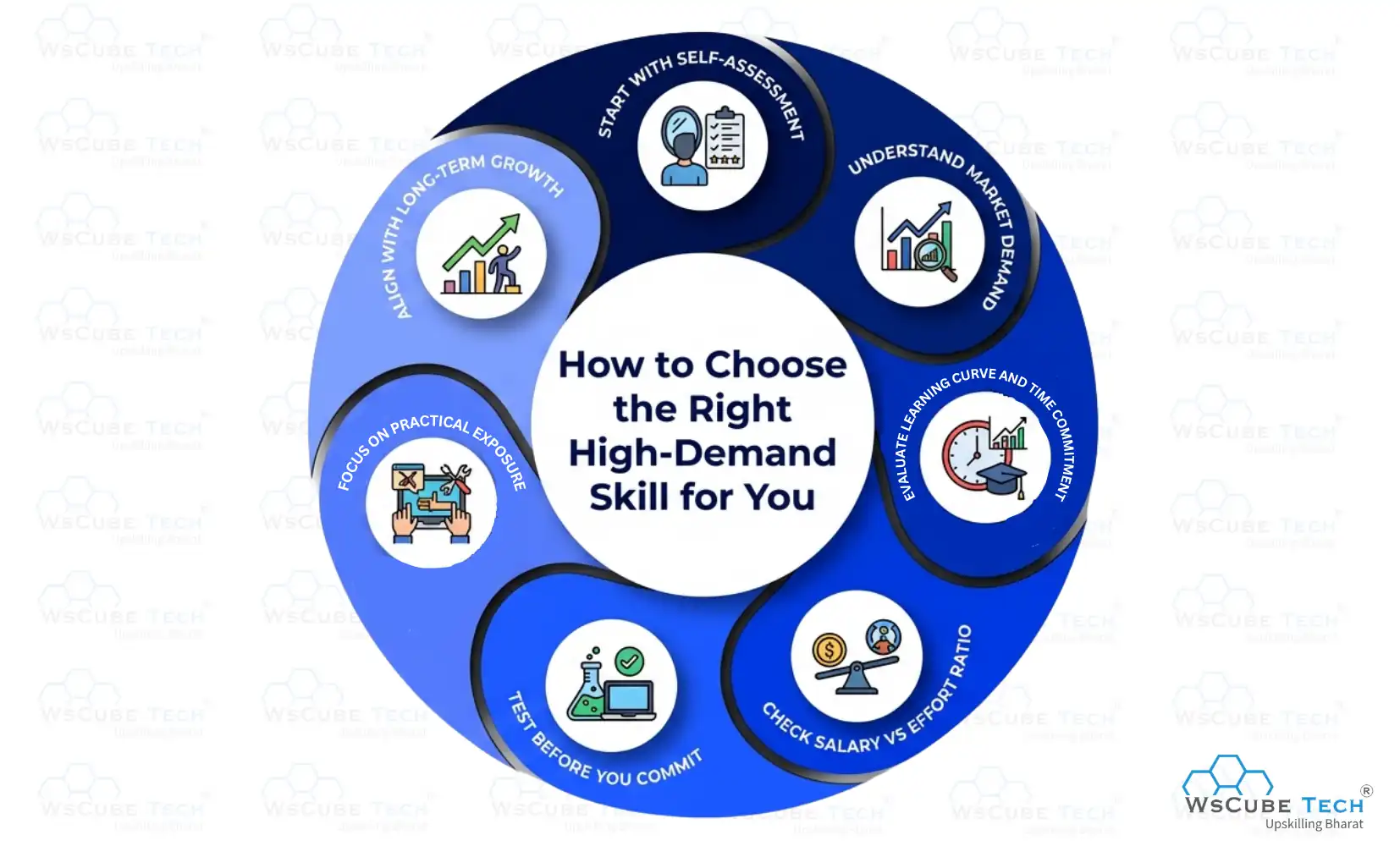
1. Start With Self-Assessment
- Identify your interests (creative, technical, analytical)
- Understand your strengths and natural abilities
- Choose a skill that feels sustainable long-term
2. Understand Market Demand (Reality Check)
- Research job portals and hiring trends
- Analyze industry growth and opportunities
- Focus on the 2026 most in-demand skills for a better career scope
3. Evaluate Learning Curve & Time Commitment
- Choose based on the available time for learning
- Understand beginner vs advanced difficulty
- Match skill complexity with your consistency level
4. Check Salary vs Effort Ratio
- Compare earning potential across skills
- Analyze time investment vs return
- Pick the best demanding skill in the future that fits your goals
5. Test Before You Commit
- Try free resources or short courses
- Build small projects to test interest
- Validate if the skill suits you practically
6. Focus on Practical Exposure
- Work on real-world projects
- Build a strong portfolio
- Practice problem-solving regularly
7. Align With Long-Term Growth
- Think beyond your first job
- Choose skills with future relevance
- Focus on the best-demanding skills in 2026 for growth
How to Upskill Effectively in High-Demand Areas
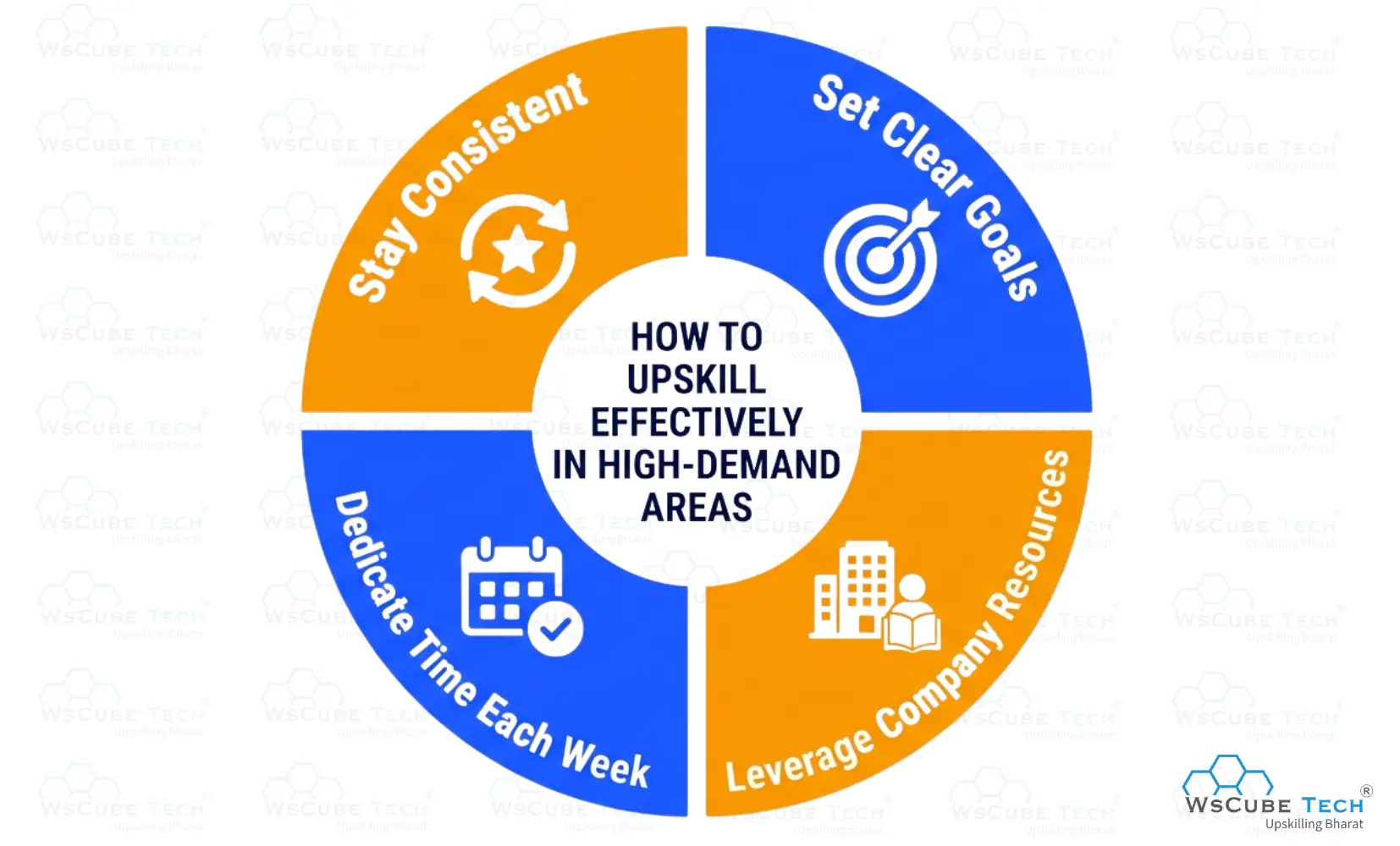
- Set clear goals: Tailor your learning to match your career aspirations. If you aim for a leadership role, focus on building skills like strategic foresight and decision-making. By aligning your upskilling with your career path, you'll stay motivated and on track.
- Leverage company resources: Many organizations offer valuable training programs or financial support for professional development. Take advantage of these opportunities—whether it's attending workshops or accessing online courses— to boost your skills without breaking the bank.
- Dedicate time each week: Set aside 2-3 hours a week for learning. Whether completing an online SQL module during your lunch break or dedicating a quiet hour after work, consistent effort will significantly impact you over time.
- Stay consistent: Consider upskilling as a long-term investment in your professional development. You can portray yourself as a forward-thinking professional prepared for new challenges by demonstrating initiative and expanding your skill set through a commitment to continual learning.'
Most Demanding Skills in Future: Video Guide
FAQs About High Demanding Skills in 2026 and the Future
By 2030, skills like AI, data analysis, cybersecurity, digital marketing, cloud computing, and communication will dominate as automation grows and businesses prioritize tech-driven, adaptable professionals.
You can learn skills like digital marketing, content writing, graphic design, data analysis, or social media management within three months with consistent practice and learning.
Remote favor skills like programming, digital marketing, content writing, UI UX design, data analysis, customer support, and project management that enable collaboration and online delivery.
High-demand skills include digital marketing, content writing, graphic design, video editing, sales, communication, SEO, and business development, offering strong career growth without programming knowledge.
Degrees matter for credibility and certain careers, but high-demand skills, experience, and portfolios increasingly outweigh formal education, especially in tech, creative, and digital fields.
The most demanding skills in the future include Data Science, Data Analytics, Business Intelligence, Web Development, Digital Marketing, Artificial Intelligence (AI), Machine Learning (ML), UX/UI Design, Cybersecurity, Programming Languages, and Cloud Computing.
Yes, many skills can be learned online using platforms that provide courses and certifications. Online learning is flexible, allowing people to learn new skills at their own speed and from the comfort of their own homes.
Soft skills ensure smooth teamwork, leadership, and adaptability. These skills help employees thrive in technology-driven workplaces and effectively manage challenges.
Professionals can sign up via online courses, certificates, and boot camps and gain practical experience through projects or internships.
The sectors most affected by these skill developments are digital marketing, e-commerce, technology, healthcare, renewable energy, and finance.
Learning skills is essential for career growth. By learning these skills, you can join different professions. You can get great opportunities in many companies by learning their high demand skills in 2026.
Collaboration, inspiring trust, and improving decision-making significantly contribute to soft career growth and leadership skills.
To effectively improve soft skills, get feedback, practice frequently, attend workshops or training sessions, and pursue lifelong learning.
Explore online courses, attend workshops, and seek advice from professionals. The best way is to start identifying your interests and then understand the demand in the job market to pick the skills that align with your passion and job requirements.
Conclusion
In 2026, users searching for “most demanding skills in future” want clear direction on what to learn, why, and how it impacts their career.
The most in-demanding skills in future include generative AI, data analytics, AI & ML, cybersecurity, cloud computing, full stack development, UX/UI, and digital marketing, all offering strong salary growth and global opportunities.
Choose one core in-demand skill aligned with your interest, build projects, and keep upgrading to stay future-ready.
Start Learning With Our Free Tutorials
| Python Tutorial | Java Tutorial | JavaScript Tutorial |
| C Tutorial | C++ Tutorial | HTML Tutorial |
| CSS Tutorial | SQL Tutorial | DSA Tutorial |
Join Our On-Campus Career Ready Courses
Explore Our Free Courses






Leave a comment
Your email address will not be published. Required fields are marked *Comments (0)
No comments yet.