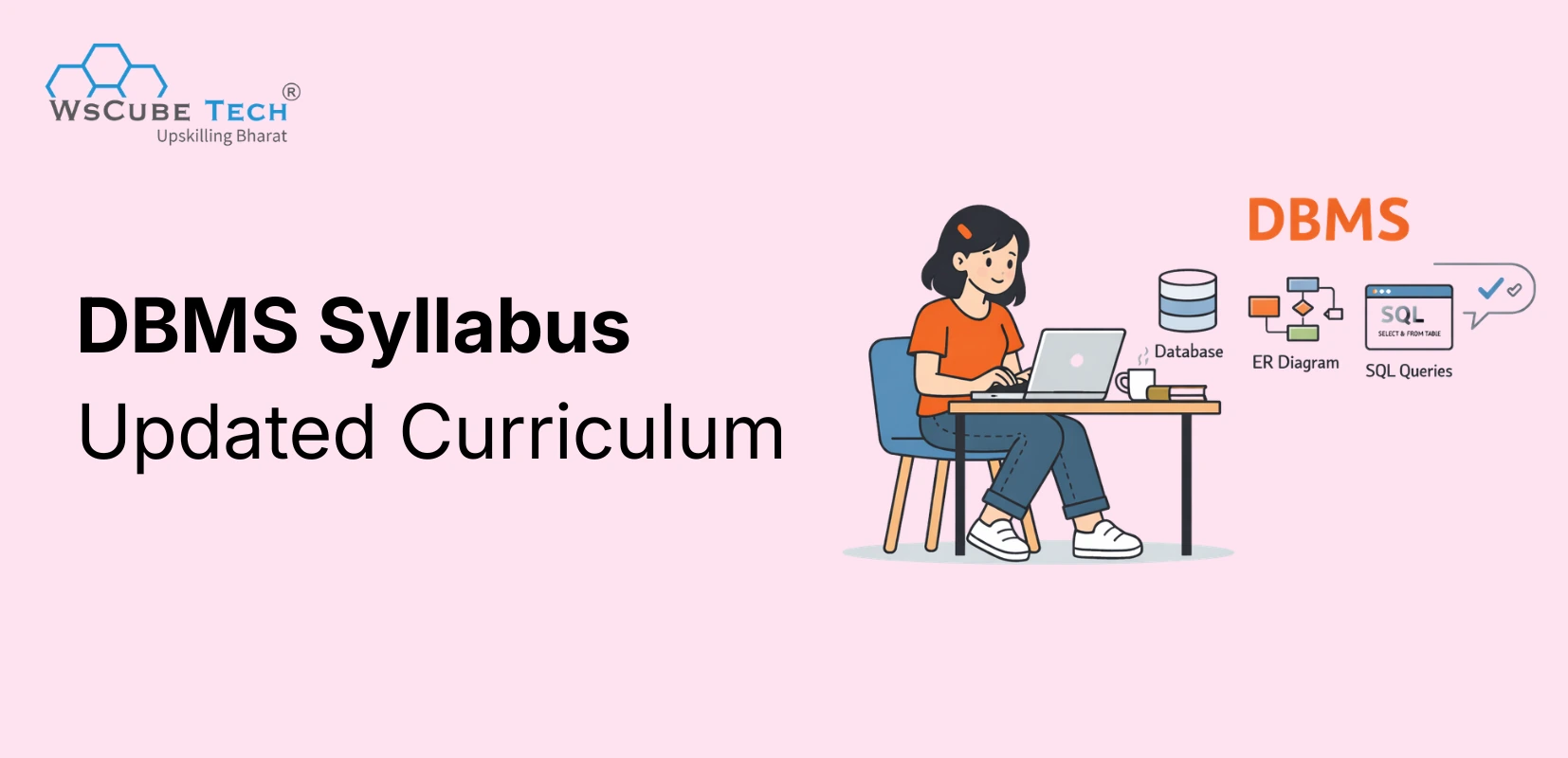
Learning Database Management Systems (DBMS) is an important step for anyone who wants to work with technology and data. Today, organizations rely heavily on databases to store customer details, financial records, product information, and much more. As digital systems continue to grow, the need for professionals who can design, manage, and secure databases is increasing across industries such as banking, healthcare, education, and e-commerce. This rising demand has created numerous career opportunities for those with strong database knowledge and practical skills.
To build expertise in this field, following a clear and structured learning path is essential. A well-designed syllabus helps you move from fundamental concepts to advanced topics in a logical order. This database management system curriculum blog guide helps you understand how databases are created, organized, and maintained, while also developing the practical skills needed to work confidently with real-world database systems.
What is DBMS?
A Database Management System (DBMS) is software that helps you store, organize, manage, and retrieve data efficiently. It acts as a bridge between users or applications and the database, making sure data is easy to access, secure, and consistent.
With a DBMS, you can:
- Store large amounts of data in an organized way
- Add, update, delete, and search data quickly
- Protect data using security and access controls
- Reduce data duplication and errors
Some common DBMS software includes MySQL, Oracle Database, PostgreSQL, Microsoft SQL Server, and SQLite.
Why Learn DBMS?
Learning DBMS helps you understand how data is stored, organized, and managed efficiently, making you job-ready for roles in software development, data management, and IT systems. Below are the key reasons to learn DBMS:
- High Industry Demand: Databases are used in almost every industry, creating strong demand for professionals with DBMS skills to manage accurate, secure, and reliable data systems.
- Strong Career Opportunities: Knowledge of DBMS opens doors to careers like database administrator, backend developer, data analyst, and software engineer. These roles offer stable growth, good salaries, and long-term career opportunities.
- Essential for Modern Applications: Websites, mobile apps, and business software all rely on databases to function properly. Learning DBMS helps you understand how applications store user information and handle large amounts of data.
- Data Security and Integrity: DBMS helps protect sensitive information using security controls and maintain data accuracy through constraints and rules, which is crucial for banking, healthcare, and enterprise systems.
- Foundation for Advanced Technologies: Understanding DBMS concepts provides a strong foundation for advanced fields such as data science, big data, artificial intelligence, and cloud computing, where efficient data management, processing, and analysis are essential.
Learning DBMS not only strengthens your understanding of data management concepts but also prepares you to design and work with reliable database systems used in real-world applications.
Recommended Professional Certificates
Full Stack Development Mentorship Program
WordPress Bootcamp
Database Management Systems Syllabus (Module Wise)
Below is the DBMS course syllabus, organized from beginner to advanced levels. It follows a clear, structured learning path that helps you build strong fundamentals and gradually move toward advanced database concepts.
Module 1: Introduction to DBMS
- Data, information, and databases
- File system vs database system
- Advantages and disadvantages of DBMS
- Characteristics of DBMS
- Applications of DBMS
- Types of databases
Module 2: Database System Architecture
- Database system environment
- Three-level architecture of DBMS
- Schema and instances
- Data independence in DBMS
- Database users and administrators
Module 3: Data Models in DBMS
- Data modeling concepts
- Hierarchical data model
- Network data model
- Relational data model
- Object-oriented data model
- Overview of semi-structured data
Module 4: Entity Relationship (ER) Model
- Entities, attributes, and entity sets
- Types of attributes
- Relationships and relationship sets
- Cardinality and participation constraints
- ER diagrams
- Mapping ER model to relational tables
Module 5: Relational Model
- Concepts of relations, tuples, and attributes
- Domains in DBMS
- Keys in DBMS (super key, candidate key, primary key, foreign key)
- Integrity constraints in DBMS
- Relational schema
Module 6: Relational Algebra and Relational Calculus
- Basic relational algebra operations
- Extended relational algebra operations
- Tuple relational calculus
- Domain relational calculus
Module 7: Structured Query Language (SQL)
- Introduction to SQL
- Data Definition Language (DDL)
- Data Manipulation Language (DML)
- Data Control Language (DCL)
- Transaction Control Language (TCL)
- Joins and subqueries
- Views and indexes
- Stored procedures and functions
- Triggers
Module 8: Database Design and Normalization
- Database design process in DBMS
- Functional dependencies
- Anomalies in databases
- Normalization concepts
- First Normal Form (1NF)
- Second Normal Form (2NF)
- Third Normal Form (3NF)
- Boyce–Codd Normal Form (BCNF)
- Denormalization
Module 9: Transaction Management
- Transactions and transaction states
- ACID properties in DBMS
- Serializability
- Schedules in DBMS
- Concurrency control problems
- Lock-based protocols
- Deadlocks and recovery
Module 10: Concurrency Control Techniques
- Locking mechanisms in DBMS
- Two-phase locking (2PL)
- Timestamp-based protocols
- Optimistic concurrency control
- Multiversion concurrency control
Module 11: Database Recovery System
- Failure Classification in DBMS
- Recovery techniques
- Log-based recovery
- Checkpointing
- Backup and restore methods
Module 12: Indexing and File Organization
- File organization techniques
- Indexing concepts in DBMS
- Types of indexes
- B-tree and B+ tree
- Hashing techniques
Module 13: Database Security
- Database security concepts
- Authorization and authentication
- Access control mechanisms
- Encryption basics
- SQL injection overview
Module 14: Distributed and Advanced Databases
- Distributed database concepts
- Client-server architecture
- Data fragmentation and replication
- NoSQL databases overview
- Cloud databases overview
Module 15: Practical DBMS and Case Studies
- SQL query practice
- Database design case studies
- Performance optimization basics
- Real-world database scenarios
After completing the full DBMS syllabus, you will be able to design efficient databases, write optimized SQL queries, manage data securely, handle transactions, and confidently work on real-world database-driven applications.
Upcoming Masterclass
Attend our live classes led by experienced and desiccated instructors of Wscube Tech.


Who Should Learn DBMS?
DBMS is an essential skill for anyone who wants to work with data, software systems, or technology-driven industries. It helps learners understand how databases are designed, managed, and secured in real-world applications.
- Students and Beginners: Students from computer science or IT backgrounds can build a strong foundation in data management. Beginners also benefit by learning how databases store, organize, and retrieve information efficiently.
- Software Developers: Developers need knowledge of DBMS to design applications that store and process data correctly. Understanding databases helps them write efficient queries and build scalable, data-driven software systems.
- Data Analysts: Data analysts rely on databases to extract, clean, and analyze large datasets. DBMS skills help them retrieve accurate information and work effectively with structured data.
- IT Professionals: System administrators and IT support professionals use DBMS knowledge to manage, monitor, and maintain organizational databases, ensuring performance, security, and reliable data access.
- Aspiring Database Administrators: Anyone aiming to become a database administrator must have a deep understanding of DBMS concepts to manage databases efficiently, handle backups, ensure data availability, maintain performance, and support secure, reliable database systems in real-world environments.
Learning DBMS opens doors to multiple career paths and provides the technical knowledge needed to work confidently with modern data systems.
Top 5 Most Popular Database Management Systems in 2026
Here are five popular database platforms that continue to see strong industry adoption and power modern, scalable, secure, and high-performance applications across sectors.
- MySQL: A popular open-source relational database widely used in web applications due to its simplicity, reliability, and strong community support.
- PostgreSQL: A powerful open-source database that keeps data accurate and secure. It works well with complex queries and is suitable for large, reliable applications.
- Oracle Database: An enterprise-level database designed for high performance, strong security, and handling very large amounts of data in big organizations.
- Microsoft SQL Server: A powerful relational database integrated with Microsoft tools and cloud services, offering business intelligence features, strong security, and enterprise-level performance.
- MongoDB: A document-oriented NoSQL database designed for flexible schema design, high scalability, rapid development, and modern web and cloud applications.
These database systems are used to build secure, scalable, and high-performance applications across many industries.
Explore More on Syllabus Blogs
| PHP Syllabus | JavaScript Syllabus |
| C++ Syllabus | SQL Syllabus |
| C Language Syllabus | Python Syllabus |
| DSA Syllabus | Java Syllabus |
| HTML Syllabus | CSS Syllabus |
DBMS Interview Question for Practice
Practicing DBMS interview questions regularly helps strengthen database knowledge and improve query-writing skills. It enhances problem-solving abilities, builds a clear understanding of how databases are used in real-world applications, and develops the confidence needed to perform well in technical interviews and database-related job assessments.
You can also explore our SQL tutorial to better understand database concepts, practice writing queries, and develop practical skills essential for real-world database applications and long-term career growth.
FAQs About DBMS Syllabus
DBMS stands for Database Management System, which helps you store, organize, and manage data efficiently. You should learn it because almost every modern application uses databases, and DBMS knowledge helps you build, manage, and secure data-driven systems confidently.
A DBMS course syllabus usually covers database concepts, data models, ER diagrams, relational models, SQL, normalization, transactions, security, and indexing. It guides you step by step so you understand both theoretical concepts and practical database management skills.
DBMS is not difficult for you if you start with basic concepts and follow a structured learning path. When you understand tables, keys, and relationships clearly, advanced topics become easier. With regular practice, you can confidently learn and apply database management concepts.
Learning DBMS helps you understand how data is stored, secured, and managed efficiently. It improves your problem-solving skills, supports software development, and prepares you for careers where handling and organizing large amounts of data is important.
You can benefit from a DBMS curriculum if you are a student, developer, data analyst, or IT professional. It helps you understand how databases work and gives you the skills needed to manage data effectively in real-world systems.
The time needed to complete a DBMS full syllabus depends on your learning pace. With consistent study and practice, you can cover core topics in two to three months and gain practical confidence through projects and exercises.
After learning DBMS, you can explore roles like database administrator, backend developer, data analyst, or software engineer. Many industries need professionals who can manage and maintain databases, giving you strong career growth opportunities.
ACID properties ensure reliable database transactions. They stand for Atomicity, Consistency, Isolation, and Durability. These rules help you maintain data accuracy and reliability, even when multiple users access or update the database at the same time.
A DBMS stores data in various forms, while an RDBMS stores data in structured tables with relationships. RDBMS follows stricter rules like keys and constraints, which help you maintain data accuracy and better manage complex data.
You can prepare for DBMS interviews by reviewing core concepts, practicing SQL queries, and understanding normalization, keys, and transactions. Solving interview questions and working on small database projects will help you build confidence and practical understanding.

Conclusion
Learning DBMS is an important step for anyone who wants to work with data and modern software systems. A well-structured DBMS syllabus helps you understand how databases are designed, managed, secured, and optimized for real-world use. From basic concepts to advanced topics, each part of the curriculum builds the knowledge needed to handle data efficiently.
With strong DBMS skills, you can pursue careers in software development, data analysis, database administration, and many other technology fields. By practicing regularly and working on real database projects, you can build confidence and become job-ready in today’s data-driven world.
Free Courses for You





Leave a comment
Your email address will not be published. Required fields are marked *Comments (0)
No comments yet.