You’ve learned the basics, HTML, CSS, JavaScript, maybe even a backend, but when it’s time to build something real, you’re stuck wondering what project will actually impress recruiters. That confusion is common and happens to almost every beginner.
Many learners rely on outdated resources or create the same basic apps as everyone else, without understanding what truly adds value to their portfolios. Because of this, your effort does not turn into real results.
You start feeling underprepared, your portfolio looks average, and you miss chances to stand out in interviews where practical skills matter the most.
The good part is that you do not need hundreds of projects, just the right ones. In this blog, you will explore the best full-stack project ideas with source code, understand what makes each project valuable, and learn how to build a portfolio that clearly shows your real-world skills.
About Full Stack Development Project
Full-stack development projects are web applications built using multiple technologies like HTML, CSS, and JavaScript, along with backend tools and databases. Developers use tools such as IDEs, version control platforms like GitHub, frameworks, and design tools to build complete applications from start to finish.
These full-stack projects are best for beginners who want to grow in web development. They help you understand both frontend and backend concepts, making it easier to build real-world applications and improve your practical skills. By working on such projects, you gain the experience needed to stand out and compete in the job market.
If you want structured learning and hands-on experience, WsCube Tech offers an online full-stack development course that helps you learn all essential technologies step by step.
Best Full Stack Projects Ideas for Beginners
Let’s explore some interesting full-stack web development project ideas for beginners that help create a standout portfolio:
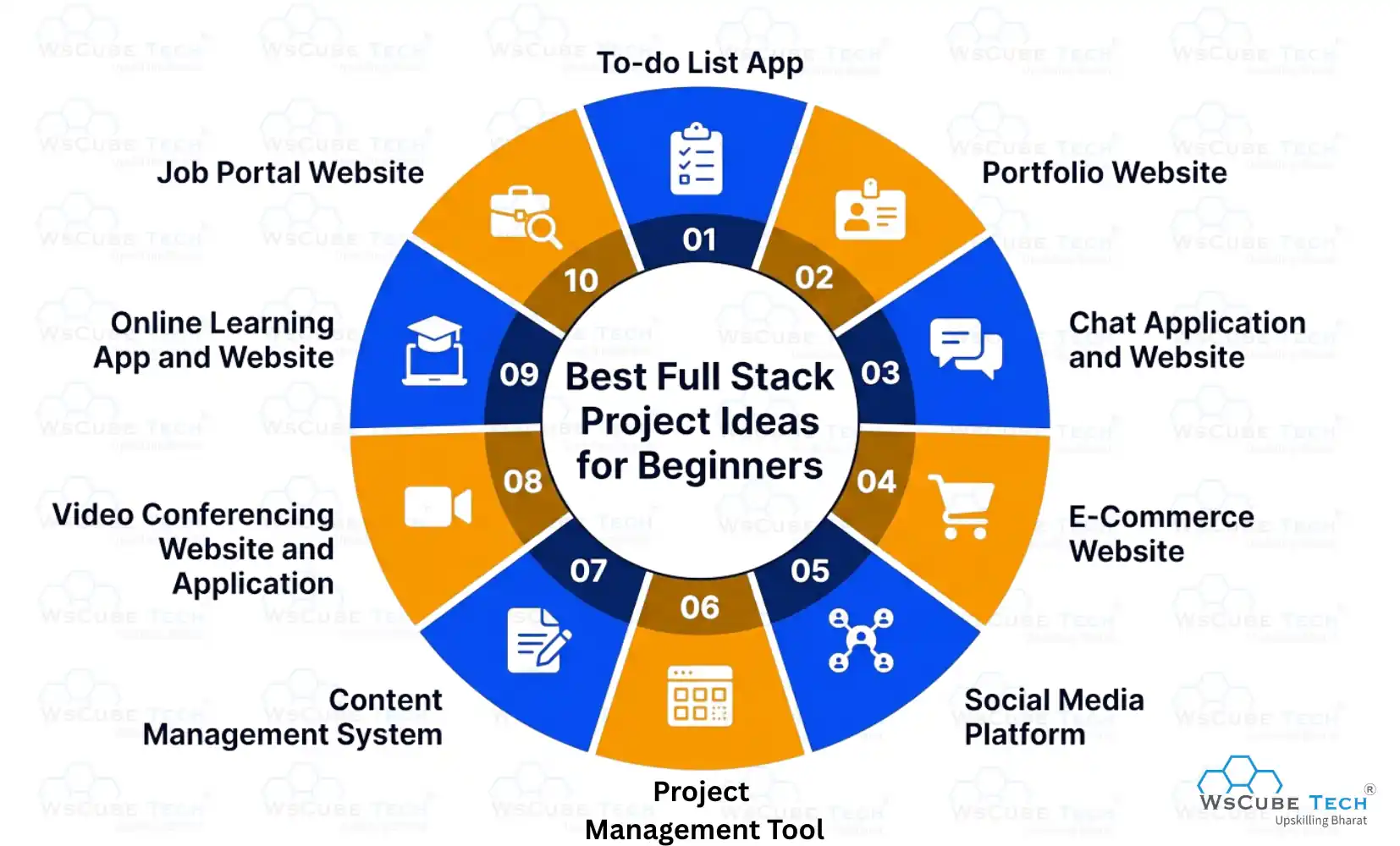
1. To-do List App
An excellent project for freshers, mainly because of its simplicity in full-stack development. However, it is still advanced enough to help you build a deeper understanding of how frontend and backend technologies work together.
Fundamental Skills: HTML, CSS, JavaScript, REST APIs, Express.js, Node.js, and MongoDB
Possible Features:
- Add new tasks to the list
- Delete tasks after completion
- Mark tasks as completed (checkbox feature)
- Edit/update existing tasks
- Store tasks in a database (persistent storage)
- User authentication (login/signup) for personalized lists
Examples: Google Tasks, Microsoft To-Do List, etc.
The primary functions of a to-do list app are to display tasks, allow users to add new tasks, and remove tasks once they are completed. Advanced versions can also include filters, due dates, and reminders for better task management.
Source Code: To-Do List - GitHub
2. Portfolio Website
Creating a portfolio website is another excellent full-stack development project idea. It helps you showcase your skills, projects, and achievements in a professional way, making it easier for employers to evaluate your profile.
Fundamental Skills: HTML, CSS, JavaScript, database management systems, server handling, and basic UI/UX design principles
Possible Features:
- Add personal information (education, background, interests)
- Showcase projects with descriptions and links
- Display skills and achievements
- Contact form for communication
- Responsive design for mobile and desktop
- Downloadable resume/CV section
Example: Yasio, Square Me, etc.
Required Framework Knowledge:
- Back-end frameworks like Django or Node.js for dynamic functionality
- Front-end technologies like HTML, CSS, and JavaScript
Build a clean, visually appealing, and responsive interface that highlights your work and ensures smooth navigation. Use secure contact forms for user interaction and consider adding a content management system (CMS) to easily update your portfolio. Regular updates and improvements based on industry trends will keep your portfolio relevant and impactful.
Source Code: Portfolio Website
3. Chat Application and Website
Chat applications have become an essential part of daily communication, as people use them to connect with friends, family, and colleagues. Building a chat app is one of the best full-stack web development project ideas, especially for final-year students, as it involves real-time communication and advanced backend concepts.
Fundamental Skills: HTML, CSS, JavaScript, real-time communication (WebSockets), Node.js, Express.js, and database management (MongoDB/Firebase)
Possible Features:
- User registration and login system
- One-on-one and group chat functionality
- Media file sharing (images, videos, documents)
- Real-time messaging using WebSockets (Socket.io)
- Message notifications and alerts
- End-to-end encryption for secure communication
- Online/offline user status and typing indicators
Examples: WhatsApp, Telegram, etc.
A chat application mainly allows users to send and receive messages instantly, either privately or in groups. Advanced versions can include voice/video calling, message reactions, and cloud-based message storage.
Source Code: Chat Application and Website
Recommended Professional Certificates
Full Stack Development Course with AI Engineering
WordPress Bootcamp
4. E-Commerce Website
Another strong full-stack development project idea is building an online e-commerce application or website. E-commerce platforms require almost every aspect of full-stack development, including frontend, backend, database management, and user authentication. Working on this project can significantly improve your practical skills and prepare you for real-world applications.
Fundamental Skills to Acquire: HTML, CSS, JavaScript, database management (SQL/NoSQL), API integration, Node.js, and Express.js
Possible Features:
- Product listing with categories and filters
- Search functionality for products
- Add to cart and remove from cart
- Secure user authentication (login/signup)
- Order placement and order history
- Online payment integration (Razorpay/Stripe)
- Admin panel for managing products and users
Examples: Flipkart, Amazon, etc.
Required Framework Knowledge:
- Front-end development using HTML, CSS, and JavaScript
- Back-end development using Node.js
Building this project gives you hands-on experience with real-world technologies and helps you understand how large-scale applications work. It also strengthens your portfolio and increases your chances of getting hired by top companies.
Source Code: E-Commerce Website
5. Social Media Platform
Another simple yet entertaining full-stack development project is building a social media platform. Databases are used for effective data storage and retrieval, and real-time systems are implemented for updates and notifications. Proper testing and iteration ensure a smooth user experience before deployment.
Fundamental Skills: HTML, CSS, JavaScript, front-end frameworks like React or Angular, Node.js, REST APIs, and database management (MongoDB/SQL)
Possible Features:
- User profile creation and customization
- Upload and manage profile pictures
- Add and connect with friends/follow users
- News feed or timeline for posts and updates
- Like, comment, and share functionality
- Secure user authentication (login/signup)
- Real-time notifications and alerts
- Messaging or chat system between users
- Media sharing (images, videos, posts)
- Privacy settings and account control options
Examples: Facebook, Instagram, Threads, etc.
Since social media is one of the most widely used platforms, building such an application helps you understand its core features and functionality.
Source Code: Social Media Platform
6. Project Management Tool
This is one of the most challenging full-stack project ideas, so be prepared to handle a significant amount of both front-end and back-end development. It involves complex features like task management, collaboration, and real-time updates, making it ideal for advanced developers.
Fundamental Skills: HTML, CSS, JavaScript, frontend frameworks (React/Angular), Node.js, REST APIs, database management (MongoDB/SQL), and real-time communication (WebSockets)
Possible Features:
- Create and manage projects and tasks
- Assign tasks to team members
- Set deadlines and track progress
- Comment and collaborate on tasks
- Real-time notifications and updates
- Kanban boards or task status tracking (To-Do, In Progress, Done)
- User roles and permissions (admin, member, viewer)
- File sharing and document attachments
Required Framework Knowledge:
- Front-end technologies that support interactive dashboards and reports (e.g., React, Angular)
- Back-end technologies for data handling, API integration, and scalability (e.g., Node.js, Django)
The project structure should resemble a social platform where users can collaborate, communicate, and manage work efficiently. It helps you understand how real-world project management tools operate.
Source Code: Project Management Tool
Upcoming Masterclass
Attend our live classes led by experienced and desiccated instructors of Wscube Tech.



7. Content Management System
A content management system (CMS) helps users create, manage, and organize digital content efficiently. This project is more complex and best suited for developers with some experience, as it involves role-based access, content workflows, and security implementation.
Fundamental Skills: HTML, CSS, JavaScript, front-end frameworks (React/Angular), Node.js, REST APIs, and database management (MongoDB/SQL)
Possible Features:
- Create, edit, and delete content (blogs/pages)
- Rich text editor for formatting content
- Role-based access (admin, editor, user)
- Media management (images, videos, files)
- Content scheduling and publishing
- SEO-friendly URLs and metadata
- Performance analytics for content
- Secure authentication and authorization
- Drag-and-drop page builder functionality
- Version control for content updates
Examples: WordPress, Joomla
This project allows you to build a dynamic platform where users can easily add text, images, videos, and other elements to create and manage websites or blogs without deep technical knowledge.
Source Code: Content Management System
8. Video Conferencing Website and Application
As an advanced project, building a video conferencing website or application helps you gain experience with real-time communication, media streaming, and secure data handling. It involves multiple technologies and gives you practical exposure to modern tools and frameworks used in real-world applications.
Fundamental Skills: HTML, CSS, JavaScript, real-time communication (WebRTC), Node.js, WebSockets, API integration, and database management (MongoDB/SQL)
Possible Features:
- One-on-one and group video calling
- Screen sharing functionality
- File sharing during meetings
- Interactive whiteboard for drawing/writing
- Real-time chat during video calls
- Secure user authentication (login/signup)
- End-to-end encryption for privacy
- Video/audio controls (mute, camera on/off)
- Meeting scheduling and joining via links
- Recording and saving meetings
Examples: Zoom, Google Meet, Microsoft Teams
This project helps you understand how large-scale communication platforms work and gives hands-on experience with media handling, networking, and performance optimization.
Source Code: Video Conferencing Website and Application
9. Online Learning App/ Website
Building an online learning application is another excellent full-stack development project idea. It allows you to create a platform where users can enroll in courses, access learning materials, and interact with instructors, helping you build a strong and practical portfolio.
Fundamental Skills: HTML, CSS, JavaScript, frontend frameworks (React/Angular), Node.js, REST APIs, database management (MongoDB/SQL), and authentication systems
Possible Features:
- User registration and login system
- Course listing and enrollment functionality
- Video lectures and downloadable resources
- Progress tracking for courses
- Instructor dashboard for managing content
- Student–instructor interaction (comments/discussion)
- Secure payment integration for paid courses
- Quiz and assignment modules
- Certificates on course completion
- Search and filter courses by category
Examples: Udemy, Coursera, etc.
Required Framework Knowledge:
- Frontend development using HTML, CSS, and JavaScript for user interaction and course management
- Backend development using Node.js or similar frameworks
- Integration of secure authentication and payment gateways
Completing this project helps you understand how large-scale learning platforms work and strengthens your ability to build complex, real-world applications.
Source Code: Online Learning App/ Website
Explore More Guides Related to Full Stack Development
10. Job Portal Website
Building a job portal website is another powerful full-stack development project idea. It allows users to search for jobs, apply for positions, and manage applications, while organizations can post job listings and manage candidates. This project helps you understand real-world business logic and user workflows.
Fundamental Skills: HTML, CSS, JavaScript, frontend frameworks (React/Angular), Node.js, REST APIs, and database management (MongoDB/SQL)
Possible Features:
- User registration and login (job seekers and recruiters)
- Job search with filters (location, role, salary)
- Apply for jobs and track application status
- Resume upload and profile creation
- Job posting and management by recruiters
- Email notifications for job updates
- Saved jobs and bookmark feature
- Admin panel for managing users and listings
Examples: LinkedIn, Naukri.com, etc.
Building this project helps you understand how recruitment platforms work and improves your ability to design scalable and user-focused applications.
Source Code: Job Portal Website
Skills Required for Full Stack Development Projects
To be a successful full-stack developer, you must have a robust front-end and back-end development foundation. Here are some essential skills required for full-stack development projects:
- Proficiency in front-end languages and frameworks: HTML, CSS, JavaScript, React, Angular, and Vue.js.
- Familiarity with back-end frameworks: Node.js, Django, and Ruby on Rails.
- Experience with databases: MySQL, MongoDB, and PostgreSQL.
- Understanding server-side languages: JavaScript (NodeJS), Python, PHP, and Ruby.
- Knowledge of web servers: Apache and Nginx.
- Familiarity with version control systems like Git.
- Knowledge of web security and leading practices for secure coding.
- A firm grasp of DevOps tools and processes for deployment and automation.
- Strong problem-solving and critical-thinking skills.
These skills provide a strong foundation for any full-stack development project. To get clear insights about the career in full-stack development, read our blog on Is Full-Stack Developer a Good Career?
Explore Our Web Development Related Courses
Tips For Effective Full Stack Project Implementation
Below are a few effective tips to follow while implementing a full-stack web development project. You can also align these steps with a full stack developer roadmap to stay structured and goal-oriented:
- Define the scope of your project.
- List the resources required as per project requirements.
- Figure out full-stack frameworks, database tools, and in-demand full-stack languages for the project.
- Work on full-stack project planning.
- Follow the plan for effective execution.
- Work on the front-end part first; it will tell you how the back-end code should be written.
- Follow the back-end process according to the front-end part.
- Use necessary tools and frameworks for autoconfiguration.
- Use effective testing tools to identify flaws.
- Track your progress and create checkpoints to test and move forward with your project.
- Confirm the final testing of your project and make it available on open-source platforms.
FAQs on Full Stack Projects
Full stack development projects are applications where developers work on both frontend and backend. This includes designing user interfaces, handling servers, managing databases, and integrating APIs to build complete, functional web applications.
Beginners can start with simple projects like a to-do list app, portfolio website, blog platform, or basic e-commerce site. These projects help in understanding core concepts of frontend, backend, and database integration.
Choose a project based on your current knowledge. Beginners should start small, while advanced learners can build complex apps like chat systems or e-commerce platforms. Gradually increase difficulty as your skills improve.
Final-year students can build advanced projects like chat applications, job portals, social media platforms, or project management tools. These projects demonstrate real-world skills and improve chances of selection during placements.
Yes, full-stack projects are very important because they show your practical skills. Recruiters prefer candidates with hands-on experience who can build real applications rather than only having theoretical knowledge.
You should include at least 3 to 5 high-quality full stack projects in your portfolio. Focus on quality over quantity, showcasing different skills like authentication, APIs, and database handling in your projects.
Full-stack projects typically require HTML, CSS, JavaScript for frontend, backend technologies like Node.js, and databases such as MongoDB or SQL for data management and storage.
Yes, beginners can build full stack projects by starting with simple tutorials and gradually practicing. With consistent learning and hands-on coding, you can develop functional projects even without prior professional experience.
Advanced project ideas include e-commerce platforms, social media apps, video conferencing systems, learning management systems, and project management tools. These involve real-time features, authentication, APIs, and complex backend logic.
The time depends on project complexity and your experience level. A simple project may take a few days, while advanced applications like e-commerce or chat apps can take several weeks or months.
You can find full stack project source code on platforms like GitHub, coding websites, and online tutorials. These resources help you understand project structure and implementation effectively.
Yes, full-stack development requires knowledge of both frontend and backend. You should understand user interface design as well as server-side logic, database handling, and API integration to build complete applications.
You can deploy full stack projects using platforms like Vercel, Netlify, or cloud services. Backend can be hosted separately, and databases can be managed using cloud providers.
Common challenges include debugging errors, handling authentication, managing databases, integrating APIs, and ensuring performance. Developers also face issues in deployment and scaling, which improve with practice and real-world experience.
You can host full stack projects using services like Heroku, Render, or AWS. Proper configuration of backend, frontend, and database is required for smooth deployment.
Conclusion
There's a wealth of full-stack web development projects readily available for students and advanced professional developers. These projects come with their source codes, making them accessible tools to learn and acquire additional skills during your tenure.
Full-stack jobs are experiencing a huge demand as they work on both sides of an application to deliver effective solutions faster. For this reason, full-stack is an ideal domain for students seeking a flourishing career. As every journey starts with working on the basics, beginners must work on the essential parts of the full-stack development technology to build effective software and web applications.
Join Our On-Campus Web Development Courses
Start Learning With Our Free Tutorials
| Python Tutorial | Java Tutorial | JavaScript Tutorial |
| C Tutorial | C++ Tutorial | HTML Tutorial |
| CSS Tutorial | SQL Tutorial | DSA Tutorial |
Free Courses for You



Leave a comment
Your email address will not be published. Required fields are marked *Comments (0)
No comments yet.