
Search is no longer limited to Google. Today, people discover information through AI chatbots, YouTube, social media, online communities, and traditional search engines. This shift has made search everywhere optimization a essential digital marketing strategy for brands that want to stay visible wherever their audience searches.
In this search everywhere optimization guide, you'll learn what it is, why it matters, how it differs from traditional SEO, and the key strategies to build a strong presence across multiple search platforms.
What is Search Everywhere Optimization?
So, what is search everywhere optimization? In simple words, it is the practice of making your brand, content, and website easy to find on every platform where your audience searches for information, products, or answers, not just on Google.
Traditional SEO focuses on ranking web pages on search engines like Google and Bing. Search everywhere optimization takes that same goal, being found when someone searches, and applies it to every place searching now happens.
That includes AI chatbots like ChatGPT, video platforms like YouTube, social apps like Instagram and TikTok, online marketplaces like Amazon, community platforms like Reddit and Quora, app stores, and voice assistants like Alexa and Siri.
Think of it this way. If someone wants to learn what is digital marketing, they might not type that exact phrase into Google anymore. They might ask ChatGPT to explain it in simple terms, search YouTube for a beginner video, or scroll Instagram reels for quick tips. Search everywhere optimization means your brand shows up no matter which of these paths the person takes.
This shift did not happen overnight. It grew out of three big changes in how people search:
- AI tools now answer questions directly, so people often get their answer before clicking any website.
- Younger audiences research through videos, social feeds, and community discussions instead of typed search queries.
- Every platform, from Amazon to app stores, has its own internal search engine, and each one now carries real search volume.
Search everywhere optimization does not mean showing up on every single platform available. It means understanding where your specific audience actually searches, and building visibility there with the same care you would give to Google rankings.
Why Search Everywhere Optimization Matters
Some content creators still treat Google as the only channel worth optimizing. The numbers tell a different story.
Google AI Overviews now show up on roughly 65% of informational search queries, which means fewer people click through to websites and more people get their answer directly on the results page.
At the same time, ChatGPT has grown to more than 900 million weekly active users, and Perplexity now processes hundreds of millions of queries every month, showing that AI chat platforms have become a genuine search destination, not a niche tool. You can read more about this shift in our detailed piece on AI for SEO.
Consumer search behavior has changed dramatically. People no longer rely only on Google. Many users now discover products through social media, AI chatbots, YouTube, and online communities before visiting a traditional search engine. This shift makes search everywhere optimization essential for brands that want to stay visible across every stage of the customer journey.
Instead of focusing on a single platform, search everywhere optimization helps businesses create a unified content strategy that improves visibility across search engines, AI platforms, social media, video platforms, and community forums. By appearing consistently wherever users search, brands build greater trust, reach wider audiences, and gain a competitive advantage.
Recommended Professional Certificates
AI-Powered Digital Marketing Course
Performance Marketing Bootcamp
SEO Specialist Bootcamp
Search Everywhere Optimization vs. Traditional SEO
Traditional SEO and search everywhere optimization are closely related, but they are not the same thing. One focuses on a single destination. The other treats the entire internet as the destination.
| Aspect | Traditional SEO | Search Everywhere Optimization |
| Main focus | Ranking web pages on Google and Bing | Visibility across every platform your audience searches |
| Core goal | Higher rankings and organic clicks | Being discovered and trusted wherever people search |
| Platforms covered | Search engines only | Search engines, AI chatbots, social apps, video platforms, marketplaces, forums, app stores, voice assistants |
| Content format | Blog posts and web pages | Blogs, videos, social posts, product listings, forum answers, app metadata |
| Success measured by | Keyword rankings, organic traffic | Rankings, AI citations, video views, social reach, app installs, brand mentions |
| Audience behavior | Typing keywords into a search bar | Typing, asking, scrolling, and watching across many apps |
| Long-term approach | Optimize one website | Build a connected brand presence everywhere |
The key point here is that search everywhere optimization does not throw traditional SEO away. It builds on it. Your website, technical SEO, and keyword strategy remain the foundation. What changes is the scope. Instead of asking "how do I rank on Google," you start asking "everywhere my audience searches, how do I show up there too."
The Core Pillars of Search Everywhere Optimization
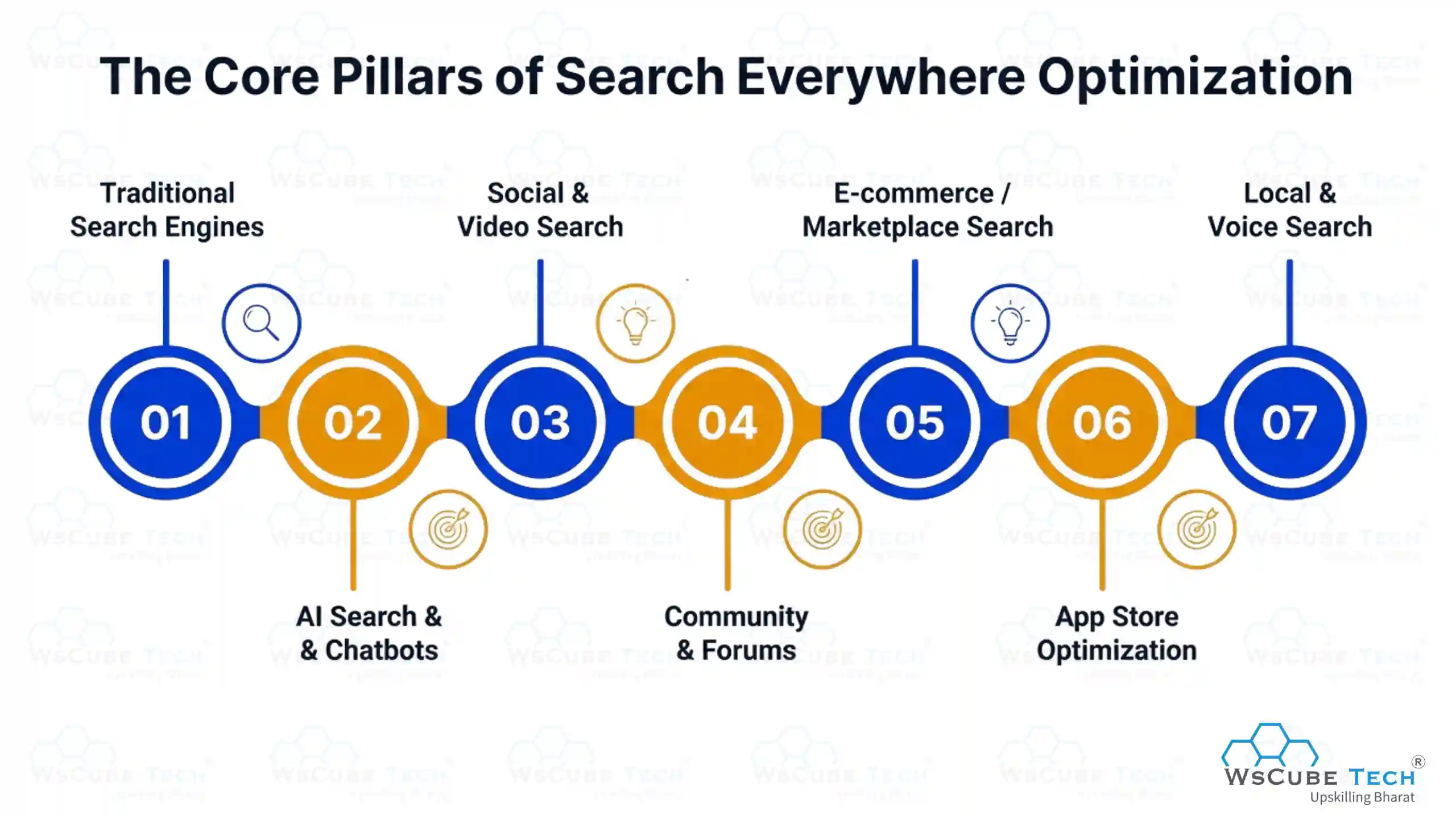
To build a working strategy, it helps to break search everywhere optimization down into its main platforms. Most marketers now recognize seven core areas. None of these pillars work in isolation.
A shopper might discover a product through a short video, check its reviews on a marketplace, ask an AI assistant to compare it with alternatives, and finally search Google for the brand name before buying. Understanding each pillar individually helps you build the right content for each stop along that journey.
1. Traditional Search Engines (Google, Bing)
Google and Bing remain the starting point for search everywhere optimization, even in a world full of AI tools and social apps. Google alone still processes billions of searches every single day, and organic search continues to drive over half of all website traffic.
This means the fundamentals of SEO, such as keyword research, quality content, backlinks, and page speed, are still non-negotiable. What has changed is what happens after someone searches. AI Overviews now appear at the top of many results, summarizing the answer before a user scrolls further.
This means your content needs to do two jobs at once: rank well in traditional blue links, and also be structured clearly enough for Google's AI systems to pull from it and cite it. Clear headings, direct answers, and well-organized facts help with both.
2. AI Search & Chatbots (ChatGPT, Gemini, Perplexity, AI Overviews)
AI chat platforms have moved from a novelty to a mainstream search habit. ChatGPT now has hundreds of millions of weekly users asking it for research, comparisons, and recommendations, and Perplexity has built a loyal audience of users who want fast, cited answers instead of a page of links.
To be visible here, your content needs to be written in a way that AI models can easily extract and trust. That means clear, direct answers near the top of a section, accurate facts backed by credible sources, and consistent information about your brand across the web.
AI systems tend to favor content that answers a question plainly, rather than content that buries the answer under long introductions. This is one of the biggest reasons brands are investing in AI for SEO practices right now, since being cited inside an AI answer is quickly becoming as valuable as ranking first on Google.
3. Social & Video Search (YouTube, TikTok, Instagram, Pinterest)
For many topics, especially tutorials and product reviews, social and video platforms now carry more search volume than traditional search engines. A simple example makes this clear: a common how-to query like fixing a leaky sink faucet gets roughly 15 times more searches on YouTube than it does across traditional search globally.
That single fact shows how much search behavior has shifted toward video for practical, hands-on topics. To win here, your content needs to speak the platform's language. On YouTube, that means clear titles, spoken keywords in the video itself, and helpful descriptions. On Instagram and TikTok, keywords in captions and on-screen text help the algorithm understand and surface your content to the right audience.
On Pinterest, strong visual descriptions and keyword-rich pins drive long-term discovery. A smart tactic that works across all of these platforms is repurposing: turn a blog post into a short video, and embed that same video back into the blog post, so both formats reinforce each other.
4. Community & Forums (Reddit, Quora)
Community platforms like Reddit and Quora have become trusted research stops, especially for people who want honest opinions rather than polished marketing copy. AI systems have also started pulling answers from these platforms more often, since they represent real user experiences rather than brand messaging.
Showing up here is less about publishing ads and more about genuine participation. Answering questions helpfully, sharing real experience, and linking back to useful resources when relevant builds authority naturally. Brands that only show up in these spaces to promote themselves tend to get called out quickly, so the better approach is consistent, honest value.
5. E-commerce/Marketplace Search (Amazon, Flipkart)
If you sell products, marketplace search matters just as much as Google search. Platforms like Amazon and Flipkart have their own internal search engines, complete with their own ranking factors such as product titles, bullet points, reviews, and sales velocity.
Optimizing here means treating your product listing the same way you would treat a landing page. Use the exact terms your customers search for in the title and description, keep your reviews strong, and make sure your images and details answer the buyer's questions before they even reach out. Since a large share of online shoppers start their product research directly inside these marketplaces, ranking well there directly affects sales.
6. App Store Optimization (ASO)
For any brand with a mobile app, app store search is its own search everywhere optimization channel. Search drives the majority of app discovery, with app store search responsible for roughly 60 to 70% of all downloads on both the Apple App Store and Google Play.
In other words, if your app is not optimized for search inside these stores, a large share of potential users will never find it, no matter how good the app itself is. App Store Optimization, or ASO, works much like SEO.
It combines keyword-rich titles and descriptions with strong visuals like icons, screenshots, and preview videos, along with ratings and reviews that build trust. Apps with higher ratings consistently rank better and convert more views into installs, which makes review management just as important as keyword placement.
7. Local & Voice Search (Google Business Profile, Alexa, Siri)
Local and voice search have become deeply connected. Nearly half of all Google searches now carry local intent, and people who search for something nearby are highly likely to visit that business within a day.
A complete, well-managed Local SEO presence, especially through your Google Business Profile, has become one of the highest-return, lowest-cost marketing assets available to any local business. Voice search adds another layer on top of this.
More than a billion voice searches happen every month, and around three-quarters of them carry local intent, things like "best coffee shop near me" or "is this store open now." Since voice assistants like Alexa and Siri typically read out only one answer, ranking in position one, or being the source that assistant pulls from, matters far more than it does in traditional search.
Keeping your business hours, address, and services updated, along with using clear, conversational language in your content, helps you capture this growing slice of search traffic.
Upcoming Masterclass
Attend our live classes led by experienced and desiccated instructors of Wscube Tech.



How to Implement Your Search Everywhere Optimization Strategy
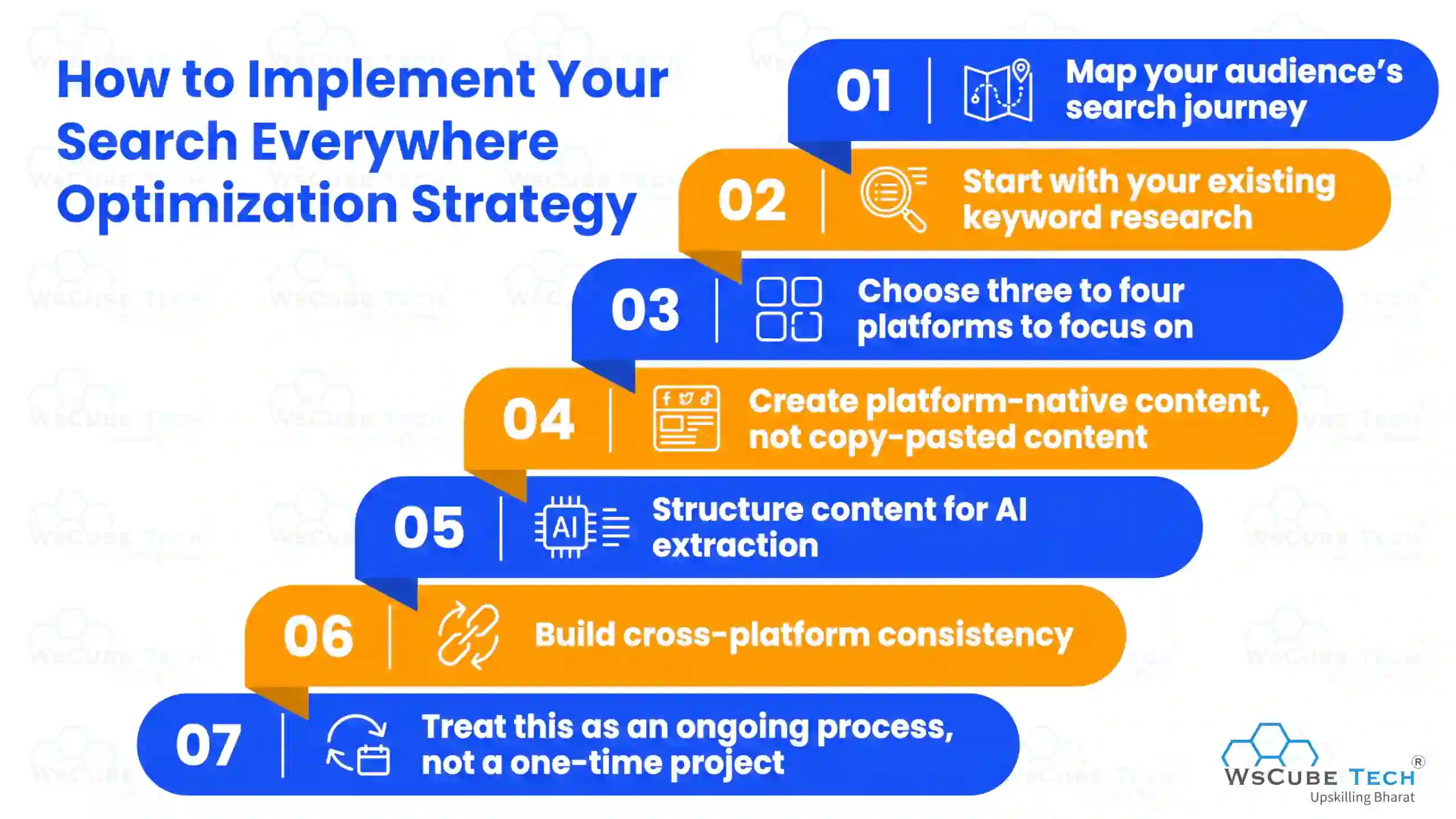
Building a working search everywhere optimization strategy does not mean trying to be present on every platform at once. It means being deliberate about where your specific audience searches, and showing up there with real value. Here is a practical, step-by-step approach.
Step 1: Map your audience's search journey
Before picking platforms, understand where your audience actually goes when they have a question or a problem. Do they ask ChatGPT? Watch YouTube? Scroll Instagram? Talk to Alexa? This research should come from real customer behavior, not assumptions based on trends.
Step 2: Start with your existing keyword research
Your current SEO keyword list is not wasted; it is your starting point. Take the keywords you already rank for or want to rank for, and expand them into what is often called an intent pillar, meaning the full conversation behind that keyword, not just the exact phrase.
Step 3: Choose three to four platforms to focus on
Trying to be active everywhere spreads your resources too thin and rarely builds real authority anywhere. Mid-market brands that focus on a handful of high-intent platforms tend to build stronger brand recall than those that spread their budget across too many channels. Pick the platforms where your audience already spends time and where you can realistically create consistent, quality content.
Step 4: Create platform-native content, not copy-pasted content
A blog post is not a YouTube script, and a YouTube script is not an Instagram caption. Each platform rewards content built specifically for how people use it. Repurpose your core ideas across formats, but adapt the structure, tone, and length to fit each platform's expectations.
Step 5: Structure content for AI extraction
Whether it is for Google AI Overviews or ChatGPT, structure your content with clear headings, direct answers near the top of each section, and factual accuracy backed by credible sources. This single habit improves your chances of being cited across almost every AI-driven search surface at once.
Step 6: Build cross-platform consistency
Keep your brand name, messaging, and key facts consistent across your website, social profiles, marketplace listings, and app store pages. AI systems and human searchers both trust brands that present the same clear story everywhere they appear.
Step 7: Treat this as an ongoing process, not a one-time project
Search everywhere optimization is not a checklist you complete once. Platforms update their algorithms constantly, competitors adjust their strategies, and new search surfaces keep emerging. Building a habit of regular review and adjustment keeps your visibility strong over time.
For example, a digital marketing institute's audience may search Google for course comparisons, watch YouTube tutorials, ask AI tools for recommendations, and check reviews before enrolling. A strong search everywhere optimization strategy ensures the institute maintains a consistent presence across these key platforms, helping it reach potential students wherever they begin their search.
Read More Marketing Guides
How to Measure Search Everywhere Optimization Success
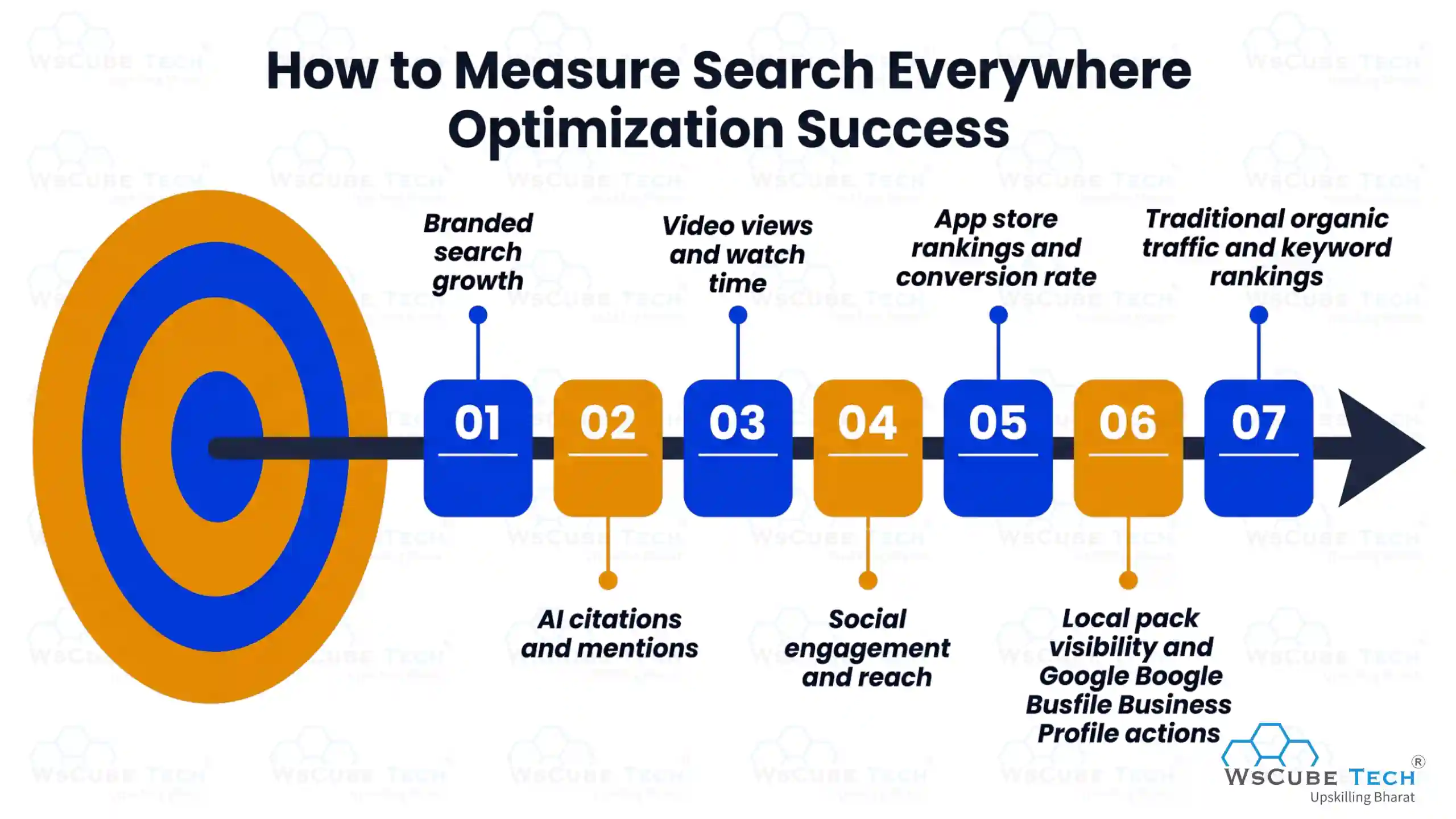
Since search everywhere optimization spans so many platforms, measuring success requires looking beyond a single metric like Google rankings. Here are the key indicators worth tracking.
1. Branded search growth
As your visibility grows across platforms, more people search for your brand name directly. This is one of the clearest signs that your presence is building real awareness, even when it is hard to trace back to a single channel.
2. AI citations and mentions
Track whether your brand or content gets referenced inside AI Overviews, ChatGPT answers, or Perplexity responses. Some tools now help monitor this, and manual spot-checks with common industry questions work too.
3. Video views and watch time
For YouTube and other video platforms, watch time and completion rates matter more than raw view counts, since they signal that your content actually answers the viewer's question.
4. Social engagement and reach
Likes, shares, saves, and comments on Instagram, TikTok, and Pinterest indicate whether your content is resonating enough to be surfaced by each platform's algorithm.
5. App store rankings and conversion rate
For apps, track keyword rankings alongside your tap-through-to-install rate, since ranking well and converting views into downloads are two separate but equally important goals.
6. Local pack visibility and Google Business Profile actions
Track how often your business appears in local search results, along with actions like calls, direction requests, and website clicks generated directly from your profile.
7. Traditional organic traffic and keyword rankings
Even with all these new channels, your core website traffic and keyword rankings remain a foundational metric, since your website is usually where conversions ultimately happen.
The most important mindset shift here is patience. Attribution across this many channels will never be perfectly clean. Instead of chasing one clean number, look at the overall trend across these metrics together to understand whether your visibility is genuinely growing.
Explore Our Most Popular Marketing Courses
Common Search Everywhere Optimization Mistakes to Avoid
Even well-intentioned teams make avoidable mistakes when adopting search everywhere optimization. Most of these mistakes come from treating this as a trend to chase quickly, rather than a long-term shift in how content and brand visibility need to work. Watch out for these common pitfalls.
- Trying to be everywhere at once: Spreading your team across ten platforms with weak effort on each one is worse than focusing deeply on three or four platforms where your audience actually spends time.
- Copy-pasting content across platforms: Posting the exact same text on Instagram, LinkedIn, and your blog rarely performs well anywhere, since each platform has its own content style and algorithm expectations.
- Ignoring traditional SEO fundamentals: Some teams get so excited about AI search and social platforms that they neglect basic technical SEO, site speed, and keyword research. Search everywhere optimization builds on strong SEO, it does not replace it.
- Treating channels as separate silos: When your SEO team, social team, and app team work in isolation, your brand message becomes inconsistent, and inconsistency hurts trust with both users and AI systems.
- Skipping audience research: Choosing platforms because they are trending, rather than because your specific audience actually uses them, leads to wasted effort and content that never finds its audience.
- Not updating profiles and listings regularly: Whether it is your Google Business Profile, app store listing, or marketplace product page, outdated information directly hurts your rankings and your customer's trust.
- Expecting instant results: Building visibility across multiple search surfaces takes time. Brands that stay consistent for months, rather than expecting overnight wins, are the ones who end up ahead of competitors who give up too soon.

FAQs about Search Everywhere Optimization
It is the practice of making your brand easy to find wherever your audience searches, not just on Google, but also on AI chatbots, YouTube, social apps, marketplaces, forums, app stores, and voice assistants.
No, but they are closely connected. Traditional SEO focuses on ranking web pages on search engines. Search everywhere optimization expands that same goal across every platform where search happens.
Because search behavior has changed. AI Overviews now answer many questions directly on the results page, AI chatbots have hundreds of millions of weekly users, and younger audiences often start their research on social and video platforms instead of a search engine.
Yes, but on a smaller scale. Small businesses do not need to be active on every platform. Choosing two or three platforms where their specific customers already search, and doing those well, is enough to see real benefits.
Start with the platforms where your audience already spends the most time and where you can realistically produce consistent content. For most brands, that usually means strong traditional SEO combined with either video, social, or local search, depending on the business type.
No. Your website remains the foundation, especially for conversions and long-term brand authority. Search everywhere optimization adds extra visibility channels around that foundation, it does not remove the need for it.
Timelines vary by platform. Some channels, like a well-optimized Google Business Profile, can show results within weeks, while building strong AI citation visibility or a loyal YouTube audience can take several months of consistent effort.
A working strategy usually needs a mix of technical SEO knowledge, content writing, basic video or design skills, and an understanding of how AI tools pull and cite information. Small teams do not need an expert in every area at once, but they do need someone coordinating the effort so the brand message stays consistent across channels.
Yes, and in some ways it can be easier for a new brand, since there is no old strategy to unlearn. Starting with a clear picture of where the target audience searches, rather than trying to copy an established competitor's full channel list, often gets faster results than spreading effort too thin from day one.
Conclusion
Search everywhere optimization is no longer optional; it is how modern brands stay visible in a world where people search on Google, ask ChatGPT, scroll Instagram, and watch YouTube before making decisions.
By strengthening your traditional SEO foundation and extending it across AI platforms, social channels, marketplaces, and voice search, you build a presence that meets your audience wherever they look. Start small, focus on three or four platforms, stay consistent, and let your visibility grow naturally across every corner of the internet.
Join Our On-Campus Digital Marketing Program
Explore Our Free Courses






Leave a comment
Your email address will not be published. Required fields are marked *Comments (0)
No comments yet.