

If you are running social media campaigns but not tracking the right numbers, you are essentially flying blind. You might be posting every day, getting some likes here and there, but have no real idea whether any of it is helping your business grow.
That is where social media KPIs come in. KPI stands for Key Performance Indicator, and these are the specific numbers that tell you whether your social media efforts are actually working or just keeping you busy.
This guide breaks down everything you need to know about social media key performance indicators. From understanding the different categories to knowing which ones to track for your specific goals, you will walk away with a clear picture of how to measure your performance in a way that actually makes sense.
Whether you are a small business owner managing your own pages or a marketing professional building out a full strategy, this guide is written to be clear and practical for everyone.
Why Social Media KPIs Matter for Growth
Social media moves fast. Trends change, algorithms shift, and audience behavior evolves. Without a solid measurement framework, it becomes very hard to know what is working and what needs to change.
Here is why tracking KPIs for social media strategy matters so much:
- They give you direction. Instead of guessing what content to create, KPIs show you what your audience responds to.
- They justify your budget. When you can prove that your social media efforts drive traffic and sales, it becomes much easier to get resources approved.
- They help you improve. If a campaign is underperforming, you catch it early and adjust rather than waiting until the end.
- They align your team. Everyone knows what success looks like when there are clear numbers to aim for.
According to Sprout Social's 2024 State of Social Media report, 85% of marketers say that data and analytics are essential for their social media strategy. Yet many teams still track vanity metrics that look good but do not connect to real business outcomes.
The goal is to track the best social media KPIs that are actually tied to what your business needs. Not just what is easy to see in a dashboard.
Social Media Metrics vs. Social Media KPIs
People often use these two terms interchangeably, but they mean different things.
- Metrics: They are raw numbers. Things like total followers, total likes, and total views. They describe what happened.
- KPIs: These are the specific metrics you have chosen to measure progress toward a goal. They are tied to a target and a time frame.
For example:
- Likes on a post = a metric
- Increasing engagement rate by 20% over the next quarter = a KPI
Not every metric is a KPI. But every KPI is built from one or more metrics. When you define kpis for social media marketing, you are choosing which numbers deserve your attention based on your business objectives.
Think of metrics as the raw ingredients and KPIs as the finished dish. You need both, but only one tells you whether the meal was a success.
Recommended Professional Certificates
AI-Powered Digital Marketing Course
Performance Marketing Bootcamp
SEO Specialist Bootcamp
The 6 Core Social Media KPI Categories
To keep things organized and useful, social media marketing KPIs are typically grouped into six categories. Each category focuses on a different stage of the customer journey and a different type of business goal.
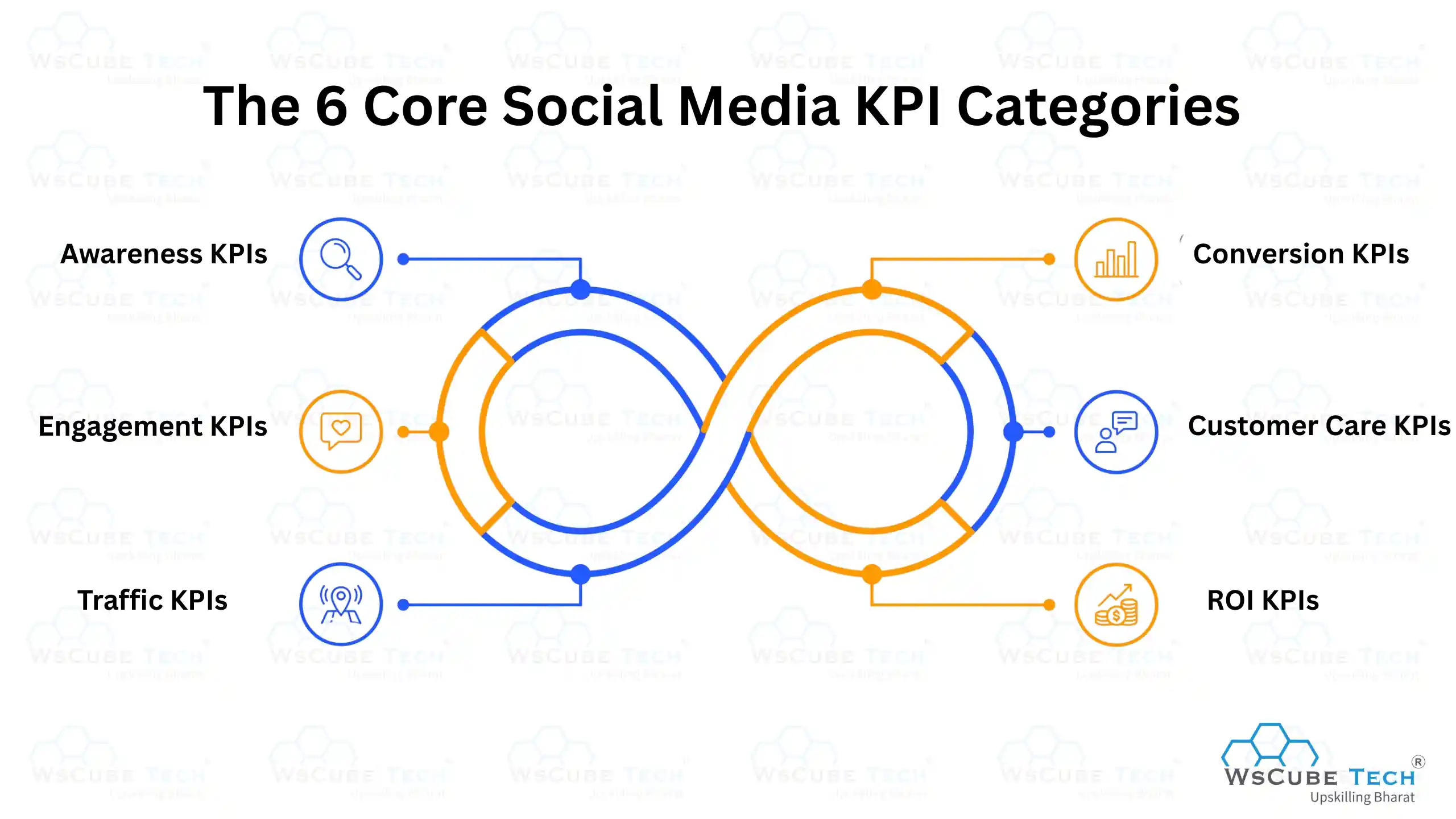
- Awareness KPIs: This measure how many people are discovering your brand on social media. They track visibility and reach.
- Engagement KPIs: This measure how people interact with your content. Likes, comments, shares, and saves all fall into this bucket.
- Traffic KPIs: This track how much traffic your social media activity sends to your website or landing pages.
- Conversion KPIs: This measure whether social media is actually driving people to take action, such as filling out a form, signing up, or making a purchase.
- Customer Care KPIs: This track how well you are handling customer questions and complaints on social media.
- ROI KPIs: This connects your social media activity directly to revenue and financial performance.
Now let us go deep into each category and the specific kpis in social media marketing that fall under them.
Social Media KPIs for Awareness
Awareness KPIs tell you how visible your brand is on social platforms. These are especially important for new businesses, product launches, or campaigns designed to expand your audience.
1. Reach
Reach refers to the number of unique people who have seen your content. If a post has a reach of 10,000, that means 10,000 different users saw it at least once.
Reach is one of the most straightforward important social media KPIs because it directly shows you how wide your net is cast. A high reach with low engagement might signal that your content is not resonating, even though many people are seeing it.
How to track it: Most native analytics dashboards (Instagram Insights, Facebook Analytics, LinkedIn Analytics) show reach at the post and account level.
2. Impressions
Impressions count the total number of times your content was displayed, including repeat views by the same person. If one user sees your post three times, that counts as three impressions but only one reach.
Impressions are useful for understanding how often your content is being surfaced. A high impressions-to-reach ratio suggests people are seeing your content multiple times, which can be good for brand recall.
3. Follower Growth
This tracks how many new followers you are gaining over a specific period. More importantly, track your follower growth rate rather than raw numbers. A brand with 5,000 followers growing by 500 a month is doing better than a brand with 50,000 followers growing by the same amount.
Formula: (New followers / Starting followers) x 100 = Growth rate %
According to HubSpot's Marketing Statistics, brands that consistently track follower growth are 2x more likely to adjust their content strategy proactively.
4. Share of Voice
Share of voice (SOV) measures what percentage of the total online conversation about a topic or industry includes your brand, compared to competitors. It is a competitive awareness KPI.
Formula: (Your brand mentions / Total industry mentions) x 100 = SOV %
Tools like Mention, Brandwatch, or Sprout Social can help you measure SOV automatically.
Upcoming Masterclass
Attend our live classes led by experienced and desiccated instructors of Wscube Tech.



Social Media KPIs for Engagement
KPIs for social media engagement are some of the most watched metrics because they show whether your audience is genuinely interested in what you are sharing. High engagement signals that your content is relevant, interesting, and worth interacting with.
1. Engagement Rate
Engagement rate is the percentage of your audience that actively interacts with your content. It is one of the most important key social media KPIs because it normalizes engagement relative to your audience size.
Formula: (Total interactions / Reach or Followers) x 100 = Engagement rate %
According to Rival IQ's Social Media Industry Benchmark Report, the average engagement rate across industries on Instagram is around 0.47% and on Facebook around 0.07%. These benchmarks help you understand how your numbers compare.
2. Likes
Likes are a basic signal of approval. While they should not be your only measure of success, a consistent pattern of low likes on posts that you expect to perform well is a signal to investigate.
3. Comments
Comments carry more weight than likes because they require more effort. A post that generates real discussion in the comments is connecting with people on a deeper level. Track not just the number of comments but also the quality and sentiment of those comments.
4. Shares
When someone shares your post, they are vouching for it to their own network. Shares extend your reach organically and signal that your content has real value. This is one of the best social media KPIs for gauging whether your content is truly resonating.
5. Saves
Saves (primarily an Instagram and Pinterest metric) show that people want to come back to your content later. A high save rate often signals that your content is educational, aspirational, or highly useful.
6. CTR (Click-Through Rate)
CTR in the engagement context measures the percentage of people who clicked on a link, button, or call-to-action in your post or story.
Formula: (Clicks / Impressions) x 100 = CTR %
CTR bridges engagement and traffic, making it one of the most versatile metrics to track.
Social Media KPIs for Traffic
Traffic KPIs measure how effectively your social media activity drives people to your website. These are especially valuable for content marketers and SEO-focused teams.
1. Social Referrals
Social referrals are visits to your website that came from a social media platform. In Google Analytics 4 (GA4), you can see a breakdown by channel, including which platforms (Facebook, Instagram, LinkedIn, etc.) are sending the most traffic.
Tracking social referrals helps you understand which platforms deserve more investment and which content formats drive people to click through.
2. Landing Page Sessions
Going one step further than referrals, this KPI tracks how many sessions were recorded on specific landing pages driven by social traffic. It tells you not just that people arrived but which pages they visited.
This is especially useful when you are running a campaign with a dedicated landing page. You can directly measure campaign traffic performance.
3. Link Clicks
Link clicks are the total number of times users clicked a link in your posts. On platforms like Facebook and LinkedIn, this is a native metric available in your analytics dashboard.
Tracking link clicks helps you understand which posts and which types of calls-to-action drive the most traffic.
4. CTR (Traffic Context)
In the traffic context, CTR refers to the percentage of people who saw your post and then clicked through to your website.
Formula: (Link clicks / Post impressions) x 100 = CTR %
A low CTR on posts with high reach tells you that your call-to-action or content is not motivating people to take the next step, even though they are seeing it.
Read More Blog Topics Related to Social Media
Social Media KPIs for Conversion
Conversion KPIs measure whether people are taking the actions your business cares about most. These are the numbers that connect social media directly to your sales funnel.
1. Leads Generated
Leads generated tracks how many people submitted their contact information through social media, whether that is through a lead form ad, a link to a landing page, or a direct message.
This is one of the most important social media KPIs for B2B marketers and businesses that rely on lead generation to drive sales.
2. Sign-Ups
If your goal is to grow an email list, drive app downloads, or get people to register for a webinar, sign-ups from social media channels is your KPI. Track this separately for each campaign so you can see which content and which platforms perform best.
3. Purchases
For e-commerce businesses, purchases attributed to social media is the ultimate conversion KPI. With tools like UTM parameters and Meta Pixel or similar tracking pixels from other platforms, you can directly attribute sales to specific social campaigns.
4. Conversion Rate
The conversion rate measures the percentage of social media visitors who complete a desired action. Understanding your conversion rate is critical because it tells you not just how many people converted, but how efficiently your funnel is working.
Formula: (Conversions / Total social media visitors) x 100 = Conversion rate %
According to WordStream's conversion rate benchmarks, the average landing page conversion rate across industries is about 2.35%, but the top 25% of pages see 5.31% or higher. Knowing your baseline helps you set realistic goals.
5. Cost Per Conversion
Cost per conversion (CPC) tells you how much you are spending for each conversion that comes from social media. This is one of the most critical paid social media KPIs for any business running paid campaigns.
Formula: Total spend / Number of conversions = Cost per conversion
Tracking this metric helps you optimize where to put your ad budget for the best return.
Social Media KPIs for Customer Care
Social media has become a primary channel for customer service. People ask questions, leave complaints, and share feedback publicly. How you handle these interactions affects your brand reputation significantly.
1. Response Time
Response time measures how quickly your team replies to messages and comments. Research by Sprout Social found that 79% of customers expect a response on social media within 24 hours, and 40% expect a reply within the first hour.
Setting a response time KPI and tracking it regularly shows your audience that you take their questions seriously.
2. Resolution Rate
Resolution rate tracks the percentage of customer issues raised on social media that were actually resolved. A high response rate with a low resolution rate is not a success, it just means you replied but did not help.
Formula: (Resolved issues / Total issues raised) x 100 = Resolution rate %
3. CSAT (Customer Satisfaction Score)
CSAT measures how satisfied customers are with the support they received through social media. This is usually gathered through a simple follow-up survey asking users to rate their experience.
It gives you direct feedback on the quality of your social customer care, not just the speed.
4. Sentiment
Sentiment analysis looks at whether mentions and comments about your brand are positive, negative, or neutral. Tools like Brandwatch, Mention, or even built-in platform tools can help you categorize sentiment automatically.
Tracking sentiment over time tells you whether your audience's perception of your brand is improving or declining. It is one of the key social media KPIs that connects customer experience to brand health.
Explore Our Most Popular Marketing Courses
Social Media KPIs for ROI and Revenue
ROI KPIs connect your social media activity to actual business revenue. These are the numbers that leadership teams care about most, and they are increasingly important as social media budgets grow.
1. Revenue Attributed to Social
This tracks the total revenue generated from customers who came through social media channels. Using proper attribution models in your analytics platform, you can tie a portion of revenue back to specific platforms and campaigns.
It is worth noting that attribution is complex. A customer might see your Instagram ad, then visit your website later from a Google search. The correct attribution model depends on your business and buying cycle.
2. CPA (Cost Per Acquisition)
CPA measures how much it costs to acquire a new customer through social media.
Formula: Total social media spend / Number of new customers acquired = CPA
This is one of the most widely tracked social media marketing key performance indicators for paid campaigns, as it directly shows efficiency of spend.
3. ROAS (Return on Ad Spend)
ROAS tells you how much revenue you earn for every dollar spent on social media advertising.
Formula: Revenue from ads / Ad spend = ROAS
A ROAS of 4 means you earned $4 for every $1 spent. According to Nielsen's Digital Ad Ratings data, the average ROAS across digital channels is around 2.87, though this varies significantly by industry and campaign type.
4. CAC (Customer Acquisition Cost)
CAC is similar to CPA but includes all costs, not just ad spend. It factors in content creation, team time, tools, and any other costs related to social media marketing.
Formula: Total social media costs / Total new customers from social = CAC
Keeping an eye on CAC helps you understand the true cost of growing your customer base through social channels.
How to Choose the Right Social Media KPIs for Your Goals
One of the biggest mistakes marketers make is trying to track everything at once. The truth is, not every KPI matters equally for every business or campaign. Here is a simple framework for choosing the right ones.
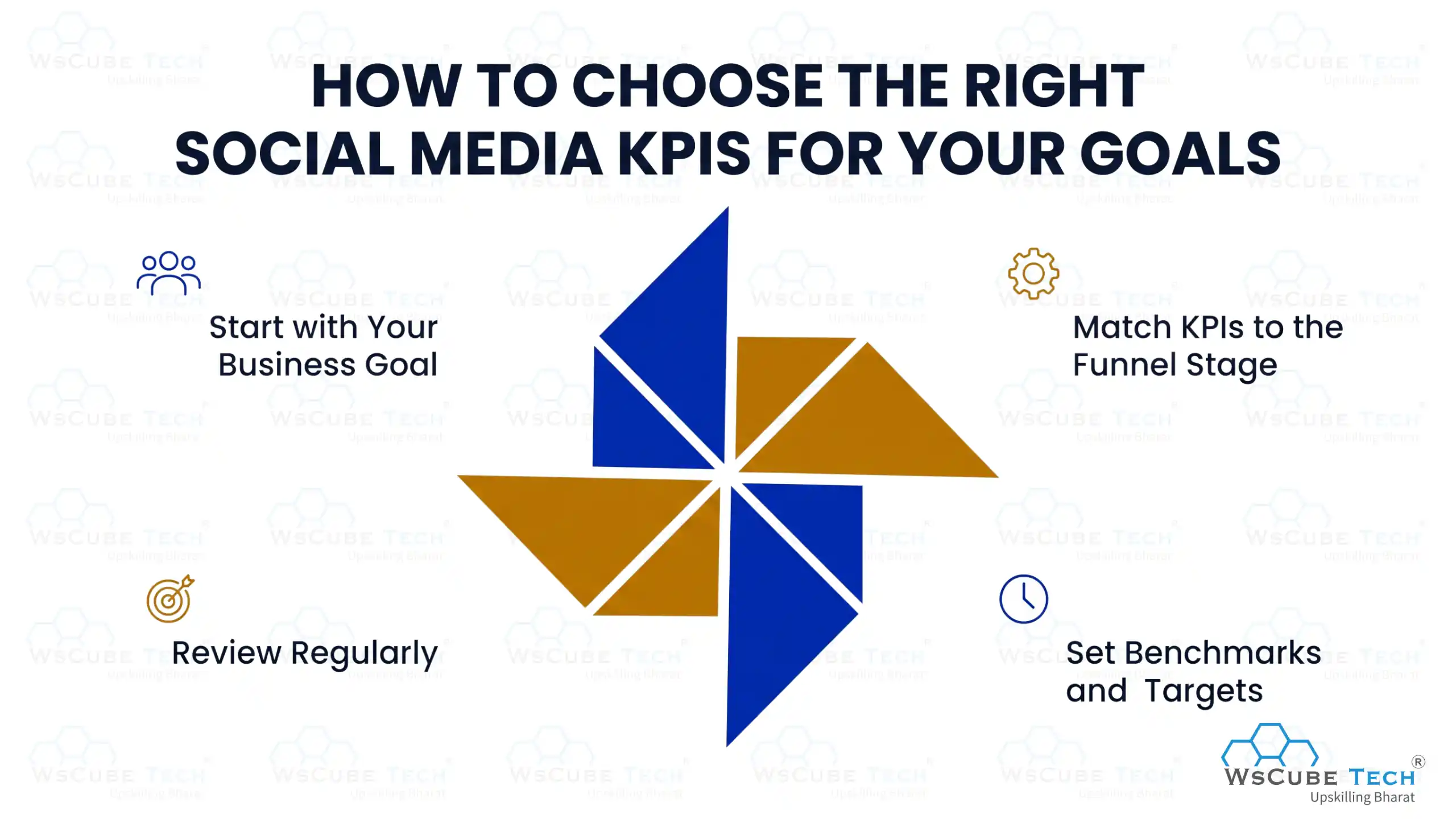
1. Start with Your Business Goal
What is the primary outcome you want from social media right now? If your goal is brand awareness, focus on reach, impressions, and follower growth. If your goal is revenue, focus on conversion rate, ROAS, and CPA.
2. Match KPIs to the Funnel Stage
- Top of funnel (awareness): Reach, impressions, share of voice, follower growth
- Middle of funnel (consideration): Engagement rate, CTR, link clicks, social referrals
- Bottom of funnel (decision): Leads, sign-ups, purchases, conversion rate, ROAS
- Retention and loyalty: CSAT, sentiment, response time, resolution rate
3. Set Benchmarks and Targets
A KPI without a target is just a number. Once you know which KPIs to track, set specific targets based on historical data, industry benchmarks, or campaign goals. For example, aim to improve engagement rate by 15% over 90 days, or reduce average response time from 4 hours to under 1 hour.
4. Review Regularly
KPIs should be reviewed on a consistent schedule. Weekly for fast-moving campaigns, monthly for ongoing channel performance, and quarterly for strategic planning. Reviewing regularly helps you catch problems early and double down on what is working.
Also Read: Digital Marketing KPIs: A Complete Guide
Common Mistakes When Measuring Social Media KPIs
Even experienced marketers fall into these traps. Knowing what to avoid is just as important as knowing what to measure.
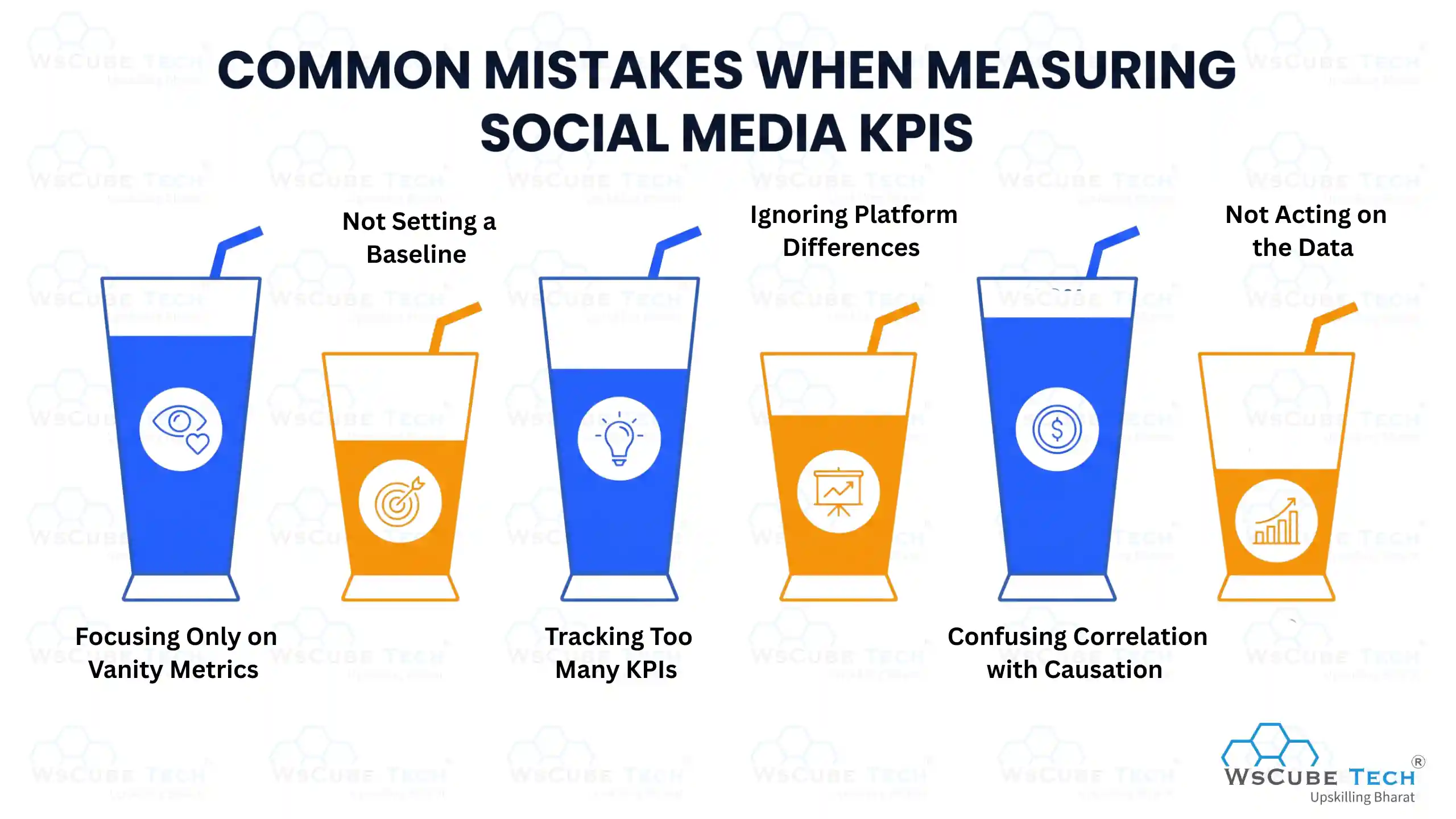
1. Focusing Only on Vanity Metrics
Likes and follower counts feel good but do not tell you much about business impact. A post with 500 likes but zero clicks to your website has limited value if traffic and conversions are your goal. Always tie your social media key performance indicators back to a real business outcome.
2. Not Setting a Baseline
If you do not know where you started, you cannot measure improvement. Before launching any campaign, record your current performance numbers so you have something to compare against.
3. Tracking Too Many KPIs
More data is not always better. When you track 20 different numbers, it becomes hard to know which ones actually matter. Pick three to five key social media KPIs per campaign or goal and focus on those.
4. Ignoring Platform Differences
What works on Instagram may not work on LinkedIn. Engagement benchmarks, posting frequency, and content formats vary significantly across platforms. Track your KPIs separately per platform rather than lumping everything together.
5. Confusing Correlation with Causation
Just because followers went up during a campaign does not automatically mean the campaign caused it. Always look for multiple data points and consider other factors that might have influenced results.
6. Not Acting on the Data
This might be the biggest mistake of all. Tracking how to measure social media KPIs is only valuable if you actually use the insights to make decisions. Build a habit of reviewing your KPIs and then making at least one specific change based on what you find.

FAQs about Social Media KPIs
Social media KPIs (Key Performance Indicators) are specific measurable values that show whether your social media activities are meeting your business objectives. They go beyond simple metrics to track progress toward defined goals.
The most important social media KPIs depend on your goals. For brand awareness, reach and impressions matter most. For engagement, focus on engagement rate and shares. For revenue, track ROAS, CPA, and conversion rate.
You can use platform-native tools (Instagram Insights, LinkedIn Analytics, Facebook Business Suite) combined with web analytics tools like Google Analytics 4 to track social media KPIs. For more advanced tracking, tools like Sprout Social, Hootsuite, or HubSpot offer centralized dashboards.
Common paid social media KPIs include cost per click (CPC), cost per conversion, ROAS, CTR, and customer acquisition cost (CAC). These help you understand the efficiency and profitability of your paid social media spend.
Most experts recommend tracking three to five social media key performance indicators per campaign or goal. Tracking too many at once makes it hard to focus. Choose the ones that most directly reflect your current objective.
Metrics are all the measurable data points available to you. KPIs on social media are the specific metrics you have chosen to track because they align with a specific business goal. All KPIs are metrics, but not all metrics are KPIs.
KPIs for social media engagement include engagement rate, likes, comments, shares, saves, and click-through rate. Together, these show how actively your audience is interacting with your content.
Start by identifying your main business objective. Then choose kpis for social media strategy that align with that objective. Match KPIs to the funnel stage you are targeting, set a specific target for each, and review performance on a regular schedule.
Share of voice shows you how prominent your brand is in industry conversations relative to competitors. It is one of the key social media KPIs that reveals whether your brand awareness efforts are actually making an impact in your market.
Popular tools for how to track social media KPIs include Google Analytics 4, Sprout Social, Hootsuite, HubSpot, Brandwatch, and native platform analytics from Instagram, Facebook, LinkedIn, X (Twitter), and TikTok. The best choice depends on your platform mix and budget.
Conclusion
Tracking the right social media KPIs is what separates a random social media presence from a strategic one. When you know what to measure and why it matters, you can make smarter decisions, prove your impact, and keep improving over time.
The key takeaways from this guide:
- Social media KPIs are specific metrics tied to business goals, not just raw numbers.
- The six core categories cover awareness, engagement, traffic, conversions, customer care, and ROI.
- Choose KPIs based on your current business goal and funnel stage.
- Avoid vanity metrics and always connect your numbers to real outcomes.
- Review your kpis on social media regularly and act on what you find.
Start small. Pick a handful of kpis for social media engagement or conversions that align with your most pressing goal right now, set a target, and start tracking consistently. Over time, you will build a clear picture of what is working and where to improve.
Join Our On-Campus Digital Marketing Program
Explore Our Free Courses






Leave a comment
Your email address will not be published. Required fields are marked *Comments (0)
No comments yet.