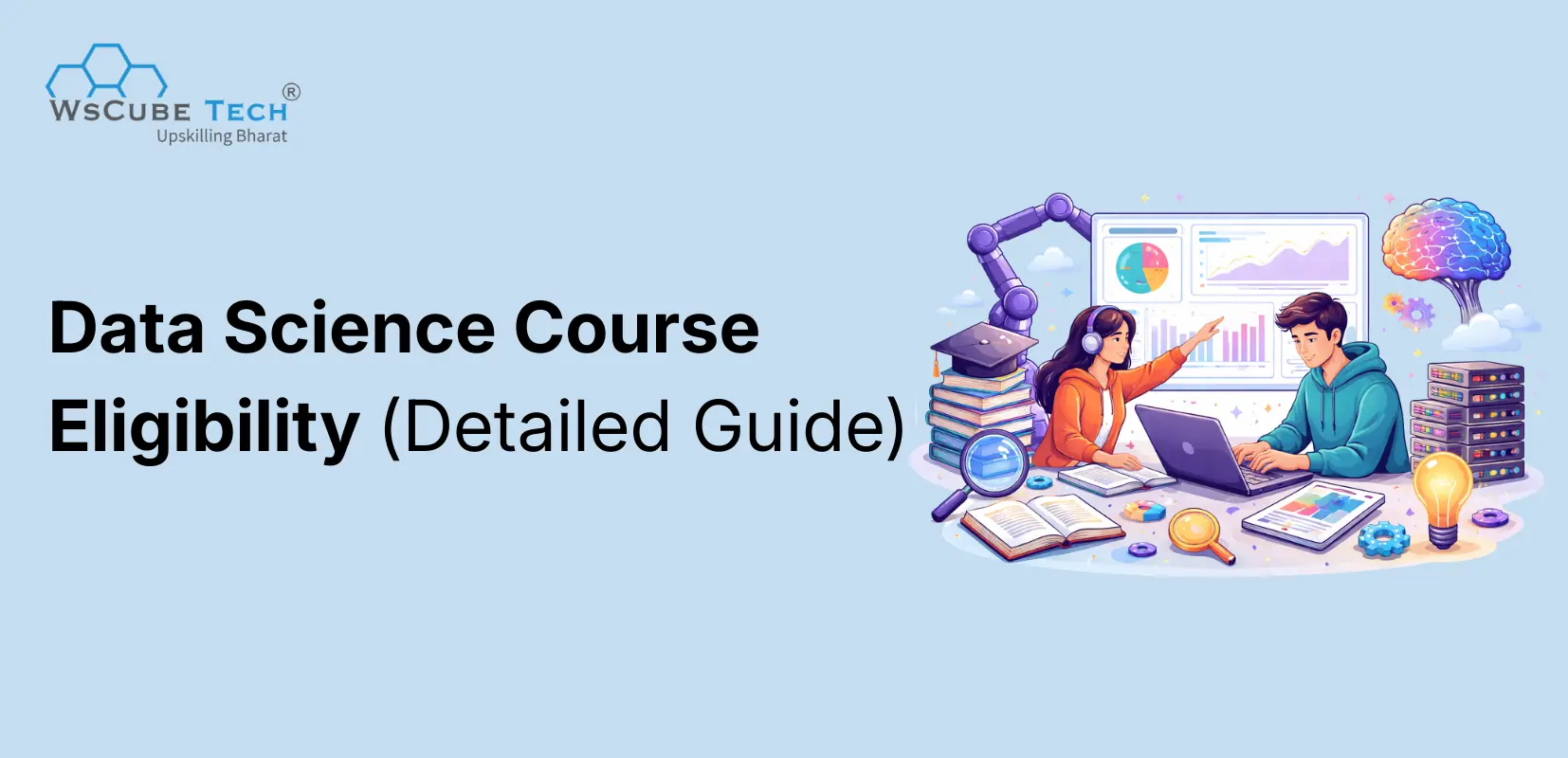
Starting a career in data science is an exciting step, but understanding the eligibility requirements for data science courses is important before you begin your learning journey in this field. Many learners feel confused about whether they meet the requirements, especially when they come from different educational backgrounds. The good news is that data science is a flexible field that welcomes learners from various streams.
Whether you are a student, graduate, or working professional, you can start learning data science with the right guidance and basic skills. Knowing the eligibility criteria helps you choose the right course, avoid confusion, and build a strong foundation for a successful career in this growing field.
Let’s learn about the detailed eligibility criteria, required skills, and who can start a data science course in the sections below.
What is Data Science?
Data Science is a field that focuses on collecting, analyzing, and interpreting data to extract useful insights and support decision-making. It combines techniques from statistics, programming, and domain knowledge to understand patterns, trends, and relationships in data.
In simple terms, data science helps you turn raw data into meaningful information. It involves processes like data cleaning, data analysis, visualization, and building predictive models. Businesses use data science to improve decisions, predict future outcomes, and solve real-world problems efficiently.
Who Can Learn Data Science?
Before understanding the eligibility of data science course, it is important to first know who can learn data science. Many people assume that only students from a technical background can enter this field, but that is not true.
Data science is open to students, graduates, and working professionals from any stream, including science, commerce, and arts. Even if you do not have prior coding experience, you can start learning with basic concepts and gradually build your skills. With the right mindset, curiosity, and problem-solving ability, anyone can learn data science and build a successful career in this field.
Basic Eligibility Criteria for Data Science Course
Before enrolling in a data science course, it is important to understand the basic eligibility requirements. These criteria may vary depending on the course type (certificate, diploma, or degree), but most institutes follow some common guidelines.
Educational Qualification
Most data science courses require at least a 10+2 (12th pass) qualification from a recognized board. For advanced programs like undergraduate or postgraduate courses, a bachelor’s degree in any field is usually required.
Minimum Percentage Requirement
There is generally no strict percentage requirement for short-term or online courses. However, for degree programs, some colleges may require around 50%–60% marks in previous qualifications.
Stream Requirements
Students from all streams, science, commerce, or arts, can pursue data science. Although having knowledge of mathematics or computer science is beneficial, it is not required for beginners.
Skills Required for Data Science
Below are some important technical skills that you should learn to build a strong foundation in data science:
Technical Skills
- Programming Languages (Python / R): You should have basic knowledge of programming languages like Python or R, as they are commonly used for data analysis, automation, and building models.
- Statistics & Mathematics: Understanding concepts like probability, mean, median, standard deviation, and linear algebra helps you analyze data and build accurate models.
- Data Analysis & Manipulation: You should know how to work with data using tools and libraries like Pandas and NumPy to clean, organize, and process data efficiently.
- Data Visualization: Skills in tools like Matplotlib, Seaborn, or Power BI help you present data in the form of charts and graphs for better understanding.
- Machine Learning Basics: A basic understanding of concepts such as supervised and unsupervised learning helps make predictions and build models from data.
- Database Management (SQL): Knowledge of SQL is important to store, manage, and access data from databases.
- Excel & Spreadsheets: Basic to advanced Excel skills are useful for data cleaning, analysis, and reporting, especially for beginners.
- Big Data Tools (Optional): Familiarity with tools like Hadoop or Spark can be helpful when working with large datasets, though it is not mandatory for beginners.
Soft Skills
- Analytical Thinking: You should be able to analyze problems logically and break them into smaller parts to find effective solutions using data.
- Problem-Solving Skills: Data science focuses on solving real-world problems, so you need the ability to think critically and find practical solutions.
- Communication Skills: You should be able to explain data insights clearly to non-technical stakeholders in a simple and understandable way.
- Curiosity & Learning Mindset: A strong desire to learn and explore new tools, technologies, and trends is important in the fast-growing field of data science.
- Attention to Detail: Small errors in data can lead to incorrect results, so being detail-oriented helps ensure accuracy, consistency, and reliability when working with data.
- Time Management: Helps in handling multiple tasks, projects, and deadlines efficiently.
- Teamwork & Collaboration: In real-world projects, you often work with teams, so the ability to collaborate and share ideas is essential.
Recommended Professional Certificates
Data Analytics Mentorship Program
Data Science & AI Mentorship Program
Do You Need Coding Knowledge for Data Science?
Coding knowledge is helpful in data science, but it is not always mandatory for beginners. Many people start learning data science without any programming background and gradually build their skills over time. Tools like Excel, Power BI, and no-code platforms allow you to begin your journey without deep coding knowledge.
However, to grow in this field and work on advanced projects, learning programming languages like Python or R becomes important. Coding helps you automate tasks, handle large datasets, and build machine learning models more efficiently. So, while you can start without coding, learning it will definitely give you better career opportunities in data science.
Eligibility for Different Types of Data Science Courses
Below is the eligibility criteria for different types of data science courses:
| Course Type | Eligibility Criteria |
| Certificate & Online Courses | Open to all learners; basic knowledge of computers is enough. No strict qualification required. |
| Diploma Courses | Usually requires 10+2 (12th pass) from a recognized board. |
| Undergraduate Courses | Requires 10+2 with minimum marks (usually 50%–60%); some colleges prefer math background. |
| Postgraduate Courses | Requires a bachelor’s degree in any field; some programs prefer science, engineering, or related backgrounds. |
Eligibility for Data Science Courses After 12th
You can start learning data science right after completing your 12th class. Most beginner-level courses, such as certificate and diploma programs, do not have strict eligibility requirements. You only need a basic understanding of computers and an interest in working with data.
Students from any stream, including science, commerce, or arts, can pursue data science courses after 12th. However, having a basic understanding of mathematics or statistics can be helpful. Along with this, developing skills like logical thinking, problem-solving, and basic programming knowledge can give you an added advantage and make your learning journey smoother.
Eligibility for Data Science Courses After Graduation
After completing graduation, you can easily pursue data science courses at both beginner and advanced levels. Most institutes accept candidates with a bachelor’s degree in any stream, including science, commerce, arts, or engineering. However, having a background in mathematics, statistics, or computer science can be an added advantage.
For postgraduate or advanced data science programs, some colleges may prefer candidates with technical degrees such as B.Tech, B.Sc, or BCA, and may require minimum marks (around 50%–60%). Basic knowledge of programming, data handling, and analytical thinking can also help you understand concepts more effectively and succeed in the field.
Also Read: Data Scientist Roadmap: A Guide for Beginners
Can Non-Technical Students Learn Data Science?
Yes, non-technical students can definitely learn data science. You do not need a strong technical or coding background to start. Many beginners from commerce, arts, or other non-technical fields successfully enter data science by starting with basic concepts.
You can begin with tools like Excel and gradually move to programming languages like Python and SQL. While learning may take a little extra effort compared to technical students, consistency and practice can help you build the required skills. With the right approach and mindset, non-technical students can also build a successful career in data science.
Eligibility for Working Professionals & Career Switchers
Working professionals and career switchers can easily learn data science, as most courses are designed to be flexible and beginner-friendly. There are no strict eligibility requirements, and you can start learning regardless of your current job role or industry.
However, having basic computer knowledge, analytical thinking, and an interest in working with data is important. Even if you do not have a technical background, you can begin with beginner-level tools like Excel and gradually learn Python, SQL, and data visualization. With consistent learning and practice, you can successfully switch your career to data science.
Upcoming Masterclass
Attend our live classes led by experienced and desiccated instructors of Wscube Tech.


Eligibility for Online Data Science Courses
Online data science courses are open to almost everyone and have very flexible eligibility criteria. Most platforms do not require any specific educational qualification, making them suitable for beginners, students, and working professionals.
To get started, you only need basic computer knowledge, internet access, and an interest in learning data-related skills. While prior knowledge of mathematics, statistics, or programming can be helpful, it is not mandatory. Many online courses are designed for beginners and start from the basics, allowing you to learn step by step at your own pace.
If you are interested in learning data science, you can join a data science online course that provides structured learning, real-world projects, and expert guidance to help you build job-ready skills.
Data Science Course Duration
After understanding the data science course eligibility, let’s now look at the duration of different types of data science courses:
| Course Type | Duration |
| Certificate Courses | 3 to 6 months |
| Diploma Courses | 6 months to 1 year |
| Undergraduate Courses | 3 to 4 years |
| Postgraduate Courses | 1 to 2 years |
| Online Courses | A few weeks to 6 months (flexible) |
The duration of a data science course depends on the type of program you choose and your learning goals. Short-term courses are ideal for beginners, while degree programs provide deeper knowledge and better career opportunities.
Also Read: Data Analyst vs. Data Scientist: Key Differences & Comparison
Data Science Course Fees in India
The fees for data science courses in India vary depending on the course type, institute, and mode of learning (online or offline). Here is a general fee structure:
| Course Type | Average Fees (INR) |
| Online Self-Paced Courses | ₹30,000 – ₹60,000 |
| Instructor-Led Online Courses | ₹50,000 – ₹1,00,000 |
| Offline Classroom Courses | ₹70,000 – ₹1,50,000 |
| Diploma Courses | ₹80,000 – ₹2,50,000 |
| Postgraduate Programs | ₹1,50,000 – ₹4,00,000+ |
| Undergraduate Degree Courses | ₹2,00,000 – ₹6,00,000 (full course) |
The fees mainly depend on factors like course duration, institute reputation, curriculum depth, and placement support. Short-term online courses are more affordable, while degree and advanced programs are higher in cost but offer better career opportunities.
Read more on Career Guides
Career Opportunities After Data Science Course
After completing a data science course, you can explore various high-demand career opportunities across industries like IT, healthcare, finance, e-commerce, and marketing with excellent growth potential.
- Data Analyst: Involves collecting, analyzing, and interpreting data to identify trends and support business decisions using tools like Excel, SQL, and visualization platforms.
- Data Scientist: Focuses on analyzing complex data, building machine learning models, and generating actionable insights to solve real-world problems and improve business performance.
- Data Engineer: Responsible for designing, building, and maintaining data pipelines and architectures to ensure smooth data flow. They manage large datasets, optimize data systems, and support efficient data processing for analysis and decision-making.
- Machine Learning Engineer: Works on developing, testing, and deploying machine learning models that learn from data and provide accurate predictions for real-time and automated systems.
- Business Analyst: Uses data to analyze business processes, identify improvement areas, and provide actionable insights that help organizations improve performance, efficiency, and overall business strategy.
- Data Visualization Specialist: Focuses on creating dashboards, charts, and reports using tools like Power BI or Tableau to present data insights in a clear and visually appealing manner.
- AI Engineer: Works on building intelligent systems using artificial intelligence techniques such as deep learning, natural language processing, and automation to solve complex problems.
Salary After Completing Data Science Course in India
After completing a Data Science course in India, students, graduates, working professionals, and career switchers can start earning by applying for roles like data analyst, machine learning engineer, data scientist, and data engineer. Freshers can expect an average annual salary between ₹4 LPA to ₹10 LPA, depending on their skills, projects, and the company they join.
As you gain experience and improve your technical skills, your salary increases significantly. With time, professionals can move into higher roles and earn better packages, making data science one of the most high-paying and rewarding career options in India.
Salary by Job Roles
| Job Role | Average Salary (INR per year) |
| Data Scientist | ₹6 – ₹14 LPA |
| Machine Learning Engineer | ₹6 – ₹11 LPA |
| Data Analyst | ₹4 – ₹8 LPA |
| Data Engineer | ₹6 – ₹12 LPA |
| Business Analyst | ₹5 – ₹10 LPA |
| Data Visualization Specialist | ₹5 – ₹9 LPA |
| AI Engineer | ₹8 – ₹18 LPA |
Salary Structure by Experience (Approx. Annually)
| Experience Level | Average Salary (INR per year) |
| Entry-Level (0–2 Years) | ₹4 – ₹10 LPA |
| Mid-Level (3–5 Years) | ₹10 – ₹20 LPA |
| Senior-Level (6+ Years) | ₹20 – ₹30+ LPA |
Note: Salaries may vary based on skills, certifications, company, and location. Metro cities like Bangalore, Mumbai, and Delhi usually offer higher salary packages due to better job opportunities.
Also Read: Data Science Course Syllabus: Fees, Duration, Eligibility, Details (With PDF)
Learn Data Science with WsCube Tech
If you are looking to start or grow your career in data science, WsCube Tech offers a comprehensive Data Science & AI Mentorship Program designed for beginners as well as professionals. This program focuses on practical learning, helping you understand core concepts with real-world applications instead of just theory.
In this Data Science & AI Mentorship Program, you will work on real datasets, build machine learning models, and deploy AI applications. With expert guidance and hands-on projects, you can fast-track your career in Data Science, Machine Learning, and AI in just 20 weeks.
FAQs About Data Science Course Eligibility
Most data science courses require at least a 12th pass for certificate or diploma programs. For undergraduate and postgraduate programs, a relevant bachelor’s degree is usually needed, sometimes with minimum marks around 50–60%.
Yes, students from any stream, arts, commerce, or science, can learn data science. While technical knowledge like mathematics or programming helps, beginners from non-technical backgrounds can start with basic courses and gradually build skills.
Coding is not mandatory for beginners. You can start with no-code tools like Excel or Power BI. Learning programming languages such as Python or R becomes important as you advance in data science.
Yes, you can enroll in certificate, diploma, or undergraduate programs after completing 12th. Students from any stream are eligible, though a basic understanding of computers and mathematics can help in grasping concepts faster.
Postgraduate programs usually require a bachelor’s degree in any field. Some institutes prefer students from technical or science backgrounds and may ask for minimum marks or prior knowledge in mathematics, statistics, or programming.
Absolutely. Data science courses are flexible and beginner-friendly. Professionals can start with online or part-time programs. Basic computer knowledge, analytical thinking, and dedication are sufficient to build a successful career.
Short-term and online courses usually have no strict percentage requirements. For undergraduate and postgraduate programs, many institutes require around 50%–60% marks in previous qualifications. Requirements may vary by college or program.
Most certificate and diploma courses are open to all students after 12th. No specific degree is required, though having basic computer skills and interest in data analysis is beneficial for beginners.
No, it is not mandatory. While a basic understanding of mathematics, statistics, and logical reasoning can make learning easier, many beginner-friendly courses start from scratch to help all students.
Yes, online data science courses are open to anyone, regardless of educational background. You only need a computer, internet access, and willingness to learn. Many courses start from fundamentals for beginners.
No, most data science courses do not have age restrictions. Students, graduates, working professionals, or career switchers of any age can enroll and learn, as long as they meet basic eligibility criteria.
Choose a course depending on your education, experience, and career goals. Beginners can start with certificate or online programs, while graduates can opt for diploma, undergraduate, or postgraduate courses for advanced knowledge.
Conclusion
Data science is a growing field that is open to learners from different backgrounds. Whether you are a student, graduate, or working professional, you can begin your journey with the right approach and basic skills. Understanding the eligibility criteria helps you select the most suitable course and start with clarity.
With consistent learning, practice, and the right guidance, anyone can build a strong career in data science. Choosing the right course and focusing on practical knowledge will help you gain confidence and achieve long-term success in this field.
Practice Coding With Our Free Compilers




Leave a comment
Your email address will not be published. Required fields are marked *Comments (0)
No comments yet.