
Every website you visit is powered by two worlds working together, one you see and one you never do. The part you never see, quietly handling logins, payments, and data behind the scenes, is the backend. It rarely gets applause, yet nothing on the internet works without it.
This invisible engine runs on a specific mix of technical know how and problem solving ability, and that combination is exactly what makes up backend developer skills. Companies today are not just hiring coders. They want people who understand servers, databases, security, and systems thinking, all at once.
If you are aiming even higher, pairing this expertise with full-stack web development can make you unstoppable. Let us break down exactly what you need to master in 2026.
What are Backend Developer Skills?
Backend developer skills are a combination of soft and technical skills needed to carry out all backend developer tasks. Technical skills are a must for working with server-side scripting languages, APIs, and database management tools.
However, for a successful career in backend development, you must also possess soft skills like communication, problem-solving, and creativity.
Recommended Professional Certificates
Full Stack Development Course with AI Engineering
WordPress Bootcamp
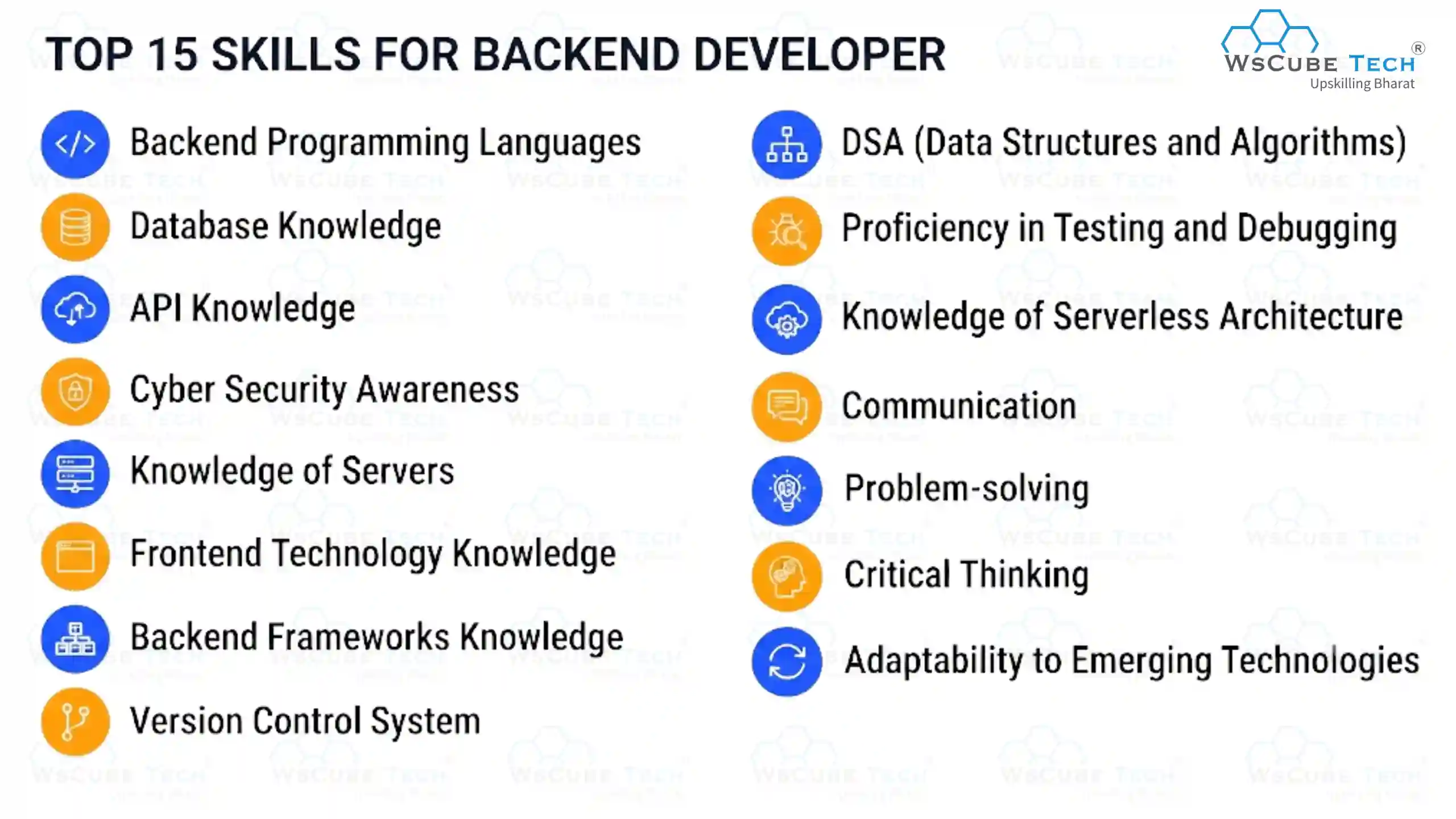
Top 15 Skills for Backend Developer
Let's look at some skills you should have as a backend engineer. You should work towards acquiring these must-have skills to crack backend developer interviews at the biggest tech companies.
1. Backend Programming Languages
Backend developers use multiple programming languages. The two main categories are:
- OOP (Object-oriented Programming): This organizes code into reusable class and object building blocks. Popular languages include Java, .NET, Python, etc.
- Functional Programming: Aims on mathematical functions, minimizing shared data. Languages like Clojure, Haskell, SQL, etc.
2. Database Knowledge
Every website requires a database to deal with client data. A database stores the data and website content in a way that makes it easy to recover, arrange, modify, and store data.
Two types of databases available in the market are:
- SQL: A SQL database is one where the data is tabulated in a table, and each is linked. They work on queries and produce results depending on them. Example: PostgreSQL, MySQL.
- NoSQL: Here, there’s no need to structure the data beforehand. NoSQL databases work basically on JSON and XML. Example: Cassandra, MongoDB.
3. API Knowledge
Application Programming Interfaces facilitate software communication while helping various systems talk to each other, using HTTP methods like GET, POST, PUT, and DELETE. Backend developers create APIs to fetch user data, improving user experience.
4. Cyber Security Awareness
With the growing number of cyber threats, backend developers must prioritize security. Knowledge of the best practices for securing web apps, knowing common vulnerabilities, and implementing appropriate authentication and authorization mechanisms are necessary.
5. Knowledge of Servers
Each web application runs a remote PC known as a server. The rem server commonly refers to the computer system that requests web-based files, including HTML, CSS, JavaScript, etc., and forwards those files to the client.
Servers are the commonly used channel to deliver essential pieces of information; most servers are never turned off. This part of the servers makes it necessary for a backend developer to know about it. Examples: IIS Servers, Apache, Microsoft IIS, Nginx.
Upcoming Masterclass
Attend our live classes led by experienced and desiccated instructors of Wscube Tech.



6. Frontend Technology Knowledge
In the world of backend technology, a touch of frontend knowledge significantly elevates your capabilities. Knowing the fundamental frontend web development technology languages like HTML, CSS, and JavaScript is a must, as they give you the power to communicate with the computers, instruct them, and create engaging user experiences. Enroll in an online Frontend Development Course and get hired by top MNCs.
7. Backend Frameworks Knowledge
Along with choosing a type of programming language, you must embrace its ecosystem with backend frameworks. These frameworks streamline your development process, giving ready-to-use tools and libraries.
Below are a few standout options:
- Ruby on Rails: This open-source framework, written in Ruby, crafts seamless web apps and is packed with automated testing, libraries, and scaffolding. It's your ticket to efficient localization.
- Node.js: An open-source platform for back-end development. With Javascript at its center, it’s a maestro framework that’s cross-platform and compatible with Linux, Windows, and macOS.
- Express.js: Built on the blocks of Node.js. Its glaring speed and reliability make it a favorite among backend developers. It is ideal for APIs, and it shines in crafting web and mobile applications.
- Django: An open-source gem that has captured the developer’s heart. Django’s magic lies in its nominal code requirements and rapid app development prowess.
- Flask: A Python-based framework for present-day creations. From WSGI assistance to quick templating, it boasts an in-built development server.
8. Version Control System
With code’s evolution, version control systems become invaluable. These systems track code changes, making reverting to previous versions and safeguarding your source code easier.
Below are some noteworthy systems:
- AWS Code Commit: Amazon’s secure version control system is perfect for managing source code and data.
- GitHub: A famous open-source community repository that fosters collaboration and contribution among developers.
- GitLab: A comprehensive platform that enables collaboration and efficient software development through streamlined communication.
9. DSA (Data Structures and Algorithms)
Effective data management is paramount. A powerful grasp of data structures and algorithms secures efficient data handling, retrieval, and memory management. These concepts optimize code and improve backend prowess.
10. Proficiency in Testing and Debugging
Backend developers must be experts in testing and debugging the applications. Familiarity with unit testing frameworks and debugging tools is pivotal to discovering and fixing issues immediately and efficiently.
Read More Web Development Related Guides
11. Knowledge of Serverless Architecture
Serverless architecture has become popular because of its scalability and cost-effectiveness. Backend developers must have hands-on experience with serverless platforms like Azure Functions and AWS lambda.
12. Communication
Backend development thrives on effective collaboration. Despite the acute focus, you must communicate proficiently with your team, prospects, and managers. Successful projects rely on understandable discussions and idea exchanges. Hone your communication skills for harmonious teamwork.
13. Problem-solving
Backend developers are troubleshooters of the digital world. Cultivate your problem-solving skills to navigate difficulties seamlessly. Your role involves keeping sites running smoothly and making strong problem-solving abilities an indispensable asset.
14. Critical Thinking
Sharpening your critical thinking as a back-end developer helps you analyze complex problems, identify patterns quickly, and come up with innovative solutions to the issues you face. Pushing the limits of your critical thinking skills also fosters a more systematic and strategic approach to coding and architecting solid and efficient solutions.
15. Adaptability to Emerging Technologies
The tech landscape is evolving constantly, with new tools, web development frameworks, and paradigms emerging regularly. Those who are quick to learn and integrate new technologies into their skill sets can drive innovation and maintain a competitive edge.
Explore Our Web Development Related Courses
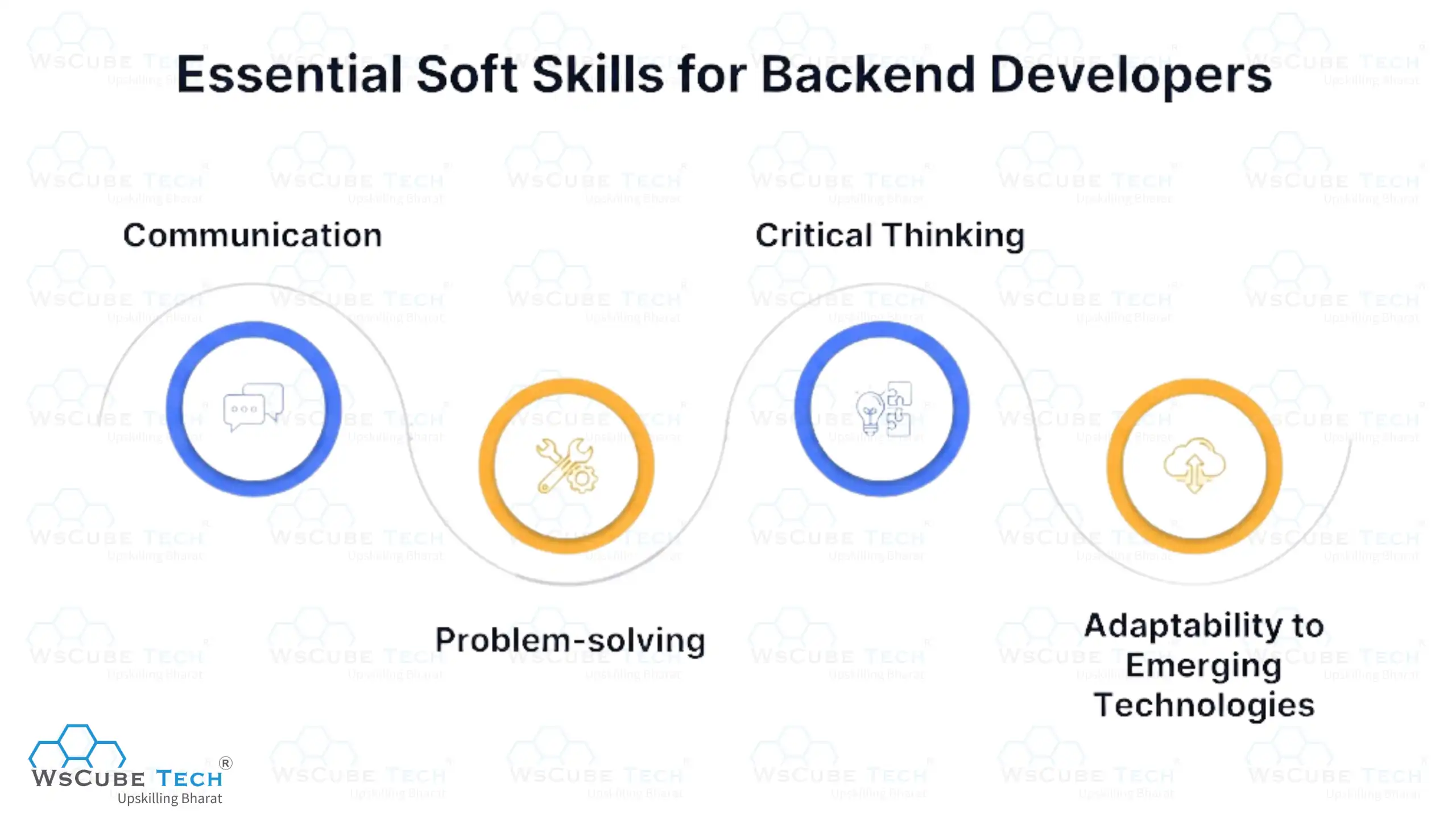
Essential Soft Skills for Backend Developers
1. Communication
Backend development thrives on effective collaboration. Despite the acute focus, you must communicate proficiently with your team, prospects, and managers. Successful projects rely on understandable discussions and idea exchanges. Hone your communication skills for harmonious teamwork.
2. Problem-solving
Backend developers are troubleshooters of the digital world. Cultivate your problem-solving skills to navigate difficulties seamlessly. Your role involves keeping sites running smoothly and making strong problem-solving abilities an indispensable asset.
3. Critical Thinking
Sharpening your critical thinking as a back-end developer helps you analyze complex problems, identify patterns quickly, and come up with innovative solutions to the issues you face. Pushing the limits of your critical thinking skills also fosters a more systematic and strategic approach to coding and architecting solid and efficient solutions.
4. Adaptability to Emerging Technologies
The tech landscape is evolving constantly, with new tools, web development frameworks, and paradigms emerging regularly. Those who are quick to learn and integrate new technologies into their skill sets can drive innovation and maintain a competitive edge.
Backend Developer Skills by Experience Level
The skillset required of backend developers evolves significantly as they advance. Recognizing which skills are essential at each career stage is crucial for backend developers who aim to progress and succeed.
1. Entry-level Backend Developer Skills
Entry-level backend developers should focus on gaining a strong understanding of programming languages like Ruby, Python, or Java. They must be proficient in database management with systems like MySQL or PostgreSQL and have basic knowledge of version control tools like Git.
Familiarity with server-side frameworks, RESTful API development, and an understanding of the software development lifecycle is also crucial. These foundational skills are critical for contributing to back-end codebases, debugging easy issues, and collaborating with frontend developers and other team members.
2. Mid-level backend Developer Skills
Mid-level backend developers must know advanced database design, data modeling, and caching strategies and have experience with containerization and orchestration technologies such as Docker and Kubernetes.
Skills in writing clean, maintainable code and implementing design patterns have become increasingly important. They should also develop a keen sense of how back-end services impact overall system performance and user experience, enabling them to optimize and refactor code for better efficiency.
3. Senior backend developer Skills
Senior backend developers must excel in system architecture design and make decisions ensuring scalability and security. They should have a firm grasp of cloud services and infrastructure, such as AWS, Azure, or Google Cloud Platform. Leadership skills are paramount, as senior developers often mentor junior team members and lead cross-functional project teams.
They must also be skilled in advanced areas like microservices architecture and continuous integration/continuous deployment (CI/CD) practices and able to drive technical strategy aligned with business objectives. Their role often involves significant stakeholder management, requiring excellent communication skills and the ability to negotiate and influence at higher levels of the organization.
Explore More on Web Development Guides
How to Learn These Backend Developer Skills (Roadmap)
Knowing the skills is only half the job, the real progress comes from following them in the right order. This backend developer roadmap breaks the journey into simple, actionable steps.
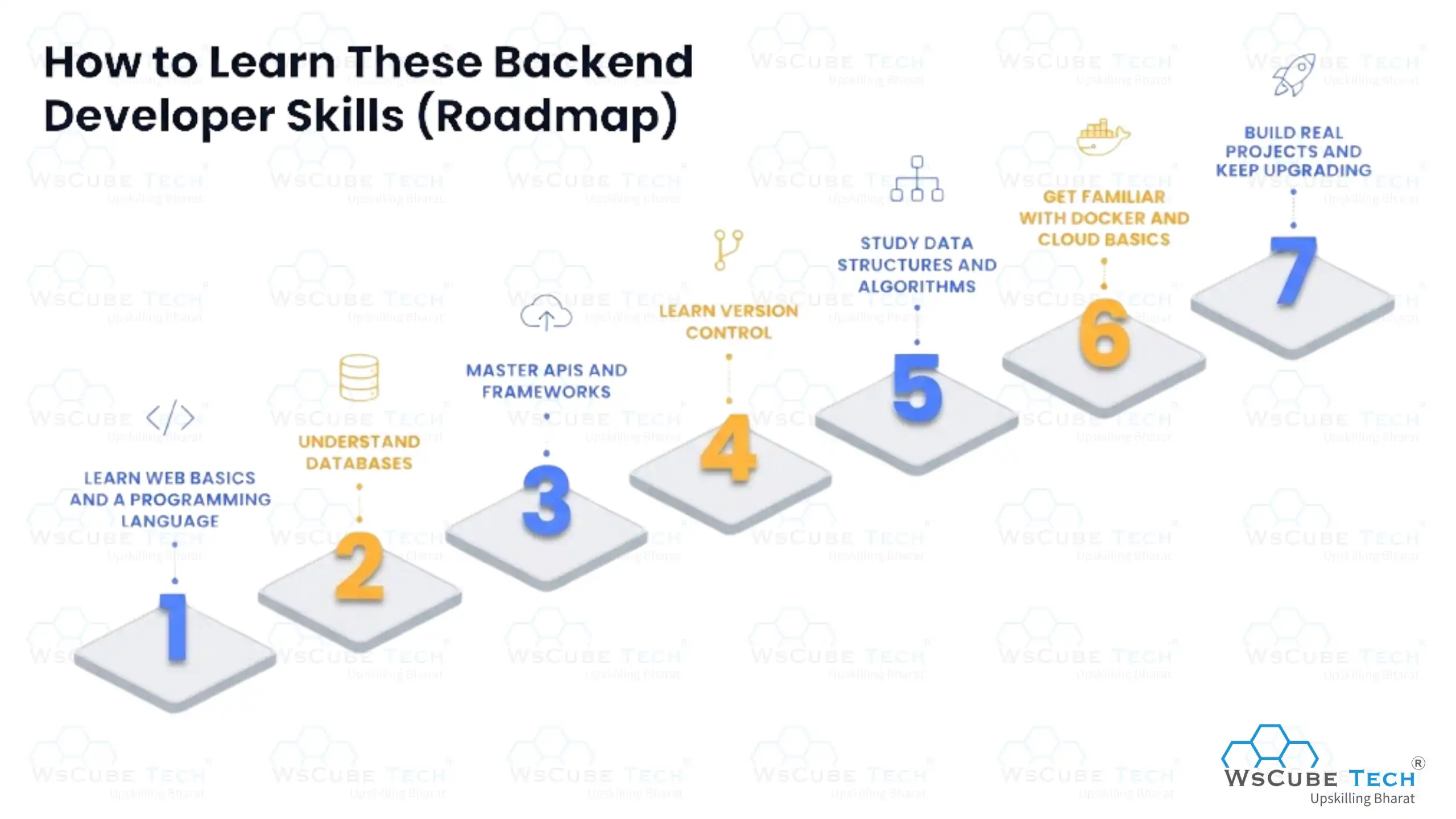
Step 1: Learn Web Basics and a Programming Language
Understand HTTP, DNS, and client-server communication first. Then pick Python, Java, or JavaScript (Node.js) and get comfortable with the fundamentals.
Step 2: Understand Databases
Learn SQL basics with MySQL or PostgreSQL. Explore NoSQL options like MongoDB once you are confident with relational databases.
Step 3: Master APIs and Frameworks
Practice building REST APIs with GET, POST, PUT, and DELETE methods. Apply this using a framework like Express.js, Django, or Flask.
Step 4: Learn Version Control
Start using Git and host your projects on GitHub. This is non-negotiable for any developer role.
Step 5: Study Data Structures and Algorithms
Focus on arrays, linked lists, and basic sorting or searching. This helps you crack interviews and write efficient code.
Step 6: Get Familiar with Docker and Cloud Basics
Learn basic containerization and try deploying a small app on AWS or Azure. This is expected even at entry level in 2026.
Step 7: Build Real Projects and Keep Upgrading
Apply everything through 2 to 3 full projects, then stay updated with new tools and trends. This is what actually proves your skills to recruiters.

FAQs on Backend Developer Skills
With consistent practice, most beginners can build job ready skills for backend developers in 6 to 12 months. The timeline depends on your prior coding experience and daily learning hours.
The skills required for backend developer roles include a programming language, database knowledge, API development, version control, and basic cloud understanding. These form the core of nearly every job description.
Python and JavaScript (Node.js) are the most beginner friendly choices. Both offer strong community support and are widely used across backend developer skills in 2026 job listings.
No, a degree is not mandatory. Many back end developer skills can be learned through self study, bootcamps, or online courses, as long as you can prove your ability through real projects.
Yes, at least the basics. Arrays, linked lists, and sorting concepts remain common in interviews and help you write efficient, scalable backend code.
Salaries vary by region and experience, but developers with strong backend developer skills generally earn competitive pay compared to many other tech roles. Cloud and security expertise can push this higher.
Yes, frontend developers can transition by learning server-side languages, databases, and APIs. Many of the skills for backend developers in 2026 build naturally on existing programming logic.
Yes, demand remains strong as businesses continue relying on scalable, secure server-side systems. Cloud, security, and API expertise are especially valued right now.
Start with SQL, since it builds a stronger foundation in structured data and relational logic. NoSQL databases like MongoDB are easier to pick up once SQL basics are clear.
Backend development can feel more complex due to servers, databases, and logic heavy tasks. With a structured roadmap and consistent practice, it becomes manageable for most learners.
Conclusion
Back-end development plays a crucial role in the success of web applications and software systems. Proficiency in backend programming languages, frameworks, data structures, and problem-solving is essential. Additionally, staying updated with emerging technologies and tools is a continuous process for a backend developer. Whether you are just starting your journey as a backend developer or looking to enhance your skills, this guide offers valuable insights to help you succeed in this ever-evolving field.
Want to be a full-stack web developer? WsCube Tech’s Full-stack web development course is the best way to learn full-stack web development. The course is comprehensive, affordable, and taught by experienced instructors. Enroll now and start your journey to becoming a full-stack web developer!
Explore Our Free Tech Tutorials
| Python Tutorial | Java Tutorial | JavaScript Tutorial |
| C Tutorial | C++ Tutorial | HTML Tutorial |
| CSS Tutorial | SQL Tutorial | DSA Tutorial |
Practice Coding With Our Free Compilers
| Online Python Compiler | Online HTML Compiler | Online C Compiler |
| Online C++ Compiler | Online JS Compiler | Online Java Compiler |
Join Our On-Campus Full Stack Related Courses
Free Courses for You





Leave a comment
Your email address will not be published. Required fields are marked *Comments (0)
No comments yet.