
Artificial intelligence is transforming digital marketing at an unprecedented pace. From content creation and ad optimization to customer support, AI-powered tools are now handling tasks that once required entire teams. As a result, many professionals are asking: will AI replace digital marketers?
The answer is not as simple as yes or no. While AI can automate repetitive tasks and improve efficiency, marketing still relies heavily on creativity, strategy, human insights, and relationship-building.
This has led to another common question: can AI replace digital marketers completely, or will it simply change how marketers work? In this blog, we explore AI’s impact on marketing, the roles most affected, and the skills professionals need to stay relevant in 2026 and beyond.
What is AI in Digital Marketing?
AI in digital marketing simply means using artificial intelligence tools, machine learning models, and automation software to plan, execute, and improve marketing tasks. These tools learn from huge amounts of data and use that knowledge to make decisions, generate content, predict outcomes, and automate repetitive work.
In simple words, AI tools use machine learning (learning patterns from data), natural language processing or NLP (understanding and generating human language), and automation (doing tasks without manual effort) to help marketers do their jobs faster and smarter.
From writing a blog post to choosing which ad to show a particular user, AI is now part of almost every step in a marketing campaign. This is not a new concept. Marketers have used basic automation tools for years, like email scheduling software or simple chatbots. What is different now is the scale and intelligence of these tools.
Today's AI can write entire articles, design social media creatives, analyze customer behavior, and even make real-time decisions on ad spending, all without constant human input.
How AI is Changing the Digital Marketing Industry (With Examples)
The pace of change in the last two years has been massive, and it raises a fair question: does AI replace digital marketing tasks across the board, or just certain parts of it? According to recent industry research, 91% of marketers now actively use AI in their work, a sharp jump from 63% just a year earlier according to Jasper's State of AI in Marketing 2026 report.
This is no longer a "nice to have" tool, it has become a core part of how marketing teams operate. Here is how AI is reshaping different areas of digital marketing:
1. Content creation speed
What used to take a content writer several hours can now be drafted by AI in minutes. AI tools can generate blog outlines, social media captions, product descriptions, and even full articles almost instantly. This does not mean the content is publish-ready without edits, but it dramatically cuts down the time needed for first drafts.
2. Hyper-personalization
AI can analyze a customer's browsing history, past purchases, and behavior patterns to show them content, offers, and product recommendations that feel tailor-made for them. This level of personalization at scale was simply not possible for human teams to do manually before.
3. Automated ad bidding
Platforms like Google Ads and Meta Ads now use AI to automatically adjust bids in real time based on which ads are likely to convert. This is called automated bidding, and it helps brands get better results from their ad spend without a person manually tweaking bids every hour.
4. AI-powered SEO
SEO tools now use AI to analyze competitor content, suggest keywords, find content gaps, and even predict which topics are likely to rank. This has made keyword research and content planning much faster than the manual processes marketers used a few years ago.
5. Chatbot-led customer support
AI chatbots can now handle a large share of customer queries instantly, 24 hours a day. They can answer FAQs, help with order tracking, and even guide customers through the buying process, freeing up human support teams for more complex issues.
AI is driving strong business results, with companies reporting an average 22% higher marketing ROI. This rapid adoption is helping businesses grow faster while raising concerns about the future of marketing jobs.
Recommended Professional Certificates
AI-Powered Digital Marketing Course
Performance Marketing Bootcamp
SEO Specialist Bootcamp
Tasks AI Can Automate in Digital Marketing
Let's get specific. Here is a list of tasks that AI tools can now handle, partly or fully, in a typical digital marketing workflow.
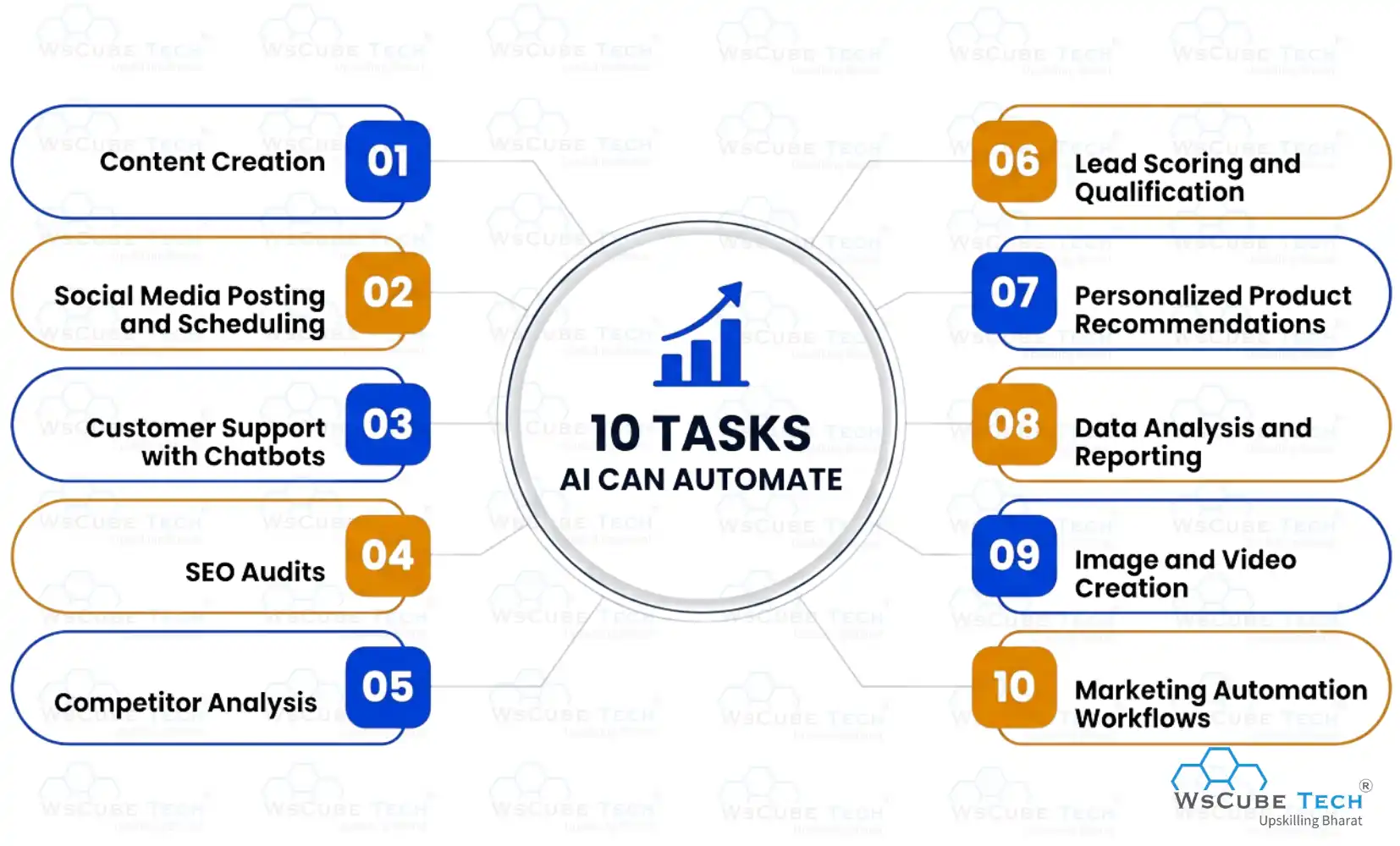
1. Content Creation
AI can write blog drafts, ad copy, email subject lines, product descriptions, and social captions based on simple prompts. It can also repurpose one piece of content into multiple formats, like turning a blog post into a LinkedIn post or a script for a short video.
2. Social Media Posting and Scheduling
AI-powered tools can suggest the best times to post, generate captions and hashtags, and automatically schedule content across multiple platforms. Some tools can even analyze which type of content performs best for a specific audience and adjust future posts accordingly.
3. Customer Support with Chatbots
As mentioned earlier, AI chatbots now handle a large portion of first-contact customer queries. They can be trained on a company's FAQs, product catalog, and policies to give instant, accurate responses around the clock.
4. SEO Audits
AI tools can crawl a website, identify technical issues like broken links, slow pages, or missing meta tags, and generate a prioritized list of fixes. This used to take SEO specialists hours of manual checking.
5. Competitor Analysis
AI tools can scan competitor websites, ad campaigns, and social media activity to give marketers a quick summary of what competitors are doing, what is working for them, and where there might be gaps to exploit.
6. Lead Scoring and Qualification
AI can analyze a lead's behavior, such as which pages they visited, how many emails they opened, and what they downloaded, to assign a score that predicts how likely they are to convert. This helps sales teams focus on the most promising leads first.
7. Personalized Product Recommendations
E-commerce platforms use AI to show "you might also like" or "frequently bought together" suggestions based on real-time behavior, which can significantly boost average order value.
8. Data Analysis and Reporting
Instead of manually pulling numbers from multiple dashboards, AI tools can combine data from different sources, identify trends, and generate easy-to-read reports with key insights highlighted.
9. Image and Video Creation
AI tools can now generate images, short video clips, and even voiceovers for marketing campaigns. This is especially useful for small businesses that do not have access to large design or video teams.
10. Marketing Automation Workflows
AI can trigger specific actions based on user behavior, like sending a follow-up email if someone abandons their cart or showing a retargeting ad to someone who visited a pricing page but did not sign up.
These automations are not just theoretical. Nearly two-thirds of marketers, 64.5%, say that AI impacts content creation and copywriting the most, exceeding the next highest task by 20 percentage points. This tells us where AI's influence is being felt most strongly right now.
What AI Can Do vs. What Humans Do Better
To really understand the future of digital marketing jobs, it helps to break things down into two clear columns: where AI has a clear advantage, and where humans still lead.
| What AI Does Better | What Humans Do Better |
| Processing large volumes of data quickly | Understanding emotions and cultural context |
| Generating content drafts at speed | Crafting original brand stories and voice |
| Running A/B tests across many variations simultaneously | Building genuine relationships with clients and influencers |
| Personalizing content for thousands of users at once | Making strategic decisions based on judgment, not just data |
| Working 24/7 without breaks | Handling crisis communication with empathy |
| Spotting patterns in customer behavior | Creating truly original ideas and campaign concepts |
| Automating repetitive, rule-based tasks | Navigating ambiguous or sensitive situations |
This table makes one thing clear. AI is excellent at speed, scale, and pattern recognition, but it struggles with things that require genuine human understanding, creativity, and judgment. The future of digital marketing is not about choosing one over the other; it is about combining both.
Upcoming Masterclass
Attend our live classes led by experienced and desiccated instructors of Wscube Tech.



AI vs Human Marketers: Key Differences
To go a bit deeper, here is a side-by-side comparison of AI and human marketers across the factors that matter most in real campaigns.
| Parameter | AI | Human Marketers |
| Speed | Extremely fast, can generate content and reports in seconds | Slower, takes time to research, write, and review |
| Creativity | Can combine existing ideas but lacks true originality | Can create fresh, culturally relevant, and emotionally resonant ideas |
| Cost | Lower cost for repetitive tasks at scale | Higher cost, especially for senior strategic roles |
| Emotional Intelligence | Cannot genuinely understand emotions, only predicts patterns | Can read between the lines and connect with people |
| Scalability | Can handle thousands of tasks simultaneously | Limited by time and team size |
| Strategic Thinking | Can suggest options based on data, but cannot set vision or goals | Sets long-term direction, brand positioning, and business goals |
| Error Rate | Can make confident but factually wrong statements (hallucinations) | Makes fewer factual errors when experienced, but can be slower to spot trends |
| Adaptability | Struggles with sudden, unexpected real-world events | Can adapt quickly to news, trends, and changing market conditions |
AI excels at speed, efficiency, and scalability, while humans lead in creativity, emotional intelligence, and strategic thinking. Most importantly, AI can make confident mistakes and struggles to adapt to cultural shifts or real-time events as effectively as human marketers.
Which Digital Marketing Jobs Are Most at Risk in This AI Era?
Let's be direct, because this is what most readers actually want to know. The question many people ask here is will AI take over digital marketing completely, or just specific tasks within it. The honest answer lies somewhere in between, and the breakdown below makes it clearer.
Roles that are most at risk:
- Data entry-based SEO roles: If your job mostly involves manually updating spreadsheets, checking rankings one by one, or doing basic on-page checks, AI tools can now do this faster and more accurately.
- Generic content writers: Writers who only produce basic, templated content without research, strategy, or a unique voice are competing directly with AI tools that can do the same thing for free or very cheap.
- Basic PPC managers: If your role is limited to setting up campaigns, adjusting bids manually, and pulling standard reports, automated bidding and AI campaign tools are already reducing the need for this kind of manual work.
Roles that are gaining value:
- AI prompt strategists: People who know how to get the best output from AI tools, by writing clear, effective prompts and refining results, are becoming valuable across teams.
- Marketing technologists: Professionals who understand how to connect different marketing tools, platforms, and AI systems together to build efficient workflows.
- Content directors: Instead of writing every piece themselves, content leads now guide AI tools, edit and improve AI drafts, and ensure everything matches the brand's voice and quality standards.
- SEO strategists: While basic SEO tasks are automated, the strategic side, understanding search intent, planning content clusters, and adapting to algorithm changes, still needs human expertise.
Rather than eliminating jobs, AI is changing how marketers work. If you're wondering is AI replacing digital marketers, current evidence suggests it is mostly automating tasks, not replacing people. While 53% of marketers believe AI will reduce jobs, real-world studies show roles are evolving, with marketers spending their time on different, higher-value activities.
If you are someone just starting your journey, understanding how to become a digital marketer in this new AI-driven landscape is more important than ever, because the entry point into this field now requires a different skill mix than it did even three years ago.
Expand Your Marketing Skills
Areas Where Human Creativity is Still Important
Even with all the progress in AI, there are areas where human input remains irreplaceable, at least for now. Let's look at a few examples.
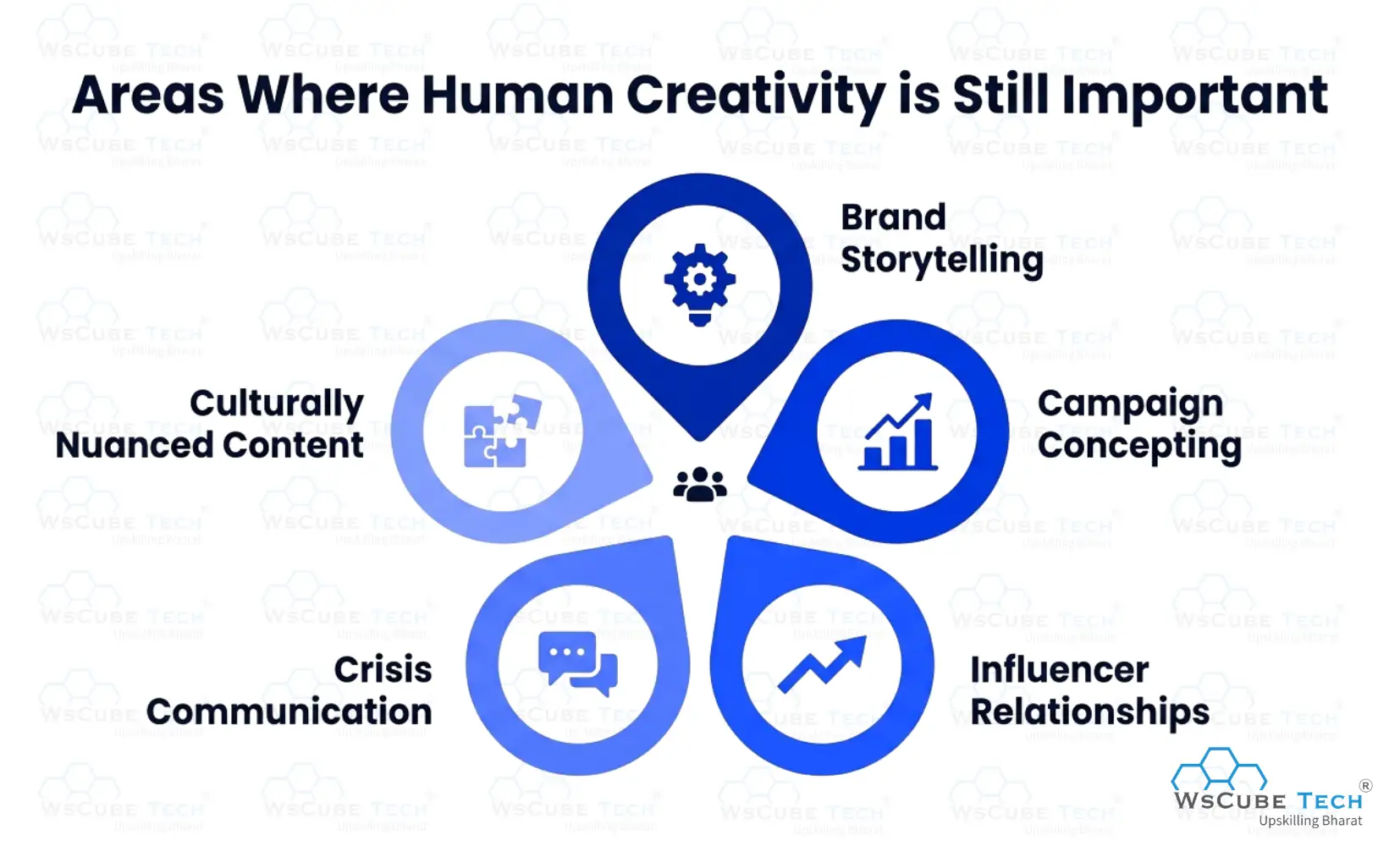
1. Brand storytelling
A brand's story is built on real history, real people, and real emotions. AI can help draft a story, but it cannot decide what makes a brand's journey meaningful or which moments will resonate with a specific audience. For example, a campaign built around a founder's personal struggle and journey connects with people because it is real, something AI cannot generate on its own without human input and lived experience.
2. Campaign concepting
The big idea behind a campaign, the kind of idea that becomes a talking point or goes viral, almost always comes from human insight into culture, timing, and emotion. AI can help execute the idea across formats, but the spark usually comes from a person who understands the audience deeply.
3. Influencer relationships
Working with influencers involves negotiation, trust-building, and understanding personal brand fit. These are relationship-driven tasks that depend on human communication skills, something AI tools simply cannot replicate.
4. Crisis communication
When something goes wrong, a product issue, a PR crisis, or a sensitive social situation, brands need carefully worded, empathetic, and quick responses. A wrong tone or poorly chosen words during a crisis can cause serious damage. This requires human judgment, not an automated response.
5. Culturally nuanced content
This is especially relevant for a diverse market like India. A campaign that works well in one region or language might not work the same way in another due to cultural differences, festivals, local slang, or sensitivities. AI can produce grammatically correct content in multiple languages, but it often misses the subtle cultural context that makes content feel authentic and relatable to a specific community.
Example: Take festive season campaigns in India as another example. A Diwali campaign for a brand in Rajasthan might use very different colors, language, and messaging compared to a campaign aimed at audiences in Tamil Nadu or West Bengal, even though the occasion is broadly similar. AI tools can generate festive content quickly, but they often default to generic templates unless a human marketer guides the tone, references, and visuals to match the specific region and audience.
In short, AI can produce content, but it cannot feel what will resonate with real people in real situations. That emotional and cultural understanding remains a deeply human skill, and it is one of the strongest reasons why human marketers will continue to play a central role in campaigns, even as AI handles more of the production work behind the scenes.
Benefits of Using AI in Digital Marketing
Despite the concerns around jobs, there is no denying that AI brings real, measurable benefits to marketing teams. Here are the key ones.
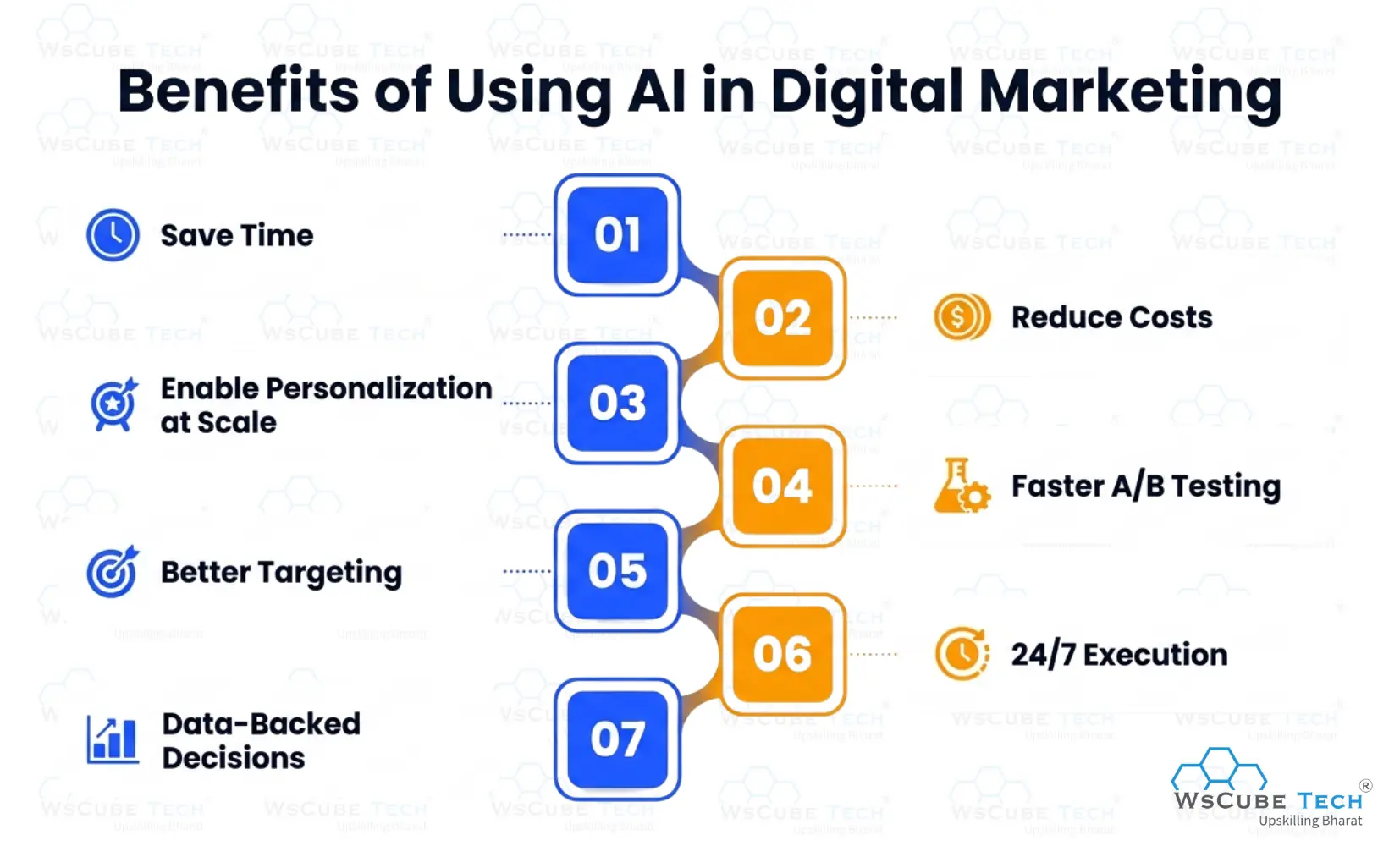
1. Save time
AI can complete tasks like drafting content, generating reports, or analyzing data in a fraction of the time it would take a human. This frees up marketers to focus on strategy and creative work instead of repetitive tasks.
2. Reduce costs
By automating routine work, businesses can manage more campaigns and content with smaller teams. This is especially helpful for small businesses and startups that do not have the budget for large marketing departments.
3. Enable personalization at scale
AI makes it possible to send personalized emails, show personalized website content, and offer personalized product recommendations to thousands or even millions of users at the same time, something that would be impossible to do manually.
4. Faster A/B testing
AI tools can run multiple versions of ads, emails, or landing pages simultaneously and quickly identify which version performs best, helping marketers make data-driven decisions faster.
5. Better targeting
AI can analyze huge amounts of customer data to identify patterns and segments that humans might miss, leading to more accurate audience targeting and better ad performance.
6. 24/7 execution
Unlike human teams, AI tools do not need breaks or sleep. Chatbots, automated email sequences, and ad optimization can run continuously, ensuring that marketing efforts never really stop.
7. Data-backed decisions
AI can process and summarize huge datasets, turning raw numbers into clear insights. This helps marketing teams make decisions based on actual data rather than guesswork.
These benefits explain why adoption has grown so quickly. Around 60% of businesses have already embraced AI for marketing purposes according to recent industry data, and that number is expected to keep climbing through 2026 and beyond.
Explore Our Most Popular Marketing Courses
Challenges and Risks of AI in Marketing
While the benefits are real, AI in marketing is not without its risks. Marketers need to be aware of these challenges to use AI responsibly.
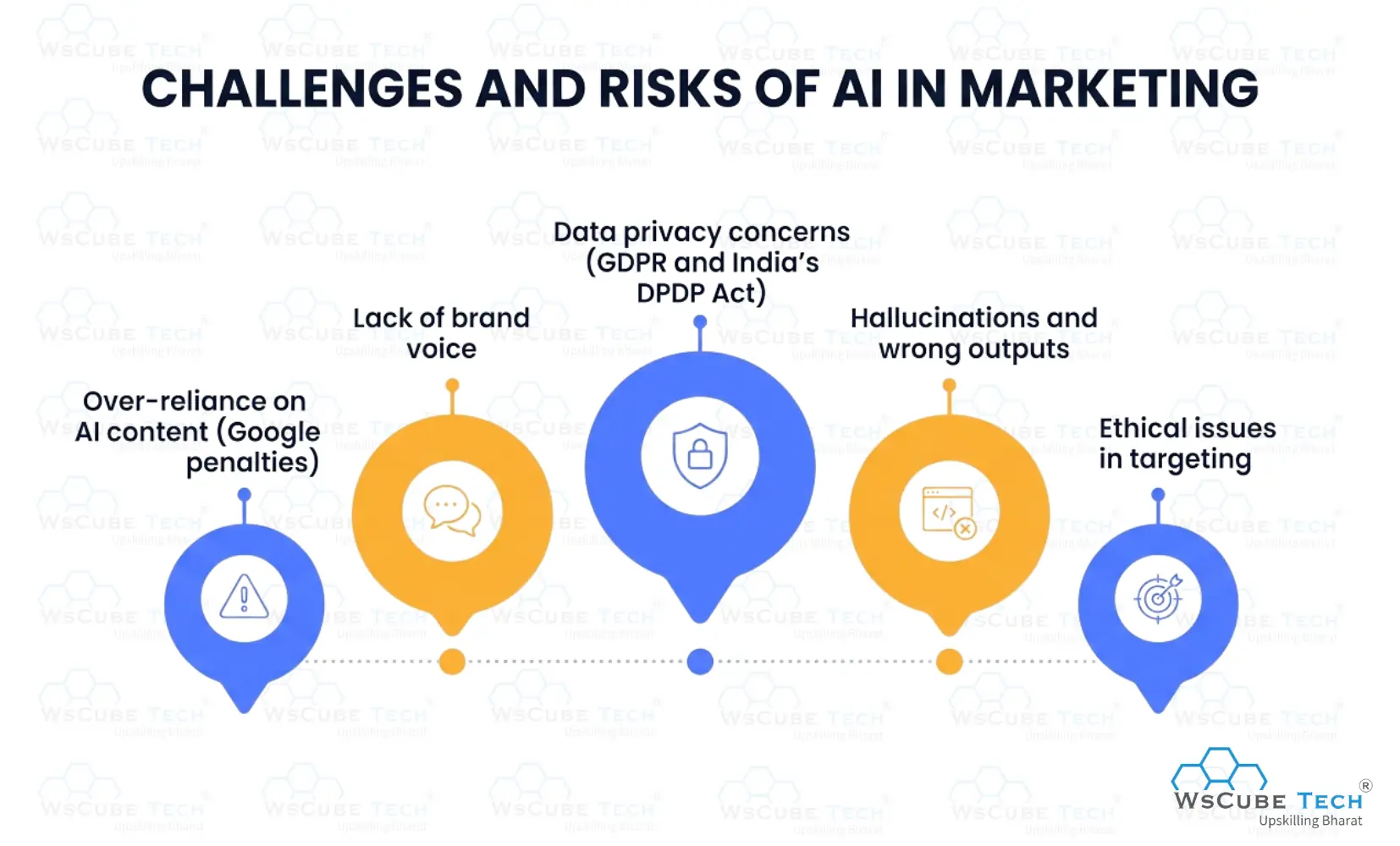
1. Over-reliance on AI content (Google penalties)
Search engines like Google have become stricter about low-quality, mass-produced AI content. Websites that publish large amounts of generic AI content without human review risk being penalized in search rankings, which can hurt organic traffic significantly.
2. Lack of brand voice
AI-generated content often sounds generic unless it is carefully guided and edited. Without human oversight, a brand's unique tone and personality can get lost, making content feel the same as everyone else's.
3. Data privacy concerns (GDPR and India's DPDP Act)
AI tools rely heavily on data, and this raises serious privacy questions. In India, the Digital Personal Data Protection (DPDP) Act, 2023 sets rules for how businesses can collect, use, and store personal data, including data used to train or run AI systems.
For AI companies, the DPDPA's rules on consent and lawful processing require that personal data used for training or model development be collected with explicit consent or on a legal basis. Marketers using AI tools that process customer data need to ensure they are complying with these regulations, similar to how GDPR applies in Europe.
4. Hallucinations and wrong outputs
AI tools can sometimes generate information that sounds confident but is factually incorrect; this is often called "hallucination." In marketing, this could mean wrong statistics, incorrect product claims, or made-up case studies, all of which can damage a brand's credibility if published without checking. In fact, more than half of marketers, 54.2%, cite inaccurate or inconsistent AI output as the biggest limitation they face when using these tools.
5. Ethical issues in targeting
AI-driven targeting can sometimes cross ethical lines, such as targeting vulnerable groups with specific ads, or making assumptions about people based on sensitive data like health conditions or financial status. Marketers need to be careful about how granular and intrusive their targeting becomes, both for ethical reasons and to stay compliant with privacy laws.
Understanding both the advantages and disadvantages of digital marketing in the context of AI helps marketers make smarter choices about which tools to adopt and how to use them responsibly. The brands that succeed with AI long term are usually the ones that treat it as a powerful assistant rather than a replacement for human judgment, keeping people in the loop at every important decision point.
How to Future-Proof Your Digital Marketing Career in 2026
If there is one section in this blog you should read carefully, it is this one. The good news is that future-proofing your career does not require starting from scratch or going back to college. It mostly means adjusting how you work and what you focus on. Here is how to make sure your career stays strong as AI continues to grow.
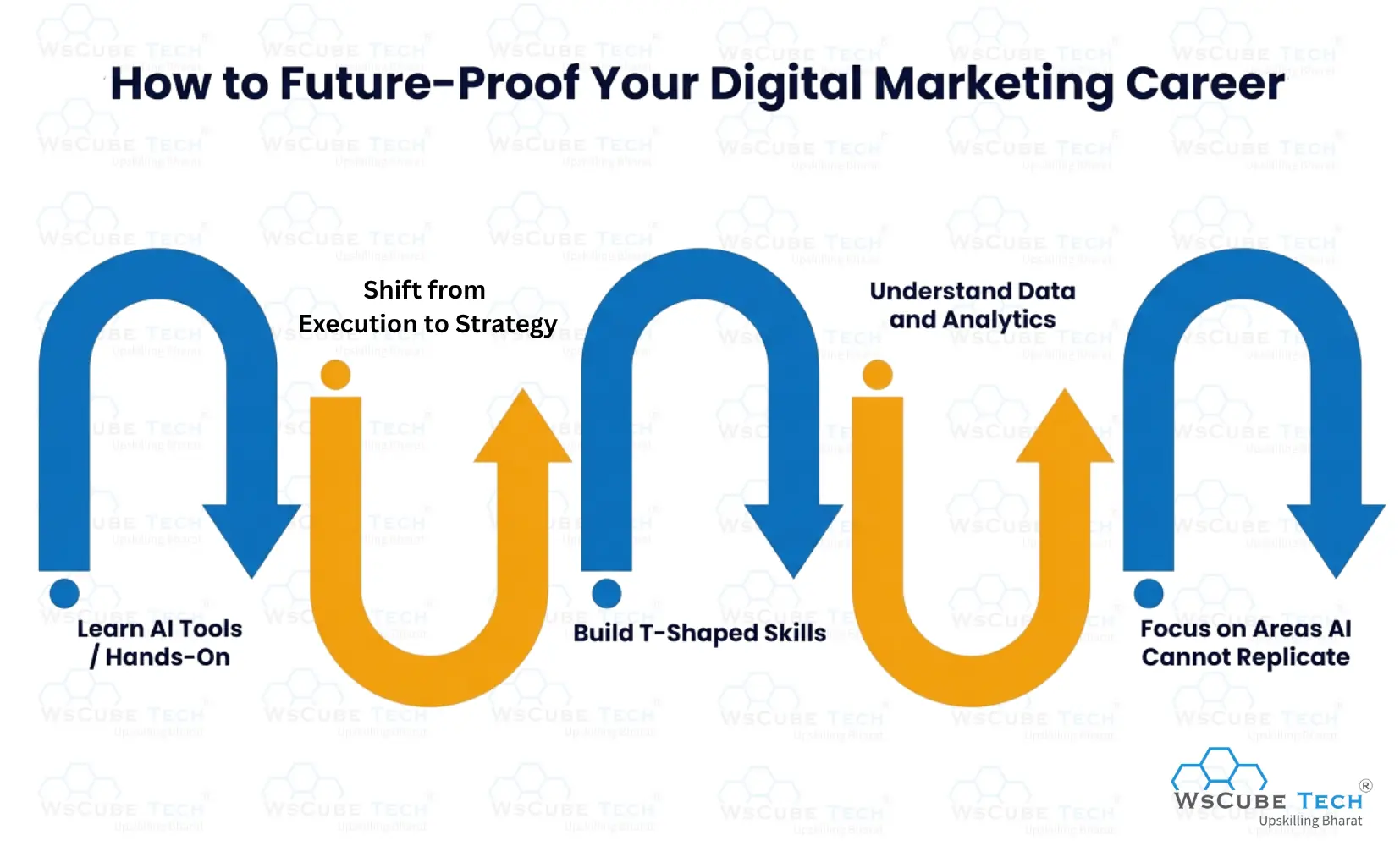
1. Learn AI tools hands-on
The biggest mistake marketers can make right now is ignoring AI tools out of fear or skepticism. Instead, spend time actually using tools like ChatGPT, Canva AI, and AI-powered SEO platforms. The more comfortable you are with these tools, the more valuable you become to any team.
2. Shift from execution to strategy
If your current role is mostly about doing tasks, writing posts, scheduling content, running basic reports, start shifting your focus toward the "why" behind these tasks. Learn to think about campaign strategy, audience psychology, and business goals, not just the "how" of getting tasks done.
3. Build T-shaped skills
A T-shaped marketer has deep expertise in one area (like SEO or paid ads) along with a broad understanding of other areas (like content, analytics, and design). This combination makes you more adaptable and valuable, because you can work across different parts of a campaign and understand how everything connects.
4. Understand data and analytics
As AI handles more execution, the ability to read data, interpret results, and make decisions based on numbers becomes even more important. Marketers who can confidently look at a dashboard and explain what it means for the business will always be in demand.
5. Focus on areas AI cannot replicate
Double down on skills like storytelling, relationship building, strategic planning, and creative thinking. These are the areas where human marketers will continue to add the most value, no matter how advanced AI becomes.
If you are looking for a structured way to build these skills, checking out digital marketing course syllabus can give you a clear roadmap of what to learn and in what order. Many courses today are also being updated to include AI tools as part of the curriculum, which makes them a practical starting point for both beginners and working professionals looking to upskill.
Before enrolling anywhere, it also helps to check the digital marketing course eligibility so you know exactly what is required to get started, since most programs today are designed to be accessible for people from different educational backgrounds.
Read More Guides Related to Artificial Intelligence
| AI Writing Tools | What is ChatGPT |
| Gemini vs.ChatGPT | Perplexity vs.ChatGPT |
| How to Use ChatGPT | How to Make Money With AI |
| ChatGPT Alternatives | Generative AI Roadmap |
Future of AI in Digital Marketing
AI's footprint in digital marketing is set to expand fast, with smarter context understanding, better content generation, and AI agents already handling tasks like campaign setup, reporting, and basic optimization. But will AI replace digital marketing in future entirely? Unlikely. The trend points to AI working alongside human teams, not replacing them.
What's clear is that skills like data analytics, AI literacy, and tech fluency will stay in high demand through 2030 (per WEF's Future of Jobs Report), and marketing roles mentioning AI already pay over 20% more on average, with general marketing roles seeing gaps above 32%. The market is sending a strong signal: AI fluency is becoming essential, not optional.
To explore where the industry is headed, check out this deep dive on the future of digital marketing and this breakdown of the scope of digital marketing in India.
Common Myths About AI Replacing Digital Marketers
There is a lot of misinformation floating around about AI and marketing jobs. Let's bust some of the most common myths.
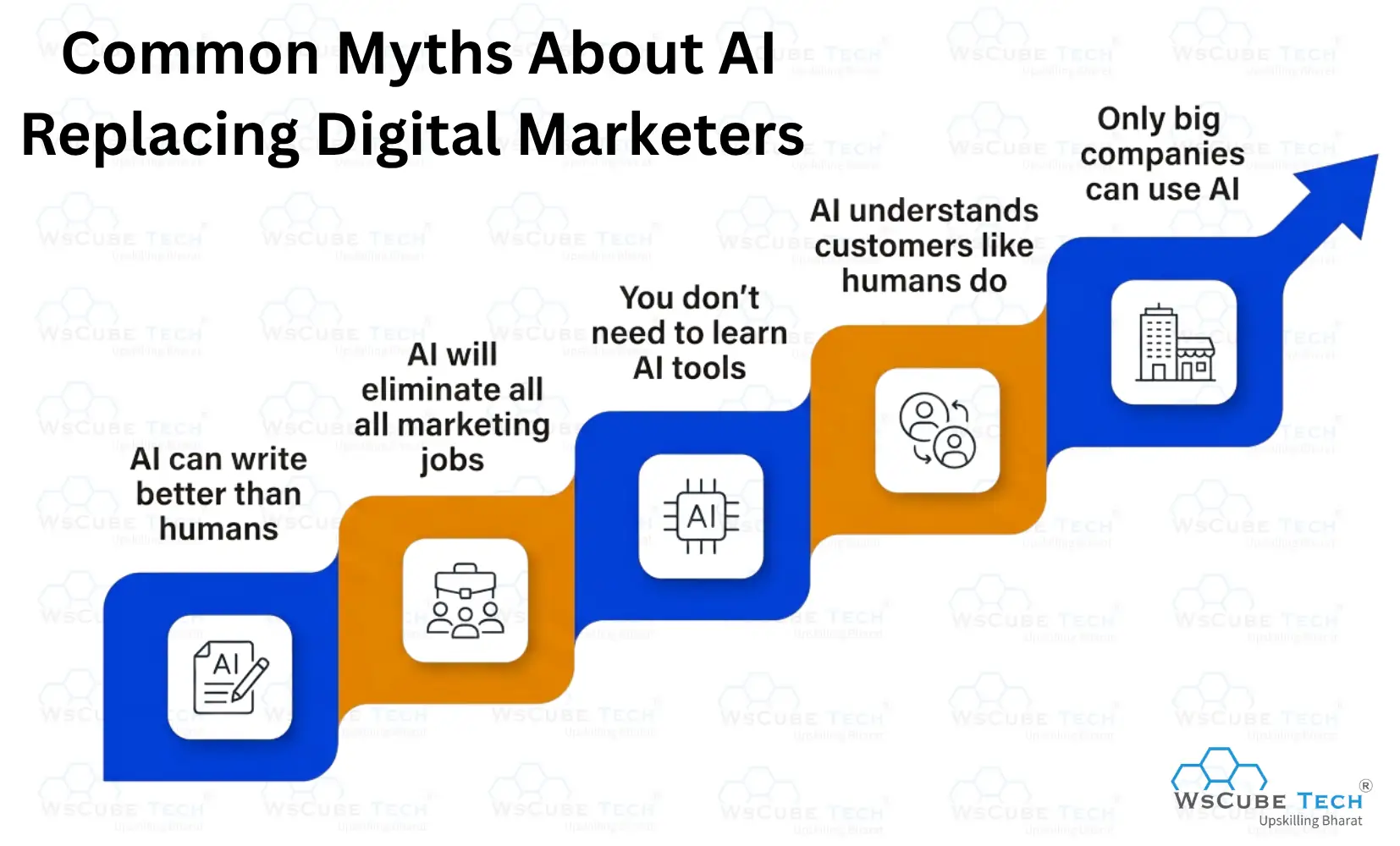
Myth 1: "AI can write better than humans"
This is partially true, but not fully. AI can write fast, grammatically correct content. However, it often lacks original insight, emotional depth, and brand-specific tone unless heavily guided by a skilled human editor. AI is a great starting point, not a finished product.
Myth 2: "AI will eliminate all marketing jobs"
This is simply wrong. While certain repetitive tasks are being automated, marketing as a whole still needs human strategy, creativity, and relationship management. In fact, marketing job openings are forecast to increase by 10% by 2026, faster than the general labor market, showing that the overall field is still growing, not shrinking.
Myth 3: "You don't need to learn AI tools"
This is dangerous thinking. Even if AI does not replace your specific job, marketers who do not learn to use AI tools will be competing against those who do, and who can complete the same work faster and often at a lower cost. Avoiding AI tools puts you at a real disadvantage.
Myth 4: "AI understands customers like humans do"
No, it does not. AI predicts behavior based on patterns in data, it does not truly "understand" emotions, motivations, or context the way a human does. It can tell you that a certain type of customer is likely to respond to a certain offer, but it cannot tell you why that offer matters to them on a personal level.
Myth 5: "Only big companies can use AI"
This is false. Many AI marketing tools today are affordable, and some are even free for basic use. Small businesses and solo marketers can use AI for content creation, social media scheduling, basic SEO, and customer support, making advanced marketing capabilities accessible to almost everyone, not just large corporations with big budgets.
Will AI Replace Digital Marketers: Video Guide
Frequently Asked Questions
No. AI can automate many repetitive tasks, but it cannot replace human creativity, strategic thinking, emotional intelligence, and relationship-building, which remain essential parts of digital marketing.
Yes. Digital marketing remains a strong career choice, especially for those who combine traditional marketing skills with AI tool knowledge. Marketing job openings are still expected to grow faster than the average job market in the coming years.
Roles focused on repetitive, rule-based tasks, such as basic content writing, manual SEO checks, and simple PPC management, are most affected. Strategic and creative roles are less affected and are evolving instead.
Marketers can use AI to speed up content creation, automate reporting, personalize customer experiences, and run faster A/B tests, while keeping human review and editing in the loop to maintain quality and brand voice.
Key skills include AI tool proficiency, data analytics, content strategy, prompt writing, and a strong understanding of customer psychology and brand storytelling.
Jobs that involve high-level strategy, creative campaign concepting, brand storytelling, client and influencer relationships, and crisis communication are the safest, since these rely heavily on human judgment and emotional intelligence.
Yes. With marketing roles continuing to grow and the demand for AI-savvy marketers rising, along with digital marketing salary trends showing AI-related roles paying more on average, 2026 remains a strong year to build or grow a career in digital marketing. For those considering this path, exploring the broader career in digital marketing options available today can help identify the right specialization to focus on.
Conclusion
So, will AI replace digital marketers? Based on everything we have covered, the honest answer is no, but it will replace marketers who refuse to adapt.
AI is transforming digital marketing, but it is not replacing marketers. While AI excels at automation, data analysis, and repetitive tasks, it cannot match human creativity, strategic thinking, emotional intelligence, or relationship-building skills.
The future belongs to marketers who use AI as a tool rather than compete with it. Those who focus on strategy, creativity, and insights will become even more valuable. AI is not ending digital marketing careers, it is changing them and creating new opportunities for professionals who adapt and grow.
Join Our On-Campus Digital Marketing Program
Explore Our Free Courses





Leave a comment
Your email address will not be published. Required fields are marked *Comments (0)
No comments yet.