
Data science is one of the fastest-growing career fields in today’s digital world. It helps businesses analyze data, find patterns, and make better decisions. As companies increasingly rely on data to guide their strategies, the demand for skilled data science professionals is growing rapidly across many industries.
If you are wondering how to become a data scientist, you are not alone. Many students and professionals are choosing this career because of high salaries, strong job demand, and global opportunities. It combines programming, analytical thinking, and problem-solving, making it both challenging and rewarding.
Let’s learn the step-by-step process, required skills, educational qualifications, tools, career opportunities, and tips needed to build a successful data science career.
What is Data Science?
Data Science is a field that involves collecting, processing, and analyzing data to extract useful insights and support decision-making. It combines techniques from statistics, programming, and machine learning to understand patterns and trends in data. Data science is widely used across industries such as healthcare, finance, marketing, and technology to solve real-world problems and improve business performance. The following are the key components of data science:
- Data Collection: Gathering raw data from different sources
- Data Cleaning: Removing errors and preparing data for analysis
- Data Analysis: Finding patterns and meaningful insights
- Data Visualization: Presenting data using charts and graphs
- Machine Learning: Building models to make predictions
- Decision Making: Using insights to make better business decisions
Who is a Data Scientist?
Data scientist is a professional who collects, processes, and analyzes large amounts of data to extract meaningful insights. You use skills like programming, statistics, and data analysis to identify patterns, solve problems, and support better decision-making in organizations across different industries.
A data scientist also builds machine learning models and creates visualizations to present data clearly. You help businesses make data-driven decisions, improve performance, and predict future trends based on structured and unstructured data.
Why Choose Data Science as a Career?
Data science is a highly rewarding career with strong demand, excellent salaries, and opportunities to work on real-world problems across industries. Below are the key reasons:
- High Demand and Job Opportunities: Data science professionals are in high demand across industries like IT, healthcare, finance, and e-commerce, as organizations increasingly rely on data-driven insights to improve decisions and gain competitive advantage.
- Attractive Salary Packages: Data scientists earn competitive salaries due to their specialized skills in data analysis, machine learning, and programming, making it one of the highest-paying and in-demand career options in the technology and analytics domain today.
- Diverse Career Opportunities: Data science offers multiple career paths, such as data analyst, machine learning engineer, business analyst, and AI specialist, allowing you to choose different roles based on your interests and skills.
- Work on Real-World Problems: As a data scientist, you get the opportunity to solve real-world problems by analyzing data, predicting trends, and helping organizations make better decisions that create meaningful impact.
- Continuous Learning and Growth: Data science is a constantly evolving field, requiring you to keep learning new tools, technologies, and techniques, which helps in long-term career growth and skill development in a competitive environment.
Recommended Professional Certificates
Data Analytics Course with Gen AI
Data Science Course with Internship & Placement Support
Educational Qualifications Required to Become a Data Scientist
To start a career as a data scientist, having a strong foundation in fields like computer science, mathematics, statistics, or engineering is highly beneficial. Most professionals have a bachelor’s degree, while some also pursue a master’s degree for advanced knowledge. However, a formal degree is not always mandatory, as many people enter this field through online courses and self-learning. The following are the common educational qualifications required:
- Bachelor’s Degree: A degree in computer science, IT, mathematics, or a related field helps you build a strong foundation in programming, data analysis, and core concepts.
- Master’s Degree (Optional): Some candidates pursue a master’s degree in data science, analytics, or artificial intelligence to gain deeper knowledge and access better career opportunities.
- Certifications & Online Courses: Short-term courses help you learn practical skills, tools, and real-world applications used in the industry, making it easier to gain hands-on experience and build job-ready knowledge.
How to Become a Data Scientist After 12th in India?
To become a data scientist after 12th, you can follow a simple roadmap: choose the right stream → select a relevant degree → learn key skills → practice with projects → gain internships → apply for jobs.
The journey usually begins with building a strong foundation in mathematics and logical thinking. After that, you can pursue a degree like B.Tech, B.Sc, or BCA in a related field. Along with your studies, start learning Python, SQL, statistics, and basic machine learning concepts.
The most important part is practical experience. Working on projects like data analysis or prediction models helps you build real skills. With consistent practice and hands-on experience, you can become ready for internships and entry-level roles.
Also Read: Data Science Course Syllabus: Fees, Duration, Eligibility, Details
Skills Required to Become a Data Scientist
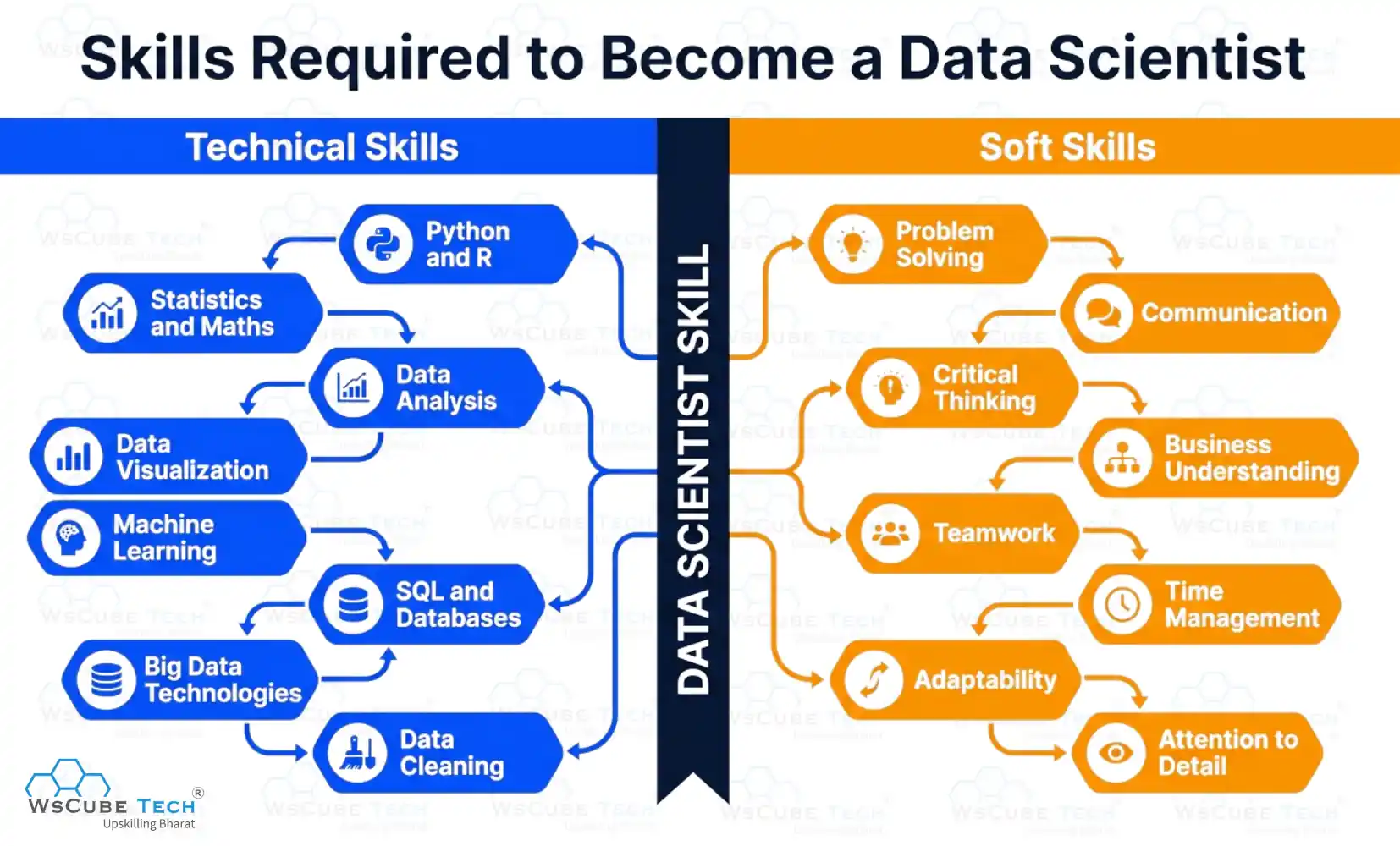
To become a data scientist, you need both technical skills and problem-solving abilities to work with data effectively. Below are the required skills:
Technical Skills
- Programming Languages (Python/R): Learn languages like Python or R to handle data, perform analysis, build models, and automate tasks efficiently in real-world data science projects.
- Statistics and Mathematics: Understanding statistics, probability, and basic mathematics helps you analyze data, identify patterns, and make accurate predictions using logical and analytical approaches.
- Data Analysis: Ability to clean, process, and analyze large datasets to extract useful insights and support business decisions using structured and unstructured data sources.
- Data Visualization: Use tools such as charts and graphs to present data clearly, helping stakeholders understand insights and make better decisions.
- Machine Learning: Knowledge of machine learning algorithms helps you build predictive models, automate decision-making processes, and improve the accuracy of data-driven solutions over time.
- Database Management (SQL): You should understand SQL to efficiently store, manage, and retrieve data from databases, which is essential for handling large datasets in real-world projects.
- Big Data Technologies: Familiarity with tools like Hadoop or Spark helps you process and analyze large volumes of data quickly and efficiently in distributed computing environments.
- Data Cleaning and Preprocessing: Learn to handle missing data, remove errors, and prepare datasets for analysis, ensuring accurate and reliable results in data science projects.
Soft Skills
- Problem-Solving Skills: Ability to identify problems, analyze data, and find effective solutions using logical thinking and a structured approach in real-world scenarios.
- Communication Skills: Strong communication helps explain complex data insights in simple terms, making it easier for non-technical stakeholders to understand and make decisions.
- Critical Thinking: You should evaluate data logically, question assumptions, and interpret results accurately to ensure reliable insights and better decision-making outcomes.
- Business Understanding: Understanding business goals helps data scientists align their analysis with real-world problems and deliver insights that create real value for organizations.
- Teamwork and Collaboration: Ability to work with cross-functional teams such as developers, analysts, and managers to complete projects efficiently and achieve common goals.
- Time Management: Managing time effectively helps handle multiple tasks, meet deadlines, and complete projects without compromising quality or accuracy.
- Adaptability: You need to continuously learn new tools, technologies, and techniques, as the data science field evolves rapidly with changing trends and innovations.
- Attention to Detail: Paying close attention to data ensures accuracy, reduces errors, and improves the overall quality of analysis and decision-making processes.
How to Become a Data Scientist? Step-by-Step
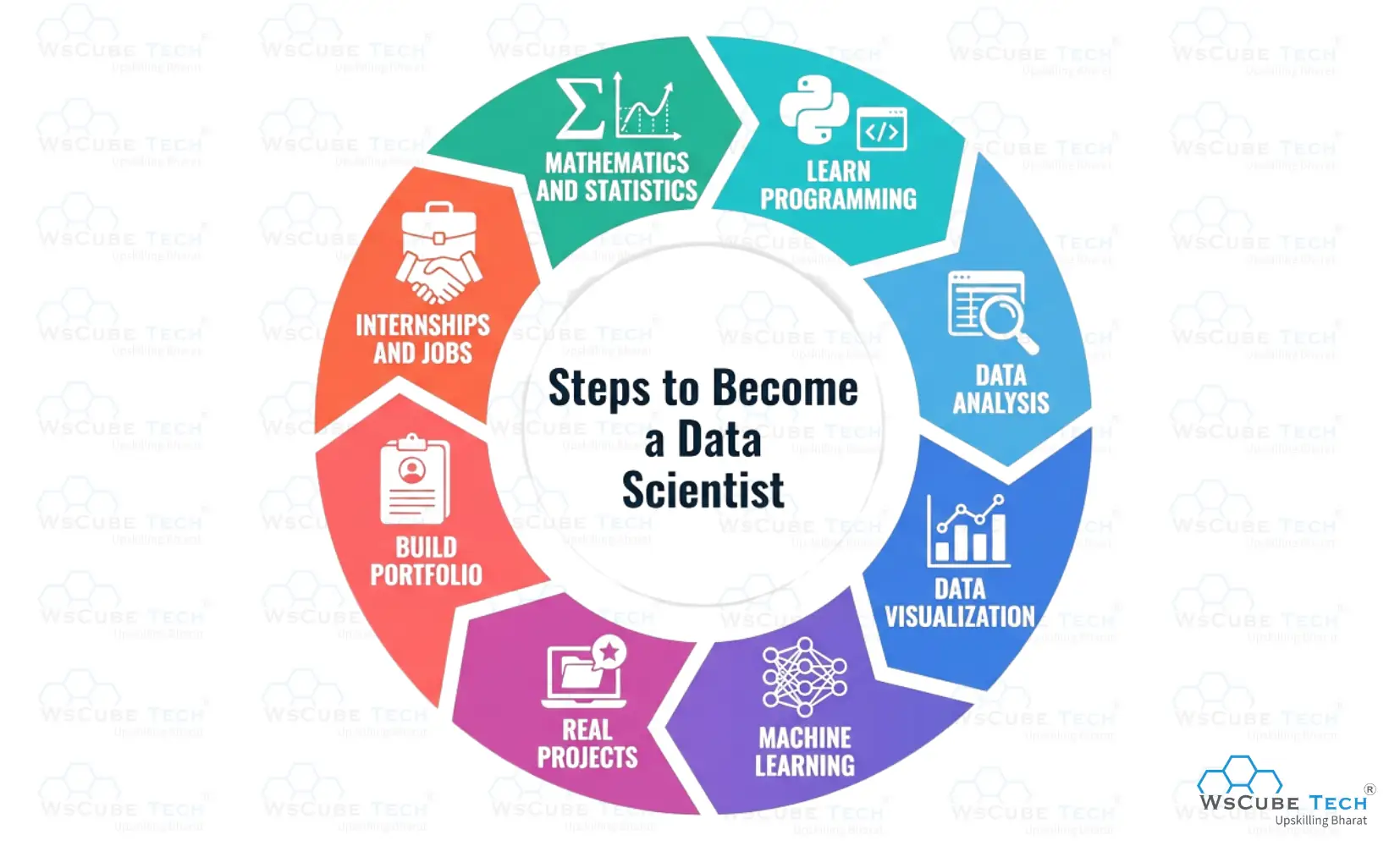
Here are the important steps that you can follow to become a successful data scientist:
Step 1: Learn Basic Mathematics & Statistics
Start by learning basic mathematical concepts such as algebra, probability, and statistics, as they form the foundation of data science. These concepts help you understand data patterns, analyze results, and build accurate models for better decision-making.
Step 2: Learn Programming (Python/R)
Learning programming is an important step in becoming a data scientist. Languages like Python and R are widely used for data analysis, data manipulation, and building machine learning models. Python is especially popular because of its simple syntax and powerful libraries.
You should focus on understanding basic concepts such as variables, loops, functions, and data structures. Practice using libraries like NumPy, Pandas, and Matplotlib to work with data efficiently and perform analysis in real-world projects.
Step 3: Understand Data Analysis
Learn how to collect, clean, and process raw data to extract useful insights. You should understand techniques such as data wrangling, exploration, and interpretation that help you identify patterns, trends, and meaningful insights to support better decision-making.
Step 4: Learn Data Visualization
Learn how to present data using charts, graphs, and dashboards to make complex information easy to understand. You should use visualization tools and libraries to highlight trends, patterns, and insights, helping stakeholders quickly interpret data and make informed decisions.
Step 5: Master Machine Learning Concepts
Machine learning is a core part of data science that allows systems to learn from data and make predictions. You should understand concepts such as supervised and unsupervised learning, along with basic algorithms such as regression, classification, and clustering.
Focus on how models are trained, tested, and improved for better accuracy. Learning concepts like overfitting, underfitting, and model evaluation helps you build reliable and effective machine learning models for real-world problems.
Step 6: Work on Real Projects
Working on real projects helps you apply your knowledge to practical problems. It improves your skills in data analysis, machine learning, and visualization. Building projects also strengthens your portfolio and demonstrates your abilities to employers, increasing your chances of getting job opportunities.
Step 7: Build a Strong Portfolio
Create a strong portfolio by showcasing your projects, code, and problem-solving skills. Include real-world projects, case studies, and clear explanations to show your abilities. A well-organized portfolio helps employers understand your skills and increases your chances of getting hired.
Step 8: Apply for Internships and Jobs
Start applying for internships and entry-level data science roles to gain practical experience. Internships help you understand real-world projects, work with teams, and improve your technical and problem-solving skills in a professional environment.
Prepare a strong resume, update your portfolio, and practice interview questions regularly. Apply on job portals and company websites to increase your chances of getting selected and starting your data science career.
Read in Detail: Data Scientist Roadmap: A Guide for Beginners
Challenges in Becoming a Data Scientist and How to Overcome Them
Below are some challenges faced while becoming a data scientist:
- Learning Multiple Skills: Data science requires knowledge of programming, statistics, and machine learning, which can feel overwhelming for beginners trying to learn all of it at once.
- Handling Large Datasets: Working with large, complex datasets can be challenging, especially when cleaning, processing, and analyzing them efficiently. It requires proper tools, techniques, and skills to extract meaningful insights accurately and effectively.
- Understanding Complex Concepts: Topics such as machine learning algorithms, data modeling, and advanced statistics can be difficult to grasp without proper guidance and consistent practice.
- Lack of Practical Experience: Many beginners struggle due to limited hands-on experience, making it difficult to apply theoretical knowledge to real-world data problems effectively.
- Keeping Up with New Technologies: The data science field evolves rapidly, and staying up to date with new tools, technologies, and trends can be challenging.
How to Overcome Them:
- Start with basics and learn step-by-step instead of trying to learn everything at once.
- Practice regularly by working on real-world projects and datasets.
- Use online resources, tutorials, and communities for continuous learning.
- Break complex topics into smaller parts for better understanding.
- Stay consistent and keep updating your skills with new tools and technologies.
Upcoming Masterclass
Attend our live classes led by experienced and desiccated instructors of Wscube Tech.





How Long Does It Take to Become a Data Scientist?
The time required to become a data scientist depends on your background, learning speed, and consistency. On average, it can take around 6 months to 1 year if you follow a structured learning path and practice regularly.
For beginners with no technical background, it may take about 1 to 2 years to gain strong knowledge in programming, data analysis, and machine learning. Learning step by step and building a solid foundation are important for long-term success.
If you already have skills in programming, mathematics, or analytics, you can become job-ready faster. Working on real projects, practicing regularly, and staying consistent can significantly reduce your learning time.
Tips to Become a Successful Data Scientist
Follow consistent learning, practice, and skill development strategies to build a strong and successful career in data science. Below are the useful tips:
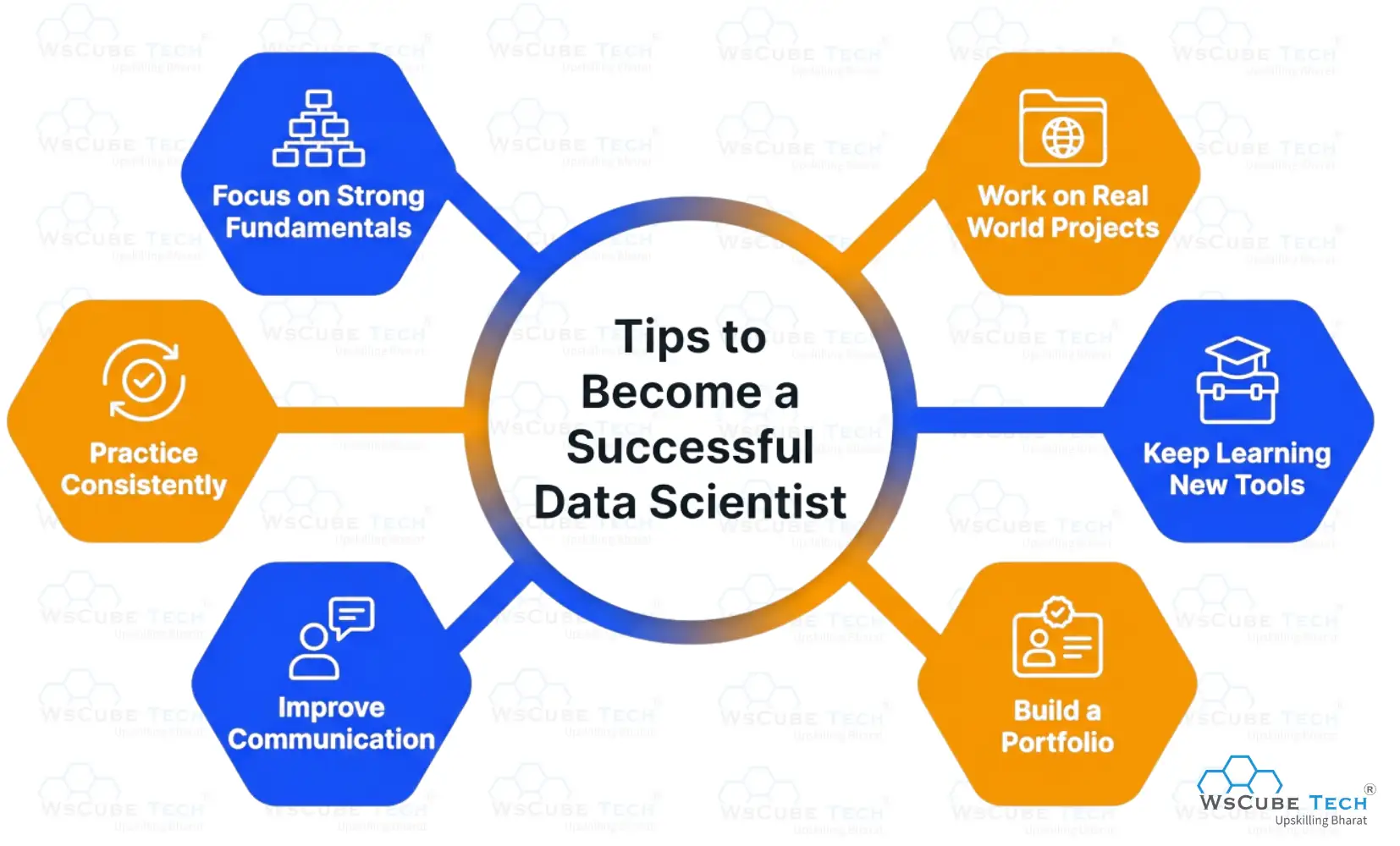
- Focus on Strong Fundamentals: Build a strong foundation in programming, mathematics, and statistics, as these core concepts are essential for understanding advanced data science topics effectively.
- Work on Real-World Projects: Practice consistently using real datasets and solve practical problems to build hands-on experience. This helps improve your analytical thinking, technical skills, and confidence in handling real-world data science challenges effectively.
- Keep Learning New Tools: Stay updated with the latest tools, technologies, and trends in data science, as the field evolves rapidly and requires continuous learning to remain competitive.
- Build a Portfolio: Create and showcase projects, case studies, and your work to demonstrate your skills and attract potential employers or recruiters effectively.
- Improve Communication Skills: Learn to present your insights clearly through reports, dashboards, or presentations, helping non-technical stakeholders understand complex data and make better decisions.
- Practice Consistently: Dedication and regular practice are key to mastering data science, as continuous effort helps you improve your skills, confidence, and problem-solving abilities over time.
Tools and Technologies Used in Data Science
Below are the tools and technologies commonly used in data science:
| Category | Tools/Technologies | Purpose |
| Programming Languages | Python, R | Used for data analysis, machine learning, and building data-driven applications. |
| Data Analysis Libraries | Pandas, NumPy | Help in data manipulation, cleaning, and numerical computations. |
| Data Visualization Tools | Matplotlib, Seaborn, Tableau | Used to create charts, graphs, and dashboards for better understanding of data. |
| Machine Learning Tools | Scikit-learn, TensorFlow | Used to build and train machine learning models. |
| Database Management | MySQL, PostgreSQL | Used to store, retrieve, and manage large amounts of data. |
| Big Data Technologies | Hadoop, Spark | Help in processing and analyzing large-scale data efficiently. |
| Version Control | Git, GitHub | Used to track code changes and collaborate with teams. |
Read more on Career Guides
Data Science Career Path & Job Roles
Data science offers diverse career paths with multiple roles suited to different skills and interests. Below are the key job roles:
- Data Analyst: Collects, cleans, and analyzes data to identify patterns and trends. They create reports and visualizations that help organizations make informed and data-driven business decisions.
- Data Scientist: Works with complex datasets to build machine learning models and extract meaningful insights. They combine programming, statistics, and domain knowledge to solve real-world business problems effectively.
- Machine Learning Engineer: Designs, builds, and deploys machine learning models for real-world applications. They focus on improving model performance, ensuring scalability, and optimizing algorithms, while integrating solutions into production systems to deliver efficient, reliable, and automated data-driven solutions.
- Business Analyst: Analyzes business data to understand requirements and improve processes. They act as a bridge between technical teams and stakeholders, supporting better strategic decision-making.
- Data Engineer: Responsible for designing, building, and managing data pipelines that collect, store, and process large volumes of data efficiently. They ensure data is clean, reliable, and easily accessible for analysis and business use.
Also Read: Data Analyst vs. Data Scientist: Key Differences & Comparison
Salary of Data Scientists in India
The salary of data scientists in India varies based on experience, skills, and location. Beginners earn a decent starting salary, while experienced professionals receive high packages. With increasing demand, salaries in this field continue to grow across industries.
The table below highlights the salaries of data scientists in India based on experience level.
| Experience Level | Average Salary (Per Year) |
| 0–1 years | ₹5,00,000 – ₹10,00,000 |
| 1–3 years | ₹8,00,000 – ₹14,00,000 |
| 4–6 years | ₹10,00,000 – ₹20,00,000 |
| 7–9 years | ₹20,00,000 – ₹40,00,000 |
| 10–14 years | ₹30,00,000 – ₹65,00,000 |
| 15+ years | ₹50,00,000 – ₹1,02,00,000 |
Top Industries Hiring Data Scientists
Many industries actively hire data scientists to analyze data and improve decision-making processes. Below are the top industries:
- IT & Software: The IT and software industry uses data science to build intelligent applications, improve user experience, detect system issues, and develop AI-driven solutions that enhance performance and innovation.
- Healthcare: Uses data science to analyze patient data, predict diseases, improve treatments, and optimize hospital operations, helping doctors make better decisions and improve overall patient care and outcomes.
- Finance & Banking: Banks and financial institutions use data science for fraud detection, risk analysis, customer segmentation, and investment predictions, helping them make secure and profitable financial decisions.
- E-commerce: Uses data science to analyze customer behavior, recommend products, optimize pricing strategies, and enhance customer experience through personalized marketing and data-driven insights, helping increase sales and improve overall business performance.
- Education: The education sector uses data science to analyze student performance, personalize learning experiences, improve course content, and make better decisions for academic planning and institutional growth.
- Marketing and Advertising: Uses data science to analyze customer behavior, target audiences, optimize campaigns, and improve ROI, helping businesses reach the right customers and increase engagement effectively.
- Manufacturing Industry: Applies data science for predictive maintenance, quality control, and supply chain optimization, helping companies reduce costs, improve efficiency, and enhance production processes.
Future Scope of Data Science
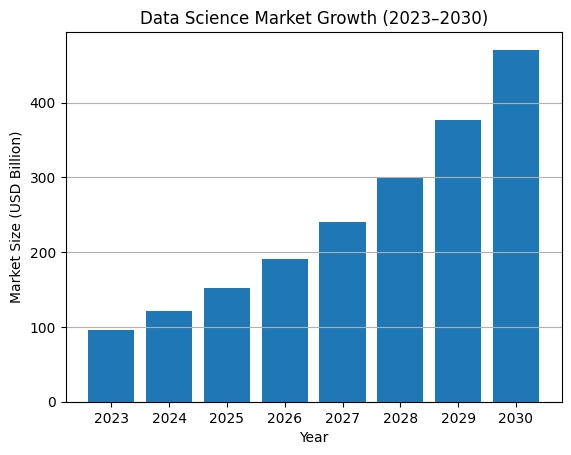
Data science has a very strong future as the demand for data-driven decision-making continues to grow rapidly across industries. According to market research, the global data science platform market was valued at around $96.25 billion in 2023 and is expected to reach $470.92 billion by 2030, growing at a 26% CAGR, showing massive career opportunities.
In India, the growth is even faster, with the market expected to reach around $1,193.1 million by 2027 at a 33.7% CAGR. This rapid expansion is driven by technologies like AI, machine learning, IoT, and big data, increasing the demand for skilled data scientists across industries.
Learn Data Science with WsCube Tech
If you are interested in learning data science in a structured way, WsCube Tech offers a practical and comprehensive online data science course. In this course, you will work on real datasets, build machine learning models, and deploy AI applications. It helps you gain practical skills and fast-track your career in data science, machine learning, and AI within 20 weeks.
Explore Our Data Related Courses
| Data Analytics Course | Live Internship + 100% Job Support |
| Business Analytics Course | Live Internship + 100% Job Support |
| Data Science Course | Live Internship + 100% Job Support |
FAQs About Becoming a Data Scientist
A data scientist collects, cleans, and analyzes large amounts of data to extract meaningful insights. You build models, identify patterns, and create visualizations to help organizations make data-driven decisions and solve real-world problems effectively.
A degree in computer science, mathematics, statistics, or a related field is helpful, but strong practical skills, certifications, and project experience are equally important for building a successful data science career.
Basic coding knowledge is essential in data science, especially in Python or R, as most tasks like data analysis, visualization, and machine learning require programming skills to work efficiently.
Yes, data science is a highly rewarding career with strong demand, high salaries, and growth opportunities, as companies across industries rely heavily on data-driven decision-making and advanced analytics.
The time required depends on your background and learning pace, but generally, it takes around 6 months to 2 years to become job-ready with consistent learning, practice, and real-world project experience.
Yes, you can start after 12th by choosing a relevant degree and learning essential skills like programming, statistics, and data analysis, while building projects and gaining practical experience over time.
Python is widely preferred in data science because it is easy to learn and has many useful libraries, while R is commonly used for statistical analysis and creating data visualizations.
A master’s degree is not mandatory, but it can provide advanced knowledge and better opportunities. Many professionals enter the field through certifications, self-learning, and strong project portfolios.
Key skills include programming, statistics, data analysis, machine learning, data visualization, and problem-solving, along with communication skills to clearly explain insights to stakeholders.
Common tools include Python, R, SQL, Tableau, Power BI, and machine learning frameworks, which are used to analyze data, build models, and create visualizations to improve understanding and decision-making.
Yes, mathematics is important, especially topics like statistics, probability, and linear algebra, as they help us understand data patterns, build models, and make accurate predictions.
Yes, beginners can learn data science with proper guidance, structured learning, and regular practice, starting from basics and gradually moving to advanced topics with real-world projects.
You can become a data scientist without a degree by learning through online courses, practicing regularly, building strong projects, and gaining practical experience to showcase your skills to employers.
No, prior experience is not required. Beginners can start by learning fundamentals, building projects, and applying for internships to gain real-world experience and improve their skills.
Conclusion
Data science is a promising and rapidly growing career that offers excellent opportunities across multiple industries. With the increasing importance of data in decision-making, skilled professionals are in high demand and can build a stable and rewarding career.
To become a data scientist, you need to focus on learning the right skills, gaining practical experience, and staying consistent in your efforts. By following a structured path, working on real projects, and continuously improving your knowledge, you can successfully start and grow your career in data science.
Practice Coding With Our Free Compilers






Leave a comment
Your email address will not be published. Required fields are marked *Comments (0)
No comments yet.