What are the latest digital marketing trends shaping 2026, and which ones actually matter for your business? This is the question every marketer, brand, and business owner is asking right now. The answer has changed significantly.
AI-powered search, social commerce, agentic advertising, and generative engine optimization are rewriting the rules of how brands get discovered and how customers make buying decisions.
In this article, we have covered 19 current digital marketing trends across SEO, content, paid media, social media, and emerging technologies. Whether you are a business owner, a working professional, or someone exploring a digital marketing course to build future-ready skills, this guide will help you understand where the industry is heading and what you need to act on now.
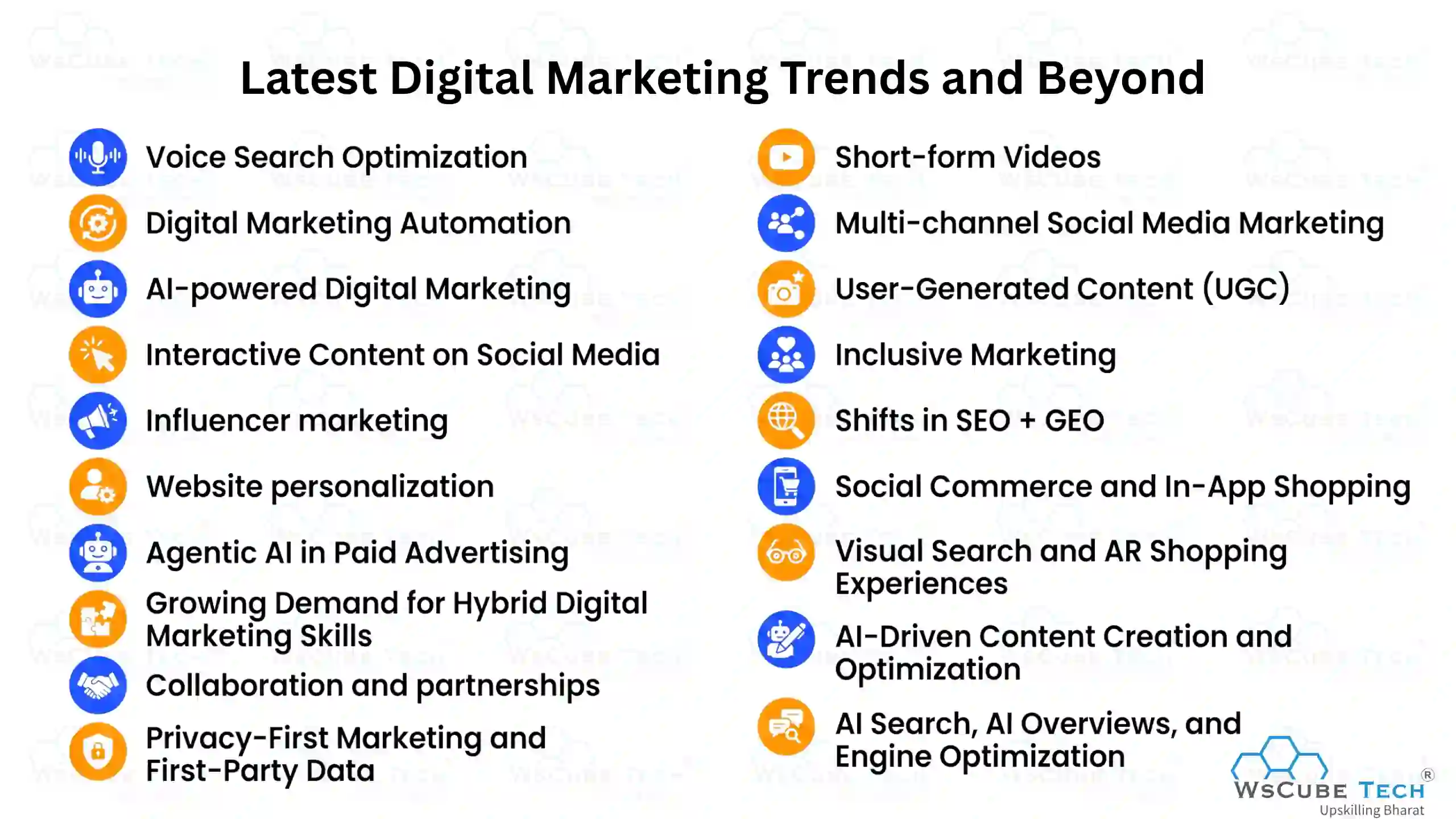
Latest Digital Marketing Trends 2026 and Beyond
We have divided the digital marketing latest trends for 2026 into some segments, like content marketing, Search Engine Optimization (SEO), video marketing, email marketing, social media marketing, and more. So, let’s kick start now.
1. Voice Search Optimization
Voice search optimization is obviously not a new trend. We have seen people talking about it for years now.
- So, why is voice search still a trend? Here are some stats for your reference:
- Nearly 50% of the users research products and services with voice search.
- 38% of Gen Z consider online purchases using voice search.
- Over 70% of the voice search results are websites with HTTPS.
These stats show that people are using voice search not only to find information but also to buy products and services online.
Earlier, the focus was more on optimizing the website content for voice search. Now, businesses must also optimize their sales approach and website for voice commerce to allow product purchases using voice search.
For instance, many businesses are now using AI-powered solutions like Jetson.ai to optimize their digital marketing strategy for both voice search and voice commerce.
When we talk about voice search, digital assistants like Alexa, Siri, Google Assistant, and Cortana can’t be kept out of the picture.
These assistants are the major drivers of voice search queries on Google and other search engines. According to Strategy Analytics, nearly 50% of the Alexa and Google Home users find these assistants now a necessity for them.
How to optimize for voice search?
Now that you know that it is one of the biggest digital marketing trends and have realized the importance of voice search, it’s time to learn how to optimize your website for voice search
Here are some quick and effective tips for doing so:
a) Understand consumer behaviour:
The voice search queries will be slightly different for every business depending on the age and demographics of the consumers. Analyze the consumer behaviour and insights to understand the common queries of people about your business and the type of devices used by them for search.
b) Optimize content for users:
Rather than stuffing multiple keywords in the content for the sake of improved rankings, shift your focus to user-optimized content.
Structure your content properly by using natural language because voice search is all about natural language processing. Use conversational keywords and questions that are being asked by the users.
c) Schema markup:
Utilize schema to mark up your content and notify Google crawlers of the intent of your site. Structured data and schema markup have the potential to improve your rankings for voice search.
This also increases your chances of appearing in featured snippets. Google Assistant typically reads the featured snippet content to the users.
d) Include FAQs on all web pages:
The voice search queries generally begin with what, how, when, where, etc. This means people are putting in questions. By including an FAQ section on the specific web pages, you get the opportunity to answer the common questions asked by users.
e) Focus on local search:
Small businesses should also optimize their content for local search queries. People nowadays search for phone numbers, directions, products, and other things using voice commands.
2. Digital Marketing Automation
Automation is here for a while now, but not many businesses were implementing it in digital marketing. Things have changed now. It is now among the recent digital marketing trends.
Using digital marketing automation, businesses can automate almost everything related to their marketing efforts, including email marketing, landing pages, PPC, social media, lead generation, etc.
There are several benefits of automation in digital marketing. It can save businesses and marketers a lot of time, improve efficiency, increase revenue, and make marketing teams more productive.
Tasks that can be automated with marketing automation
- Google Ads placements
- Schedule social media posts
- Send emails
- Data analysis
- Send SMS
- Data management
- Website widget content
- Lead nurturing
3. AI-powered Digital Marketing
Artificial intelligence has moved from a supporting tool to the strategic core of modern digital marketing. Among all the latest digital marketing trends, AI is evolving the fastest and the biggest shift in 2026 is the rise of Agentic AI.
Unlike earlier AI tools that needed human prompts at every step, agentic AI can analyze performance data, coordinate across platforms, and adapt campaigns in real time without constant oversight. This is fundamentally changing what marketers spend their time on less execution, more strategy.
What AI can now handle in digital marketing
- Generate and test ad creative variations at scale
- Forecast customer behavior before campaigns go live
- Personalize emails, product recommendations, and CTAs at an individual level
- Run real-time bid adjustments in paid advertising
- Score and qualify leads without manual intervention
However, 2026 has surfaced a key challenge: AI sameness. As more brands use the same tools, outputs are starting to look and sound identical. Three in four marketers are now concerned that AI-generated content risks making their brand indistinguishable from competitors.
The new trends in digital marketing around AI are therefore not just about adoption. They are about using AI to enhance originality, not replace human judgment. Brand voice and strategic direction remain irreplaceable.
4. Interactive Content on Social Media
It is one of those top digital marketing trends that is here for a while now, but most of the businesses found it a casual thing to use. Interactive content not only increases the engagement rate on social media, but also improves user experience.
Following stats by Outgrow shows that interactive social media content can boost conversion rate, reduce bounce rate, and significantly increase the number of post shares.
If you are not sure what interactive content actually is, here is a short overview:
The content that can encourage users to interact with it, rather than just consuming it, is called interactive content. Examples of such content on social media include open-ended questions, polls and surveys, contests, videos, etc.
Today, every social media platform has many interactive features for improved engagement. For instance, you can post polls and surveys on Facebook, Twitter, Instagram stories, and Telegram. These things drive users to click on the post and engage with it.
Sharing some examples of interactive social media content on various platforms:
Dave Gerhardt has conducted a poll on LinkedIn, and more than 2,700 people have engaged with it.
In the second example, a simple Instagram poll has encouraged people to tap and respond to it.
5. Influencer marketing
Many businesses and brands are already using influencer marketing as part of growing organic opportunities for their products and services. This type of digital marketing brings genuine customers who can stick for longer terms.
A few more key reasons to choose influencer marketing in 2026 are that it improves audience engagement on social media platforms, especially Facebook and Instagram, and a high number of product endorsements and recommendations.
This year, we will see a rise in influencer marketing becoming part of the digital marketing strategy for more small and medium businesses.
As one of the latest digital marketing trends 2026, influencer marketing will see these innovations:
- Growth of micro-influencers
- Increased focus on performance tracking
- Long-term collaborations with influencers
- Increased focus on return on investment (ROI)
- Influencers will become communicators
What are the key benefits of influencer marketing?
- Raise brand awareness
- Develop trust and authority
- Reach target audience and potential customers
- Build partnerships with other businesses
- Increase conversions
- More leads
- Faster reach to market
- Cost-effective compared to traditional advertising
Recommended Professional Certificates
AI-Powered Digital Marketing Course
Performance Marketing Bootcamp
SEO Specialist Bootcamp
6. Website personalization
As the number of businesses shifting online with a website or mobile app is increasing exponentially, the competition has become massive.
This is an era where every business has less than a minute on the website to grab the attention of the users. Offering a personalized experience will work as a blessing in disguise.
If you haven’t heard about website personalization and its role in digital marketing, here is an overview:
It is an art of providing a unique and custom experience to website visitors. When people visit the site, they come across products and services they have been actually looking for. The experience is personalized on the basis of their past purchases, location, user behaviour, age, etc.
In 2026, this will be one of the hottest online marketing trends in India and around the world. More eCommerce sites and businesses will be adopting this approach to increase customer satisfaction, improve engagement rate, reduce bounce rate, convert leads into customers, and enhance business reputation.
The better the personalized experience on a website, the more the chances of converting visitors into customers. Modern technologies like artificial intelligence (AI) and machine learning play a key role here. It is among the latest digital marketing trends 2026.
Benefits of website personalization
- Landing page optimization
- More conversions
- Reduced bounce rate
- Relevant content recommendation to visitors
- More qualified leads
- High engagement rate
- High customer satisfaction
7. Agentic AI in Paid Advertising
Paid advertising in 2026 has been restructured around AI. The online marketing trends in this space have moved well beyond format innovations. Autonomous systems now handle what marketers previously managed manually.
Agentic AI in PPC can make multi-step decisions across a campaign lifecycle: audience selection, creative generation, bid adjustments, and performance analysis, without step-by-step human input.
Key shifts in paid advertising for 2026
- AI-driven bidding: Systems predict conversion probability in real time and adjust bids dynamically across thousands of micro-segments
- Dynamic ad copy: AI continuously generates and tests headline combinations, optimizing for live intent signals
- Predictive planning: 31% of marketers now use AI models to forecast campaign performance before launch, reducing wasted spend
- Shoppable video and CTV: Connected TV has evolved from brand awareness to a direct-action channel where viewers can purchase within the content they are watching
- Retail media networks: Closed-loop measurement now links ad exposure directly to verified purchase
For businesses running Google Ads or social media campaigns, these digital marketing trends demand a shift from manually managed campaigns to AI-supervised ones, where the marketer sets strategy and interprets outcomes rather than executing each step.
8. Growing Demand for Hybrid Digital Marketing Skills
The most important digital marketing trend reshaping careers in 2026 is the rise of the hybrid marketer, someone who combines creative thinking, data literacy, and AI tool fluency in a single role.
Traditional specializations still matter. But the fastest-growing demand is for marketers who can work across disciplines while directing AI systems to produce better outcomes. As marketing teams flatten and AI handles more execution, individual contributors are expected to think more strategically and operate more autonomously.
Most in-demand skills in 2026
- AI tool proficiency like prompt engineering, generative AI, analytics platforms
- Cross-channel strategy and funnel thinking
- Data interpretation and performance analysis
- SEO combined with Generative Engine Optimization (GEO)
- Content strategy that balances AI efficiency with human originality
Digital marketing jobs are growing at 14% annually. As AI lowers the barrier to building products, the marketer who can capture and retain audience attention becomes the most valuable person in any business. Updated digital marketing courses that cover AI integration alongside traditional channels are the clearest starting point.
How to make a career in digital marketing?
Since the demand for digital marketers is growing significantly, you can start your career in this field with the best digital marketing courses. These courses help you build the required skills, such as Search Engine Optimization (SEO), social media marketing, Google Advertising, etc.
9. Collaboration and partnerships
One of the fastest-accelerating online marketing trends in 2026 is the formalization of brand partnerships with independent creators. The creator economy has matured, and brands are no longer experimenting with this channel. They are building dedicated creator programs as a core part of their digital marketing strategy.
Social content and creator recommendations now heavily influence how consumers discover new brands, with search used primarily for validation after discovery. This makes creator partnerships one of the highest-ROI channels available today.
Why this is a priority in 2026
- Niche creators with smaller but engaged audiences consistently outperform broad-reach campaigns on ROI
- Long-term creator collaborations build significantly more trust than one-off sponsored posts
- Creator-led content feels more authentic than brand-produced content, driving higher engagement
- Platforms like Instagram, YouTube, and TikTok now offer native tools for brand-creator collaboration and performance tracking
For small and medium businesses, this is one of the most accessible new trends in digital marketing. Even local businesses can partner with community-level creators to build awareness without large advertising budgets.
10. Privacy-First Marketing and First-Party Data
Among the most critical digital marketing trends for 2026 is the shift to privacy-first marketing. With third-party cookies being phased out and data privacy regulations tightening globally, first-party data has become a foundational marketing asset.
First-party data that are collected directly from your customers through your own channels enables precise audience targeting, personalized experiences, and accurate attribution without relying on third-party sources.
What first-party data activation looks like
- Email and SMS lists with behavioral segmentation
- CRM data integrated with paid ad platforms for custom audience targeting
- On-site behavioral data powering personalized recommendations
- Zero-party data (surveys, quizzes, preference centers) where customers voluntarily share preferences
Businesses that treat data privacy as a trust-building strategy rather than a compliance checkbox are pulling ahead. Integrating your CRM with Google Ads and Meta is no longer optional. It is the baseline for competitive paid marketing in 2026.
Upcoming Masterclass
Attend our live classes led by experienced and desiccated instructors of Wscube Tech.


11. Short-form Videos
TikTok certainly took the world by storm, becoming the most popular social media platform among younger users and brands. In fact, many popular social media portals started copying its concept. We saw Instagram introducing Reels, YouTube added YouTube Shorts, and Twitter also tried Fleets but removed it in 2021.
As users' attention span gets shorter, businesses are leveraging short-form videos to attract potential clients, making it one of the latest digital marketing trends. Yes, you can find other captivating and detailed videos on YouTube and other channels, but short-form videos are now a completely different type of content, targeting a section of the audience to engage with a product or brand.
Users can see it while scrolling through their phones. The challenge is to grab their attention in the first two seconds and then try to save the video and brand into the memory through engaging and unique content.
With most marketers saying that it offers the highest ROI, it has become the top content marketing format. According to HubSpot, around 44% of marketers use short-form videos to market their products.
12. Multi-channel Social Media Marketing
Go back a few years, and you will realize that you had only Facebook to care about your social media presence and connectivity. Everyone was on Facebook, and you could see everything that happened on one portal.
However, in 2026, you have multiple channels to maintain your social media presence and stay updated with everything happening in the world. Now, social media marketing is a different aspect of digital marketing that requires specific skills, knowledge, and tools. It is one of the best marketing channels with the highest ROI, with around 43% of marketers using it more than other platforms. The reason is that it is a leading channel for product discovery and buying. No wonder it is among the top digital marketing trends for 2026 and will continue to reign.
People now explore products and brands through social media to know about reviews, quality, and other aspects, and then make purchasing decisions. The Consumer Trend Survey by HubSpot shows that social media is a preferred channel for product discovery for Millennials and GenZ, and Boomers and Gen X are warming up to it. 59% of Millennials, 64% of Gen Z, and 47% of Gen X have said that they discovered products through social media.
Social media is a one-stop destination for in-app purchases, influencer recommendations, product discovery, and customer services via direct messages. According to a survey, 87% of marketers have agreed that social media is effective, and 59% have claimed to drive more social sales than in past years.
13. User-Generated Content (UGC)
User-generated content is a content type that users post as reviews or feedback for products on different social media profiles. It is similar to content that affiliate marketers and influencers post, but businesses don’t work with users directly to create the content in user-generated content.
It is unsponsored content that many marketing professionals rely on as a cost-effective strategy to promote their products and increase brand awareness. It is more like word-of-mouth marketing, where users generate content and share it across various platforms with the audiences, and businesses can use this content through giveaways and social sharing.
Although affiliate and influencer marketing techniques still stand strong, GC feels more organic to viewers, winning their trust. According to Gartner, around 80% of consumers believe that user-generated content improves product discovery, brand experience, and trust.
14. Inclusive Marketing
When we talk about customer experience, inclusive marketing is a crucial aspect. As people are becoming more conscious and aware, businesses are focusing on inclusive marketing. Besides providing users with personal experiences, marketers need to craft their strategies and messages while caring about minorities.
Gone are the days when brands didn’t care much about people from monitory groups while crafting their marketing strategies. Now, they must think of inclusiveness to keep up with the current digital marketing trends. They must ensure their websites are adjusted for poor-sighted people.
Businesses with brick-and-mortar stores must make their spaces accessible for people with disabilities. Inclusivity is not restricted to disabilities. When viewers see brands featuring someone they can relate or identify with, they are more likely to buy their products. Remember, minorities are consumers, too, so you can’t ignore them while creating marketing messages and tactics.
15. Shifts in SEO + GEO
SEO is undergoing its most significant transformation in years. According to Gartner, businesses will see a 50% decline in organic search traffic by 2028 due to AI-powered search enhancements. Yet 92% of marketers plan to maintain or increase their SEO investment because the channel remains critical, even as the rules change.
What traditional SEO looks like in 2026
Keyword stuffing is dead. Search engines now reward EEAT (Experience, Expertise, Authoritativeness, and Trustworthiness). Content written to genuinely answer user questions outperforms content written purely to rank. Your strategy must also include video, image, and audio optimization not just text to capitalize on every dimension of modern search.
The new frontier: Generative Engine Optimization (GEO)
This is the most important addition to any digital marketing trends 2026 discussion. AI-powered search tools like Google AI Overviews, ChatGPT search, Perplexity don't show ten blue links. They synthesize answers and cite sources directly. The question is no longer just "Can I rank on page one?" - it is "Will AI cite my content as a trusted source?"
How to optimize for GEO
- Write content built on first-hand expertise and original insight (AI deprioritizes generic aggregated content)
- Use direct, clear answers to specific questions (AI overviews favor content that is easy to extract)
- Earn citations from high-authority publications in your niche
- Structure content with clear headings and factual claims that AI can parse easily
- Optimize for conversational, intent-driven queries, not just head keywords
Businesses that treat GEO as a parallel strategy alongside traditional SEO will be far better positioned as AI search captures an increasing share of information discovery. This is one of the most significant online marketing trends of 2026 and one most businesses have not yet adapted to.
Must-Know Concepts in Digital Marketing
16. Social Commerce and In-App Shopping
Social commerce is one of the fastest-growing new trends in digital marketing, and it is reshaping how consumers discover and buy products. The line between browsing and buying on social media has effectively disappeared.
Platforms like Instagram, TikTok, and Pinterest now offer fully native shopping experiences. Users can discover, evaluate, and purchase a product without ever leaving the app. TikTok Shop in particular has accelerated this shift dramatically, turning short-form content directly into a sales channel.
What social commerce looks like in 2026
- TikTok Shop and Instagram Shops enabling in-app checkout
- Live shopping streams where viewers purchase in real time during broadcasts
- Creator-tagged products that link directly to purchase pages
- Pinterest and YouTube shoppable pins and video ads
- AI-powered product recommendations embedded within social feeds
According to HubSpot, social media is now the preferred purchase channel for Gen Z and Millennials, not just for discovery but for completing transactions. Businesses that have not set up native storefronts on at least one social platform are already behind on this trend.
For SMBs, social commerce is one of the most accessible online marketing trends. It removes friction from the buyer journey and puts products directly in front of audiences where they already spend time.
17. Visual Search and AR Shopping Experiences
Visual search and augmented reality are transforming how consumers find and evaluate products online, making them two of the most significant latest digital marketing trends for eCommerce businesses in 2026.
Visual search allows users to search using images instead of text. A shopper can photograph a pair of shoes on the street and instantly find where to buy them. Google Lens, Pinterest Lens, and similar tools have made this mainstream. For businesses, this means product images need to be optimized just as carefully as text-based content.
AR shopping takes this further by letting consumers interact with products virtually before purchasing. Consumers can visualize how furniture looks in their home, try on glasses or makeup, or walk through a virtual store, all from their phone.
Why this matters for your digital marketing strategy
- 71% of consumers say they would shop more frequently if AR were available
- Visual search queries are growing rapidly, particularly among Gen Z shoppers
- AR-powered try-ons reduce return rates significantly for fashion and beauty brands
- Google and Pinterest are investing heavily in visual search infrastructure, making it an emerging SEO surface
Businesses in fashion, beauty, furniture, and home decor have the most immediate opportunity here. But any eCommerce brand should be optimizing product imagery and exploring AR integrations as part of their broader digital marketing strategy.
18. AI-Driven Content Creation and Optimization
AI-driven content creation is one of the most important new trends in digital marketing, and in 2026 it has moved well past the experimental stage. Tools like ChatGPT, Gemini, Jasper, and Claude are being used to draft blog posts, ad copy, email campaigns, social captions, and product descriptions at a scale that was previously impossible.
What AI-driven content creation covers
- Blog and long-form content drafted and optimized with AI assistance
- Ad copy variations generated and A/B tested automatically
- Email subject lines and body copy personalized at scale
- Content gap analysis powered by AI SEO tools like Surfer, Clearscope, and Semrush
The biggest challenge emerging from this trend is differentiation. As more brands use the same tools, content is starting to feel generic. Businesses winning in 2026 are those using AI for speed while keeping human expertise and brand voice at the center of their strategy.
19. AI Search, AI Overviews, and Answer Engine Optimization
AI-powered search is one of the most disruptive digital marketing trends of 2026. Google AI Overviews, ChatGPT search, and Perplexity are replacing traditional link lists with synthesized direct answers, meaning your content may rank but never get visited.
Answer Engine Optimization (AEO) is the emerging practice of optimizing content to be cited by AI search engines, not just ranked on traditional SERPs.
How to optimize for AI search
- Write concise, direct answers to specific questions
- Build EEAT signals since LLMs prioritize credible and authoritative sources
- Use structured data and schema markup so AI can parse your content easily
- Earn citations from high-authority publications in your niche
- Optimize for conversational queries that match how people speak to AI tools
Businesses that treat AEO as a parallel strategy alongside traditional SEO will be far better positioned as AI search continues to grow.
What’s the future of digital marketing?
The future scope of digital marketing will witness several important changes in strategies and content creation. The trend will shift towards lifecycle marketing, integrating AI and other modern technologies in digital marketing, and conservational marketing.
As Google releases new algorithmic updates, SEO experts will need to keep track of important changes and modify their SEO strategy accordingly. The aim of Google is always to improve the experience of users. For successful SEO, digital marketers will also need to aim for the same. The use of black hat SEO and grey hat SEO will be reduced in the future as search engine guidelines become more strict. More and more people are choosing a trusted online SEO course in India to acquire relevant skills.
The digital marketing strategies for businesses will need to be modified as the new generation (Gen Z: Born 1997-2012) enters the workforce and consumer base. The user behaviour of this generation will be different than that of millennials.
A scary thing about this generation is that they are quick and difficult to predict. Their taste and way of content consumption keep on varying. Digital marketers will need to create unique and new strategies to target and serve all generations.
Explore Our Most Popular Marketing Courses
Ready to Embrace Opportunities by Following The Latest Digital Marketing Trends 2026?
These are the emerging trends in digital marketing in India and globally. These are already in the field and all set to continue their dominance throughout the year. Some of these latest trends in digital marketing will continue in 2026 and beyond. For example, AI-powered digital marketing, automation, interactive content, and website personalization are here to hold their importance for a long.
Are you revamping your digital marketing strategy based on these trends?
FAQs about Digital Marketing Trends
The biggest digital marketing trends in 2026 include agentic AI, generative engine optimization (GEO), social commerce, short-form video, first-party data, and answer engine optimization. These trends are reshaping how businesses reach, engage, and convert customers online.
The latest digital marketing trends for small businesses include social commerce, micro-influencer partnerships, AI-driven automation, voice search optimization, and short-form video content. These are cost-effective strategies that deliver strong ROI without requiring large budgets.
AI is transforming trends in digital marketing by enabling agentic campaign execution, predictive analytics, personalized content at scale, and automated bid management. Marketers are shifting from manual execution to AI supervision, focusing more on strategy and less on repetitive tasks.
Generative Engine Optimization (GEO) is the practice of optimizing content to be cited by AI-powered search tools like Google AI Overviews, ChatGPT, and Perplexity. It matters because AI search is reducing traditional organic clicks, making citation-worthiness as important as keyword rankings.
New trends in digital marketing for social media include social commerce with in-app checkout, creator-led content, short-form video, interactive polls and stories, and AI-powered product recommendations embedded directly in social feeds.
Yes, SEO remains one of the most important online marketing trends in 2026, but its scope has expanded. Beyond traditional keyword optimization, businesses now need to focus on EEAT signals, structured data, and GEO to maintain visibility in both traditional and AI-powered search.
First-party data has become a foundational asset in digital marketing trends 2026 as third-party cookies phase out. Businesses are collecting data directly through CRM systems, email lists, and on-site behavior to power personalized campaigns and precise ad targeting without relying on third-party sources.
Short-form video remains the highest-ROI content format in 2026, with shoppable video and connected TV ads emerging as major new trends in digital marketing. Brands are also using live shopping streams and employee-generated video to build authenticity and drive conversions.
Social commerce allows consumers to discover and purchase products without leaving a social media platform, whereas traditional eCommerce directs users to a separate website. It is one of the fastest-growing online marketing trends, driven by TikTok Shop, Instagram Shops, and live shopping features.
The most in-demand digital marketing skills in 2026 are AI tool proficiency, GEO and SEO strategy, data interpretation, cross-channel campaign management, and content strategy that balances AI efficiency with human originality. These skills reflect the broader shift toward hybrid marketing roles.
Join Our On-Campus Digital Marketing Program
Explore Our Free Courses



Leave a comment
Your email address will not be published. Required fields are marked *Comments (0)
No comments yet.