Python continues to dominate the tech industry, and companies are constantly searching for developers who can build scalable, reliable applications. If you want to stand out in this competitive field, mastering the right python developer skills is what sets you apart from the crowd.
Among the many programming languages available today, Python remains a top choice because of its simple syntax, versatility, and powerful ecosystem. From web development to data science, it powers projects across nearly every industry, which makes skilled Python developers highly valuable.
In this blog, we will walk you through the essential skills you need to succeed as a Python developer. Whether you are just starting out or looking to level up, this guide will help you build a strong and future-ready career.
What Is Python?
Python is a versatile programming language with features like simple syntax, ease of use, and readability, making it beginner-friendly. It reads like the English language, so it is easy to learn.
Python is widely used for web development, data analysis, automation, and machine learning. Hence, it is a valuable tool for programmers working across different fields and industries. Python’s extensive libraries and active community support make it a popular choice among coders.
No wonder Python offers lucrative and promising career opportunities. If you want to hone your python developer skills, take our Python course online and kickstart your career confidently.
Who are Python Developers?
A Python developer is a software professional who uses Python to design, build, and maintain applications, websites, and other software solutions. They work as part of a development team, writing clean and efficient code, fixing bugs, and ensuring that applications run smoothly. Depending on the project, their work can span web development, data analysis, automation, machine learning, and more.
Python developers are in demand across a wide range of industries because of the language's flexibility and ease of use. Whether it is building the backend of a web application, creating data pipelines, or developing AI models, Python developers play a key role in turning ideas into functional, scalable products.
What Does a Python Developer Do?
A Python developer works as a member of a software development team, creating, designing, maintaining, and delivering software applications and more using Python. Using Python developer skills, developers handle complex projects to meet client requirements. They identify and fix bugs in applications and other programs. They also handle various other tasks, such as:
- Scripting design
- Web development
- Web scraping
- Data analysis
- Web frameworks
- Automation
Although their specific duties may vary based on the team size, project, and industry, their primary responsibilities include:
- Problem-solving- They find and resolve bugs and technical issues within software.
- Writing Code- They write code using Python to create powerful and scalable applications.
- Team Collaboration- They work closely with designers, project managers, developers, quality analysts, and other team members to successfully deliver projects.
- Staying Updated- They must learn, grow, and adapt continuously to upskill themselves and stay updated with the latest developments related to Python frameworks, libraries, and best practices.
Recommended Professional Certificates
Full Stack Development Course with AI Engineering
WordPress Bootcamp
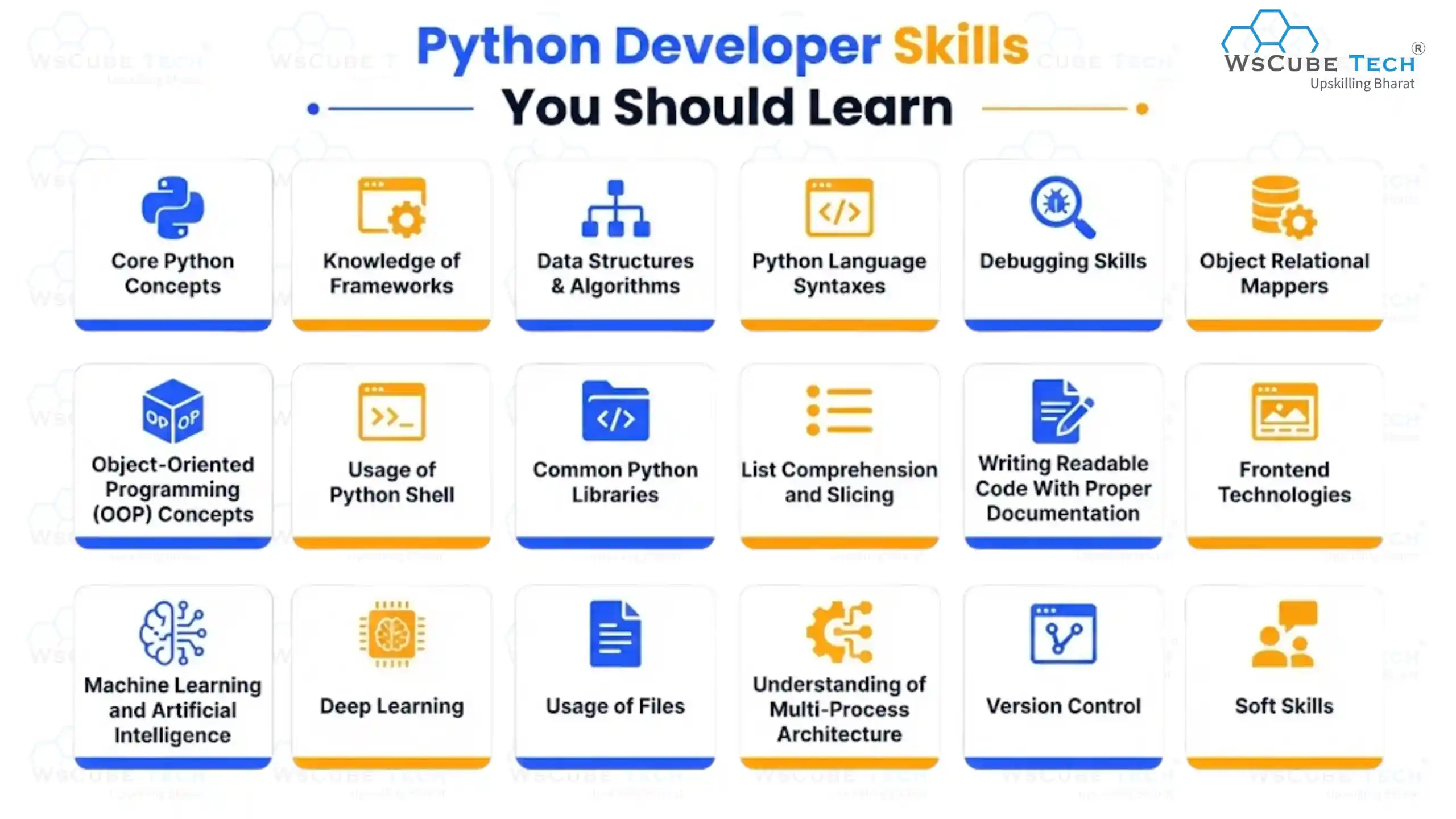
21 Python Developer Skills You Should Learn
Knowing the role is one thing; mastering the craft is another. Below are the core skills for a Python developer that take you from writing code that simply runs to writing code that is clean, efficient, and production-ready. Think of this as the checklist of python developer required skills that hiring teams actually look for.
1. Core Python Concepts
The first step to becoming a skilled Python developer is mastering the core, fundamental concepts. They are the foundation of Python programming, and to be proficient you must have a strong hold on them.
- Data structures and data types
- OOP concepts, functions, and packages
- Multithreading, generators, and iterators
- Exception handling and file handling
- Variables and upgrading versions
2. Knowledge of Frameworks
Python web frameworks like Django and Flask are hugely popular because they are easy to use, secure, scalable, and sophisticated. While there are others such as Falcon, web2py, CherryPy, and Dash, Django and Flask are the two you must know, and mastering both is one of the strongest python full stack developer skills you can build.
- Django (Full-stack framework): A high-level, scalable, fast framework for rapid development of secure web applications. It handles user authentication, project structure (views, models, templates), database interaction, templating, and URL routing, streamlining development while reducing boilerplate code.
- Flask (Microframework): A lightweight, flexible framework for smaller web applications and APIs. It gives more control over application structure than Django, making it ideal when you need a smaller footprint. Key topics include templating, routing, request handling, and building APIs.
3. Data Structures & Algorithms
Data Structures & Algorithms or DSA are special formats for organizing and storing data, and choosing the right structure and algorithm is crucial to optimize the performance and efficiency of your Python code. Since Python developers deal with vast amounts of data, familiarity here is essential.
- Common data structures: tuples, sets, lists, dictionaries
- Basic algorithms: sorting, searching, traversing
- Time and space complexity analysis
4. Python Language Syntaxes
Syntax is the basic building block that defines how to write a program, and understanding it is important to writing correct, well-structured Python code. Python includes several elements you must be comfortable with.
- Data types (numbers, strings, lists, dictionaries, booleans)
- Control flow statements (if, else, for loops, while loops)
- Variables and operators (arithmetic, assignment, bitwise, logical)
- Functions: defining, parameters, return values, and calling
5. Debugging Skills
While writing Python programs, there will be times you expect one output but get another, such as issues with the range() function or failing to close a file. Debugging is the process of finding and resolving these errors, and it is among the most sought-after python developer skills as it keeps code clean and fully functional.
- Print variable values and use print statements
- Stop execution and change the path of a program
- Use cutting-edge debugging tools to find the root cause
- Build debugging strategies and problem-solving techniques for common errors
Recommended Professional Certificates
Data Analytics Course with Gen AI
Data Science Course with Internship & Placement Support
6. Object Relational Mappers
An Object Relational Mapper (ORM) is a class of library that converts and transfers data from relational databases (like MySQL or PostgreSQL) into Python objects. ORMs make accessing data simpler by letting you interact with databases using objects, and they are more efficient than raw SQL since they let you pick any database for development.
- Popular ORMs: SQLAlchemy (used with Flask), TortoiseORM, Django ORM
- Reduce boilerplate for CRUD (create, read, update, delete) operations
- Handle complex queries efficiently
- Understand models, relationships, and migrations
7. Object-Oriented Programming (OOP) Concepts
OOP is a paradigm that focuses on objects, which are data structures that encapsulate data and related operations. It is an important concept that promotes code reusability, maintainability, and modularity, helping you structure organized and scalable applications.
- Classes and objects
- Inheritance (creating new classes from existing ones)
- Polymorphism (objects responding differently to the same method call)
- Encapsulation (bundling data and methods within a class)
8. Usage of Python Shell
Python has a robust shell, also known as REPL (read, evaluate, print, loop), that reads a command, evaluates it, prints the result, and waits for the next one. This text-based command prompt lets you test code without creating a file, so developers use it to save time and try out new code.
- Read, evaluate, print, loop workflow
- Test code instantly without a file
- Use a python online compiler for quick browser-based testing
- Quickly experiment with new logic
9. Common Python Libraries
Python is known for its rich ecosystem of libraries such as Pandas, TensorFlow, NumPy, and scikit-learn. These contain useful functions so you don't have to write code from scratch every time, making the development process seamless, fast, and smooth. Mastering them lets you apply for jobs in AI, data science, business intelligence, and machine learning.
- Pandas and NumPy for data manipulation and analysis
- TensorFlow and PyTorch for machine learning and deep learning
- scikit-learn for ML algorithms (classification, regression)
- Requests for HTTP requests
10. List Comprehension and Slicing
List comprehension and slicing are powerful Python features. List comprehension creates a new list from an existing one or other structures, converting multiple lines of a loop into a single, easy-to-understand line. Slicing carves out a subset of a string or list, making your code more elegant.
- List comprehension turns multi-line loops into a single clean line
- Slicing extracts subsets of strings and lists
- Avoids looping through indices with if conditions
Upcoming Masterclass
Attend our live classes led by experienced and desiccated instructors of Wscube Tech.
11. Writing Readable Code With Proper Documentation
Unlike other languages that depend on braces, Python relies heavily on tabs and spaces, so readable, easy-to-debug code matters. Python code can sometimes be too complex for others to understand, which is why proper documentation is crucial to enhance readability.
- Maintain clean, consistent indentation
- Document complex logic clearly
- Keep code understandable and easy to debug for the whole team
12. Frontend Technologies
Python developers often work with the frontend team to ensure the server and client sides align, so to be a full-stack developer you need a working knowledge of frontend languages. These control the visual presentation and interactivity of web pages and give you more control over the user experience.
- Core HTML elements and structure
- CSS styling for layout and presentation
- JavaScript fundamentals
- Familiarity with frontend frameworks
13. Machine Learning and Artificial Intelligence
In this digital era surrounded by AI and ML, Python developers must have a fair understanding of these fields, which are part of data science. With expertise here, you can obtain, visualize, and interpret information to find meaningful insights and predict user behavior.
- Data science and data analytics
- Neural networks and data collection
- Data visualization
- Turning insights into business predictions
14. Usage of Files
In Python you frequently interact with files while writing code, whether storing results or working with data. File handling is vital to the job, so make sure you can work with files seamlessly and master file I/O.
- Reading from and writing to files
- Storing and working with data
- Mastering file handling for real projects.
15. Deep Learning
Deep learning is part of data science, and its concepts differ from those in machine learning, AI, and data science basics. Python developers are expected to have a strong grasp of neural network architecture and related processing techniques.
- Neural network architecture
- Video and audio processing
- Natural language processing (NLP)
Read More Guides Related to Python
16. Understanding of Multi-Process Architecture
Among the top key skills needed for python developers is multi-process architecture. Multi-process architecture involves the know-how of code used to release and deploy applications. Even if a design engineer handles this, you must understand how the code works to manage the entire project and solve issues related to the core framework.
- MVC (Model View Controller) architecture
- MVT (Model View Template) architecture
- Troubleshooting core framework-level issues
17. Version Control
Source code changes constantly, and tracking those changes effectively is a primary job responsibility. Git is a distributed version control system that lets developers collaborate without hassle, view history, roll back changes, and merge code, keeping it traceable, organized, and recoverable.
- Commit, push, pull, and fork
- Working with remote repositories
- Git fundamentals for team collaboration
- Branching and merging strategies
18. Soft Skills
Technical depth gets you in the door, but these are the key skills needed for Python developers to truly thrive on a team.
- Analytical Skills – A must for any good developer. Includes building scalable websites, data visualization, algorithm optimization, and writing clean code.
- Communication Skills – Convey technical ideas clearly to both technical and non-technical people, listen actively to understand requirements, and document decisions for future reference.
- Design Skills – Design scalable, highly available products, and understand how Python works across both server-side and client-side programming with frameworks like Django and Flask.
- Collaboration and Teamwork – Work smoothly with designers, QAs, PMs, and fellow developers. Adapt, accept feedback, and contribute positively to a collaborative environment.
Explore Our Web Development Related Courses
How to Build Python Developer Skills
You know all the key skills needed for Python developers, but the real question is how to build them. Mastering Python demands consistent practice, constant learning, and dedication. Here are some useful tips to develop the above-mentioned python developer skills.
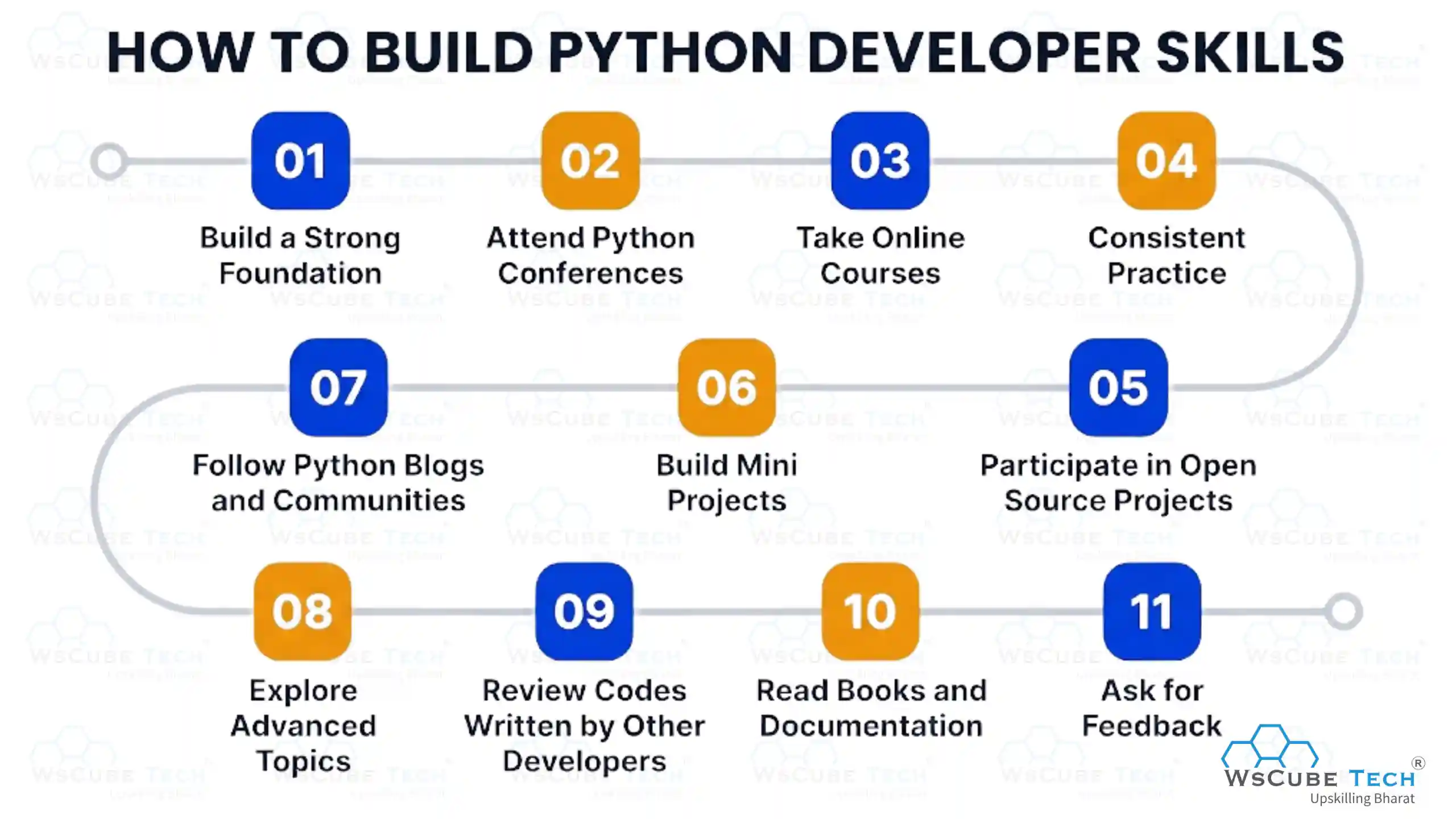
Step 1: Build a Strong Foundation
Start by learning the core concepts of Python, including syntax, data structures, and control flow. Make sure you have a solid grip on the basics before moving on to advanced topics, as everything else builds on this foundation.
Step 2: Attend Python Conferences
Attend Python conferences organized by institutes and colleges to learn new techniques, methods, and coding ideas. These events help you stay updated with industry developments, hear from experts across sectors, and take part in productive discussions that expand your knowledge.
Step 3: Take Online Courses
Sign up for a top-notch, reliable Python course to build practical skills and get guidance from industry leaders. Choose one that fits your goals; WsCube Tech offers a comprehensive Python course with hands-on experience and professional certifications.
Step 4: Consistent Practice
Coding demands consistent practice, so invest enough time to build new projects and try new ideas. Start with basic code, then move to advanced techniques and design patterns. Take risks, make mistakes, ask for feedback, and work on your weaknesses.
Step 5: Participate in Open Source Projects
Try your hands on different open source projects to learn from experienced developers and gain real practical experience. Contributing to open source also helps you build an impressive portfolio that strengthens your skills for a Python developer role.
Step 6: Build Mini Projects
Gradually put your learning into practice by building mini yet slightly complex projects. These test your knowledge, push you out of your comfort zone, and let you learn something new while sharpening the python developer required skills employers look for.
Step 7: Follow Python Blogs and Communities
Follow websites, YouTube channels, forums, and communities that post regularly about Python and its updates. They keep you informed about best practices and trends, and you can ask queries or share doubts to get help from the wider Python community.
Step 8: Explore Advanced Topics
Once you have a strong foundation and a few mini-projects behind you, delve into advanced topics such as data science libraries, machine learning, and web development frameworks. This is where the more valuable python full stack developer skills begin to take shape.
Step 9: Review Codes Written by Other Developers
Reading and reviewing code written by other developers is one of the best ways to improve. Visit coding websites, set up a peer code review system, and share feedback. You can also ask others to review your code and suggest improvements.
Step 10: Read Books and Documentation
Read online books and official documentation to deepen your understanding and fill in knowledge gaps. Documentation especially helps you learn the correct, intended way to use Python's features, libraries, and frameworks in real-world scenarios.
Step 11: Ask for Feedback
Ask your mentor, manager, colleagues, or guide to review your work and share honest feedback. Request their opinion on your performance, identify your strengths and weaknesses, and actively work on the areas that need improvement.
Explore Our Data Related Courses
| Data Analytics Course | Live Internship + 100% Job Support |
| Business Analytics Course | Live Internship + 100% Job Support |
| Data Science Course | Live Internship + 100% Job Support |

FAQs - Python Developer Skills
The most in-demand python developer skills include core Python, Django and Flask frameworks, data structures and algorithms, Git, SQL and ORMs, and knowledge of AI/ML libraries. Strong debugging and communication skills round out the profile.
With consistent practice, most people reach a job-ready level in around 6 to 12 months. The timeline depends on your background, daily effort, and how quickly you build real projects.
Freshers should focus on core Python, OOP, basic data structures, one framework (Django or Flask), Git, and simple frontend basics. Adding a data science or ML library gives you an extra edge in interviews.
Yes, at least the basics. A working knowledge of HTML, CSS, and JavaScript helps Python developers align the server and client sides and is essential for full-stack roles.
A backend developer focuses on server-side logic, databases, and APIs. Full-stack developers handle both backend and frontend, so python full stack developer skills also include HTML, CSS, and JavaScript.
Python alone is a strong start, but employers usually expect supporting skills like Git, SQL, a framework, and problem-solving ability. Combining Python with a specialization such as data science or web development boosts your chances significantly.
Freshers typically earn around ₹3.5 to ₹6 LPA, while experienced developers can earn ₹8 to ₹20 LPA or more. Salaries rise sharply with skills in AI, ML, and cloud technologies.
Yes. Python has simple syntax and vast learning resources, so many successful developers are self-taught. A strong portfolio of real projects often matters more than a formal degree.
Skills in machine learning, deep learning, cloud platforms, and data engineering command a premium. Developers with AI/ML expertise often earn significantly more than pure web developers.
Start with small projects like a to-do app or web scraper, then move to a full web app with Django or Flask, or a data analysis project. Real projects are the best way to demonstrate your skills to employers.
Conclusion
Becoming a successful Python developer is a journey that blends technical depth with the right mindset. From mastering core concepts, frameworks, and libraries to sharpening your debugging, version control, and soft skills, every step adds to your growth. The python developer skills covered in this guide give you a clear roadmap to follow, whether you are just starting out or looking to level up your existing expertise and stand out in a competitive job market.
The key is consistency. Keep building projects, contribute to open source, stay updated with new trends, and never stop learning. If you want to accelerate your progress with structured guidance and hands-on experience, consider enrolling in a full stack development course to build real-world skills and a strong portfolio. Stay dedicated and focused, and you will be well on your way to a rewarding career as a proficient Python developer.
Explore Our Free Tech Tutorials
| Python Tutorial | Java Tutorial | JavaScript Tutorial |
| C Tutorial | C++ Tutorial | HTML Tutorial |
| CSS Tutorial | SQL Tutorial | DSA Tutorial |
Practice Coding With Our Free Compilers
| Online Python Compiler | Online HTML Compiler | Online C Compiler |
| Online C++ Compiler | Online JS Compiler | Online Java Compiler |
Join Our On-Campus Full Stack Related Courses
Join Our On-Campus Data Related Courses
Free Courses for You




Leave a comment
Your email address will not be published. Required fields are marked *Comments (0)
No comments yet.