Python is one of the easiest and most powerful programming languages to learn, which is why it is loved by both beginners and experienced developers worldwide. Its clean and simple syntax makes coding easier to understand, while its versatility allows developers to build everything from websites and automation tools to AI applications and data-driven systems. Today, Python is widely used in fields like web development, machine learning, data science, cybersecurity, and software development, making it one of the most in-demand skills in the tech industry.
With so many career paths and technologies connected to Python, beginners often feel confused about where to start and what to learn next. This Python Developer Roadmap is designed to make your learning journey simple and structured. It helps you understand the right skills to learn step by step, from programming basics to advanced development concepts and real-world projects. By following this roadmap, you can learn with clarity, build practical skills, and confidently prepare for a successful career as a Python developer.
Who is a Python Developer?
A Python developer is a professional who uses the Python programming language to design, develop, and maintain software solutions. Python developers work in areas such as web development, automation, data analysis, machine learning, and backend development. Python’s simple and readable syntax helps developers write efficient code and solve problems quickly.
Python developers also use frameworks, libraries, and databases to create reliable and scalable applications. They collaborate with designers, frontend developers, and other teams to test, improve, and maintain software that meets real-world business and user needs.
Key Responsibilities of a Python Developer
- Develop clear, well-structured, and high-quality Python code by following best practices, coding standards, and proper documentation to build reliable and maintainable applications.
- Design and develop secure, scalable backend logic using Python to support high-performance web and software applications.
- Build, maintain, and manage web applications using popular Python frameworks such as Django and Flask.
- Work with databases to store, retrieve, and manage data efficiently while ensuring data security, integrity, and performance.
- Debug, test, and optimize Python programs to improve application speed, stability, and overall reliability.
- Apply version control systems such as Git to handle code changes, collaborate with teams, and maintain organized development workflows.
Why Choose Python as a Career?
Python stands out as a highly preferred programming language due to its clean syntax and beginner-friendly nature. New learners can start writing code easily, while experienced developers can create powerful applications with minimal code and clear structure.
Python is used in many areas such as web development, data analysis, automation, artificial intelligence, and cloud computing. Its broad range of libraries and frameworks allows developers to build efficient solutions and handle real-world problems faster.
Python also provides strong career opportunities and steady global demand. Many organizations depend on Python for modern software development, making it a reliable and future-ready skill. To learn more, you can explore Python language advantages & benefits and understand why Python remains a top career choice.
Recommended Professional Certificates
Data Analytics Course with Gen AI
Data Science Course with Internship & Placement Support
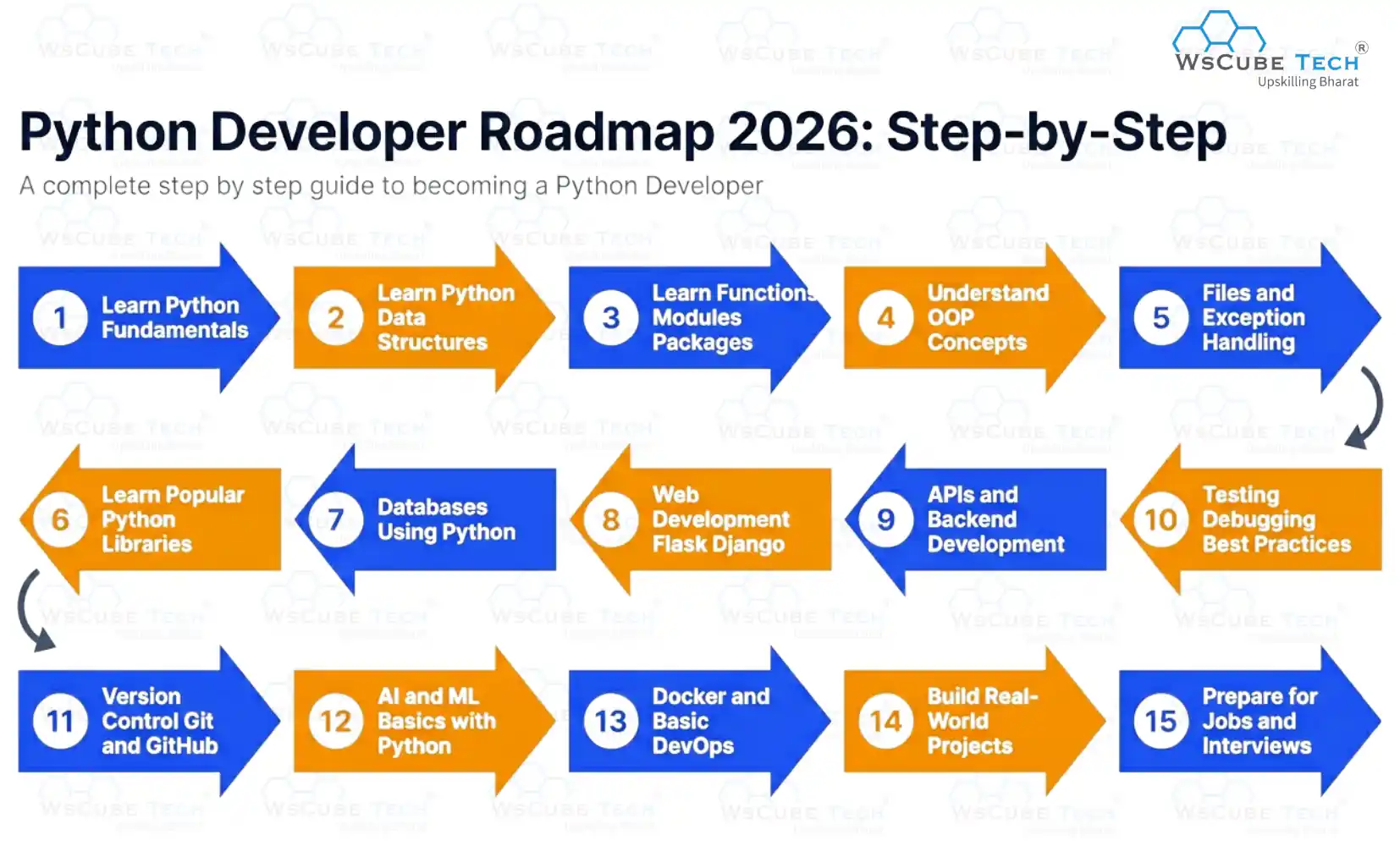
Python Developer Roadmap 2026: Step-by-Step
Below are the steps that help you become a skilled Python Developer:
- Learn Python Fundamentals
- Learn Python Data Structures
- Learn Functions, Modules, and Packages
- Understand Object-Oriented Programming (OOP)
- Work with Files and Exception Handling
- Learn Popular Python Libraries
- Work with Databases Using Python
- Learn Web Development with Python (Flask / Django)
- Understand APIs and Backend Development
- Learn Testing, Debugging, and Best Practices
- Work with Version Control (Git & GitHub)
- Learn AI/ML Basics with Python
- Learn Docker and Basic DevOps Concepts
- Build Real-World Python Projects and Portfolio
- Prepare for Python Developer Jobs and Interviews
Now, you will go through each step one by one to clearly understand what to learn, which concepts to focus on, and how every step helps you grow as a confident Python developer.
Step 1: Learn Python Fundamentals
This step builds the foundation of your Python developer journey. You learn what Python is, how it works, and how basic programming concepts are applied using the Python language. Understanding these basics helps you write simple programs and think logically while solving problems. Below are the key concepts to focus on.
- Basic Syntax Rules: Learn Python syntax, indentation, keywords, and comments that define how Python code is written and executed.
- Variables and Data Types: Learn how to store data using variables and understand common data types such as integers, floats, strings, and booleans.
- Operators: Learn arithmetic, comparison, logical, and assignment operators used to perform calculations and make decisions in Python programs.
- Input and Output: Understand how to take user input and display output using basic Python functions.
- Control Flow Basics: Learn conditional statements and loops in Python to control the flow of a Python program.
Understanding these basics helps you build a strong programming foundation and prepares you to learn advanced Python concepts in the next steps of the Python roadmap. You can learn complete Python through our easy-to-follow Python tutorial.
Step 2: Learn Python Data Structures
After learning Python fundamentals, the next step is to understand how data is stored and organized in Python programs. Python data structures help you manage multiple values efficiently and write cleaner, more structured code. Learning these concepts is essential for solving real-world problems and building practical applications. Below are the key concepts to focus on.
- Python Lists: Learn how to store ordered collections of data, access elements, modify values, and perform common list operations.
- Python Tuples: Understand immutable data structures used to store fixed collections of items safely and efficiently.
- Python Sets: Learn how to store unique values, remove duplicates, and perform set operations like union and intersection.
- Python Dictionaries: Learn how to store data in key-value pairs and retrieve, update, and manage information efficiently.
- Common Operations: Understand indexing, slicing, looping, and built-in functions used across Python data structures.
Understanding Python data structures improves your ability to manage data efficiently and prepares you for advanced Python concepts and real-world application development.
Step 3: Learn Functions, Modules, and Packages
Functions, modules, and packages help organize Python code and improve reusability. They allow programs to be divided into smaller, manageable parts, making code easier to read, maintain, and scale. These concepts are important for building structured and efficient Python applications. Below are the key concepts to focus on.
- Python Functions: Understand how to define and use functions, pass arguments, return values, and reduce code repetition.
- Python Built-in Functions: Understand commonly used Python built-in functions that simplify everyday programming tasks.
- Python Modules: Learn how to import and use Python modules to organize code and access reusable functionality.
- Python Packages: Understand how packages group multiple modules together and how to install and use external packages.
- Code Organization: Learn how functions, modules, and packages help create clean, maintainable, and reusable Python code.
Mastering these concepts helps you manage Python projects more effectively and write well-structured programs.
Step 4: Understand Object-Oriented Programming (OOP)
Object-Oriented Programming helps structure Python code by organizing it around objects and classes. OOP makes programs easier to understand, reuse, and maintain, especially when working on large or complex applications.
- Python Classes and Objects: Learn how to create classes and objects to represent real-world entities in Python programs.
- Attributes and Methods: Understand how data and functions are defined inside a class and accessed using objects.
- Python Encapsulation: Learn how to restrict direct access to data and protect the internal state of objects.
- Python Inheritance: Understand how one class can inherit properties and methods from another to reuse code efficiently.
- Python Polymorphism: Learn how the same method or function can behave differently based on the object or class used.
Mastering OOP helps you write structured, reusable code and prepares you to build real-world Python applications with confidence.
Step 5: Work with Files and Exception Handling
After learning OOP concepts, you can start working with files and handling errors in Python programs. File handling enables you to read and write data, while exception handling helps your programs manage errors smoothly without crashing. Below are the key concepts to focus on.
- File Handling Basics: Learn how to open, read, write, and close files using different file modes in Python.
- Working with File Types: Understand how to work with text files, CSV files, and basic data files.
- Exception Handling: Learn how to handle errors using try, except, else, and finally blocks.
- Common Errors: Understand common Python errors such as syntax errors, runtime errors, and logical errors.
- Custom Exceptions: Learn how to raise and handle custom exceptions for better error control.
Mastering file handling and exception handling helps you write safe, stable, and user-friendly Python programs that manage data and errors effectively while working smoothly with Python libraries.
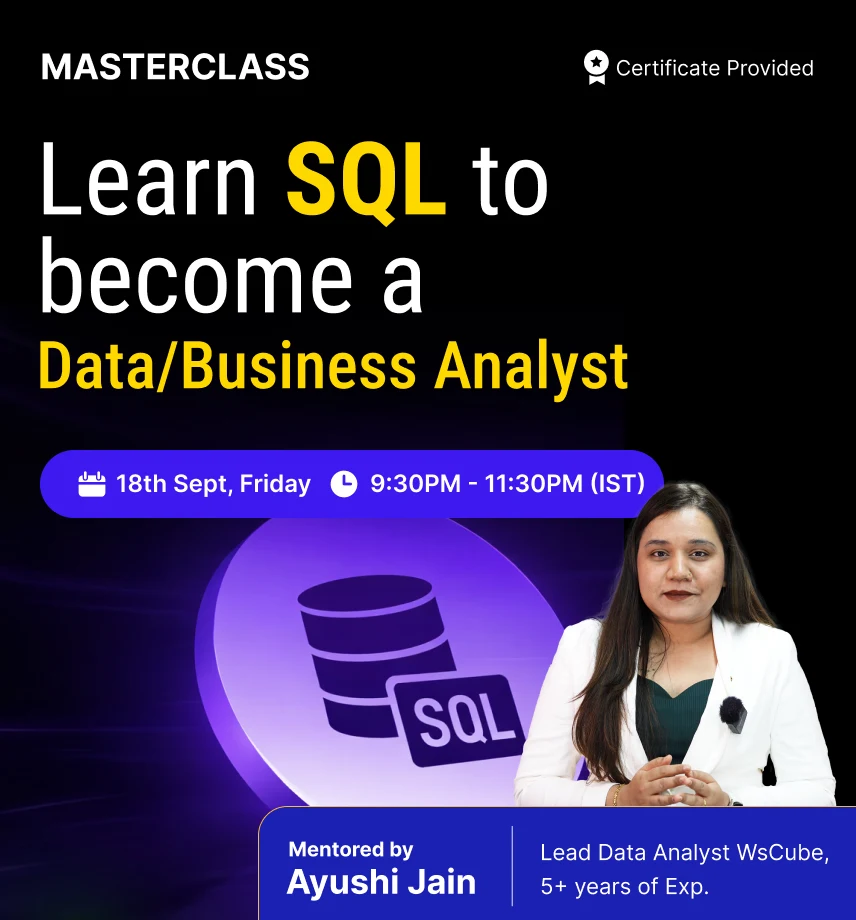
Upcoming Masterclass
Attend our live classes led by experienced and desiccated instructors of Wscube Tech.




Step 6: Learn Popular Python Libraries
Python libraries extend the language’s functionality and make development faster and easier. Libraries help you perform common tasks without writing code from scratch and are widely used in real-world Python applications.
- Standard Libraries: Learn built-in libraries such as math, datetime, os, and sys for calculations, file handling, and system-level operations.
- NumPy: Understand how to work with arrays, numerical operations, and mathematical functions for efficient data processing.
- Pandas: Learn data manipulation, data cleaning, and analysis using DataFrames and Series.
- Matplotlib: Learn to create basic plots, charts, and visualizations to represent data clearly and effectively.
- Requests and Automation Libraries: Use libraries like requests for API communication and other libraries for scripting and automation tasks.
Learning popular Python libraries helps you write efficient code and build practical, real-world Python applications.
Step 7: Work with Databases Using Python
Working with databases is an essential part of building real-world Python applications. Databases allow you to store, organize, and retrieve large amounts of data efficiently while keeping information secure and organized. Python provides built-in modules and external libraries to work with different databases smoothly.
- Database Basics: Understand what databases are and learn the difference between relational and non-relational databases.
- SQL Fundamentals: Learn basic SQL commands such as SELECT, INSERT, UPDATE, and DELETE to work with stored data.
- Database Libraries: Learn Python database libraries such as sqlite3, MySQL Connector, and psycopg2 to connect and interact with databases.
- SQLite with Python: Understand how to use SQLite with Python for lightweight database applications.
- CRUD Operations: Learn how to create, read, update, and delete data securely using Python.
Working with databases using Python helps you build reliable, data-driven applications that manage information efficiently and support real-world business needs.
Step 8: Learn Web Development with Python (Flask / Django)
Web development is a core skill for a Python developer. It allows you to build dynamic, database-driven websites and backend systems used in real-world applications. Python frameworks like Flask and Django make web development easier by providing tools for routing, request handling, security, and database integration. Below are the key concepts to focus on.
- Web Basics: Understand how websites work, including HTTP methods, URLs, request–response flow, and client–server architecture.
- Flask Framework: Learn Flask for creating lightweight and flexible web applications, handling routes, templates, and backend logic.
- Django Framework: Learn Django for building scalable and secure web applications with built-in features like authentication, admin panels, and ORM.
- Templates and Forms: Learn how to use templates, handle forms, and process user input in Flask and Django applications.
- Database Integration: Understand how to connect web applications with databases and manage data using ORM tools.
- Security and Authentication: Learn basic security practices, user authentication, and authorization in Python web applications.
Learning web development with Flask and Django helps you build production-ready Python applications and strengthens your Python development skills.
Step 9: Understand APIs and Backend Development
Backend development focuses on the logic, data handling, and server-side operations of an application. APIs allow different systems and applications to communicate with each other efficiently. Understanding backend development and APIs is essential for building scalable and connected Python applications. Below are the key concepts to focus on.
- Backend Basics: Understand what backend development is and how servers, databases, and application logic work together.
- APIs Fundamentals: Learn what APIs are, how they work, and the difference between REST APIs and web services.
- Building APIs with Python: Learn how to create APIs using frameworks like Flask or Django REST Framework.
- HTTP Methods and Status Codes: Understand GET, POST, PUT, DELETE methods and common HTTP status codes.
- API Authentication: Learn basic authentication methods such as API keys, tokens, and JWT.
- API Testing: Learn how to test APIs using tools like Postman or similar testing tools.
Understanding APIs and backend development helps you build connected, scalable Python applications that work across platforms and services.
Step 10: Learn Testing, Debugging, and Best Practices
Testing and debugging are essential for building reliable and error-free Python applications. They help you identify issues early, improve code quality, and ensure your programs work as expected in real-world scenarios. Following best practices also makes your code easier to read, maintain, and scale.
- Testing Basics: Learn why testing is important and understand different testing types such as unit testing and integration testing.
- Testing Tools: Learn how to use Python testing frameworks like unittest and pytest to test your code.
- Debugging Techniques: Understand how to find and fix errors using debugging tools, logs, and error messages.
- Code Quality Standards: Learn best practices such as writing clean code, following PEP 8 guidelines, and using meaningful variable names.
- Error Handling: Improve error-handling techniques to make Python programs stable and user-friendly.
Learning testing, debugging, and best practices helps you build professional, maintainable, and high-quality Python applications.
Explore More Career Roadmaps
Step 11: Work with Version Control (Git & GitHub)
Version control is important for tracking code changes and working smoothly with other developers. Git and GitHub help track project history, manage updates, and work efficiently in team environments. These tools are widely used in professional Python development. Below are the key concepts to focus on.
- Basics of Version Control: Understand what version control is and why it is important for software development projects.
- Git Fundamentals: Learn basic Git commands such as init, add, commit, branch, and merge.
- GitHub Basics: Learn how to create repositories, push code, and manage projects using GitHub.
- Collaboration: Understand how to work with teams using pull requests, code reviews, and issue tracking.
- Project Management: Learn how version control helps manage code changes, fix bugs, and maintain project history.
Working with Git and GitHub helps you collaborate effectively and manage Python projects professionally.
Step 12: Learn AI/ML Basics with Python
Artificial Intelligence and Machine Learning add powerful capabilities to Python applications, but learning these concepts is optional for Python developers. Understanding AI and ML basics helps you learn how machines work with data and make predictions. Python is widely used in AI and ML because of its simple syntax and strong library support, making it a good choice for developers who want to explore this specialization in the future.
- AI and ML Fundamentals: Learn what artificial intelligence and machine learning are and understand how these technologies are applied in real-world systems and applications.
- Machine Learning Types: Learn supervised, unsupervised, and basic reinforcement learning concepts.
- Python ML Libraries: Learn popular libraries such as NumPy, Pandas, Scikit-learn, and TensorFlow for AI and ML tasks.
- Data Preparation: Understand how to clean, preprocess, and prepare data for machine learning models.
- Basic ML Models: Learn simple models like linear regression, classification, and clustering.
Learning AI and ML basics with Python helps you build intelligent applications and expand your career opportunities as a Python developer.
Step 13: Learn Docker and Basic DevOps Concepts
Docker and DevOps concepts help Python developers build, deploy, and manage applications efficiently. Learning these skills makes it easier to run Python projects consistently across different environments and improves collaboration between development and operations teams. Below are the key concepts to focus on.
- DevOps Basics: Understand what DevOps is and why it is important for faster and reliable software delivery.
- Docker Fundamentals: Learn what Docker is, how containers work, and why they are used in modern application development.
- Docker Images and Containers: Understand how to create, run, and manage Docker images and containers for Python applications.
- Dockerfile Basics: Learn how to write a Dockerfile to containerize a Python project.
- Basic CI/CD Concepts: Understand the basics of continuous integration and continuous deployment for automated workflows.
Learning Docker and basic DevOps concepts helps you deploy Python applications smoothly and prepares you for real-world development and production environments.
Step 14: Build Real-World Python Projects and Portfolio
Building real-world Python projects is a crucial step toward becoming a confident Python developer. Projects allow you to apply Python concepts, libraries, frameworks, and tools together in practical scenarios and understand how complete applications are built.
By working on real-world Python projects, you learn how backend logic, databases, APIs, and deployment workflows interact. You can explore Python project ideas to practice real-world use cases, improve problem-solving skills, understand full project workflows, and build applications that reflect real industry requirements.
Step 15: Prepare for Python Developer Jobs and Interviews
Preparing for Python developer jobs involves strengthening both technical and practical skills. Focus on revising core Python concepts, data structures, OOP, databases, APIs, and frameworks like Flask or Django. Practice solving coding problems and building Python applications regularly.
You should also work on resume building by highlighting real-world Python projects, GitHub contributions, and deployed applications. Practice technical interviews, basic system design concepts, and problem-solving questions. Clearly explaining your projects helps interviewers understand your skills and experience.
To get structured guidance and industry-focused training, you can explore our full-stack certification course by WsCube Tech, which helps you learn job-ready skills, build real projects, and prepare confidently for Python developer roles.
Read More Python Related Blogs
Career Opportunities After Learning Python
After completing the roadmap for Python developer, you unlock diverse career paths across software development, data, automation, and emerging technologies, based on skills, interests, and industry demand.
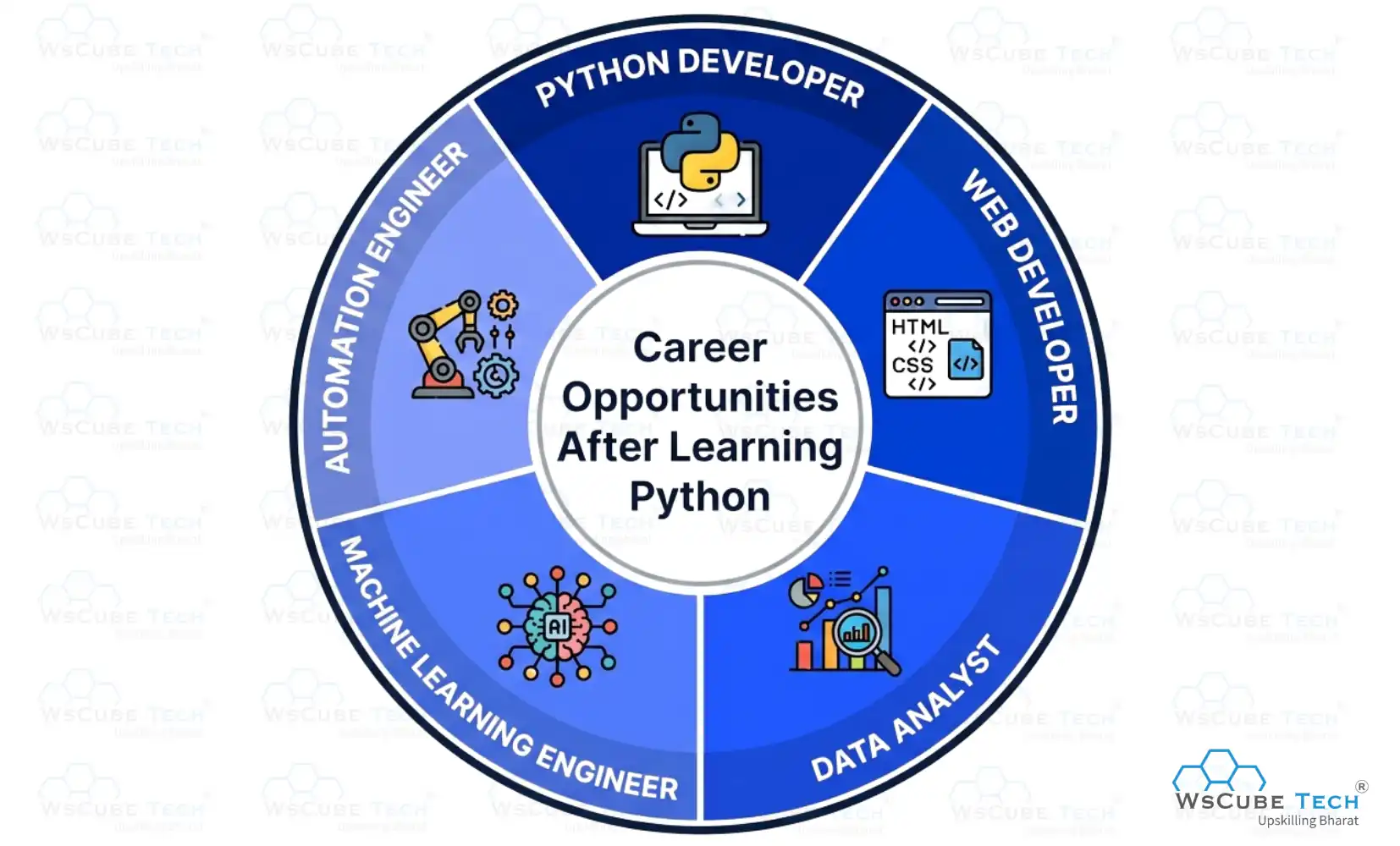
- Python Developer: Build backend systems, scripts, and applications using Python. Work with databases, APIs, and frameworks like Flask or Django to develop scalable and reliable software solutions.
- Web Developer (Flask/Django): Develop dynamic web applications using Python frameworks. Handle server-side logic, database integration, authentication systems, and application performance optimization.
- Data Analyst: Apply Python to clean, analyze, and visualize data. Use tools such as Pandas and NumPy to organize datasets, identify patterns, and support accurate data-driven decisions and reporting.
- Machine Learning Engineer: Design, train, and deploy machine learning models using Python. Work with data pipelines, algorithms, and predictive systems for real-world AI applications.
- Automation Engineer: Create Python scripts to automate repetitive tasks. Improve workflow efficiency by automating testing, data processing, file handling, and system operations.
With experience and specialization, Python developers can advance into senior roles, technical leadership positions, or domain-focused careers such as AI, backend, or cloud development, offering strong career growth, higher responsibility, and better salary opportunities.
Python Developer Salary and Demand (2026)
Python continues to be one of the most in-demand programming languages in the tech world. According to job market insights, Python adoption grew significantly in recent years, with over 1.19 million job listings requiring Python skills, showing strong demand across industries like web development, data science, AI, and automation. Python also saw a notable increase in adoption in 2025, with one of the largest single-year growth jumps among major languages.
In India, Python developers are actively hired by companies ranging from startups to large enterprises. According to salary trend reports, Python developers with experience can earn competitive packages depending on their skills and expertise.
Python Developer Salary in India (2026)
| Experience Level | Average Salary Range |
| Fresher (0–2 years) | ₹3 LPA – ₹5 LPA |
| Mid-Level (2–5 years) | ₹8 LPA – ₹15 LPA |
| Experienced (5+ years) | ₹15 - ₹22 LPA |
Across India, Python developer salaries vary by city, industry, and the technologies you specialize in. Developers skilled in backend frameworks, cloud tools, or AI/ML often command higher pay.
With rising adoption of Python for automation, data science, web apps, and AI, career opportunities and salary potential for Python developers in 2026 and beyond remain strong. Companies continue to seek developers who can build scalable solutions and work across modern tech stacks.
Explore Our Data Related Courses
| Data Analytics Course | Live Internship + 100% Job Support |
| Business Analytics Course | Live Internship + 100% Job Support |
| Data Science Course | Live Internship + 100% Job Support |
Python Roadmap (Video Guide)
FAQs About Python Developer Roadmap
A Python developer roadmap is a step-by-step learning path that guides you from Python basics to advanced skills. You understand what to learn, in what order, and which tools are required to become a job-ready Python developer.
Yes, our Python developer roadmap is suitable for both beginners and professionals. You start by learning basic Python concepts and syntax, then slowly progress to advanced topics, real-world projects, and practical skills, helping you build confidence and grow step by step in a structured way.
The time depends on your learning speed and practice consistency. If you study regularly, you can complete a roadmap for python developer in 6–9 months, covering core concepts, projects, and basic job preparation.
No prior coding experience is required to learn Python. You can start as a complete beginner. Python’s simple and readable syntax helps you understand programming concepts easily, practice logic step by step, and build confidence by working on small programs and beginner-friendly projects.
No, you do not need a specific degree to become a Python developer in India. You can build a strong career by learning Python skills, practicing regularly, working on projects, and showcasing your abilities through a portfolio and practical experience.
To become a Python developer, you need basic programming logic, Python fundamentals, data structures, and problem-solving skills. You should also learn databases, frameworks, Git, and debugging to build reliable applications and grow confidently as a developer.
Yes, projects are very important while following a Python roadmap. Working on real projects helps you apply concepts in practice, improve problem-solving skills, understand real-world scenarios, and build a strong portfolio that increases your confidence and job readiness.
Yes, if you follow the Python roadmap properly and practice consistently, you can build strong coding skills. Creating projects, learning tools, and preparing for interviews improves your chances of getting a Python developer job.
Yes, the roadmap to become a python developer usually includes web development. You learn frameworks like Flask or Django to build backend systems, handle databases, and create dynamic web applications using Python.
Yes, Python development is a good career choice in 2026. Python continues to be widely used in web development, data science, automation, AI, and backend roles. As demand grows, learning Python helps you access diverse job opportunities and long-term career growth.
You can practice by writing Python code daily, solving small problems, building mini projects, and experimenting with examples. Regular practice helps you understand concepts clearly, improve logic, fix mistakes, and gain confidence as you progress through the Python roadmap.
Conclusion
Python continues to be one of the most in-demand and beginner-friendly programming languages in 2026. Whether you want to become a web developer, data scientist, AI engineer, automation expert, or software developer, Python offers endless career opportunities across different industries. With the right python developer roadmap, consistent practice, and real-world projects, anyone can build strong Python skills and grow from a beginner to a job-ready developer.
The key is to learn step by step, stay consistent, and focus on practical implementation instead of only theory. Follow this Python Developer Roadmap 2026, keep improving your problem-solving skills, and work on projects regularly to build confidence and industry-ready experience.
Explore Our Free Tech Tutorials
| Python Tutorial | Java Tutorial | JavaScript Tutorial |
| C Tutorial | C++ Tutorial | HTML Tutorial |
| CSS Tutorial | SQL Tutorial | DSA Tutorial |
Practice Coding With Our Free Compilers
| Online Python Compiler | Online HTML Compiler | Online C Compiler |
| Online C++ Compiler | Online JS Compiler | Online Java Compiler\ |
Free Courses for You





Leave a comment
Your email address will not be published. Required fields are marked *Comments (0)
No comments yet.