
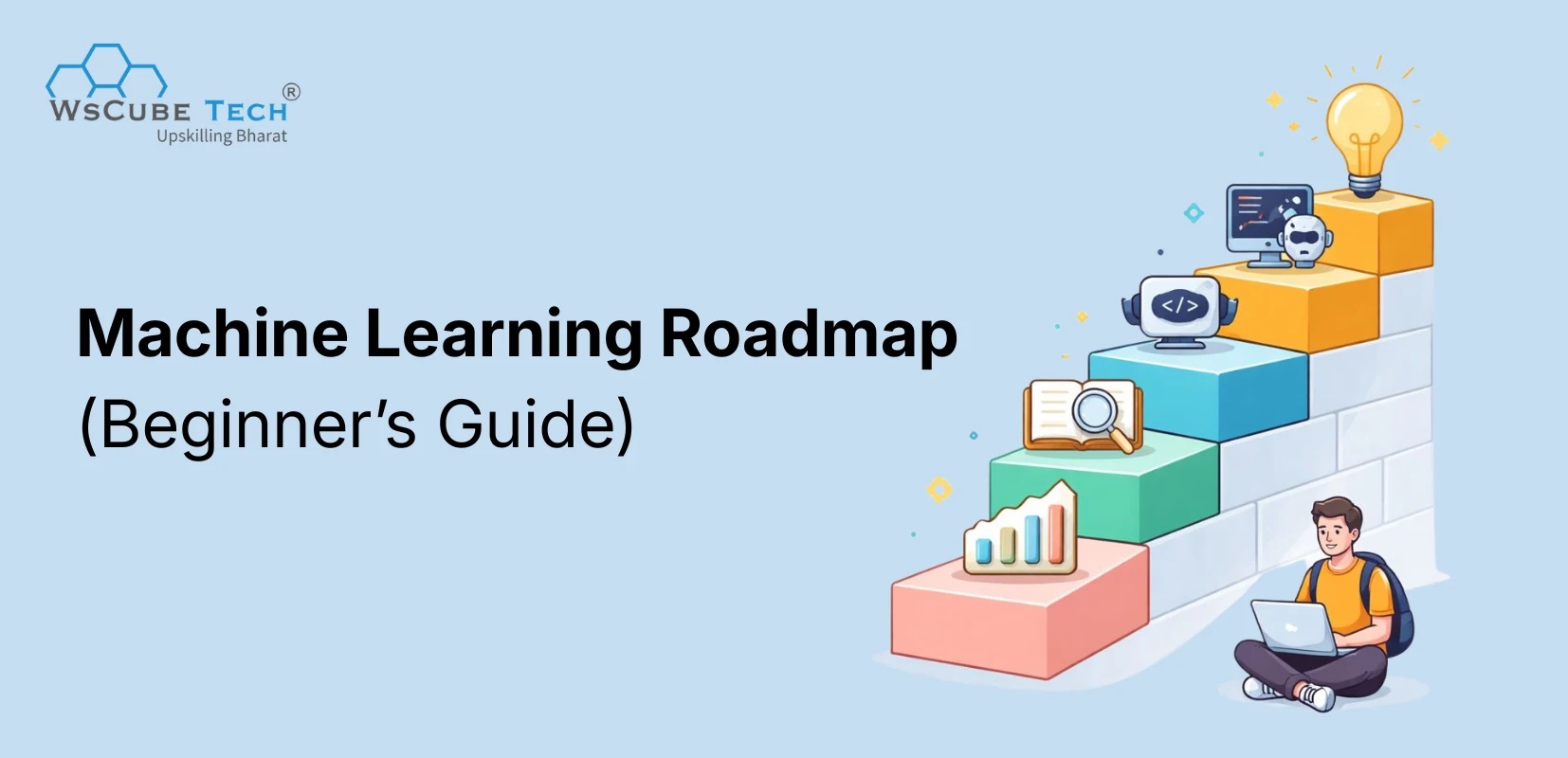
Machine learning helps computers learn from data and improve decisions without being directly programmed. It is used in everyday applications like recommendations, image recognition, voice assistants, and fraud detection. For beginners, learning machine learning can feel confusing because many concepts are connected and depend on each other.
This machine learning roadmap provides a clear and organized learning path. It guides learners on what to study first, what skills to build next, and how topics fit together. Following a roadmap saves time, reduces confusion, and helps learners move confidently from basics to real-world machine learning applications and careers.
What is Machine Learning?
Machine learning is a branch of artificial intelligence where computers learn from data and improve their performance without being explicitly programmed. Instead of following fixed rules, machine learning systems find patterns in data and use them to make predictions, decisions, or recommendations. It helps machines become smarter over time by learning from experience and past results.
Types of Machine Learning
- Supervised Learning: The model learns from labeled data, where the correct output is already known. It is used for tasks like classification and prediction.
- Unsupervised Learning: The model works with unlabeled data and finds hidden patterns or groupings on its own, such as clustering similar data points.
- Reinforcement Learning: The model learns by trial and error using rewards and penalties, improving actions based on feedback from its environment.
Why Machine Learning is Important
Machine learning is important because it allows computers to learn from data and make decisions without being explicitly programmed. Instead of following fixed rules, systems can identify patterns, adapt to new information, and improve accuracy over time. This makes machine learning suitable for handling complex and changing problems.
Machine learning reduces manual effort, improves efficiency, and supports better decision-making. It is widely used in healthcare, finance, cybersecurity, e-commerce, and transportation to automate tasks, personalize user experiences, detect risks, and predict future outcomes, making technology smarter and more reliable.
Recommended Professional Certificates
Full Stack Development Mentorship Program
WordPress Bootcamp
Demand for Machine Learning Engineers in 2026
The demand for machine learning engineers is increasing because companies now depend heavily on data to improve their products and services. Many systems are built to learn from data and give better results over time, which helps businesses save effort and make smarter decisions.
Machine learning is commonly used in apps, websites, and online platforms to suggest content, detect patterns, and automate tasks. Companies in healthcare, finance, education, and e-commerce use these systems to improve accuracy and speed. As data keeps growing every day, the need for skilled engineers who can build and manage machine learning models also keeps rising.
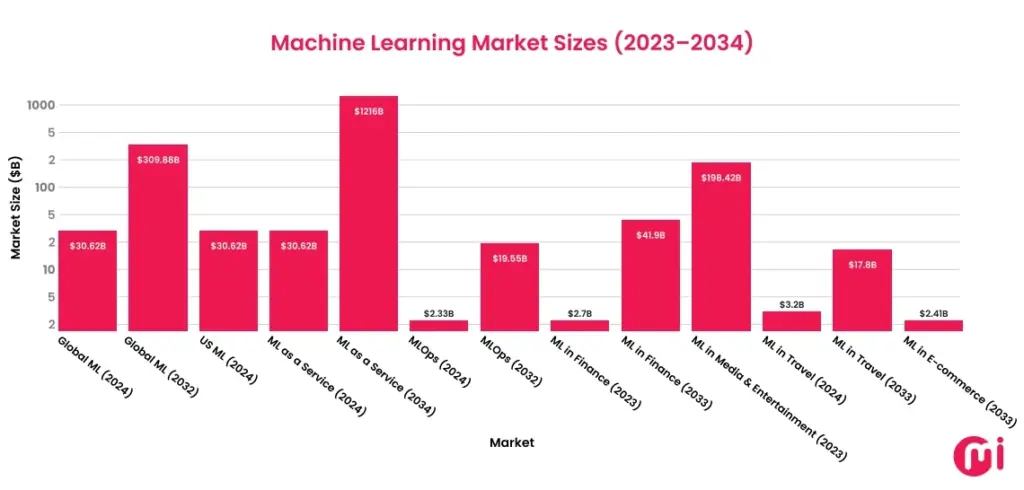
Image source: mind inventory
The demand for machine learning engineers has grown fast over the years. Job opportunities increased from a small number in the early years to a much higher level recently. This rapid rise shows that companies rely more on data-based systems, making machine learning a strong and growing career choice.
Why Follow a Machine Learning Roadmap?
Starting with random courses or tutorials without a clear plan often confuses. When learning is unstructured, you may miss important basics and struggle as topics become advanced. Our machine learning engineer roadmap gives you a clear and structured path, helping you learn step by step and move in the right direction with confidence.
If you dream of working at a top tech company, our ML roadmap helps you by:
- Showing the correct learning order, from fundamentals to advanced topics and deployment
- Helping you build strong foundations in mathematics and programming before learning algorithms and tools
- Turning theory into real skills through hands-on projects and practical examples
- Preparing you for interviews and jobs by helping you understand not just what works, but also why it works.
For beginners, an ML roadmap helps you avoid missing important steps. With a clear plan, learning becomes faster, more organized, and aligned with real industry needs, helping you grow with confidence and clarity.
Upcoming Masterclass
Attend our live classes led by experienced and desiccated instructors of Wscube Tech.



Prerequisites for Learning Machine Learning
Before starting machine learning, it is important to build a strong foundation in a few core areas. These basics make learning algorithms easier and help you understand how and why models work instead of just using them.
1. Mathematics and Statistics
A strong understanding of mathematics and statistics is essential for learning and applying machine learning. These concepts help you understand how algorithms work and how models make predictions.
- Linear Algebra: Vectors, matrices, eigenvalues, and eigenvectors are used to represent and process data. These concepts also support techniques like Principal Component Analysis (PCA).
- Calculus: Derivatives and gradients explain how models reduce errors during training using optimization methods such as gradient descent.
- Probability and Statistics: Probability distributions, uncertainty, hypothesis testing, and statistical measures help analyze data and evaluate model performance.
These topics are enough for beginners to get started. You do not need advanced mathematics; only a basic understanding is needed to grasp key concepts and follow how machine learning algorithms work.
2. Programming Skills
Programming skills are essential for learning machine learning because they allow you to turn ideas into working models. By writing and understanding code, you can handle data, train models, test results, and improve performance in real projects.
- Python Basics: Variables, loops, functions, and data types help you write and understand machine learning programs.
- R Programming: R is useful for statistical analysis, data visualization, and research-oriented machine learning tasks.
- Data Structures: Lists, dictionaries, and arrays help you store, organize, and process data efficiently.
- Libraries and Tools: Libraries like NumPy and Pandas help you work with data and perform calculations smoothly.
- SQL: Important for retrieving, managing, and preparing data from databases for machine learning projects.
3. Data Handling and Analysis
Data handling and analysis are essential parts of machine learning. Before building or training any model, you need to understand the data, clean it, and prepare it in the right format. Strong data skills help you build accurate models and avoid problems caused by missing, incorrect, or messy data.
- Data Collection: Understanding how to gather data from files, databases, or APIs helps you work with real-world datasets.
- Data Cleaning: Handling missing values, duplicates, and incorrect entries improves data quality and reliability.
- Exploratory Data Analysis (EDA): Studying patterns, trends, and relationships helps you understand the data before modeling.
- Data Preprocessing: Scaling, encoding, and transforming data prepares it for machine learning algorithms.
- Data Visualization: Charts and graphs help you analyze data clearly and communicate insights effectively.
4. Logical Thinking and Problem Solving
Machine learning involves experimentation, debugging, and improvement. Strong problem-solving skills help you analyze results, fix issues, and understand why models behave a certain way.
Machine Learning Roadmap: Step-by-Step Guide
This machine learning roadmap step by step gives you a clear learning path from beginner to advanced levels. It helps you build strong foundations, understand core concepts, and move forward with confidence in your machine learning journey.
- Build Programming and Math Foundations
- Learn Core Machine Learning Concepts and Algorithms
- Work with Machine Learning Libraries and Tools
- Explore Advanced Machine Learning Topics
- Deploy Models and Learn MLOps Basics
- Apply Skills Through Real-World Machine Learning Projects
- Continue Learning, Practice, and Research
Next, we will go through each step one by one to clearly explain what you should learn, how to practice effectively, and how to progress confidently in your machine learning learning journey.

Step 1: Build Programming and Math Foundations
Begin by learning Python, as it is easy to understand and commonly used in machine learning. Practice coding using Jupyter Notebooks, which make learning interactive and help you test ideas quickly. Get familiar with tools that help you work with data and numbers efficiently.
- Learn Python fundamentals and practice coding in Jupyter Notebooks
- Use libraries such as NumPy and Pandas to work with numerical data and tables
- Practice cleaning data, filtering records, and performing basic data operations
- Understand linear algebra basics like vectors and matrices, along with core probability concepts
- Slowly learn calculus ideas such as derivatives and gradients
This stage helps you become comfortable with both data and the mathematical thinking needed to understand how machine learning algorithms work.
Step 2: Learn Core Machine Learning Concepts and Algorithms
In this step, you focus on understanding how machine learning works at a core level. You learn the main types of machine learning and the most important algorithms used in real-world problems.
- Understand what machine learning is and how models learn from data
- Learn types of machine learning: supervised, unsupervised, and reinforcement learning
- Understand key terms like features, labels, training data, and testing data
- Learn core algorithms such as linear regression, logistic regression, KNN, decision trees, and SVM
- Study unsupervised methods like K-means clustering and dimensionality reduction
- Learn model evaluation basics using metrics like accuracy, precision, recall, and error measures
This step builds your problem-solving ability and helps you know when and why to use specific machine learning algorithms.
Step 3: Work with Machine Learning Libraries and Tools
At this stage, you start using popular machine learning libraries and tools to build models more easily and efficiently. These tools help you apply concepts in practice and focus on solving real problems.
- NumPy: Used for numerical computing, array operations, mathematical calculations, and handling large datasets efficiently.
- Pandas: Helps you load datasets, clean missing values, filter records, and perform data analysis using tables.
- Scikit-learn: Allows you to build, train, test, and evaluate machine learning models using simple and reliable functions.
- Data Visualization Tools: Tools like Matplotlib or Seaborn help you visualize data patterns and understand model performance clearly.
- Jupyter Notebooks: Provide an interactive environment to write code, test ideas, visualize results, and document your learning process.
This step helps you gain hands-on experience and turn machine learning concepts into real, usable skills.
Step 4: Explore Advanced Machine Learning Topics
After learning core algorithms and tools, the next step is to explore advanced machine learning topics. This stage helps you handle complex problems, improve model performance, and work with large and real-world datasets.
- Ensemble Learning: Learn techniques like bagging, boosting, and random forests to combine multiple models and improve accuracy and stability.
- Deep Learning Basics: Understand neural networks, activation functions, and layers. Learn how deep learning models work for images, text, and speech data.
- Natural Language Processing (NLP): Learn how machines understand text using techniques like tokenization, text classification, and sentiment analysis.
- Computer Vision: Explore image processing concepts and models used for image recognition, object detection, and classification.
- Model Optimization: Learn hyperparameter tuning, regularization, and cross-validation to improve model performance and avoid overfitting.
This step helps you move beyond basics and prepares you for solving advanced, real-world machine learning problems.
Step 5: Deploy Models and Learn MLOps Basics
This step focuses on taking your trained machine learning models and making them available for real use. You learn how to expose models through applications, run them on cloud platforms, and manage them in production environments.
- Deploy models using web frameworks like Flask, Streamlit, or FastAPI
- Run and manage models on cloud platforms such as AWS, Google Cloud, or Azure
- Use Docker to package models and understand basic Kubernetes concepts for scaling
- Learn how production workflows are managed and automated
At this stage, your machine learning work moves beyond experiments and becomes fully functional, real-world applications.
Step 6: Apply Skills Through Real-World Machine Learning Projects
In this step, you focus on using your knowledge in practical situations. Working on projects helps you understand how machine learning is applied to real problems and builds confidence through hands-on experience.
- Start with simple problems such as prediction or classification to apply basic concepts
- Use real datasets to learn how to handle missing data, noise, and data imbalance
- Build complete projects covering data preparation, model training, evaluation, and basic deployment
- Experiment with different models and settings to improve accuracy and performance
- Document your work clearly to create a strong project portfolio
These final steps provide a clear roadmap for ML Engineer roles, helping you translate learning into real-world skills that are valuable in practical machine learning jobs.
More Web Development Blog Topics to Read
Real-World Applications of Machine Learning
Machine learning solves real-world problems across industries; below, we will see some applications of ML used in daily life today.
1. Healthcare and Medical Diagnosis
Machine learning helps doctors detect diseases early by analyzing medical images, patient records, and reports, supporting faster diagnosis, better treatment planning, reduced human error, and improved healthcare outcomes for patients worldwide systems.
2. Finance and Fraud Detection
Machine learning analyzes transaction patterns to detect fraud, prevent unauthorized activities, assess credit risk, automate approvals, and improve security for banks, online payments, and financial platforms used by millions daily worldwide users.
3. E-commerce and Recommendation Systems
Machine learning powers recommendation systems by understanding user behavior, preferences, and history, helping platforms suggest products, movies, music, or content that improves user experience, engagement, and overall business growth across digital platforms.
4. Transportation and Smart Mobility
Machine learning supports transportation systems by improving route planning, traffic prediction, and self-driving technologies, using sensor and image data to enhance road safety, reduce delays, and increase travel efficiency for urban mobility.
5. Cybersecurity and Threat Detection
Machine learning helps identify malware, phishing attempts, and unusual network behavior by analyzing patterns in real time, improving system security and protecting sensitive data from cyber attacks.
Career Opportunities After Learning Machine Learning
Learning machine learning opens doors to many exciting and high-demand careers across industries. With strong skills, you can work on real-world problems, build intelligent systems, and grow in technology-focused roles.
- Machine Learning Engineer: Builds, trains, and deploys machine learning models to solve real-world problems and integrate them into applications and systems.
- Data Scientist: Analyzes large datasets, builds predictive models, and extracts insights to support business decisions using machine learning and statistics.
- AI Engineer: Works on artificial intelligence systems such as chatbots, recommendation engines, and intelligent automation using machine learning techniques.
- Data Analyst (ML-Focused): Uses data analysis and basic machine learning models to find trends, patterns, and insights that help organizations improve performance.
- Research Scientist: Focuses on developing new machine learning algorithms, improving existing models, and contributing to research in AI and machine learning.
- Applied Machine Learning Engineer: Focuses on applying machine learning models to real-world use cases, optimizing performance, and ensuring models work effectively in practical environments.
These roles are in demand across sectors like healthcare, finance, e-commerce, cybersecurity, and technology companies.

Expected Salary After Learning ML in India (By Experience)
Machine learning salaries in India vary based on skills, experience, and company type. Below is a simple and realistic breakdown:
- Entry-Level (0–2 years) – ₹8 LPA to ₹9 LPA
- Mid-Level (3–5 years) – ₹13 LPA to ₹15 LPA
- Senior-Level (6+ years) – ₹16 LPA to ₹25+ LPA
Salaries are higher in top tech companies, startups, and roles involving advanced skills, deployment, and real-world project experience.
Future Scope of Machine Learning
The future of machine learning is very strong and full of opportunities. As data grows and technology advances, machine learning will play a bigger role in solving complex problems and automating tasks.
Machine learning will continue to expand in areas like healthcare, finance, cybersecurity, transportation, and smart cities. It will improve decision-making, personalization, and automation across industries. With advancements in deep learning, cloud computing, and AI tools, demand for skilled machine learning professionals will keep increasing, making it a long-term and rewarding career choice.
Machine Learning Roadmap (Video Guide)
FAQs About Machine Learning Roadmap
Machine Learning is a part of AI where you teach systems to learn from data and improve automatically. You use data, algorithms, and models to make predictions, find patterns, and solve problems without constant manual programming.
The time depends on your background and consistency. If you follow a machine learning roadmap for beginners and practice regularly, you can understand basics in 3–4 months and become job-ready in 8–12 months.
As a Machine Learning Engineer, you build, train, test, and deploy models. You work with data, algorithms, and tools to create systems that solve real-world problems using machine learning techniques.
A machine learning roadmap gives you a clear learning order. It helps you avoid confusion, build strong foundations, and move step by step toward advanced topics and real-world machine learning engineering roles.
AI is the broad field of smart machines. ML is a subset where systems learn from data. Deep Learning is a part of ML that uses neural networks to solve complex tasks like images and speech.
Yes, a machine learning roadmap for beginners is designed to start from basics. You first learn programming, math, and data handling, then gradually move to algorithms, tools, and projects without skipping important steps.
You do not need a CS degree to learn machine learning. With the right roadmap for ML engineer roles, consistent practice, and projects, you can build strong skills and enter the field successfully.
Machine learning has strong career growth in India. You can find opportunities in tech, finance, healthcare, and startups as companies increasingly use data-driven and intelligent systems for business solutions.
You need basic programming, mathematics, statistics, and data handling skills. Following a roadmap for machine learning helps you learn these skills in the right order and apply them through practical projects.
After learning machine learning, you can target roles like Machine Learning Engineer, Data Scientist, AI Engineer, or Applied ML Engineer. These roles focus on building models, solving problems, and deploying real-world solutions.
Free Courses for You





Leave a comment
Your email address will not be published. Required fields are marked *Comments (0)
No comments yet.