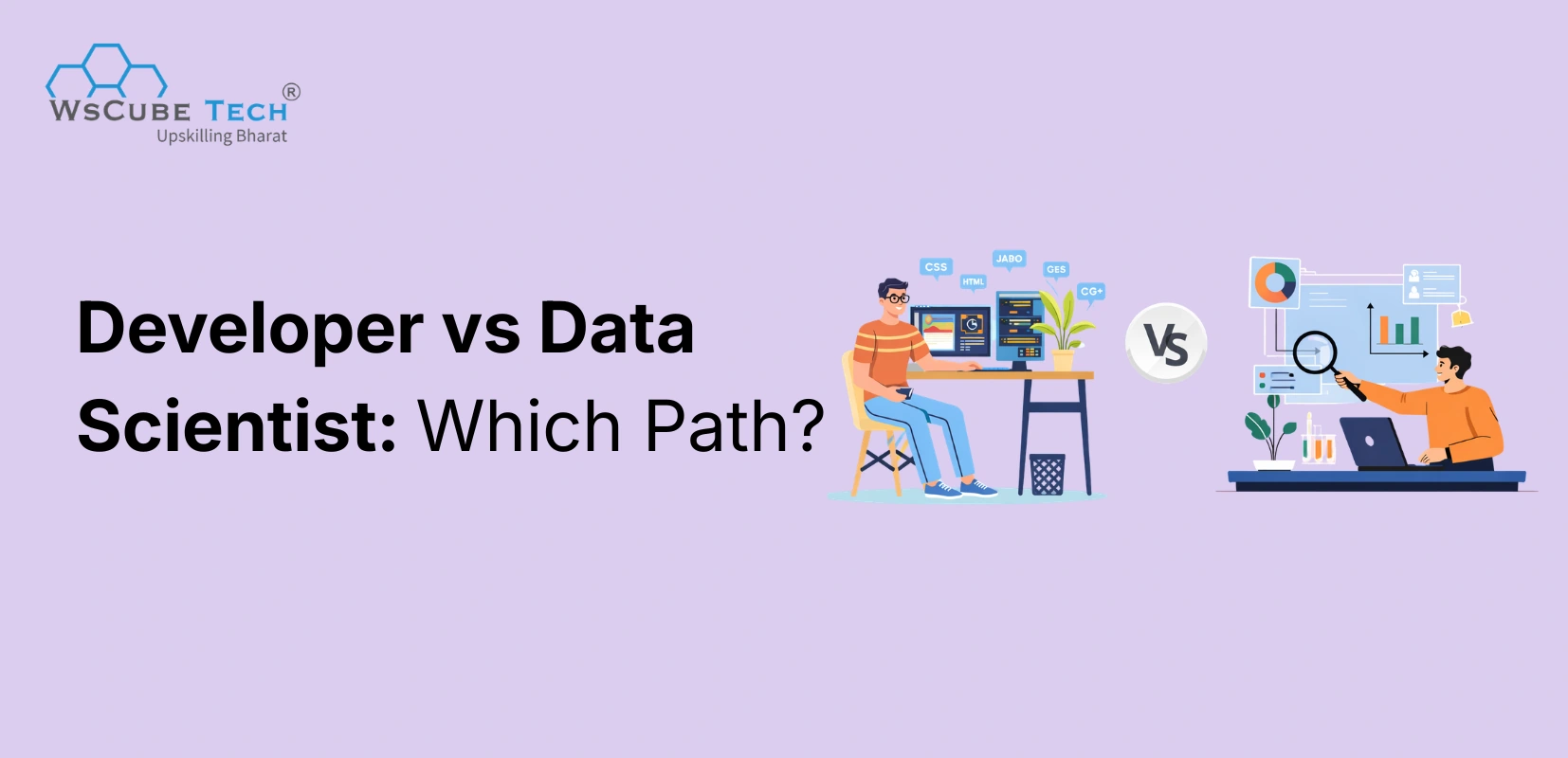
Technology offers many career options today, and two of the most popular are Full Stack Developer and Data Scientist. Both careers are in high demand and offer good salary and growth opportunities.
A full-stack developer builds complete websites and web applications by working on both the front-end and back-end. A Data Scientist works with data to find useful insights that help companies make better decisions.
In this blog, you will learn the complete details about Full Stack Developer vs Data Scientist, including skills, roles, salary, and career opportunities.
Who is a Full Stack Developer?
A full-stack developer is a software professional who builds and manages both the user-facing interface and the server-side functionality of a web application. Instead of working on only one layer of development, they understand how different parts of a system connect and operate together.
Because they work across the complete development process, full-stack developers are responsible for ensuring that an application runs smoothly from the interface users interact with to the backend systems that store and process data.
A full-stack developer commonly works with multiple technologies involved in web development, including:
- Frontend technologies such as HTML, CSS, and JavaScript to design the user interface
- Backend programming languages that handle server-side logic and application functionality.
- Databases that store and manage application data.
- APIs and frameworks that help connect different parts of the application system.
Now that you understand who a full-stack developer is, the next step is learning how to become one. If you want to start your journey in this field, consider following our detailed full stack developer roadmap, which explains the skills, tools, and learning steps required to build a successful career.
Recommended Professional Certificates
Full Stack Development Mentorship Program
WordPress Bootcamp
Who is a Data Scientist?
A data scientist is a professional who studies large amounts of data to discover useful patterns, trends, and insights. Instead of building applications or websites, their work focuses on examining data and turning it into information that can support better decisions.
Organizations collect large volumes of data from customers, systems, and operations. A data scientist helps make sense of this data by cleaning it, analyzing it, and identifying meaningful relationships that can guide planning and strategy.
A data scientist commonly works with tools and methods used for data analysis, including:
- Programming languages such as Python or R for data analysis.
- Statistical methods to study patterns and relationships in data.
- Machine learning techniques to build predictive models.
- Data visualization tools to present insights in charts, graphs, and reports.
Since you now understand the role of a Data Scientist, the next step is learning how to build a career in this field. If you are interested in becoming one, you can follow our complete data scientist roadmap, which outlines the essential skills, tools, and learning stages required to get started.
Full Stack Developer vs Data Scientist: Comparison Table
The table below highlights the key differences in a clear and structured format:
| Basis of Comparison | Full Stack Developer | Data Scientist |
| Primary Focus | Builds and manages both front-end and back-end of web applications. | Analyzes large datasets to identify patterns and insights. |
| Scope of Work | Mainly works on websites and web applications. | Works with business data, analytics systems, and prediction models. |
| Core Objective | Create functional and interactive software applications. | Convert raw data into meaningful insights for decision-making. |
| Technical Approach | Develops and connects different layers of an application. | Uses statistical methods and machine learning for analysis. |
| Skill Depth | Broad knowledge across many web technologies. | Deep understanding of data analysis, statistics, and modeling. |
| Programming Languages | JavaScript, Python, Java, PHP, Node.js | Python, R, SQL |
| Tools and Technologies | Web frameworks, APIs, databases, and version control tools | Data analysis libraries, machine learning frameworks, visualization tools |
| Career Growth | Senior developer, tech lead, and product engineer | Senior data scientist, AI specialist, analytics manager |
Recommended Professional Certificates
Data Analytics Mentorship Program
Data Science & AI Mentorship Program
Full Stack Developer vs Data Scientist: Core Responsibilities
It is also important to know what professionals in each position actually do on a daily basis. The responsibilities of a full-stack developer and a data scientist reflect their core objectives: building functional software systems and analyzing data to support decisions.
Although both roles require technical skills and problem-solving ability, the type of work they perform within an organization is quite different.
Core Responsibilities of a Full Stack Developer
A full-stack developer is responsible for building and maintaining web applications from the user interface to the backend systems that support them.
Common responsibilities include:
- Developing frontend interfaces using HTML, CSS, and JavaScript.
- Building backend functionality that processes requests and manages application logic.
- Designing and managing databases that store application data.
- Creating and integrating APIs that allow different systems or services to communicate.
- Testing and debugging applications to ensure smooth performance and reliability.
- Maintaining and updating web applications as new features or improvements are required.
Core Responsibilities of a Data Scientist
A data scientist focuses on working with data to identify patterns, generate insights, and support business decision-making.
Common responsibilities include:
- Collecting and preparing data from different sources for analysis.
- Cleaning and organizing datasets to ensure accuracy and consistency.
- Analyzing data using statistical methods to discover patterns and relationships.
- Building machine learning models to predict trends or future outcomes.
- Visualizing data findings using charts, graphs, and dashboards.
- Communicating insights to help teams and leaders make informed decisions.
Full Stack Developer vs Data Scientist: Tools and Technologies Used
The tools and technologies used in each role reflect the type of work they perform. A Full Stack Developer works with technologies that help build and manage web applications, while a Data Scientist uses tools designed for data analysis, modeling, and visualization.
Understanding these tools helps clarify how both roles operate within modern technology systems.
Tools and Technologies Used by Full Stack Developers
Full-stack developers use a variety of tools and technologies that support both frontend and backend development, allowing them to build and manage complete web applications.
Common tools and technologies include:
- Frontend technologies such as HTML, CSS, and JavaScript for building user interfaces.
- Frontend frameworks like React, Angular, or Vue to structure web interfaces.
- Backend technologies such as Node.js, Python, Java, or PHP to handle server-side logic.
- Databases like MySQL, PostgreSQL, or MongoDB to store and manage application data.
- Version control tools such as Git to track and manage code changes.
- API tools and frameworks that help different systems communicate and exchange data.
Tools and Technologies Used by Data Scientists
To study and interpret large datasets, data scientists use different analytical and visualization tools that support data processing, analysis, and prediction.
Common tools and technologies include:
- Programming languages such as Python and R for data analysis and modeling.
- Data analysis libraries like Pandas and NumPy for handling large datasets.
- Machine learning frameworks such as TensorFlow or Scikit-learn for building prediction models.
- Data visualization tools like Matplotlib, Power BI, or Tableau for presenting insights.
- Database query languages, such as SQL for retrieving and managing structured data.
- Big data tools that help process large-scale datasets in enterprise environments.
Upcoming Masterclass
Attend our live classes led by experienced and desiccated instructors of Wscube Tech.

Full Stack Developer and Data Scientist: Career Opportunities
After understanding the tools and technologies used in these roles, the next important thing to consider is the career opportunities available for each profession. Both full-stack developers and data scientists are in demand because organizations rely on software systems and data analysis to support their operations and growth.
However, the industries, job roles, and career paths associated with these professions differ based on the nature of their work.
Career Opportunities for Full Stack Developers
Full-stack developers have access to a wide range of career opportunities in companies that build and maintain digital platforms. Their knowledge of both frontend and backend development opens doors to several technical roles.
The table below highlights common career opportunities and their primary focus:
| Career Role | Purpose |
| Full Stack Developer | Builds and manages both frontend and backend parts of web applications. |
| Frontend Developer | Focuses on user interface design and client-side functionality of web applications. |
| Backend Developer | Develops server-side logic, manages APIs, and handles database operations. |
| Web Application Developer | Creates and maintains websites and web-based platforms used by organizations. |
| Technical Lead | Guides development teams, reviews system design, and ensures project execution. |
| Software Engineer | Works on building scalable application systems and improving software performance. |
Career Opportunities for Data Scientists
Data science skills open the door to many career opportunities across industries that work with large volumes of data. Professionals in this field can pursue several roles focused on analyzing data and generating insights.
The table below outlines common career opportunities and their primary focus:
| Career Role | Purpose |
| Data Scientist | Analyzes large datasets to identify patterns and generate business insights. |
| Machine Learning Engineer | Develops predictive models and intelligent systems based on data. |
| Data Analyst | Studies datasets and prepares reports that support decision-making. |
| AI Specialist | Works on intelligent systems that use data to perform automated tasks. |
| Business Intelligence Analyst | Creates dashboards and reports to help organizations track performance. |
| Analytics Manager | Leads data teams and manages projects related to data analysis and strategy. |
Read More Related Guides
Educational Background of Full Stack Developer and Data Scientist
The educational background for these roles reflects the type of skills required in each profession. A Full Stack Developer usually builds strong programming and development skills, while a Data Scientist develops expertise in mathematics, statistics, and data analysis.
Although formal education can help build a strong foundation, both careers also allow professionals to enter the field through certifications, practical projects, and specialized training programs.
Educational Background of Full Stack Developers
Full stack developers typically study subjects related to computer programming and software development. These programs focus on building the technical knowledge required for designing and developing web applications.
The table below highlights common educational paths and their purpose:
| Education | Purpose |
| Bachelor’s Degree in Computer Science or Information Technology. | Provides knowledge of programming, data structures, and software development fundamentals. |
| Diploma in CS or IT | Focuses on practical skills related to frontend and backend web technologies. |
| Coding Bootcamps | Offer short-term intensive training in web development tools and frameworks. |
| Online Certifications in Full Stack Development | Help learners gain hands-on experience with modern development technologies. |
| Self-learning through Projects and Practice | Allows developers to build practical experience by creating real web applications. |
Educational Background of Data Scientists
Data scientists usually study subjects related to mathematics, statistics, and data analysis, which help them understand how to interpret and analyze large datasets.
The table below outlines common educational paths and their purpose:
| Education | Purpose |
| Bachelor’s Degree in Computer Science, Mathematics, or Statistics | Provides foundational knowledge in programming, probability, and data analysis. |
| Master’s Degree in Data Science or Analytics | Focuses on advanced data analysis techniques and machine learning concepts. |
| Certification Courses in Data Science | Teach practical tools used for data analysis and predictive modeling. |
| Courses in Machine Learning and Artificial Intelligence | Help develop skills for building predictive and analytical models. |
| Practical Projects and Data Analysis Practice | Allow learners to apply analytical methods to real datasets and problems. |

Full Stack Developer vs Data Analytics: Salary Comparison
Salary levels for Full Stack Developers and Data Analytics professionals differ based on technical specialization, analytical skills, and the type of responsibilities involved in each role.
Data analytics roles generally offer competitive salaries in many cases because they involve data interpretation, statistical analysis, and insight generation, which help organizations make informed business decisions.
Full stack developer salaries increase with experience, especially when the developer is skilled in both frontend and backend technologies. Compensation depends on experience, location, company type, and technical expertise.
Salary Comparison in India
The following table presents the salary comparison for Full Stack Developer and Data Analytics roles in India:
| Experience | Avg Salary/Annual – Full Stack Developer (India) | (India)Avg Salary/Annual – Software Engineer (India) |
| Entry-Level (0–1 yrs) | ₹3 – 6 LPA | ₹4 – 10 LPA |
| Early Career (1–3 yrs) | ₹4 – 7 LPA | ₹4 – 12.7 LPA |
| Mid-Level (4–6 yrs) | ₹6 – 10 LPA | ₹7 – 16.9 LPA |
Salary Comparison in the United States
The following table presents the salary comparison for Full Stack Developer and Data Analytics roles in the United States:
| Experience | Avg Salary/Annual – Full Stack Developer (USA) | Avg Salary/Annual – Software Engineer (USA) |
| Entry-Level (0–1 yrs) | $61K – $100K | $70K – $110K |
| Early Career (1–3 yrs) | $67K – $100K | $77K – $100K |
| Mid-Level (4–6 yrs) | $72K – $100K | $87K – $100K |
Start Learning Programming with Our Free Tutorials
| Python Tutorial | Java Tutorial | JavaScript Tutorial |
| C Tutorial | C++ Tutorial | HTML Tutorial |
| CSS Tutorial | SQL Tutorial | DSA Tutorial |
Full Stack Developer vs Data Scientist: Future Scope
It is important to understand their future scope in the technology industry. As digital platforms and data-driven systems continue to expand, both roles are expected to remain valuable for organizations.
Future Scope of a Full Stack Developer
The demand for full-stack developers is expected to grow as more businesses expand their digital platforms and online services. Companies continue looking for professionals who can handle both frontend and backend development.
Key future opportunities include:
- Developing modern web applications for startups and product companies.
- Working with cloud platforms and scalable web architectures.
- Building SaaS platforms and enterprise web systems.
- Specializing in advanced frameworks and microservices architecture.
- Moving into senior roles such as technical lead or solution architect.
- Contributing to large-scale digital transformation projects.
Future Scope of a Data Scientist
The future scope of data science continues to grow as organizations generate and store larger amounts of data. Companies need professionals who can analyze this information and convert it into useful insights.
Key future opportunities include:
- Analyzing large datasets to support business decision-making.
- Building predictive models using machine learning techniques.
- Working in industries such as finance, healthcare, retail, and technology.
- Developing AI-based systems that learn from data patterns.
- Advancing into roles such as senior data scientist or analytics manager.
- Leading data-driven strategy and innovation projects.
Full Stack Developer vs Data Scientist: Which Career Should You Choose?
Your choice should depend on the type of problems you enjoy solving and the skills you want to develop.
Choose a Full Stack Developer if you:
- Enjoy building websites and web applications.
- Like working with both frontend design and backend logic.
- Prefer creating user interfaces and interactive digital products.
- Are interested in learning web technologies such as HTML, CSS, JavaScript, and backend frameworks.
- Want to work on complete application development projects.
- Like seeing the direct results of your code in a working application.
If you want to become a full stack developer, you can join our fully practical and project-based full stack development course, available in both online and offline modes to help you build real-world web development skills.
Choose a Data Scientist if you:
- Enjoy working with data and identifying patterns.
- Are interested in statistics, mathematics, and analytical thinking.
- Like solving business problems using data insights.
- Want to learn tools such as Python, machine learning libraries, and data visualization tools.
- Prefer analyzing datasets rather than building user-facing applications.
- Are curious about how data can guide decisions and predict trends.
If you are interested in working with data and advanced ai training, you can enroll in our fully practical and project-based data science course, offered in both online and offline formats to gain hands-on experience with real datasets and tools.
Full Stack Developer vs Data Scientist: Advantages and Disadvantages
Understanding the advantages and disadvantages of both roles helps provide a clearer perspective on what working in each career actually involves. While both careers offer strong opportunities in the technology industry, they differ in learning requirements, work style, and long-term specialization.
Full Stack Developer: Advantages and Disadvantages
The advantages and disadvantages of a full-stack developer are summarized in the table below:
| Category | Points |
| Advantages | -High demand in startups and companies building web applications. -Ability to work on both the front end and the back end of a project. -Strong freelance and remote work opportunities. -Better understanding of how complete web applications function. -Good career growth in web development and product-based companies. |
| Disadvantages | -May not develop deep specialization in one specific technology area. -Continuous learning required due to frequent changes in web frameworks and tools. -Handling both frontend and backend tasks can increase workload. -Managing multiple parts of an application can be technically demanding. |
Data Scientist: Advantages and Disadvantages
The advantages and disadvantages of a data scientist are summarized in the table below:
| Category | Points |
| Advantages | -High demand in industries that rely on data-driven decision-making. -Opportunities to work with advanced technologies such as machine learning and AI. -Strong salary potential in technology, finance, and healthcare sectors. -Ability to solve complex business problems using data analysis. -Growing career opportunities in analytics, AI, and data-driven industries. |
| Disadvantages | -Requires strong knowledge of mathematics, statistics, and analytical methods. -Learning data science tools and techniques can take significant time. -Handling large datasets and complex models can be challenging. -Results sometimes depend heavily on data quality and availability. |
Free Courses for You
FAQs about Full Stack Developer vs Data Scientist
A Full Stack Developer builds and manages web applications, including frontend and backend systems. A Data Scientist focuses on analyzing data, identifying patterns, and generating insights that support business decisions.
A full-stack developer needs skills in web technologies such as HTML, CSS, JavaScript, backend programming, and databases. A Data Scientist requires knowledge of statistics, data analysis, machine learning, and programming languages such as Python.
Both roles offer strong salaries, but Data Scientist positions sometimes pay more due to the need for advanced analytical and statistical skills. However, compensation mainly depends on experience, location, and company type.
Full Stack Developers design and maintain web applications, manage databases, and connect frontend and backend systems. Data Scientists analyze datasets, build predictive models, and present insights that help organizations make decisions.
Yes, Data Scientists usually need knowledge of mathematics and statistics to analyze data and build models. Full-stack developers mainly rely on programming and system development skills rather than advanced mathematical concepts.
Full-stack development is commonly easier for beginners because it focuses on programming and web technologies. Data Science usually requires additional knowledge of statistics, mathematics, and data analysis techniques.
Full-stack developers use tools like HTML, CSS, JavaScript frameworks, backend technologies, and databases. Data Scientists use tools such as Python, R, SQL, machine learning libraries, and data visualization platforms.
Yes, a full-stack developer can transition to Data Science by learning statistics, data analysis, and machine learning concepts. Since developers already know programming, they mainly need to develop strong analytical skills.
Full-stack developers are needed in companies building websites, applications, and digital platforms. Data Scientists are in demand in industries that rely on data analysis, such as finance, healthcare, technology, and retail.
Full-stack developers commonly study computer science or complete web development training programs. Data Scientists often pursue degrees in computer science, mathematics, statistics, or specialized courses in data science and analytics.
Join Our On-Campus Related Courses



Leave a comment
Your email address will not be published. Required fields are marked *Comments (0)
No comments yet.