Every time you scroll through social media, click a link, or open an app, information appears on your screen almost instantly. Behind this smooth experience lies a complex system working quietly in the background, one most users never think about.
This is made possible by backend programming languages, which power the server side of any application. While Front-end technologies handle what users see and interact with, the backend manages data, logic, and communication between the server and the client, making the entire experience seamless.
Web development is generally divided into two halves: front-end and back-end. Understanding backend programming languages helps you become a more complete developer. This blog covers everything you need to know about them and their real-world applications.
What is Backend Development?
Backend development is an important aspect of web development that focuses on creating and maintaining the server-side components of a website or web application. It's the part of the development process that handles the "behind-the-scenes" functionality, data management, and the server's interaction with the client-side (front-end) of a website.
Backend developers manage the server where the website or web application is hosted. This includes setting up and configuring the server, ensuring its security, and optimizing its performance.
Backend developers design and maintain the database systems that store and manage the website's data. This involves creating database schemas, optimizing database queries, and ensuring data integrity.
The developers also write code to handle server-side logic, which includes processing user requests, authentication, authorization, and business logic. They determine how data is retrieved and presented to the user.
What Are Backend Programming Languages?
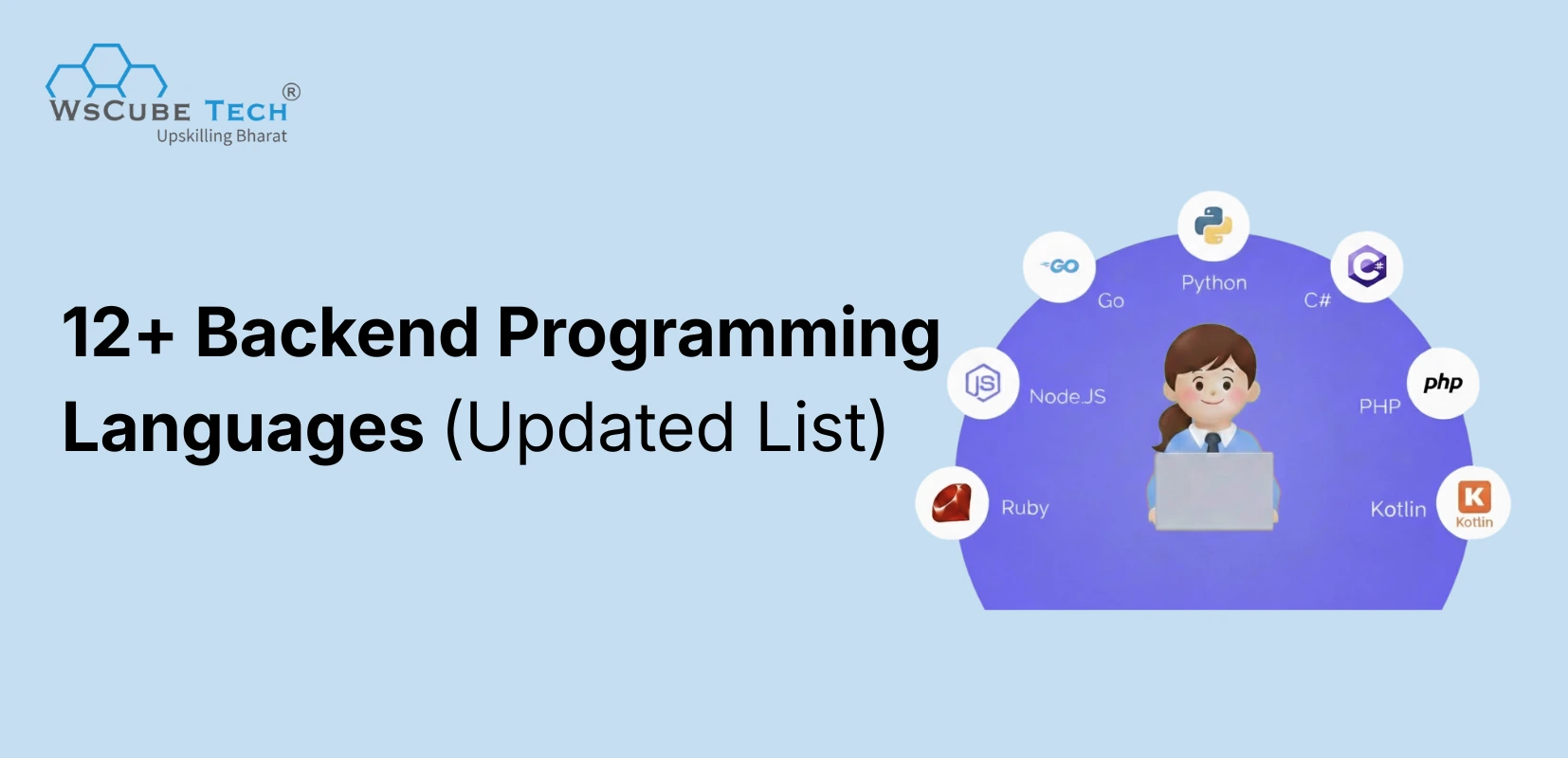
Backend programming languages are used to build and run the server-side systems that power a web application. They handle everything users don't see - processing requests, managing data, and enabling communication between the server and the client.
If you want to become a backend developer, our web development course teaches you these backend languages for web development and the frameworks used to build:
- Websites
- Interactive online tools
- Mobile apps
- Desktop apps
- Web servers
- Software prototypes
- Online games
- Security features
- Data collection
- Networking
Recommended Professional Certificates
Full Stack Development Course with AI Engineering
WordPress Bootcamp
Types of Backend Programming Languages
Usually, backend programming languages are categorized into two major types:
1. Object-Oriented Programming
This approach emphasizes object or data formations instead of using logic. Here, the object is a data field in functional programming with uncommon characteristics.
Object-oriented programming is best when developers work in teams on big and complex projects. PHP, Java, Ruby, and Python are the common examples of OOP backend programming.
2. Functional Programming
FP back-end programming focuses more on declarations and results than the programming procedure. It backs parallel, immutable data and doesn’t have any side effects.
To improve productivity & modularity and sort out scripting issues in the most straightforward ways, FP is the best option. SQL, R, Haskell, and F# are the best FP backend programming languages.
Best Backend Programming Languages at a Glance
Here is a quick overview of the top backend programming languages. This table gives you a fast comparison of what each language is best suited for, its standout features, and where it is commonly used.
| Programming Language | Best For | Key Features | Common Uses |
| Java | Enterprise applications | Platform independent, secure, dynamic memory | Banking, large-scale apps, Android |
| Python | Beginners, data-heavy apps | Simple syntax, automation, rich libraries | ML, data science, web apps |
| PHP | Dynamic web pages | Open-source, HTML friendly, secure sharing | Websites, CMS, web apps |
| Node.js | Real-time applications | Non-blocking, scalable, V8 engine | Chat apps, streaming, APIs |
| Ruby | Rapid web development | Convention over configuration, MVC, ORM | Web apps, scripting, DevOps |
| C# | Windows and game apps | Type safety, auto memory, LINQ | Desktop apps, games, business software |
| Kotlin | Android development | Concise, Java compatible, safe | Mobile apps, backend services |
| C++ | High-performance systems | Speed, memory control, portable | Game engines, systems programming |
| Perl | Text processing | Strong text handling, system admin | Reports, automation, scripting |
| SQL | Database management | Centralized control, recovery, security | Data storage, queries, analytics |
| Golang | Scalable backends | Easy syntax, built-in concurrency | Servers, web dev, CLI tools |
| ASP.NET Core | Cross-platform web apps | Cross-platform, Blazor, IoT ready | Web services, IoT, mobile backends |
| Django | Fast secure websites | Python based, rapid dev, well documented | Web apps, prototypes, scalable sites |
Upcoming Masterclass
Attend our live classes led by experienced and desiccated instructors of Wscube Tech.





Top Backend Languages (2026 List)
In web development, one should first select the backend programming language and determine how it affects the project.
So, if you are developing a website, web app or software, here are some of the best programming languages for backend you can use.
1. Java
Java is a versatile, object-oriented programming language. It has free access and runs on any platform. Also, it shares many features with C++ and has advanced and simplified capabilities.
Why learn Java?
Learning Java makes you a well-rounded programmer. Being a popular language worldwide, it is in high demand among employers. It also helps you develop skills businesses always seek in their developers.
Features
- Simple: Java eliminates all the difficulties of C++, such as operator overloading or pointers.
- Secured: For humans, Java bytecode is difficult to understand after compilation preventing any untrustworthy sources from performing activities in the sandbox. It develops virus-free, tamper-free systems or applications.
- Dynamic: It supports dynamic memory allocation. This minimizes memory waste and improves the application's performance.
2. Python
Python is a high-level backend programming language. It is famous for its clear syntax object-oriented design with the ability to allow developers to rapidly create applications.
Why learn Python?
Python has endeared itself to many professionals because of its object-oriented features, flexibility, and adaptability. Software engineers, machine learning experts, data scientists, and hackers love Python.
Features
- Smooth learning curve: Python language has minimal syntax. This makes it easy to learn and use as a computer language. Also, it is utilized for novices and converts since it resembles ordinary English writing and reading.
- Automation: Python is widely known for its ease of automation because of the plethora of tools and modules. In software testing, Python excels in efficiency and speed with minimal code.
- Open-source libraries: Python has an active community developing various open-source libraries and providing user support. This means Python is an excellent choice for almost any purpose.
3. PHP
PHP Hypertext Preprocessor is an extensively used open-source server-side programming language. It helps create dynamic web pages.
Why learn PHP?
PHP is a server-side programming language. It is an excellent backend programming language for creating dynamic web applications, as it works well with HTML and databases.
Features
- Cybersecurity application: Often, cybersecurity uses PHP to manage secure data sharing between servers and users, enhancing security while transferring data.
- Diversity of output: It generates PDF, Flash, and simple text files without requiring new languages. PHP can build forms that collect user information, deliver dynamic page content, or send cookies to identify returning visitors and start remarketing efforts.
- Ease of learning: Like HTML, PHP has built-in features to reuse code blocks you create. This makes it easier to learn than other programming languages.
4. NodeJS
Node.js allows JavaScript to be used on a web app backend and in a serverless architecture. This presents an intersection of frontend and backend technologies, as JavaScript is only used on a web application's frontend, client-side part.
Why learn Node.js?
Using JavaScript, Node.js makes sending and syncing data between the server and client sides easy. Using the same language makes code cleaner and more consistent. Further, you can use the same naming convention, tools, and best practices.
Features
- Performance and Scalability: Node.js is grounded on the Chrome V8 engine. It enables Node to provide a server-side runtime environment. This compiles and executes JavaScript at breakneck speeds. The Chrome V8 engine converts JavaScript into native machine language instead of interpreting or running it as a bytecode,. This gives Node a speed advantage over other languages like Python and Ruby.
- Scalable: NodeJs handle numerous requests simultaneously. It has a cluster module to balance the load across all active CPU cores.
- Cross-platform compatibility: NodeJS is a versatile system used on Unix, Linux, Windows, macOS X, and mobile devices. When paired with the correct package, NodeJS can generate a self-sufficient executable.
5. Ruby
Ruby is a well-known, versatile programming language. It is used for web scraping, site building, command-line tools, automation, and data processing. Released in 1995 by Yukihiro Matsumoto, Ruby is often called a language of careful balance.
Why learn Ruby?
Ruby is a versatile, in-demand programming language for web development, data processing, scripting, DevOps, static site generation, and more.
Features
- Convention over configuration: Ruby reduces the code programmers need to write.
- ActiveRecord: Ruby has an ORM library. It enables easy database interactions.
- MVC architecture: Ruby programming language has a modular and scalable design.
6. C#
C# is a Microsoft object-oriented programming language. It enables the construction of more complex programs as it was developed from the necessity for a robust object-oriented language. C# is a 2002 release with various applications, including desktop applications, web development, and all phases of scripting languages.
Why learn C#?
C# is widely used for several applications, including game creation, mobile apps, and business software.
Features
- Type safety: C# enables type checking during compile time. This prevents errors during runtime.
- Memory management: C# manages memory automatically, preventing memory leaks.
- Support LINQ: C# enables easy data manipulation and querying.
Read More Web Development Related Guides
7. Kotlin
Kotlin language runs on multiple platforms. It is concise, safe, interoperable, and easy to use with tools. As a statically typed programming language, it primarily uses the Java virtual machine and JavaScript or LLVM compiler infrastructure.
Why learn Kotlin?
Kotlin is popular among developers for its straightforward syntax and extensive features. Due to its compact codebase, it is a stable and consistent language for code development. You can easily detect and resolve codes during compile time before running the code.
Features
- Write less code: Less code equals fewer bugs when done correctly. You may concentrate on more essential tasks by delegating routine chores to the framework.
- Fully compatible with Java: Kotlin's beauty is that Android developers can use all Java frameworks and libraries while writing more concise code. You don't have to choose between two languages while building a mobile product. Also, migrating the applications from Java to Kotlin is always an option.
- Concise: Kotlin drastically reduces the boilerplate code. With inferred syntax, you can declare variables without stating their type explicitly. This eliminates the entire errors class before compilation even happens.
8. C++
C++ is an object-oriented programming language with low system dependence. It is so compatible with C that it will compile over 99% of C programs without altering a source code's line. Although C++ is a well-structured and safer language than C, it is OOP-based.
Why learn C++?
C++ is nearly identical to C. It runs most C programs unchanged. However, it is a safer language for systems programming and game development compared to C, as it uses OOP principles.
Features
- Speed and high performance: C++'s quickness makes it a favorite of software developers everywhere. An upgraded form of C language, C++ is a complex back end web programming language to learn for newbies, but it is powerful and versatile.
- Platform-independent: C++'s portability allows developers to write software to run on several operating systems without changing the source code.
- Memory control: C++ provides functions to manage memory efficiently, including dynamic memory allocation and pointers.
9. Pearl

Perl programming language is high-level, general-purpose, interpreted, and dynamic. Since there's no official full form of Perl, the widely used expansion is "Practical Extraction and Reporting Language. "
Why learn Perl?
Perl is syntactically similar to other languages and is easier to code and learn. You can write programs in any text editor like Notepad++.
Features
- Text-Processing: Perl has remarkable text manipulation capabilities. This allows it to produce reports from numerous text files quickly. It can convert files to other formats, too.
- System Administration: Perl simplifies system administration tasks. You can complete all the system administration tasks in one language instead of depending on many languages. Perl is the most versatile backend programming language for web programming, web automation, and GUI programming.
- Easy to start: Perl resembles standard programming languages such as C and C++. Therefore, Perl is easy to learn for anyone interested in coding.
10. SQL
Structured Query Language manages relational databases. A relational database is a database that tracks and makes available data points connected. We can store data in an SQL table and access or change it.
Why learn SQL?
SQL is popular due to its usefulness in data processing. The ease of learning and beginner-friendliness make it an ideal choice for anyone looking into coding or data processing.
Features
- Centralized Database Control: The database control is integrated directly into the program. Hence, the chances of data corruption or human error during the loading process are absent.
- Data Recovery and Restore Features: SQL Server has data recovery and restore features that programmers and developers use when there is a problem with processing data in a database.
- Database Security Management: Besides powerful security capabilities, Microsoft SQL Server has excellent data protection management.
11. Golang

Golang is a Google-originated open-source programming language. Go creators wanted developers to have a programming language that allows them to create applications quickly and easily. Golang is used in servers, web development, and command-line interfaces. It aims to be simple, high-performing, readable, and efficient.
Why learn to Go?
Learning Go is more accessible if you have prior experience with C or Java languages. Despite this preexisting knowledge, Golang is globally recognized as more superficial to learn.
Features
- Easy learning curve: Go has a simple syntax and minimal structure, making it easy to understand.
- Built-in concurrency: Go has built-in support for concurrency. This allows multiple processes to run simultaneously.
- Robust standard library: The standard library offers developers a lot of reliable and well-tested code.
12. ASP.NET Core
ASP.NET is a Microsoft-developed open-source software. It is used for building web applications, services, IoT applications, and mobile back-end components. The major difference between ASP.NET and ASP.NET Core is that they are cross-platform. This enables us to run on .NET Core or Net Framework.
Why learn ASP .NET Core?
ASP.NET Core is a re-imagined ASP.NET framework that uses modern software design ideas. It has incorporated several mature, stable, and reliable .NET Framework features.
Features
- Web Apps and Services: You can create reliable and efficient web applications with HTML, CSS, and Javascript.
- Run .NET in Browser: With Blazor and C#, you can create interactive web UIs that run .NET in the browser directly.
- Internet of Things: You can develop cutting-edge apps or background services for IoT devices.
13. Django
Django is an open-source Python web framework. It helps develop websites quickly, securely, and with clean design. Django is a web app framework that provides all the components needed for application development. Instagram, BitBucket, Mozilla, and other popular sites are created with the Django framework.
Why learn Django?
The Django framework is a wonderful choice for creating software because it's a web framework with various essential features to create an app more quickly.
Features
- Easy to use: Django framework uses Python. Widely used, its applications are free and open-source.
- Fast and simple: Django has the advantage of rapid development principles. This allows developers to work on various iterations without starting from the beginning.
- Excellent documentation: Django's extensive documentation makes it easy to develop different real-world applications.
Explore Our Web Development Related Courses
FAQs Related to Backend Languages
Backend languages are used to build the server-side logic of a website or app like handling databases, APIs, authentication, and business logic that users never see directly.
The most popular backend languages right now are Python, JavaScript (Node.js), Java, PHP, and Go, each suited to different project needs and scale requirements.
Python is widely considered the best backend language for beginners due to its simple syntax, strong community support, and beginner-friendly frameworks like Django and Flask.
Java and C# remain the top backend programming languages for enterprise systems, thanks to their stability, scalability, and mature ecosystems used in banking and large-scale platforms.
Choosing the right backend languages for web development depends on project scale, performance needs, team expertise, and long-term maintenance requirements.
SQL is used alongside general-purpose back end programming languages like Python or Java to manage and query relational databases, though it isn't a full programming language on its own.
Node.js is the preferred choice for real-time applications because of its non-blocking, event-driven architecture that handles multiple concurrent connections efficiently.
Yes, JavaScript works on both ends, through Node.js, it becomes a powerful backend language, making it a practical, cost-effective choice for full-stack development.
Backend programming languages like Python or Java are the core coding languages, while frameworks like Django or Express.js are pre-built tools that speed up development using those languages.
Most learners take 2-3 months to grasp the basics and around 8-12 months to become proficient in a chosen backend language, depending on prior coding experience.

Conclusion
The digital world is evolving at an unprecedented pace. With this, the demand for efficient, powerful, and advanced backend technologies has never been greater. Backend web programming languages influence the project closure speed and make a difference in the success of your complex web or mobile application. So, you must stay diligent and pay close attention to your project’s unique demands.
When choosing the best backend programming languages for your project, there is no one-size-fits-all solution. Each language has its strengths and weaknesses, so the best choice for you depends on the specific goals of your project. Whatever language you choose, research ahead to ensure it’s the best choice for your project.
Explore Our Free Tech Tutorials
| Python Tutorial | Java Tutorial | JavaScript Tutorial |
| C Tutorial | C++ Tutorial | HTML Tutorial |
| CSS Tutorial | SQL Tutorial | DSA Tutorial |
Practice Coding With Our Free Compilers
| Online Python Compiler | Online HTML Compiler | Online C Compiler |
| Online C++ Compiler | Online JS Compiler | Online Java Compiler |
Join Our On-Campus Full Stack Related Courses
Free Courses for You






Leave a comment
Your email address will not be published. Required fields are marked *Comments (0)
No comments yet.