
Every day, companies collect huge amounts of data from websites, apps, and digital platforms. But without proper analysis, this data cannot help businesses make better decisions.
That is why data science and machine learning are highly popular today. They help organizations analyze data, automate tasks, and solve business problems more efficiently across different industries.
Many beginners often struggle to understand the difference between data science and machine learning because both fields are closely connected and work with data and modern technologies. However, they have different goals, tools, skills, and career paths.
Learning about these fields can help you choose the right career direction and build future-ready skills in the tech industry. In this blog, you will explore their differences, skills, responsibilities, salaries, and career opportunities in simple language.
What is Data Science?
Data Science is a technology-driven field that focuses on collecting, analyzing, and interpreting data to solve real-world problems and support better decision-making. It combines programming, statistics, machine learning, and business knowledge to extract useful insights from large amounts of data.
- Converts raw data into meaningful insights for better understanding and planning.
- Uses statistical methods, data analysis, and machine learning to identify patterns and trends.
- Works with different types of data, including structured and unstructured data.
- Supports organizations in improving efficiency, predicting outcomes, and solving business challenges.
- Widely used in industries such as healthcare, finance, e-commerce, marketing, and technology.
Data Science Process
- Data Gathering: Collecting data from websites, applications, surveys, databases, and devices.
- Data Preparation: Organizing and transforming data into a clean and usable format.
- Data Exploration: Analyzing datasets to identify trends, relationships, and useful insights.
- Model Building: Applying statistical methods and machine learning models for predictions.
- Insight Communication: Presenting findings through reports, dashboards, visualizations, and charts for decision-making.
Careers in Data Science
Below are some popular career opportunities in data science that you can explore after learning data science skills and technologies:
| Career Role | Description |
| Data Scientist | Analyzes large datasets to identify patterns, build predictive models, and support business decision-making. |
| Data Analyst | Collects, organizes, and analyzes data to generate reports and insights for organizations. |
| Machine Learning Engineer | Develops and deploys machine learning models for automation and prediction tasks. |
| Business Analyst | Uses data insights to improve business strategies, operations, and overall performance. |
| Data Engineer | Builds and manages data pipelines, databases, and large-scale data processing systems. |
| AI Engineer | Creates artificial intelligence systems and smart applications using machine learning techniques. |
| Data Architect | Designs and manages the structure, storage, and organization of data systems. |
| Statistician | Applies statistical methods to analyze data and solve research or business problems. |
| Business Intelligence Analyst | Creates dashboards, reports, and visualizations to help companies make informed decisions. |
| Research Scientist | Conducts advanced research in data science, AI, and machine learning technologies. |
What is Machine Learning?
Machine Learning is a branch of artificial intelligence that enables systems to learn from data without explicit programming. It uses algorithms and data patterns to make predictions, automate tasks, and solve problems. Machine learning is widely used in recommendation systems, chatbots, fraud detection, and image recognition.
- Learns from historical data to make predictions and decisions automatically.
- Uses algorithms and statistical models to identify patterns and trends in data.
- Helps automate repetitive tasks and improve overall system efficiency.
- Improves performance continuously as more training data becomes available.
- Widely applied in healthcare, finance, e-commerce, cybersecurity, and robotics.
Machine Learning Process
- Data Collection: Gathering relevant data from multiple sources for training machine learning models.
- Data Preprocessing: Cleaning and preparing data to improve model accuracy and performance.
- Model Training: Applying machine learning algorithms to learn patterns and relationships from the data.
- Model Testing: Evaluating model performance using test datasets and accuracy metrics.
- Prediction and Deployment: Using trained models to make predictions and deploy solutions in real-world applications.
Careers in Machine Learning
Below are some popular career opportunities in Machine Learning that you can explore after learning machine learning concepts, algorithms, and tools:
| Career Role | Description |
| Machine Learning Engineer | Builds, trains, and deploys machine learning models for real-world applications. |
| AI Engineer | Develops intelligent systems and AI-based applications using machine learning techniques. |
| Data Scientist | Uses machine learning and data analysis to extract insights and solve business problems. |
| NLP Engineer | Works on natural language processing systems such as chatbots, translators, and voice assistants. |
| Computer Vision Engineer | Develops systems that can process and understand images and videos. |
| Robotics Engineer | Uses machine learning to improve automation and intelligent robotic systems. |
| Deep Learning Engineer | Designs deep learning models for tasks such as image recognition and speech processing. |
| Business Intelligence Developer | Uses machine learning insights to create reports, dashboards, and business strategies. |
| Research Scientist | Conducts advanced research in machine learning, artificial intelligence, and data technologies. |
| Software Engineer (ML Applications) | Develops software applications integrated with machine learning features and models. |
Recommended Professional Certificates
Data Analytics Course with Gen AI
Data Science Course with Internship & Placement Support
Data Science vs Machine Learning: Key Differences
Below are the key differences between Data Science and Machine Learning:
| Feature | Data Science | Machine Learning |
| Definition | A field focused on analyzing and interpreting data for insights and decision-making. | A branch of AI focused on enabling systems to learn from data automatically. |
| Main Goal | Extract meaningful insights from data. | Build models that can make predictions and improve automatically. |
| Scope | Broad field that includes statistics, data analysis, and machine learning. | A subset of data science and artificial intelligence. |
| Focus Area | Data collection, cleaning, analysis, and visualization. | Algorithm development, model training, and prediction. |
| Data Type | Works with structured and unstructured data. | Mainly works with training datasets for model learning. |
| Techniques Used | Data analysis, visualization, statistics, and predictive analytics. | Supervised, unsupervised, and reinforcement learning algorithms. |
| Programming Languages | Python, R, SQL, and Java. | Python, Java, and C++. |
| Output | Reports, dashboards, insights, and business decisions. | Prediction models and automated systems. |
| Applications | Business analytics, healthcare, finance, and marketing. | Recommendation systems, chatbots, fraud detection, and image recognition. |
| Career Roles | Data Scientist, Data Analyst, Business Analyst. | Machine Learning Engineer, AI Engineer, NLP Engineer. |
How Data Science and Machine Learning Work Together
Data Science and Machine Learning work together to analyze data, identify patterns, and solve real-world problems more efficiently. Data Science focuses on collecting, cleaning, organizing, and analyzing data, while Machine Learning uses that data to train models and make predictions automatically.
In many projects, data scientists prepare high-quality and structured data before machine learning models are developed. Clean and accurate data helps machine learning algorithms learn patterns more effectively and improve prediction accuracy.
Together, Data Science and Machine Learning are used in industries such as healthcare, finance, e-commerce, and marketing to automate tasks, predict trends, personalize services, and support better business decisions.
Skills Required for Data Science vs Machine Learning
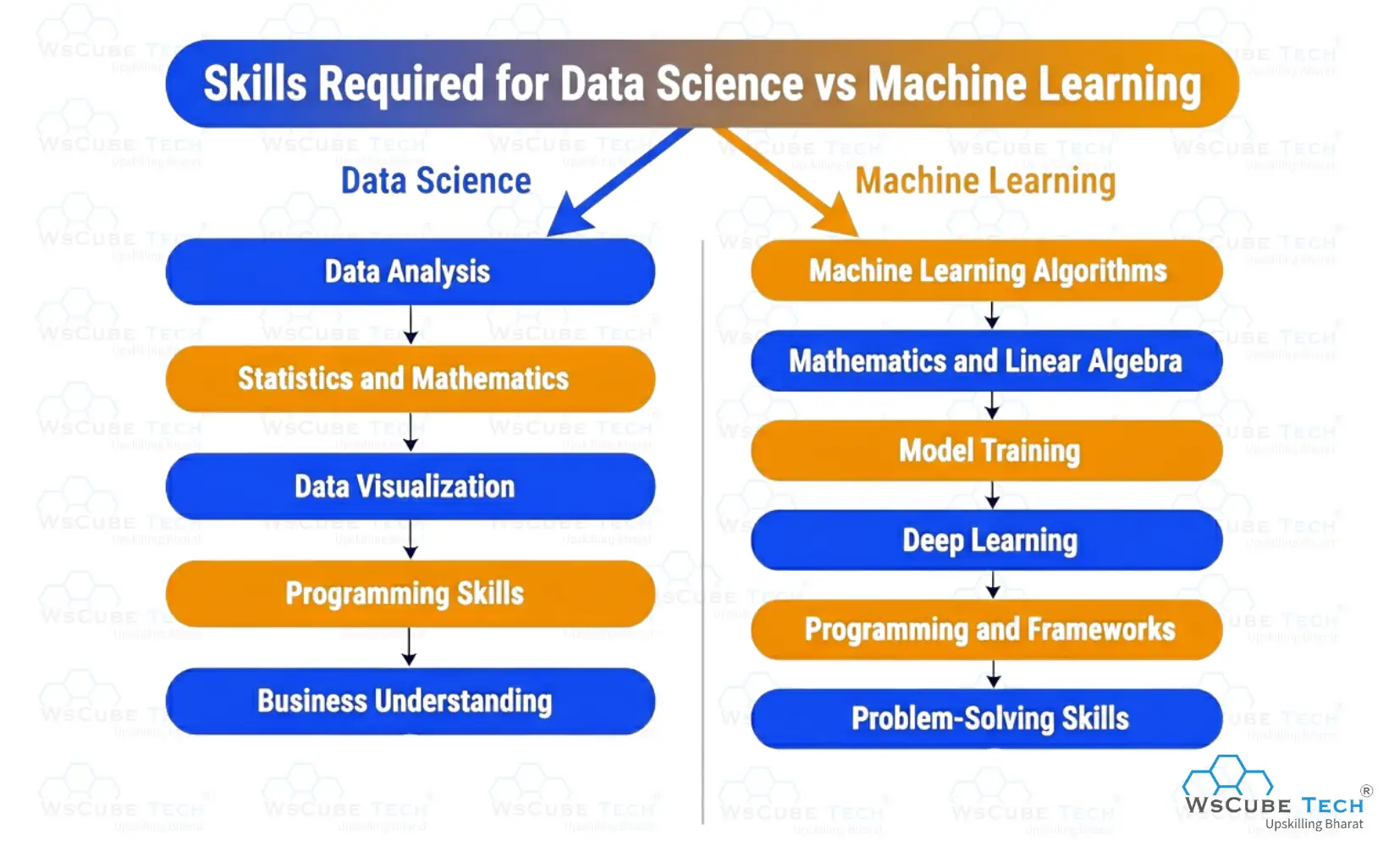
Below are the important skill sets required for both data science and machine learning. While some skills are common in both fields, others are more specialized depending on the career role and project requirements:
Skills Required for Data Science
- Data Analysis: Data science professionals must analyze large datasets to identify trends, patterns, and insights that help organizations make informed business decisions.
- Statistics and Mathematics: Strong knowledge of statistics and probability helps data scientists understand data relationships, perform analysis, and solve business-related analytical problems effectively.
- Data Visualization: Data scientists use visualization tools like Tableau and Power BI to present complex data insights through charts, graphs, and dashboards clearly.
- Programming Skills: Knowledge of programming languages such as Python, R, and SQL is important for handling, processing, and analyzing large datasets efficiently.
- Business Understanding: Data science requires understanding business goals and industry requirements to convert data insights into practical and strategic business solutions.
Skills Required for Machine Learning
- Machine Learning Algorithms: Machine learning professionals must understand supervised and unsupervised learning algorithms to build accurate predictive and automated intelligent systems successfully.
- Mathematics and Linear Algebra: Strong knowledge of mathematics, calculus, probability, and linear algebra is essential for effectively developing and optimizing machine learning models.
- Model Training: Machine learning engineers need skills in training, testing, and optimizing models using datasets to improve prediction accuracy and overall performance.
- Deep Learning: Knowledge of neural networks and deep learning frameworks helps machine learning professionals develop advanced AI applications such as image recognition systems.
- Programming and Frameworks: Machine learning requires strong programming skills in Python, Java, and C++, along with frameworks like TensorFlow, Scikit-learn, and PyTorch for model development.
- Problem-Solving Skills: Machine learning professionals solve technical challenges and improve model performance for automation and prediction-based applications.
Upcoming Masterclass
Attend our live classes led by experienced and desiccated instructors of Wscube Tech.






Roles and Responsibilities in Data Science and Machine Learning
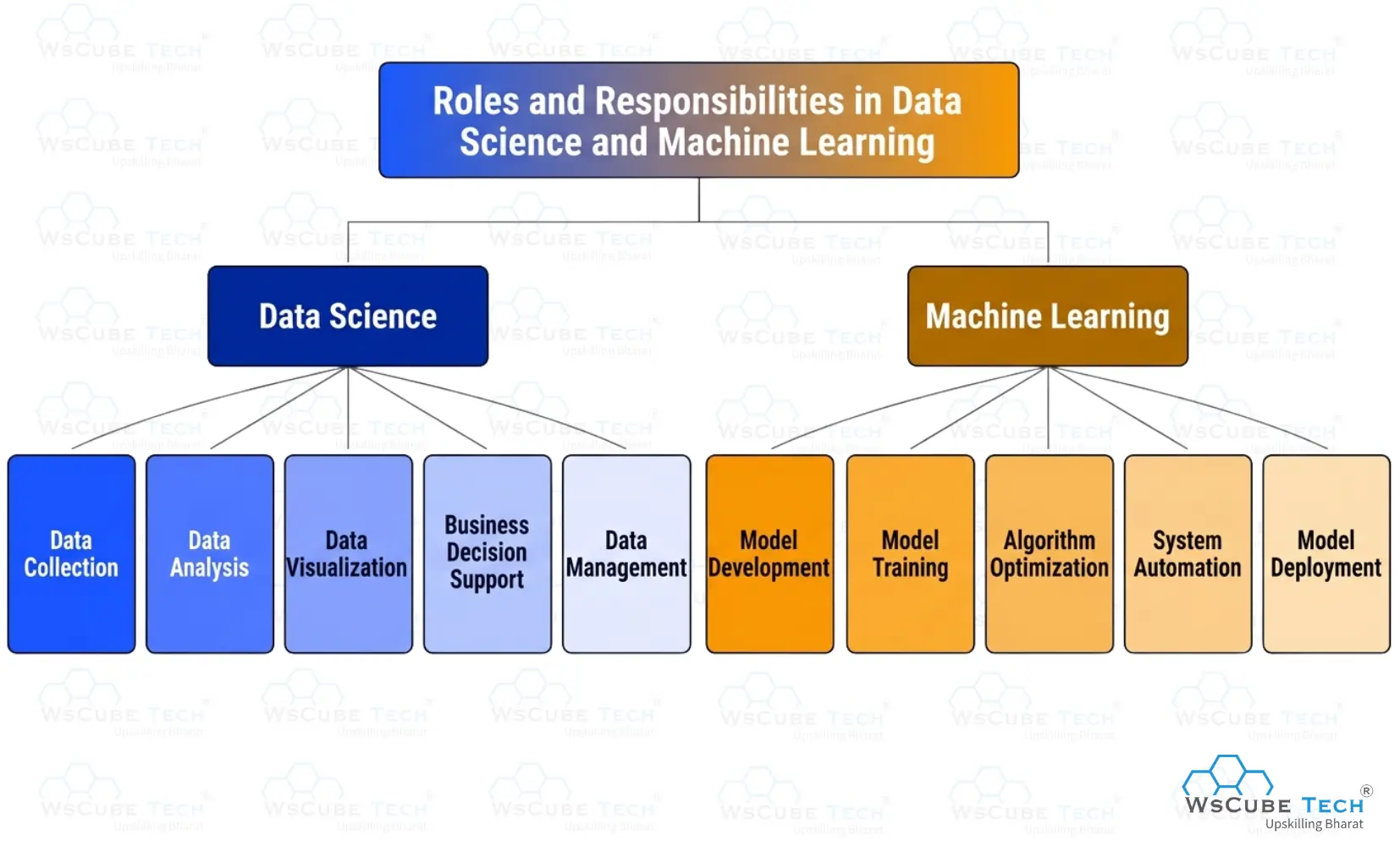
Below are the major roles and responsibilities in both data science and machine learning. Although both fields work with data and technology, their responsibilities differ based on project goals and tasks.
Roles and Responsibilities in Data Science
- Data Collection: Data science professionals gather data from multiple sources such as databases, websites, applications, and business systems for analysis.
- Data Analysis: Data scientists analyze datasets to identify patterns, trends, and insights that support business growth and better decision-making processes across different industries.
- Data Visualization: Creating charts, dashboards, and reports helps organizations understand complex data and communicate insights more effectively to stakeholders.
- Business Decision Support: Data science professionals help companies make data-driven decisions by providing accurate insights and predictive analysis reports.
- Data Management: Managing, cleaning, and organizing structured and unstructured data is an important responsibility in data science projects and workflows.
Roles and Responsibilities in Machine Learning
- Model Development: Machine learning professionals build predictive models using algorithms and training datasets to solve automation and prediction-related problems.
- Model Training: Machine learning engineers train models with large datasets to improve prediction accuracy and system performance over time.
- Algorithm Optimization: Improving algorithms and reducing model errors helps create faster, more accurate, and efficient machine learning systems for real-world applications.
- System Automation: Machine learning professionals develop systems that automate repetitive tasks and improve operational efficiency in various industries.
- Model Deployment: Deploying machine learning models into real-world applications helps organizations use intelligent systems for predictions and automation.
Data Science or Machine Learning: Which Should You Choose?
Choosing between Data Science and Machine Learning depends on your interests, skills, and career goals. If you enjoy working with data, analyzing trends, creating reports, and solving business problems, Data Science can be a better career option for you.
On the other hand, if you are interested in algorithms, artificial intelligence, automation, and predictive systems, Machine Learning may be the right choice. Machine learning focuses more on model building, programming, and improving system accuracy using data.
Both fields offer excellent career opportunities, high salaries, and strong future growth in the technology industry. You can also start with Data Science and later specialize in Machine Learning as your skills and experience grow over time.
Data Science or Machine Learning: Which is Harder?
Both Data Science and Machine Learning can be challenging, but the difficulty level depends on interests, background, and learning style. Both fields require analytical thinking, problem-solving abilities, and technical knowledge to work with data effectively.
Data Science mainly focuses on data analysis, visualization, statistics, and business understanding. It is often considered easier for beginners interested in analytics, reporting, and solving business-related problems using data insights.
Machine Learning is usually considered more technical because it involves algorithms, mathematics, programming, and model development. Learning concepts such as linear algebra, calculus, probability, and model optimization can be difficult for beginners.
Choosing the easier field depends on personal interests and career goals. Data Science focuses more on analytics and decision-making, while Machine Learning focuses on artificial intelligence, automation, and predictive systems.
Explore More on Related Guides
Data Scientist vs Machine Learning Engineer: Career Comparison
Below is a career comparison between Data Scientists and Machine Learning Engineers based on skills, responsibilities, career growth, and job focus:
| Comparison Factor | Data Scientist | Machine Learning Engineer |
| Main Focus | Analyzing data and generating business insights | Building and deploying machine learning models |
| Primary Responsibilities | Data analysis, visualization, reporting, and prediction | Model training, optimization, and automation |
| Technical Skills | Statistics, SQL, Python, data visualization | Algorithms, Python, deep learning, model deployment |
| Mathematics Requirement | Moderate to high | High |
| Programming Requirement | Medium | Advanced |
| Tools Used | Tableau, Power BI, Pandas, SQL | TensorFlow, PyTorch, Scikit-learn |
| Work Style | Business and analytics focused | AI and system development focused |
| Career Opportunities | Data Analyst, Business Analyst, Data Scientist | ML Engineer, AI Engineer, Deep Learning Engineer |
| Salary Potential | High | Very High |
| Difficulty Level | Moderate | More technical and complex |
| Best For | Analytics, business insights, and decision-making | Artificial intelligence, automation, and predictive systems |
| Industry Demand | Very high across multiple industries | Rapidly growing in AI-driven industries |
Both careers offer excellent salaries, strong career growth, and high industry demand. Data Science is better for analytics and business-focused roles, while Machine Learning Engineering is ideal for AI, automation, and advanced technical development.
Data Scientist or Machine Learning Engineer: Which is Better?
Both Data Scientists and Machine Learning Engineers are highly valuable careers in the technology industry. Both roles offer excellent salaries, strong career growth, and increasing demand across industries such as healthcare, finance, e-commerce, and artificial intelligence.
A Data Scientist role is better for careers focused on data analysis, visualization, business insights, and decision-making. This field is suitable for working with datasets, identifying trends, and helping organizations solve business problems using data-driven strategies.
A Machine Learning Engineer role is better for artificial intelligence, automation, algorithms, and predictive system development. This career focuses more on programming, model training, optimization, and building intelligent applications using machine learning technologies.
Overall, the better career depends on your interests, skills, and career goals. If you want to explore these careers further, checking the Data Scientist roadmap and Machine Learning roadmap can help you understand which topics should be learned deeply and which skills are most important for each career path.
Data Science vs Machine Learning: Salary Comparison
Now it’s time to understand the machine learning vs. data science salary in India and compare the earning potential of both fields. Salaries in these careers depend on experience, technical skills, company size, industry demand, and project expertise.
| Experience Level | Data Science Salary (India) | Machine Learning Salary (India) |
| Freshers (0–2 Years) | ₹4 LPA – ₹8 LPA | ₹5 LPA – ₹10 LPA |
| Mid-Level (3–5 Years) | ₹8 LPA – ₹15 LPA | ₹10 LPA – ₹18 LPA |
| Experienced (5+ Years) | ₹15 LPA – ₹30 LPA+ | ₹18 LPA – ₹35 LPA+ |
| Senior Roles | ₹25 LPA – ₹45 LPA+ | ₹30 LPA – ₹50 LPA+ |
Factors Affecting Salaries
- Technical skills and programming expertise
- Experience with AI, deep learning, and big data tools
- Company size and industry demand
- Certifications, projects, and practical experience
- Knowledge of cloud platforms and advanced technologies
Overall, Machine Learning roles often offer slightly higher salaries because they require advanced programming, mathematics, and AI expertise. However, both Data Science and Machine Learning provide excellent salary growth and strong career opportunities in India.
Explore Our Data Related Courses
| Data Analytics Course | Live Internship + 100% Job Support |
| Business Analytics Course | Live Internship + 100% Job Support |
| Data Science Course | Live Internship + 100% Job Support |
Common Myths About Data Science and Machine Learning
Many beginners have misconceptions about Data Science and Machine Learning. Below are some common myths related to both fields:
Data Science and Machine Learning Are the Same
Many assume both fields are identical, but Data Science focuses on analyzing and interpreting data, while Machine Learning mainly focuses on building predictive and automated systems using algorithms and models.
Only Advanced Programmers Can Learn These Fields
Many beginners think strong coding expertise is required from the beginning, but basic programming knowledge, regular practice, and step-by-step learning can help build skills in Data Science and Machine Learning successfully over time.
Machine Learning Can Work Without Data
Machine Learning models depend heavily on quality data for training and predictions. Without clean, relevant, and structured data, machine learning systems cannot perform accurately or efficiently in real-world applications.
Data Science and Machine Learning Guarantee Instant High Salaries
Many learners believe these careers provide immediate high salaries, but strong technical skills, practical projects, certifications, and industry experience are important for achieving better salary packages and long-term career growth in competitive technology industries.
Future Trends in Data Science and Machine Learning
Below are the future trends in Data Science and Machine Learning that are shaping modern technologies and career opportunities:
Future Trends in Data Science
- Big Data Analytics: Organizations are increasingly using big data technologies to process massive datasets and generate valuable business insights for better strategic decision-making.
- Real-Time Data Processing: Real-time analytics is becoming more important for businesses to monitor customer behavior, track performance, and improve operational efficiency instantly.
- Data Visualization Tools: Advanced visualization tools and dashboards help businesses understand complex data and communicate insights more effectively.
- Cloud-Based Data Science: Cloud platforms are simplifying data storage, processing, and analytics, making data science solutions more scalable, flexible, and cost-effective for organizations.
- Data-Driven Decision Making: Businesses are relying more on data-driven strategies to improve customer experiences, optimize operations, and gain competitive advantages across industries.
Future Trends in Machine Learning
- Artificial Intelligence Integration: Machine learning is becoming a core part of AI systems, enabling smarter automation, virtual assistants, and intelligent business applications.
- Deep Learning Advancements: Deep learning technologies are improving applications such as image recognition, speech processing, autonomous vehicles, and natural language understanding systems.
- Automation and Robotics: Machine learning is increasing automation in industries by improving robotic systems, predictive maintenance, and intelligent manufacturing processes efficiently.
- Explainable AI: Organizations are focusing on explainable AI systems to improve transparency, trust, and understanding of machine learning model predictions and decisions.
- Edge Machine Learning: Edge computing allows machine learning models to process data directly on devices for faster, private, and real-time decision-making.

FAQs About Data Science vs Machine Learning
Data science focuses on collecting, analyzing, and interpreting data for business insights, while machine learning focuses on building algorithms and predictive models that allow systems to learn automatically from data.
Data science is often considered better for beginners because it includes data analysis and visualization concepts, while machine learning requires stronger mathematics, algorithms, and programming knowledge for advanced model development.
Yes, machine learning requires coding skills because professionals use programming languages like Python, Java, and C++ to build, train, test, and optimize machine learning models and intelligent applications.
Yes, data science is expected to remain a highly demanding career in 2026 because companies across industries rely heavily on data analysis, business insights, automation, and predictive technologies for growth.
Machine learning roles often offer slightly higher salaries because they require advanced technical skills, AI knowledge, and model development expertise, while data science also provides excellent salary opportunities and career growth.
Machine learning careers require programming, mathematics, algorithms, model training, deep learning, and frameworks like TensorFlow, Scikit-learn, and PyTorch.
To become a data scientist, you need skills in data analysis, statistics, programming, data visualization, SQL, machine learning basics, and business understanding for solving real-world analytical problems effectively.
Both machine learning and data science have excellent future scope because industries increasingly use artificial intelligence, automation, analytics, and predictive technologies to improve business operations and customer experiences globally.
Yes, a data scientist can become a machine learning engineer by improving programming, mathematics, algorithms, model deployment, and deep learning skills required for advanced machine learning and AI development.
Yes, mathematics is important for both fields because concepts like statistics, probability, calculus, and linear algebra help professionals analyze data, build models, and improve prediction accuracy effectively.
Machine learning is generally considered harder because it involves advanced mathematics, algorithms, and model training, while data science focuses more on analytics and visualization.
Career opportunities include Data Scientist, Data Analyst, Machine Learning Engineer, AI Engineer, Data Engineer, Business Intelligence Analyst, and Deep Learning Engineer across healthcare, finance, e-commerce, and technology industries.
Yes, many companies hire freshers for entry-level data science and machine learning roles, especially candidates with strong technical skills, certifications, internships, projects, and practical knowledge of relevant tools.
Python is considered the best programming language for data science and machine learning because it offers simple syntax, powerful libraries, automation support, and frameworks for analytics and AI development.
Conclusion
Data Science and Machine Learning are two rapidly growing fields that offer excellent career opportunities, high salaries, and strong future demand across different industries. While Data Science focuses more on data analysis and business insights, Machine Learning mainly focuses on automation, algorithms, and predictive systems.
Both fields require technical skills, continuous learning, and practical experience to build a successful career. Choosing the right field depends on your interests, career goals, and the type of technology you want to work with in the future.
Explore Our Free Tech Tutorials
| Python Tutorial | Java Tutorial | JavaScript Tutorial |
| C Tutorial | C++ Tutorial | HTML Tutorial |
| CSS Tutorial | SQL Tutorial | DSA Tutorial |
Practice Coding With Our Free Compilers
| Online Python Compiler | Online HTML Compiler | Online C Compiler |
| Online C++ Compiler | Online JS Compiler | Online Java Compiler |
Join Our On-Campus Data Science Program
Explore Our Free Courses






Leave a comment
Your email address will not be published. Required fields are marked *Comments (0)
No comments yet.