
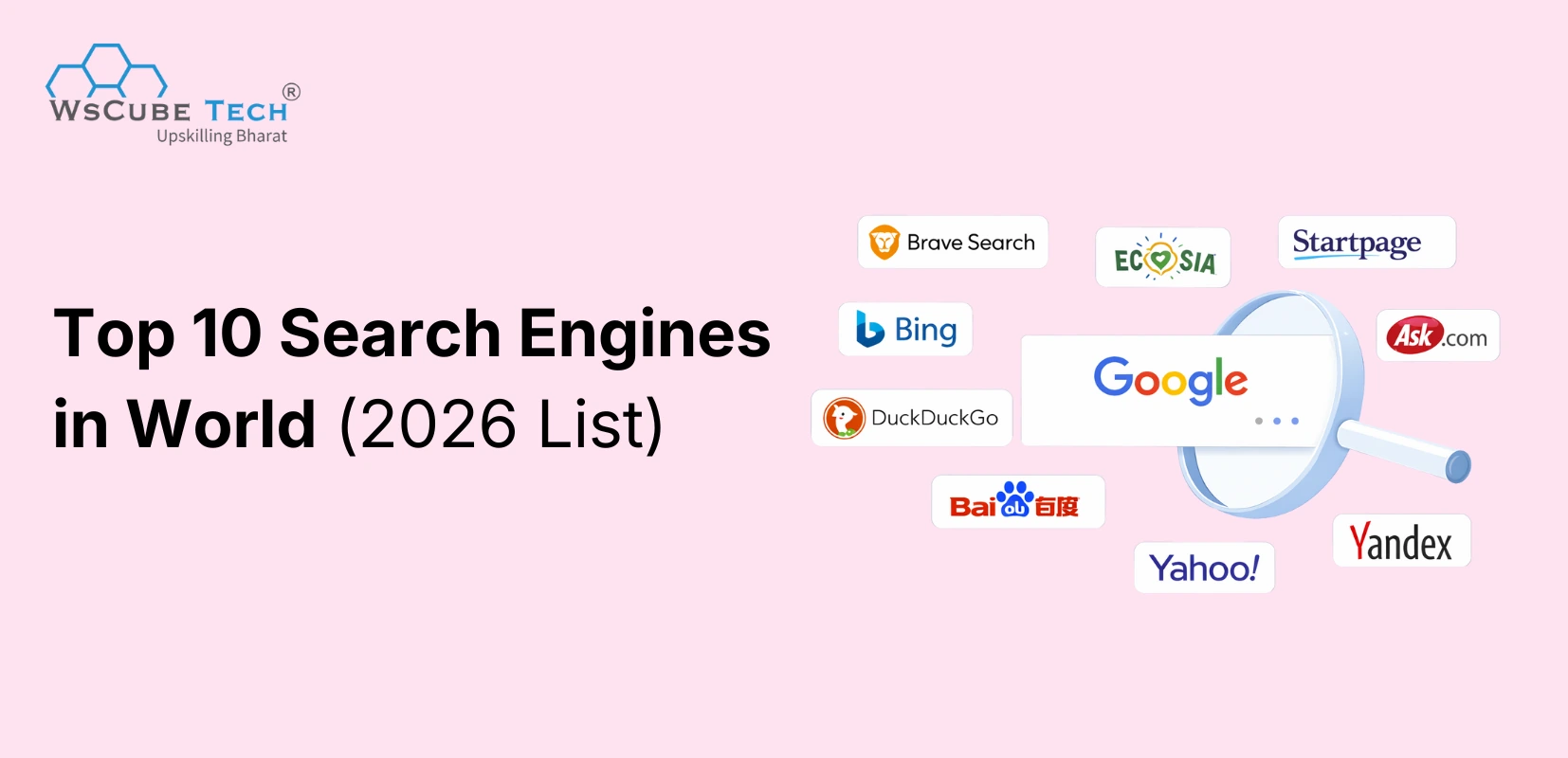
Search engines decide how the world finds information online, and the dominance at the top is not even close. Google continues to lead the market by a massive margin, holding close to 90% worldwide share for many years.
It is followed far behind by Bing, Yandex, Yahoo, and DuckDuckGo. This clearly shows how concentrated the search ecosystem is.
Below, we have covered the top 10 search engines in detail and present a complete search engines list.
Search Engine Websites List
| Rank | Search Engine | Website | Primary Region / Use |
| 1 | https://www.google.com | Global | |
| 2 | Bing | https://www.bing.com | Global |
| 3 | Yahoo | https://www.yahoo.com | Global |
| 4 | DuckDuckGo | https://duckduckgo.com | Global (Privacy-focused) |
| 5 | Baidu | https://www.baidu.com | China |
| 6 | Yandex | https://yandex.com | Russia & Eastern Europe |
| 7 | Brave Search | https://search.brave.com | Global (Privacy-focused) |
| 8 | Ecosia | https://www.ecosia.org | Global (Eco-focused) |
| 9 | Startpage | https://www.startpage.com | Global (Privacy-focused) |
| 10 | Ask.com | https://www.ask.com | Global |
Top 10 Search Engines in the World
Let’s discuss in detail the 10 best search engines:
1. Google

Google is the most widely used search engine in the world and has dominated the global search market for many years. Launched in 1998, Google is known for its highly advanced algorithms that focus on relevance, quality, and user intent. It operates globally and supports hundreds of languages, making it the default search choice for most internet users.
Google’s key strength lies in its ability to understand complex queries and deliver accurate results across web pages, images, videos, news, maps, and shopping. It continuously updates its ranking systems to fight spam and reward high-quality content. Google is also deeply integrated with products like Gmail, YouTube, Google Maps, and Android, which further strengthens its ecosystem.
Best for:
General web searches, research, local search, business discovery, and up-to-date information.
Key Highlights:
- World’s most popular search engine
- Advanced ranking algorithms
- Strong local and mobile search support
- Integrates with many Google services
- Best overall accuracy and relevance
2. Bing

Bing is Microsoft’s search engine and the second most used search engine globally. It powers searches across Microsoft products such as Windows, Edge browser, and Cortana. Bing has a strong presence in countries like the United States and is widely used as the default search engine on Windows devices.
Bing focuses heavily on visual search, offering rich image previews, video carousels, and clean layouts. It is also the backbone of Yahoo Search. In recent years, Bing has gained attention for integrating AI-powered features that enhance search experiences.
For marketers, Bing is valuable because it reaches a slightly different demographic, often including desktop-heavy and enterprise users.
Best for:
Desktop users, image and video search, Microsoft ecosystem users, and alternative SEO targeting.
Key Highlights:
- Powered by Microsoft
- Default on Windows and Edge
- Strong visual search features
- Lower competition for advertisers
- AI-enhanced search experience
3. Yahoo

Yahoo is one of the oldest names in the search industry and originally started as a web directory before becoming a full-fledged search engine and content portal. Today, Yahoo Search is powered by Bing’s search technology but maintains its own interface and ecosystem.
Yahoo is popular for combining search with content such as news, finance, sports, and email services. Many users visit Yahoo not just to search the web, but also to consume daily news and updates. While it no longer leads in search innovation, Yahoo remains relevant due to brand loyalty and its all-in-one portal approach.
Best for:
Users who prefer news, finance, sports, and email integrated with search.
Key Highlights:
- One of the oldest search brands
- Powered by Bing search results
- Strong content ecosystem (news, finance)
- Popular among long-time users
- Combines portal + search experience
Recommended Professional Certificates
Digital Marketing Mentorship Program
Advanced AI Marketing Bootcamp
Performance Marketing Bootcamp
SEO Specialist Bootcamp
4. DuckDuckGo

DuckDuckGo is a privacy-focused search engine designed for users who do not want their searches tracked or personalized. Unlike Google and Bing, DuckDuckGo does not store personal data, search history, or user profiles.
It delivers search results by combining data from multiple sources, including its own crawler and other search providers. DuckDuckGo has grown rapidly among users concerned about data privacy, tracking, and targeted advertising. It also offers browser extensions and a privacy-focused mobile browser.
Best for:
Privacy-conscious users, anonymous searching, and avoiding personalized results.
Key Highlights:
- No tracking or data collection
- Clean and simple interface
- Same results for all users
- Popular among privacy-first users
- Growing global adoption
5. Baidu
Baidu is the leading search engine in China and dominates the Chinese search market. Due to government regulations and restrictions, Google is not widely accessible in China, which makes Baidu the primary search platform for Chinese users.
Baidu is heavily optimized for Chinese-language searches and integrates deeply with local services such as maps, music, forums, and cloud products. Its algorithm prioritizes local content and Chinese websites, making it essential for businesses targeting the Chinese market.
Best for:
Searching content in China and reaching Chinese-speaking audiences.
Key Highlights:
- Market leader in China
- Optimized for Chinese language
- Strong local service integration
- Essential for China-focused SEO
- Operates under regional regulations
6. Yandex

Yandex is the most popular search engine in Russia and several neighboring countries. It was launched in the late 1990s and is often referred to as the “Google of Russia.” Yandex is designed specifically to understand the Russian language and its complex grammar, which gives it an advantage over global search engines in that region.
Beyond web search, Yandex offers a wide ecosystem of services including maps, email, cloud storage, ride-hailing, and music streaming. Its search algorithm is highly localized, focusing on regional intent, local businesses, and language nuances.
For businesses and content creators targeting Russia or Eastern Europe, Yandex plays a critical role in visibility and traffic generation.
Best for:
Users searching in Russian language, regional content discovery, and businesses targeting Eastern Europe.
Key Highlights:
- Dominant search engine in Russia
- Strong language and regional understanding
- Wide ecosystem beyond search
- Local SEO importance in Eastern Europe
- Optimized for Cyrillic content
7. Brave Search

Brave Search is a relatively new but fast-growing search engine built by the creators of the Brave browser. Unlike many alternatives, Brave Search uses its own independent index, reducing reliance on Google or Bing. This makes it a truly independent search engine in terms of infrastructure.
Brave Search focuses heavily on user privacy, transparency, and unbiased results. It does not track users, store personal data, or create search profiles. The platform is closely integrated with the Brave browser, but it can also be used independently. Brave Search appeals strongly to users who want privacy without sacrificing result quality.
Best for:
Privacy-focused users looking for an independent alternative to Google.
Key Highlights:
- Uses its own search index
- No tracking or user profiling
- Integrated with Brave browser
- Transparent ranking approach
- Growing adoption among tech users
Upcoming Masterclass
Attend our live classes led by experienced and desiccated instructors of Wscube Tech.




8. Ecosia

Ecosia is a unique search engine that uses its ad revenue to fund tree-planting projects around the world. Based in Germany, Ecosia partners with Bing for search results while focusing its mission on environmental sustainability.
Every search contributes to Ecosia’s revenue, which is transparently published in financial reports. The company claims that a certain number of searches lead to planting one tree, making it popular among environmentally conscious users. Ecosia also emphasizes privacy by not selling user data and limiting tracking.
Best for:
Users who want their searches to contribute to environmental causes.
Key Highlights:
- Profits used for tree planting
- Powered by Bing search results
- Strong environmental mission
- Privacy-friendly approach
- Transparent financial reporting
9. Startpage

Startpage is a privacy-focused search engine that delivers Google search results without tracking users. It acts as a privacy layer between the user and Google, ensuring searches remain anonymous.
Unlike many search engines, Startpage does not store IP addresses, search history, or personal identifiers. This makes it appealing to users who trust Google’s result quality but dislike data collection. Startpage is especially useful for users who want accurate results without personalization or tracking influence.
Best for:
Users who want Google-quality results with complete privacy.
Key Highlights:
- Uses Google results anonymously
- No tracking or data storage
- Clean, simple interface
- Ideal for privacy-conscious professionals
- Strong trust among security-focused users
10. Ask.com

Ask.com started as a question-and-answer–based search engine, originally known as Ask Jeeves. Its focus was on allowing users to search in natural language questions rather than keywords.
Today, Ask.com operates more as a content-driven search platform, providing curated answers, articles, and FAQs. While it no longer competes directly with Google or Bing in raw search scale, it still attracts users looking for straightforward answers and topic-based browsing.
Best for:
Simple question-based searches and informational browsing.
Key Highlights:
- Question-focused search format
- Easy for beginners
- Content and answer-driven results
- Long-standing search brand
- Simpler alternative to major engines
What is a Search Engine?
A search engine is an online tool that helps you find information on the internet. When you type a query, the search engine scans its massive database of web pages and shows you the most relevant results.
At a high level, search engines work in three steps: they crawl websites, store information in an index, and rank pages based on relevance and usefulness.
Search engines do not create content; they organize existing content so users can find answers quickly. Common examples of search engines include Google, Bing, Yahoo, DuckDuckGo, and Baidu. Each search engine follows its own rules and ranking systems.
Explore Key Concepts of Digital Marketing
| Digital Marketing KPIs | Digital Marketing Platforms |
| Digital Marketing Process | 5 D’s of Digital Marketing |
| Importance of Digital Marketing | Lead Generation in Digital Marketing |
Best Search Engine in the World: Which One Should You Use?
When people ask for the best search engine in the world, the answer depends on what you value most—accuracy, privacy, regional focus, or special features.
For most users, Google remains the top choice because of its unmatched relevance, speed, and ability to understand search intent. It delivers consistent results across web, images, videos, news, and local searches, making it the most reliable option globally.
However, Google is not always the best fit for everyone. If privacy matters more than personalization, DuckDuckGo or Startpage may suit you better. If you use Windows devices heavily, Bing integrates smoothly. For users in China or Russia, Baidu and Yandex are far more effective.
- General users → Google
- Privacy-first users → DuckDuckGo / Startpage
- Regional searches → Baidu / Yandex
- Microsoft ecosystem users → Bing
How Search Engines Rank Websites?
Search engines rank websites using automated systems designed to deliver the most relevant and useful results. The process generally works in three stages:
- First, search engines crawl the web using bots that discover pages by following links and sitemaps.
- Next, they index the content by storing and organizing information about each page.
- Finally, they rank pages when a user searches, using hundreds of factors such as relevance, content quality, page experience, freshness, and authority.
Modern search engines also evaluate user intent, meaning they try to understand why someone is searching, not just what they typed. Factors like mobile friendliness, page speed, internal linking, and helpful content play an important role. Rankings are not manual; they are determined algorithmically and updated constantly.

FAQs About Search Engines
Yes. Popular alternatives include Bing, Yahoo, DuckDuckGo, Baidu, and Yandex.
DuckDuckGo and Startpage are among the safest for privacy because they do not track users.
DuckDuckGo does not store personal data or search history.
Bing is not better overall, but it can be useful for image search, desktop users, and Microsoft integrations.
Baidu is the most widely used and effective search engine in China.
There are dozens of search engines, but only a handful are widely used globally.
Yes. Websites can rank on multiple search engines, though ranking factors may differ slightly.
Google is generally best due to its accuracy and access to educational resources.
Explore Our Free Courses





Leave a comment
Your email address will not be published. Required fields are marked *Comments (0)
No comments yet.