
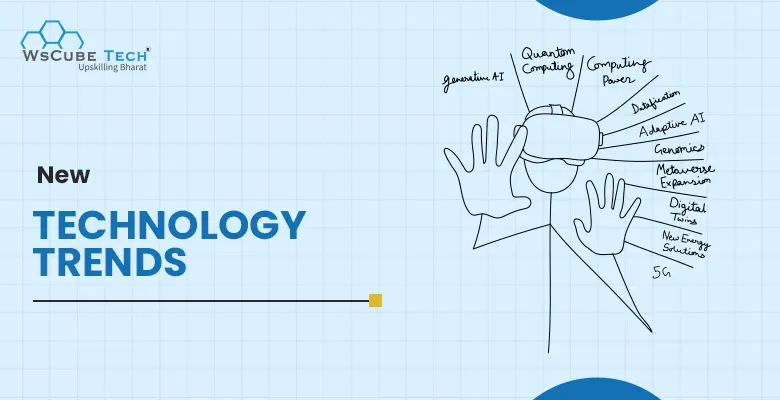
Technology is changing faster than ever, and 2026 will bring many important innovations that shape how people live and work. New technology trends are focused on making systems smarter, safer, and more connected. These trends are not just for experts, they affect everyday life, businesses, and future careers.
In 2026, new technologies will play a key role in areas such as artificial intelligence, cybersecurity, cloud computing, and automation. Companies will use advanced tools to improve efficiency, while individuals will benefit from smarter devices and better digital services in daily life.
Understanding these trends helps you stay prepared for the future. Whether you are a student, developer, or business owner, learning about upcoming technologies makes it easier to adapt, grow skills, and make better decisions in a fast-changing digital world.
Top 24 New Technology Trends in 2026
Technology is changing rapidly, and 2026 will introduce powerful innovations that will shape the digital future. Below, you will learn about the latest trending technologies transforming industries and everyday life.
1. Agentic AI (Autonomous AI Agents)
In 2026, AI is evolving beyond simple assistants toward agentic AI systems that can independently plan, decide, and act without continuous human guidance. These intelligent agents are reshaping how digital work gets done.
Why It Matters
Agentic AI is part of the fastest-growing segment of the AI market. According to recent industry market research, autonomous AI technologies are expected to grow at a CAGR above 40% through 2035, with market value projected to reach over $11 billion by 2026. This growth reflects increasing trust in AI systems that can operate at scale.
Business Impact
Companies adopting agentic AI report 30–50% faster task completion and significant reductions in manual errors. These systems can work continuously, adapt to changing conditions, and free human teams to focus on higher-value work.
Career Outlook
As agentic AI expands, demand is rising for professionals who can design, manage, and govern autonomous systems. Skills in ethical AI oversight, automation strategy, and system validation will be especially valuable.
2. Generative AI 2.0
Generative AI is entering a more advanced phase in 2026, often called Generative AI 2.0. This new generation goes beyond basic text and image creation to deliver more accurate, context-aware, and multimodal outputs. It can understand complex instructions and produce content that is more reliable and practical for real-world applications.
Why It Matters
The generative AI market is projected to grow rapidly in the coming years, with some forecasts estimating it could expand at a CAGR of around 40% from 2026 to 2033 and reach a market size of roughly USD 324.68 billion by 2033 according to a report on global generative AI market growth. This rapid growth reflects broader shifts toward automation and AI-driven creativity, with enterprises increasingly using generative models to streamline workflows and boost productivity.
Business Impact
Companies are using it to automate content creation, accelerate product development, and improve customer interactions. This leads to faster workflows, reduced operational costs, and better personalization at scale.
Career Outlook
Demand is increasing for professionals skilled in prompt engineering, AI content evaluation, and responsible AI practices, as organizations balance creativity with accuracy and compliance.
Recommended Professional Certificates
AI-Powered Digital Marketing Course
Performance Marketing Bootcamp
SEO Specialist Bootcamp
3. AI Governance and Regulation
In 2026, AI governance is becoming a necessary part of how companies use artificial intelligence. Governments are creating new rules to make sure AI systems are safe, fair, and transparent. For example, the EU AI Act and similar laws in other regions are pushing organizations to check their AI systems regularly for bias and risks.
Why It Matters
The AI governance market was valued at around USD 227.6 million in 2024 and is expected to grow to about USD 1.42 billion by 2030. This shows that companies are taking AI compliance and ethical practices more seriously. Instead of just having policies on paper, businesses are now actively monitoring and reviewing how their AI systems behave.
Business Impact
Organizations with strong governance practices can reduce regulatory risks, avoid financial penalties, and strengthen customer trust. Responsible AI is increasingly viewed as a sign of reliability, accountability, and long-term business stability.
Career Outlook
This shift is driving demand for professionals who can assess bias, manage model risk, and ensure accountability in AI systems, bridging the gap between technology, ethics, and regulation.
4. AI-Native Development Platforms
AI-native development platforms are software platforms built with artificial intelligence at their core, not added later as a feature. In 2026, these platforms help developers design, build, test, and deploy applications faster using AI-driven automation and intelligent assistance.
Why It Matters
AI-native platforms reduce development time and complexity by automating coding, testing, debugging, and optimization. Surveys show a rapidly growing number of developers now use AI-assisted coding tools, highlighting how quickly AI is becoming part of the standard development workflow.
Business Impact
Companies using AI-native development platforms see faster product launches, lower development costs, and improved software quality. These platforms also support continuous improvement by learning from usage data and system performance.
Career Outlook
There is strong demand for developers who understand AI-powered development tools, platform integration, and automation workflows. Skills in AI-assisted coding, cloud platforms, and system architecture are becoming essential for modern software roles.
Also Read: How to Choose a Career or Profession? Complete Guide
5. Low-Code / No-Code AI-Assisted Development
Low-code and no-code platforms enhanced with AI are making software creation accessible to a much wider audience in 2026. These tools allow users to build applications using visual interfaces, while AI assists with logic creation, automation, and optimization.
Why It Matters
The global low-code and no-code platform market is expected to reach around USD 129.13 billion by 2030, showing how quickly these tools are being adopted. Companies want faster digital transformation and easier ways to build applications. AI makes these platforms smarter by suggesting workflows, finding errors, and improving app performance.
Business Impact
Companies can develop internal tools, automate processes, and launch customer-facing applications faster without relying entirely on large developer teams. This reduces development backlogs and lowers costs.
Career Outlook
Professionals who can design solutions using low-code platforms, understand automation logic, and combine them with AI capabilities will be in high demand across business and technology roles.
6. AI Supercomputing Platforms
In 2026, AI supercomputing platforms are becoming the backbone of advanced artificial intelligence. These platforms combine powerful GPUs, specialized AI chips, and high-speed networking to train and run large AI models at massive scale.
Why It Matters
Modern AI applications, such as large language models and real-time intelligent systems, need huge computing power. AI supercomputing platforms provide the speed and scale required to handle these demanding workloads.
Business Impact
Companies using AI supercomputing platforms can train models faster, reduce time-to-market, and handle complex workloads efficiently. This enables breakthroughs in areas like drug discovery, climate modeling, and financial risk analysis.
Career Outlook
As demand grows, opportunities are increasing for AI infrastructure engineers, cloud architects, and system optimization experts. Skills in high-performance computing, GPU optimization, and AI infrastructure management are becoming highly valuable.
Upcoming Masterclass
Attend our live classes led by experienced and desiccated instructors of Wscube Tech.



7. Confidential Computing
Confidential computing is a security approach that protects data not only when stored or transmitted, but also while it is being processed. In 2026, this technology is becoming essential as organizations run sensitive workloads in cloud and AI environments.
Why It Matters
Traditional security protects data at rest and in transit, but data can still be exposed during processing. Confidential computing solves this by using hardware-based secure areas that keep data encrypted even while it is being used. The confidential computing market is expected to grow from about USD 5.3 billion in 2023 to around USD 59.4 billion by 2028, showing strong investment in secure data processing.
Business Impact
Organizations can securely process financial records, healthcare data, and confidential AI models without exposing them to unauthorized access. This reduces the risk of breaches and supports safer cloud adoption.
Career Outlook
There is growing demand for professionals with expertise in data security, cloud infrastructure, and privacy-preserving technologies as businesses prioritize secure computing environments.
8. Multi-Agent Systems
In 2026, multi-agent systems are becoming a key part of advanced AI applications. These systems consist of multiple AI agents that communicate, coordinate, and work together to solve complex problems more efficiently than a single model.
Why It Matters
Multi-agent systems are seeing rapid adoption in areas like finance, logistics, gaming, and robotics. Research and industry use cases show that collaborative AI systems can significantly improve efficiency, adaptability, and decision-making, especially in dynamic and complex environments.
Business Impact
Businesses use multi-agent systems to manage complex workflows such as supply chain planning, traffic control, and automated trading. By dividing tasks among specialized agents, organizations achieve faster decision-making, better scalability, and improved system reliability.
Career Outlook
There is a growing demand for AI engineers and researchers who understand agent communication, coordination strategies, distributed AI, and reinforcement learning. Skills in designing and monitoring collaborative AI systems are becoming highly valuable in 2026.
Also Read: 11 Key Skills for Interview to Get Hired
9. Domain-Specific Language Models (DSLMs)
Domain-Specific Language Models (DSLMs) are AI systems trained for particular industries rather than general use. By focusing on specialized data, terminology, and workflows, these models deliver more precise, context-aware outputs, making them ideal for professional environments where accuracy and domain expertise matter.
Why It Matters
Industry-focused AI models often achieve higher accuracy and relevance than general-purpose models when applied to specialized tasks. This makes DSLMs especially valuable in regulated and high-risk environments where precision and reliability are critical.
Business Impact
Companies using DSLMs see faster insights, reduced hallucinations, and better alignment with industry standards. These models help automate documentation, decision support, and analysis while maintaining strong domain relevance.
Career Outlook
Professionals with domain expertise combined with AI skills will be in high demand, as businesses need specialists who can fine-tune, evaluate, and manage these industry-focused AI models.
10. Physical AI
Physical AI refers to intelligent systems that can sense, understand, and act in the real world using hardware such as robots, drones, and smart machines. Unlike software-only AI, Physical AI combines algorithms with sensors, cameras, and actuators to perform real-world actions.
Why It Matters
The global robotics and physical AI market is growing rapidly, driven by demand in manufacturing, healthcare, logistics, and smart cities. This growth shows how AI is moving from digital systems into physical environments where machines can interact intelligently with the real world.
Business Impact
Physical AI improves efficiency, safety, and precision. Companies use it in automated warehouses, medical robotics, autonomous delivery systems, and industrial inspections, helping reduce human risk and operational costs.
Career Outlook
Demand is rising for robotics engineers, AI hardware specialists, and system integrators who can design and manage intelligent machines that operate safely in real-world environments.
Explore More Career Guides
| HR Interview Questions And Answers | How to Write a Job Application Email |
| 100+ MS Excel Shortcut Keys | Best Career Objective for Resume |
| Most In-Demanding Skills | 10 Best IT Courses After 12th |
11. Preemptive and Predictive Cybersecurity
Preemptive and predictive cybersecurity focuses on preventing cyberattacks before they occur by using AI and advanced analytics to study behavior patterns, detect early warning signals, and forecast potential threats. This new technology shifts cybersecurity from reactive damage control to proactive risk prevention.
Why It Matters
Cybercrime losses are projected to exceed $10 trillion per year by 2026, making traditional security methods insufficient. Predictive cybersecurity systems can detect suspicious activities days or even weeks earlier, helping organizations stay ahead of attackers.
Business Impact
Businesses benefit from fewer security breaches, reduced operational downtime, and lower financial losses. Faster threat detection improves incident response time and helps protect sensitive customer and enterprise data.
Career Outlook
The growing adoption of predictive security is increasing demand for professionals such as AI-based security analysts, SOC engineers, and threat intelligence specialists who can manage and optimize these advanced systems.
12. AI Security Platforms
AI security platforms are specialized systems designed to protect artificial intelligence models, data, and infrastructure from attacks and misuse. As AI adoption grows in 2026, securing models against threats like data poisoning, model theft, and adversarial attacks is becoming a top priority.
Why It Matters
The global AI security platforms market is expanding quickly, with research projecting growth from around USD 3.5 billion in 2025 to about USD 25.6 billion by 2035. This rise reflects the increasing need for advanced tools that can identify vulnerabilities, detect threats in real time, and protect AI systems throughout their lifecycle.
Business Impact
Organizations use AI security platforms to monitor model behavior, detect vulnerabilities, and prevent unauthorized access. This helps protect sensitive data, maintain compliance, and ensure AI systems operate safely.
Career Outlook
Demand is increasing for professionals skilled in AI risk management, model security testing, and adversarial defense as businesses invest in securing their AI ecosystems.
13. Digital Provenance and Content Authenticity
Digital provenance and content authenticity technologies help verify the origin and integrity of digital content. In 2026, as AI-generated media becomes widespread, tools that track how content was created and modified are becoming essential for maintaining trust online.
Why It Matters
The rise of deepfakes and synthetic media has made it harder to distinguish real content from manipulated material. Provenance systems use metadata, cryptographic signatures, and watermarking to confirm whether content is genuine.
Business Impact
Organizations use these tools to protect brand reputation, prevent misinformation, and ensure the authenticity of media, documents, and communications.
Career Outlook
Demand is growing for professionals skilled in digital forensics, media verification, and cybersecurity as businesses and platforms prioritize content trust and transparency.
Recommended Professional Certificates
Data Analytics Course with Gen AI
Data Science Course with Internship & Placement Support
14. Edge AI and Edge Computing
Edge AI and edge computing bring data processing and artificial intelligence closer to where data is generated, such as on devices, sensors, and local servers. Instead of sending all data to distant cloud centers, systems can analyze information in real time at the “edge” of the network.
Why It Matters
By 2026, a large portion of enterprise-generated data will be processed outside traditional centralized data centers, reflecting a shift toward decentralized computing. Research forecasts that the edge computing market will be worth around USD 257.76 billion in 2026 and may grow further as demand for real-time, low-latency processing increases. This growth is fueled by IoT expansion, 5G adoption, and the need for instant analytics at the data source.
Business Impact
Industries use edge AI for smart manufacturing, autonomous vehicles, healthcare monitoring, and retail analytics. Real-time decision-making improves efficiency, safety, and customer experiences while reducing reliance on centralized infrastructure.
Career Outlook
Demand is rising for professionals skilled in edge devices, IoT systems, embedded AI, and real-time data processing as organizations expand intelligent edge deployments.
15. AI-Powered Edge IoT Ecosystems
AI-powered edge IoT ecosystems combine connected devices, sensors, and edge computing with artificial intelligence to enable smart, autonomous systems. In 2026, these ecosystems allow machines and devices to collect data, process it locally, and make real-time decisions without constant cloud dependence.
Why It Matters
The number of IoT devices worldwide continues to grow rapidly, reaching tens of billions of connected devices, creating massive streams of data. Integrating AI at the edge helps process this data instantly, improving speed, reliability, and operational efficiency.
Business Impact
Industries use AI-powered edge IoT for predictive maintenance, smart cities, intelligent logistics, and energy management. This reduces downtime, lowers operational costs, and improves system responsiveness in dynamic environments.
Career Outlook
Demand is increasing for professionals skilled in IoT architecture, edge AI deployment, embedded systems, and real-time analytics as organizations build intelligent, connected ecosystems.
Also Read: 8 Effective Presentation Skills and Tips to Improve Them
16. Green and Sustainable Computing
Green and sustainable computing focuses on designing and using technology in ways that reduce environmental impact. In 2026, organizations are prioritizing energy-efficient hardware, low-power software, and eco-friendly data center practices to lower carbon emissions and support global sustainability goals.
Why It Matters
Data centers already account for a significant share of global electricity use, and demand continues to rise with AI and cloud growth. Sustainable computing helps reduce energy consumption, electronic waste, and the overall carbon footprint of digital infrastructure.
Business Impact
Companies adopting green computing practices can cut energy costs, meet regulatory requirements, and improve brand reputation. Energy-efficient systems and optimized workloads also support long-term operational savings.
Career Outlook
Demand is growing for professionals skilled in energy-efficient system design, green cloud architecture, and sustainable IT practices as businesses integrate environmental responsibility into their technology strategies.
17. Quantum Computing
Quantum computing is an advanced computing approach that uses quantum mechanics to process information far beyond the limits of traditional computers. Instead of standard bits, quantum computers use qubits, which can exist in multiple states at once, allowing them to solve complex problems faster.
Why It Matters
The global quantum computing market is rapidly expanding. Industry forecasts estimate that the market could grow from around USD 3.52 billion in 2025 to about USD 20.20 billion by 2030, reflecting strong investment and rising applications in sectors such as drug discovery, financial modeling, and optimization problems. This growth underlines how quantum technologies may increasingly underpin breakthroughs in science, engineering, and secure computing.
Business Impact
Businesses can gain powerful problem-solving capabilities for simulations and optimization tasks that are impossible with classical computing. Early adoption also helps organizations prepare for future security and innovation challenges.
Career Outlook
There is a rising demand for quantum engineers, researchers, and developers with expertise in quantum algorithms, physics, and hybrid quantum-classical systems.
Also Read: 10 Highest-Paying IT Jobs & Careers
18. Post-Quantum Cryptography
Post-quantum cryptography focuses on developing encryption techniques that can remain secure even if future quantum computers gain the power to break today’s standard security systems. As quantum technology continues to advance, safeguarding sensitive data against these emerging risks is becoming an important priority in 2026.
Why It Matters
Experts say that future quantum computers might be able to break today’s common encryption methods, such as RSA and ECC. Because of this risk, global security groups are already working on new encryption systems that can stay safe even in the age of quantum computing.
Business Impact
Companies handling financial, healthcare, and government data are starting long-term security upgrades. Transitioning to post-quantum cryptography helps protect data that must remain secure for 10–20 years or more, reducing future breach risks.
Career Outlook
Demand is increasing for cybersecurity professionals skilled in cryptography, secure systems design, and quantum-resistant security technologies as organizations prepare for the post-quantum era.
19. Immersive Computing (AR, VR, XR)
Immersive computing includes technologies like Augmented Reality (AR), Virtual Reality (VR), and Extended Reality (XR) that integrate digital content with the real world or create fully virtual environments. By 2026, these tools are becoming more practical, affordable, and widely used across industries beyond entertainment.
Why It Matters
Immersive technologies are changing how people learn, work, and interact with digital information. From virtual training and remote support to interactive shopping and design visualization, AR and VR make experiences more engaging and hands-on.
Business Impact
Organizations use immersive computing for employee training, product demonstrations, virtual collaboration, and design simulations. These solutions help reduce costs, improve learning outcomes, and support faster innovation.
Career Outlook
Demand is rising for professionals skilled in AR/VR development, 3D design, spatial computing, and immersive user experience design as businesses expand into interactive digital environments.
Recommended Professional Certificates
Full Stack Development Course with AI Engineering
WordPress Bootcamp
20. Robotics and Autonomous Systems
Robotics and autonomous systems refer to machines that can perform tasks with little or no human intervention by using sensors, AI, and real-time data processing. In 2026, these systems are becoming more intelligent, adaptable, and capable of operating in complex real-world environments across industries.
Why It Matters
As a new trending technology, robotics and autonomous systems are transforming how physical work gets done. Advances in AI, computer vision, and motion control allow robots to navigate spaces, handle delicate tasks, and make decisions based on changing conditions.
Business Impact
Businesses use autonomous robots in warehouses, manufacturing lines, agriculture, and delivery services to improve efficiency and reduce operational risks. These systems help lower labor costs, increase productivity, and maintain consistent performance.
Career Outlook
Demand is rising for robotics engineers, automation specialists, and AI system developers who can design, program, and maintain autonomous machines. Skills in robotics software, sensor integration, and real-time control systems are becoming highly valuable.
21. 6G Networks and Next-Generation Connectivity
6G is the next evolution of wireless communication beyond 5G, expected to deliver ultra-fast speeds, extremely low latency, and intelligent network capabilities. By 2026, research and early development of 6G technologies are accelerating as industries prepare for future connectivity demands.
Why It Matters
The global 6G market is estimated to reach around USD 10 billion in 2026, reflecting growing investment in next-generation wireless infrastructure. 6G will support advanced applications such as autonomous systems, immersive digital experiences, and large-scale IoT networks that require real-time data processing.
Business Impact
Businesses will benefit from faster, more reliable connectivity that enables real-time analytics, seamless IoT integration, and smarter edge computing solutions.
Career Outlook
Demand is expected to rise for professionals in telecommunications, wireless systems, and network architecture as organizations prepare for the future of high-speed, intelligent connectivity.
22. Cloud Sovereignty and Hybrid Cloud
Cloud sovereignty focuses on ensuring that data stored in the cloud remains subject to the laws and governance rules of the country or region where it resides. At the same time, hybrid cloud combines public cloud services with private infrastructure, allowing organizations to balance flexibility, control, and security.
Why It Matters
As data privacy regulations grow stricter worldwide, organizations must know where their data is stored and who can access it. Hybrid and sovereign cloud strategies help businesses meet legal requirements while still benefiting from cloud scalability and performance.
Business Impact
Companies use hybrid cloud models to keep sensitive data in secure private environments while running other workloads in the public cloud. This approach improves compliance, reduces risk, and provides greater control over critical systems.
Career Outlook
Demand is increasing for cloud architects, security specialists, and compliance professionals who understand hybrid infrastructure, data governance, and cross-border data regulations.
23. Ambient AI (Human-Centered AI)
Ambient AI refers to intelligent systems that work quietly in the background, understanding user needs and responding naturally without constant direct input. These systems use sensors, context awareness, and machine learning to create seamless interactions between humans and technology in everyday environments.
Why It Matters
As a latest technology, Ambient AI is shaping a future where devices and systems can anticipate user needs in homes, workplaces, healthcare, and smart cities. The ambient intelligence market is projected to grow steadily and is expected to exceed USD 90 billion by the end of the decade, driven by demand for personalized, context-aware digital experiences.
Business Impact
Businesses use Ambient AI to improve customer experiences, automate environments, and enable smarter decision-making. Applications include smart offices, adaptive retail spaces, intelligent healthcare monitoring, and personalized digital assistants.
Career Outlook
Demand is rising for professionals skilled in AI, IoT integration, sensor systems, and human-centered design, as organizations build environments where technology responds intelligently to human behavior.

24. Real-World Asset Tokenization
Real-world asset (RWA) tokenization involves converting physical and financial assets, such as real estate, commodities, art, or bonds, into digital tokens on a blockchain. These tokens represent ownership or shares of the asset and can be traded more easily and securely in digital markets.
Why It Matters
Tokenization increases liquidity, transparency, and accessibility in markets that were traditionally difficult to enter. By breaking large assets into smaller digital shares, more investors can participate, and transactions can happen faster with lower administrative overhead.
Business Impact
Financial institutions and asset managers are using tokenization to modernize trading, reduce paperwork, and improve settlement times. It also opens new fundraising models and global investment opportunities through blockchain-based platforms.
Career Outlook
Demand is growing for professionals with skills in blockchain development, digital asset compliance, fintech systems, and smart contract design as tokenized asset ecosystems continue to expand.
Also Read: How to Improve Communication Skills? For Professionals & At Workplace
20 Trending Jobs in 2026: Shaped by New Technology
In 2026, rapid innovation is reshaping the job market, where the latest trends and technologies are creating new opportunities that demand strong digital skills, a growth mindset, and continuous learning.
| Job Title | Job Description | Skills Required | Average Salary (USD / Year) |
| AI Engineer | Builds and trains AI models for smart applications | Python, Machine Learning, Deep Learning | $101,752 |
| Data Scientist | Analyzes data to support business decision-making | Statistics, Python, SQL | $129,401 |
| Cybersecurity Analyst | Protects systems and networks from cyber threats | Network Security, Risk Analysis | $105,629 |
| Cloud Engineer | Manages cloud infrastructure and deployments | AWS, Azure, DevOps, Networking | $135,847 |
| Machine Learning Engineer | Develops systems that learn from data | ML Algorithms, Python, TensorFlow | $186,019 |
| DevOps Engineer | Automates software deployment and operations | CI/CD, Docker, Kubernetes | $129,515 |
| Blockchain Developer | Builds decentralized applications and smart contracts | Solidity, Web3, Cryptography | $120,000 |
| AR/VR Developer | Creates immersive digital experiences | Unity, 3D Modeling, XR Tools | $109,905 |
| Robotics Engineer | Designs and programs intelligent robots | Robotics, Embedded Systems | $116,002 |
| Data Engineer | Builds and manages data pipelines | SQL, ETL, Big Data Tools | $135,626 |
| AI Ethics Specialist | Ensures AI systems are fair and responsible | AI Policy, Risk Assessment | $86,430 |
| UX Designer | Designs user-friendly digital interfaces | UI/UX Tools, User Research | $121,624 |
| IoT Engineer | Develops connected smart devices | Sensors, Networking, Embedded C | $111,063 |
| Edge Computing Engineer | Works on real-time processing at edge devices | Edge AI, Networking | $101,000 |
| Quantum Computing Scientist | Develops quantum algorithms and systems | Quantum Mechanics, Python | $121,520 |
| Prompt Engineer | Optimizes AI model outputs using prompts | NLP, AI Tools, Creativity | $98,161 |
| Automation Engineer | Builds automated business systems | RPA, Scripting | $104,579 |
| Bioinformatics Scientist | Applies data science to biological research | Genomics, Data Analysis | $120,469 |
| AI Product Manager | Leads AI product planning and delivery by aligning business needs with technical teams | AI Fundamentals, Product Strategy, Data Analysis, Communication | $159,405 |
| Sustainability Specialist | Develops eco-friendly technology solutions | Green Tech, Energy Systems | $122,624 |
Future Scope of Emerging Technologies
The future of technology is being shaped by current trending technologies that are changing how we live, work, and solve problems. From artificial intelligence and robotics to smart networks and sustainable systems, these advancements are opening new possibilities across industries and everyday life.
In the coming years, new innovations in technology will make services faster, smarter, and more personalized. Businesses will use them to improve efficiency, create better products, and deliver improved customer experiences. At the same time, cities and communities may become more connected, efficient, and environmentally friendly.
Emerging technologies will also help address global challenges such as healthcare access, climate change, and digital security. As these technologies continue to grow, the demand for skilled professionals who can develop and manage them responsibly will increase.
Overall, the future scope of emerging technologies is broad and full of opportunity, bringing progress, innovation, and better solutions for society.
FAQs About Newest Technology Trends
You should focus on AI automation, edge computing, cybersecurity, green computing, and immersive technologies. These new technology trends are shaping how businesses operate and how people interact with digital systems every day.
You already use current trending technologies through smart assistants, online shopping recommendations, digital payments, and streaming platforms. In 2026, these systems will become faster, more personalized, and more integrated into your home and workplace.
You can stay updated by following trusted tech news, enrolling in online courses, joining professional communities, and building hands-on projects. Regular learning helps you stay confident in understanding the latest trends and technologies.
Fastest-growing new technologies in software include artificial intelligence, machine learning, cloud computing, edge computing, low-code/no-code development, cybersecurity tools, and automation platforms. These technologies are being adopted rapidly as companies seek faster development, smarter systems, and better security.
The latest emerging technology improves security by using AI, automation, and real-time monitoring to detect threats early, prevent attacks faster, and reduce human errors across digital systems.
Understanding the latest technologies helps you stay relevant in a fast-changing world. When you know how new tools work, you can adapt more easily, solve problems faster, and make smarter career and business decisions.
New technologies and innovations help you automate tasks, analyze data faster, and improve customer experiences. Businesses that adopt these tools often work more efficiently, reduce costs, and create better products and services for their users.
In 2026, the most in-demand skills will include AI and machine learning, data analysis, cloud computing, cybersecurity, automation, and software development. Human skills like problem-solving, creativity, ethical thinking, and communication will also be highly valued.
In 2026, Machine Learning Engineer and AI Research Scientist roles are among the highest-paying tech jobs, often earning $150,000–$200,000+ per year, due to strong demand and advanced skill requirements.
Healthcare, finance, manufacturing, retail, transportation, education, and smart cities will benefit the most from emerging technologies. AI improves diagnostics and automation, cloud platforms support scalability, cybersecurity protects digital assets, and data-driven systems help businesses operate faster, safer, and more efficiently.

Explore Our Free Courses






Leave a comment
Your email address will not be published. Required fields are marked *Comments (0)
No comments yet.