
AI is changing the way people work, and one of the biggest trends in 2026 is the rise of the AI agent. Unlike a traditional chatbot, an AI agent can plan, make decisions, use tools, and complete tasks with minimal human input. As artificial intelligence agents become more capable, they are helping businesses and individuals automate complex workflows and improve productivity.
If you are new to this technology, this guide explains the basics, real-world use cases, popular tools, and how to build one. You can also explore our guide on what are AI agents for a quick overview before diving deeper.
How AI Agents Work
Understanding how AI agents work is easier when you break the process into four simple steps: sense, think, act, and learn.
- Sense: The agent gathers information from its environment. This could be a user's prompt, an email, website data, a spreadsheet, or information from connected business tools.
- Think: It analyses the information using a large language model (LLM), understands the goal, plans the required steps, and decides which tools or actions are needed.
- Act: The agent carries out the plan by performing tasks such as searching the web, calling APIs, writing code, generating content, sending emails, or updating databases.
- Review: After each action, the agent checks the results, identifies any errors or missing information, and adjusts its approach until the task is completed successfully.
AI agents differ from traditional software because they continuously sense, think, act, and learn from results. Unlike rule-based programs, they can adapt to new information, make decisions, and choose the best way to achieve a goal.
Connected to large language models, tools, APIs, and databases, AI agents can automate real-world tasks such as scheduling, document analysis, reporting, and business workflows.
AI Agents vs. Chatbots vs. AI Assistants vs. Copilots
People often use these four terms interchangeably, but they are not the same thing. Each one represents a different level of independence, from simple scripted replies to full autonomy. Understanding these differences helps you pick the right tool for the right job, whether you are building a product or just trying to make sense of the AI landscape.
What Is a Chatbot?
A chatbot is built to hold a conversation. It answers questions based on a script or a knowledge base and mostly reacts to what you say. It does not take independent action. Most chatbots follow decision trees or simple rule sets, so they work well for repetitive tasks like answering FAQs or guiding a user through a basic support flow.
What Is an AI Assistant?
An AI assistant goes a step further than a chatbot. It can help with tasks like setting reminders or answering questions using live information, but it usually still needs a person to approve or trigger each action. Think of tools like Siri or Google Assistant. They understand natural language and can pull in real-time data, but they wait for your command before doing anything.
What Is a Copilot?
A copilot sits alongside a human while they work, offering suggestions, writing code, or drafting text, but the human stays in control of the final decision at every step. GitHub Copilot is a good example. It suggests code as you type, but you decide whether to accept, edit, or reject each suggestion. A copilot amplifies human effort rather than replacing it.
What Is an AI Agent?
An AI agent is different because it can work with real autonomy. You give it a goal, and it decides the steps needed to reach that goal, uses tools on its own, and only comes back to you when the task is done or when it truly needs your input. Instead of waiting for step-by-step instructions, an AI agent can break a big goal into smaller tasks, choose the right tools for each one, and adjust its approach if something does not work.
Recommended Professional Certificates
AI-Powered Digital Marketing Course
Performance Marketing Bootcamp
SEO Specialist Bootcamp
AI Agent vs Chatbot vs AI Assistant vs Copilot: Quick Comparison
| Feature | AI Agent | Chatbot | AI Assistant | Copilot |
| Autonomy level | High, works toward a goal independently | None, fully scripted | Low, needs approval for actions | Low, human makes final call |
| Decision-making | Plans and decides its own steps | Follows fixed rules or scripts | Follows commands | Offers suggestions only |
| Tool use | Can use multiple tools on its own | Rarely uses external tools | Uses limited tools when triggered | Works within one tool or environment |
| Human involvement | Minimal, only when needed | Constant, drives every reply | Frequent, approves each action | Constant, reviews every suggestion |
| Best suited for | Multi-step tasks and complex goals | FAQs, basic support | Reminders, quick lookups | Coding, drafting, creative work |
| Example | Autonomous research or task agent | Website support chatbot | Google Assistant | GitHub Copilot |
Which One Do You Need?
If your task is simple and repetitive, a chatbot is enough. If you want quick help with everyday tasks but still want to stay in charge, an AI assistant fits well. If you are working on creative or technical tasks and want a second pair of hands, a copilot is the right choice.
But if you have a complex goal that involves multiple steps and decisions, an AI agent can handle the entire process with far less supervision.
What Are the Types of AI Agents?
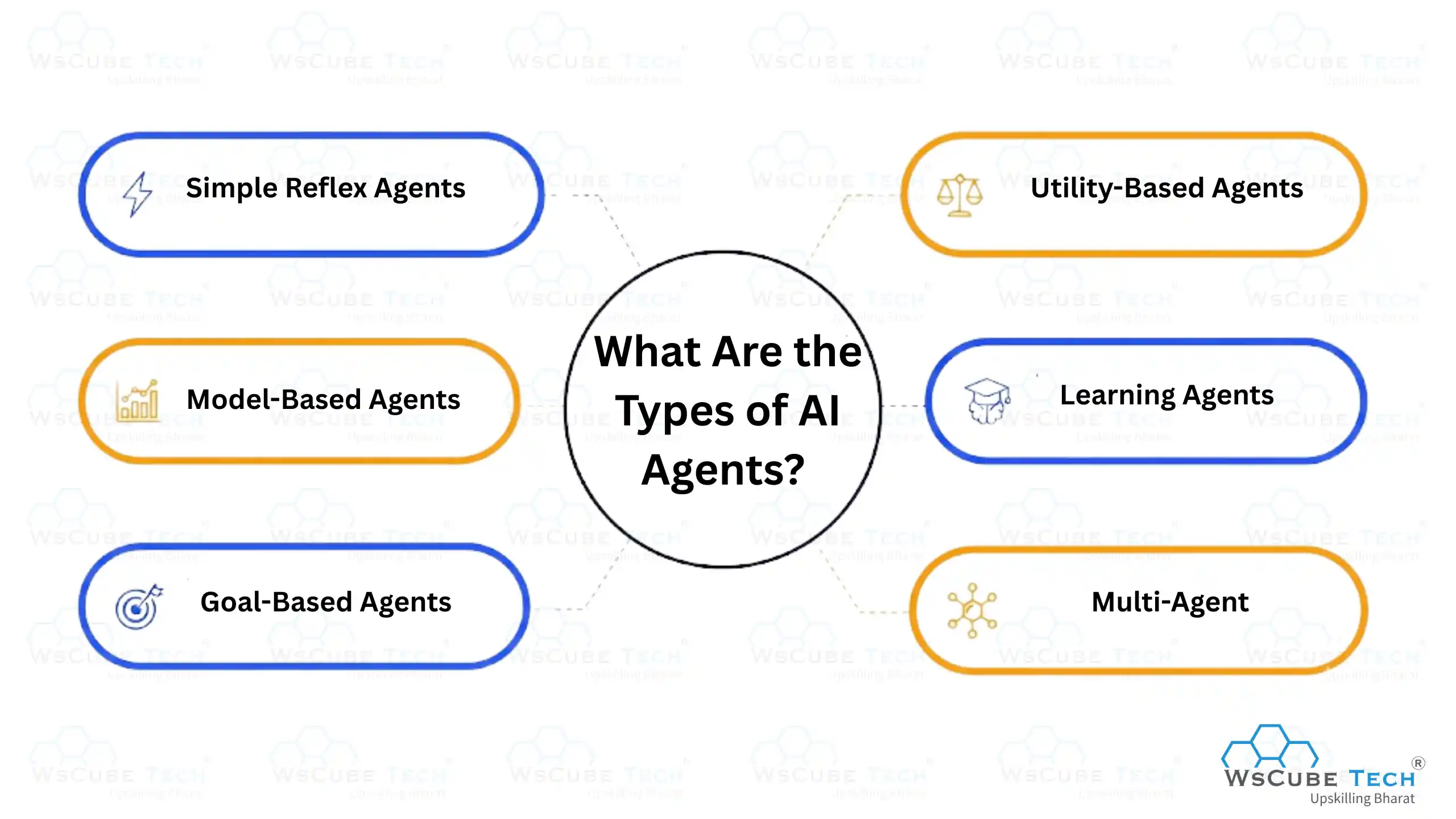
When people ask about the types of agents in ai, they are usually referring to a classification that comes from classic artificial intelligence research. Here are the main categories.
1. Simple Reflex Agents
These are the most basic type. A simple reflex agent acts only on the current situation in front of it, using simple “if this happens, then do that” rules. It has no memory of the past. A thermostat that turns on the heater when the room gets cold is a good example of this idea in the physical world.
2. Model-Based Agents
A model-based agent keeps an internal picture of how the world works. It uses this model to understand things it cannot directly observe, which helps it make better decisions than a simple reflex agent, especially in situations where information is incomplete.
3. Goal-Based Agents
These agents do not just react. They plan. A goal-based agent looks at different possible actions and picks the one that will move it closer to achieving a defined goal, similar to how a navigation app plans a route to your destination.
4. Utility-Based Agents
A utility-based agent goes one step further than a goal-based agent. Instead of just reaching a goal, it tries to reach the goal in the best possible way, weighing factors like speed, cost, or safety, and choosing the option with the highest overall value.
5. Learning Agents
A learning agent improves its performance over time. It starts with some basic knowledge and gets better through feedback and experience, much like how a recommendation system improves its suggestions the more you use it.
6. Multi-Agent / Autonomous AI Agents
This is the newest and fastest-growing category. Instead of one single agent handling everything, multiple specialised agents work together, each responsible for a part of a larger task. One agent might collect data, another might analyze it, and a third might write the final report.
Upcoming Masterclass
Attend our live classes led by experienced and desiccated instructors of Wscube Tech.





The Four Core Characteristics of an AI Agent
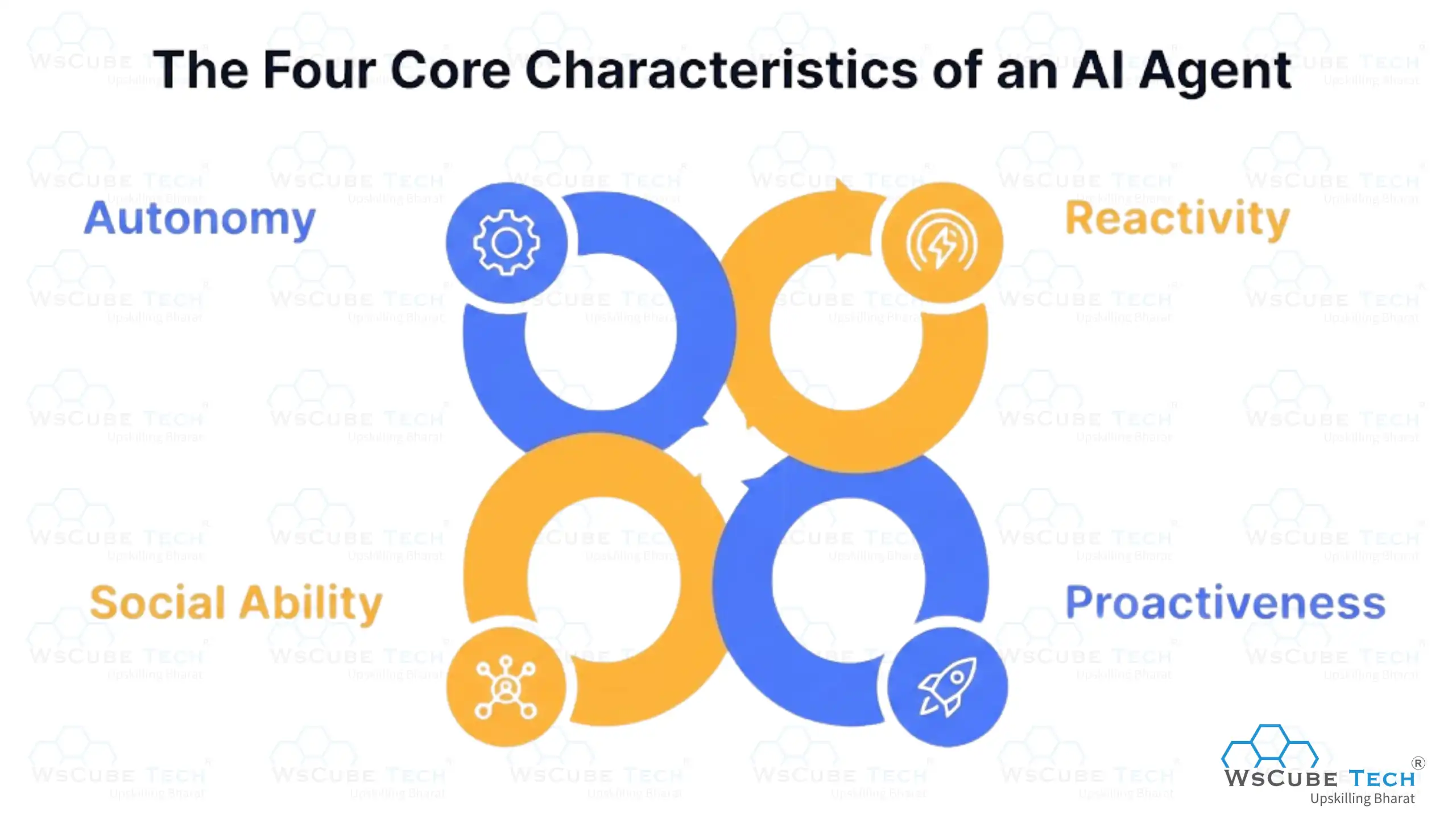
If someone asks you what are the four core characteristics of an AI agent, these are the four qualities to remember.
1. Autonomy
An agent can operate without constant human supervision. Once you give it a goal, it works through the necessary steps on its own.
2. Reactivity
An agent notices changes in its environment and responds to them in real time, rather than following a rigid, unchanging script.
3. Proactiveness
A good agent does not just react. It takes initiative to reach its goal, planning ahead, and anticipating what needs to happen next.
4. Social Ability
Many agents need to communicate, whether that is with a human user, another software system, or other agents in a multi-agent setup. This ability to exchange information and coordinate is part of what makes agents useful in real business workflows.
Together, these four traits explain what is an agent in artificial intelligence at its core, and they are the foundation behind every framework built for AI agents workflow design today.
Real-World Examples of AI Agents
Talking about theory is one thing, but seeing AI agents examples in daily life makes the concept click.
1. AI Agents in Customer Support
Support agents can read a customer's message, check order history, look into a company database, and resolve the issue or escalate it to a human, all without a support staff member typing a single reply. Data from Gartner shows customer service has the shortest payback period among all business functions using agents, at around 4.1 months.
2. AI Agents in Marketing & Social Media
Marketing teams use agents to research trending topics, draft social media captions, schedule posts, and even track performance metrics across platforms, cutting down hours of manual work every week.
3. AI Agents in E-commerce
Online stores use agents to track inventory, personalise product recommendations, answer shopping questions, and automatically follow up with customers who abandon their cart.
4. AI Agents for Small Businesses
Even a solo entrepreneur can use an agent to manage bookings, send invoices, reply to common customer questions, and organize leads, work that would otherwise need a full-time assistant.
These examples of ai agents show that this is not a distant, futuristic idea. It is already changing how everyday business tasks get done.
Popular AI Agent Tools & Platforms in 2026
There is a long ai agents list available today, ranging from beginner-friendly, no-code tools to advanced developer frameworks. Some of the most talked about options in 2026 include:
- n8n and Zapier Agents – Popular no-code and low-code automation platforms that let non-developers connect apps and add agent-style decision-making on top.
- LangChain and LangGraph – Open-source developer frameworks widely used to build custom agents with fine control over logic and tool use.
- CrewAI and AutoGen – Frameworks that make it easier to build multi-agent systems where several agents work as a team with defined roles.
- Microsoft Copilot Studio – A platform for building agents that work deeply inside the Microsoft 365 ecosystem.
- Salesforce Agentforce and Google Vertex AI Agent Builder – Enterprise-grade platforms designed for businesses already using Salesforce or Google Cloud.
- Claude, ChatGPT, and Gemini-based agent tools – First-party agent builders from the major AI labs, offering built-in tool use, browsing, and code execution.
The wider ai agents tools market reached roughly 7.6 billion dollars in 2025 and is projected to keep growing at almost 50% every year through the rest of the decade. That growth explains why so many new platforms are entering this space every few months.
Read More AI-Related Guides
How to Build an AI Agent (Step-by-Step)
If you are wondering how to build ai agents, here is a simple beginner path.
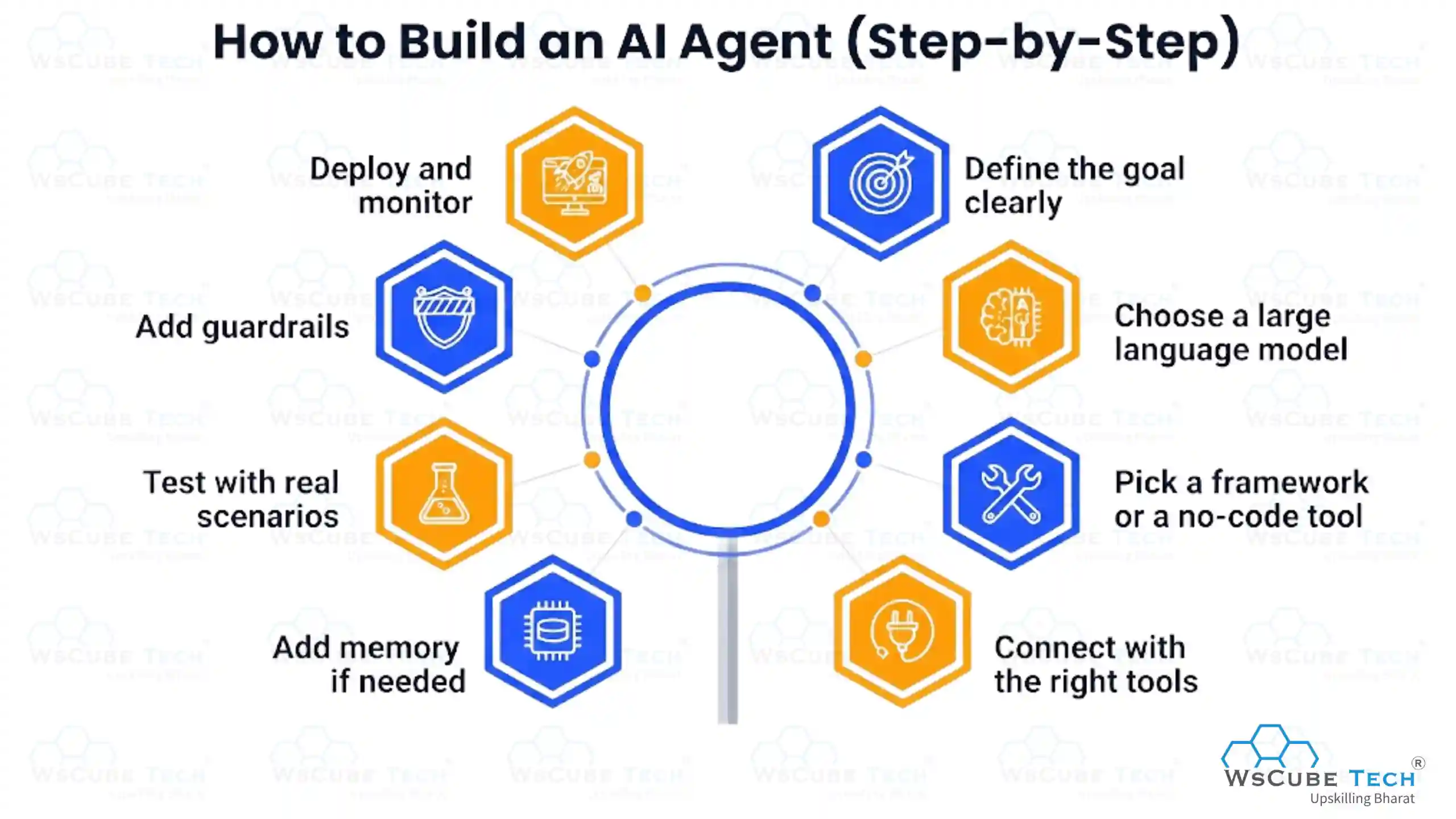
- Define the goal clearly: Decide exactly what task the agent should complete, such as answering customer emails or summarizing documents.
- Choose a large language model” This is the "brain" of your agent. Popular choices include GPT, Claude, and Gemini models.
- Pick a framework or a no-code tool: Beginners often start with no-code platforms like n8n or Zapier, while developers may prefer LangChain or CrewAI.
- Connect with the right tools: Give the agent access to what it needs, such as a search tool, a calendar, an email inbox, or a database.
- Add memory if needed: For agents that need to remember past conversations or data, connect to a vector database to store and retrieve information.
- Test with real scenarios: Run the agent through realistic tasks and watch where it succeeds or fails.
- Add guardrails: Set limits on what actions the agent is allowed to take on its own, and where it should ask for human approval.
- Deploy and monitor: Launch the agent and keep an eye on its performance, since even a well-designed agent can behave unexpectedly with new inputs.
If you want to know how to create an ai agent without touching a single line of code, tools like n8n, Zapier Agents, and Gumloop are built exactly for that. For a full walkthrough, this below video on build AI agent without coding breaks the process down visually.
For readers who want to go deeper, learning how to build ai agents from scratch using Python and a framework like LangChain gives you far more control, though it does need some coding knowledge.
The core principles of building ai agents stay the same either way: start with a narrow, well-defined task, give the agent only the tools it truly needs, and always build in a way for a human to step in when something looks wrong.
AI Agent Project Ideas for Beginners
Practicing with small projects is the fastest way to actually learn this skill. Here are a few beginner-friendly ideas.
- A personal research agent that reads articles on a topic and gives you a short summary.
- An email sorting agent that labels and prioritizes your inbox automatically.
- A simple customer support agent trained on your own FAQ document.
- A social media caption generator that also schedules posts for you.
- A price-tracking agent that alerts you when a product price drops.
- A study buddy agent that creates quizzes from your notes.
Each of these projects can be built using free or low-cost tools, and they give you real hands-on experience with ai agents workflow design.
What are the Benefits of Using AI Agents?
The appeal of AI agents comes down to a few clear benefits that make them useful across many industries.
Key Benefits:
- Save time: They handle repetitive tasks that would otherwise eat up hours of a person's day
- Work continuously: They operate without needing breaks, which is useful for tasks like monitoring or customer support
- Process information faster: They can go through large amounts of data far faster than a human, which is valuable for research and analysis
- Reduce errors: They cut down on simple human mistakes in repetitive workflows
- Scale easily: They can handle more tasks simply by adding more capacity rather than hiring more people
The Real-World Impact
Businesses have already started measuring this impact in real numbers. Research puts the average return from AI agent deployments at around 171%, though it also notes that close to one in five projects never reach payback at all. This shows that good planning matters just as much as technology itself.
Limitations and Risks of AI Agents
It would not be fair to only talk about the good side. AI agents also come up with real risks that beginners should understand before relying on them too heavily.
Common Risks to Watch For
- Mistakes in judgment: Agents can misunderstand a goal and take actions that were not really intended
- Security concerns: Since agents often need access to sensitive data and multiple systems, poor access control can create new vulnerabilities
- Rising costs: Running agents continuously on powerful models can get expensive if usage is not monitored carefully
- Limited flexibility: Agents still struggle with complex, unfamiliar situations that fall outside their training or instructions
Why a Clear Plan Matters
Gartner has gone as far as predicting that more than 40% of agentic AI projects will be cancelled by the end of 2027, mainly due to unclear business value, rising costs, and weak governance. This is an important reminder that adopting AI agents needs a clear plan, not just excitement about the technology.
Explore Our Popular Courses
Should You Use an AI Agent Right Now?
The honest answer depends on your situation. If you are dealing with repetitive, rule-based tasks such as answering common customer questions, organizing data, or scheduling, an agent can likely save you real time starting today.
If your work involves highly sensitive decisions, complex judgment calls, or constantly changing rules, it is safer to use an agent as a support tool alongside a human rather than letting it work fully unsupervised.
A good approach for most beginners and small businesses is to start small. Pick one repetitive task, build or set up a simple agent for it, watch how it performs over a few weeks, and only then expand it to bigger or more sensitive workflows.
AI Agents and Career Opportunities in India
This shift is not just changing how businesses operate. It is also opening up serious career opportunities, especially in India. As companies move from simple automation to systems that can plan and act on their own, the demand for people who can build and manage these systems is rising fast.
1. Rising Demand for AI Agent Skills
Job postings asking for skills in LangChain, CrewAI, or general AI agent experience grew by more than 300% between January 2025 and March 2026 on LinkedIn. This sharp rise shows that companies are no longer just experimenting with agentic AI. They are actively hiring for it.
The same report notes that India is expected to need over 50,000 specialised agentic AI professionals by 2027, while the current pool of trained talent remains far smaller than that demand. This gap between demand and supply is exactly why now is a good time to build these skills.
2. Where the Hiring Is Happening
Cities like Bengaluru, Hyderabad, Pune, and Delhi NCR are currently leading the hiring activity, with Bengaluru alone accounting for close to 45% of AI-related job postings in the country. This makes Bengaluru the clear hub for AI agent talent right now, though the other cities are catching up quickly as more companies set up AI teams.
3. Job Roles to Watch
Roles in this space include:
- AI agent developer
- LLM developer
- Prompt engineer
- Machine learning operations engineer
These roles span industries from banking and e-commerce to healthcare, which means the opportunities are not limited to tech companies alone.
4. Turning the Skill into Income
If you are curious about turning this skill into income, the video below on how to make money with AI agents walks through practical ways freelancers and beginners are already doing it.
5. Why This Matters for Students and Professionals
For students and working professionals in India, this makes AI agent skills one of the more future-proof additions to a resume right now. The best approach is to pair these skills with a working portfolio of small projects rather than relying on certificates alone. Employers are increasingly looking for proof that you can actually build and deploy an agent, not just that you understand the theory behind it.
How to Get Started Building or Using AI Agents
If you are completely new to this space, the best approach is to move step by step, starting with ready-made tools before attempting to build your own AI agent from scratch. Here is a simple path to follow:
- Start by using ready-made agent tools rather than building your own from scratch
- Spend a week or two exploring platforms like Zapier Agents or n8n
- Learn how triggers, actions, and decisions fit together within these tools
- Once comfortable, connect a large language model to a simple task using a beginner-friendly framework
- Follow project-based tutorials instead of only reading theory
- Build something small, since hands-on practice teaches more than passive learning
- Join online communities around tools like LangChain or CrewAI
- Use these communities to find real project examples and troubleshooting tips
AI Agents: A Video Guide
FAQs about AI Agent
A chatbot mainly replies to messages using a script or knowledge base and does not take independent action. An AI agent can plan, use tools, and complete multi-step tasks on its own, going far beyond just replying to a message.
Not exactly. AI assistants usually help with tasks but still need a human to trigger or approve most actions. AI agents can work with more independence, carrying out a full task and only checking in with a human when truly needed.
For no-code tools, you mainly need logical thinking and a clear understanding of the task you want to automate. For building agents from scratch, basic Python knowledge, an understanding of how large language models work, and familiarity with a framework such as LangChain or CrewAI will take you a long way.
They can be, as long as proper guardrails, access controls, and human review points are built in. Giving an agent too much unsupervised access to sensitive systems without oversight is where most of the real risk comes from.
Agentic AI is the broader concept behind AI agents. It refers to AI systems designed to act with autonomy, planning and carrying out multi-step actions to reach a goal, rather than simply responding to a single prompt.
Yes. This is known as a multi-agent system, where multiple AI agents collaborate on different tasks. For example, one researches, another writes, and a third reviews the output before delivering the final result efficiently.
Not always. Some AI agents work entirely with local files or private databases without internet access. Others require online connectivity to search for current information, interact with websites, or complete real-time tasks.
The cost depends on the agent's complexity and usage. Basic no-code AI agents may be free or low-cost, while advanced agents using large language models can become expensive with frequent or large-scale usage.
AI agents are more likely to automate repetitive tasks than replace entire jobs. They allow people to focus on creativity, decision-making, and problem-solving, while increasing demand for professionals who can build and manage AI systems.
Banking, insurance, software, and e-commerce are leading AI agent adoption because they rely on structured workflows. Healthcare and government are adopting more cautiously due to strict regulations, privacy concerns, and compliance requirements.
Beyond business use cases, individuals are also using agents to manage personal tasks such as planning travel, organizing study schedules, tracking expenses, and drafting routine messages. This everyday use is a good starting point for understanding what ai agents can do before moving into more advanced or business-focused applications.

Conclusion
AI agents are becoming a practical tool for businesses and individuals, helping automate repetitive tasks, improve productivity, and create new career opportunities. If you are exploring what are agent in AI, the best approach is to start with the basics, build a simple project, and learn through hands-on experience. While the technology continues to evolve rapidly, understanding its core concepts will help you adapt to future advancements.
Join Our On-Campus Courses
Explore Our Free Courses



Leave a comment
Your email address will not be published. Required fields are marked *Comments (0)
No comments yet.