
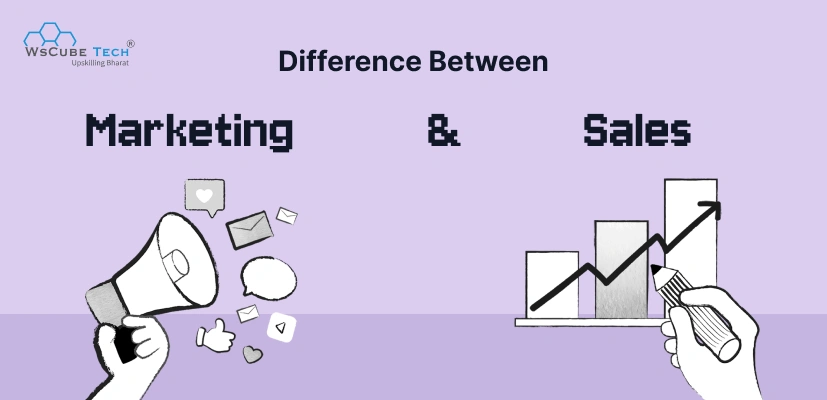
Many people use sales and marketing interchangeably, but they serve different purposes in driving business growth. Knowing the difference between sales and marketing helps companies plan better strategies and achieve long-term success.
Marketing focuses on attracting potential customers and building brand awareness, while sales converts those prospects into paying customers.
Knowing the definition of sales and marketing gives clarity on how both teams contribute to revenue generation. When aligned, they form a powerful combination that increases customer satisfaction, boosts conversions, and strengthens brand loyalty: making it essential for every business to distinguish and coordinate these two vital functions.
What is Marketing?
Marketing is the process of identifying customer needs, creating valuable products or services, and promoting them to build awareness and interest. It focuses on attracting potential customers through research, branding, advertising, and communication.
The goal of marketing is not just to sell but to build relationships and trust with the audience. It includes strategies like digital marketing, social media campaigns, search engine optimization (SEO), content creation, and market analysis to reach the right people at the right time.
In simple terms, marketing creates demand by telling the world why a product matters and how it can make customers’ lives better.
What is Sales?
Sales is the process of directly engaging with potential customers to persuade them to purchase a product or service. It includes understanding customer needs, presenting solutions, handling objections, negotiating terms, and closing deals.
The primary goal of sales is to convert interested prospects generated by marketing into paying customers, thereby driving revenue for the business. Sales activities include meetings, calls, product demonstrations, and follow-ups.
Unlike marketing, which focuses on awareness and attraction, sales focuses on action and conversion, turning interest into commitment.
Recommended Professional Certificates
Digital Marketing Mentorship Program
Advanced AI Marketing Bootcamp
Performance Marketing Bootcamp
SEO Specialist Bootcamp
Marketing and Sales Examples
Below are some examples of sales and marketing difference:
1. Smartphone Industry
Marketing: A smartphone company like Samsung runs ad campaigns, influencer promotions, and social media teasers highlighting new features such as advanced cameras and battery life. This builds excitement and awareness among potential buyers.
Sales: Once customers visit the store or website, sales representatives help them compare models, answer queries, and offer discounts or EMI options to close the deal.
So, marketing creates demand; sales converts that demand into purchases.
2. Real Estate
Marketing: A real estate firm advertises luxury apartments through Google ads, virtual tours, and YouTube videos showing lifestyle benefits. They collect leads through inquiry forms.
Sales: The sales team contacts those leads, arranges property visits, explains pricing, and negotiates until the buyer signs the deal.
So, marketing attracts interested homebuyers; sales finalizes the transaction.
Also Read: How to Make Money in Digital Marketing? 12 Best Ways
3. Education Sector (EdTech or Coaching Institutes)
Marketing: A coaching institute or edtech company like WsCube Tech runs YouTube ads, blog posts, and webinars explaining the benefits of its upskilling courses.
Sales: Once students fill inquiry forms, counselors call them, guide them about batches, and help them enroll.
4. Automobile Industry
Marketing: A car brand like Hyundai promotes its latest SUV through TV commercials, social media campaigns, and roadshow events to generate leads.
Sales: The dealership staff follows up with interested buyers, offers test drives, and finalizes payment and delivery.
Main Difference Between Marketing and Sales
The difference between marketing and sales lies in their focus and purpose. Marketing aims to create awareness, attract potential customers, and build long-term brand value through research, promotion, and communication. It focuses on understanding customer needs and generating interest in a product or service.
Sales, on the other hand, focuses on converting that interest into actual purchases through direct interaction, negotiation, and deal closure. While marketing works on a broader strategy to reach and engage audiences, sales deals with individuals to achieve revenue goals.
Together, they form a complete process of driving business growth and customer satisfaction.
Marketing vs Sales: All Differences
Below is the full comparison of difference in marketing and sales:
| Basis of Comparison | Marketing | Sales |
| 1. Objective | To create awareness and generate leads | To convert leads into paying customers |
| 2. Focus | Understanding customer needs and building brand value | Meeting targets and closing deals |
| 3. Time Frame | Long-term strategy for consistent growth | Short-term goals focused on immediate results |
| 4. Approach | Customer-centric and research-driven | Product or service-centric and transaction-driven |
| 5. Communication Type | One-to-many (mass communication) | One-to-one (personal interaction) |
| 6. Process | Market research, advertising, content creation, promotions | Lead follow-ups, product demos, negotiations, closing |
| 7. Platforms Used | SEO, social media, email marketing, ads | CRM systems, calls, meetings, presentations |
| 8. Metrics for Success | Brand reach, website traffic, engagement, ROI | Sales volume, revenue, conversion rate |
| 9. Outcome | Brand awareness and customer interest | Actual purchase and customer acquisition |
| 10. Relationship Goal | Building long-term trust and loyalty | Building direct, transactional relationships |
Also Read: What is Lead Generation in Digital Marketing? With Strategies
How Marketing and Sales Work Together?
Marketing and sales work together as two connected stages of a single growth process — attracting potential customers and converting them into loyal buyers.
Marketing creates awareness, educates the audience, and generates qualified leads through strategies like advertising, social media, and content marketing. Once these leads are ready to make a decision, the sales team steps in to engage personally, address objections, and close the deal.
When both teams share data and goals, it leads to smoother communication, better lead quality, and higher conversion rates. This alignment, called “Smarketing”, ensures consistent messaging, stronger relationships, and sustainable business growth.
Read More Marketing Guides
| What is Digital Marketing? | What is Email Marketing? |
| What is PPC? Pay-Per-Click | What is 360° Digital Marketing? |
| What is Google Ads? | What is Performance Marketing? |
Importance of Aligning Marketing and Sales Teams
1. Improves Lead Quality: When both teams share insights, marketing generates leads that match the sales team’s ideal customer profile, reducing wasted time and effort.
2. Boosts Conversion Rates: Sales teams receive more qualified and well-informed leads from marketing, making it easier to convert them into paying customers.
3. Creates a Unified Customer Experience: Alignment ensures consistent messaging across ads, emails, and sales conversations, strengthening brand trust and customer satisfaction.
4. Enhances Data Sharing and Insights: Collaborating helps both teams use shared data to understand customer behavior, refine campaigns, and predict future trends.
5. Reduces Internal Conflicts: When marketing and sales work toward common KPIs, it minimizes blame-shifting and fosters teamwork.
6. Increases Revenue Growth: A smooth handoff from marketing to sales shortens the buyer journey, leading to faster deal closures and higher revenue.
7. Improves Strategic Planning: Joint meetings and feedback loops help companies align campaigns, product positioning, and follow-up strategies for maximum impact.
8. Builds Long-Term Customer Relationships: A cohesive approach ensures customers stay engaged even after purchase, improving loyalty and repeat business.
Tools for Marketing and Sales
The following are the top sales and marketing tools to bridge the gap between these teams:
| Category | Purpose | Popular Tools |
| CRM (Customer Relationship Management) | Manage leads, track interactions, and monitor the sales pipeline | HubSpot CRM, Salesforce, Zoho CRM |
| Marketing Automation | Automate email campaigns, lead nurturing, and scoring | Mailchimp, ActiveCampaign, Marketo |
| Analytics & Reporting | Track campaign performance and measure ROI | Google Analytics, SEMrush, Tableau |
| Lead Management | Capture, qualify, and distribute leads effectively | Pipedrive, Freshsales, LeadSquared |
| Communication & Collaboration | Improve team coordination and information sharing | Slack, Microsoft Teams, Trello |
| Content & Social Media Tools | Align content marketing and social selling efforts | Buffer, Hootsuite, Canva |
| Customer Support & Feedback | Maintain post-sale engagement and satisfaction | Zendesk, Intercom, Freshdesk |
Marketing and Sales Skills
Below are top sales and marketing skills:
Top Marketing Skills
- Market Research & Analysis: Understanding audience behavior, competition, and trends.
- Strategic Thinking: Planning campaigns that align with business goals.
- Creativity: Designing engaging content, visuals, and ideas that attract attention.
- Communication Skills: Writing persuasive copy and delivering clear brand messages.
- Digital Marketing Skills and Expertise: SEO, social media, email marketing, and analytics.
- Data Interpretation: Measuring performance and optimizing campaigns using metrics.
- Brand Management: Building and maintaining a consistent brand identity.
- Customer Understanding: Creating campaigns that resonate with target audiences.
- Collaboration: Working closely with sales, design, and product teams.
- Adaptability: Adjusting strategies based on trends and feedback.
Top Sales Skills
- Active Listening: Understanding customer needs and tailoring solutions.
- Persuasion & Negotiation: Convincing prospects and closing deals effectively.
- Relationship Building: Developing trust and long-term customer connections.
- Product Knowledge: Explaining features and benefits confidently.
- Communication Skills: Presenting and pitching with clarity and impact.
- CRM Management: Using tools like HubSpot or Salesforce to manage leads.
- Goal Orientation: Staying focused on meeting targets and quotas.
- Problem-Solving: Handling objections and turning challenges into opportunities.
- Time Management: Prioritizing leads and sales activities efficiently.
- Resilience: Staying motivated through rejections and challenges.
Upcoming Masterclass
Attend our live classes led by experienced and desiccated instructors of Wscube Tech.

Sales and Marketing Funnel
| Funnel Stage | Handled By | Objective | Key Activities | Example |
| 1. Awareness | Marketing | Create brand awareness and reach potential customers | Advertising, social media, content marketing, SEO | Running Instagram ads to introduce a new product |
| 2. Interest | Marketing | Engage audience and generate leads | Email marketing, blogs, webinars, videos | Publishing blog posts highlighting product benefits |
| 3. Consideration | Marketing → Sales | Nurture leads and educate them | Case studies, testimonials, targeted campaigns | Sending newsletters comparing product features |
| 4. Intent | Sales | Identify serious prospects and personalize outreach | Follow-up calls, demos, free trials | Offering a free demo or consultation call |
| 5. Evaluation | Sales | Address objections and build trust | Negotiation, answering queries, sharing pricing | Sales rep explains plans and offers limited-time discounts |
| 6. Purchase (Decision) | Sales | Close the deal and finalize transaction | Proposal signing, payment processing | Customer completes purchase after final discussion |
| 7. Retention & Loyalty | Marketing + Sales | Keep customers engaged for repeat business | Feedback surveys, loyalty programs, follow-up offers | Offering discounts for renewals or referrals |

FAQs About Sales vs Marketing
Marketing attracts potential customers, while sales convert them into paying clients. Without marketing, businesses struggle to reach audiences; without sales, they can’t generate revenue.
Not effectively. Marketing can generate interest and leads, but without a sales team to convert them, revenue generation becomes inconsistent and slow.
Marketing usually comes first. It creates awareness and interest, laying the foundation for the sales team to approach warm, qualified leads.
Digital marketing attracts targeted audiences through SEO, ads, and email campaigns, making it easier for the sales team to connect with informed and interested prospects.
The main challenge is communication. Misaligned goals and unclear lead definitions generally create gaps between the two teams.
By generating high-quality leads, running retargeting campaigns, and educating potential customers about the product’s value, marketing boosts conversion rates and sales performance.
A CRM helps both teams track leads, monitor interactions, and analyze customer behavior to ensure a smooth flow from lead generation to conversion.
Sales teams gather real-time customer feedback, which marketing uses to refine messages, campaigns, and product positioning for better future results.
No. Marketing goals focus on awareness, traffic, and lead generation, while sales goals revolve around revenue, conversions, and customer acquisition.
Misalignment leads to poor lead quality, lower conversion rates, inconsistent messaging, and lost revenue opportunities.
Startups combine efforts — using digital marketing for lead generation and founders or small teams personally handling sales until scale is possible.
Content like blogs, videos, and case studies educate potential buyers, helping the sales team build trust and credibility faster during conversations.
Regular meetings, shared KPIs, integrated CRM systems, and transparent communication channels can strengthen collaboration between the two teams.
Strong branding built by marketing builds trust, making it easier for sales teams to close deals because customers already perceive the brand positively.
Marketing KPIs include traffic, engagement, and ROI. Sales KPIs include conversion rate, deal size, and revenue growth.
Explore Our Free Courses




Leave a comment
Your email address will not be published. Required fields are marked *Comments (0)
No comments yet.