

Every year, thousands of students and working professionals in India ask the same question before picking a career path: will this job still matter five years from now or is business analyst a good career? With AI tools changing how companies work and every industry talking about data, it is fair to wonder if a role built around numbers, reports, and business decisions still has a future.
This guide answers that question in detail. We'll cover what the role actually involves, what it pays in India and abroad, how AI is changing the job rather than replacing it, and how you can start building this career step by step.
Is Business Analyst a Good Career?
Yes, it's a common question among students and career switchers, and the answer is yes. It is a flexible career that combines business, technology, data, and problem-solving without requiring advanced coding skills.
Here are a few reasons why business analysis is a good career choice:
- Strong demand: Businesses across industries need professionals who can turn business problems into practical solutions.
- Good earning potential: Business analysts can build competitive salaries as they gain experience and technical skills.
- Multiple career paths: You can move into business analytics, data analysis, product management, consulting, or leadership roles.
- No advanced coding required: Basic knowledge of tools such as SQL, Excel, and Power BI is often enough to get started.
- Industry flexibility: Business analysts can work in IT, banking, healthcare, retail, e-commerce, manufacturing, and more.
Is Business Analyst a Good Job?
Yes, a Business Analyst is considered a good job, especially in today’s data-driven world. It’s a role where you solve real business problems, work with different teams, and help companies make smarter decisions.
A Business Analyst acts as a bridge between business needs and technical solutions. Instead of just working on theory, you actually help improve how a company performs.
Here’s why it’s a good job:
- High Demand: Almost every industry, IT, finance, healthcare, and e-commerce — needs Business Analysts to improve processes and decision-making.
- Good Salary Growth: You can start with a decent salary, and your income grows steadily with experience and skills.
- Career Growth Options: This role opens doors to higher positions like Product Manager, Project Manager, or even leadership roles.
- Less Coding Pressure: You don’t need deep coding knowledge, which makes it easier for non-technical backgrounds to enter.
- Real Business Impact: Your work directly helps companies solve problems and grow.
Simple example:
Suppose a company is losing customers. A Business Analyst looks at the data, finds the main issue (like slow delivery or poor service), and suggests improvements. When those changes are applied, the business performs better, and that’s the real value of this job.
Recommended Professional Certificates
Data Analytics Course with Gen AI
Data Science Course with Internship & Placement Support
What a Business Analyst Actually Does Day to Day
A business analyst sits between a business problem and the solution to that problem. They rarely build the fix themselves. Instead, they figure out what is actually broken, who it affects, and what a workable solution looks like, then hand that plan to the people who will build it.
A typical week usually includes:
- Talking to stakeholders: To understand a business problem or goal. This means interviews, workshops, and a lot of listening, since the person asking for a fix does not always describe the real problem on the first try.
- Studying current processes: Along with it, and finding gaps or inefficiencies. This often means sitting with a team, watching how they work, and mapping out where time or money is being lost.
- Collecting and analyzing data: By using tools like Excd zel, SQL, or Power BI to turn raw numbers into a pattern that explains what is happening.
- Writing clear requirement documents: Documents that developers and managers can follow without needing to ask the business analyst to explain every line.
- Testing whether a new system or process: It actually solves the original problem, rather than creating a new one in its place.
- Presenting findings and recommendations: Provide such things to leadership, usually with a clear ask: to approve this budget, change this process, or greenlight this project.
This mix of communication, analysis, and problem solving is what makes the role interesting. A business analyst is not stuck behind a screen all day running reports, and they are not spending every hour in meetings either. The job moves between the two, which is exactly what keeps it from feeling repetitive.
If you want a full breakdown of daily responsibilities and required skills, this detailed guide on What Does a Business Analyst Do? covers the role in depth.
Why Business Analyst Is a Good Career Choice
Understanding why business analyst is a good career comes down to a few solid reasons that keep the profession attractive across industries and experience levels.
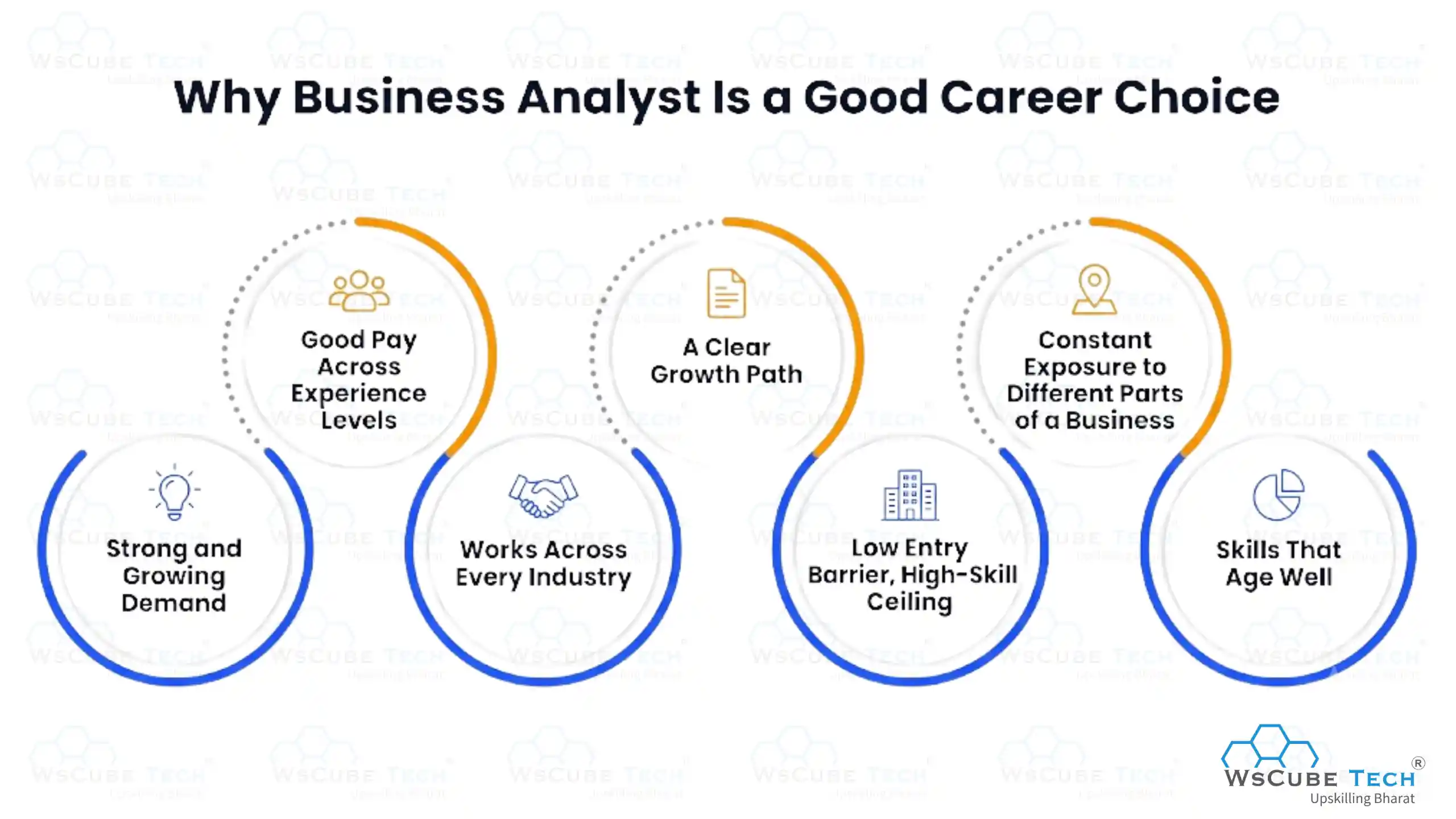
1. Strong and Growing Demand
Companies across banking, retail, healthcare, IT, and manufacturing all rely on business analysts to bridge the gap between what leadership wants and what technical teams can build. Moreover, employment of management analysts is projected to grow 9 percent from 2024 to 2034, much faster than the average for all occupations, with about 98,100 openings projected each year over the decade.
This steady demand is one of the strongest signals that the role isn't going away anytime soon, and it holds true for related analyst roles in India and other markets with similar hiring patterns.
2. Good Pay Across Experience Levels
Business analysis consistently ranks as one of the better-paying entry points into the business and tech world, and the pay only improves as you gain experience and specialize in a domain like banking or healthcare.
3. Works Across Every Industry
Unlike some roles that are tied to a single sector, business analysis skills transfer easily. A business analyst working in fintech today can move into healthcare or e-commerce tomorrow, because the core skill of solving business problems with data stays the same.
4. A Clear Growth Path
The role naturally leads to senior positions like business analysis manager, product manager, project manager, or even domain consultant, giving you multiple directions to grow into depending on your interests.
5. Low Entry Barrier, High-Skill Ceiling
You do not need an engineering degree to start as a business analyst, but the ceiling is high. You can add skills like data visualization, Agile methodology, or basic programming and keep growing your value in the job market for years.
6. Constant Exposure to Different Parts of a Business
A business analyst rarely works in isolation. On any given project, you might sit in on a finance discussion one day and a technology planning meeting next. This exposure gives you a broad, practical understanding of how a company actually runs, which is knowledge that is hard to gain in a narrower, single-function role. Over time, this makes business analysts strong candidates for leadership positions, since they already understand how different departments think and what trade-offs they care about.
7. Skills That Age Well
Tools change every few years, but the core skills of a business analyst, such as structured problem solving, clear communication, and stakeholder management, do not go out of date. This is different from many purely technical roles, where a specific programming language or framework can lose relevance within a few years. A business analyst who keeps updating their tool of knowledge while holding on to these core skills tends to stay employable for a long time.
Is Business Analyst a Good Career for Freshers?
Yes, business analysis can be a strong career choice for freshers. Companies value candidates with skills in Excel, SQL, Power BI, problem-solving, and communication. Internships, projects, and practical case studies can also help freshers prove their abilities and secure entry-level roles.
- Excel and SQL Basics: Learn basic Excel functions, data cleaning, formulas, and SQL queries to work with datasets and support everyday business analysis tasks.
- Communication and Writing: Strong communication helps you understand requirements, ask relevant questions, document findings, and explain business problems clearly to technical and non-technical stakeholders.
- Business Process Understanding: Understand how businesses operate through internships, college projects, or case studies, and learn to identify process gaps, inefficiencies, and improvement opportunities.
- Willingness to Learn Tools: Be ready to learn tools such as Power BI, Tableau, and Jira, as employers value candidates who can quickly adapt to new technologies.
Many freshers enter the field through internships, entry-level roles, or by transitioning from customer support, operations, or QA, where they already understand how a business runs. If you need a step-by-step path, see How to Become a Business Analyst?
Freshers often underrate their own soft skills. Leading a project, organizing an event, or handling customer queries builds the communication and problem-solving skills a business analyst uses daily. Pair these with basics like Excel, SQL, or Power BI, and you have a strong entry-level profile, no specific degree or prior experience required.
Upcoming Masterclass
Attend our live classes led by experienced and desiccated instructors of Wscube Tech.



Is Business Analyst a Good Career in India?
Yes, business analysis is a promising career in India, with growing demand across IT, consulting, e-commerce, healthcare, and BFSI. Companies need professionals who can turn business requirements and data into actionable decisions.
- Strong Industry Demand: Business analysts are increasingly needed across IT, consulting, e-commerce, healthcare, BFSI, fintech, and other rapidly digitizing industries, creating steady career opportunities.
- Competitive Salaries: Freshers can start around ₹4–₹7 lakh annually, while experienced professionals can earn ₹15–₹20+ lakh with the right skills, experience, and industry expertise.
- High-Demand Cities: Bengaluru, Mumbai, Gurugram, Hyderabad, and Pune offer strong opportunities due to their growing technology, consulting, startup, and global business ecosystems.
- Diverse Career Paths: Business analysts can progress into senior analysts, product management, business consulting, project management, data analytics, or leadership positions as they gain experience.
- Growing Technical Requirements: Skills such as SQL, Excel, Power BI, and basic Python can help analysts handle data more effectively and improve their job prospects and earning potential.
- Global Exposure: India's strong IT services and GCC presence allow business analysts to work with international clients, global teams, and diverse business processes across different markets.
- Cross-Industry Opportunities: Professionals can move between banking, healthcare, retail, e-commerce, telecommunications, consulting, and technology without completely changing their core business analysis skills set.
- AI and Digital Transformation: The growing adoption of AI, automation, and digital technologies is creating new opportunities for analysts who can connect business requirements with emerging technology solutions.
Is Business Analyst a Good Career in the Future?
Yes, business analysis has strong long-term potential as companies continue adopting AI, automation, and data-driven decision-making. While AI will automate some repetitive tasks, businesses will still need professionals who can understand problems, interpret insights, and connect technology with business goals.
- Growing Demand: Businesses will continue to need analysts who can connect business goals, data, technology, and customer needs to support better decisions.
- AI Creates New Opportunities: AI will automate repetitive analysis, but analysts will remain important for defining problems, validating insights, and making strategic decisions.
- Strong Data Focus: As companies become more data-driven, analysts with SQL, Power BI, Excel, and data visualization skills will remain highly valuable.
- Multiple Career Paths: Business analysts can progress into product management, data analytics, consulting, project management, or senior leadership roles.
- Cross-Industry Demand: Future opportunities will span technology, BFSI, healthcare, e-commerce, retail, manufacturing, consulting, and other digitally transforming industries.
- Higher Value of Technical Skills: Professionals who combine business knowledge with AI, automation, analytics, and technical skills are likely to have stronger career prospects.
- Global Opportunities: Remote work, global capability centers, and international projects can provide business analysts with opportunities to work with companies across different markets.
- Continuous Skill Development: Staying updated with AI tools, analytics platforms, Agile methods, and emerging technologies will help business analysts remain relevant as the role evolves.
Is Business Analyst a Good Career in the AI Era?
Yes, business analysis remains a promising career in the AI era. While AI can automate repetitive tasks and analyze data faster, businesses still need analysts to understand problems, make decisions, and connect technology with business goals.
The role is evolving, not disappearing. Analysts who combine business knowledge with AI and technical skills can stay competitive and valuable.
- AI-Assisted Analysis: Business analysts can use AI to analyze data, identify patterns, summaries findings, and generate insights faster.
- Human Decision-Making: AI provides recommendations, but analysts are still needed to understand context, evaluate risks, and make business decisions.
- Growing AI Skills: Knowledge of AI tools, automation, prompt engineering, and data analytics can help business analysts stay competitive.
- Better Productivity: AI can reduce time spent on repetitive documentation, reporting, research, and data-processing tasks.
- New Career Opportunities: AI adoption creates roles around AI business analysis, automation, digital transformation, and AI product development.
- Stronger Technical Advantage: Analysts who combine business knowledge with SQL, Power BI, Python, and AI tools can stand out in the job market.
- Cross-Industry Demand: AI adoption across banking, healthcare, retail, IT, e-commerce, and manufacturing will continue creating opportunities for business analysts.
- Evolving Role: Future business analysts will focus more on strategic thinking, problem-solving, stakeholder management, and guiding AI-driven business initiatives.
For a closer look at whether it is too late to enter this field given how fast AI is moving, this video on Is it too late to become a business analyst in the AI era? addresses the concern directly.
Read More Related Guides
Is Business Analyst a Good Career for You?
Yes, being a business analyst is really a good career. Moreover, it certainly depends on your choice of work, like how you like to work instead of relying on what the market says. To achieve success in this role, one needs to focus completely on time, money, and effort.
This role tends to suit people who naturally lean toward the following working styles, even if they have never worked in a formal business or analytics role before:
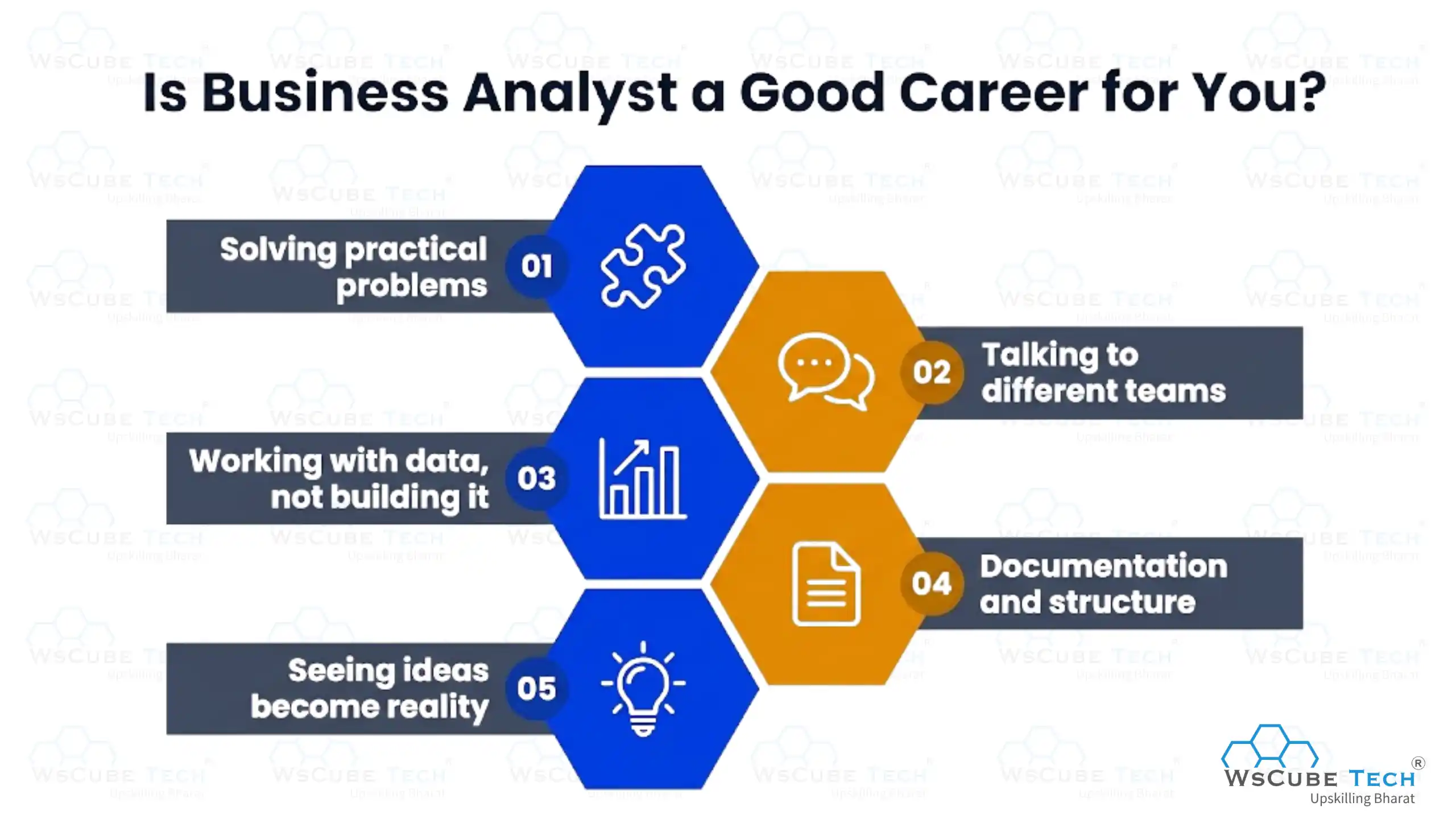
- Solving practical problems: You would rather fix something a team is struggling with today than debate a problem in the abstract, since the work is measured by real, visible improvement.
- Talking to different teams: You enjoy sitting with finance, operations, and engineering in the same week, picking up how each group sees the same problem from a different angle.
- Working with data, not building it: You like using numbers to support a decision or back up a recommendation, without wanting to spend your career writing production code full time.
- Documentation and structure: You take satisfaction in writing a requirement or process document clearly enough that another person can act on it without needing you to explain every line.
- Seeing ideas become reality: You want to watch a project move from a rough idea in a meeting to a system or process the business actually uses every day.
How to Start Your Career as a Business Analyst?
Once you decide this role fits you, the next question is how to get started. Here is a practical roadmap most beginners follow:
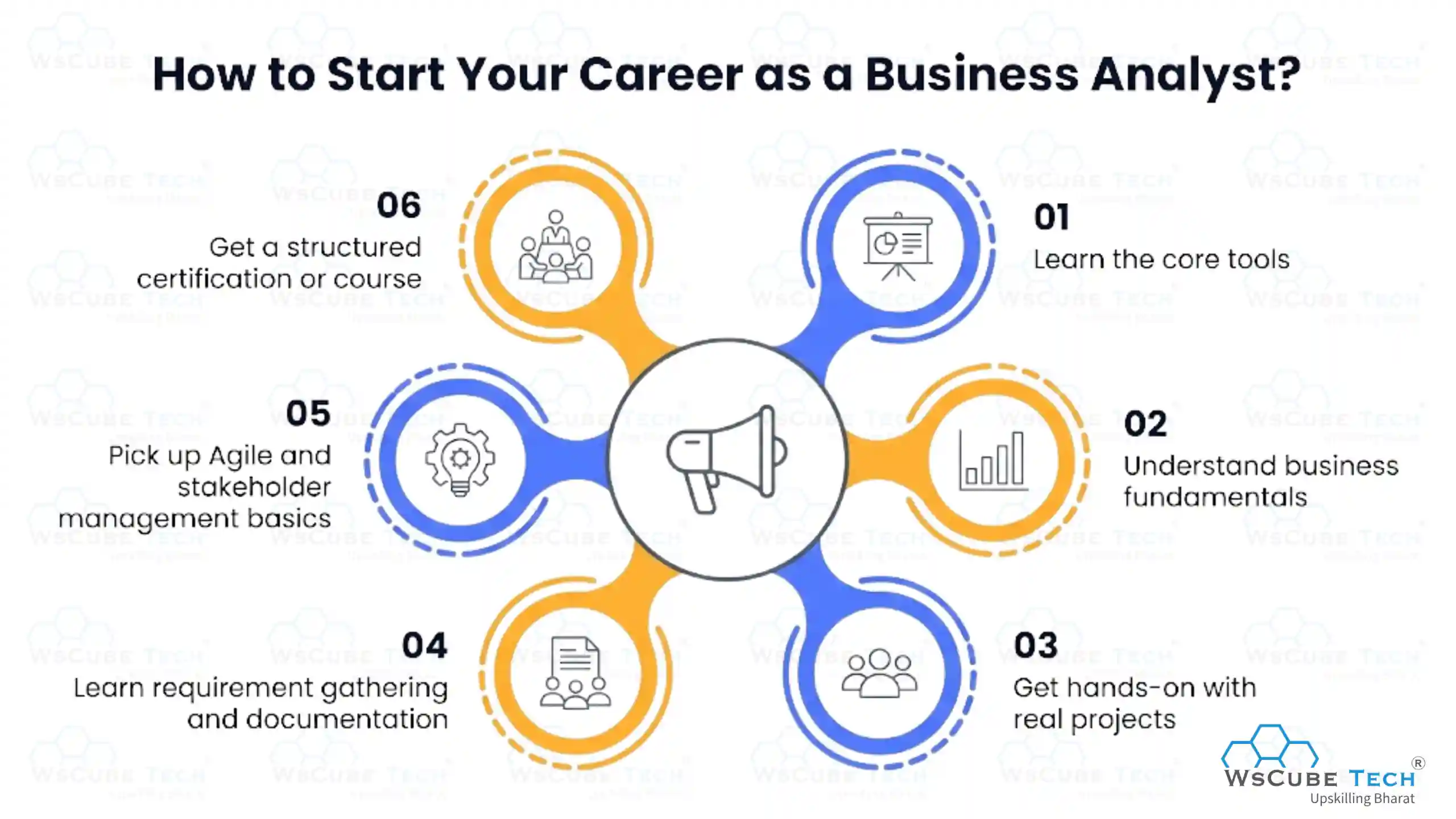
- Learn the core tools: Start with Excel for basic analysis, then move to SQL for querying data, and a visualization tool like Power BI or Tableau for building dashboards.
- Understand business fundamentals: Learn how businesses operate, including basic finance, operations, and marketing concepts, since a business analyst needs to speak the language of every department.
- Get hands-on with real projects: Work on case studies or sample projects, such as analyzing sales data or mapping a company process, to build a portfolio you can show recruiters.
- Learn requirement gathering and documentation: Practice writing clear business requirement documents (BRDs) and user stories, since this is a core deliverable in almost every BA role.
- Pick up Agile and stakeholder management basics: Most companies today run projects using Agile or Scrum, so understanding sprints, backlogs, and stakeholder communication will help you fit into a team quickly.
- Get a structured certification or course: A guided program can save months of confusion by teaching tools, frameworks, and real case studies in the right order, along with placement support.
If you want a structured path instead of piecing this together on your own, WsCube Tech's Business Analytics Course covers tools, real-world case studies, and career support to help you go from beginner to job-ready faster.
For a beginner-friendly overview of what such a learning path looks like, this video on the Business Analytics roadmap for beginners is a good starting point before you enroll in any course.
Explore Our Data Related Courses
| Online Data Analytics Course | Live Internship + 100% Job Support |
| Online Business Analytics Course | Live Internship + 100% Job Support |
| Online Data Science Course | Live Internship + 100% Job Support |
Frequently Asked Questions
Yes. Many successful business analysts start with a non-technical degree and pick up tools like SQL and Power BI along the way. Communication and analytical thinking matter more at the start than coding skills.
Both are strong career paths, but they suit different interests. Business analytics focuses more on business processes, stakeholder needs, and decision-making, while data analytics focuses more on statistics and technical data work. Many professionals build skills in both areas.
With focused learning, most beginners can become job-ready in 4 to 8 months, depending on their starting point and how consistently they practice tools and case studies.
Not necessarily. Basic SQL is helpful and often expected, but you do not need advanced programming knowledge like a software developer would.
IT services, banking and financial services, e-commerce, and consulting firms are among the biggest hirers of business analysts in India.
Yes, especially for MBA graduates with a specialization in operations, finance, or systems. Many organizations prefer MBA graduates for strategic or senior business analyst roles.
Certifications like CBAP, CCBA, and ECBA from the IIBA, along with Agile or Scrum certifications, are widely recognized and can help with salary negotiations and promotions.
It is unlikely. AI will continue to automate repetitive tasks like report generation, but the core job of understanding business needs and making judgment calls will still require human analysts. Explore whether AI will replace business analysts and what the future holds for the profession.
Entry-level business analysts in India typically earn between ₹4 and ₹7 lakh per year, with higher offers going to candidates with strong tool knowledge or internship experience.
Yes. The role offers clear progression into senior analysts, product managers, project managers, or consulting positions, giving professionals multiple long-term career directions to choose from.

Explore Our Free Tech Tutorials
| Python Tutorial | Java Tutorial | JavaScript Tutorial |
| C Tutorial | C++ Tutorial | HTML Tutorial |
| CSS Tutorial | SQL Tutorial | DSA Tutorial |
Practice Coding With Our Free Compilers
| Online Python Compiler | Online HTML Compiler | Online C Compiler |
| Online C++ Compiler | Online JS Compiler | Online Java Compiler |
Join Our On-Campus Data Analytics Program
Join Our On-Campus Data Science Program
Explore Our Free Courses





Leave a comment
Your email address will not be published. Required fields are marked *Comments (0)
No comments yet.