

Are you here to know what does business analyst do, and why this role is so important today? If yes, you've stepped into the right place. A business analyst bridges the gap between business needs and technical solutions, turning complex problems into clear, actionable plans.
From analyzing data to working with teams and improving processes, they help businesses make smarter decisions. In this guide, we’ll explore their role, key skills, tools, daily responsibilities, and career prospects in 2026.
Who Is a Business Analyst?
A business analyst (BA) is a professional who studies how a business works, finds problems or gaps, and suggests practical solutions to improve results. They sit between business and technical teams, ensuring both sides understand what needs to be built and why. Their overall goal is to help a company make smarter decisions using data, research, and clear communication.
For example, if an online store notices declining sales, a business analyst studies customer behavior, reviews the website's checkout process, and recommends changes, such as a simpler payment flow, to address the issue.
To understand the basics of this role in more depth, you can also watch this video.
Business Analyst vs. Business Analytics: What's the Difference?
Before going deeper into the duties of a business analyst, it helps to clear up common confusion. Business Analyst refers to a person and a job title, while Business Analytics refers to a process or practice of using data to guide business decisions.
One is a profession; the other is a method. A business analyst may use business analytics as one of their tools, but their role is much wider and includes talking to people, documenting requirements, and managing change.
| Aspect | Business Analyst | Business Analytics |
| Meaning | A role or job profession | A process or practice of using data |
| Focus | Solving business problems through requirements and communication | Extracting insights from data to guide decisions |
| Typical Activities | Meetings, documentation, process mapping, stakeholder management | Statistical modeling, forecasting, data mining |
| Skills Needed | Communication, critical thinking, requirement gathering | Statistics, coding, data visualization |
| Output | Business requirement documents, process improvements, solutions | Reports, dashboards, predictive models |
A business analyst is the professional who solves business problems, while business analytics is a method they may use to analyze data and make better decisions. Business analysts combine data skills with communication, documentation, and stakeholder management.
Recommended Professional Certificates
Data Analytics Course with Gen AI
Data Science Course with Internship & Placement Support
What Does a Business Analyst Do? (Overview)
At its core, a business analyst studies a company's current processes, identifies what is not working, and recommends changes to improve how things run. They act as the bridge between what the business wants and what the technical team can build. Their day is filled with conversations, research, and documentation that all lead toward one goal: better decisions.
Here is a quick summary of what this involves:
- Understand business problems: Study the situation before suggesting any fix
- Analyze processes and data: Look for patterns, gaps, and inefficiencies
- Gather requirements: Collect what stakeholders need
- Communicate with stakeholders: Keep everyone aligned and informed
- Recommend solutions: Suggest practical, achievable fixes
- Support implementation: Help teams put the solution into action
- Measure results: Check if the fix worked
Example: Real-World Business Analyst Improving E-Commerce Checkout
To understand what a business analyst does in practice, consider an e-commerce company that is losing customers during checkout.
The Problem: The company notices that many customers add products to their carts but leave before completing their purchases. Management wants to understand why and improve the checkout completion rate.
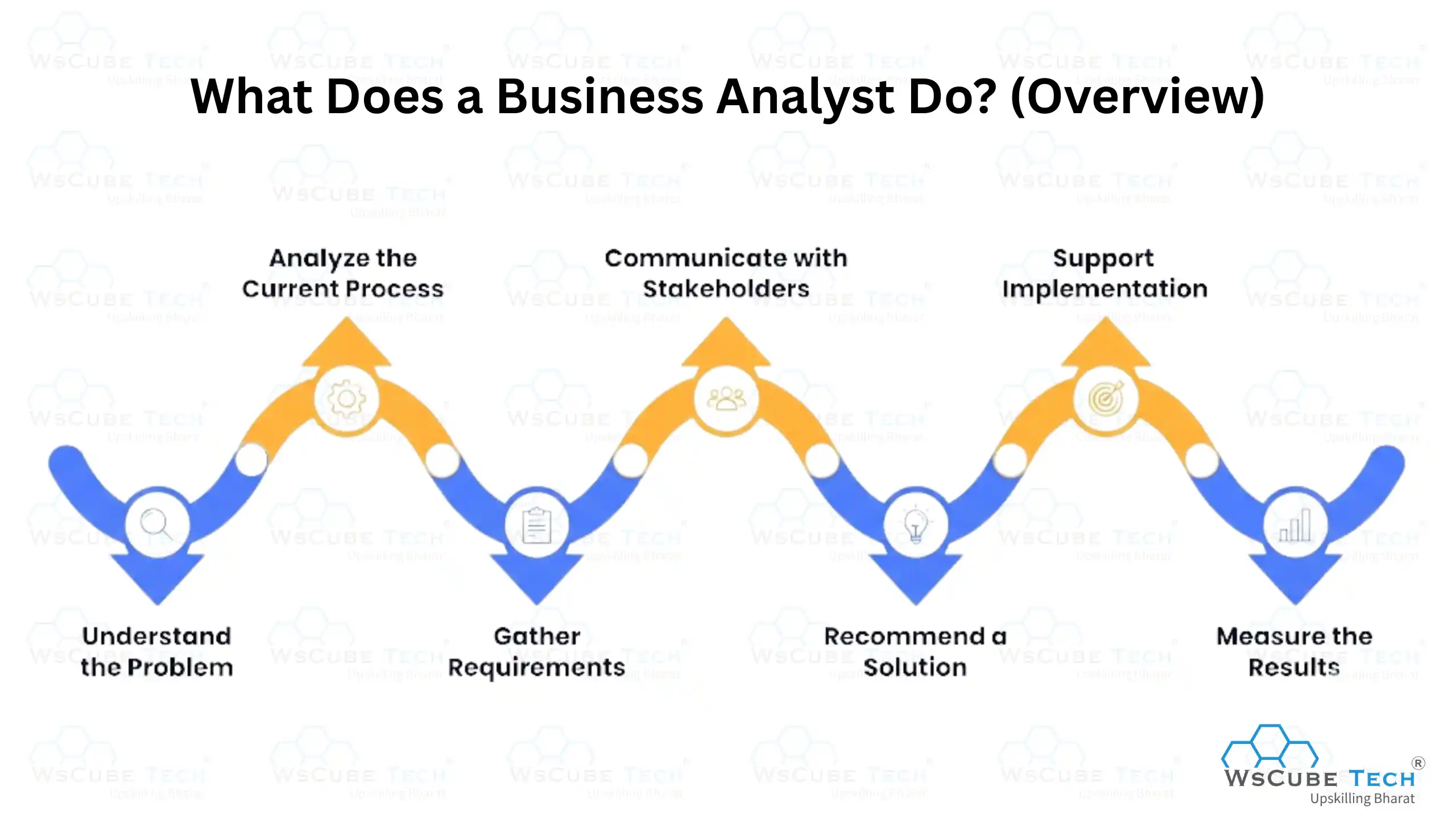
Step 1: Understand the Problem
The business analyst first speaks with stakeholders from sales, marketing, customer support, product, and technology teams. They review customer complaints and existing performance data to understand where the problem occurs.
Step 2: Analyze the Current Process
The BA maps the existing checkout journey from adding a product to completing payment. They identify several unnecessary steps, including mandatory account creation before payment.
Step 3: Gather Requirements
The BA discusses the findings with stakeholders and documents what the business needs from a new checkout process. For example, customers should be able to complete purchases without creating an account, while the business should still collect the information needed for order processing.
Step 4: Communicate with Stakeholders
Throughout the project, the BA keeps sales, marketing, product, and technology teams updated on findings and progress. They hold regular check-ins to explain what has been discovered, clarify open questions, and make sure every team stays aligned before any solution is finalized.
Step 5: Recommend a Solution
Based on the findings, the BA recommends introducing a guest checkout option and simplifying the payment flow. They document the requirements and share them with the product and development teams.
Step 6: Support Implementation
During development, the BA works with developers and testers to clarify requirements, answer questions, and make sure the new checkout process matches the agreed expectations.
Step 7: Measure the Results
After the updated checkout goes live, the BA tracks metrics such as checkout completion rate, cart abandonment rate, and customer feedback. If the results improve, the solution has achieved its intended business outcome. If not, the BA investigates further and recommends additional improvements.
What This Example Shows: This example demonstrates that a business analyst does much more than analyzing data. They identify problems, gather requirements, analyze processes, communicate with stakeholders, recommend solutions, support implementation, and measure results.
In a real project, these activities often overlap rather than happen in a perfectly linear sequence. The BA's role is to keep the business problem and the proposed solution aligned throughout the project.
Key Roles & Responsibilities of a Business Analyst
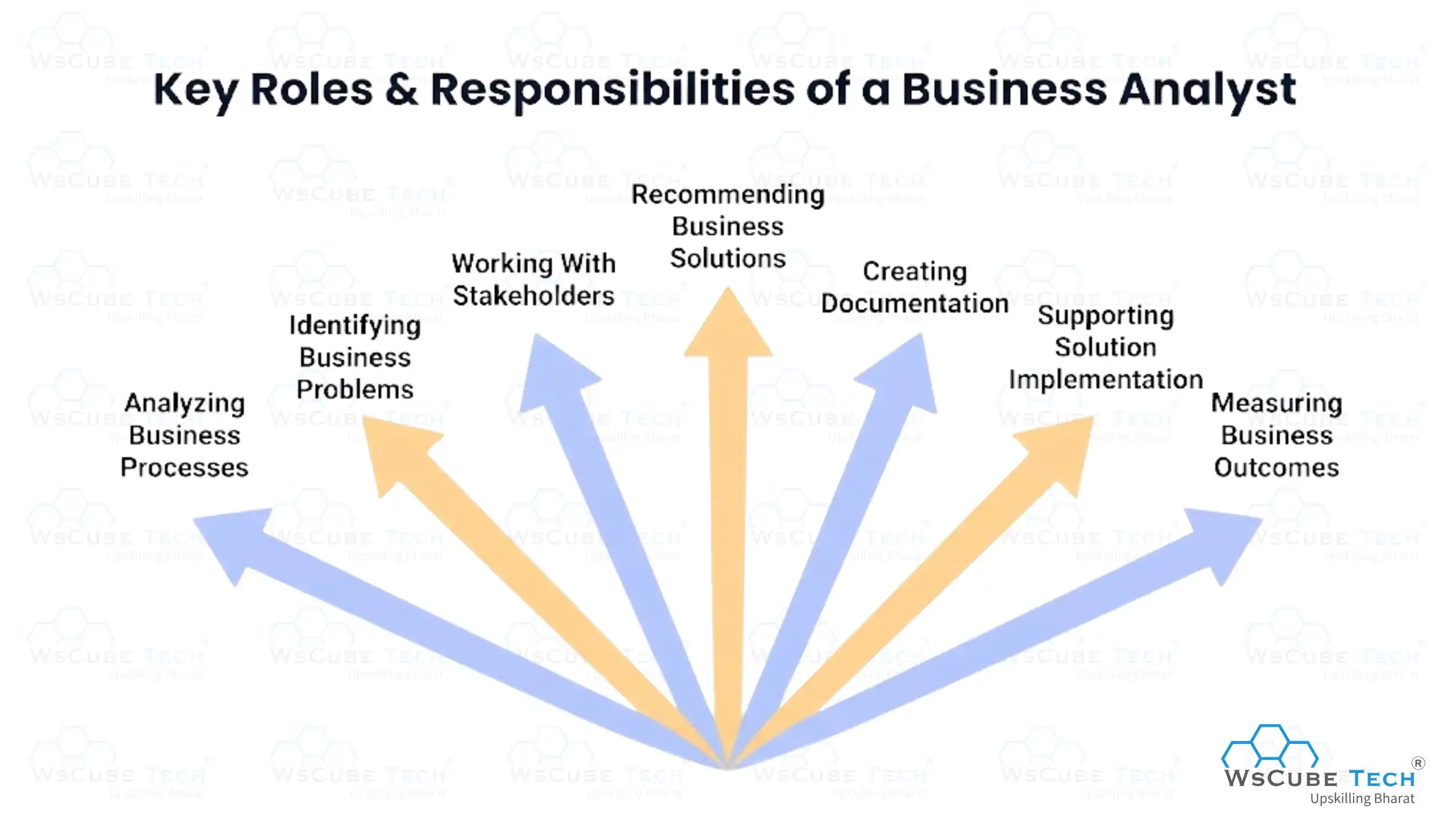
This section covers the overall responsibilities of a business analyst, focusing on the outcomes they deliver rather than their daily tasks. Understanding the business analyst job role and responsibilities helps you see the bigger picture of the role.
1. Analyzing Business Processes
A business analyst studies how a company currently operates, step by step, to understand where time, money, or effort is being wasted. They map out workflows to spot repeated steps, delays, or unnecessary approvals. This analysis becomes the foundation for every recommendation they make later. Without a clear picture of the current process, it is impossible to suggest a meaningful fix.
2. Identifying Business Problems
Part of the job is spotting problems before they get worse. A business analyst looks at complaints, performance numbers, and feedback to find the real issue behind a symptom. They ask why something is happening rather than just treating the surface-level complaint. This skill of digging into root causes separates a good analyst from an average one.
3. Working With Stakeholders
Business analysts spend a large part of their time talking to people such as managers, clients, developers, and end users. They gather opinions, resolve conflicting needs, and make sure every voice is heard before decisions are made. Good stakeholder management often decides whether a project succeeds or fails. A BA needs patience and clarity to keep everyone aligned.
4. Recommending Business Solutions
Once a problem is clear, the business analyst suggests solutions that are realistic and achievable within the company's budget and timeline. These recommendations are backed by data, research, and input from stakeholders. A good solution balances what is ideal with what is actually possible to implement. This is where analytical thinking turns into real business value.
5. Creating Documentation
Every requirement, decision, and process change needs to be written down clearly. Business analysts create documents such as business requirement documents (BRDs), functional specifications, and process flow diagrams. This documentation becomes the reference point for developers, testers, and managers throughout the project. Clear documentation reduces confusion and rework later.
6. Supporting Solution Implementation
A business analyst does not disappear once a solution is approved. They stay involved during development and testing to make sure the final product matches what was originally requested. They answer questions from developers, clarify requirements, and flag issues early. This ongoing support keeps the project aligned with business goals.
7. Measuring Business Outcomes
After a solution goes live, the business analyst checks whether it actually solved the problem. They track key metrics, gather feedback, and compare results against the original goals. If the outcome falls short, they go back to the drawing board and adjust. This feedback loop is what makes the role genuinely results-driven.
Day-to-Day Tasks of a Business Analyst
While the responsibilities above describe the bigger picture, this section answers a more practical question: what does a business analyst do day to day? These are the actual tasks that fill out a typical workday.
1. Attending Meetings
Most days start with meetings involving stakeholders, project managers, or development teams. These discussions help the BA stay updated on progress and gather fresh input on requirements, and they often set the priorities for the rest of the day.
2. Gathering and Clarifying Requirements
Business analysts spend time interviewing stakeholders and asking follow-up questions to remove any confusion about what is actually needed. Clear requirements prevent costly mistakes later in the project, since a small misunderstanding early on can turn into a major rework later.
3. Analyzing Data and Information
They review reports, spreadsheets, and performance data to spot trends or issues that need attention. This analysis often forms the basis of the recommendations they make, which is why accuracy at this stage matters so much.
4. Creating Reports and Documentation
A large chunk of the day goes into writing requirement documents, updating specifications, and preparing summaries for stakeholders. These documents keep everyone on the same page, even when team members join a project midway.
5. Mapping Business Processes
Using tools and diagrams, business analysts visually map out how a process currently works and how it should work after changes are made. This makes complex workflows easier to understand for people outside the immediate project team.
6. Collaborating With Teams
BAs work closely with developers, testers, designers, and managers throughout the day to make sure the project stays on track. This collaboration is central to the business analyst job role, since no single team can succeed without the others.
7. Reviewing Solutions
Before a solution goes live, business analysts review it against the original requirements to check for gaps or mismatches. This quality check helps catch problems early, before they become expensive to fix.
8. Tracking Issues and Changes
Requirements often change during a project. Business analysts track these changes carefully and update documentation, so nothing gets lost or forgotten, keeping a clear history of why each decision was made.
9. Presenting Findings
At various points, BAs present their analysis, recommendations, or project updates to leadership and stakeholders. Strong presentation skills help their ideas get approved and acted quickly, rather than getting stuck in endless follow-up questions.
Upcoming Masterclass
Attend our live classes led by experienced and desiccated instructors of Wscube Tech.



Types of Business Analysts
Business analysts work differently depending on the industry and business needs. Some focus on software development, while others work in finance, marketing, or operations. Understanding these specializations can help you choose the right path for your career.
| Type | Main Focus |
| IT Business Analyst | Bridges business needs and software development teams |
| Data Business Analyst | Focuses on interpreting data to guide business decisions |
| Systems Business Analyst | Analyzes and improves how software systems function within a business |
| Marketing Business Analyst | Studies market trends, campaigns, and customer behavior |
| Financial Business Analyst | Analyzes budgets, forecasts, and financial performance |
| Agile Business Analyst | Works within Agile teams to manage backlogs and sprint requirements |
| Product Business Analyst | Focuses on product features, user needs, and roadmap planning |
Each type applies to the same core skill set of research, communication, and problem-solving, just to a different part of the business. Many professionals also move between these specializations over the course of their career as their interests and industry exposure change.
Business Analyst vs. Data Analyst: What's the Difference?
People often mix up these two roles because both work with information. However, their focus and day-to-day work are quite different.
| Aspect | Business Analyst | Data Analyst |
| Primary Focus | Business problems and process improvement | Numbers, datasets, and statistical patterns |
| Main Tools | Excel, documentation tools, process mapping software | SQL, Python, data visualization tools |
| Output | Requirement documents, recommendations | Reports, dashboards, statistical insights |
| Interaction | Heavy stakeholder communication | More time spent working directly with data |
| Skill Emphasis | Communication and business understanding | Technical and analytical depth |
Both roles can overlap in many companies, especially smaller ones where one person handles both functions. In larger organizations, however, the two roles usually sit on separate teams, with business analysts reporting closer to operations or product, and data analysts often sitting within a dedicated data or analytics department.
If you want a deeper comparison to decide which path suits you better, this video on Data Analyst or Business Analyst breaks it down further.
Skills Required to Be a Business Analyst
To succeed in this role, a mix of soft and technical skills is needed. No single skill works in isolation; it is the combination of thinking, communicating, and understanding the business that makes someone effective in this position.

1. Analytical Skills
These skills help a business analyst break down a complex problem into smaller, manageable parts and figure out what is actually causing it.
- Critical thinking
- Problem-solving
- Data interpretation
- Business analysis
2. Communication Skills
Since a large part of the job involves talking to people from very different backgrounds, from developers to senior executives, clear communication is non-negotiable.
- Verbal communication
- Written communication
- Active listening
- Presentation
3. Business Skills
These skills help a BA understand the bigger picture of how a company makes money and where decisions actually get made.
- Business process understanding
- Decision-making
- Domain knowledge
- Stakeholder management
4. Technical Skills
While not always mandatory, some technical grounding makes it easier to work closely with development and data teams.
- Excel
- SQL
- Data visualization
- Requirements management
- Basic understanding of databases and software systems
A common question people ask is does business analyst do coding. The honest answer is that coding is not a core requirement for most BA roles, though a basic understanding of SQL or databases is helpful, especially in IT-focused positions. You do not need to be a programmer to succeed in this field.
Read More Data Related Guides
Tools Used by Business Analysts
Business analysts rely on a set of software tools to gather requirements, analyze data, and communicate findings clearly. Knowing these tools also gives you a practical sense of what does a business analyst does day-to-day, since much of the job happens inside these applications rather than in abstract discussions. Most companies expect familiarity with at least a few of the following.
1. Microsoft Excel

Used for organizing data, building simple models, and tracking requirements or issues. It remains one of the most reliable tools for quick analysis without needing specialized software.
2. SQL
Helps BAs pull and query data directly from databases when they need deeper insights. Even basic working knowledge is often enough to answer common business questions independently.
3. Jira

A popular tool for tracking tasks, managing backlogs, and collaborating with Agile teams. It keeps everyone updated on what is in progress, what is pending, and what has been completed.
4. Confluence

Used to create and store documentation such as requirement specs and meeting notes. It works well alongside Jira, giving teams one shared space for both tasks and documentation.
5. Power BI

Helps turn raw data into visual dashboards that are easy for stakeholders to understand. This makes it simpler to present findings to people who may not be comfortable reading raw numbers.
6. Microsoft Visio

Useful for creating process flow diagrams and mapping out business workflows. Visual maps often communicate a process far more clearly than a written description ever could.
7. Balsamiq or Figma

Used for creating wireframes and mockups when working on product or software requirements. These tools help stakeholders visualize a solution before any actual development begins.
8. Trello or Asana

Helps manage smaller projects, track deadlines, and coordinate tasks across teams. They are especially useful for BAs working across multiple projects at once.
How to Become a Business Analyst (With or Without a Degree)
There is more than one way to enter this field, depending on your background.
With a Degree
- Complete a bachelor's degree in business, IT, finance, or a related field
- Build core skills in Excel, SQL, and communication
- Take up internships or entry-level analyst roles
- Learn tools like Jira and Power BI on the job
- Pursue certifications such as CBAP or ECBA to strengthen your profile
- Apply for junior business analyst positions and grow from there
Without a Degree
- Start with a strong understanding of business fundamentals through self-study or a structured business analytics course.
- Learn practical tools such as Excel, SQL, and basic data visualization
- Build a portfolio using sample projects or case studies
- Gain experience through internships, freelance work, or entry-level roles
- Get an industry-recognized certification to prove your skills to employers
- Network and apply for junior roles where skills matter more than the degree on paper
Many companies value practical skills and problem-solving as much as formal education. Build real examples, such as requirement documents or process maps, to demonstrate your skills to employers.
Now, if you are interested in starting a career as business analyst, it’s time to join WsCube Tech’s business analytics course and get job-ready within 14 weeks.
Business Analyst Salary in India
Salaries for business analysts in India vary depending on experience, location, and industry. According to Glassdoor’s salary data, the average salary for a business analyst is around ₹9,00,000 per year in India. Broader salary surveys show a wider range depending on company type and seniority.
| Experience Level | Approximate Annual Salary (INR) |
| Entry-Level (0-2 years) | ₹3,00,000 - ₹7,00,000 |
| Mid-Level (6-9 years) | ₹8,00,000 - ₹15,00,000 |
| Senior-Level (15+ years) | ₹15,00,000 - ₹25,00,000 |
Location also plays a big role, with cities like Bengaluru, Mumbai, and Gurugram generally offering higher pay due to the concentration of product companies, consulting firms, and global capability centers. Moreover, pay can range widely based on skills, bonuses, and company type, so these numbers should be treated as a general guide rather than a fixed figure.
Explore Our Data Related Courses
| Online Data Analytics Course | Live Internship + 100% Job Support |
| Online Business Analytics Course | Live Internship + 100% Job Support |
| Online Data Science Course | Live Internship + 100% Job Support |
Is Business Analyst a Good Career in 2026?
Yes, business analysis remains a strong, high-demand career choice in 2026. Here are the key reasons why this role continues to thrive in an evolving market:

- Strong Job Growth and Continued Demand: Business analysts remain in demand as organizations increasingly rely on data, technology, and process improvements to make better decisions. Employment across related analyst roles is projected to grow faster than the average for many occupations, creating opportunities across industries.
- A Critical Bridge Between AI, Data, and Business: AI can now automate tasks such as analyzing data, generating reports, and drafting requirements, but businesses still need professionals who can interpret these outputs, validate AI-generated insights, understand business context, and ensure responsible decision-making. This makes the BA role increasingly important in an AI-driven workplace.
- Opportunities Across Multiple Industries: Business analysts can work across sectors such as IT, fintech, healthcare, e-commerce, retail, banking, and consulting. This flexibility allows professionals to move between industries, explore different domains, and reduce their dependence on opportunities in a single market.
- Strong Career Growth and Leadership Opportunities: The business analyst role provides valuable exposure to stakeholders, technology, operations, data, and business strategy. With experience, BAs can move into roles such as Product Manager, Project Manager, Scrum Master, Business Consultant, Analytics Consultant, or Enterprise Architect.
- Accessible Career Path for Diverse Backgrounds: A career in business analysis does not always require an advanced technical background. Professionals from business, finance, engineering, commerce, humanities, and other fields can transition into the role by developing skills such as requirements gathering, problem-solving, data analysis, communication, and process mapping.
In fact, employment of management analysts, a closely related occupation, is projected to grow 9 percent from 2024 to 2034 in the United States, much faster than the average for all occupations.
This reflects the kind of steady global demand that also applies to business analyst roles.
If you are still unsure whether this career path is right for you, this video on Is Business Analyst Actually Worth It? covers real perspectives on the role.
Frequently Asked Questions
A business analyst studies business problem, gathers requirements from stakeholders, and recommends solutions that help a company work more efficiently. They also document these findings clearly so that technical teams can turn ideas into working solutions.
Their role is to act as a bridge between business teams and technical teams, making sure both sides understand goals and requirements clearly. This reduces miscommunication and helps projects stay on schedule and within budget.
Key responsibilities include analyzing processes, identifying problems, working with stakeholders, recommending solutions, documenting requirements, and measuring outcomes after implementation.
You need a mix of analytical thinking, communication skills, business understanding, and basic technical knowledge such as Excel and SQL.
Yes, many professionals enter this field through certifications, self-study, and practical experience instead of a formal degree. What matters most to employers is your ability to demonstrate real problem-solving skills, often through a portfolio of sample requirement documents or case studies.
It is a mix of both. While some technical understanding helps, the job leans more on communication, analysis, and problem-solving than pure coding. You do not need to write software, but you do need to understand how systems and processes fit together.
Basic SQL knowledge is helpful, especially in IT-focused roles, but it is not always mandatory depending on the company and industry.
Common tools include Excel, SQL, Jira, Confluence, Power BI, Microsoft Visio, and wireframing tools like Figma.
A business analyst focuses on solving business problems through requirements and communication, while a data analyst focuses more deeply on interpreting numbers and datasets.
Yes, the role continues to be in strong demand across industries, with multiple paths for growth into consulting, product, or analytics roles.
On average, business analysts in India earn between ₹9 lakh and ₹12 lakh per year, though this varies by experience, location, and company.
Yes, freshers can enter the field with the right skills, certifications, and internship experience, though salaries typically start at the lower end of the range.

Explore Our Free Tech Tutorials
| Python Tutorial | Java Tutorial | JavaScript Tutorial |
| C Tutorial | C++ Tutorial | HTML Tutorial |
| CSS Tutorial | SQL Tutorial | DSA Tutorial |
Practice Coding With Our Free Compilers
| Online Python Compiler | Online HTML Compiler | Online C Compiler |
| Online C++ Compiler | Online JS Compiler | Online Java Compiler |
Join Our On-Campus Data Analytics Program
Join Our On-Campus Data Science Program
Explore Our Free Courses






Leave a comment
Your email address will not be published. Required fields are marked *Comments (0)
No comments yet.