
Here's a common story. A business spends ₹1 lakh on ads, gets plenty of clicks, and sees almost no sales. So the team changes the ad, then the audience and then the ad again. Nothing really improves, because nobody checked where people were actually dropping off.
That's the problem a performance marketing funnel solves. This guide explains how it works, which numbers to watch, how to plan one, and how to fix it when it leaks. If you're completely new, start with our post on what is performance marketing.
What is a Performance Marketing Funnel?
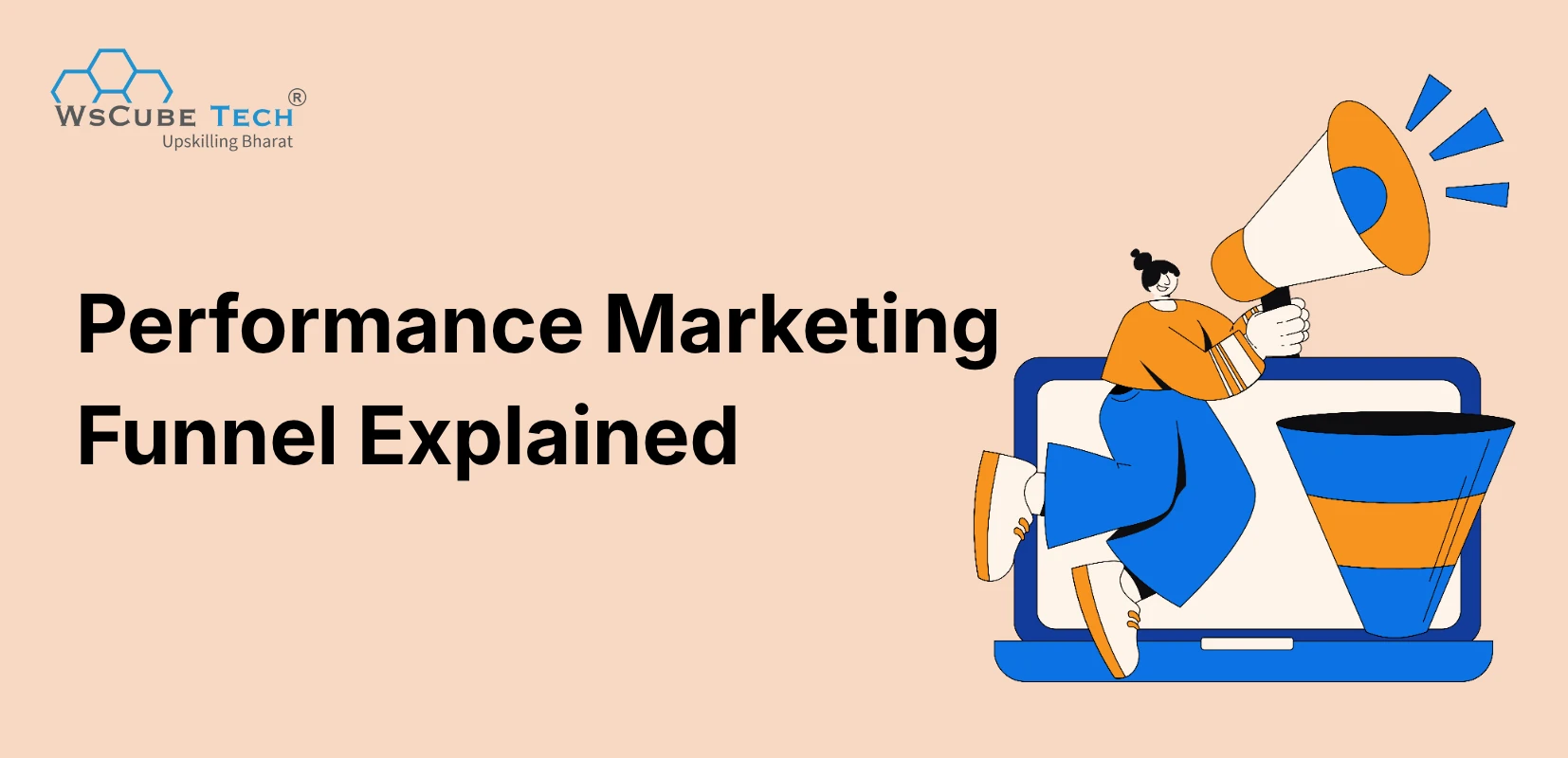
A performance marketing funnel is a map of the steps a person takes from seeing your ad to buying from you, with a number and a cost attached to every step. It tells you how many people made it to each step and how much it costs to get them there.
Think of a shoe ad you saw on Instagram last month. You saw it, maybe clicked, looked at a pair, left, and later saw the same shoes follow you around online. If you finally bought it, you went through every stage of a funnel. The brand counted you at each step.
The funnel shape comes from simple math. A lot of people see the ad, fewer clicks, fewer add to cart, and only a few buy. Each of those drops is something you can measure and improve.
Recommended Professional Certificates
AI-Powered Digital Marketing Course
Performance Marketing Bootcamp
SEO Specialist Bootcamp
1. Why a Performance Marketing Funnel Matters
A funnel turns a vague question like “are my ads working?” into specific ones you can answer with numbers. Instead of judging a campaign by one total, you see how a stranger becomes a customer, so decisions rest on data rather than gut feeling.
- Common language: Marketing, sales and founders read the same map
- Forecasting: Estimate the sales a budget could bring before you spend it
- Early warnings: A dip at one step shows up before revenue falls
- Simple reporting: Explain results to clients or bosses in plain steps
2. Performance Marketing Funnel vs. Traditional Marketing Funnel
A traditional funnel is mostly a thinking tool. Brand teams use it to decide what to say to someone at each stage of their decision. A performance funnel follows the same journey, but every stage is tied to something you can count, like a click, a form fill or a purchase. For the wider idea, see our guide on the digital marketing funnel.
| Metric | Traditional funnel | Performance marketing funnel |
| What it measures | Awareness, recall, how people feel | Clicks, leads, sales, cost per sale |
| How fast you get feedback | Slow, often from surveys | Daily or weekly from ad platforms |
| How budget is decided | Brand goals | Cost and return at each stage |
The two aren't opposites. A performance funnel still needs people to hear about you first. It just checks that it actually happened.
What are the 4 Stages of a Performance Marketing Funnel?
The four stages are awareness, consideration, conversion and retention. Each has one job, and each is judged by a different number.
1. Awareness (TOFU): Reach the Right People
At this stage, you're getting your offer in front of people who could actually buy, and trying to earn a click. Right people matter more than lots of people. Showing your ad to a million people who'll never buy just costs money.
These people are cold. They don't know you yet, so talk about their problem, not your product. A coaching institute, for example, would run an ad saying "Struggling to crack interviews?" before it says anything about its course.
Typical places to run this stage are Meta (Instagram and Facebook) ads, YouTube, Google Search on problem keywords, and influencer or affiliate partners. The types of performance marketing channels by WsCube covers each one.
2. Consideration (MOFU): Turn Clicks into Interest
Now the person knows they have a problem and is comparing options. Your job is to turn a click into a real sign of interest. That could be viewing a product page, watching most of a video, filling in a form, starting a free trial or adding something to the cart.
This is where lots of funnels quietly leak. The ad worked, but the page didn't. Think about the last time you clicked an ad, landed on a slow or confusing page, and closed it in five seconds. That visit was wasted money. People who visit but don't act can be put into a retargeting list so you can show them ads again.
3. Conversion (BOFU): Get the Sale or the Lead
This is the stage where someone does the thing your business needs: buys, books a call, or sends a serious enquiry. Your job is to clear away the last doubts.
What helps here is a clear offer, a short checkout or form, search ads on buying keywords like "digital marketing course fees", and retargeting ads showing the exact product someone looked at. You've probably noticed these yourself: you leave a product in your cart, and a day later an ad shows you the same thing.
Because these people are already warm, results look great at this stage. But be careful. Bottom-funnel ads often just collect demand that the earlier stages created, so don't cut awareness spend because the bottom looks good.
4. Retention: Maximize Customer Lifetime Value (LTV)
Retention is everything after the first sale: onboarding, repeat orders, upsells, referrals and win-back offers. You've already paid to get this customer, so every repeat order brings your real cost of acquisition down.
A pharmacy or grocery brand might send a WhatsApp reminder when a monthly product is about to run out. An app might guide new users to their first useful action in the first few minutes. For one-time purchases like a course or a sofa, retention usually means reviews, referrals, and a second purchase.
Key Performance Marketing Funnel Metrics to Track by Stage
Pick one or two main numbers per stage, plus a few that explain why they move. Early on, that's click-through rate and cost per lead. At the bottom, it's conversion rate, cost per acquisition (CPA) and return on ad spend (ROAS). After the sale, it's repeat purchase rate.
1. Top and Middle Funnel Metrics
These tell you whether you're reaching the right people and whether they take the first steps.
- CPM: what you pay for 1,000 views of your ad. Spend divided by impressions, times 1,000.
- CTR: the share of people who saw your ad and clicked. Clicks divided by impressions.
- CPC: what one click costs. Spend divided by clicks.
- Landing page view rate: the share of clicks where the page actually loaded. A big gap between clicks and page views usually means a slow page or accidental clicks.
- Cost per lead (CPL): spend divided by leads. A low CPL isn't always good, because it only matters if those leads turn into customers.
- Add-to-cart rate: the share of visitors who add something to their cart.
A low CTR usually points at the ad or the audience, not the landing page.
2. Bottom Funnel and Retention Metrics
These connect your ads to real business results. Conversion rate is conversions divided by visitors. CPA is spend divided by conversions. ROAS is revenue divided by ad spend. Repeat purchase rate is the share of customers who order more than once. Lifetime value (LTV) is how much a customer is worth over time, and comparing it with what you paid to win them tells you whether the whole thing is worth it.
The number beginners skip most is break-even ROAS, which is 1 divided by your gross margin. A ROAS of 3 sounds great. But if your margin is 25%, break-even is 4, so you're losing money at 3.
3. How to Calculate Drop-Off Between Stages (Worked Example)
The easiest way to read a funnel is to follow one budget through every step. These numbers are made up, just to show the method. Say an online store spends ₹1,00,000 on ads in a month.
| Funnel step | Volume | What happens next |
| Impressions | 5,00,000 | CPM is ₹200 |
| Clicks | 7,500 | CTR is 1.5%, CPC is about ₹13 |
| Landing page views | 6,000 | 80% of clicks |
| Add to cart | 480 | 8% of page views |
| Checkout started | 240 | 50% of add-to-carts |
| Purchases | 120 | 50% of checkouts, CPA is about ₹833 |
With an average order of ₹2,000, revenue is ₹2,40,000, so ROAS is 2.4. If the product has a 40% margin, break-even ROAS is 2.5 and break-even CPA is ₹800. So this store is just under break-even on the first order.
Now look at where people drop. Only 8% of page views turn into an add-to-cart, which is the weakest step. If you lift that to 10%, you get 150 purchases for the same spend. CPA falls to about ₹667 and ROAS rises to 3.0. A small fix at the leakiest step often beats a big effort on ad creative.

How to Build a Performance Marketing Funnel Step by Step
Work backwards from the sale. Decide what counts as a conversion, set a cost target from your margins, split your budget between new and returning audiences, set up tracking, then launch small and scale only what works. Don't start by picking channels. That's the most common mistake.
Step 1: Define Your Primary Conversion Event
Be clear about the action that really matters. For a store, it's a paid order. For an institute, it's a counselling call that actually happened, not just a form fill. Then list the steps people take to get there, and make sure each one can be tracked. For lead generation it might look like this: ad click, page view, form started, form submitted, call answered, qualified, enrolled. Every step is a conversion rate you can measure.
Step 2: Calculate Target CPA and Break-Even ROAS
Your targets should come from your margins, not from what other advertisers say they get.
- Work out your gross margin per order or per customer.
- Calculate break-even CPA (average order value × gross margin) or break-even ROAS (1 ÷ gross margin).
- Aim for better than break-even if you want profit on the first order. If you plan to earn from repeat purchases, you can accept a higher first-order CPA, but only if your own repeat data backs that up.
Step 3: Split Budget Between Prospecting and Retargeting
Prospecting finds new people. Retargeting brings back people who already showed interest. Retargeting usually looks cheaper per sale, but the audience is small, and it only exists because of your prospecting spend. As a rough starting point, not an industry rule, put most of the budget into prospecting and a smaller share into retargeting. Then adjust. If your retargeting audience is tiny, spending more there just shows the same people the same ads again and again.
Step 4: Set Up Conversion Tracking Before Launch
If you can't measure the funnel, you can't improve it, so sort out tracking before you spend a rupee.
- Set up Google Analytics 4 (GA4) and mark your important actions as key events.
- Install the Meta Pixel, and if you can, add the Meta Conversions API (server-side tracking) so more conversions get captured.
- Set up conversion tracking in Google Ads and link it with GA4.
- Put consistent UTM tags on every ad link.
- Go through the whole journey yourself and check that each event fires once, not twice.
Platform settings change often, so follow each platform's current documentation for the exact steps.
Step 5: Launch Small, A/B Test, and Scale Winners
Start with a few clear campaigns, not twenty. First, check that tracking works and the offer gets clicks and conversions on a small budget. Then test one thing at a time, like the hook, the format, the audience or the page headline, and give each test enough data to read. When a campaign hits your target CPA or ROAS, raise the budget slowly and watch whether costs climb as the audience gets used up. Only then add more awareness spend and retention flows.
Changing many things at once means you'll never know what helped. If you'd like hands-on practice running campaigns like this, understanding how performance works will help you evaluate ads, analytics, and optimization.
Digital Marketing Career Guides Blogs
Best Performance Marketing Funnel Tools by Function
You don’t need a big stack. Pick one tool for each job, and add a paid one only when a specific problem shows up. The tracking basics (GA4, Meta Pixel, Conversions API) are covered in the tracking step above, so this section looks at what sits on top of them.
- Page behavior: Microsoft Clarity or Hotjar show heatmaps and recordings of why visitors leave
- Landing pages and testing: Unbounce, Instapage or VWO help you build and A/B test page versions
- Creative: Canva and CapCut make it quick to produce ad variations
- CRM and follow-up: HubSpot or Zoho CRM track lead status, and WhatsApp tools like WATI or Interakt automate replies
- Retention: Klaviyo or Mailchimp for email, and MoEngage or WebEngage for app users
- Reporting: Looker Studio or Supermetrics pull data from every platform into one view
Check each tool’s current features and pricing before you commit, as both change often.
Real-World Performance Marketing Funnel Examples
Here are three funnels you'll recognize: an online store, a lead-generation business and a subscription app. These are everyday scenarios with made-up numbers, not real company data, so use them to learn how a funnel reads, not as benchmarks.
1. E-Commerce Funnel Example: D2C Skincare Brand
A skincare brand runs short Instagram videos showing a skin problem and a quick result. They reach interest groups and people similar to past buyers. Clickers land on a product page with reviews, before-and-after photos and an ingredient list. Anyone who looks but doesn't buy goes into a retargeting list.
A few days later, those people see an ad for the exact product they viewed, with a first-order offer. Google Search catches people typing the brand name. After delivery, a WhatsApp message reminds the customer to reorder around the time the product runs out.
The numbers to watch here are CTR, add-to-cart rate, checkout completion, CPA, ROAS and repeat purchase rate.
2. Lead Generation Funnel Example: Coaching Institute
Imagine an institute in Jaipur spending ₹2,00,000 a month on ads for a paid course. Here's how it plays out:
- 800 leads come in, so cost per lead is ₹250.
- 320 of them turn out to be genuinely interested and suitable, which is 40%.
- 128 attend a demo or counselling session, which is 40% of those.
- 16 enroll, which is 12.5% of the people who attended.
That's ₹12,500 per enrolment. This is why cost per lead alone can mislead you. A campaign with cheaper leads, but only 20% of them suitable, could cost more per enrolment than one with pricier, better leads. Judge the funnel by cost per enrolment, and treat CPL as a clue.
3. Subscription App Funnel Example: Fitness & Learning App
Say an app spends ₹3,00,000 a month. It gets 6,000 installs at ₹50 each. Of those, 30% finish onboarding, which is 1,800 people, and 5% of them pay, giving 90 subscribers. Each paying subscriber costs about ₹3,333 to win. At ₹499 a month, it takes roughly 6.7 months of subscription revenue just to earn back the ad cost.
Now suppose the app improves its first-day experience and activation rises from 30% to 40%, with everything else unchanged. Subscribers go up to 120, and the cost per subscriber falls to about ₹2,500. For apps, what happens after the install matters as much as the ad.
How to Find and Fix Leaks in Your Performance Funnel
Find the first stage where far fewer people continue than you'd expect, and fix that first. A fix early in the funnel carries through every stage after it, so polishing your checkout while your landing page is broken is wasted effort.
1. Read the Drop-Off Pattern to Find the Problem
Compare each step's conversion rate with your own past numbers. The pattern usually points to the cause:
- Plenty of impressions but few clicks: look at the ad creative or the audience.
- Plenty of clicks but few page views: look for a slow page, broken links or accidental clicks.
- Plenty of page views but few add-to-carts or leads: look at the page, the offer or trust. Check that the page matches what the ad promised.
- Plenty of add-to-carts but few purchases: look for friction at checkout, like surprise shipping costs or forced sign-ups.
- Plenty of leads but few sales: look at lead quality or how slowly your team follows up.
2. Fix Low CTR, Weak Landing Pages and Cart Abandonment
Low CTR: Try new hooks in the first seconds of a video or the first line of text. Show the product or result more clearly, and speak to one specific problem, not a vague benefit. Tighten the audience too.
Weak landing page: Put the main benefit and the button where people can see them without scrolling. Make sure the page loads fast on a phone. Add proof like reviews or case studies, and remove links that lead visitors away.
Cart abandonment: Show the total cost early, since surprise shipping or fees make many people leave. Offer the payment options your customers actually use, such as UPI and cash on delivery where it fits. Allow guest checkout, and remind people who left items behind.
3. Fix Plenty of Leads but Poor Quality
When you get lots of leads and few of them buy, check what happens before and after the form:
- Add a question or two, like budget or experience level, so casual submissions drop off.
- If you can, send qualified-lead or actual-sale data back to the ad platform, so it learns to find people like your best leads, not anyone who fills in a form.
- Check how fast and how consistently your team follows up. Slow calls waste good leads.
- Look at the offer. A free giveaway attracts people who just want free things.
Common Performance Marketing Funnel Mistakes to Avoid
Most of the mistakes that hurt a funnel are covered earlier in this guide: picking channels first, copying benchmarks, skipping tracking and changing too much at once. These are the ones that tend to slip through after launch.
- Sending all traffic to the homepage: Visitors have to hunt for the offer, so send each ad to a page built for it
- Showing prospecting ads to existing customers: Exclude buyers and past leads so you don’t pay to reach people you already won
- Letting creative go stale: Frequency climbs and CTR falls, so plan a regular refresh
- Overlapping audiences: Campaigns compete in the same auction and push up your own costs
- Ignoring mobile: Most ad traffic comes from phones, so test every page and form on one
- Scaling on a lucky week: Wait for steady results before raising budgets
Upcoming Masterclass
Attend our live classes led by experienced and desiccated instructors of Wscube Tech.







Why Funnel Numbers Differ Across Ad Platforms and Analytics?
Each platform counts conversions its own way, and each only sees its own ads. So the totals rarely match, and they often add up to more than your real sales. That's normal, and it doesn't always mean your tracking is broken.
1. How Attribution Models and Windows Affect Conversion Data
Attribution decides which ad gets credit for a sale. Last-click gives all the credit to the final click before the sale, which favours channels like branded search. Other models spread the credit across several touchpoints. Each platform also sets its own counting window, so it may claim a sale that happened days after someone clicked.
Here's a simple case. A customer sees your Meta ad on Monday, then clicks a Google ad on Thursday and buys. Both platforms can say "that sale was ours". Your analytics tool looks across all sources, so it will show yet another number.
2. How to Measure True Performance (Blended ROAS & Incrementality)
No single model is right, so look at more than one view:
- Blended ROAS: total revenue from all sources divided by total ad spend across all platforms. It skips the attribution arguments and shows whether the business is profitable overall.
- Match against real orders: compare what platforms report with the orders or leads in your own database or CRM.
- Incrementality tests: pause a channel or campaign for one region or audience while it keeps running for another, then compare. The gap shows how many sales the ads actually caused.
- Ask customers: a short "how did you hear about us?" at checkout or in your CRM often shows channels the platforms miss.
Use platform numbers for day-to-day decisions. Use blended and CRM data to judge whether the business is actually making money.
A performance marketing funnel works best as a tool for finding problems, not a diagram on a slide. Map the stages, put a measurable action and a cost on each one, set targets from your own margins, and fix the leakiest step first.
How to Optimize a Performance Marketing Funnel for Higher ROI
Fixing leaks gets you to break-even, and optimizing for ROI is what comes after. The goal is to earn more from every visitor and every customer you’ve already paid for.
- Raise order value: Bundles, free-shipping thresholds and add-ons lift revenue without raising CPA
- Grow customer value: Repeat offers, subscriptions and referrals spread acquisition cost over more orders
- Cut wasted spend: Pause losing ad sets and move budget to the best performers
- Review on a schedule: A weekly check of spend and results beats daily tinkering
Take the store from the worked example, where a ₹2,000 order and ₹833 CPA gave a ROAS of 2.4, below the 2.5 break-even. A bundle that lifts the average order to ₹2,300 takes ROAS to about 2.76 with no change in ad spend, which puts the first order in profit.
Where to Learn Performance Marketing Funnel Strategy Hands-On
If you want to practice building and fixing a funnel like this on real ad accounts, start with our guide on how to learn performance marketing. If you’d like a structured route, WsCube Tech’s performance marketing course is an 8-week live online program with 48+ hours of classes and 12+ projects, and it focuses on paid ads, analytics and conversion tracking.
A good part of it covers the same steps you’ve just read about. You set up the Meta Pixel through Google Tag Manager and add the Conversions API. You build custom and lookalike audiences for retargeting, and you run lead generation campaigns. One project asks you to link a YouTube channel to Google Ads and build a story-style ad sequence, which is a funnel in video form.
Another has you build a patient lead generation campaign for a healthcare platform like Practo. This course sticks to paid advertising. If you also want to learn SEO, content and email marketing, the broader digital marketing course is a better fit.
Final Thoughts: Building a Profitable Funnel
Remember this: a performance marketing funnel shows you where people drop off between seeing your ad and buying, so you can fix the right step instead of guessing. The business at the start of this guide, with plenty of clicks and almost no sales, didn’t need a new ad. It needed someone to look at each stage and find the weak one.
To put that into practice:
- Decide what counts as a real conversion.
- Set your CPA or ROAS target from your own margins.
- Set up tracking before you spend.
- Launch small and change one thing at a time.
- Fix the first stage that leaks.
Your ad platforms won’t always agree with each other, so check them against your real orders. Don’t forget retention, because a customer who buys again makes the whole funnel cheaper.
Ready to try this on real campaigns? Check the curriculum of WsCube Tech’s performance marketing course, or talk to a program advisor to see if it fits your goals.

FAQs About Performance Marketing Funnel
No. Digital marketing covers every online channel, including SEO, content, email, social media and ads. Performance marketing is the part where you pay for a measurable result, like a click, lead or sale, and judge everything by those numbers.
A sales funnel usually starts once someone is already a lead and follows them through your sales team to a closed deal. A performance marketing funnel starts earlier, at the ad, and tracks how people become leads or buyers. In lead-based businesses, the performance funnel feeds the sales funnel.
It means running campaigns for every stage at the same time, from awareness to retention, instead of putting all the money into bottom-funnel ads. It matters because bottom-funnel ads only reach people who already know you.
If people already search for what you sell, start with conversion-focused campaigns, like search ads on buying keywords, because they show results fastest. If nobody knows your product exists, you’ll need awareness campaigns first. Either way, add the other stages once the first one is stable.
They’re the small actions people take before the main goal, such as watching a video, starting a form, signing up for an email list or adding something to the cart. They’re useful when sales are rare because they give you earlier signals to learn from. Don’t let them replace your main goal, though.
CPA is your ad spend divided by the number of conversions, and a conversion can be a lead as well as a sale. CAC is the full cost of winning one paying customer, which can also include agency fees, tools and sales team costs. For a business that sells on its website, CPA is often the narrower number.
ROAS only compares revenue with ad spend. ROI looks at profit after all your costs. A campaign can have a healthy ROAS and still lose money, because product cost, delivery and other expenses aren’t in the ROAS number.
There’s no single good number. It depends on your margin, your average order value and how often customers buy again. The useful comparison is your own break-even point, not someone else’s average.
You’ll see early signs like clicks and cost per lead within days. A reliable CPA or ROAS usually takes longer because each test needs enough conversions to read, and lead-based businesses also have to wait for leads to turn into sales. Give each test enough data before you change it.
Work backwards from your CPA. Decide how many conversions you need to judge a test, then multiply that by your expected cost per conversion. If your budget can’t produce enough conversions to read, split it across fewer campaigns instead of spreading it thin.
Yes, but it looks different. B2B buying takes longer, involves more people and brings fewer leads, so lead quality matters more than lead count. Many B2B teams add steps like “qualified lead” and “sales meeting”, and judge campaigns by closed deals, not form fills.
Yes, in a simple form. A local business might run a search or social ad, send people to a form or a WhatsApp chat, and track how many enquiries turn into customers. You don’t need every stage on day one.
Not always. You can use lead forms inside ad platforms, WhatsApp click-to-chat ads, or marketplace ads on platforms like Amazon. A website still gives you more control over tracking and retargeting.
Browser and phone privacy settings mean ad platforms can miss some conversions. Server-side tracking, first-party data (like emails and phone numbers customers gave you) and checking platform numbers against your real orders all help close the gap.
These tools choose audiences and placements across several stages for you. Your job shifts toward feeding them accurate conversion data, strong creatives and a good offer. You still need the funnel to check whether the results are real and profitable.
Google Analytics 4 has a funnel exploration report that shows where users drop off between steps. Ad platform dashboards cover the top of the funnel, and a CRM covers leads that turn into sales. If you want one combined view, a tool like Looker Studio or a simple spreadsheet can pull them together.
The customer journey is everything a person actually does, and it isn’t a straight line. People compare, leave, return and look at other options. The funnel is a simplified model marketers use to measure and improve that journey.
Start with the basics of Google Ads, Meta Ads and GA4, then practise on small real budgets or practical assignments so you have results to show. Roles to aim for include PPC specialist, media buyer and growth marketer. If you want guided practice, WsCube Tech’s Performance Marketing Course covers these tools through live classes and projects.
Join Our On-Campus Digital Marketing Program
Explore Our Free Courses



Leave a comment
Your email address will not be published. Required fields are marked *Comments (0)
No comments yet.