Ever wondered how long it really takes to turn coding basics into a full career? If you are planning a career switch or starting completely from scratch, this is often the very first question that comes to mind before you even begin.
Many beginners feel unsure on How much time is required., which skills to focus on first, and how to stay consistent. This confusion can make the entire journey feel slow, unclear, and easy to give up on.
In this blog, you will learn realistic timelines, the key factors that shape your progress, and simple, practical ways to become job ready much faster. You can also speed up your growth with a structured online full-stack development course that takes you from the basics to real-world projects.
Who Is a Full Stack Developer?
A full stack developer is a professional who works on both the front-end (what users see) and the back-end (server, database, and logic) of a website or web application. This means you can design user interfaces, build functionality, manage databases, and ensure everything works smoothly together. Because of this versatility, full stack developers are in high demand across industries. Below are the key responsibilities of a full stack developer:
- Front-End Development: Designing and developing user-friendly interfaces using HTML, CSS, and JavaScript
- Back-End Development: Building server-side logic and handling application functionality using languages like Node.js, Python, or PHP
- Database Management: Working with databases such as MySQL, MongoDB, or PostgreSQL to store and manage data
- API Development & Integration: Creating and integrating APIs to connect front-end and back-end systems
- Performance & Security: Ensuring fast loading speed, responsiveness, and protecting applications from vulnerabilities
- Testing & Maintenance: Debugging errors, testing applications, and maintaining smooth performance over time
Recommended Professional Certificates
Full Stack Development Course with AI Engineering
WordPress Bootcamp
Key Skills Required to become a full-stack developer
A full-stack developer needs a strong mix of technical abilities and soft skills to build, manage, and deploy complete web applications efficiently. Below are the essential skills required to become a full-stack developer:
Technical Skills
- HTML, CSS, and JavaScript: These core technologies help create the structure, design, and interactive elements of websites, forming the foundation of front-end development for responsive and user-friendly interfaces.
- Frontend Frameworks: Knowledge of frameworks like React, Angular, or Vue.js helps developers build dynamic, fast, and scalable user interfaces with reusable components and smoother user experiences.
- Backend Development: Understanding backend languages and frameworks such as Node.js, Python, Java, PHP, or Express.js is essential for handling server-side logic and application functionality.
- Database Management: Skills in databases like MySQL, PostgreSQL, or MongoDB are important for storing, managing, and retrieving application data securely and efficiently.
- API Development and Integration: A full-stack developer should know how to create and integrate REST APIs or third-party APIs to connect frontend and backend systems seamlessly.
- Version Control: Familiarity with Git and GitHub is necessary for tracking code changes, collaboration, and maintaining project versions during development.
- Deployment and Hosting: Knowledge of deployment tools, cloud platforms, and hosting services helps in launching applications and keeping them accessible online.
Soft Skills
- Problem-Solving Skills: Helps developers identify bugs, analyze complex issues, and find effective solutions quickly during development, testing, and maintenance to ensure smooth application performance.
- Communication Skills: Important for explaining ideas clearly, collaborating with team members, and understanding client or project requirements.
- Time Management: Enables developers to handle multiple tasks, meet deadlines, and complete projects efficiently without compromising quality.
- Adaptability: Technology changes rapidly, so developers must be willing to learn new tools, frameworks, and coding practices regularly.
- Teamwork and Collaboration: Full-stack developers often work closely with designers, testers, project managers, and other developers, making teamwork and smooth collaboration essential for successful project delivery.
- Attention to Detail: Ensures clean code, fewer errors, better debugging, and a smoother user experience in web applications.
Factors That Affect Learning Time to become a Full-Stack Developer
The time required to become full stack developer depends on several personal and learning-related factors. Below are the key factors that affect your learning time:
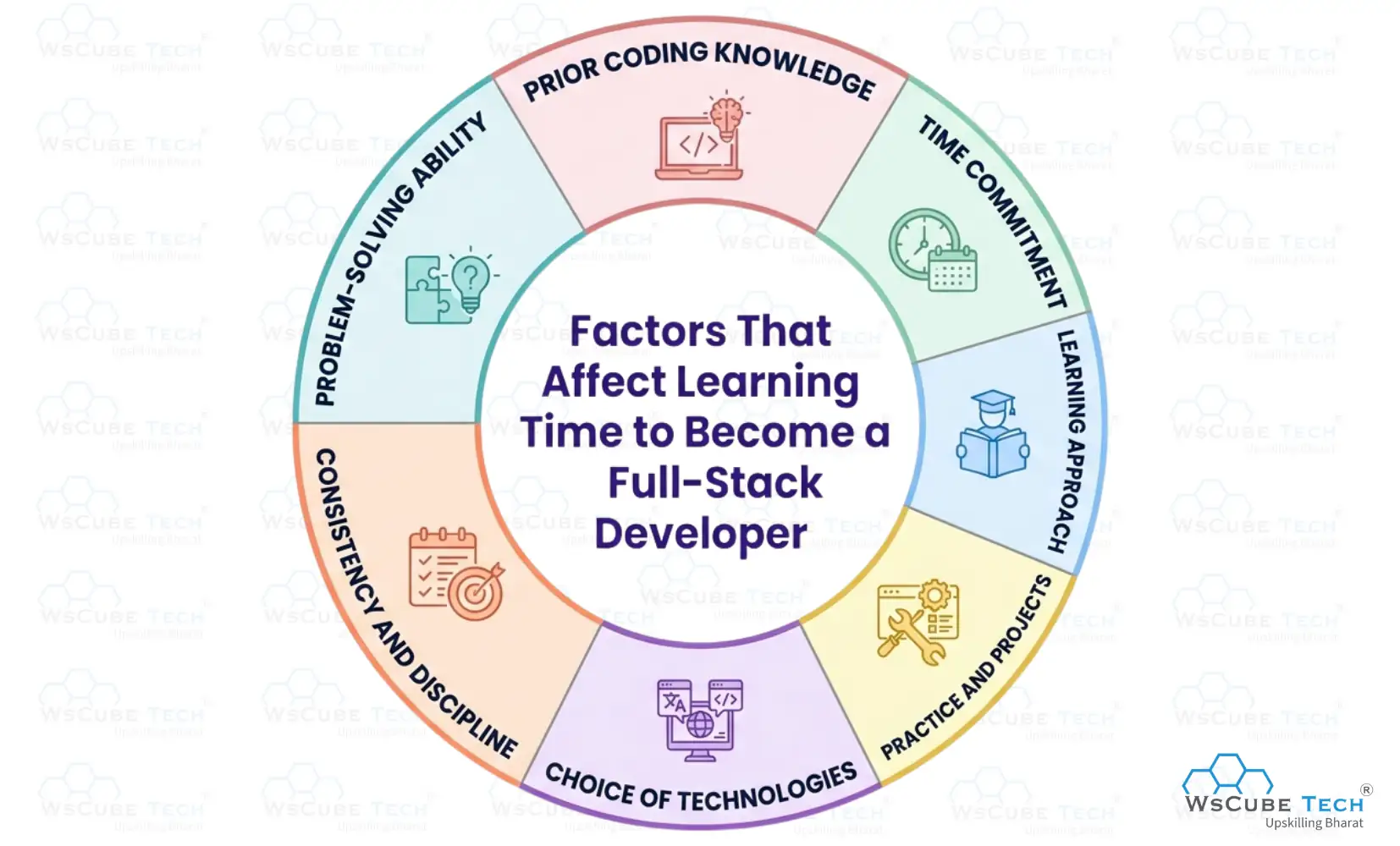
- Prior Coding Knowledge: If you already know programming basics like HTML, CSS, JavaScript, or any backend language, you can learn full-stack development much faster than someone starting completely from scratch.
- Time Commitment: The number of hours you dedicate daily plays a major role. Full-time learners progress faster, while part-time learners may take longer to cover the same concepts.
- Learning Approach: Structured courses, mentorship, and guided learning paths help you stay focused, avoid confusion, and follow a clear roadmap for becoming a full-stack developer. This reduces wasted time, improves understanding, and allows you to learn concepts faster compared to random or unorganized self-learning methods.
- Practice and Projects: Regular practice and building real-world projects improve your understanding quickly, while only learning theory without implementation slows down your overall development progress.
- Choice of Technologies: Learning too many technologies at once can slow you down, while focusing on a specific stack like MERN or MEAN helps you learn efficiently.
- Consistency and Discipline: Staying consistent with your learning schedule helps you build momentum, whereas long breaks or irregular study habits can significantly delay your progress.
- Problem-Solving Ability: Strong logical thinking and problem-solving skills help you understand coding concepts faster, debug errors efficiently, and reduce the time spent struggling with issues.
Upcoming Masterclass
Attend our live classes led by experienced and desiccated instructors of Wscube Tech.



How Long Does It Take to Become a Full-Stack Developer? (Timeframes)
The time required to become a full-stack developer depends on your background, consistency, and learning method. Here is the estimated timeframe based on different learning levels:
Beginner Level: 3–6 Months
At the beginner level, you can learn the basics of HTML, CSS, JavaScript, responsive design, and simple backend concepts within 3–6 months. With regular daily practice and small projects, you can build a strong foundation and start creating basic websites and web applications.
Intermediate Level: 6–12 Months
In 6–12 months, learners usually gain hands-on experience with frontend frameworks, backend development, databases, APIs, and version control tools. You can start working on real full-stack projects, strengthen problem-solving and debugging skills, build a strong portfolio, and gain the confidence needed for internships, freelance work, or entry-level developer roles.
Advanced Level: 1–2 Years
Within 1–2 years, you can develop advanced skills in system design, deployment, cloud platforms, authentication, performance optimization, and real-world project development. At this stage, most learners become job-ready for full-time full-stack developer roles and can handle complex applications independently.
Tips to Speed Up Your Full Stack Development Learning
Learning full-stack development faster requires the right strategy, consistency, and regular practice. Below are some effective tips to speed up your learning journey:
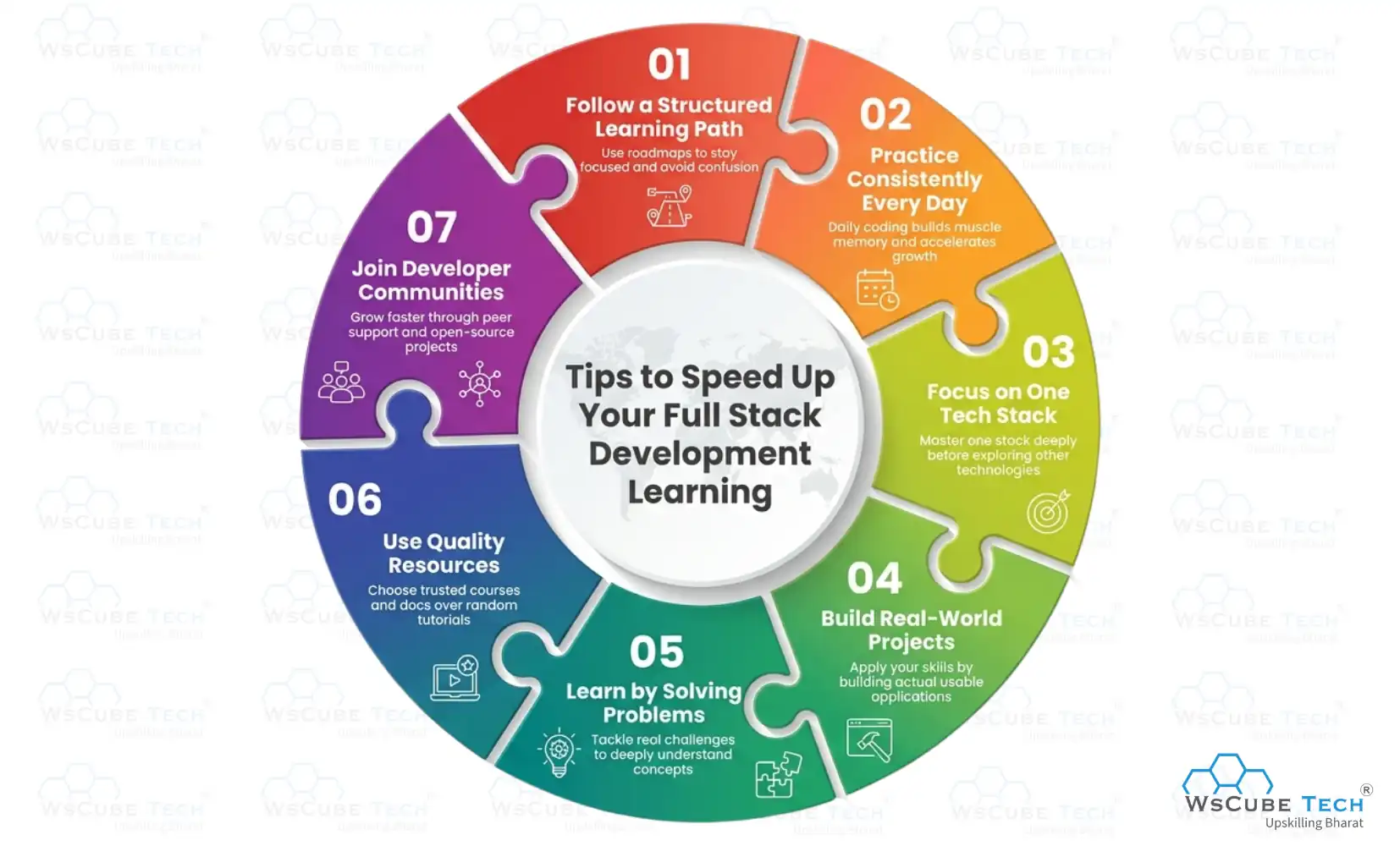
- Follow a Structured Learning Path: Choose a clear roadmap or course that covers front-end and back-end development step by step, helping you avoid confusion, stay focused, and learn concepts in the correct sequence without wasting time.
- Practice Consistently Every Day: Dedicate regular time daily for coding, even if it’s a few hours, because consistency builds momentum, improves retention, and helps you progress faster compared to irregular learning habits.
- Focus on One Tech Stack: Avoid learning too many technologies at once. Instead, focus on one stack like MERN to gain deep understanding, reduce confusion, and become job-ready more efficiently.
- Build Real-World Projects: Start building projects early, as practical implementation helps you understand concepts faster, improves your problem-solving skills, and builds confidence while creating a strong portfolio for job opportunities.
- Learn by Solving Problems: Practice coding challenges, debug errors, and try solving real problems, as this strengthens logical thinking and helps you handle real-world development tasks with confidence.
- Use Quality Resources: Learn from trusted courses, documentation, and tutorials to avoid misinformation, save time, and gain clear understanding instead of getting stuck with outdated or confusing content.
- Join Developer Communities: Engage with communities, forums, or groups where you can ask questions, share knowledge, and learn from others’ experiences, which helps you grow faster and stay motivated.
Explore More Guides Related to Full Stack Development
When Are You Job-Ready as a Full Stack Developer?
You are job-ready as a full stack developer when you can build real-world projects, solve problems, and confidently apply your development skills. Below are the key signs that show you are job-ready:
| Skill Area | What Shows You’re Job-Ready |
| Project Development | You can build complete web applications such as portfolio websites, dashboards, CRUD apps, or e-commerce projects independently. |
| Frontend & Backend Knowledge | You confidently understand user interface development, server-side logic, API integration, and database management. |
| Debugging Skills | You can identify errors, fix bugs, and improve code performance without relying fully on tutorials. |
| Portfolio | You have 3–5 strong projects uploaded on GitHub or displayed on a personal portfolio website. |
| Deployment Knowledge | You can deploy applications using platforms like Vercel, Netlify, or cloud hosting services. |
| Interview Readiness | You are comfortable answering coding questions, explaining projects, and discussing technical concepts confidently. |
Learn Full Stack Development with WsCube Tech
The full stack developer course duration typically ranges from 6 to 12 months, depending on whether you study full time or alongside a job.
If you are interested in learning full stack development, WsCube Tech offers an online full stack developer course designed to help beginners and aspiring professionals build strong technical skills through a structured learning roadmap. The course covers essential concepts from front-end development to back-end technologies, databases, and API integration.
With expert mentorship, hands-on projects, and career-focused guidance, WsCube Tech helps you become job-ready with practical experience. This course is ideal for learners who want to build modern web applications and confidently prepare for internships or full-time developer roles.
Explore Our Web Development Related Courses
FAQs About How Long It Takes to Become Full Stack Developer
It usually takes 6 months to 2 years, depending on your background, learning method, and daily practice time. Beginners need longer, while learners with coding basics progress faster.
The time required varies based on your dedication, daily practice, and learning method, but most learners take around 6 to 12 months to gain intermediate skills and become job-ready.
Most structured courses run for 6 to 12 months. Short bootcamps cover fundamentals in 3 to 4 months, while longer programs include deployment, advanced topics, and portfolio projects.
You can learn the basic concepts in 3 months with intensive daily study. Becoming fully job-ready usually needs more time, consistent practice, and real-world projects.
Six months is enough to learn core concepts and build a few projects with consistent practice. Strong confidence and interview readiness may require a few additional months.
Most learners take around 4 to 8 months to become comfortable with MongoDB, Express, React, and Node.js. Focusing on one stack instead of many speeds this up significantly.
Practicing 2 to 4 hours daily is ideal for steady progress. Dedicating more consistent hours can shorten your timeline and improve coding confidence quickly.
Yes, prior coding knowledge significantly reduces learning time. You already understand logic and syntax, so you can focus directly on advanced full stack concepts.
Yes, by dedicating 2 to 3 focused hours daily and using weekends for projects. It takes longer than full-time learning, but it is very achievable.
Usually yes. Self-taught learners often spend extra months figuring out what to learn next, while structured courses and mentorship remove that guesswork and shorten the path.
Start with frontend using HTML, CSS, and JavaScript, since results are visible immediately and keep motivation high. Move to backend once you are comfortable with JavaScript fundamentals.
Begin with HTML, CSS, and JavaScript fundamentals, then move to a frontend framework, backend development, databases, and APIs in that order.
Three to five solid projects are usually enough, including at least one complete full stack application with authentication, a database, and live deployment.
Yes. Employers prioritise practical skills, so a strong GitHub profile, deployed projects, and clear problem-solving ability matter far more than a degree.
It is challenging but manageable with a structured roadmap. The difficulty comes from breadth rather than depth, so learning one layer at a time keeps it simple.
Conclusion
There is no fixed timeline to become a full stack developer. For some, it may take six months, while for others, it can take up to two years. The difference is not about luck; it depends on how consistent you are, how early you start building real projects, and how focused you stay on one tech stack instead of jumping between multiple tools.
Instead of treating it like a race, think of this journey as a series of small, consistent wins. Focus on understanding concepts deeply rather than rushing through them. Keep building and improving projects, because a strong portfolio will matter more than just theoretical knowledge.
Explore Our Free Tech Tutorials
| Python Tutorial | Java Tutorial | JavaScript Tutorial |
| C Tutorial | C++ Tutorial | HTML Tutorial |
| CSS Tutorial | SQL Tutorial | DSA Tutorial |
Practice Coding With Our Free Compilers
| Online Python Compiler | Online HTML Compiler | Online C Compiler |
| Online C++ Compiler | Online JS Compiler | Online Java Compiler |
Join Our On-Campus Full Stack Related Courses
Free Courses for You




Leave a comment
Your email address will not be published. Required fields are marked *Comments (0)
No comments yet.