Every few months, someone on the internet declares a tech role dead. Full stack development has survived every one of those predictions. The role keeps showing up in hiring plans, startup job boards, and enterprise teams that want people who can build a feature from screen to server.
So the real question is simple. Is full stack developer a good career, or is it just a title companies use to get two jobs done for the price of one? The honest answer sits somewhere in the middle, and it depends on how you build your skills.
This guide breaks it down clearly. You will learn what the role actually involves, how the market looks in India, what AI changes, which skills matter most, and the exact steps to start a full stack developer career from zero.
Who is a Full Stack Developer?
A full stack developer is someone who can build both sides of a website or application. The front end is everything the user sees and clicks. The back end is the logic, the database, and the server work that happens quietly behind the screen.
Instead of handing work to another team at every step, a full stack developer can take a feature from design to deployment. They write the interface, connect it to an API, store the data, and push the code live. They are not experts in every single tool, but they understand how the whole system fits together and can work comfortably at each layer.
Is Full Stack Developer a Good Career? Quick Answer
Yes. Full stack development is a strong career choice in 2026 because companies want fewer people who can do more, and full stack developers fit that need exactly. Salaries are healthy, the skill set works across industries, and you are not tied to one company size or one type of product.
Here is why the role holds up so well:
- Wider job pool: You can apply for front-end roles, back-end roles, and full stack roles. One skill set, three doors. That is a big advantage when hiring slows down in one area.
- Startups need you most: Small teams cannot afford five specialists. They hire one person who can ship an entire feature, which makes full stack developers the first technical hires at most early-stage companies.
- Strong pay for the effort: Because you cover more ground, you are usually paid more than a single-layer developer at the same experience level. You can check current numbers in this breakdown of Full-stack developer salary in India.
- Faster growth into leadership: Understanding the full system makes it easier to move into tech lead, product engineer, or architect roles later.
- Freelance and remote friendly: Client's love hiring one developer who can deliver a working product instead of coordinating three.
Recommended Professional Certificates
Full Stack Development Course with AI Engineering
WordPress Bootcamp
Is Full Stack Developer a Good Career in the Future?
Yes, and the demand is likely to stay steady rather than fade. The tools will change, but the need for people who understand how a full application works end to end is not going anywhere. If anything, the full stack developer future looks stronger because software is getting more connected, not less.
Here is what supports the long-term outlook:
- More applications, not fewer: Every business now runs on some kind of web or mobile product. Someone has to build, fix, and scale all of it.
- Cloud and APIs favour generalists: Modern apps are built by connecting services. That work rewards people who understand both the client side and the server side.
- AI tools raise the ceiling: Developers who use AI well ship faster and take on bigger scopes. The full-stack developer future scope grows when one person can now do the work of two.
- Product thinking is in demand: Companies want engineers who understand users and systems together. Full stack developers naturally sit in that space.
- The skill set keeps transferring: Frameworks change every few years, but core logic, data handling, and system design stay useful across your whole career.
Is Full Stack Developer a Good Career in India?
Yes. India is one of the best markets in the world for this role right now. The country has a huge base of startups, product companies, IT service firms, and global teams hiring remotely, and all of them regularly hire for full stack profiles. Entry-level competition is real, but developers with actual project work still get hired quickly.
According to a Statista chart based on GitHub data, India had the second highest number of developers on GitHub in 2024, with more than 17 million developers, and the country is on track to become the largest developer community in the world by 2028. That kind of growth tells you exactly where the work is going.
Here is why the Indian market works in your favour:
- Startup density is high: Bengaluru, Gurugram, Pune, Hyderabad, and Jaipur all have growing product ecosystems that hire full stack developers early.
- Service companies hire in volume: Large IT firms staff client projects continuously, which creates a steady stream of openings for freshers.
- Remote work pays more: Many Indian developers now work for international teams from home, which pushes pay well above local averages.
- Skills matter more than college tags: A strong portfolio can beat an average degree in this field. Hiring managers check GitHub before they check your marksheet.
- Freelance demand keeps rising: Small Indian businesses need websites, dashboards, and internal tools, and they prefer one developer who can handle everything.
Is Full Stack Developer a Good Career for You?
Yes, full stack development can be a rewarding career if you enjoy coding, problem-solving, and building digital products. As a full stack developer, you work on both the front end, which users interact with, and the back end, which powers the application behind the scenes.
This career can be a good fit if you:
- Enjoy learning and working with technology
- Like solving logical and technical problems
- Want to build complete websites and web applications
- Are comfortable learning new programming languages and tools
- Want flexible career opportunities across startups, IT companies, and product-based businesses
- Are willing to continuously update your skills as technology evolves
Upcoming Masterclass
Attend our live classes led by experienced and desiccated instructors of Wscube Tech.


Will AI Replace Full Stack Developers?
No. AI will not replace full stack developers, but it will change what the job looks like. Tools can now write boilerplate, generate components, and suggest fixes. What they cannot do is own a system, understand a business need, or take responsibility when something breaks in production.
Here is a clearer picture of what actually changes:
- Routine code gets automated: Basic CRUD screens, form validation, and simple API calls are faster with AI help. That frees your time for harder work.
- Debugging still needs humans: AI can suggest a fix, but someone has to understand the system well enough to know if the fix is safe.
- System design stays human work: Deciding how services talk to each other, where data lives, and how to scale is judgement work, not pattern matching.
- Requirements are messy: Turning a vague business request into a working feature involves questions, trade-offs, and context that no tool has.
- The bar moves up, not down: Junior work shrinks, but developers who use artificial intelligence well become far more productive and more valuable.
The short version is this. AI replaces tasks, not ownership. Developers who learn to work alongside these tools will be in a stronger position than those who ignore them.
Skills Required to Become a Full Stack Developer
To become a full stack developer, you need skills across front-end development, back-end development, databases, APIs, deployment, testing, and security. You do not need to learn everything at once. Start with the fundamentals and build your skills gradually through hands-on projects.
The table below gives you a quick overview of the key full stack developer skills before we break them down in detail.
| Category | Key Skills & Technologies | Purpose |
| Front-End Basics | HTML, CSS, JavaScript | Build web pages and interfaces |
| Front-End Frameworks | React, Angular, Vue, Next.js | Build modern user interfaces |
| Styling Tools | Tailwind CSS, Bootstrap, Sass | Style websites faster |
| Back-End Languages | Node.js, Python, Java, PHP, Go | Build server-side logic |
| Back-End Frameworks | Express, Django, Spring Boot, Laravel | Develop structured applications |
| Databases | MySQL, PostgreSQL, MongoDB, Redis | Store and manage data |
| APIs | REST, GraphQL, JSON | Connect applications and services |
| Version Control | Git, GitHub | Track and manage code |
| Deployment & DevOps | Docker, CI/CD, AWS, Azure | Deploy and maintain applications |
| Testing | Jest, Postman, unit testing | Find and prevent bugs |
| Security | HTTPS, JWT, input validation | Protect applications and data |
| AI Tools | GitHub Copilot, Claude, ChatGPT | Assist with coding and debugging |
| Soft Skills | Communication, problem-solving, teamwork | Work effectively with teams |
Full Stack Developer Skills Explained in Detail
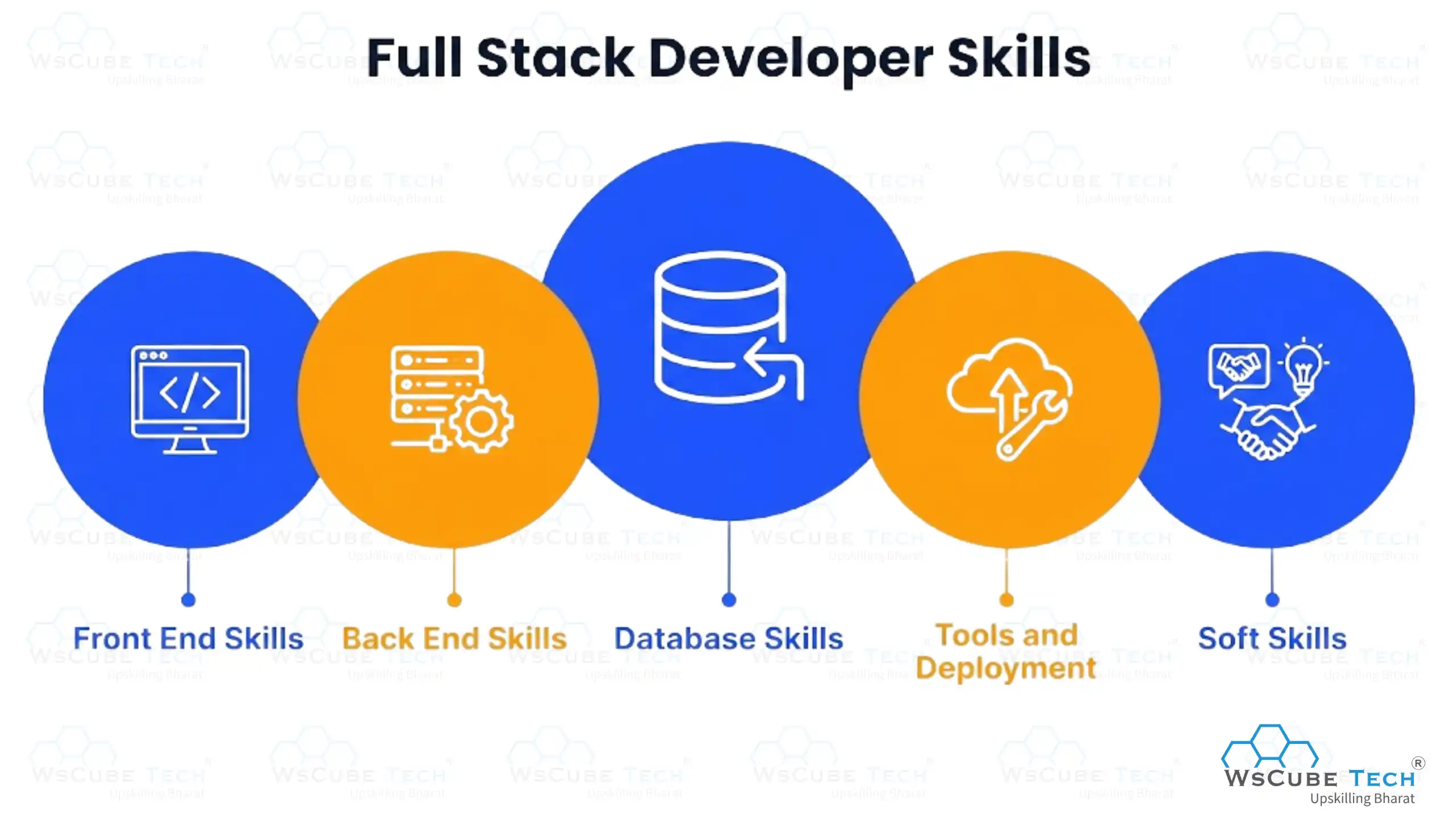
The table gives you the map. This section explains what to actually do with each area, in the order that works best for beginners.
1. Front End Skills
Start with HTML for structure, CSS for design, and JavaScript for behavior. Once those feel natural, pick one framework such as React and go deep. A complete guide to the skill set for developing front-end will help you sequence this properly.
2. Back End Skills
Choose one language and stick with it for at least six months. Node.js is popular because you reuse your JavaScript knowledge. Python and Java are also strong choices. If you are still deciding, this comparison of the best programming languages makes the choice easier.
3. Database Skills
Learn one relational database such as MySQL or PostgreSQL, then one document database such as MongoDB. Focus on writing clean queries, designing tables, and understanding relationships.
4. Tools and Deployment
Git is non-negotiable. After that, learn how to deploy an app on a platform like Vercel, Render, or AWS. Add Docker once you are comfortable with the basics.
5. Soft Skills
Explaining your work clearly, asking good questions, and estimating time honestly will separate you from equally skilled developers. These skills decide who gets promoted.
Explore More Guides Related to Full Stack Development
How to Start Your Full Stack Developer Career: Step-by-Step Guide
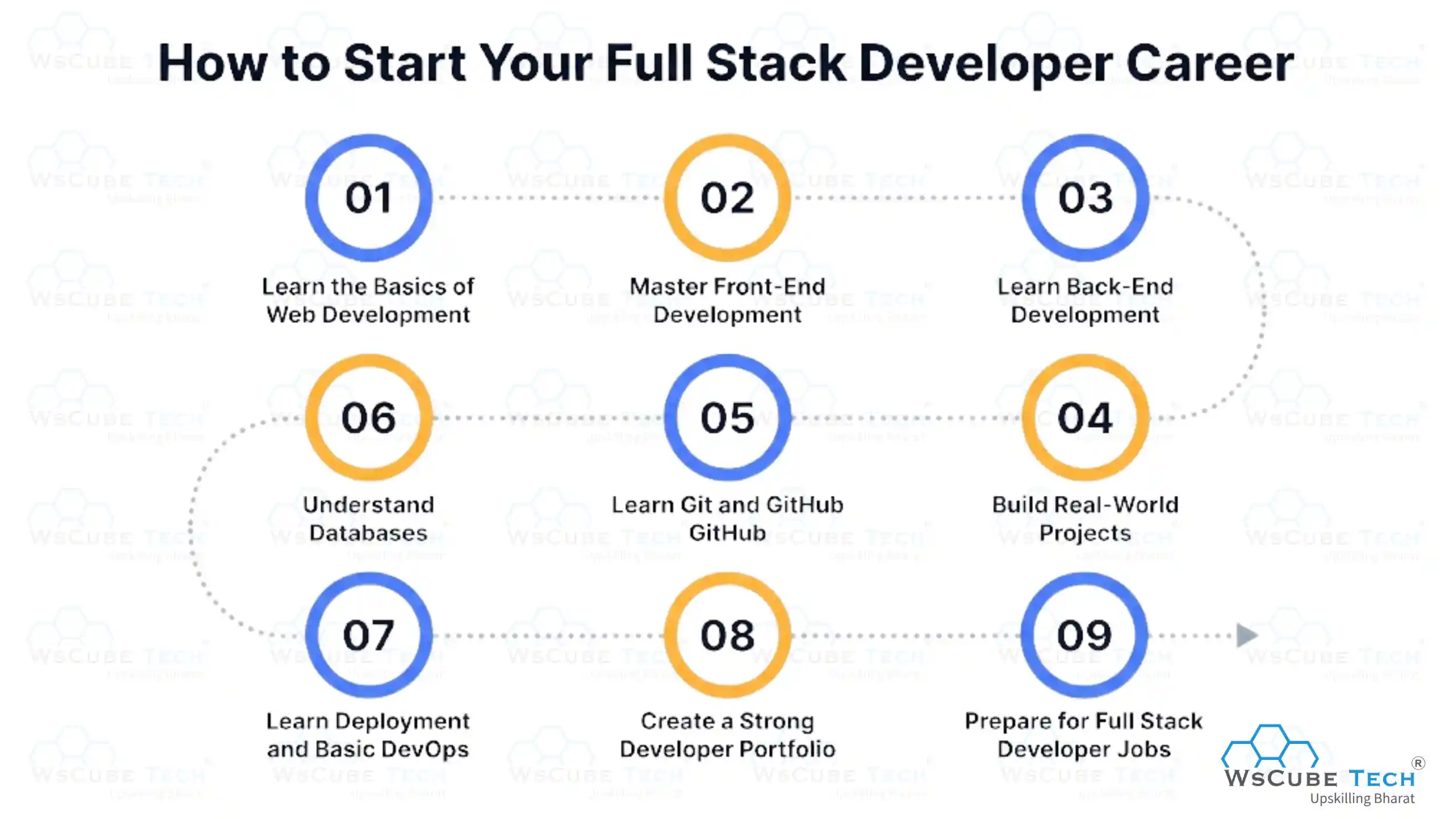
Starting a career in full stack can feel overwhelming. The key is to follow a structured full stack developer's career path instead of trying to master everything at once. Here is a simple step-by-step roadmap to get started.
Step 1: Learn the Basics of Web Development
Start with the fundamentals of how websites and web applications actually work. Learn HTML, CSS, and JavaScript properly before touching any framework. Focus on responsive design, DOM manipulation, and basic programming logic, since every step after this builds on them.
Step 2: Master Front-End Development
Once the basics feel comfortable, move on to front-end development. Learn one popular JavaScript framework or library such as React and stay with it long enough to get confident. Cover components, state management, routing, and API integration, because those four areas make up most daily front-end work.
Step 3: Learn Back-End Development
Next, learn how the server side of an application works. Choose one back-end technology such as Node.js, Python, Java, or PHP and stick with it for a few months. Understand APIs, authentication, server-side logic, and database connectivity, as this is where the full picture of web development finally clicks.
Step 4: Understand Databases
Learn how applications store, retrieve, and manage data. Start with a relational database such as MySQL or PostgreSQL and get comfortable writing queries and designing tables. After that, explore a NoSQL database such as MongoDB so you can work with both types of data models.
Explore Our Web Development Related Courses
Step 5: Learn Git and GitHub
Version control is an essential skill for every modern developer, not an optional extra. Learn how to use Git and GitHub to manage code, track changes, and collaborate with other developers. Practise branching, commits, and pull requests early, because you will use them from your very first day on a team.
Step 6: Build Real-World Projects
The best way to develop practical skills is by building things yourself. Start with simple applications, then move on to advanced projects such as e-commerce websites, dashboards, booking systems, or social media applications. Add login, real data, and proper error handling, since those details are what interviewers actually ask about.
Step 7: Learn Deployment and Basic DevOps
Understand how to take an application from your local computer to the internet. Learn the basics of hosting, deployment, environment variables, CI/CD, and cloud platforms. You do not need deep DevOps expertise at this stage, just enough to ship your work and keep it running.
Step 8: Create a Strong Developer Portfolio
Showcase your best projects through a professional portfolio and a clean GitHub profile. Explain what you built, the technologies you used, and the problems you solved. Keep each project live and clickable, because a working link demonstrates your skills far better than a list of tools.
Step 9: Prepare for Full Stack Developer Jobs
Finally, prepare your resume, practise coding questions, and sharpen your problem-solving skills for technical interviews. Apply for internships and entry-level positions while you continue building projects. If self-learning slows down, a structured full-stack development course with mentors and project reviews can help you cover the gaps faster.
Is Full-Stack Developer a Good Career: Video Guide
Frequently Asked Questions
Yes, but only if you can show real work instead of certificates alone. Freshers with two or three deployed applications on GitHub get shortlisted far more often. Hiring managers open your project link before they read your resume.
Both paths work, they just pay off at different times. Full stack gives you more interview calls early because you fit front-end, back-end, and full stack openings. Specializing usually pays more after five or six years of focused depth.
Around eight to twelve months if you practice daily and build alongside learning. Career switchers from non-technical backgrounds usually need closer to a year. The timeline depends far more on consistency than on talent.
No, a degree is helpful but not a requirement in this field. It matters most for campus placements and a few large service companies. Everywhere else, your projects and your problem solving in interviews carry the decision.
Freshers commonly start between six and fifteen lakh per year, depending on whether the company is a service firm or a product company. Pay rises sharply after two to three years of solid experience. Remote roles with international clients sit well above these ranges.
MERN is the easiest starting point because JavaScript runs on both the front end and the back end. That means one language to learn instead of two. Once you understand one stack properly, switching to another takes weeks rather than months.
Yes, for developers who learn to work with these tools instead of avoiding them. AI now handles repetitive code and first-draft functions well. System design, debugging, and judgement calls in production still need experienced people.
Yes, and most successful learners do start from zero. What separates those who make it is daily practice and finishing projects rather than collecting tutorials. Progress is slow for the first two months, then it speeds up quickly.
It usually runs from junior developer to mid-level developer to senior developer over roughly six to eight years. After that, the common branches are tech lead, solution architect, or engineering manager. Many developers also move into freelancing or start their own product.
Yes, and it is one of the strongest freelance skill sets available today. Clients prefer paying one person who can deliver a complete working product. Most developers start freelancing part time after their first year of professional work.
It is improving steadily as remote hiring becomes normal. Developers in cities like Jaipur, Indore, and Coimbatore now work for teams based in Bengaluru or abroad. Local demand is also rising as smaller businesses move their operations online.
Three strong projects are enough for a first job. Each one should be deployed, documented in a README, and something you can explain line by line. Depth beats quantity, since interviewers dig into whatever you list.
Most beginners find the back end harder because databases, servers, and authentication are less visual. Front end feels easier early on but gets difficult later with performance and complex state. Neither side stays easy once real users are involved.
Basic knowledge is enough to get hired and be useful. Learn deployment, environment variables, and a simple CI/CD pipeline. Full DevOps expertise is a separate career track you can explore later if it interests you.
It can get intense near releases because you own more layers than a specialist. The pressure usually comes from unclear scope rather than the coding itself. Strong fundamentals and honest time estimates keep the workload manageable.
Conclusion
So, is full stack developer a good career? Yes, if you are willing to build real things and keep learning. The role gives you wider job options, better freelance potential, and a clear path into senior technical positions. The demand in India is strong, the remote market is open, and AI has made skilled developers more productive rather than less needed.
The one thing that decides your outcome is execution. Learn the fundamentals properly, build projects you can defend in an interview, and deploy everything you make. If you want a structured route with mentorship and project feedback instead of figuring it out alone, a guided full-stack development course can help you build the right skills in the right order and move into your first role faster.
Explore Our Free Tech Tutorials
| Python Tutorial | Java Tutorial | JavaScript Tutorial |
| C Tutorial | C++ Tutorial | HTML Tutorial |
| CSS Tutorial | SQL Tutorial | DSA Tutorial |
Practice Coding With Our Free Compilers
| Online Python Compiler | Online HTML Compiler | Online C Compiler |
| Online C++ Compiler | Online JS Compiler | Online Java Compiler |
Join Our On-Campus Full Stack Related Courses
Free Courses for You


Leave a comment
Your email address will not be published. Required fields are marked *Comments (0)
No comments yet.