
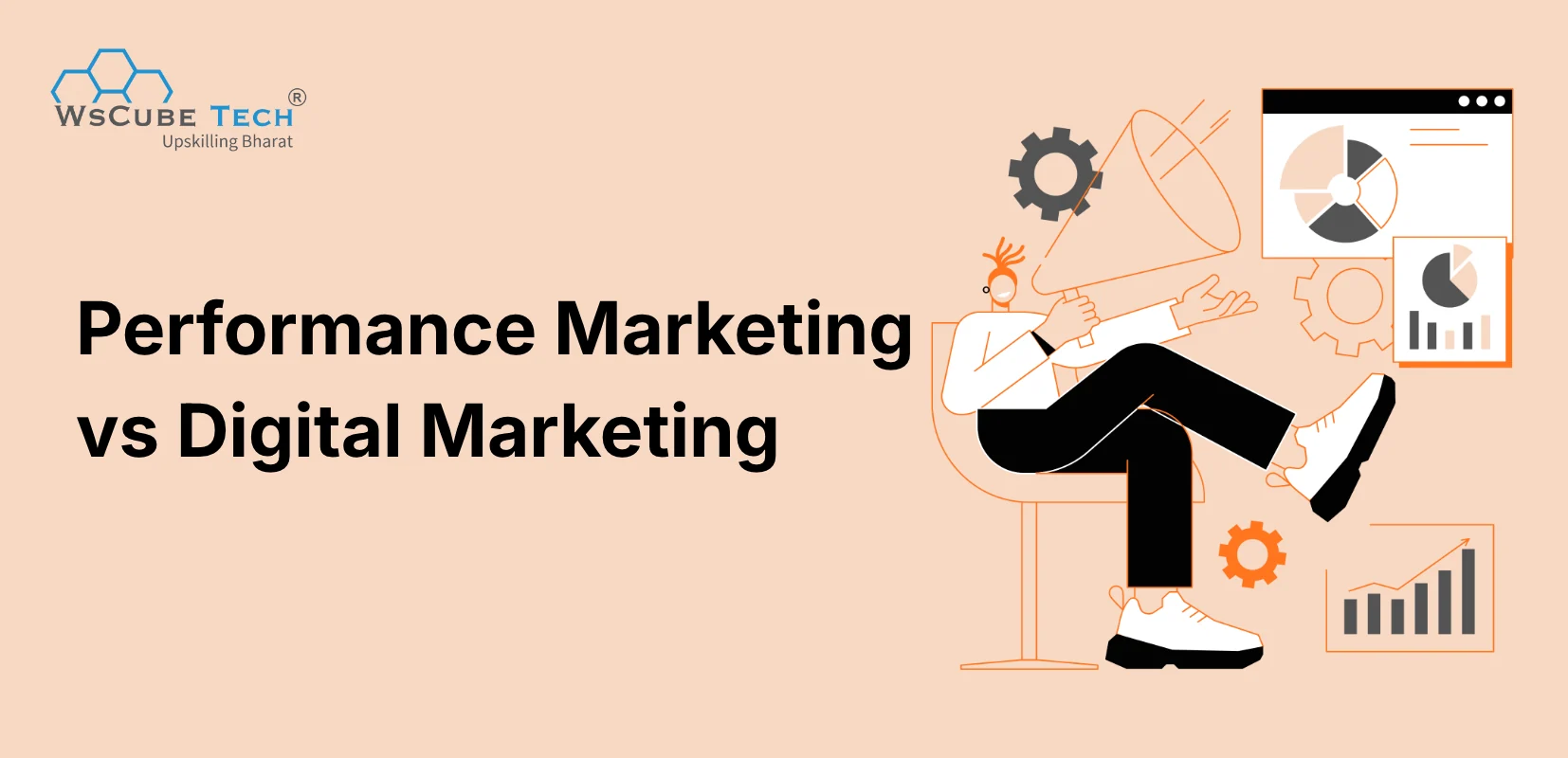
Are you confused about performance marketing vs. digital marketing and wondering which one is better? The two terms show up side by side in job listings and course pages, so it’s easy to assume they mean the same thing. They don’t, but they are closely related.
Digital marketing is the broad umbrella. It covers every way a business reaches customers online, from SEO and content to social media, email and paid ads, with goals like visibility, audience growth and leads over time. Performance marketing is a specialised approach within digital marketing that focuses on measurable actions such as leads, sales and app installs. It commonly uses paid advertising campaigns where results are tracked against the money spent.
Picture two job offers in your inbox: one says Digital Marketing Executive, the other says Performance Marketer. Same industry, similar-sounding work, but not the same job.
This guide breaks it all down. You’ll see how the two compare, what a typical week looks like in each job, what each pays in India, and how to decide where to start, whether you’re a student, a career switcher or a freelancer.
Recommended Professional Certificates
AI-Powered Digital Marketing Course
Performance Marketing Bootcamp
SEO Specialist Bootcamp
What Is the Difference Between Performance Marketing and Digital Marketing?
Digital marketing is the full set of online marketing channels. Performance marketing is the part of it judged on tracked actions such as leads, sales or app installs. Every performance marketing campaign is a digital marketing campaign, but most digital marketing work is not performance marketing.
1. Performance Marketing Is a Specialisation Within Digital Marketing
Digital marketing covers everything a business does to reach customers online: SEO, content, social media, email and paid ads. Performance marketing narrows that to campaigns where each outcome, such as a lead or a purchase, is traced back to the spend that produced it. Paid search, paid social and affiliate programmes are the usual channels. For a channel-by-channel breakdown, see our guide to the types of performance marketing.
Email and SEO can also be tracked to sales, and some teams call that performance work. Most job listings, however, use "performance marketing" for paid media roles, and that is the meaning used in this guide.
The practical difference is what you answer for. A digital marketer may be judged on traffic, rankings or engagement. A performance marketer is judged on what each lead or sale cost.
2. Performance Marketing vs Digital Marketing: Key Differences
Here is how digital marketing vs performance marketing compares on the six points that matter most to a beginner.
| Aspect | Digital marketing | Performance marketing |
| Scope | All online channels, paid and organic | Paid and partner channels where actions can be tracked |
| Main goal | Visibility, traffic, engagement and leads over time | Conversions such as leads, sales and installs at a target cost |
| Typical channels | SEO, content, social media, email, paid ads | Search ads, social ads, affiliate, retargeting |
| Core metrics | Traffic, rankings, reach, engagement | CPA, ROAS, conversion rate, cost per lead |
| Dependence on tracking | Varies by channel | High: spend is judged against tracked conversions |
| Time to first signal | Varies; SEO and content build slowly | Often days after a campaign launches |
To see the difference in practice, take one business: an online store that sells running shoes.
Digital marketing example: The store publishes SEO blogs, creates social media content and sends email newsletters. The aim is to attract potential customers, build brand awareness and generate organic traffic.
Performance marketing example: The same store runs Google Ads and Meta Ads campaigns with a fixed budget to generate leads or sales. The team tracks metrics such as cost per lead, CPA and ROAS.
Two metrics sit at the centre of performance work. CPA (cost per acquisition) is ad spend divided by conversions. ROAS (return on ad spend) is revenue divided by ad spend. For a deeper look at the second, see our explainer on ROAS.
Here is a worked example. A campaign spends ₹10,000, produces 25 sign-ups and earns ₹40,000 in revenue. Its CPA is ₹400 and its ROAS is 4.
These numbers exist only if tracking works. Google’s help documentation says conversion-based bidding requires conversion tracking to be switched on, which is one reason tracking skills matter so much in this field.
3. Do You Really "Pay Only for Results" in Performance Marketing?
On the largest ad platforms, usually not. You are billed for clicks or impressions, and "performance" describes what you optimize and measure. Payment tied strictly to a completed sale or lead exists, but mainly in affiliate and similar commission deals.
On Google, Google Ads Help explains that with cost-per-click bidding, you pay when someone clicks your ad. Its conversion-focused option, CPA bidding, lets you set a cost-per-action goal and Google sets the bids to reach it. On Display campaigns, you are still charged for each engaged view and click.
For how a campaign runs from setup to optimisation, see How Does Performance Marketing Work?
Digital Marketer vs Performance Marketer: Roles, Skills & Tools
A digital marketing executive spreads the week across several channels and content tasks. A performance marketer spends most of it inside ad accounts and tracking data, adjusting live campaigns against results. The two weeks below are illustrative composites, and real duties vary by employer and team size.
1. A Digital Marketing Executive's Typical Week
In a small or mid-sized team, this role is a generalist's: one or two people own a bit of everything. A typical week might run like this:
- Monday: plan the content calendar and review last week's analytics report.
- Tuesday: publish a blog post or social posts and fix on-page SEO issues on key pages.
- Wednesday: build and send the email newsletter.
- Thursday: brief the designer, schedule social posts and reply to comments and messages.
- Friday: compile the weekly report for the manager and note what to change.
The output is steady, visible work: published content, a growing audience and a healthier website. Its effect on sales often shows up over months rather than days.
2. A Performance Marketer's Typical Week
This role centres on live campaigns that spend money every day, so the week is built around checking results and adjusting. A typical week might run like this:
- Monday: review the weekend's results, pause ads that are not producing and move budget towards those that are.
- Tuesday: brief creatives, write several versions of ad copy and set up a test.
- Wednesday: verify that tracking records sign-ups or purchases correctly, and fix any gaps.
- Thursday: build a new audience or retargeting list and request changes to a landing page.
- Friday: report what each rupee of spend produced and propose next week's budget.
The output is a campaign that is cheaper or larger than last week's, backed by data. A tracking fault left unchecked can quietly waste budget, which is why verification is a fixed part of the week.
3. Which Skills Overlap and Which Are Specific to Each Role
Both roles need clear writing, an understanding of the audience, and comfort with reports. Performance roles add ad-platform, tracking, and testing skills on top. The table lists the tools you will see named in job listings and training guides.
| Skill area | Digital marketing generalist | Performance marketer |
| Writing | Blog posts, social captions, email copy | Short ad copy, headlines, landing-page text |
| Analytics | Reads traffic and engagement reports in GA4 | Sets up conversion events and reads attribution in GA4 |
| Channel tools | SEO tools such as SEMrush or Ahrefs, email platforms, social schedulers | Google Ads, Meta Ads Manager, sometimes LinkedIn Ads or affiliate networks |
| Tracking setup | Basic: UTM tags on links | Core: Google Tag Manager, Meta Pixel, conversion events |
| Testing | Occasional: subject lines, post formats | Routine: ad creatives, audiences, landing pages |
| Budget handling | Small or none | Daily budgets, bids and spend limits |
Skills carry across the two paths. A generalist moving into performance marketing mainly adds ad-platform, tracking and testing skills. A performance marketer moving the other way mainly adds SEO, content and email.
Job listings for performance roles on Indian job boards commonly ask for Google Ads, Meta Ads, GA4 and Google Tag Manager together. WSCube Tech's article on learning performance marketing lists the same toolset and walks through how to build it step by step.

Performance Marketing vs Digital Marketing Salary in India
In the salary data we checked, entry-level ranges overlap, but performance roles pull ahead with experience. At 5 years, AmbitionBox shows ₹4.2–18 LPA for performance marketers and ₹2–7.8 LPA for digital marketing executives. These are different job titles, and every figure here is a wide range reported by employees, so read them as guides rather than offers.
For the full digital marketing breakdown by role, skill and city, see Digital Marketing Salary in India.
1. Fresher Salary: Side-by-Side
Freshers in both paths start in a similar band, with performance roles slightly higher in most sources. Published guides put entry-level pay at roughly ₹3–6 LPA, while AmbitionBox's self-reported data spans ₹1.1–7.8 LPA.
| Role | Range (₹ LPA) | Source |
| Digital marketing executive, fresher | 3.3 – 3.7 | AmbitionBox, 48.5k salaries updated Nov 2026 |
| Performance marketer, 1 year of experience | 3.4 – 4.9 | AmbitionBox, 1.4k salaries, updated Nov 2026 |
| Digital marketing executive, starting salary | 3–5 | WSCube Tech digital marketing salary guide |
| Fresher PPC executive | 3–5 | WSCube Tech digital marketing salary guide |
| Entry-level performance marketing role | 3.4–6 | WSCube Tech performance marketing guide |
2. Mid-Career and Senior Salary: Side-by-Side
With experience, the gap widens, mostly at the top of the range. Manager-level bottoms stay close, while the ceiling is higher for performance roles.
| Role | Experience | Range (₹ LPA) | Source |
| Performance marketer | 5 years | 11.6–12.8 | AmbitionBox, 56 salaries, updated Nov 2026 |
| Digital marketing executive | 5 years | 3.8 – 4.2 | AmbitionBox, 1.2k salaries, updated Nov 2026 |
| Performance marketing manager | 2–10 years | 14.2-15.6 | AmbitionBox, 3k salaries · Updated: 15 Nov 2026 |
| Digital marketing manager | 2–12 years | 10.9-12.1 | AmbitionBox, 20.7k salaries, updated 2026 |
| Performance marketing manager | 5–10 years | 10–25 | WSCube Tech digital marketing salary guide |
| Digital marketing manager | 5–10 years | 8–20 | WSCube Tech digital marketing salary guide |
The manager rows are the fairer comparison. Their top 1% get around ₹30.6 vs ₹25 LPA in AmbitionBox and ₹25 vs ₹20 LPA in WSCube Tech's guide. Their bottom ends are within ₹2 lakh of each other in both sources.
3. Why Salary Figures Differ Between Sources, Cities, and Employer Types
Figures differ because sources count different job titles, experience bands, cities, and dates. Treat any single number as a rough guide.
- Job titles: the same work appears as performance marketer, PPC specialist, paid media specialist or growth marketer, so no single title captures the whole pool.
- Experience bands and sample sizes: AmbitionBox's manager ranges cover 2–10 and 2–12 years. A wider band raises the top end.
- City and employer type: AmbitionBox's average salary of a performance marketer ranges from ₹6.6 - ₹7.5 LPA in Gurugram and ₹6.2- ₹6.9 LPA in Mumbai. By industry, it is around ₹7.3 LPA in internet companies and ₹4.9 LPA in marketing and advertising firms.
Before relying on a figure, check your target title and city on live salary pages such as AmbitionBox, Glassdoor or Naukri. Also ask whether an offer is fixed pay only or fixed plus variable.
Which Career Path Fits You?: Performance Marketer or Digital Marketer
Choose digital marketing if you want a broad base and have not settled on a channel. Choose performance marketing if you like numbers, testing, and being judged on outcomes. The choice is not permanent, because performance marketing sits inside digital marketing and the skills carry across.
1. Students and Fresh Graduates: Choosing a First Role and Where to Start
Either path is a reasonable first role. A generalist role shows you several channels, so you learn what you enjoy. A junior paid media role takes you deeper into one area, with less exposure to the rest.
Whichever you choose, hands-on practice matters more than the job title. A sensible order for a beginner:
- Learn how search and social advertising work, and how a click becomes a tracked conversion.
- Pick one ad platform and learn it properly before adding a second.
- Run a small campaign of your own, for a personal project, a family business or a local shop. Record what you changed and what happened.
Certificates help at the start, but they are not enough alone. Google Ads certification is free through Google Skillshop, and Meta Blueprint's courses are free. Meta's certification exam costs about $99–150 per attempt, according to the ad agency Stackmatix (September 2026). The same source reports that hiring managers treat neither certificate as decisive and weigh demonstrated campaign results more heavily.
For a full roadmap and portfolio ideas, see How to Learn Performance Marketing.
2. Career Switchers and Working Professionals Upskilling
Your existing background points to a starting path. Writers, SEO specialists, and social media managers already hold generalist skills, so adding paid media and tracking is the natural step into performance marketing. People from finance, operations, data or sales often fit performance work because it rewards comfort with numbers, hypotheses and budgets.
- If you come from IT or analytics, the technical side of performance work, such as tracking setup and reporting, will feel familiar. You still need to learn how ads are bought, written and tested. Coding is not a requirement.
- If you are already employed, the lowest-risk route is to add the skill inside your current job. Ask to support a small paid campaign, take over the reporting, or run a test on one channel. Then move to a performance title once you have results to show.
3. Freelancers and Aspiring Entrepreneurs
Performance work suits freelancing because campaign results can be measured, which gives you concrete evidence to show prospective clients. Before you start, agree who owns the ad account and who pays the platform. That keeps you accountable for results without handling the client's budget.
Also agree in writing what counts as a valid lead or sale. As the earlier section on billing showed, spend can happen without outcomes. A good contract states what you control, such as setup, testing and reporting, and what you do not, such as the product, the price and the sales follow-up.
If you are building your own business, paid ads can test demand quickly, while SEO and content usually take longer to build. A sensible order is to set up tracking first and spend a small, capped budget on one channel. Then review what each lead cost, and scale only after you have confirmed that conversions are recorded correctly.
Upcoming Masterclass
Attend our live classes led by experienced and desiccated instructors of Wscube Tech.






How Do You Choose a Digital Marketing or Performance Marketing Course?
If you are weighing a digital marketing and performance marketing course, judge it by what you will do in it, not by what it promises: live campaign practice, tracking and analytics depth, current content and outcomes you can verify. A free route also exists. Google Skillshop and Meta Blueprint cover platform basics at no cost, so a paid course should add practice, feedback and mentoring on top.
| Criterion | What to check | Warning sign |
| Coverage | Digital marketing fundamentals (SEO, content, social, email) plus paid media with tracking, matched to the role you want | Paid ads taught as a few slides inside a generic syllabus |
| Live practice | You launch campaigns with a real or practice budget, and a mentor reviews the results | "Practical" is claimed but no campaign is reviewed |
| Tracking and analytics | You set up conversion tracking and read GA4 reports yourself | Tools are listed by name only |
| Currency | You can see when the syllabus was last revised and which recent platform changes it covers | No revision date, or screenshots from old interfaces |
| Instructors | Mentors who manage ad spend now and can show campaign work | Only generic trainer profiles |
| Outcomes | How many learners were placed, in which roles and at what pay, confirmed by speaking to alumni | One headline "average salary" with no breakdown |
| Credentials | Whether the certificate is the institute's own or a platform credential | Charging for something free without adding practice or feedback |
| Cost and terms | Total fees, including tool subscriptions and ad budget, with refund terms in writing | Pressure to enrol before you can see the syllabus and terms |
Ask for the syllabus and a demo class before you pay, and compare at least two options against this table. Treat placement and salary claims as marketing until alumni confirm them, and compare any salary figure with the city and role ranges in the salary section above.
To apply the checklist to one option, WSCube Tech lists its digital marketing course and its Performance Marketing Course at 8 weeks. Evaluate them against the same criteria as any alternative.
Wrapping Up!
Ultimately, performance marketing vs digital marketing comes down to the breadth of skills you want. WsCube Tech’s 20-week AI-Powered Digital Marketing Course covers SEO, content, social media, performance marketing and automation, with 112+ live hours and 20+ projects. Its 8-week Performance Marketing Bootcamp is more focused, covering Meta, Google, LinkedIn and Amazon Ads, tracking, analytics and campaign optimisation through 48+ live hours and 12+ projects.
Choose the broader course if you are starting out and want to explore different channels. Choose the bootcamp if paid campaigns are your clear career direction. Compare the curriculum carefully with your goals before enrolling.
Explore Digital Marketing Career Guides Blogs
FAQs About Performance Marketing vs Digital Marketing
Digital marketing covers all online marketing activities, including SEO, content marketing, social media, email and paid advertising. Performance marketing is a specialised part of digital marketing that focuses on measurable results such as leads, sales, app installs and conversions.
Yes, performance marketing is a part of digital marketing. It focuses on paid campaigns and measurable outcomes, while digital marketing also includes organic activities such as SEO, content creation and social media marketing.
Neither is universally better. Digital marketing is suitable if you want to explore multiple marketing channels and build a broad skill set. Performance marketing is a better fit if you enjoy working with numbers, managing ad budgets, testing campaigns and improving conversions.
Performance marketing is not necessarily easier than digital marketing. It requires a good understanding of advertising platforms, conversion tracking, analytics and campaign optimisation. Digital marketing also involves different skills, including SEO, content creation, social media management and email marketing.
A digital marketer usually handles multiple online marketing activities, such as SEO, content, social media and email campaigns. A performance marketer primarily manages paid advertising campaigns, tracks conversions and optimises spending to achieve specific business goals.
Performance marketing roles can offer higher salaries as professionals gain experience in campaign management, paid advertising and analytics. However, salaries depend on experience, location, company size and skills. Entry-level salaries in both fields can overlap.
A fresher entering performance marketing can expect approximately ₹3–6 LPA, depending on their skills, practical experience, location and employer. Experience with Google Ads, Meta Ads, GA4 and conversion tracking can improve career opportunities.
Yes, a digital marketer can transition into performance marketing by learning paid advertising, conversion tracking, audience targeting, campaign optimisation and analytics. Existing knowledge of customer behaviour, content and marketing fundamentals can make the transition easier.
No, coding is not a mandatory skill for performance marketing. However, understanding basic technical concepts such as tracking codes, pixels, conversion events and Google Tag Manager can help you manage campaigns more effectively.
A performance marketer needs skills in paid advertising, audience research, budget management, data analysis, conversion tracking, A/B testing and campaign optimisation. Familiarity with Google Ads, Meta Ads Manager, GA4 and Google Tag Manager is also useful.
Start with Google Ads, Meta Ads Manager, Google Analytics 4 (GA4) and Google Tag Manager. You can gradually learn LinkedIn Ads, Amazon Ads, Looker Studio and other reporting or advertising tools based on your career goals.
Yes, freshers can apply for entry-level roles such as PPC Executive, Performance Marketing Executive and Paid Media Executive. Learning advertising platforms, practising campaign setup and building a portfolio with practical projects can help demonstrate job readiness.
Yes, digital marketing offers multiple career paths in SEO, content marketing, social media, email marketing and paid advertising. Students and freshers can start with a generalist role, gain practical experience and specialise in a channel that matches their interests.
Yes, you can learn performance marketing without becoming an SEO specialist. However, understanding SEO and other digital marketing fundamentals helps you see how paid and organic channels work together to attract and convert customers.
A digital marketing course generally covers multiple online marketing channels, including SEO, content, social media, email and paid advertising. A performance marketing course focuses more deeply on paid campaigns, advertising platforms, conversion tracking, analytics, testing and optimisation.
Beginners who want to explore different marketing channels can start with a digital marketing course. Those who already know they want to work in paid advertising and campaign optimisation can choose a performance marketing course. Consider the syllabus and practical training before deciding.
Look for a course that includes practical campaign experience, Google Ads, Meta Ads, conversion tracking, GA4, Google Tag Manager, A/B testing and campaign reporting. Also check the trainer's industry experience, project work, mentorship and placement support.
WsCube Tech offers different learning paths for these career goals. Its 20-week AI-Powered Digital Marketing Course covers multiple digital marketing channels, while its 8-week Performance Marketing Bootcamp focuses on paid advertising, campaign management, tracking and optimisation. The right choice depends on whether you want broad digital marketing knowledge or specialised performance marketing skills.
Yes, performance marketing offers freelance opportunities. Businesses hire freelancers to manage Google Ads, Meta Ads, lead generation campaigns and paid media strategies. Before taking on clients, build practical experience and learn to track campaign performance and report results.
Performance marketing has strong career potential as businesses continue investing in digital advertising and measurable customer acquisition. Professionals who understand advertising platforms, analytics, automation, tracking and campaign optimisation can build opportunities across agencies, startups and established companies.

Join Our On-Campus Digital Marketing Program
Explore Our Free Courses




Leave a comment
Your email address will not be published. Required fields are marked *Comments (0)
No comments yet.