
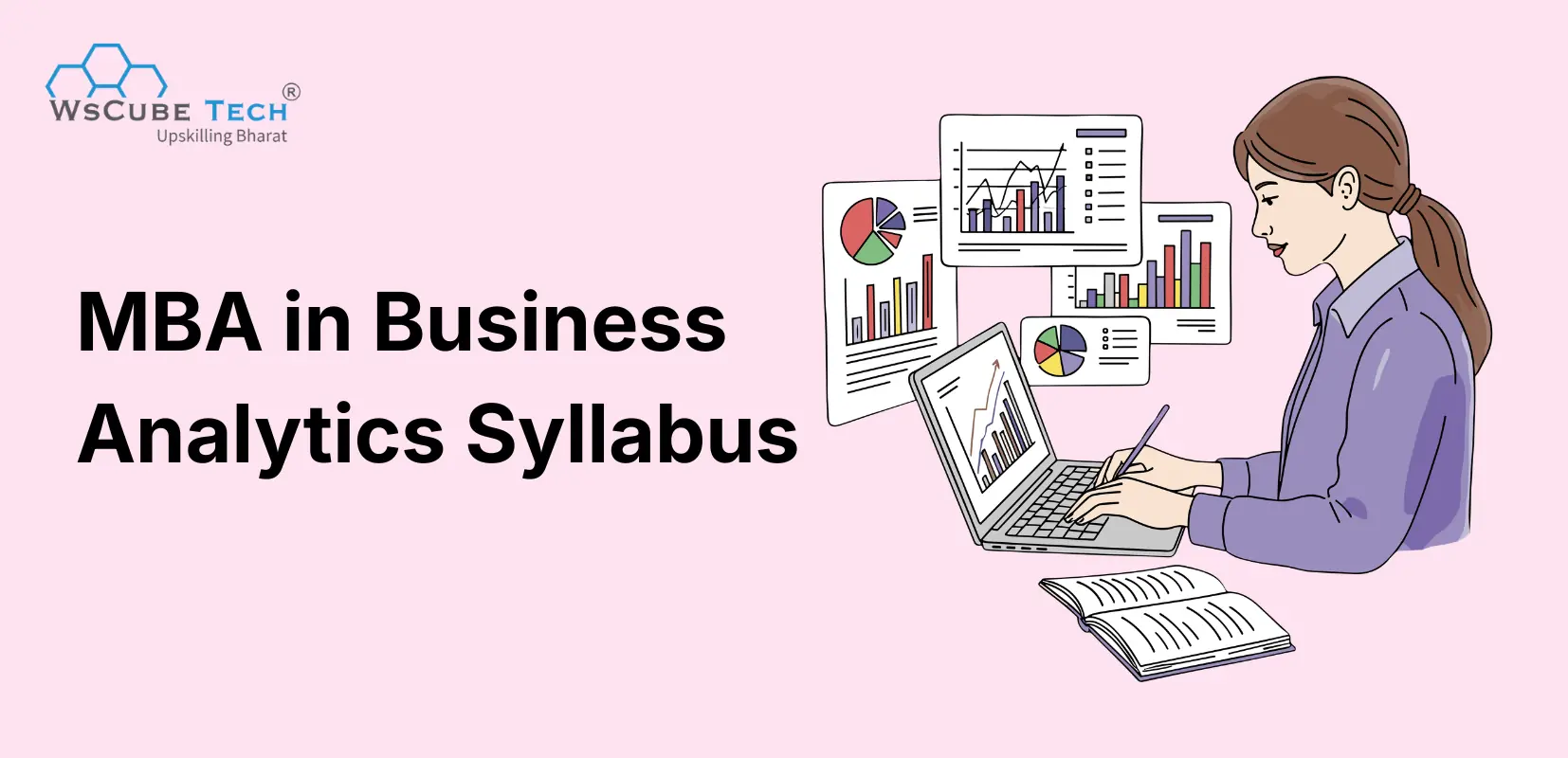
Choosing an MBA specialization requires understanding what you will actually study. The MBA in business analytics syllabus combines management fundamentals, analytical concepts, technology, practical projects, and data-driven decision-making skills.
This guide explains the complete curriculum semester by semester, covering core subjects, analytics tools, practical skills, electives, projects, and career-focused learning.
If you are comparing colleges or evaluating whether this degree fits your goals, understanding the curriculum helps you assess programs beyond fees, rankings, and brand names before making an informed decision.
Key Takeaways
- An MBA in Business Analytics combines business management with data-driven decision-making, preparing you for leadership and strategy roles.
- The program typically lasts 2 years (4 semesters) and includes core subjects, advanced analytics, internships, and a capstone project.
- You will learn key skills like data analysis, visualization, predictive modeling, and business intelligence, along with management fundamentals.
- Hands-on training with tools like Excel, SQL, Python, Power BI, and Tableau is an important part of the curriculum.
- Compared to an MBA, a short-term Business Analytics course is faster, more affordable, and focused on job-ready technical skills.
- If you want to enter the job market quickly, choosing a short-term Business Analytics course instead of an MBA can be a practical and efficient option.
- The demand for analytics professionals is growing rapidly, creating strong career opportunities across industries.
MBA in Business Analytics: Course Overview
An MBA in Business Analytics combines business management education with data-driven decision-making. Students learn core management areas such as finance, marketing, operations, and strategy alongside analytics concepts, tools, and techniques used to solve business problems.
Unlike a short-term analytics certification, an MBA provides broader exposure to management, leadership, business strategy, and analytics. The goal is to prepare students to analyze data, communicate insights, manage teams, and make decisions that support business growth.
If you are new to the field, our detailed guide on business analytics explains the fundamentals before you explore the MBA curriculum in detail.
Recommended Professional Certificates
Data Analytics Course with Gen AI
Data Science Course with Internship & Placement Support
What Will You Learn in an MBA in Business Analytics?
The MBA in business analytics curriculum is designed to develop both business and analytical capabilities. Depending on the institution, students may study areas such as:
- Business Statistics and Quantitative Techniques
- Data Management and Database Concepts
- Business Intelligence and Data Visualization
- Predictive and Prescriptive Analytics
- Marketing and Customer Analytics
- Financial and Risk Analytics
- Operations and Supply Chain Analytics
- Machine Learning for Business
- Strategic Management
- Business Research Methods
Note: Students may also work with tools such as Excel, SQL, Power BI, Tableau, Python, R, or other analytics platforms, depending on the university and its curriculum.
Duration & Structure of the MBA Business Analytics Syllabus
Most MBA programs in business analytics run for two years, split into four semesters of roughly six months each. Some executive or online formats compress this into 12 to 18 months. The structure usually follows this pattern:
- Year 1: Core management subjects plus foundational statistics and analytics tools
- Year 2: Advanced analytics, electives, industry internships, and a capstone project
Institutions differ slightly in how they sequence subjects. Some introduce data tools as early as semester one, while others wait until semester three to bring in predictive and big data topics.
| Year | Semester | Focus Area |
| Year 1 | Semester 1 | Management and analytical foundations |
| Year 1 | Semester 2 | Functional business knowledge and basic analytics |
| Year 2 | Semester 3 | Advanced analytics and predictive modeling |
| Year 2 | Semester 4 | Industry projects, internship, and electives |
You will also find part-time and online variants of this MBA. These formats suit working professionals who want to upgrade their analytics skills without a career break.
Regardless of format, the core academic content stays largely the same. What changes is the pace, delivery mode, and how much time you get for the capstone project.
Upcoming Masterclass
Attend our live classes led by experienced and desiccated instructors of Wscube Tech.



MBA Business Analytics Syllabus: Semester-Wise Breakdown
Here is a practical, semester-wise look at the syllabus of MBA in business analytics as taught across most Indian and global business schools.
Semester 1: Management and Analytical Foundations
The first semester lays the groundwork with core business subjects and introductory quantitative methods. You build the base needed for advanced analytics later.
Common subjects include:
- Quantitative Methods and Managerial Economics
- Financial Accounting
- Marketing Management
- Organizational Behavior
- Management Information Systems
- Statistical Analysis and Data Modeling
Statistics and computational methods matter here because most analytics subjects in later semesters build directly on these fundamentals. Do not underestimate this semester because it looks purely theoretical. Skipping a strong grip on statistics here makes semester three noticeably harder to follow later.
Semester 2: Functional Business Knowledge
Semester two moves into functional areas of business while introducing early analytics applications. You start working with real datasets and basic reporting tools.
Key subjects usually include:
- Operations Management
- Financial Management and Financial Analytics
- Human Resource Management
- Research Methods
- Business Intelligence
- Corporate Communication
This is where students typically get their first structured exposure to dashboards and business reporting. Group projects usually start here, too. You might analyze a mock company's sales data or design a basic HR dashboard using spreadsheet tools.
Semester 3: Advanced Analytics Learning
This semester forms the analytical core of the MBA business analytics syllabus. It is more technical and project-heavy than the first year.
Subjects usually cover:
- Predictive Analytics and Data Mining
- Risk Management
- Marketing Analysis
- Simulation Modeling
- Analytics Systems Analysis and Design
- Elective specializations
Many schools bring in software platforms like Python, R, or Tableau during this stage of the program. This semester is often considered the toughest, since it demands both technical accuracy and business framing. Students typically spend extra hours on lab work here.
Semester 4: Industry Applications and Projects
The final semester focuses on real-world implementation and career readiness. Most of the heavy theory is already behind you by this point.
Common components include:
- Big Data Analytics
- HR Analytics and Supply Chain Analytics
- Strategic Management
- Legal and Ethical Aspects of Analytics
- Capstone Project or Industry Internship
- Project and Product Management
These final projects often simulate genuine business problems, requiring students to present data-backed recommendations to a panel. Many students land their first analytics job through the internship completed this semester, since employers often convert strong performers into full-time hires.
Explore More Blogs Related to Business Analytics
Subjects Included in MBA Business Analytics Syllabus
Beyond the semester structure, it helps to understand what each major subject actually teaches you. Here is a closer look at the core MBA in business analytics subjects.
- Business Statistics: Covers probability, correlation, regression, and hypothesis testing. This forms the basis for almost every analytics technique you will learn later.
- Predictive Analytics: Focuses on using historical data to forecast outcomes like sales trends, customer churn, and demand planning.
- Business Intelligence: Teaches you to convert raw data into dashboards and reports. You learn data warehousing basics and KPI tracking here.
- Marketing Analytics: Applies data analysis to customer behavior, segmentation, and campaign performance measurement.
- Financial Analytics: Covers budgeting, portfolio analysis, and risk assessment using quantitative models.
- Big Data Analytics: Introduces large-scale data processing concepts, often using tools like Hadoop or Spark.
- HR Analytics: Covers workforce planning, attrition prediction, and performance measurement using employee data.
- Risk Management: Teaches you to identify, quantify, and manage business risks using quantitative and analytical models.
- Data Mining: Focuses on extracting patterns from large datasets, often using programmatic tools and query languages.
- Business Communication: Trains you to present technical findings clearly to non-technical stakeholders and senior leadership.
- Operations and Supply Chain Analytics: Applies analytics to inventory planning, logistics, and process efficiency across the supply chain.
Beyond these core subjects, most programs also offer electives such as machine learning fundamentals, supply chain analytics, and digital marketing analytics for deeper specialization.
To understand how these subjects map to real career paths, check out our breakdown of the types of business analytics used across industries today.
Skills You'll Gain from the MBA Business Analytics Syllabus
By the end of an MBA in Business Analytics, you should be able to combine analytical expertise with business and leadership skills. The focus goes beyond theory, helping you solve real-world business problems using data.
1. Data Interpretation and Statistical Reasoning
Learn to analyze datasets, identify patterns, apply statistical methods, and draw meaningful conclusions that support accurate business decisions.
2. Dashboard Building and Data Visualization
Develop skills to create interactive dashboards and visual reports using tools such as Power BI or Tableau to communicate insights clearly.
3. Predictive Modeling and Forecasting
Understand predictive analytics techniques to identify future trends, estimate outcomes, and support business planning through forecasting and data-driven models.
4. Business Communication and Stakeholder Presentation
Learn to present complex analytical findings in simple language, prepare business reports, and communicate insights effectively to clients, managers, and stakeholders.
5. Strategic Decision-Making Using Data
Use data-driven insights to evaluate business opportunities, compare alternatives, solve problems, and support strategic decisions across different business functions.
6. Basic Programming Exposure
Gain foundational knowledge of Python, R, or SQL to work with datasets, perform analysis, automate basic tasks, and understand technical analytics workflows.
7. Risk Assessment and Financial Modeling
Learn to evaluate business risks, analyze financial data, build basic financial models, and use quantitative insights to support investment and business planning.
8. Team Leadership and Project Management
Develop leadership skills to manage analytics projects, coordinate teams, define project goals, allocate resources, and deliver data-driven solutions within deadlines.
Growing Demand for Business Analytics Skills in India
Demand for these hybrid skills is only rising. India's data analytics market is projected to reach $28.9 billion by 2034, up sharply from current levels. The growing demand for analytics professionals has created a talent gap in India, with reports estimating a shortage of over 200,000 skilled professionals.
For MBA graduates, this creates opportunities in roles that combine business strategy and technical expertise, while skills like stakeholder management, negotiation, and data storytelling can support long-term career growth.
Tools & Software Covered in the BA Curriculum
Theory alone will not prepare you for the job market. Most programs now include hands-on training with the following tools.
| Tool or Technology | Purpose |
| Excel | Data analysis and reporting |
| SQL | Database querying |
| Python | Data analytics and automation |
| R Programming | Statistical analysis |
| Tableau | Data visualization |
| Power BI | Business intelligence dashboards |
| Hadoop | Big data processing |
| SPSS | Statistical modeling |
MBA Business Analytics programs combine projects, case studies, and internships with practical tool training. Students typically learn SQL, visualization, spreadsheet modeling, cloud analytics, and AI tools to meet industry needs.
Explore Our Data Related Courses
| Online Data Analytics Course | Live Internship + 100% Job Support |
| Online Business Analytics Course | Live Internship + 100% Job Support |
| Online Data Science Course | Live Internship + 100% Job Support |
MBA in Business Analytics vs. a Regular Business Analytics Course
A common question students ask is whether a full MBA is even necessary. Here is a side-by-side comparison to help you decide.
| Factor | MBA in Business Analytics | Regular Business Analytics Course |
| Duration | 1 to 2 years | Weeks to a few months |
| Focus | Business strategy plus analytics | Purely technical analytics skills |
| Career Outcome | Management and leadership roles | Analyst or technical specialist roles |
| Cost | Higher | Comparatively lower |
| Core Subjects | Finance, marketing, operations, analytics | Statistics, tools, data modeling only |
| Best Suited For | Aspiring managers and consultants | Career switchers wanting fast, focused skills |
MBA or Business Analytics Course: Which Is Right for You?
Choosing between an MBA and a business analytics course depends on your career goals, time, and budget. If you want a detailed look at a practical, skill-based program, you can explore this business analytics course to understand what you’ll learn.
- Choose an MBA if: You want leadership, strategy, or management roles and can commit more time and money.
- Choose an Analytics Course if: You want job-ready technical skills, a shorter learning timeline, and lower costs.
Some professionals choose both, starting with an analytics course and pursuing an MBA later for career growth. Cost and time are key factors, as MBA programs typically require a larger investment and longer commitment.
WsCube Tech Business Analytics Course: A Best Option
If a two-year MBA feels too heavy on time and fees, WsCube Tech offers a faster route. WsCube Tech's business analytics course builds the same job-ready skills in a fraction of that duration.
| What You Get | Details |
| Tools Covered | Excel, SQL, Python, Power BI, Tableau |
| Learning Format | Live classes with recorded access |
| Projects | Real industry datasets and capstone work |
| Mentorship | Guidance from working analytics professionals |
| Career Support | Resume building, mock interviews, placement help |
| Best Suited For | Freshers, career switchers, working professionals |
The syllabus stays updated with current hiring demands, including AI-assisted analytics workflows. If you are starting from zero, our guide on how to become a business analyst maps out the exact steps to follow.
FAQs About MBA Business Analytics Course Syllabus
Most programs run for two years across four semesters. Some accelerated or online formats compress this into 12 to 18 months, depending on the institution.
Basic coding knowledge in Python or SQL is introduced gradually. You do not need prior programming experience, since most programs start from the basics.
Most business schools publish their detailed syllabus on their official admissions page. You can also request it directly from the college's admission office.
Semester one usually covers managerial economics, financial accounting, statistics, and organizational behavior. These build the base for analytics-heavy subjects later.
Yes, subject sequencing and elective options vary between institutions. Core areas like statistics, predictive analytics, and business intelligence remain fairly consistent everywhere.
Common tools include Excel, SQL, Python, R, Tableau, and Power BI. Some programs also introduce Hadoop for big data processing later semesters.
It can feel challenging initially, especially statistics-heavy subjects. Most programs start from fundamentals, so consistent effort helps you catch up quickly.
Business analytics leans toward decision-making and strategy. Data science goes deeper into algorithms, programming, and model building for technical roles.
Common roles include business analyst, data analyst, BI analyst, and analytics consultant. Many graduates also move into strategy and consulting positions.
Yes, most programs include a mandatory internship or industry project, usually in the final semester, to build real-world analytics experience.
Salaries vary by city, industry, and prior experience. Analytics roles in India generally pay well due to a growing skills shortage across the sector.
Yes, most students come from commerce, humanities, or general business backgrounds. Programs are designed to teach analytics from the ground up.
It depends on your goals. A full MBA suits leadership aspirations, while shorter courses suit those wanting focused, fast technical skills.
Banking, e-commerce, consulting, healthcare, and retail are among the top hiring industries, since all rely heavily on data-backed decisions.
Most reputed institutions now include AI applications, machine learning basics, and cloud analytics tools to keep the curriculum current.
Explore Our Free Tech Tutorials
| Python Tutorial | Java Tutorial | JavaScript Tutorial |
| C Tutorial | C++ Tutorial | HTML Tutorial |
| CSS Tutorial | SQL Tutorial | DSA Tutorial |
Practice Coding With Our Free Compilers
| Online Python Compiler | Online HTML Compiler | Online C Compiler |
| Online C++ Compiler | Online JS Compiler | Online Java Compiler |
Join Our On-Campus Data Analytics Program
Join Our On-Campus Data Science Program
Explore Our Free Courses




Leave a comment
Your email address will not be published. Required fields are marked *Comments (0)
No comments yet.