
Ten years ago, most people thought of AI as something out of a science fiction movie. Today, it writes your emails, recommends your next show, drives cars, and helps doctors spot diseases earlier than ever before. In 2026, AI is not a futuristic idea anymore. It is part of daily life, whether you notice it or not.
If you have ever asked "what does AI actually mean" or "how does it work," this guide is for you. We will break down the concept of artificial intelligence in plain language, walk through its history, explain how it works, look at its types and branches, and explore where it is heading next. No jargon, no confusion, just a clear and complete look at one of the most talked about technologies of our time.
What Is Artificial Intelligence?
So, what is artificial intelligence? In simple words, artificial intelligence is the ability of a computer or machine to perform tasks that normally require human thinking, such as learning, reasoning, solving problems, understanding language, and recognizing patterns.
Full form of AI
AI stands for Artificial Intelligence. "Artificial" means something made by humans rather than occurring naturally, and "Intelligence" refers to the ability to learn, reason, and make decisions. Put together, it means intelligence created by humans and built into machines.
Artificial Intelligence Examples
The easiest way to understand artificial intelligence is by looking at the technology you use every day.
For example, when Google Maps analyzes live traffic and suggests the fastest route to your destination, it is using AI. When Netflix recommends movies or TV shows based on your viewing history, AI is analyzing your preferences. Your smartphone uses AI to recognize your face and unlock the device, while your email service uses AI to detect and filter spam messages before they reach your inbox.
These are all real-life examples of artificial intelligence working behind the scenes to make everyday tasks faster, easier, and more personalized.
A Brief History of AI
The artificial intelligence history goes back further than most people realize. The idea of "thinking machines" was first explored seriously by British mathematician Alan Turing, who published a paper in 1950 introducing the famous Turing Test, a way to check if a machine could imitate human conversation well enough to be mistaken for a person.
The term "Artificial Intelligence" itself was coined in 1956, at a summer workshop held at Dartmouth College in the United States. Researchers John McCarthy, Marvin Minsky, Nathaniel Rochester, and Claude Shannon organized the event, and their proposal argued that every part of human learning and intelligence could, in principle, be described precisely enough for a machine to simulate it. This event is widely considered the official birth of AI as a field of study.
Here is a quick timeline of the major milestones since then:
- 1956: The Dartmouth workshop formally introduces the term "artificial intelligence."
- 1960s to 1970s: Early excitement builds around rule-based, logic-driven systems.
- 1970s to 1980s: The first "AI winter" hits as funding dries up when results fail to match the hype.
- 1980s to 1990s: Expert systems become popular, and machine learning starts gaining ground.
- 1997: IBM's Deep Blue defeats world chess champion Garry Kasparov.
- 2011: IBM Watson wins the quiz show Jeopardy!, showcasing data-driven AI.
- 2012: Deep learning makes a major breakthrough in image recognition.
- 2016: Google's AlphaGo defeats a world champion at the complex board game Go.
- 2017: The transformer architecture is introduced, laying the foundation for modern language models.
- 2020s: Generative AI tools like ChatGPT go mainstream, and AI becomes a core part of business strategy worldwide.
Understanding this journey helps put today's AI boom into context. It was not an overnight invention. It is the result of more than 70 years of research, setbacks, and breakthroughs.
Recommended Professional Certificates
AI-Powered Digital Marketing Course
Performance Marketing Bootcamp
SEO Specialist Bootcamp
Difference between Artificial Intelligence vs Machine Learning vs Deep Learning
People often use AI, machine learning, and deep learning as if they mean the same thing, but they do not. Think of them as layers inside one another, like a set of Russian nesting dolls.
- Artificial Intelligence (AI) is the broadest concept. It covers any technique that allows machines to mimic human intelligence, whether through simple rule-based programs or advanced learning systems.
- Machine Learning (ML) is a subset of AI. Instead of being programmed with fixed rules, ML systems learn patterns from data. The more data they see, the better they get at making predictions. Spam filters and product recommendation engines are common examples.
- Deep Learning (DL) is a further subset of machine learning. It uses structures called neural networks, loosely inspired by the human brain, with many layers that process information step by step. Deep learning powers technologies like facial recognition, voice assistants, and self-driving car vision systems.
So, the relationship looks like this: all deep learning is machine learning, all machine learning is AI, but not all AI is machine learning. Some AI systems still run on simple, pre-set rules rather than learning from data at all.
Here is a quick side-by-side comparison to make the differences clearer:
| Aspect | Artificial Intelligence (AI) | Machine Learning (ML) | Deep Learning (DL) |
| Definition | Broad field of making machines mimic human intelligence | Subset of AI where systems learn patterns from data | Subset of ML using multi-layered neural networks |
| Scope | Widest, includes ML, DL, and rule-based systems | Narrower than AI, focused on data-driven learning | Narrowest, focused on complex, unstructured data |
| Data dependency | Can work with or without large datasets | Needs moderate to large amounts of structured data | Needs very large datasets to perform well |
| Computing power | Varies, low for simple rule-based systems | Moderate | High, often requires GPUs |
| Human intervention | Can be high, especially in rule-based AI | Requires feature selection and tuning by humans | Learns features automatically with less manual input |
| Examples | Chatbots, expert systems, robotics | Spam filters, recommendation engines | Facial recognition, voice assistants, self-driving cars |
How Does AI Actually Work?
Understanding how AI works does not require a computer science degree. At a basic level, most modern AI systems follow four steps:
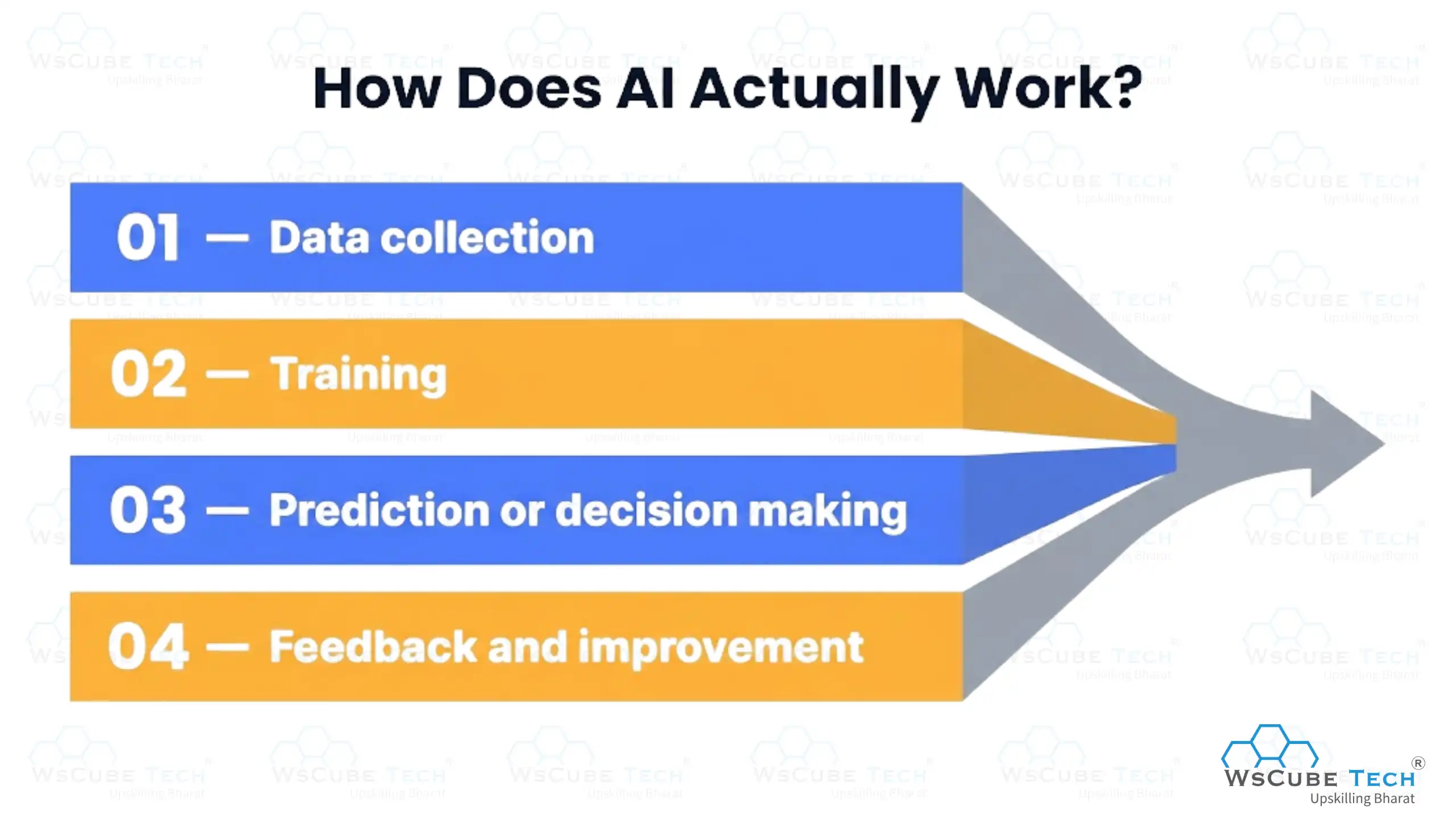
- Data collection: The system is fed large amounts of information, such as text, images, numbers, or sound.
- Training: The AI model studies this data to find patterns and relationships. This is similar to how a student studies past exam papers to understand the kind of questions that come up.
- Prediction or decision making: Once trained, the model uses what it has learned to make predictions, classify information, or generate new content when given new input.
- Feedback and improvement: The system's outputs are checked, and its performance is fine-tuned over time, so it keeps getting more accurate.
Behind this process sit algorithms, which are basically step-by-step instructions the machine follows to learn and make decisions. The quality of an AI system depends heavily on the quality and quantity of data it is trained on.
Poor or biased data leads to poor or biased results, which is part of why fair and diverse data is such a hot topic in the field.
Key Components of AI Application Architecture
Behind every working AI application, there are a few essential building blocks:
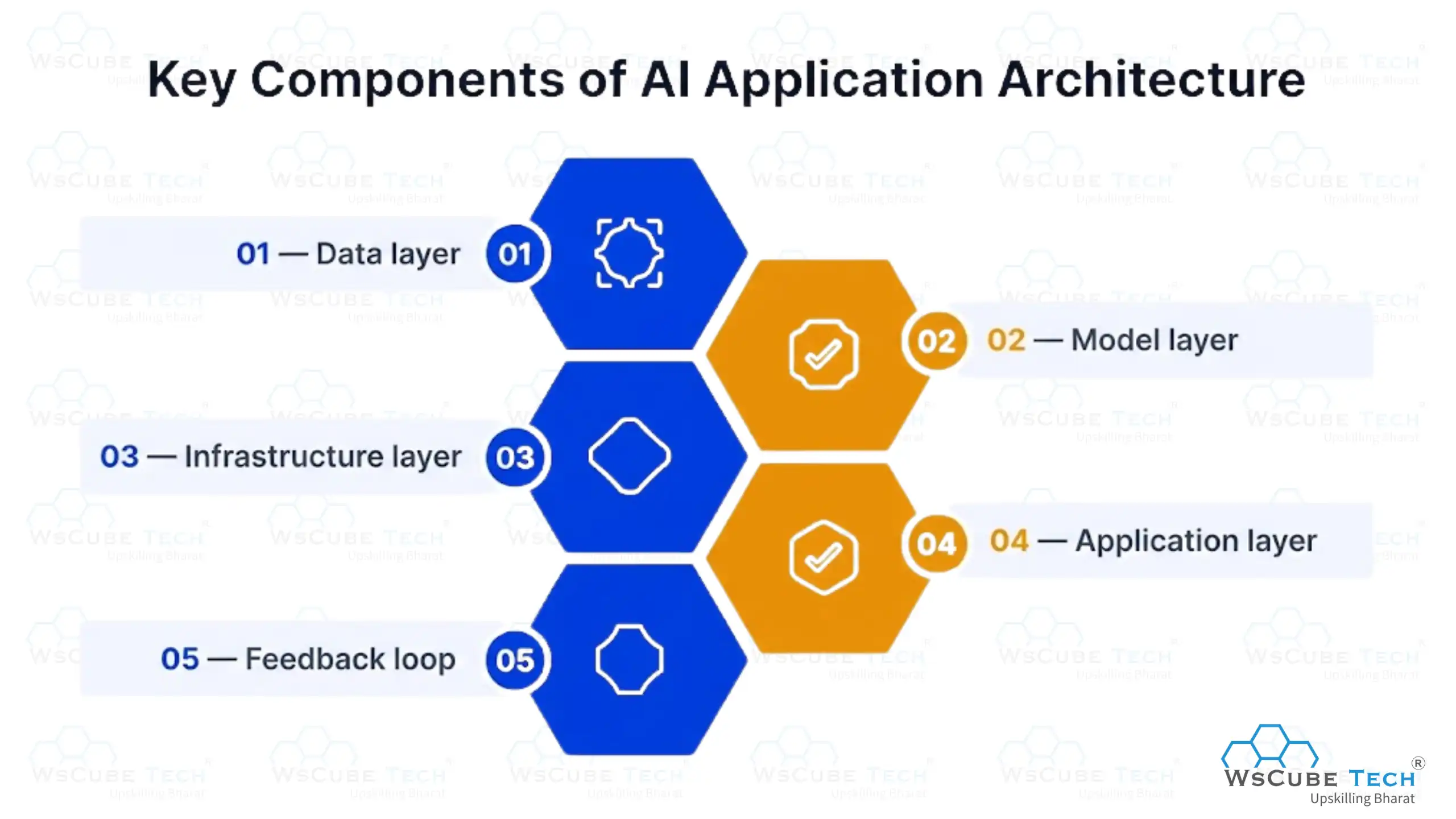
- Data layer: Where raw data is collected, cleaned, and stored, since AI is only as good as the data feeding it.
- Model layer: The trained algorithm or neural network that does the actual "thinking" and pattern recognition.
- Infrastructure layer: The computing power, often cloud-based GPUs or specialized chips, needed to train and run the model.
- Application layer: The interface where the AI meets the end user, such as a chatbot window, a recommendation feed, or a voice assistant.
- Feedback loop: A system for collecting user responses and outcomes so the model can be retrained and improved over time.
These layers work together like a factory assembly line. Data comes in raw, gets processed by the model, runs on infrastructure with enough power, and finally reaches the user through an app or tool they can actually use.
Upcoming Masterclass
Attend our live classes led by experienced and desiccated instructors of Wscube Tech.

Types of Artificial Intelligence
Artificial intelligence types are usually grouped in two ways: by capability and by functionality.
By capability:
- Narrow AI (Weak AI): Designed to do one specific task well, like voice assistants, spam filters, or recommendation systems. Almost every AI tool in use today falls into this category.
- General AI (Strong AI): A theoretical form of AI that could perform any intellectual task a human can, adapting across different situations. This does not exist yet.
- Super AI: A hypothetical stage where machine intelligence surpasses human intelligence in every field. This remains a topic of research and debate, not reality.
By functionality:
- Reactive Machines: Respond only to current input with no memory of the past, such as early chess-playing computers.
- Limited Memory AI: Uses recent past data to make decisions, which describes most AI systems today, including self-driving cars.
- Theory of Mind AI: A developing category aimed at understanding human emotions and intentions, still largely in research stages.
- Self-Aware AI: A purely theoretical future stage with machine consciousness, existing only in concept for now.
Knowing these features of artificial intelligence helps set realistic expectations. Most tools you interact with, from chatbots to fraud detection systems, are narrow AI built for a specific job, not all-knowing digital minds.
Uses of AI Technologies
The uses for artificial intelligence stretch across nearly every part of modern life. A few common examples include:
- Personalized recommendations on shopping and streaming platforms
- Voice assistants like Siri, Alexa, and Google Assistant
- Fraud detection in banking and online payments
- Predictive maintenance in factories and manufacturing plants
- Chatbots for customer support
- Navigation and route optimization apps
- Automated content moderation on social media
- Smart email filtering and scheduling assistants
One growing area worth knowing about is agentic AI, where systems do not just answer questions but take multi-step actions on their own, like booking a flight or managing a workflow. If this interests you, our guide on what are AI agents? breaks the concept down in detail.
Core Branches of AI
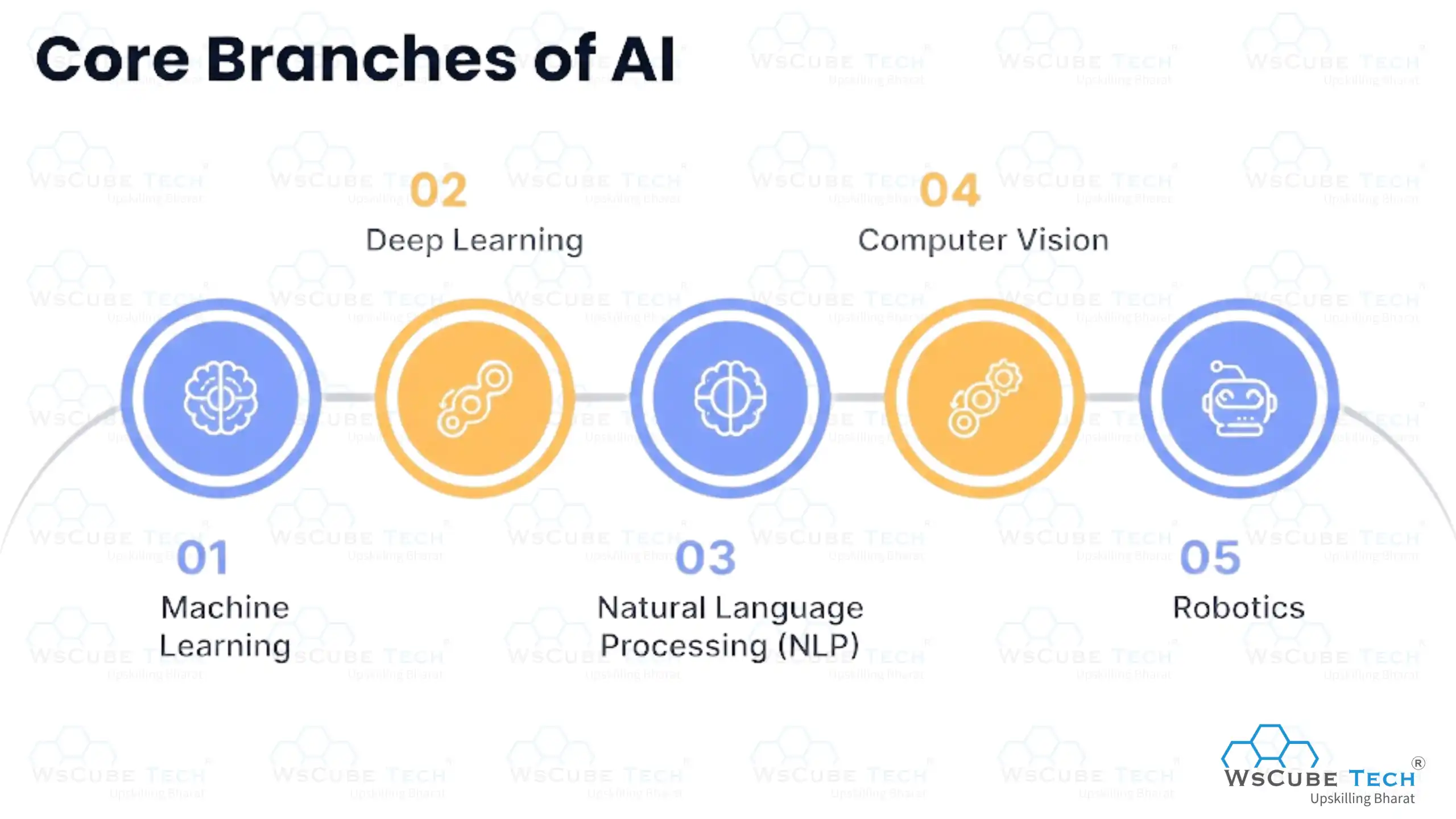
AI is not one single technology. It is an umbrella term covering several specialized branches, each solving a different kind of problem.
Machine Learning
Machine learning teaches computers to learn from data instead of following fixed instructions. It powers everything from credit scoring models to recommendation engines. There are three broad types: supervised learning, where the model learns from labeled examples; unsupervised learning, where it finds hidden patterns in unlabeled data; and reinforcement learning, where it learns through trial and error, often used in robotics and game-playing AI.
Deep Learning
Deep learning uses multi-layered neural networks to process complex, unstructured data like images, audio, and text. It is the technology behind facial recognition, speech-to-text tools, and the large language models that power modern chatbots. Deep learning generally needs far more data and computing power than traditional machine learning, but it delivers much higher accuracy on complex tasks.
Natural Language Processing (NLP)
NLP allows machines to understand, interpret, and generate human language, both written and spoken. It powers translation apps, grammar checkers, voice assistants, and the chat tools millions of people now use every day. NLP is what allows you to type a casual question and get a coherent, human-sounding answer back.
Computer Vision
Computer vision gives machines the ability to interpret images and video, identifying objects, faces, text, and even emotions. It is widely used in medical imaging, security cameras, quality checks on factory production lines, and self-driving car systems that need to "see" the road.
Robotics
Robotics combines AI with physical machines to perform tasks in the real world, from robotic arms on assembly lines to delivery robots and surgical robots that assist doctors with precision movements. Modern robotics increasingly relies on machine learning and computer vision to help robots adapt to changing environments rather than just repeating fixed motions.
Read More Blogs Related to Artificial Intelligence
Applications of Artificial Intelligence (With Examples)
Looking at real applications of artificial intelligence examples makes the technology much easier to understand. Here is how AI is already changing key industries.
AI in Healthcare
AI is transforming diagnosis, treatment, and patient care. FDA-authorized AI-enabled medical devices now number over 1,400, with the majority used in radiology for detecting conditions like strokes, brain tumors, and breast cancer.
In cardiology, AI-based heart rhythm analysis has shown a false-negative rate of just 0.3%, far lower than the 4.4% rate seen with manual technician review, based on a study covered in the same report. The global AI in healthcare market itself is projected to be worth over $50 billion in 2026.
AI in Finance
Banks and financial institutions use AI for fraud detection, credit risk scoring, algorithmic trading, and customer service chatbots. AI models can flag suspicious transactions in real time, something that would take human analysts far longer to catch manually, helping reduce financial losses and protect customer accounts.
AI in Marketing
Marketing has been one of the industries most reshaped by AI, from content generation to ad targeting and customer segmentation. Tools now help marketers write copy, analyze campaign performance, and personalize customer journeys at scale.
If you are curious how deep this shift goes, our detailed piece on the impact of AI on digital marketing covers it thoroughly, and many professionals in the field are also asking will AI replace digital marketers in 2026?, a question worth exploring if you are building a career in this space.
Join our Online AI Certification Course and learn to build AI assistants, AI agents, and powerful automations. Gain hands-on experience with the latest AI tools and real-world projects.
AI in Education
AI is helping personalize learning through adaptive platforms that adjust content difficulty based on a student's progress. It also powers plagiarism detection, automated grading, and intelligent tutoring systems.
Stanford's 2026 AI Index found that four out of five university and high school students in the United States now use generative AI for schoolwork, most commonly for research, essay editing, and brainstorming.
AI in Everyday Life (And More)
Beyond these major sectors, AI shows up in smart home devices, GPS navigation, photo editing apps, language translation tools, and even the autocorrect on your phone keyboard. It filters your spam, curates your social media feed, and suggests what to buy next when you are shopping online. Very few digital experiences today are completely untouched by some form of AI.
Popular Artificial Intelligence Tools in 2026
The market for artificial intelligence tools has exploded in the past few years. Some of the most widely used categories and tools in 2026 include:
- Conversational AI: ChatGPT, Claude, and Gemini for writing, research, and problem-solving
- Image generation: Midjourney and DALL-E style tools for creating visuals from text prompts
- Coding assistants: GitHub Copilot and similar tools that help developers write and debug code faster
- Marketing and SEO tools: AI writing assistants, keyword research tools, and content optimization platforms
- Productivity tools: AI-powered scheduling, email drafting, and meeting summary tools
ChatGPT alone reached around 900 million weekly active users by February 2026, more than double the figure from a year earlier. If you work in marketing specifically, our roundup of the best AI tools for digital marketing is a great next read to see which tools fit your workflow.
Why AI Matters in 2026
AI is no longer an experiment happening in the background of a few tech companies. It has become core business infrastructure. Organizational AI adoption reached 88% in 2026, up sharply from 71% the year before.
Generative AI usage has also crossed 53% population-level adoption within just three years of its mass-market launch, spreading faster than the personal computer or the early internet did. This matters because AI adoption is no longer optional for businesses that want to stay competitive.
The global AI market itself was valued at roughly $514 to $600 billion in 2026 depending on the research firm's methodology, with projections showing it could grow several times over by the early 2030s.
Understanding how artificial intelligence is transforming the world is no longer just useful for tech professionals. It affects hiring, marketing, healthcare, education, and nearly every career path.
Explore Our Popular Courses
Advantages and Disadvantages of Artificial Intelligence
Like any powerful technology, AI comes with real benefits and real risks. Understanding the full picture, not just the exciting parts, is key to using it responsibly.
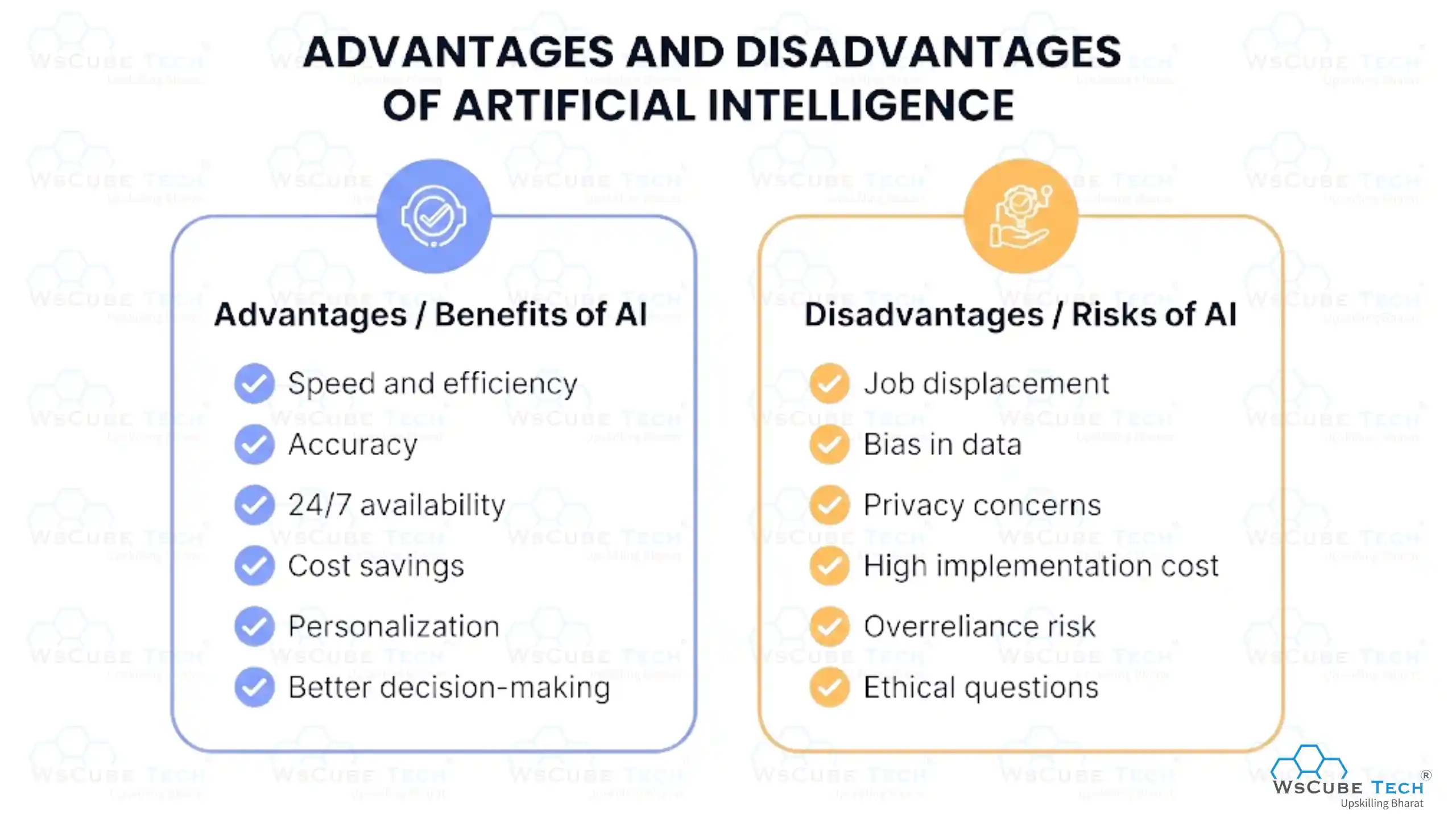
Advantages / Benefits of AI
The benefits of artificial intelligence are wide-ranging:
- Speed and efficiency: AI can process massive amounts of data far faster than humans, cutting down time spent on repetitive tasks.
- Accuracy: In fields like medical imaging, AI-assisted analysis has shown notably fewer errors compared to manual review alone.
- 24/7 availability: Unlike humans, AI systems like chatbots can operate around the clock without breaks.
- Cost savings: Automating routine work reduces operational costs over time for businesses of all sizes.
- Personalization: AI enables tailored recommendations, from shopping suggestions to customized learning paths for students.
- Better decision-making: AI can uncover patterns in large datasets that would be nearly impossible for humans to spot manually.
Disadvantages / Risks of AI
The artificial intelligence disadvantages deserve equal attention:
- Job displacement: The World Economic Forum's Future of Jobs Report 2025 estimates that 92 million jobs could be displaced by 2030, though it also projects 170 million new roles will be created, a net gain of around 78 million jobs globally.
- Bias in data: AI systems trained on unrepresentative data can produce less accurate or unfair results for certain groups.
- Privacy concerns: Data privacy remains a leading worry among both consumers and professionals using AI tools.
- High implementation cost: Building and maintaining advanced AI systems requires significant investment in infrastructure and skilled talent.
- Overreliance risk: Leaning too heavily on AI outputs without human review can lead to costly mistakes, especially in high-stakes fields like healthcare and finance.
- Ethical questions: Issues like accountability, transparency, and consent continue to raise important artificial intelligence ethics debates around how these systems should be built and used.
Weighing the advantages and disadvantages of artificial intelligence side by side shows that AI is neither purely good nor purely bad. It is a tool, and its impact depends heavily on how thoughtfully it is designed, regulated, and applied.
Importance of Artificial Intelligence
The artificial intelligence importance in today's world comes down to one simple fact: it helps solve problems at a scale and speed that was previously impossible. Here is why it matters across different parts of society:
- Healthcare: AI helps detect diseases earlier, from analyzing scans for early signs of cancer to flagging heart rhythm irregularities that a manual review might miss.
- Agriculture: Farmers use AI to predict crop yields, monitor soil health, and plan irrigation more efficiently, reducing waste and improving output.
- Education: Adaptive learning platforms personalize lessons based on a student's pace and progress, making education more effective for individual learners.
- Finance: AI catches fraudulent transactions in real time, something that would take human analysts far longer to identify manually.
- Business operations: Companies use AI to automate repetitive work, freeing up teams to focus on strategy, creativity, and problem-solving.
For businesses specifically, staying updated on the fundamentals of artificial intelligence is no longer optional. A few reasons why:
- Faster decision-making: AI can process large volumes of data and surface insights in minutes, not days.
- Better customer experience: AI-powered tools like chatbots and recommendation systems help businesses respond to customers instantly and personalize their journey.
- Competitive advantage: Companies that apply AI effectively tend to move faster and adapt more easily than those that ignore it.
- Cost efficiency: Automating routine tasks reduces long-term operational costs.
The Future of AI: What to Expect Beyond 2026
Looking ahead, a few trends are likely to define the next phase of AI development:
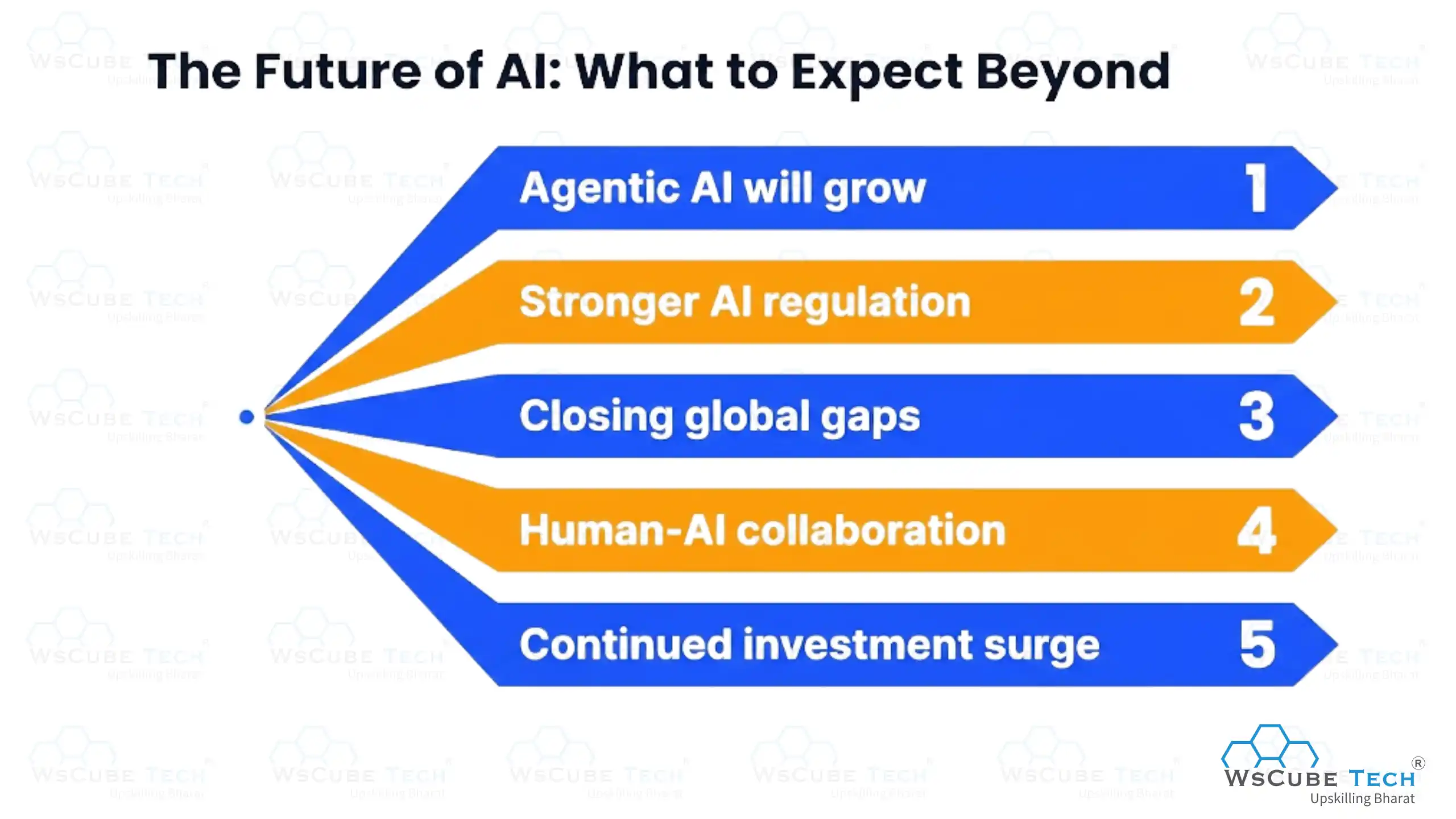
- Agentic AI will grow: AI systems that can independently complete multi-step tasks, not just answer questions, are expected to become far more common in business workflows.
- Stronger AI regulation: Governments worldwide are expected to introduce clearer rules around data privacy, transparency, and accountability as AI becomes more embedded in daily life.
- Closing global gaps: AI adoption is expected to spread further into emerging economies, though access and digital infrastructure gaps will remain a challenge in some regions.
- Human-AI collaboration: Rather than full automation, the more likely near-term future involves AI handling repetitive tasks while humans focus on judgment, creativity, and strategy.
- Continued investment surge: Corporate AI investment more than doubled to over $580 billion in 2025 alone, and this pace of funding is expected to continue shaping the technology landscape well beyond 2026.
The bottom line is that AI is not slowing down. Understanding it now, rather than later, puts you in a stronger position, whether you are a student, a business owner, or simply someone curious about where technology is headed.
Master What is Artificial Intelligence in Just 13 Minutes
FAQs About AI (Artificial Intelligence)
Artificial Intelligence is technology that allows computers and machines to perform tasks that normally require human thinking, such as learning from data, recognizing patterns, understanding language, and making decisions.
AI is generally grouped into Narrow AI, which handles specific tasks like voice assistants; General AI, a theoretical form that could match human intelligence across any task; and Super AI, a hypothetical stage where machines would exceed human intelligence entirely.
No. Machine learning is a subset of AI. AI is the broader concept of machines mimicking human intelligence, while machine learning specifically refers to systems that learn from data rather than following fixed rules.
AI will change many jobs rather than simply erasing them. Research from the World Economic Forum projects that while 92 million jobs may be displaced by 2030, around 170 million new roles are also expected to be created, resulting in a net increase in global employment.
Beginners can start by learning the basics of Python programming, exploring free introductory courses on machine learning, and practicing with beginner-friendly AI tools to understand how prompts, data, and models work together before moving into more advanced topics.
Automation follows fixed, pre-programmed rules to complete repetitive tasks, while artificial intelligence can learn from data and adjust its behavior over time. A simple automated system will do the same thing every time, but an AI system can improve its output as it sees more examples.
No. Current AI systems can process language, recognize patterns, and generate responses that sound human, but they do not have consciousness, emotions, or genuine understanding. This kind of human-like thinking falls under General AI, which does not exist yet.
A career in AI usually starts with Python programming, basic statistics, and an understanding of data structures. From there, most people move into machine learning concepts, working with data, and eventually specialize in areas like NLP, computer vision, or AI engineering.
AI is generally safe when built and used responsibly, but it carries real risks like data bias, privacy concerns, and overreliance without human oversight. Following good artificial intelligence ethics practices, such as transparency and regular auditing, helps reduce these risks.
Traditional AI is usually built to classify, predict, or recommend based on existing data, such as flagging fraud or suggesting a product. Generative AI goes a step further by creating new content, including text, images, audio, and video, based on patterns it has learned.
Healthcare, finance, marketing, retail, and education currently show some of the highest AI adoption rates. Manufacturing and logistics are also growing quickly, especially for predictive maintenance and supply chain optimization.
Small businesses can benefit from AI just as much as large companies, often through affordable tools for customer support, email marketing, content creation, and scheduling. Many artificial intelligence tools available in 2026 are built specifically for small teams with limited budgets.
An AI model is the underlying system trained on data to perform a specific function, such as GPT or Gemini. An AI tool is the product built around that model, like a chatbot app or writing assistant, that makes the model usable for everyday tasks.
This depends on the type of AI. Simple machine learning models can work with smaller, structured datasets, while deep learning models typically need very large volumes of data to perform accurately, especially for tasks like image or speech recognition.
Many people assume AI can think, reason, and make judgments the way humans do. In reality, most AI in use today is Narrow AI, designed to perform one specific task well rather than replicate general human intelligence.

Join Our On-Campus Courses
Explore Our Free Courses




Leave a comment
Your email address will not be published. Required fields are marked *Comments (0)
No comments yet.